A DWI arrest can be overwhelming, but you don't have to face it alone. Your vehicle may be impounded, your release papers may be confusing, and you may be worried about work, family, court, and your license all at once. In Waco, the smartest response is not to wait for the criminal case to explain itself.
You face two parallel legal tracks from the beginning. The criminal DWI case proceeds through court, while the Administrative License Revocation, or ALR, case is a separate civil proceeding that can affect your driving privileges before the criminal case ends. If you're searching for a DWI lawyer Waco TX, make license protection part of the first conversation, not an afterthought.
The First Night After a Waco DWI Arrest
Your car is in an impound lot, your phone is filling with unanswered messages, and your release packet is folded in the back seat. You need to know whether you can drive to work tomorrow. Start by controlling the paperwork and protecting both legal tracks, the criminal case and the separate license case.
Confirm where the vehicle was taken, who signed the bond documents, and whether your release imposes conditions involving alcohol monitoring, travel, an ignition interlock device, or a court appearance. Photograph the citation, bond paperwork, property receipt, license notice, and any visible injuries. If someone needs medication or personal property from the vehicle, call the impound lot before going there and follow its retrieval rules. Ask for the current release fees, accepted payment methods, and required identification.
Practical rule: Preserve facts, not explanations. Write down what happened while your memory is fresh, but don't call the officer, prosecutor, insurance company, or witnesses to argue your version.
Save texts, voicemails, receipts, medication details, pharmacy records, and contact information for anyone who saw the stop, arrest, testing, or events before it. Don't post about the arrest. Don't guess about how much you drank or make statements designed to “clear things up.” Those statements can become evidence even when you believe they help.
Your immediate checklist should include:
- Identify the charge: Determine the alleged offense, arresting agency, court, and case number listed on your documents.
- Check driving status: Don't drive until you've confirmed whether your license remains valid and whether release conditions limit your driving.
- Calendar deadlines: A written suspension notice may trigger an ALR deadline separate from the criminal court schedule.
- Record health details: Note medications, medical conditions, injuries, fatigue, footwear, and anything else that could affect roadside testing.
- Check document accuracy: If the release papers list the wrong court, call the issuing jail or clerk promptly and have the correction confirmed in writing.
Send your complete packet to a Waco DWI lawyer, including prescription information, relevant medical records, dashcam details, and witness names. Do not send only the citation. Preserve the original documents and keep copies of everything provided to counsel.
The Texas Department of Public Safety explains that an ALR case can arise after a DWI arrest involving a refusal or a failed chemical test, and the driver generally has 15 days to request an ALR hearing before an automatic suspension can take effect (Texas DPS ALR program). The suspension may begin on the 40th day after arrest if no hearing is requested. The criminal case does not pause that clock, so license protection must be handled alongside the criminal defense.
For a plain-language overview of immediate post-arrest decisions, review what to do after a DWI arrest in Texas. If chemical testing is involved, Challenging Breath and Blood Tests in Texas DWI Cases explains how that evidence may be questioned.
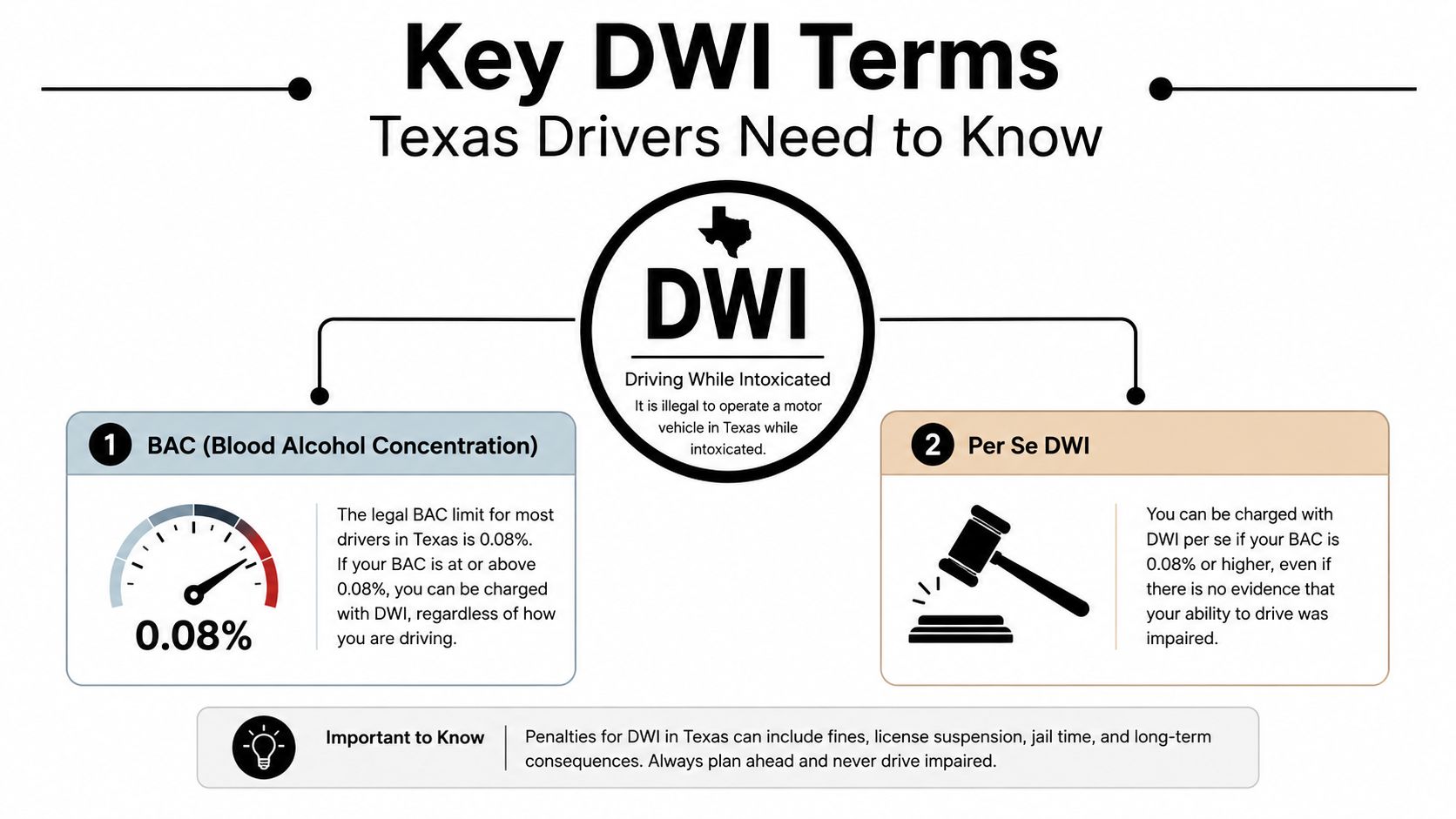
Key DWI Terms Texas Drivers Need to Know
A Waco DWI case usually runs on two tracks from the first night: the criminal prosecution and the separate fight over your driving privilege. The terms below explain what the State may claim, what the tests can show, and why license protection cannot wait for the criminal case to finish.
BAC, or blood alcohol concentration, measures alcohol in a person's blood. For an adult driving a non-commercial vehicle, a BAC of 0.08% or higher can support a per se allegation. The State may also pursue impairment based on an alleged loss of normal mental or physical faculties, even when the case does not depend solely on a reported BAC.
Per se DWI centers on the chemical result. If the State proves an admissible test showing the required alcohol concentration, it does not need to rely only on driving behavior, speech, or other observations. The result can still be challenged through questions about the traffic stop, arrest, warnings, collection process, instrument reliability, and laboratory procedures.
Implied consent and ALR
Implied consent means that driving on Texas public roads generally carries consent to chemical testing after a lawful DWI arrest. A refusal or failed test can create an Administrative License Revocation, known as an ALR, separate from the criminal prosecution (Texas impaired driving laws).
An ALR proceeding is civil and administrative, not a criminal trial. It can affect a driver's license after a refusal or a test at 0.08% or higher in a non-commercial vehicle, or 0.04% or higher in a commercial motor vehicle. A CDL holder should treat that distinction seriously because the same event can create separate professional consequences.
The next section breaks down the 15-day window day by day. Do not assume that handling the criminal charge protects your license. These are parallel tracks, and the ALR request needs its own immediate attention.
Field sobriety tests and probable cause
A field sobriety test, often called an SFST, is a roadside divided-attention exercise. Officers may evaluate eye movement, walking, turning, balance, instructions, and other observations to support an impairment theory. These exercises are not laboratory measurements. The NHTSA manual reports accuracy figures of 77% for HGN, 68% for Walk-and-Turn, and 65% for One-Leg Stand, with combined testing reaching 91% correct arrest decisions in research involving SFST-experienced personnel at the 0.08 threshold (NHTSA SFST manual).
Administration can change the meaning of the result. The surface, lighting, footwear, instructions, weather, medical conditions, injuries, and the officer's scoring all deserve review.
Reasonable suspicion is generally the lower threshold used to support a traffic stop. Probable cause is the stronger basis required for a warrantless arrest. Your lawyer should test both decisions against the report, video, and available records.
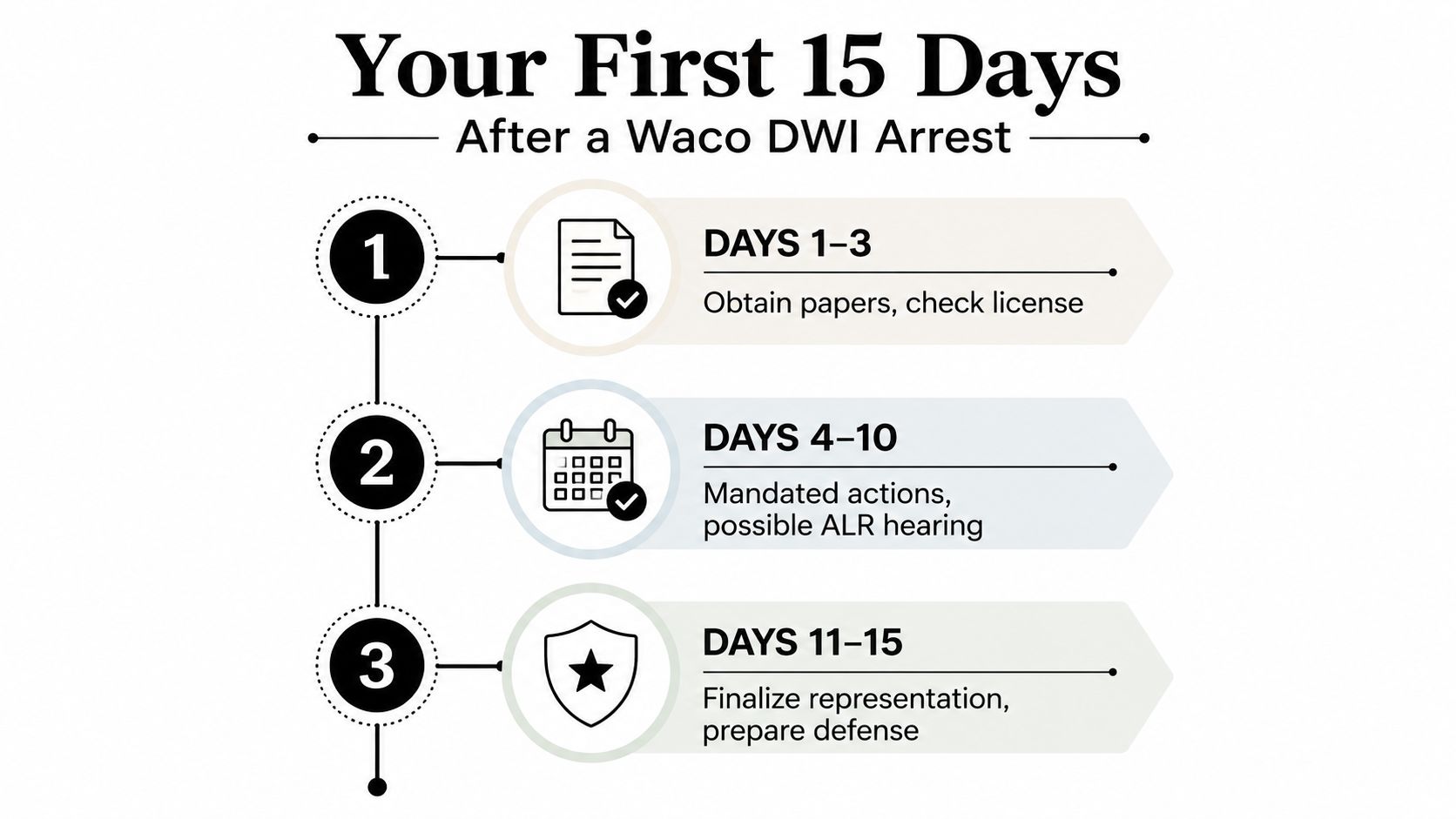
Your First 15 Days After a Waco DWI Arrest
The first 15 days require action. Your criminal case and your license fight run on separate tracks, so handle both from the start.
Days 1 through 3
Collect the release papers, citation, bond conditions, towing information, temporary license, and any officer-issued suspension notice. Read every condition involving alcohol, travel, reporting, testing, or an ignition interlock device. If you do not know whether your license is valid, do not drive until counsel or DPS confirms your status.
Write a factual timeline while your memory is fresh. Record the hours before the stop, where you drove, passenger conversations, the traffic stop, roadside exercises, chemical testing, booking, release, and any medical event. Keep it accurate. Your lawyer needs your recollection, not a polished version.
Send counsel the complete packet, including prescription information, relevant medical records, dashcam details, and witness names. Ask counsel to preserve video, receipts, and other records before they disappear or become harder to obtain.
Days 3 through 7
Request the ALR materials and review the notice carefully. Confirm the exact deadline printed there, then ask counsel what driving options may apply while the matter is pending. The hearing request must be made within the stated period, or the administrative suspension may begin without a hearing. Use the Texas ALR hearing process to understand this separate license proceeding.
If your vehicle remains impounded, address it quickly to limit storage charges and protect your property. Tell the lot, police, insurer, or prosecutor only what is needed to retrieve the vehicle or handle property. Do not offer a theory about what happened.
Days 8 through 15
Finalize the ALR request and preserve supporting material. Gather traffic-camera or dashcam information, pharmacy records, employment schedules, medical documentation, and witness contact details. Do not contact the arresting officer or try to influence witnesses. Do not enter a rushed guilty plea to end the uncertainty.
Your lawyer should prepare the ALR matter and criminal prosecution as parallel tracks. The Texas ALR hearing process explains the license challenge, while The Texas DWI Court Process From Arrest to Resolution covers the criminal case. The written notice controls your deadline, not a general online timeline.
A short video can help you understand the immediate process before your consultation.
Texas DWI Penalties and Waco Court Consequences
A first DWI in Texas is typically a Class B misdemeanor when the evidence doesn't support the higher alcohol-concentration allegation. The jail range is 72 hours to 180 days, and the criminal fine can reach $2,000 (first-offense DWI penalties). A separate state assessment under Transportation Code § 709.001 can add $3,000 for a first conviction, or $6,000 when the evidence shows an alcohol concentration of 0.15 or higher.
The criminal fine and state assessment are different charges to your finances. License consequences, bond conditions, monitoring, treatment, insurance requirements, and possible employment disruption can create additional burdens that aren't captured by the court fine alone.
| Offense Level | Max Fine | Jail Time | License Suspension | Annual Surcharge |
|---|---|---|---|---|
| First DWI | Up to $2,000 criminal fine | 72 hours to 180 days | Depends on the criminal and ALR tracks | $3,000 state assessment for a first conviction |
| First DWI with alcohol concentration of 0.15 or higher | Up to $2,000 criminal fine | 72 hours to 180 days | Depends on the criminal and ALR tracks | $6,000 state assessment |
| Refusal or failed test under ALR | Administrative consequence | Not a criminal jail term by itself | First-offense refusal can be 180 days, and a first failed test can be 90 days | Not applicable |
The ALR table above reflects the separate administrative process. DPS materials identify a 90-day suspension for a first failed test and a 180-day suspension for a first refusal in the ALR framework (Texas ALR implied-consent timing). A conviction can create additional consequences, so your lawyer must evaluate both cases together.
McLennan County bond conditions may affect your daily routine, including driving and alcohol-related restrictions. CDL holders require special attention because a commercial motor vehicle result at 0.04% or higher can trigger administrative action, and independent Texas and federal-facing summaries explain that a CDL holder can face a one-year disqualification for a first DWI and lifetime disqualification after a second major offense, even if the arrest involved a personal vehicle (Texas DWI with CDL).
The Ignition Interlock Devices in Texas DWI Cases resource explains when Texas requires an interlock as a condition of driving. Don't assume an interlock issue is merely technical. For a person who commutes or holds a CDL, it can affect work, scheduling, and compliance.
How a Waco DWI Lawyer Builds Your Defense
A strong defense begins by separating the state's evidence into parts. A Texas DUI attorney should not treat the officer's report, field sobriety tests, breath result, and blood result as one inseparable story. Each part has its own legal and technical weaknesses.
The traffic stop
First ask whether the officer had lawful grounds to stop the vehicle. A stop based on a traffic violation may be valid, but the report, dashcam, body camera, dispatch records, and timing must match. A stop that began without reasonable suspicion can affect everything that follows.
Consider a driver leaving a Buc-ee's parking lot in the Waco area. If the alleged traffic violation isn't supported by video or a clear report, the stop itself may become the central issue. That isn't a conclusion about any particular case. It's the kind of evidence question counsel should raise before discussing a plea.
Roadside testing
SFST evidence is persuasive only when the officer administered and scored the exercises correctly. NHTSA's materials distinguish the tests and show that each one has limitations, which is why a lawyer should examine the instructions, surface, lighting, footwear, weather, physical condition, and exact clues recorded.
A person with an injured knee, balance disorder, medication side effect, or unsuitable roadside location may perform poorly without being intoxicated. An officer's failure to follow the standardized method can weaken the interpretation of the result. A single roadside test should not automatically establish probable cause.
Chemical testing and procedure
Breath and blood evidence requires a technical audit. DPS states that its Office of the Scientific Director develops standardized calibration processes for evidential breath instruments, and its calibration manual calls for repeated verification steps, including 20 consecutive alcohol concentration analyses in the simulator procedure (Texas DPS breath alcohol testing).
Counsel should seek maintenance and calibration records, operator documentation, collection details, chain-of-custody records, and laboratory compliance materials. A room-temperature breath sample, an undocumented deprivation period, or a blood draw with chain-of-custody gaps may require careful litigation, but the facts must be established from records rather than assumed.
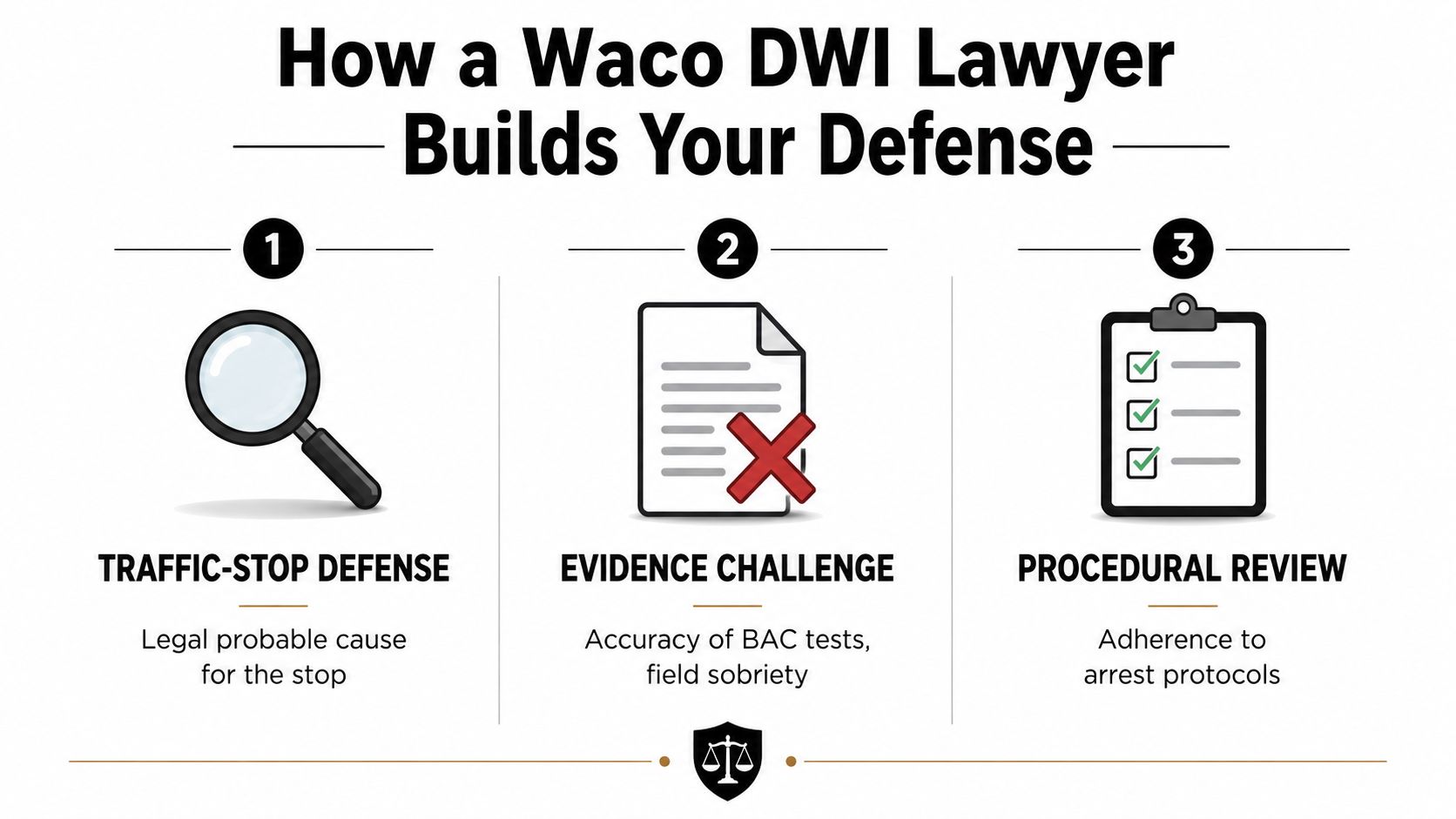
The right defense depends on the evidence. Some cases turn on the stop. Others turn on SFST administration, chemical-test reliability, or whether the state can prove the required elements beyond a reasonable doubt. “Fight DWI Texas” is not a slogan. It means testing every legally relevant step instead of accepting the report as the final word.
What to Bring and What to Ask a Waco DWI Lawyer
A productive consultation starts with a complete file. Bring paper copies or clear electronic scans, and label each document so counsel can locate it quickly.
- Waco PD offense report: Include every page you received and identify anything missing.
- Bond paperwork: Bring release conditions, court dates, reporting instructions, and interlock requirements.
- ALR notice and temporary license: These documents may contain the deadline needed to protect your license.
- BAC result sheet: Include breath-test printouts, blood-test notices, or laboratory paperwork.
- Photos and video: Preserve images of the stop location, vehicle, road surface, lighting, footwear, injuries, and vehicle damage.
- Insurance information: Bring your insurance card and any communication from the insurer.
- Written timeline: Cover the period from 12 hours before the stop through your release.
- Medical and pharmacy records: Include prescriptions, medical conditions, and treatment that could affect testing or balance.
- Witness information: List passengers, bystanders, medical personnel, and anyone who saw your driving or condition.
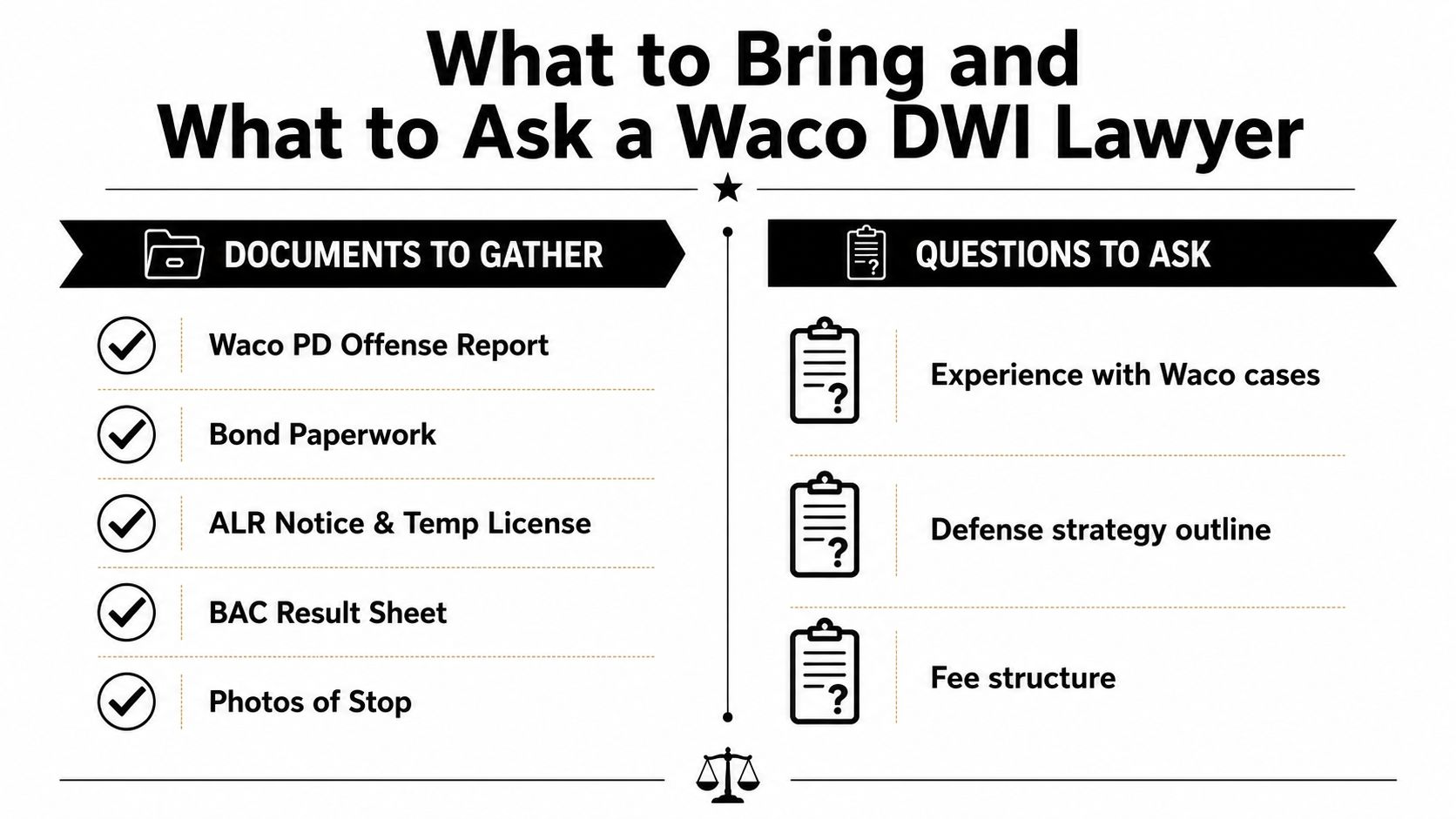
Ask direct questions at the first meeting:
- How many McLennan County DWI cases have you tried recently?
- Who will handle the ALR hearing?
- What facts support challenging the stop?
- Which SFST issues do you see in my evidence?
- How will you review the breath or blood testing?
- What are the realistic outcome ranges, without guarantees?
- What is your position on negotiation, trial, and alternative resolutions?
- What is included in the legal fee?
- Could expert-witness costs be separate?
- How do you handle ignition-interlock or BAIID compliance?
A lawyer should explain uncertainty clearly. Be cautious about promises, guaranteed dismissals, or answers that avoid discussing the ALR deadline. The Texas DWI attorney consultation can help you prepare for that first conversation.
Your Next 30 Days and How to Get Started
The month after arrest should produce an organized defense, not more confusion. Confirm that the ALR hearing request was filed and keep proof of submission. If bond requires an ignition interlock device, arrange compliance promptly and preserve installation and monitoring records.
Attend every listed appearance at the McLennan County Courthouse unless your lawyer confirms that your presence isn't required. Keep your contact information current, respond to counsel, and provide documents as soon as you find them. A missed court date or ignored bond condition can create problems unrelated to the underlying DWI evidence.
Avoid three mistakes that damage cases:
- Driving on a suspended license: Confirm your status before driving and obey every restriction.
- Missing the ALR hearing: The criminal case doesn't replace the separate license proceeding.
- Talking to prosecutors without counsel: Statements made during an attempt to negotiate can affect how the state evaluates your case.
Continue preserving evidence. Save messages, video, receipts, medical information, work records, and witness details. Don't post about the arrest, discuss facts with potential witnesses, or contact the officer to dispute the report. Your lawyer needs time to compare your account with video, reports, test records, and court filings.
A Waco DWI lawyer should work on license protection and criminal defense at the same time. Early representation can preserve options that become harder to recover after a deadline, missed appearance, or careless statement.
The Law Office of Bryan Fagan, PLLC provides Texas DWI defense, ALR representation, evidence review, and criminal case guidance for drivers facing a Waco-area arrest. Request a free, confidential case evaluation through the Law Office of Bryan Fagan, PLLC to discuss your license deadline, bond conditions, and defense options with a Texas DWI lawyer.