
A DWI arrest can be overwhelming—but you don’t have to face it alone. The sudden flash of red and blue lights in your rearview mirror is a feeling no one wants. Your heart pounds. A traffic stop for a suspected Driving While Intoxicated (DWI) is one of the most stressful situations you can face, and it's the most common time you’ll encounter a legal concept you might not even know exists: implied consent.
That simple act of driving on a public road in Texas creates a legal agreement you never signed, but are still bound by. Understanding this concept is the first step toward protecting your rights.
The Moment You Are Pulled Over for DWI in Texas

From the second you see those flashing lights, a legal clock starts ticking that can affect your freedom, your finances, and your ability to drive. Understanding what’s happening—and why—is the first step toward building a strong defense.
The officer walks to your window. After a few questions, they ask the one you were dreading: “How much have you had to drink tonight?” This question is almost always a prelude to a request to step out of your car for field sobriety tests or, more importantly, a demand for a breath or blood sample. This is where implied consent comes crashing into reality.
Key Terms You Need to Know
During a DWI stop, you'll hear legal terms that can be intimidating. Here’s what they actually mean in clear terms:
- DWI (Driving While Intoxicated): This is the charge you face in Texas if you operate a vehicle in a public place while not having the normal use of your mental or physical faculties due to alcohol or drugs. It also applies if your BAC is 0.08% or higher.
- BAC (Blood Alcohol Concentration): This is simply a measurement of the percentage of alcohol in your bloodstream. For most adult drivers in Texas, the legal limit is 0.08%.
- Implied Consent: This is the "silent agreement" you made when you obtained your Texas driver's license. By accepting the privilege to drive on Texas roads, you have automatically consented to provide a breath or blood sample if you are lawfully arrested for DWI.
- Administrative License Suspension: This is a civil penalty from the Texas Department of Public Safety (DPS) that automatically suspends your license if you refuse a chemical test. It is completely separate from any criminal penalties.
This "silent agreement" is the bedrock of Texas DWI enforcement, codified in Texas Transportation Code §724. Because of this law, refusing an officer's lawful request for a chemical test has its own serious and immediate consequences—even before a DWI case begins. A first-time refusal triggers an automatic driver’s license suspension of 180 days.
While every state has some form of implied consent law, studies show that about 20% of drivers nationwide still refuse testing, which can complicate prosecution. You can find more data on how implied consent laws work across the country in this comprehensive review from the National Institutes of Health.
An Arrest Is Not a Conviction.
It's crucial to remember that an officer's request for a test—and your response—is just one piece of the puzzle. Even if you refused the test and are facing a DWI license suspension, a skilled Houston DWI lawyer can challenge the stop, the arrest, and the administrative penalties to fight for your license and your future.
Understanding the Implied Consent Doctrine
You've been pulled over, the blue and red lights are flashing in your rearview mirror, and the officer suspects you of DWI. Now, they're asking you to provide a breath or blood sample. You’re probably wondering, “Do I have to say yes?”
This is where one of the most misunderstood parts of Texas DWI law comes into play: Implied Consent. It’s a concept that trips up a lot of people in the heat of the moment, but understanding it is crucial to protecting your rights.
Think of it this way: the moment you accepted your Texas driver's license, you made an unspoken promise to the state. By choosing to drive on public roads, you have automatically—or implicitly—agreed to take a breath or blood test if you are ever lawfully arrested for driving while intoxicated. This isn't a negotiation that happens on the side of the road; it's a pre-existing condition of your driving privileges.
A Real-World Example of Implied Consent
Let's make this less abstract. Imagine you see a sign at the entrance of a department store that says, "By entering, you agree to a bag check upon exit." You don't have to talk to anyone or sign a paper. The simple act of walking into the store means you've agreed to their policy.
Texas's implied consent law works just like that. The "store" is any public road in Texas, and your "entry" is the act of driving your car. The law assumes that by driving, you've already given your consent to a chemical test if an officer has probable cause to arrest you for DWI. This is the legal foundation they use to request that sample.
Key Takeaway: Implied consent isn't about what you agree to during a traffic stop. It's about the agreement you already made when you got your license. Your decision on the roadside is simply whether to honor that promise or face the consequences for breaking it.
This "unspoken promise" is powerful. It’s what gives the state the authority to pursue an administrative license suspension, which is a civil penalty completely separate from the criminal DWI charges you might be facing.
The Legal Basis in Texas
This isn't just a vague concept; it's spelled out clearly in the law. Texas Transportation Code Chapter 724 is the statute that establishes the implied consent rule. It states that anyone arrested for an offense involving operating a motor vehicle in a public place while intoxicated is deemed to have consented to a breath or blood test.
The law's purpose is simple: to help law enforcement collect what they see as the most critical evidence in a DWI case—your Blood Alcohol Concentration (BAC). While you absolutely still have the right to refuse the test, the law ensures there are immediate and automatic consequences for that refusal. An officer is legally required to read you a statement (the DIC-24) explaining those consequences before you have to make a choice.
However, just because this law exists doesn't mean it's always applied correctly. For a license suspension based on a refusal to be valid, the officer must have followed every single procedure perfectly—from the reason for the initial stop to the arrest and the reading of your rights. Any mistake can become a powerful tool for your defense. An experienced Houston DWI lawyer will scrutinize every detail to protect your rights and fight the state's case against you.
The Two Fights You Face After a Test Refusal
Refusing a breath or blood test during a DWI stop might feel like the right move in the moment. Many people think that by not giving the police evidence, they're making the problem go away. But in Texas, the exact opposite is true.
Saying "no" to a chemical test doesn't end your legal troubles—it multiplies them. Instead of one case, you now face two separate legal battles, each with its own set of rules, penalties, and courtroom. The first step to a strong defense is understanding this two-front war.
The Administrative Battle for Your License
The first fight has nothing to do with a criminal court. This is a civil action brought against you directly by the Texas Department of Public Safety (DPS), and its only goal is to take away your driver's license.
This process is called an Administrative License Revocation (ALR), and it starts the second you refuse the test. It’s swift, unforgiving, and moves much faster than the criminal case. You have just 15 days from the date of your arrest to formally request a hearing to fight the suspension. If you miss that deadline, your license is automatically suspended—no questions asked.
This is a critical deadline that trips up countless people, costing them their legal right to drive. The ALR hearing is your only opportunity to challenge this automatic suspension, and it’s a fight that happens entirely outside of the criminal justice system.
The state’s logic for this is rooted in the idea of implied consent. In their view, getting a Texas driver's license means you’ve already agreed to take a chemical test if you're lawfully arrested for DWI.
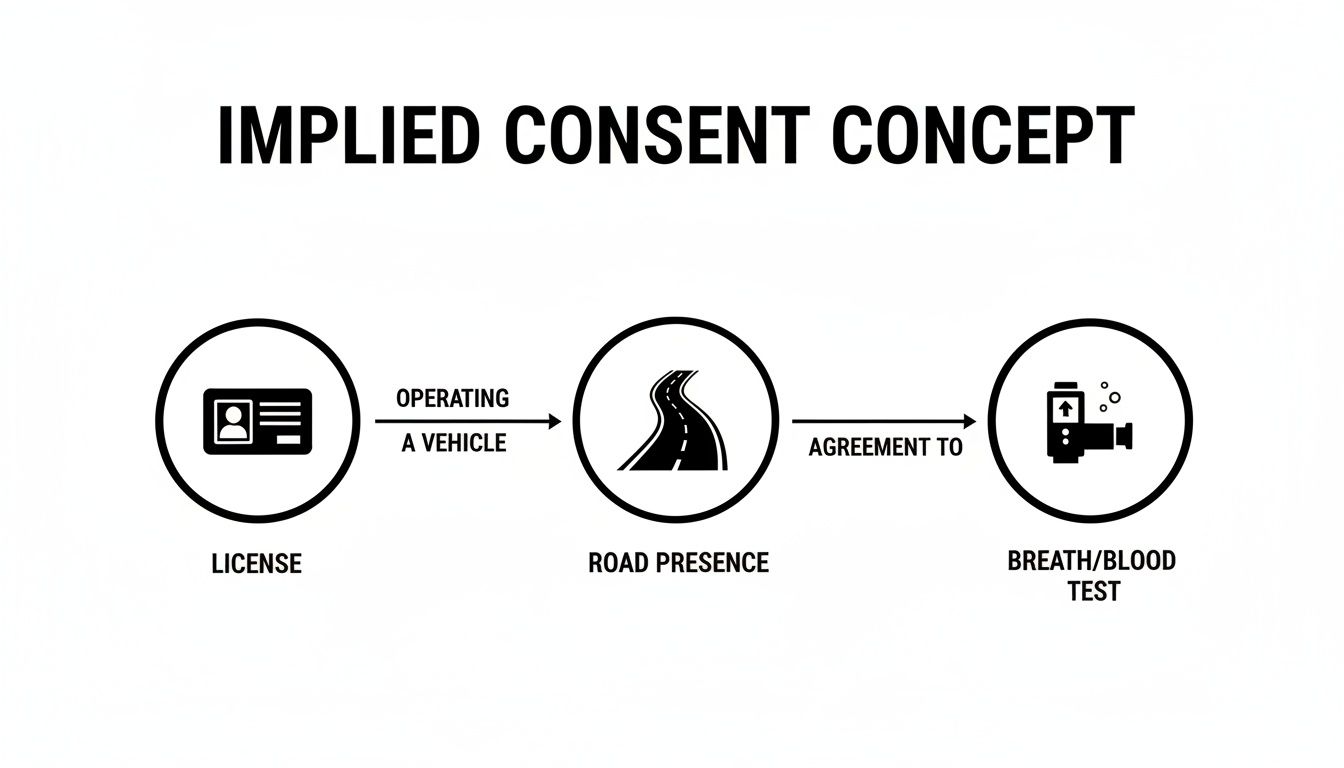
As you can see, the act of driving on a Texas road is viewed as a constant agreement to cooperate with testing. Refusing breaks that agreement, which triggers the administrative penalty.
The suspension periods for a refusal are harsh and depend on your prior record.
Texas License Suspension Periods for Chemical Test Refusal
Here’s a clear breakdown of the automatic license suspension you’ll face under the ALR program just for refusing the test.
| Offender Type | Suspension Period for First Refusal | Suspension Period for Subsequent Refusal |
|---|---|---|
| Driver with No Prior DWI Contacts | 180 Days | 2 Years |
| Driver with a Prior DWI Conviction or Refusal | 2 Years | 2 Years |
It's crucial to remember that these suspensions are purely administrative. They are completely separate from any criminal penalties, like jail time or fines, that a judge might impose later.
The Criminal Fight for Your Freedom
The second fight is the one most people think of: the criminal DWI charge. Even without a breath or blood sample to prove your Blood Alcohol Concentration (BAC), the prosecutor can—and will—still press forward with the case. A refusal does not get the charges dropped.
Worse, the prosecutor will twist your refusal into a weapon against you at trial. They'll stand in front of a jury and argue that your refusal is evidence of guilt. The story they'll tell is simple: "The defendant refused the test because they knew they were intoxicated and had something to hide."
A Refusal Is Not a Confession.
The state's attorney wants the jury to see your refusal as an admission of guilt. We work to dismantle that narrative. We show that there are many valid reasons an innocent person might say no, such as being confused by the officer's instructions, being afraid of police, or simply not trusting the accuracy of the machines.
While refusing the test denies the prosecution a key piece of scientific evidence, it creates the immediate ALR problem and gives them a new argument to use in court. The decision is never easy, which is why we break down the pros and cons in our guide on whether you should refuse a breathalyzer.
An experienced DWI defense attorney knows how to fight this war on both fronts at the same time. We will immediately request your ALR hearing to protect your license while simultaneously building a powerful defense against the criminal charge. We'll challenge the traffic stop, the officer's testimony, the field sobriety test results, and every other piece of evidence the state plans to use against you.
How Implied Consent Impacts Different Texas Drivers
A DWI charge doesn't hit everyone the same way. The rules of implied consent can create unique—and often devastating—challenges depending on your job, your age, or even where you live. For many Texans, refusing a breath or blood test isn’t just about a potential license suspension; it can put their entire livelihood on the line.
It's a mistake to think a one-size-fits-all defense will work. Your case is personal, and the stakes are uniquely yours. A good Houston DWI lawyer gets this. They build a defense strategy that is laser-focused on protecting what matters most to you.
Commercial Driver’s License (CDL) Holders
For a commercial truck driver, a DWI arrest can be a career-ending event. Under both federal (FMCSA) and Texas law, CDL holders are held to a much stricter standard than the average driver. There's almost no room for error.
If you have a CDL and refuse a chemical test—even if you’re in your personal car on a Saturday night—you face an immediate one-year disqualification of your commercial license. This isn't a criminal penalty; it’s an administrative one that happens automatically, regardless of whether you're ever convicted of DWI. For anyone who depends on that CDL to feed their family, this is a crushing blow.
Drivers Under 21
Texas law has a special set of rules for young drivers and alcohol. While the standard DWI laws apply to everyone, the state’s zero-tolerance policy for underage drinking adds another layer of trouble.
Under the Texas Alcoholic Beverage Code, it's illegal for a minor to drive with any detectable amount of alcohol in their system. This is a DUI, not a DWI, but the implied consent rules still kick in. If an officer suspects a driver under 21 has been drinking at all, a refusal can trigger a license suspension—even if their blood alcohol level is nowhere near the adult DWI standard of 0.08.
Out-of-State Drivers
Visiting Texas from another state? You're not off the hook. The moment you drive on Texas roads, you’ve automatically agreed to its implied consent laws. If you’re arrested for DWI and refuse a chemical test, Texas will start the process to suspend your driving privileges within its borders.
But it doesn't stop there. Thanks to the Interstate Driver's License Compact, Texas will report that suspension to your home state. More often than not, your home state’s DMV will then suspend your license, too. Suddenly, a DWI arrest in Texas has followed you home, creating legal headaches in two places at once.
Your Profession Can Be at Risk
For licensed professionals—doctors, lawyers, pilots, nurses, and real estate agents—a DWI arrest can be a professional catastrophe. A test refusal often triggers mandatory reporting requirements to your state licensing board, which can lead to disciplinary action and put the career you’ve worked so hard for in jeopardy.
The fight against drunk driving is a serious public safety concern. In 2023, alcohol-related crashes took the lives of 12,429 people across the country, with Texas seeing a significant share of that tragedy. Law enforcement often sees test refusals as a way for offenders to dodge convictions, which is why the penalties are so stiff. As this in-depth analysis of implied consent laws shows, these rules are designed to be strict.
Whether it’s your first offense or you hold a special license like a CDL, a refusal can lead to an immediate license suspension. The first and most critical step is to fight back by requesting an Administrative License Revocation (ALR) hearing within 15 days of your arrest. This is your only chance to challenge the stop and save your license from suspension. If a suspension does happen, you may need to learn how to get an occupational license to keep driving for work, school, and other essential needs.
Building Your Defense After a Test Refusal

If you refused a breath or blood test, it’s easy to feel like the deck is stacked against you. The state is already moving to suspend your license, and you know they’ll use that refusal as evidence in court. But here's what many people don't realize: a refusal is not a conviction. In fact, it often gives a skilled Houston DWI lawyer a unique advantage to build a powerful, two-front defense.
By saying "no," you’ve denied the prosecution their single most powerful piece of evidence: a specific BAC number. This forces them to rely on subjective observations and officer testimony—things that are often full of holes. Your defense begins the moment you decide to fight back against both the administrative and criminal penalties.
The First Battle: Defending Your Driver's License
Your first and most urgent fight is the Administrative License Revocation (ALR) hearing. After refusing a test, you have just 15 days from the date of arrest to request this hearing. If you miss that deadline, your license will be automatically suspended. There are no exceptions, so acting fast is non-negotiable.
This hearing is your one and only shot to stop the administrative suspension. Our job as your attorney is to challenge the state's case from every possible angle, including:
- The Traffic Stop: Did the officer even have a valid reason to pull you over? If the stop was illegal, everything that happened after can be thrown out.
- The Arrest: Did the officer have enough probable cause to arrest you for DWI? We scrutinize their reasoning for putting you in cuffs.
- The Refusal Warning: Was the DIC-24 statutory warning read to you correctly? Any mistake in explaining the consequences of refusal can invalidate the entire suspension.
The ALR hearing also gives us an invaluable sneak peek into the state's case. We get to question the arresting officer under oath, lock in their story, and expose weaknesses we can use later in your criminal defense. You can learn more about this crucial first step in our detailed Texas ALR hearing process guide.
The Second Battle: Fighting the Criminal Charge
While we work to save your license, we're simultaneously building your defense against the criminal DWI charge. Without a BAC number, it becomes much harder for the state to prove you were intoxicated "beyond a reasonable doubt." The prosecutor is left with nothing but the officer's word and other subjective evidence.
This is where an experienced defense attorney really shines. We go on the offensive by attacking the prosecution’s evidence:
- Scrutinizing Police Reports and Videos: We dig through every dashcam and bodycam video, looking for contradictions between what the officer wrote and what the camera actually shows. Often, the video tells a completely different story.
- Challenging Field Sobriety Tests (FSTs): These tests are notoriously subjective and unreliable. We can demonstrate how nervousness, bad instructions, a physical limitation, or even just uneven pavement could have made you "fail," even if you were sober.
- Questioning the Officer's Observations: Were the claims of "slurred speech" or "bloodshot eyes" exaggerated? We show the jury that these signs have innocent explanations and don't automatically prove intoxication.
Without a number, the state's case is just an opinion. Your refusal forces the prosecutor to rely on an officer's subjective interpretation of events. We are experts at showing a jury why that opinion isn't enough to take away your freedom.
By refusing the chemical test, you’ve already taken away the prosecution’s strongest weapon. Now, let us help you build the strategic defense needed to fight your DWI in Texas. With no scientific proof of your BAC, we can create the reasonable doubt necessary to protect your record, your freedom, and your future.
What Happens Next? A Step-by-Step Guide After a DWI Arrest
A DWI arrest can feel like the world is closing in on you. It's overwhelming, confusing, and frankly, terrifying. But right now, it's critical to take a deep breath and remember one thing: an arrest is not a conviction. You have rights, and more importantly, you have options.
The most important thing you can do is act fast. The decisions you make in the next few days will directly impact your driver's license and the entire trajectory of your defense.
Navigating the aftermath of a DWI arrest feels complicated because it is. You're not just fighting one case; you're fighting two separate battles at the same time: the administrative fight for your license and the criminal case for your freedom. Taking the right steps immediately can make all the difference in both.
The Most Critical Deadline in Your DWI Case
Your most urgent priority is the 15-day deadline to request an Administrative License Revocation (ALR) hearing. This is not a suggestion; it's a hard-and-fast deadline.
From the moment you are arrested, a clock starts ticking. You have just over two weeks to formally challenge the automatic suspension of your driver’s license. If you miss this window, the Texas Department of Public Safety will suspend your license—no matter what happens in your criminal case.
Here’s what you need to do to take control right now:
- Don't Wait: That 15-day clock is unforgiving. Procrastinating can cost you your driving privileges and a crucial opportunity to challenge the state's evidence early on.
- Preserve All Evidence: Hold on to every single piece of paper the police gave you. This includes the notice of suspension, your bond paperwork, and any tickets. These documents contain vital information for your defense.
- Contact a DWI Defense Attorney: This is the single most important step you can take. An experienced attorney can immediately file the ALR hearing request for you, stopping the clock and starting the fight to protect your license.
Take Control of Your Future Today
The anxiety and uncertainty you're feeling are completely understandable, but you have the power to fight back. Whether this is your first DWI in Texas or you’re facing more complicated charges, a smart, strategic defense is your best weapon. You don't have to let one mistake or one wrongful accusation define your future.
Your next move is the most important one. By seeking experienced legal counsel, you are not just hiring a lawyer; you are gaining a strategic partner dedicated to protecting your rights, your license, and your reputation.
The team at The Law Office of Bryan Fagan, PLLC, is here to stand by your side. We know what you are going through, and we know how to fight DWI Texas charges. Our team is available 24/7 to listen to your story and give you a clear path forward.
Don't risk your future by waiting. Call us now to request a free and confidential case evaluation. Let us help you take the first step toward putting this behind you.
Common Questions We Hear About Texas Implied Consent
After a DWI arrest, your mind is probably racing with a thousand questions. It's a confusing and stressful time, and the legal jargon around "implied consent" only makes things worse. We get it. Here are some real answers to the questions our attorneys hear every single day from people just like you. While this guide can clear up some confusion, remember that no two cases are the same—talking to an attorney about your specific situation is the most important step you can take.
Can Police Force Me to Give a Blood Sample in Texas?
Yes, but only under specific circumstances and with a warrant. While you have the right to refuse a breath or blood test, an officer can’t just strap you down and take your blood. If you refuse, the officer must seek a search warrant from a judge.
This is a common tactic, especially in cases involving:
- An accident where someone was seriously injured or killed.
- A child under the age of 15 in the vehicle.
- A driver with a history of certain DWI-related convictions.
If the judge signs the warrant, it legally compels you to provide a blood sample. However, this process is not infallible. A skilled Texas DUI attorney will immediately investigate how that warrant was obtained and how the blood draw was performed. Any procedural error, lack of probable cause, or mistake in the process can be a powerful reason to get that blood evidence excluded from court.
If I Win My DWI Case, Do I Get My License Back?
Not necessarily, and this is a critical detail that surprises many people. The administrative license suspension for refusing a test is a completely separate case from your criminal DWI charge. You are fighting two different battles on two different fronts.
You could be found "not guilty" of DWI in criminal court but still lose your license because of the refusal. This is why you must fight DWI Texas charges on both fronts. A strategic defense involves challenging the license suspension at the ALR hearing and simultaneously building your defense for the criminal case. Winning one does not guarantee you win the other.
Does Implied Consent Only Cover Alcohol?
No. The Texas implied consent law applies to intoxication from alcohol, a controlled substance, a drug, a dangerous drug, or any combination of these substances.
If an officer has probable cause to believe you are impaired by any substance—including a legal prescription, marijuana, or over-the-counter medication—they can request a chemical test. Refusing a test for suspected drug impairment carries the exact same automatic DWI license suspension as refusing a test for alcohol.
Is It Always Better to Refuse a Breathalyzer?
There’s no simple "yes" or "no" answer. This is a critical strategic decision with significant trade-offs. On one hand, refusing a test denies the state its most powerful piece of evidence: a specific BAC number. This can make the criminal case much harder for them to prove beyond a reasonable doubt.
On the other hand, refusing triggers an immediate and automatic DWI license suspension. Furthermore, the prosecutor will argue to the jury that you refused because you knew you were guilty. The right choice depends entirely on the specific facts of your case, your driving history, and what’s at stake for you professionally. This is one of the most important strategic discussions to have with your DWI lawyer right away.
A DWI arrest can feel like your world is falling apart, but it doesn't have to ruin your future. The experienced attorneys at The Law Office of Bryan Fagan, PLLC are here to help you take back control. We’ll stand with you and fight for your rights, carefully examining every detail of your case—from the moment you were pulled over to the implied consent warning.
Call us 24/7 for a free, confidential case evaluation. Let us start building the strongest defense possible for you.