
A DWI arrest can be overwhelming, but you don't have to face it alone.
If you were just released, you're probably tired, embarrassed, angry, and unsure what matters most. Start with this: don't panic, and don't wait. The first decisions you make after a Texas DWI arrest can protect your license, preserve useful evidence, and keep you from making the case harder than it already is.
Individuals considering what to do after a DWI arrest in Texas immediately typically focus on court. That's not the first problem. In most cases, the urgent issue is your driver's license and the evidence that can disappear before your first court date even arrives.
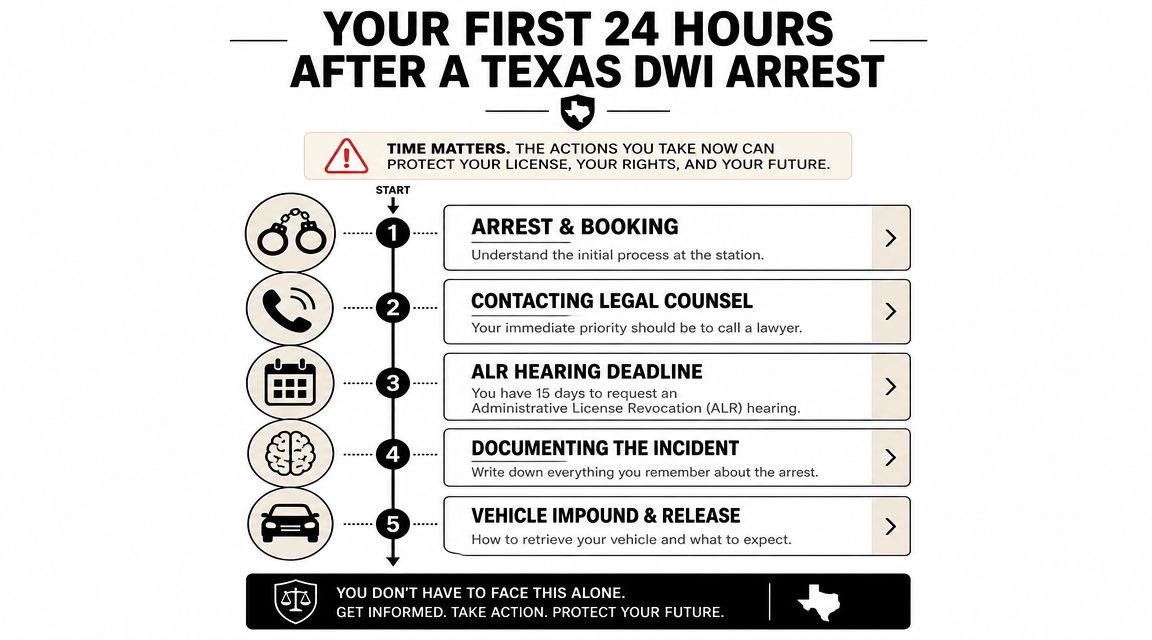
Your First 24 Hours After a Texas DWI Arrest
The first question isn't whether you'll beat the case. The first question is whether a deadline is already running against you.
Texas treats a DWI arrest as two separate tracks. One is the criminal case in court. The other is the administrative license suspension case handled through the Administrative License Revocation, or ALR, process. An administrative license suspension is the state's separate attempt to suspend your driving privilege, apart from whether you're ultimately convicted in criminal court.
That distinction matters right away. Texas guidance explains that a driver typically receives a Notice of Suspension or temporary driving permit after arrest, and the person generally has only 15 days from service to request an ALR hearing or the license can be suspended, as explained in this Austin DWI arrest overview.
Find your paperwork before you do anything else
Get every document you were handed. Look for the temporary driving permit, DIC form, bond papers, tow or impound paperwork, and any citation or booking sheet.
Then do three simple things:
- Photograph every page so nothing gets lost.
- Confirm the service date on the notice tied to your license.
- Put the deadline on your calendar immediately.
If you wait until your first court appearance to think about your license, you can lose a major defense opportunity before the criminal case even starts moving.
Practical rule: If you have your paperwork in a pile on the kitchen counter, you're already late. Put the deadline on your phone calendar now.
Your first-day checklist
You don't need a perfect plan tonight. You need the right priorities.
- Call a lawyer quickly: The ALR process starts fast, and early representation can help preserve your right to challenge the stop, probable cause, or testing issues.
- Write down what happened: Do this before you sleep if possible. Your memory is best now, not next week.
- Stay off social media: Don't post jokes, explanations, photos, apologies, or "I was fine" comments.
- Don't talk about the facts with friends: Casual conversations turn into bad evidence.
- Figure out where your car is: If it was impounded, gather the information you'll need to retrieve it.
Know the basic terms now
A few terms matter immediately:
- Implied consent: In Texas, by driving, you are considered to have consented to certain chemical testing procedures after a DWI arrest under state law.
- BAC: This means blood alcohol concentration.
- Field sobriety test: These are roadside tasks officers use to claim they observed impairment.
- Administrative license suspension: This is the license consequence handled outside the criminal court case.
You don't need to master the law tonight. You just need to stop the damage from spreading.
What to Say and Do During and After the Arrest
Most DWI cases get harder because people talk too much. They try to sound helpful. They try to explain. They try to talk their way out of it.
That almost never helps.
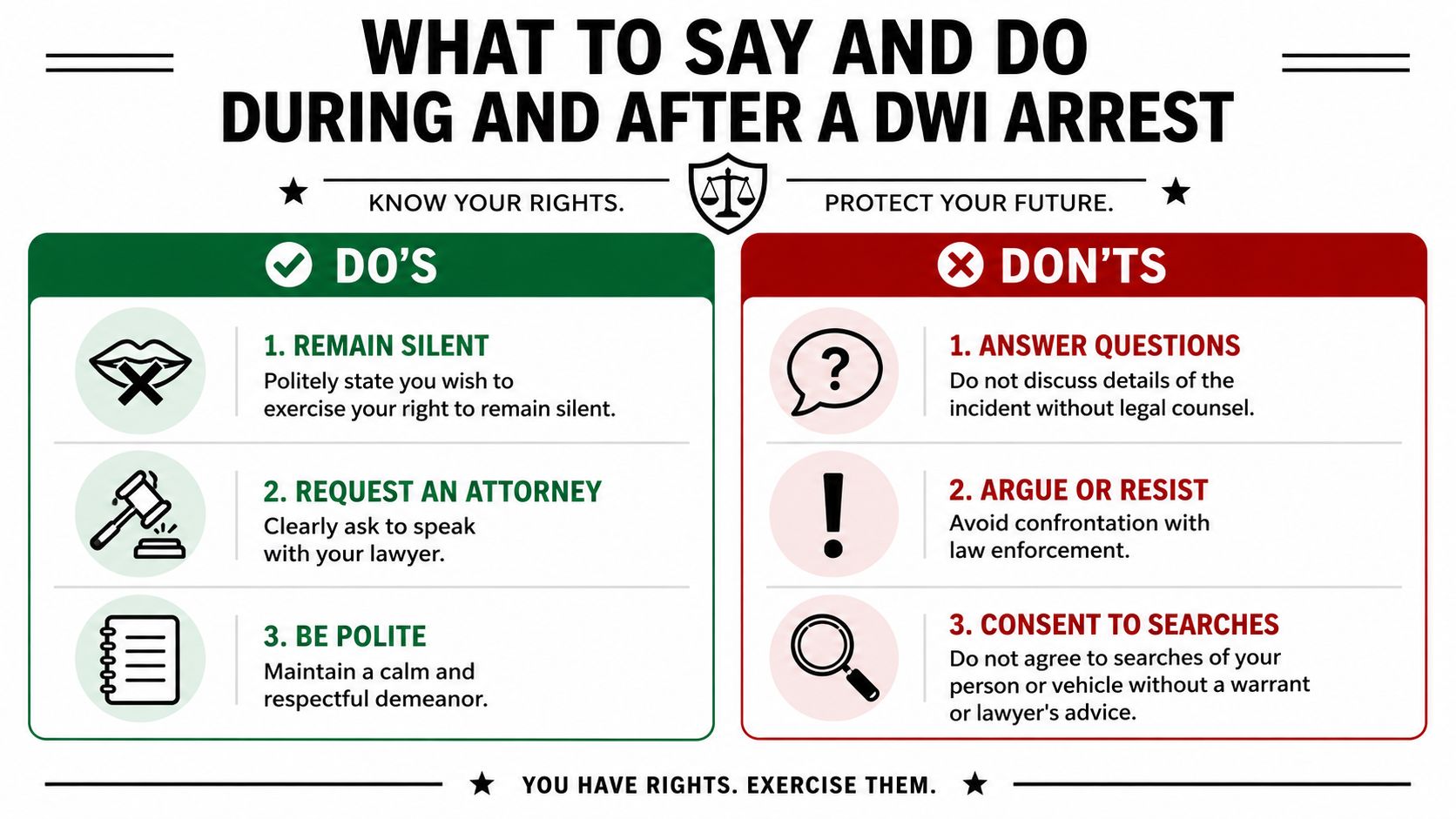
Your job during and after the arrest is simple: be polite, don't resist, and stop giving the state extra evidence.
What you should say
Use short, calm sentences. You are not there to persuade the officer.
Good examples:
- "I want to remain silent."
- "I want a lawyer."
- "I won't answer questions without counsel."
That's enough. Keep your tone respectful. Give identifying information when required, but don't volunteer where you were, what you drank, when you stopped drinking, or whether you think you're okay to drive.
If you want a fuller discussion of why statements matter so much, read this guide on how your statements to police can affect a Texas DWI case.
What not to say
People often think these answers are harmless:
- "I only had a couple."
- "I was coming from dinner."
- "I'm tired, not drunk."
- "I can do the test."
- "I take medication."
Every one of those statements can be used to build the officer's report. The report often becomes the backbone of the prosecution's version of events.
The officer is collecting details for a report, not helping you clear things up.
Field sobriety tests and chemical tests are not the same thing
A field sobriety test is a roadside exercise such as following an object with your eyes, walking heel-to-toe, or standing on one leg. These tests are used to create observations the officer can later describe in court. They are subjective, and many people perform poorly for reasons that have nothing to do with intoxication.
A chemical test is typically a breath or blood test used to measure alcohol concentration. That's where BAC becomes relevant.
An implied consent law means Texas can impose administrative consequences related to testing decisions after arrest. Texas guidance also notes that a first-time refusal can trigger an administrative suspension of 180 days, as discussed in this Texas DWI deadline article.
Be cooperative without helping build the case
There is a difference between cooperation and self-incrimination.
Don't argue.
Don't resist.
Don't consent to searches.
Don't try to perform your way out of suspicion.
Don't chat in the patrol car, at booking, or on a recorded jail phone as if none of it counts.
This video gives a useful overview of immediate legal choices after arrest:
The best posture is boring
The strongest clients are usually the least dramatic ones. They stay calm, say very little, and leave the legal strategy for later.
If you've already said more than you should have, don't spiral. Tell your lawyer exactly what happened. A good Texas DUI attorney or Houston DWI lawyer can't fix what you hide.
How to Save Your License The 15-Day ALR Deadline
If you do one thing immediately after a DWI arrest, do this.
Texas uses the Administrative License Revocation process to handle the driver's license side of a DWI arrest. It is separate from the criminal prosecution. The criminal court date does not control this deadline. Waiting for court is one of the most common mistakes people make.
Texas defense guidance explains that after arrest, the notice typically starts a strict 15-day countdown to request an ALR hearing, and missing that window can trigger an automatic suspension, as explained in this Texas ALR hearing guide.
What the ALR hearing is
An ALR hearing is your chance to contest the administrative suspension of your license. It also gives your lawyer an early opportunity to examine issues such as the stop, probable cause, or chemical-test problems.
That early hearing matters strategically. It can create testimony and preserve information before the criminal case is fully developed.
What you should do today
Use this sequence:
- Locate the notice: Check your temporary permit or DIC paperwork.
- Confirm the service date: That's the date tied to the countdown.
- Calendar the deadline: Don't trust memory.
- Have counsel request the hearing before day 15: Filing on time protects your position.
A DWI court date and an ALR deadline are not the same thing. Treating them like they are can cost you your license.
Texas DWI license suspension periods for first offense
| Action Taken | Administrative Suspension Period |
|---|---|
| Refusal of chemical test | 180 days |
| Failed chemical test | Separate suspension process |
If you want to understand how these hearings are fought, this article on ALR hearing cross-examination in Texas is a useful next step.
Why this hearing matters beyond driving
People usually think of the ALR process only as a transportation problem. That's too narrow.
The hearing can matter because it forces early attention to the facts. It can expose weaknesses in the officer's basis for the stop, the sequence of events, or the handling of testing. Even when the criminal case continues, the ALR track can become an important source of defense material.
If you're dealing with a DWI license suspension, don't treat the hearing request like optional paperwork. It's one of the first real opportunities to fight DWI in Texas.
Preserving Critical Evidence for Your DWI Defense
You get out of jail, sleep a few hours, and tell yourself you'll deal with it tomorrow. That delay costs people good defense material all the time. The first 24 to 72 hours matter because videos get deleted, receipts disappear into email clutter, and your own memory starts changing fast.
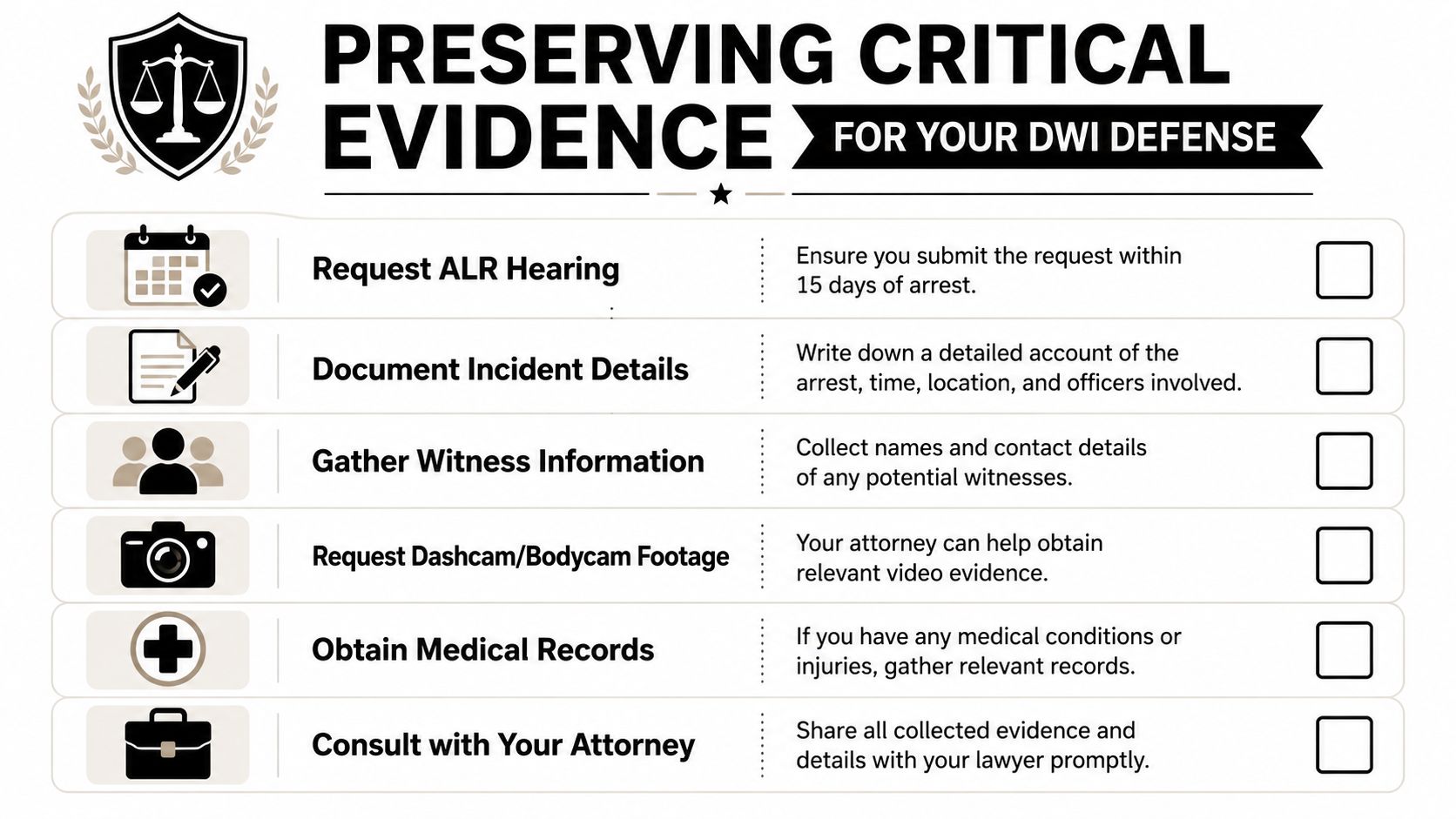
Your case will not be decided only by what the officer wrote. It may turn on timing, video, medical facts, witness accounts, and whether your behavior has an innocent explanation. Preserve that proof now. If you need a Houston drunk driving lawyer, this is the kind of work your lawyer will want started immediately.
Write your timeline while it is still fresh
Do it today. Use a notes app, email draft, or notebook, but keep it private and stick to facts.
Include details that will be hard to recreate later:
- Where you were: Start with the first stop that matters that day or night.
- What you ate and drank: List what you remember. Do not guess or estimate to sound helpful.
- Timing: Note when you arrived, left, were stopped, arrested, and tested.
- Officer instructions: Record what you were asked to do and how directions were given.
- Physical conditions: Include lighting, weather, road surface, shoes, fatigue, injury, illness, anxiety, or any medical issue.
A strong defense often comes from small facts. If your timeline is written early, your lawyer can compare it against the police report, body camera, dispatch records, and test records before your memory gets contaminated.
Save the evidence that disappears first
Start with the material that gets deleted automatically or becomes harder to retrieve with time.
Focus on these items first:
- Business or home surveillance video: Gas stations, restaurants, bars, apartment gates, and nearby homes may have footage of your driving, stop, or appearance.
- Dashcam footage: Your own vehicle or another driver's camera may have recorded the stop.
- Rideshare records: Save trip history, pickup and dropoff times, and receipts.
- Texts, call logs, and location history: These can support your timeline and show who you were with.
- Receipts and transaction records: Food, parking, tolls, or store purchases can pin down timing.
- Witness names and numbers: Get full names and contact information now, not weeks later.
Download copies. Take screenshots. Back them up.
A lot of people make the same mistake here. They assume they can go back for it later. Later is when the system overwrites the footage and the witness says they do not remember.
Ask for preservation before evidence is gone
If a bar, store, apartment complex, or nearby business may have useful footage, act quickly. Tell your lawyer about it right away so a preservation request can go out before the video is erased in the normal course of business.
Do not wait for formal discovery to solve this. Discovery often comes after the material is already gone.
Do not create new evidence for the State
The hours after release are dangerous because people start explaining. That usually makes the case worse.
Avoid these mistakes:
- Posting on social media: Photos, captions, jokes, and late-night explanations can be used against you.
- Sending detailed texts about what happened: Messages to friends, family, or coworkers are still evidence.
- Editing or deleting content: Deleting posts, messages, or videos can create a separate problem.
- Retelling the story differently: Inconsistencies damage credibility and give the prosecutor easy cross-examination.
Save first. Stay quiet. Then talk to your lawyer.
That is the right order.
How to Hire the Right Houston DWI Lawyer
Hiring a lawyer isn't about finding the loudest website or the cheapest quote. It's about finding someone who knows how to handle both the license fight and the criminal case with a coherent strategy.
A DWI defense starts with details. Before you call anyone, collect your paperwork, your written timeline, bond conditions, tow information, and any notes about testing or officer statements. If you have screenshots, receipts, or witness names, gather those too.
What to ask in the consultation
You don't need to ask twenty questions. Ask the right ones.
Start with these:
- How do you handle the ALR side of the case?
- What facts do you want from me in the first few days?
- How do you evaluate stop issues, field sobriety testing, and chemical testing?
- Who will appear with me in court and at hearings?
- What should I avoid doing while the case is pending?
Listen for clear answers, not slogans. A good Houston DWI lawyer should be able to explain process, priorities, and timing in plain English.
What a strong lawyer should want from you
The right attorney won't just ask for money and a court date. They should want documents, dates, names, and your account while it's still fresh.
Useful things to send right away include:
- Notice of Suspension or temporary permit
- Bond paperwork
- Booking or release papers
- Your written timeline
- Video or receipt screenshots
- Witness contact information
If you're looking for a local starting point, this page on a Houston drunk driving lawyer outlines the type of representation many Texas defendants look for after arrest.
Don't hire based on comfort alone
You should feel respected. But comfort isn't enough.
Hire the lawyer who spots issues quickly, asks precise follow-up questions, and talks strategy instead of making empty promises. No ethical Texas DUI attorney can guarantee dismissal. What they can do is move fast, preserve options, and challenge the state's case intelligently.
The Law Office of Bryan Fagan, PLLC provides Texas DWI defense representation, including help with ALR hearings and criminal court defense, which is the kind of immediate legal assistance many people need after arrest.
Frequently Asked Questions After a Texas DWI Arrest
Can I get my car out of impound right away
Usually, yes. Start by calling the impound lot and ask exactly what they need before you show up.
Get the required documents, confirm the hours, and ask about fees. Bring your release paperwork, identification, proof you own the vehicle, proof of insurance if you have it, and a payment method. If someone else is picking it up for you, ask what written authorization the lot requires. Do not assume one lot handles release the same way another does.
What are bond conditions and why do they matter
Bond conditions are court orders. Treat them that way.
They may restrict alcohol use, travel, driving, reporting, or who you can contact. Read every line the day you get out. If a condition is unclear, ask your lawyer before you do anything that might violate it. A bond violation can put you back in custody and hand the prosecution a fresh problem to use against you.
What if I have a CDL or I live out of state
Act faster if you have a commercial driver's license or you were arrested in Texas while living elsewhere. These cases create extra licensing problems, and delay makes them worse.
Keep every document. Save every notice. Tell your lawyer right away about your CDL status or home state license so the defense and license response can be handled together, not as an afterthought.
Can I still be charged if my BAC was under 0.08
Yes.
Texas does not require a BAC of 0.08 or higher in every DWI case. The state may still claim you lost the normal use of your mental or physical faculties. That means the case can turn on the officer's observations, body camera video, field sobriety testing, your statements, and the timeline of what happened before the stop.
Do not assume a lower number ends the case. It does not.
What should I do tonight if I'm exhausted and can't deal with all of this
Do four things and stop there.
- Put every paper from the arrest in one folder
- Take clear photos of each document
- Write a short timeline while the details are fresh
- Stay off text, email, and social media about the case
Then set one reminder for tomorrow morning to deal with the ALR deadline and contact a lawyer.
A DWI arrest does not end your future. It does create deadlines, and missed deadlines can quickly put people at a disadvantage. If you need help with the license case, the criminal case, or both, you can request a free consultation with the Law Office of Bryan Fagan, PLLC. Early action gives your defense more room to work.