 Skip to content
A DWI arrest can be overwhelming, but you don't have to face it alone. The worst part is how fast it happens. One stop turns into handcuffs, a stack of paperwork, and a license problem that can hit before your criminal case even gets moving. If you're dealing with a Texas ALR hearing process right now, your next moves matter more than your arrest itself.
Treat this as a separate fight, because that's exactly how Texas treats it. Your criminal DWI case and your license case are not the same thing, and the state can suspend your driving privileges even while the criminal charge is still pending. That's why the first call should be to a Houston DWI lawyer or another experienced Texas DUI attorney who understands both sides of the case, not just the court date you see on the citation.
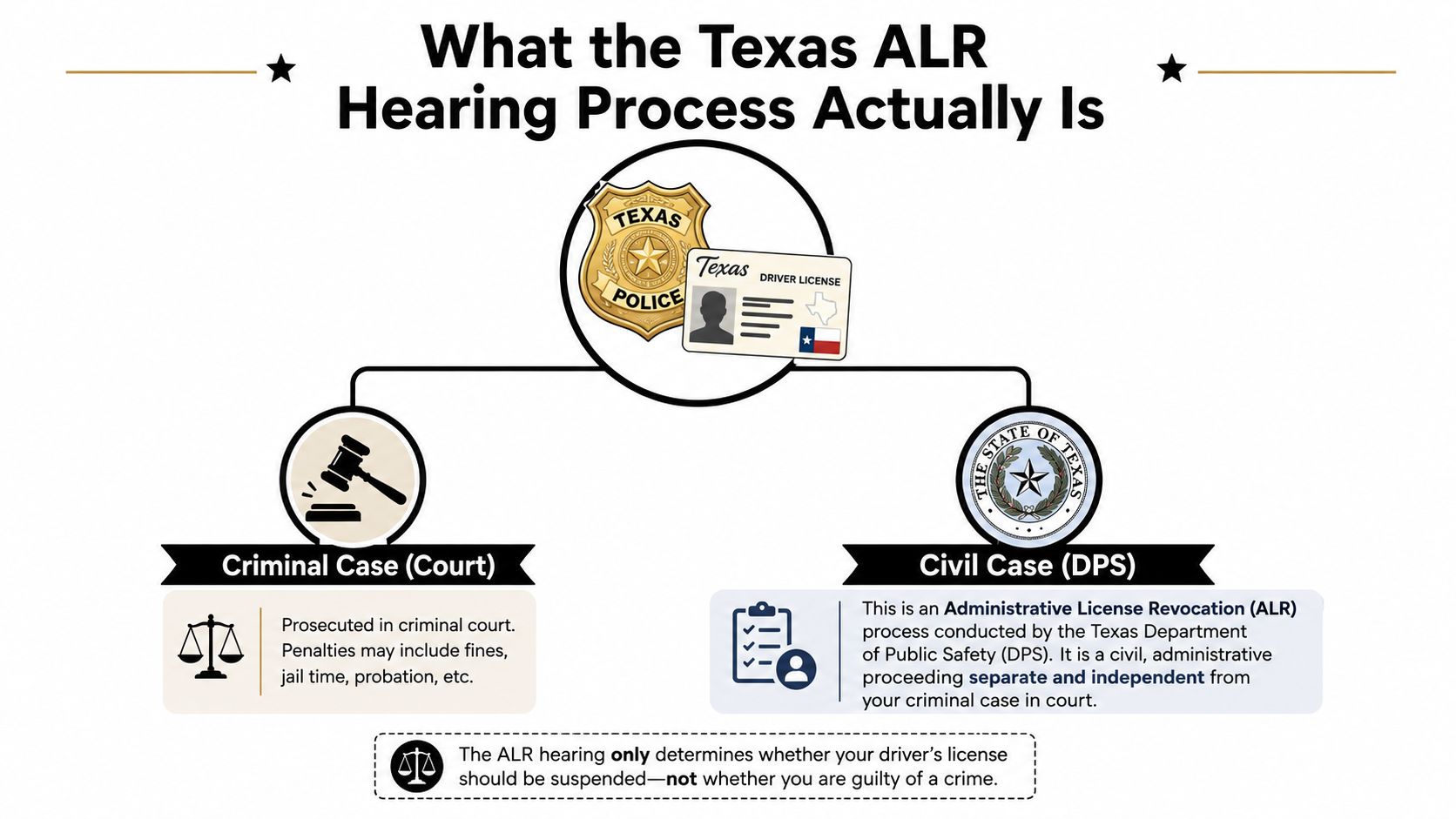
What the Texas ALR Hearing Process Actually Is
A DWI arrest creates two tracks, and only after the paperwork is already in hand do many realize this. One track is the criminal case. The other is the civil fight over your driver's license, and that is where the Administrative License Revocation, or ALR, hearing comes in.
The ALR hearing is a civil administrative proceeding handled by the State Office of Administrative Hearings (SOAH), not a criminal trial. An Administrative Law Judge (ALJ) hears the evidence and decides whether the Texas Department of Public Safety proved the legal grounds to suspend your license. If DPS doesn't meet that burden, your license is not suspended. That's a different standard, a different forum, and a different strategy than the criminal case. The hearing exists to decide one thing only, whether your driving privileges should be taken away.
Why this hearing matters immediately
The ALR process is built around the idea of implied consent, which means Texas law treats driving as a choice that comes with testing consequences after a lawful arrest. That doesn't mean the state gets a free pass. It means DPS has to prove the grounds for suspension in a formal proceeding, and that hearing is your first real chance to push back.
Practical rule: if you ignore the ALR process, you're not “waiting to see what happens.” You're letting DPS move forward with the suspension unopposed.
A common mistake is assuming a criminal dismissal or plea bargain will automatically resolve the license issue. It won't. A DWI license suspension is a separate matter that requires its own defense.
If you want a deeper look at how hearing officers handle evidence and witness issues, review this ALR hearing officer discretion guide. It helps show why this process is not a rubber stamp.
Critical Deadlines and How to Request Your Hearing
The first deadline is the one that catches people off guard. Under Texas DPS guidance, you have only 15 days after you're served notice to request the ALR hearing, and DPS says the hearing may take up to 60 days to be scheduled (SOAH guidance). Miss that window, and you've handed the state the easiest path to suspension.
The clock usually starts when you receive the notice tied to the arrest paperwork. Don't guess at the date. Don't rely on memory. The filing deadline is a hard deadline, and if you're asking how to fight DWI Texas style, the fight begins here.
How to file the request the right way
You need to act fast and keep proof that the request was made. In most cases, your attorney can file it for you, which reduces the chance of a paperwork error. If you're handling the request yourself, include the identifying information tied to the arrest and keep a record of how and when it was submitted.
The blood-test exception matters more than most consumer guides explain. For blood-test-only cases, DPS's own request form says ALR hearing requests under Texas Transportation Code Chapter 524 should not be submitted until a notice of suspension is received from DPS (DPS ALR form and guidance). That difference changes when the deadline logic matters, and it's exactly where people get trapped by assuming the arrest date always controls everything.
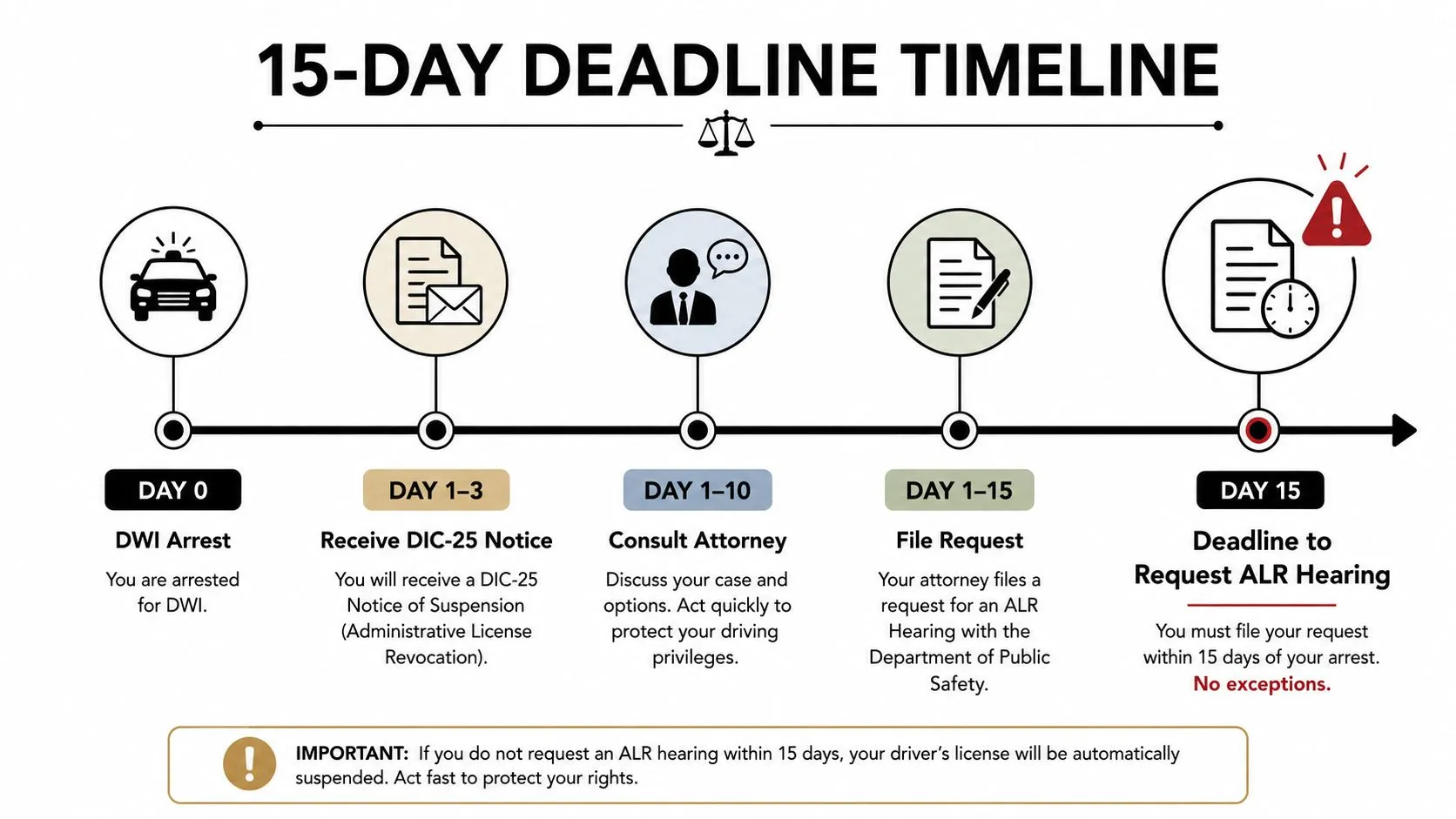
If you want a simple overview of why the clock matters so much, read The 15-Day ALR Deadline: Save Your License After a DWI Arrest. It covers the basic reason the deadline exists, which is to stop an automatic suspension from going forward unchecked.
What happens after you file
Once the request goes in, SOAH schedules the hearing and DPS prepares its evidence. That waiting period is not dead time. It's the period when your defense starts collecting records, video, and witness information that can expose errors before the hearing date arrives.
A lot of people assume they can wait until the hearing notice shows up and then start worrying. That's too late. Use the full window. A first DWI in Texas is stressful enough without losing your license because you waited on paperwork.
Grounds for Suspension and Your Chances of Winning
Texas DPS does not get to suspend a license just because someone was arrested. It has to prove a legal trigger. In ALR cases, that usually means either refusal to submit to a breath or blood test, or a test result showing a BAC of 0.08% or higher (Texas DWI/ALR overview). That is the core of the state's case.
The hearing is narrow by design. The ALJ is not deciding whether you are a bad driver or whether you probably drank too much. The ALJ is deciding whether DPS proved the statutory basis for a suspension. That matters because it gives your lawyer room to attack the stop, the arrest, the test, or the paperwork instead of relitigating guilt.
The numbers show this is a real fight
Publicly reported SOAH data show that these hearings are worth taking seriously. Analysts at reported SOAH data summary reported that since 2022, there have been 53,090 ALR hearings, and a meaningful share of drivers avoided suspension. The same summary also says the results vary by county, which is exactly why a weak defense in one case can still fail even when a similar case elsewhere gets dismissed.
County results matter. The reported dataset says Harris County had a high rate of cases resolved without suspension, while Denton and Tarrant counties reportedly had among the highest suspension rates. That kind of spread tells you local practice and case details change outcomes.
Bottom line: your chances are not fixed on arrest day. The facts, the county, and the quality of the defense all shape the outcome.
A separate SOAH reporting cycle for 2020 recorded 4,426 ALR cases received and 6,252 disposed, and noted that SOAH typically receives 2,000 to 3,000 cases per month in ordinary periods (reported SOAH data summary). That volume explains why these hearings are procedural and evidence-driven. If your case is weak, the state should have to prove it. If it is strong, you should push it hard.
Blood-test cases and breath-test or refusal cases do not play out the same way. In a blood case, the fight usually centers on collection, handling, and the paper trail. In a breath case or refusal case, the record of the request, the warnings, and the machine or officer paperwork often decide the hearing. A focused cross-examination plan matters, and this ALR hearing cross-examination guide shows how those weaknesses get exposed.
For readers facing the felony side of a DWI, Felony DWI in Texas: Third Offense and Child Passenger explains when the criminal charge gets far more serious. The ALR hearing still matters because your license can be affected before the criminal case is resolved.
Common Defenses and Evidence Challenges at the ALR Hearing
The best ALR defenses are rarely flashy. They're built on mistakes the officer made, records DPS can't produce, or procedures that weren't followed correctly. That's why a seasoned Texas DUI attorney looks at the stop, the arrest, the test, and the notice as separate attack points.
Refusal cases versus test-failure cases
In a refusal case, the question is whether the officer properly asked for the specimen and explained the consequences. If the request was unclear, the warnings were incomplete, or the record is inconsistent, the state's case can weaken fast. In a chemical test case, the fight shifts to the reliability of the machine, the blood draw, and the chain of custody.
For breath cases, calibration and maintenance records matter. For blood cases, the procedures around collection and handling matter just as much. If the person who drew the blood was not properly qualified or the sample moved through the system with gaps in documentation, that gives your defense room to argue that DPS didn't prove its case.
The usual defense themes
- Traffic stop legality: If the officer lacked a lawful reason to stop you, everything after the stop gets harder for DPS to justify.
- Probable cause for arrest: The officer needs more than a hunch. The observations have to support the arrest.
- Field sobriety tests: These tests are subjective, and poor administration can undermine the report.
- Notice and paperwork errors: If the notice is wrong or missing, the deadline and suspension issues can get messy for DPS.
A practical resource on witness questioning is this ALR cross-examination guide. Use it to understand why live testimony matters so much in these hearings.
Don't try to win the hearing by arguing every point at once. Pick the weak link and break the chain.
Procedural defenses that often get overlooked
Officer failure to appear can still matter, especially when the hearing is set up so live testimony is necessary to prove the state's case. Missing documents can matter too. The ALR process is paperwork-heavy, and that gives your defense a real opportunity to press the state on details instead of slogans.
For drivers whose cases started with a failed test, the criminal charge can still move forward separately. But if DPS can't prove the suspension ground here, you may keep your license while the rest of the case plays out.
How the ALR Hearing Connects to Your Criminal DWI Case
People like to say the ALR hearing and the criminal case are separate, and they are. But separate doesn't mean disconnected. The same arresting officer, the same body-cam, and the same roadside observations can show up in both places, which means the hearing is often the first real test of the state's story.
At the ALR hearing, your lawyer can cross-examine the officer under oath and pin down the details before trial. That testimony can reveal weak points, missed observations, or inconsistencies the prosecution would rather keep vague. If the officer stumbles on basic facts in the hearing, that's a problem for the criminal case too.
The outcome also shapes strategy. If you win the ALR hearing, it does not erase the criminal case, but it can give your defense useful advantages and a clearer picture of what evidence is vulnerable. If you lose, your lawyer still has the hearing record, the testimony, and the state's evidence roadmap to work with.
Why the two cases should be managed together
The ALR hearing can affect:
- Evidence strategy, because it shows what the officer can and can't explain.
- Witness preparation, because the defense learns how the state's witness performs under pressure.
- Risk assessment, because your lawyer can see which facts are strong and which ones need to be challenged early.
Use this ALR hearing versus criminal case guide if you want a clean explanation of the difference between the two tracks. The key point is simple. Don't let anyone tell you the license case is “just administrative” and therefore unimportant.
A criminal conviction can affect insurance, employment, and licensing in ways a simple suspension does not. But a suspension can also disrupt your life immediately, especially if you drive for work or family obligations. That's why the ALR hearing deserves real defense work, not a quick form filing.
Why Hiring a DWI Attorney Early Changes Everything
You can represent yourself at an ALR hearing, but that's a bad trade. The state shows up prepared, and the hearing officer hears these cases all the time. You need someone who knows what records to request, what testimony to challenge, and where the state usually cuts corners.
A lawyer can subpoena the officer, request calibration and maintenance records, challenge the admissibility of test evidence, and push on procedural defects before the hearing starts. That matters because you usually don't get a second chance to fix a mistake after the deadline has passed or the evidence has already gone in.
Practical rule: the earlier your lawyer gets involved, the more options you keep.
The cost of a suspension goes well beyond inconvenience. Lost work, restricted driving, and the paperwork that follows a suspension can hit hard. If the hearing goes badly, you may also have to deal with an occupational license, insurance complications, and other conditions before you're fully back on the road.
That's why experienced representation is worth considering immediately, not after the hearing notice arrives. The Law Office of Bryan Fagan, PLLC handles DWI defense and ALR matters, including the license hearing stage, criminal court defense, and related post-arrest issues. If you're trying to fight DWI Texas consequences early, that kind of coordinated approach matters.
Your Immediate Next Steps After a DWI Arrest
The first 48 hours should be about control. Write down everything you remember while it's still fresh, including where the stop happened, what the officer said, whether you were asked to take field sobriety tests, and whether you consented or refused a breath or blood test. Save any paperwork, photograph it if needed, and don't post about the arrest on social media.
The first week is about preservation. Ask your lawyer to move quickly on video, body-cam, dashcam, and arrest records. If you've got a blood case, make sure the timeline around the notice is reviewed carefully, because that can affect when the ALR clock matters.
A simple checklist
- Preserve evidence: Keep every document, notice, and receipt from the arrest.
- Write your memory down: Details fade fast, and small details often matter.
- Stay off social media: Comments and photos can create new problems.
- Call a lawyer quickly: Don't wait for the deadline to become urgent.
By the two-week mark, you should know whether your hearing request has been filed and whether the defense has started collecting the records that matter. If you're near the 15-day mark, stop delaying and get counsel involved now. A missed deadline can turn a fight into a suspension.
A DWI arrest does not define your future. The right response can protect your license, your record, and your livelihood. If you're in Houston, Dallas-Fort Worth, Austin, San Antonio, or a surrounding county, get legal help before the clock runs out.
The Law Office of Bryan Fagan, PLLC helps Texans respond quickly after a DWI arrest, including ALR hearing deadlines, license suspension issues, and criminal defense strategy. If you need guidance on your texas alr hearing process, visit Law Office of Bryan Fagan, PLLC and request a free consultation so you can protect your driving privileges before the deadline passes.

