
A DWI arrest can be overwhelming, but you don't have to face it alone. The Texas DWI court process timeline moves fast at the start, then seems to slow down just when you're trying to make sense of it. That's why your first moves matter so much, especially if you want to protect your license, challenge the stop, and keep the criminal case from defining your future. Understanding the Texas DWI court process timeline gives you a clearer view of what happens next, what deadlines you cannot miss, and how a Texas DUI attorney can step in early to protect your rights.
Texas uses two parallel tracks after an arrest. One track is administrative, which affects your driver's license. The other is criminal, which affects the DWI charge itself. The license deadline can move before the courtroom date even arrives, and that's exactly why you need a plan from day one. If you're dealing with a first DWI in Texas or a repeat arrest, the right strategy starts with the first paper you receive, not the first time you stand in front of a judge.
1. Arrest and Booking
A DWI case usually starts with a traffic stop, then an officer's decision to investigate further. That investigation may include roadside observations, a request for field sobriety tests, and a breath or blood test request. If the officer believes there's probable cause, you're arrested and taken to jail or a station for booking.
Booking is administrative, but it matters. Your identifying information is recorded, your property is logged, and the arrest paperwork begins the official paper trail that your lawyer will later examine for errors. If the stop was illegal or the officer overreached during the arrest, that can shape the entire defense.
A few early decisions help you protect yourself right away:
- Refuse roadside field sobriety tests. You're not required to help build the case against you.
- Use your right to remain silent. Don't explain, negotiate, or try to talk your way out of the arrest.
- Ask for a lawyer immediately. Do not sign anything beyond basic booking paperwork without advice.
- Write down officer details. Badge numbers, names, and physical descriptions can matter later.
- Request medical help if needed. Balance, medication, or injury issues can affect how tests look on paper.
A Texas DWI defense lawyer who handles cases under Texas DWI Defense Lawyer works with the arrest record from the start, including whether the officer had a lawful reason to stop you and whether the evidence was gathered properly.
Practical rule: What you say in the first hour after arrest can echo through the rest of the case.
If you're reading this from jail or just after release, stay calm and focus on the details you can control. Save every paper, remember every request the officer made, and don't let panic turn into extra statements that hurt your defense later.
2. Administrative License Revocation Hearing Request
Your driver's license problem starts fast. In Texas, you generally have 15 days from service of the suspension notice to request an ALR hearing, and that deadline runs separately from the criminal case (Texas DWI case timeline). If you miss it, you can face automatic license consequences even while the criminal charge is still pending.
An administrative license suspension is a civil penalty, not a criminal conviction. It comes from the state's licensing process, often based on a breath or blood result, or on a refusal to take the test. Implied consent means Texas treats driving on public roads as consent to chemical testing in certain circumstances, and BAC, or blood alcohol concentration, is the measurement officers and labs use to assess alcohol in a sample.
The ALR hearing gives you a real chance to challenge the state's case against your license. Your lawyer can question the legality of the stop, whether the officer had probable cause, whether you were properly advised, and whether the chemical testing was accurate. Those issues often overlap with the criminal case, which is why this hearing can help your overall defense strategy.
An attorney who knows the ALR process will also make sure the hearing request is filed on time, gather discovery early, and preserve testimony that may later matter in court. If the officer tells one story at the hearing and another in the report, that inconsistency can become useful later.
You can read more about the next steps after suspension in this guide to how to get your license back after suspension.
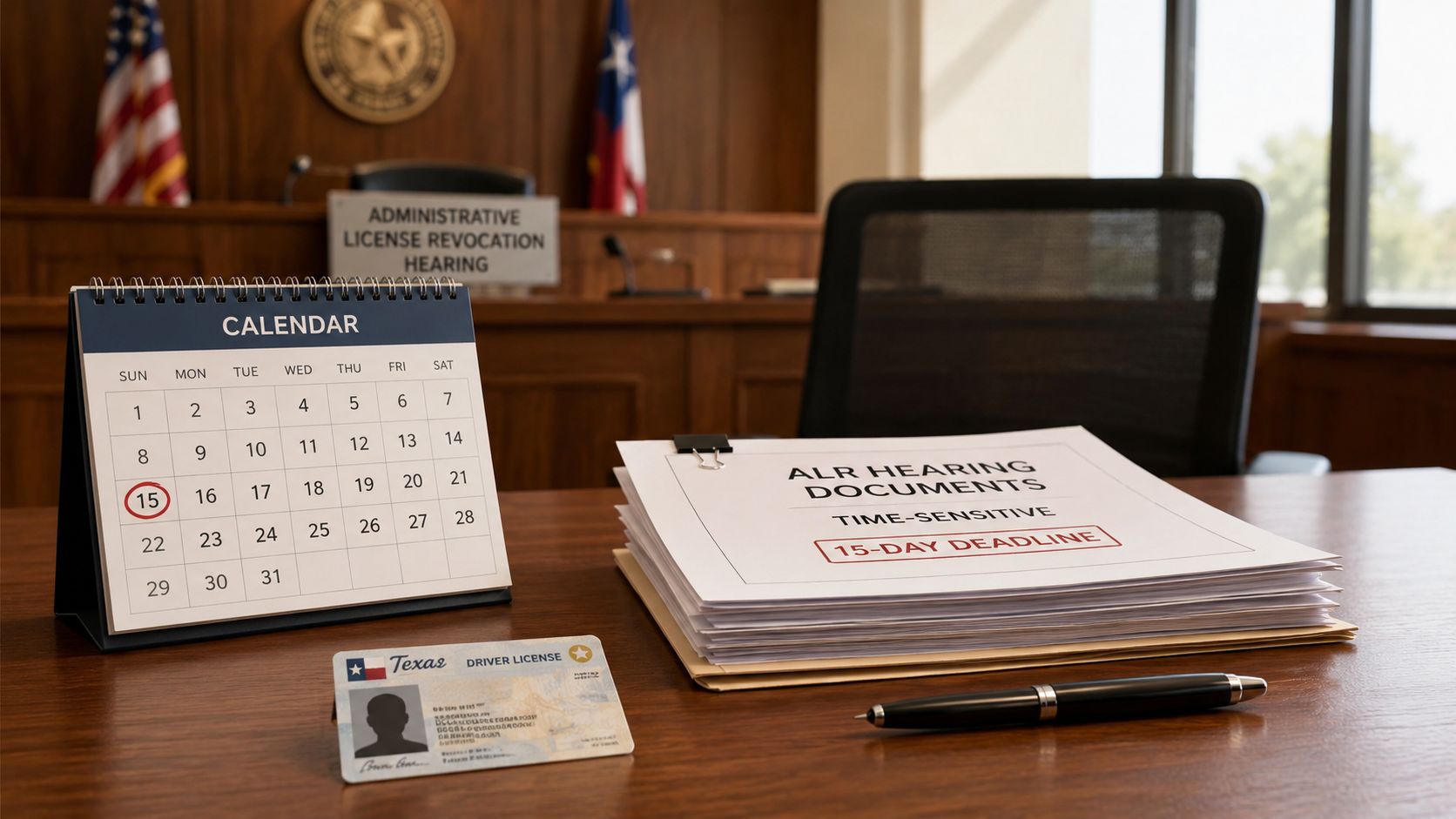
Don't wait for the criminal court date before acting on the license case. The license deadline comes first.
If you want to fight DWI Texas the right way, this is one of the first places your lawyer gets involved. The sooner the ALR hearing is requested, the more room you have to protect your driving privilege and prepare for the criminal side.
3. Criminal Complaint and Charging Decision
The prosecutor doesn't file a case in a vacuum. After the arrest, the state reviews the police report, test results, and any other evidence before deciding whether to file a formal DWI charge. In Texas, a DWI charge requires proof that you operated a motor vehicle in a public place while intoxicated, meaning your mental or physical faculties were impaired or your BAC was 0.08% or higher.
That charging decision can change the entire tone of the case. A first or second DWI is usually a misdemeanor. A third DWI, or a DWI with injury or death, can become a felony. The prosecutor may also look at prior convictions, a refusal to test, crash facts, and any aggravating circumstances before deciding how hard to push.
Early defense work is critical. If the evidence is weak, your attorney can challenge whether the state can prove the charge as filed. In some cases, that opens the door to negotiation before the case hardens into a court fight.
What you should do now
- Contact a lawyer immediately. Early contact gives your attorney room to speak with the prosecutor before the case escalates.
- Gather support material. Medical records, witness names, and character references can help frame your defense.
- Request discovery. Your lawyer needs the state's evidence before meaningful negotiation starts.
- Ask about alternatives. Deferred adjudication, diversion, or reduced charges may be possible in the right case.
- Understand the charge level. Misdemeanor and felony cases move differently and carry different consequences.
The strongest defense at this stage is not panic. It's organization. A Houston DWI lawyer can start pushing back as soon as the case is charged, especially if the facts suggest the state is overreaching or missing a key element.
Practical rule: The earlier your lawyer sees the evidence, the more options you usually have.
4. First Appearance and Bond Hearing
Your first court appearance is about release, rights, and immediate conditions, not a final resolution. One source states that within 48 hours of arrest, Texas law requires you to be brought before a magistrate judge, who informs you of the charge, reads Miranda rights, and sets or denies bail (DWI arraignment process in Texas). In many counties, the criminal case itself comes later, but this first checkpoint happens quickly.
The judge may release you on your own recognizance, set bail, or impose bond conditions. Those conditions can include no alcohol, random testing, work restrictions, or location limits. The point is control, not punishment. If the conditions are too harsh or unrealistic, your attorney can argue for something more manageable.
Your behavior at this hearing matters. Speak respectfully, dress neatly, and bring proof of employment, housing, and family ties. If your bail is high or the conditions threaten your ability to work, tell your attorney right away so they can challenge them.
A realistic bond strategy often looks like this:
- Show stability. Employment and residence records help the judge see you as reliable.
- Challenge unfair conditions. If the bond interferes with your job, your lawyer should ask for modifications.
- Respect every condition. A violation can create new problems and weaken your defense.
- Ask about alternatives. In some cases, ankle monitor or GPS options may be better than jail.
- Prepare for the next setting. The bond hearing is the first step, not the last.
If you're facing a DWI license suspension and bond conditions at the same time, you need a lawyer who can manage both tracks together. The court wants to know you'll appear. Your defense wants to preserve your ability to keep working and keep building the case.
5. Discovery and Evidence Review
Discovery is where the case starts to take shape. The prosecution must turn over the evidence it plans to use, including police reports, dashcam footage, body camera footage, test results, witness statements, and favorable evidence that helps the defense. Your attorney then goes line by line through the file looking for weak spots, missing records, or procedural mistakes.
That review is not just busywork. It's how a defense attorney finds the issues that can change the outcome. A bad stop, sloppy maintenance records, shaky testing procedures, or incomplete officer training can all create an advantage. If the state's proof is thin, your lawyer may be able to push for dismissal, exclusion of evidence, or a better plea result.
You can learn more about that process in what discovery means in a Texas DWI case.
What your lawyer should look for
- Calibration and maintenance records. A testing device that wasn't maintained properly can undermine the state's case.
- Officer training materials. Incomplete training can weaken the reliability of the investigation.
- Video timestamps and behavior. Dashcam and bodycam footage can tell a different story than the report.
- Chain of custody documents. Blood evidence must be tracked carefully.
- Exculpatory evidence. Anything that helps your defense has to be handled seriously.
One practical example stands out. If video shows you clearly asking for an attorney and refusing field sobriety tests, the state's case may depend more on the officer's interpretation than on hard evidence. That kind of file gives your defense room to work.

Don't treat discovery like paperwork you can skim. It's the backbone of the defense. A Texas DUI attorney uses this stage to find the state's mistakes before they become courtroom problems.
6. Pretrial Motions and Evidence Suppression Hearings
Pretrial motions give your lawyer a direct way to challenge the state's evidence before trial. The most important of these is often a suppression motion, which asks the judge to exclude evidence that was obtained unlawfully or handled improperly. That can include an illegal stop, a flawed arrest, improper questioning, or unreliable test results.
The law becomes technical, and that technical work matters. If the officer lacked reasonable suspicion for the stop, the court may exclude everything that followed. If your rights weren't respected during questioning, your statements may be suppressed. If a breath or blood test was handled incorrectly, the result may become unusable.
You can see how this kind of challenge works in how to file a motion to suppress evidence.
A strong defense attorney will push on each weak point:
- Stop legality. Was there a lawful reason to pull you over?
- Arrest basis. Did the facts really support probable cause?
- Testing procedures. Were the breath or blood protocols followed correctly?
- Search issues. Was any vehicle search lawful?
- Statement issues. Were your rights read before questioning?
Practical rule: If the stop was bad, everything that came after it may be bad too.
Pretrial hearings can change the entire direction of the case. If the judge suppresses a key test result, the prosecution may have to rethink whether it can still prove intoxication beyond a reasonable doubt. That's why experienced trial lawyers spend so much time here. They know that winning before trial can be the difference between a conviction and a dismissal or a much better offer.
If you're trying to fight DWI Texas, this stage is where the fight becomes concrete. It's not about general fear. It's about whether the state can legally use the evidence it gathered.
7. Plea Bargain Negotiations and Case Resolution
Not every DWI case goes to trial. Many are resolved through negotiation, and your lawyer should treat those talks as a real part of the defense, not as a fallback plan. A plea bargain can reduce the charge, limit penalties, or create a different outcome than the state first pushed for.
Common resolutions can include a lesser offense, deferred adjudication, or a diversion-style result, depending on the county and the facts. In some cases, a defendant may plead to a lesser driving offense instead of a full DWI conviction. The right agreement depends on the evidence, your record, and your long-term goals.
People need clear advice, not pressure. A plea can make sense, but only if your lawyer has already tested the state's case and measured the trial risks. If the prosecution's file is weak, that gives your attorney an advantage. If the case is strong, negotiation may be the smarter move.
What to ask before you agree
- What happens if we go to trial and win?
- What happens if we go to trial and lose?
- Will this resolve the license issue too?
- Does this create a conviction or a deferred outcome?
- What happens to my record later?
A plea deal still has consequences, and you should understand them clearly before you accept anything. That's especially true if you're trying to protect a professional license, keep your driving record clean, or avoid a repeat-offense label later.
A first-time offender may benefit from a dismissal-oriented program in the right county. A repeat defendant may need a more aggressive negotiation strategy. Either way, your attorney should use the state's weak points to push for the best result available.
8. Trial Preparation, Jury Trial, and Verdict
If the case doesn't resolve, trial becomes the final battleground. Your attorney prepares witnesses, reviews exhibits, and builds the defense story around the facts the jury will hear. That work includes jury selection, pretrial conferences, and final motions before the courtroom presentation begins.
At trial, the state must prove its case beyond a reasonable doubt. The defense can challenge the officer's version, cross-examine witnesses, and present expert testimony when the science or procedure is questionable. If you testify, your lawyer will prepare you carefully so you know how to answer clearly and stay calm under pressure.
The outcome can be a guilty verdict, a not guilty verdict, or a hung jury that leads to a mistrial. A hung jury doesn't mean the defense failed. It means the state didn't convince everyone, and that matters.
A solid trial strategy often turns on simple things the jury understands. Did the officer stay consistent? Did the testing make sense? Did the state really prove intoxication, or did it assume guilt from a shaky stop and a messy report? Your attorney's job is to show the difference clearly.
If you're facing a first DWI in Texas, trial preparation can feel intimidating. It doesn't have to. With the right lawyer, you'll know what the jury will see, what the state must prove, and how your defense can create reasonable doubt.
8-Step Texas DWI Court Timeline Comparison
| Stage | 🔄 Complexity | ⚡ Speed / Efficiency | Resource Requirements | 📊 Expected Outcomes | ⭐ Key Advantages / 💡 Ideal Use Cases |
|---|---|---|---|---|---|
| Arrest and Booking | Moderate, routine procedures with legal nuance | Immediate (occurs at stop/arrest) | Minimal police resources; prompt attorney contact advised | Arrest record, samples collected, booking documentation | Critical to assert rights early; spot procedural errors and preserve challenges |
| Administrative License Revocation (ALR) Hearing Request | Moderate, strict administrative rules and deadlines | Fast, 15-day deadline to act | Moderate, attorney, hearing prep, test records, possible experts | Potential to prevent license suspension; administrative ruling on tests/refusal | Best to preserve driving privileges and obtain discovery useful for criminal defense |
| Criminal Complaint and Charging Decision | Moderate–High, prosecutor discretion and legal review | Short-term (days–weeks after arrest) | Moderate, prosecutor review, defense counsel involvement, records collection | Charges filed or declined; misdemeanor vs. felony classification; case severity set | Opportunity for early plea negotiation, charge reduction, or dismissal motion |
| First Appearance and Bond Hearing | Low–Moderate, procedural with judicial discretion | Very fast, within 72 hours of arrest | Low, court appearance, attorney advocacy, evidence of ties | Release status, bail amount, and bond conditions determined | Early chance for release and reasonable conditions; demonstrate low flight risk |
| Discovery and Evidence Review | High, technical, voluminous evidence analysis | Ongoing (pretrial phase) | High, attorney time, video review, expert consultants, document requests | Identify weaknesses, testing errors, evidence to challenge or use at trial | Essential for technical challenges to tests; shapes plea or trial strategy |
| Pretrial Motions & Evidence Suppression Hearings | High, complex legal and evidentiary issues | Variable (depends on motion calendar) | High, legal research, hearings, expert testimony | Possible exclusion of evidence; may lead to dismissal or stronger plea leverage | Most effective stage to remove unlawful or unreliable evidence before trial |
| Plea Bargain Negotiations & Case Resolution | Moderate, strategic negotiation and trade-offs | Variable, can be quick or protracted | Moderate, negotiation time, possible program requirements, attorney | Reduced charges, deferred adjudication, or conviction with lesser penalties | Reduces risk and cost vs. trial; useful for resolving case promptly with mitigated consequences |
| Trial Preparation, Jury Trial & Verdict | Very High, comprehensive litigation and strategy | Long, weeks to months for prep and trial | Very High, extensive attorney time, experts, trial exhibits, jury work | Final adjudication: acquittal, conviction, or hung jury; significant consequences | Full opportunity to contest prosecution; potential complete vindication if successful |
Take the First Step to Defend Your Future
The Texas DWI court process timeline can feel long when you're living through it, but it becomes manageable when you know what happens at each stage. The most important thing to understand is that you do not have to wait for the system to slow down before you act. The license deadline starts fast, the criminal case follows its own pace, and the defense work begins immediately.
Every stage gives you a chance to protect yourself. The arrest record can be challenged. The ALR hearing can preserve your driving privilege. Discovery can expose weak evidence. Pretrial motions can keep unlawfully obtained proof out of court. Plea negotiations can reduce the damage. Trial can still be the right answer when the state's case is thin.
If you're dealing with a DWI arrest in Texas, don't try to sort this out alone. A Houston DWI lawyer can explain your options, track the deadlines, and build a defense that fits your facts and your goals. The right lawyer will treat your case like a legal problem that can be managed, not like a personal failure that defines you.
The Law Office of Bryan Fagan, PLLC works with Texans facing DWI and DUI charges at every stage of the process, from the first arrest through ALR hearings, negotiation, and trial. If you need help understanding your next move, contact the firm now for a free consultation and get clear guidance on how to protect your license, your record, and your future.
If you're ready to act, visit Law Office of Bryan Fagan, PLLC to request a free consultation and get help with your Texas DWI court process timeline. The firm can review your arrest, explain the ALR deadline, and help you build a defense strategy that fits your case.