
A DWI arrest can be overwhelming, but you don't have to face it alone. If you were just booked, got a stack of papers you barely understood, and now you're staring at a deadline you can't afford to miss, the smartest move is a Texas DWI attorney consultation right away. That first meeting is not a sales call. It's a triage session with two clocks running at once, the 15-day ALR deadline and the criminal case timeline.
The reason that matters is simple. In Texas, a first DWI conviction can bring $2,000 to $10,000 in fine exposure alone, and the Department of Public Safety can seek an Administrative License Revocation after the arrest, before the criminal case is finished (McConathy Law). A second DWI can move up to a Class A misdemeanor with fines up to $4,000 and jail time up to one year, and a third offense becomes a felony with prison exposure of 2 to 10 years and fines up to $10,000 (McConathy Law). That is why the first consultation has to focus on action, not anxiety.
Why a Texas DWI Attorney Consultation Is the First Move That Matters
One stop at night, one set of flashing lights, and one ride to jail can put your driver's license, job, and record at risk. If you are a CDL holder, a first-time offender, a licensed professional, or an out-of-state driver, the consultation has to sort out two clocks right away, the 15-day ALR deadline and the criminal case timeline. A good lawyer treats that first meeting as triage, because the facts you bring in the door can shape the defense from the start.
The first hour decides what can still be challenged
Texas gives you a short window to fight the automatic license process. A driver has 15 days from arrest to request an ALR hearing, and the criminal case runs separately from that civil license fight (Texas DWI Site). If you wait, the suspension issue can move ahead while you are still trying to make sense of the charge. That is why the consultation has to start with the arrest date, the notice you received, and the deadline on the calendar.
Practical rule: bring the arrest date, the notice, and every paper the officer handed you. Those three things tell your lawyer whether the license fight is still alive.
The consultation also gives your lawyer a chance to evaluate the case while the evidence is still fresh. The lawyer should look at the stop, the detention, the field sobriety tests, and the chemical-test record before memories fade and records get harder to track down. The point is not to talk vaguely about “a DWI.” The point is to figure out whether the stop was lawful, whether the testing was reliable, and whether the license suspension can be challenged fast enough to matter.
A first-time client often walks in thinking the arrest already decided everything. It hasn't. A strong consultation is where the defense starts, and it starts with the timeline. If you want a plain-language roadmap for the criminal side, The Texas DWI Court Process From Arrest to Resolution lays out what happens at each stage of a Texas DWI criminal case, and this post-arrest checklist for Texas DWI cases shows the documents and details worth gathering before that first meeting.
What to Bring and Gather Before Your Consultation
Bring the paperwork first, then bring your memory. Texas DWI defense moves faster when your lawyer has the official documents in front of them instead of a vague retelling from the parking lot or the jail release desk. The cleaner your packet, the faster your attorney can decide whether to file the ALR request, demand records, and start attacking weak points in the stop or the test.

Official documents to gather first
The most useful items are the ones that show what the state already did. That includes the DIC-24 statutory warning, the DIC-25 temporary license, any citation or offense report number, and any court paperwork you were given. If you have arrest paperwork from the jail, bring that too. If you were told about the DWI process in writing, save that packet and don't rely on memory alone.
You should also collect anything tied to the evidence trail, including breath or blood test paperwork, tow records, and any notice about dashcam or bodycam requests. If you were arrested in a county where records move through different offices, that paper trail matters even more because it helps your lawyer ask for the right file the first time. For a practical organizing tool, the page at Texas DUI post-arrest checklist for Texas drivers is a useful companion for sorting your documents before the meeting.
Bring a one-page timeline with the stop, the arrest, the test, and the release. Lawyers can work with messy facts, but they work faster when the sequence is clear.
Personal details that change the strategy
Write down what you remember while it's still fresh. Keep it short and specific. Note where you were driving, why the officer said he stopped you, what you said, what the officer said, whether you took field sobriety tests, and whether you blew, gave blood, or refused. If you remember medical conditions, fatigue, injuries, contact lens issues, or balance problems, write those down too because they can matter later.
CDL holders should bring their commercial paperwork, including medical certificate details and any employer-notification timeline. Out-of-state drivers should bring proof of residency and any state licensing details so the lawyer can think through how Texas procedures interact with home-state consequences. If you're trying to understand the broader court path after arrest, The Texas DWI Court Process From Arrest to Resolution gives a factual overview of the case stages without the guesswork.
What to leave out
Don't show up trying to perform confidence. Show up with facts. Don't edit out bad details either, because your lawyer needs the full story to spot the weak link in the state's case.
What Your Texas DWI Attorney Will Evaluate
A first consultation is a triage meeting. Your lawyer is sorting two clocks at once, the 15-day ALR deadline and the criminal case timeline, while checking whether the facts give you room to fight. The goal is simple. Find the weak points early and decide where to press.
The stop and detention
Start with the reason the officer says he pulled you over. A clean traffic violation is a different story from a vague hunch or a thin report. If the stop may have lacked reasonable suspicion or probable cause, every later step deserves scrutiny because evidence gathered after an unlawful stop can be attacked.
The testing record
Field sobriety tests are not scientific theater. They are officer-run tasks, and the lawyer will check whether they were given correctly, whether a medical issue or balance problem affected performance, and whether the surroundings made the results less reliable. Breath testing and blood testing get the same hard look, but the problems are different. Breath cases often turn on maintenance, calibration, and observation. Blood cases often turn on collection, storage, and chain of custody, which is why a close review of what evidence prosecutors use in Texas DWI cases matters early.
The charge itself
The lawyer also wants your prior record, your driving history, and anything that changes how the charge will be handled. A first DWI in Texas does not carry the same exposure as a repeat case, and a third offense can become a felony with prison exposure and a much heavier fine range. That is not a detail to save for later. Your attorney needs the full picture now so the defense plan fits the charge you are really facing.
Your job is to bring the facts that change the strategy. CDL holders should flag commercial paperwork, medical certificate details, and any employer-notification deadlines. Licensed professionals need to raise any licensing board issues right away. Out-of-state drivers should bring proof of residency and home-state license details so the lawyer can map Texas consequences against what happens back home. First-time offenders should focus on the stop, the tests, and whether the state proof is thin enough to challenge.
The Questions You Should Ask During the Consultation
Don't sit there and let the lawyer do all the talking. A consultation is only useful if you force clear answers. You need to know how the firm will handle the ALR hearing, how they view your evidence, and whether their plan fits your job and your risk level.
Ask about the license fight first
- Will you file the ALR hearing request today? You need a direct yes or no, because the 15-day deadline is not flexible (Texas DWI Site).
- What happens if we miss that deadline? A lawyer who dodges the answer is telling you something important.
- Who handles the ALR hearing, and how do you prepare for it? The administrative case is separate from the criminal case, so you want a lawyer who can explain both.
Ask about the evidence
- How do you evaluate the stop?
- Have you handled breath-test or blood-test challenges in my county?
- What records will you request first?
- How do you look for problems in the sobriety tests, calibration records, or chain of custody?
Those questions force the lawyer to talk about process, not slogans. If all you hear is “we fight hard,” keep asking until the answers turn concrete.
Ask about your situation
CDL holders need to ask how a DWI charge can affect work and licensing. Licensed professionals should ask about collateral consequences that touch credential boards. Repeat offenders need a frank answer about exposure, not a soft sales pitch. Out-of-state drivers should ask how a Texas case interacts with home-state licensing and whether they need to appear in person for every step.
Ask about communication and fees
If a lawyer can't explain who will call you back and when, the representation will feel chaotic later.
Ask who your day-to-day contact will be, how updates are delivered, and what the fee covers. One useful question is whether the firm's approach fits your case stage, since the Texas DWI defense consultation cost guide helps frame the financial questions you should ask before you sign anything. A consultation should leave you with a plan, not a sales fog.
Understanding Free Consultations and Attorney Fees
A free consultation should mean the first meeting costs you nothing and gives you a real case assessment. It should cover intake, the ALR strategy, and the first look at the stop and testing issues. It should not mean the lawyer has agreed to full representation, court appearances, or trial work without a separate fee arrangement.
What the pricing conversation should sound like
Some firms use flat fees for a first DWI, some tier the fee by charge level, and some bill hourly for more complex felony cases. Don't get distracted by the label. Focus on what's included, what costs extra, and when the money is due. Ask about expert witnesses, investigators, record retrieval, and any filing-related expenses before you commit.
| Charge Level | Typical Fee Model | What's Usually Included |
|---|---|---|
| First DWI | Flat fee | Initial case review, negotiation, routine court work |
| Repeat or enhanced case | Tiered flat fee | More filings, more hearings, more review of evidence |
| Felony DWI | Hourly or advanced flat fee | Heavier investigation, motion practice, trial preparation |
That table is a practical comparison tool, not a promise of any specific number. The key is transparency. If the fee proposal is vague, assume the missing pieces will show up later.
What “free” does and doesn't mean
A free meeting is supposed to give you enough information to make a smart decision. It is not supposed to pressure you into an immediate plea or rush you past the evidence review. If the attorney won't talk about the ALR deadline, the criminal case track, and what extra costs could arise, you're not getting a full consultation.
A Texas firm that handles DWI matters, including Law Office of Bryan Fagan, PLLC, should be able to explain the process plainly and tell you what work is needed next. That's the standard you should demand from any lawyer you hire.
Your Next 48 Hours After the Consultation
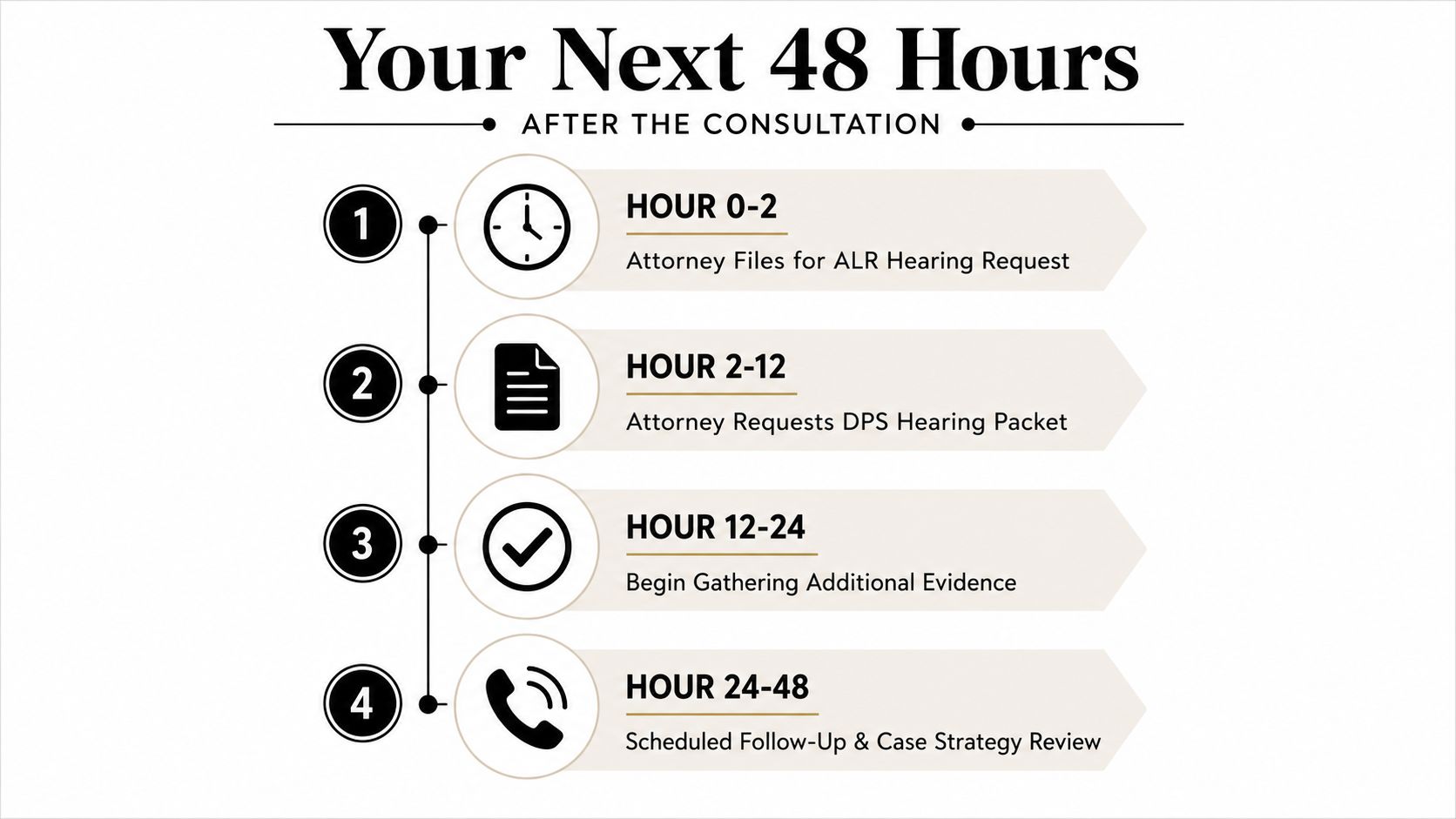
The first two days after the meeting matter because that is when the defense starts turning into action. Your lawyer should file or prepare the ALR hearing request, request the DPS packet, and start preserving records before they disappear. That early work protects both the license case and the criminal case.
What happens right away
Within the first day, your lawyer should be focused on license protection and evidence preservation. That means the ALR request, the hearing packet, and the steps needed to keep the state from controlling the story with only its own paperwork. If your case involves a refusal or a blood draw, your lawyer should already be thinking about how to lock down the records that explain what happened.
What you should do
Don't post about the arrest. Don't miss court dates. Don't assume the case is “just beginning” and therefore can wait. If your lawyer asks for texts, photos, medical records, or employment documents, send them fast. CDL holders should flag any work-related deadline immediately. Licensed professionals should think about credential reporting before they panic. Out-of-state drivers should tell counsel exactly where they live and whether they can return to Texas easily.
Straight answer: the best evidence is often the evidence preserved in the first 48 hours. After that, some of it gets harder to recover.
The courtroom process is separate from the license fight, so keep both tracks in mind. If you need to understand the later stages after the consultation, the internal roadmap at The Texas DWI Court Process From Arrest to Resolution is the right next stop.
Take the Next Step With a Free Case Evaluation
A good consultation should answer three questions fast, whether to challenge the stop, whether to file the ALR hearing, and whether to negotiate or fight. Those decisions are time-sensitive, and delay helps the state more than it helps you. If you're dealing with a first DWI in Texas, a CDL issue, or a repeat charge, you need a lawyer who can triage the case today and not next week.
The right Houston DWI lawyer or Texas DUI attorney will give you a direct plan, explain the DWI license suspension risk, and help you decide how to fight DWI Texas charges with purpose. Free consultations and 24/7 support should make that first step easier, not harder. You don't need perfect facts to start. You need fast action and a lawyer who knows what to do with them.
The Law Office of Bryan Fagan, PLLC handles Texas DWI consultations with a focus on the ALR deadline, the criminal case, and the evidence that can change both. If you need a clear next step today, visit Law Office of Bryan Fagan, PLLC to request a free consultation and get your case reviewed by a Texas defense team that understands how quickly these deadlines move.