
A DWI arrest can be overwhelming—but you don’t have to face it alone. One minute, your life is normal. The next, you’re caught in a legal nightmare, facing a system that can feel designed to assume the worst. The shock and fear are completely understandable, but right now, you have to remember one thing: an accusation is not a conviction.
You have rights. A powerful defense is not just a possibility—it’s the only way forward. With an experienced Houston DWI lawyer on your side, you can protect your rights, challenge the evidence, and fight to clear your name.
The Disorienting Reality of a False Accusation

When you're wrongfully accused of a DWI in Texas, your mind floods with questions about your job, your family, your driver's license, and your future. It's a helpless feeling, and it’s a perfectly normal reaction. The most important thing you can do is shift from panic to action. This accusation is the start of a legal battle, not the end of your story.
You aren't alone in this, and there is a clear, strategic path to reclaiming your name. To help you focus on what matters most in these critical first moments, here's a quick reference guide.
Your Immediate Dos and Don'ts After a DWI Arrest
| What You Must Do (DO) | What You Must Avoid (DON'T) |
|---|---|
| Remain silent. Politely state you wish to speak with an attorney. | Do not try to explain your side of the story to the police. |
| Contact a DWI defense lawyer immediately. | Do not post about the incident on social media. |
| Write down every detail you can remember about the stop. | Do not speak with investigators or the accuser without your lawyer. |
| Request your ALR hearing within 15 days to save your license. | Do not assume the breath or blood test results are accurate. |
This table isn't just a list—it's your first line of defense. Following these steps can prevent you from making a difficult situation even worse while your attorney gets to work building a strong defense strategy to fight your first DWI in Texas.
How Do False DWI Accusations Happen?
To build a strong defense, you first need to understand how an innocent person gets charged. A Texas DWI charge can be triggered by:
- Flawed Field Sobriety Tests: These roadside exercises are notoriously subjective. We’ve seen sober clients fail them due to exhaustion, anxiety, a medical condition, or just the pressure of the moment.
- Faulty Breathalyzer Readings: Breathalyzers require strict calibration and proper handling. Operator error or machine malfunction can easily create a false positive. Your Blood Alcohol Content (BAC) reading may not be accurate.
- Misinterpreted Behavior: An officer might mistake your natural nervousness, confusion, or even a medical issue for signs of intoxication.
The harsh truth is that being wrongfully accused isn't as rare as people think. It’s a known flaw in our justice system. According to the National Registry of Exonerations, over 3,175 people in the U.S. have been exonerated since 1989 after collectively losing more than 27,000 years of their lives. You can discover more details about wrongful convictions on usclaims.com.
You Have a Fundamental Right to Challenge the State
No matter what the police report says, you have an absolute right to fight the allegations against you. The burden of proof lies entirely with the prosecution—they must prove every element of the crime "beyond a reasonable doubt."
A skilled Houston DWI lawyer knows better than to take the state’s evidence at face value. We dig into every detail, from the reason for the initial traffic stop to the chain of custody for a blood sample. This is not a fight to take on by yourself. The legal system is a maze, and going it alone often leads to critical, irreversible mistakes. Your focus right now should be on finding a strategic partner—an attorney who can channel your fear and frustration into a powerful, methodical defense. We know what you're up against, and we're here to help you get your future back.
How to Protect Your Rights During a DWI Stop

The moment flashing lights fill your rearview mirror, your case has begun. Everything you say and do from this point forward matters immensely. A seemingly routine traffic stop can turn into a life-altering arrest in minutes, and knowing how to handle it is the first line of defense—especially when you’ve done nothing wrong.
This isn’t about being difficult or uncooperative. It's about being smart and protecting your rights.
Police are trained to ask questions, and the pressure to “just explain what happened” can feel overwhelming. Your first instinct might be to tell your side of the story, hoping your honesty will clear things up. This is the single most damaging mistake you can make.
The Best Legal Advice Is Two Words: Stay Silent
You have a constitutional right to remain silent, and you absolutely should use it. This right is guaranteed by the Fifth Amendment and is the core of the Miranda Rights you've heard on TV. If you are in custody, police must inform you of these rights before they question you.
- You have the right to remain silent.
- Anything you say can and will be used against you in a court of law.
- You have the right to an attorney.
- If you cannot afford an attorney, one will be appointed for you.
But here’s the crucial part: you don't have to wait to be in custody to use this right. Innocent explanations get twisted. Saying, "I only had two beers a couple of hours ago," isn't a statement of innocence to a prosecutor. It’s a confession that you consumed alcohol before driving, and they will use it to build their case.
How to Use Your Rights Without Being Confrontational
Let’s be clear: exercising your rights is not an admission of guilt. It's a sign that you understand how serious this is and are taking the correct steps to protect yourself.
You don't need to be rude or aggressive. A calm, polite, and firm statement is all it takes. When an officer starts asking where you've been, what you've been doing, or if you've been drinking, this is what you say:
"Officer, with all due respect, I am going to remain silent. I want to speak with my lawyer."
That’s it. You don't need to debate or explain yourself. Just repeat that phrase if you have to. Staying silent is the most powerful tool you have to prevent a wrongful conviction.
Why Your Silence Is So Important
Police need probable cause to arrest you. This is a legal bar they have to meet, showing they have a reasonable belief you committed a crime based on facts. They get those facts from your statements, their observations (like smelling alcohol), and how you do on field sobriety tests.
By staying silent and refusing to perform field sobriety tests, you deny them the very evidence they need to build a case. You can learn more about this standard in our guide on what is the definition of probable cause.
Remember, the police report is a one-sided story—the officer's. What you see as nervous fidgeting, they might write down as a "clear indicator of intoxication." What you intended as a helpful clarification can be documented as a confession.
A Houston DWI lawyer knows these tactics. Our job is to get involved immediately to protect you, take over all communication with law enforcement, and start building a defense that picks apart the state's evidence—or highlights the complete lack of it. An arrest is terrifying, but you don't have to go through it alone.
Challenging the Evidence Against You: How to Fight a DWI in Texas
When you’re facing a wrongful DWI accusation, it’s easy to feel like the deck is stacked against you. The state presents its "evidence," and it can seem like an immovable mountain. But here's the truth: that mountain is often just a pile of flawed, misinterpreted, or downright incorrect assumptions.
A real defense isn't just about saying "I'm innocent." It's about taking a sledgehammer to the prosecution's case, brick by brick. At The Law Office of Bryan Fagan, PLLC, we never take evidence at face value. This is where an experienced Texas DUI attorney can completely change the game.
Uncovering Errors in Field Sobriety and Chemical Tests
In most Texas DWI cases, the core of the state's case rests on tests done on the side of the road or back at the station. But these tests are far from perfect. In fact, they’re often the weakest link in the entire chain.
A good attorney knows exactly what to hunt for:
- Field Sobriety Test (FST) Flaws: The "walk-and-turn," "one-leg stand," and HGN (eye) tests have to be administered under specific conditions. Was the ground flat and well-lit? Were instructions given correctly? Did the officer consider your age, weight, or a medical condition? Any deviation can make the results completely unreliable.
- Breathalyzer Inaccuracies: A breath test machine is a piece of equipment that needs constant maintenance and calibration. We immediately pull the records for the specific machine used in your arrest. If the department failed to keep up with required checks, that breath reading may not be admissible in court. Even the officer failing to conduct the required 15-minute observation period can invalidate the result. This is a key strategy when you need to fight a breath test result.
- Blood Test Contamination: Blood tests are vulnerable to human error. We scrutinize the entire chain of custody. Was the person who drew your blood qualified? Was the vial sealed, stored, and transported properly? Any break in that chain could mean the sample was contaminated, and the result is worthless.
Scrutinizing the Police Report for Inconsistencies
Think of the police report as the officer's version of events—it's their story, not the whole story. Our job is to compare that written narrative, line by line, against the objective truth captured on dashcam and bodycam video.
It’s amazing how often the two don’t match. An officer might write that you had "slurred speech," but the video shows you speaking clearly. When we play that video in court, it doesn't just challenge the evidence; it destroys the officer's credibility.
An experienced lawyer knows how to turn these procedural mistakes and inconsistencies into a powerful legal strategy. We use a motion to suppress to argue that illegally or unreliably obtained evidence should be thrown out before a jury ever sees it. You can learn more about how to file a Motion to Suppress evidence in Texas.
Exposing Official Misconduct and Bad Faith
Sometimes, a wrongful accusation isn't just a mistake—it's the result of official misconduct. This is a tough reality, but it happens. An officer might hide evidence that points to your innocence or use illegal tactics to bully you into a confession.
This problem is far more common than people think. The National Registry of Exonerations' 2023 report found that official misconduct was a factor in an incredible 77.1% of all exonerations that year. You can read the full 2023 exonerations report to see the data for yourself.
When we suspect an officer crossed a line, we go on the attack. We file motions to get their disciplinary records. Uncovering this kind of bad faith doesn't just weaken a piece of evidence; it can poison the prosecution's entire case and often leads to a full dismissal.
Navigating the Texas Legal Maze After a DWI Arrest
Getting arrested for something you didn't do is a bewildering experience. It feels like you’ve been thrown into a legal maze with no map. What most people don’t realize is that in Texas, a DWI accusation kicks off two separate legal battles at the same time.
One fight is for your driver's license, and the other is for your freedom. Each has its own clock, its own rules, and its own disastrous consequences if you ignore them. You shouldn't walk this path alone; this is exactly where a strategic lawyer becomes your guide.
The 15-Day Rule for Your Driver's License
The first, and most urgent, issue is the fight for your driver's license. This isn't part of the criminal case. It's a civil process called an Administrative License Revocation (ALR) hearing, and it's handled by the Texas Department of Public Safety (DPS).
From the moment of a DWI arrest, a timer starts. You have just 15 days to formally request this hearing. If you miss that deadline, your license gets suspended automatically. No exceptions. This is known as an administrative license suspension.
The ALR hearing is your only shot to stop the DWI license suspension. More importantly, it's a golden opportunity for your attorney. We get to put the arresting officer on the stand, under oath, and pick apart their reasons for the traffic stop and arrest. The testimony we uncover here often gives us a sneak peek into the prosecutor's criminal case, which can be a massive strategic advantage.
The Criminal Court Process for a DWI in Texas
While the license battle is raging, your criminal case moves along a parallel track. This is the fight that carries heavy penalties—steep fines, potential jail time, and the stain of a permanent criminal record. Here is a step-by-step guide of what to expect:
Bond and Arraignment: After the arrest, a bond is set so you can get out of jail. Your first official court date is the arraignment, where the state reads the formal charges and you enter a plea of "not guilty."
Pre-Trial Phase: This is where the real work of your defense happens. We file motions to challenge the state's evidence, negotiate with the prosecutor, and dig into every piece of discovery—police reports, videos, and witness statements. This is our chance to push for a plea to a lesser charge or get the case dismissed entirely.
Trial or Resolution: If the case can't be resolved, it heads to trial. You have a constitutional right to have a jury of your peers decide your fate. In some situations, options like deferred adjudication might be on the table, a type of probation that can keep a conviction off your permanent record.
This is the basic blueprint your lawyer will use to dismantle the state's evidence during the critical pre-trial phase.
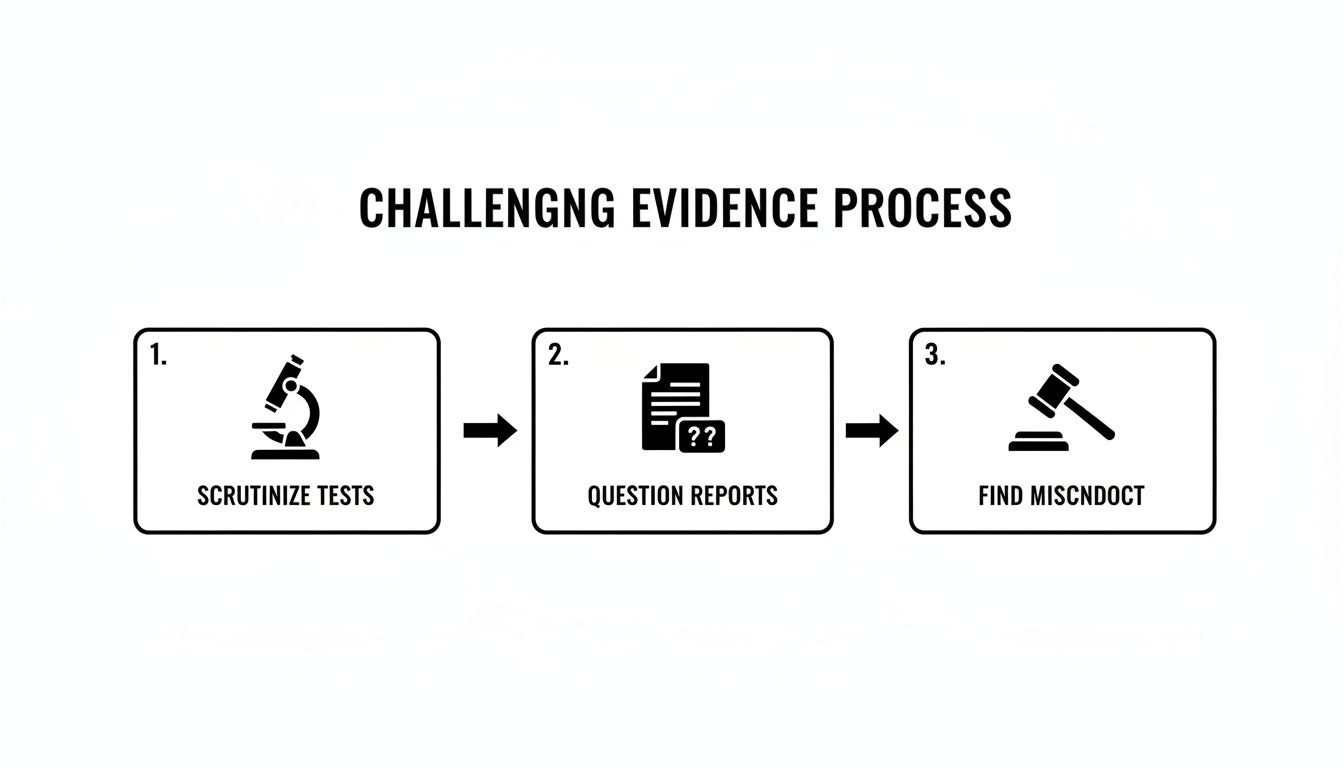
As you can see, a powerful defense isn't just about showing up to court. It's a methodical process of investigation, scrutiny, and aggressive legal challenges designed to poke holes in the prosecution’s story.
Texas DWI Penalties Explained
Understanding the stakes is critical. Texas DWI penalties are severe, even for a first-time offense.
- First DWI in Texas (Class B Misdemeanor): Up to 180 days in jail, a fine up to $2,000, and a driver's license suspension of up to one year.
- Second DWI (Class A Misdemeanor): Up to one year in jail, a fine up to $4,000, and a license suspension of up to two years.
- Third DWI or More (Third-Degree Felony): 2 to 10 years in state prison, a fine up to $10,000, and a license suspension of up to two years.
These penalties can increase if there are aggravating factors, such as having a child in the car or a BAC of .15 or higher.
Juggling both the administrative and criminal systems requires a clear-headed strategy from day one. An experienced Houston DWI lawyer knows how these two tracks run and how to use one to influence the other. Our job is to manage both fights at the same time to protect your rights, your license, and your future. The process is tough, but with the right guide, it’s not unbeatable.
How to Clear Your Name and Reclaim Your Future

Getting a "not guilty" verdict or having your case dismissed is a massive victory. But the shadow of the accusation can hang around long after the legal battle is won. That arrest record can follow you, creating roadblocks for jobs, housing, and your own peace of mind.
The fight isn't over. Texas law gives you powerful tools to truly clear your name. Winning your case was the most important battle; now it's time to erase any evidence that the fight ever happened.
Wiping the Slate Clean in Texas
Even with a dismissal, the record of your arrest remains public. This means a potential employer, landlord, or licensing board can still see you were arrested for a DWI, often without ever seeing the final, favorable outcome.
To fix this, Texas law provides two primary paths: an expunction and an order of nondisclosure. They both aim to protect your privacy, but they work in completely different ways.
An arrest record, even from a dismissed case, can feel like a life sentence. It’s a mark that can unfairly torpedo your ability to get a job, secure a professional license, or even rent an apartment. We firmly believe you shouldn't have to pay for a crime you didn't commit, which is why we aggressively pursue these post-case remedies for our clients.
Understanding Expunctions: Your Right to Erase the Record
An expunction, sometimes called expungement, is the gold standard for clearing your name. When a judge grants an expunction, it's as if the arrest never happened. All records tied to the incident—from the initial arrest report to court files—are ordered to be legally destroyed. Once an expunction is complete, you can legally deny you were ever arrested.
You are generally eligible for an expunction in Texas if your case ended in one of these outcomes:
- You were found not guilty at trial.
- Your case was dismissed by the prosecutor.
- You were arrested but never formally charged.
- You successfully completed a pre-trial diversion program.
An expunction gives you a true clean slate. To learn more, read our guide on how to expunge a record in Texas.
Orders of Nondisclosure: Sealing the Record from Public View
But what if you successfully completed deferred adjudication for a DWI? While you weren't convicted, you won't qualify for an expunction. This is where an order of nondisclosure becomes essential.
Instead of destroying your records, this court order seals them from public view. This means private entities like background check companies and most potential employers won't see the arrest. It's an incredibly effective way to keep a past mistake from defining your future.
Expunction vs. Nondisclosure in Texas: A Quick Comparison
To make sense of these two options, it helps to see them side-by-side. Both are valuable, but they serve different purposes based on how your case was resolved.
| Feature | Expunction (Record Destruction) | Order of Nondisclosure (Record Sealing) |
|---|---|---|
| What It Does | Permanently destroys all records of the arrest and case. | Seals records from public view but allows law enforcement access. |
| Legal Status | You can legally deny the arrest ever occurred. | You cannot deny the arrest occurred if asked under oath. |
| Typical Eligibility | Case dismissed, found not guilty, or never charged. | Successfully completed deferred adjudication probation. |
| Best For | Individuals who were truly wrongfully accused and fully exonerated. | Individuals who resolved their case without a final conviction but don't qualify for expunction. |
Understanding which path you qualify for is the first step toward putting this chapter behind you for good. The Texas DUI attorney who successfully handled your criminal case is perfectly positioned to guide you through this final, critical step. A wrongful accusation can shake your faith in the justice system. Winning your case and clearing your name is how you restore it.
Your Questions Answered by a Houston DWI Lawyer
When you’re facing a DWI charge you know is wrong, your mind is flooded with urgent questions. Here are answers to some of the most common concerns we hear from Texans just like you.
I'm innocent. Should I just take the plea deal to make this go away?
This is a tempting but dangerous path. A plea bargain for a crime you didn't commit still leaves you with a permanent criminal record that follows you forever. Before you even consider it, an experienced DWI attorney will scrutinize the state's case. Is their evidence flimsy? Were your rights violated? A decision to plead should be a strategic one, made with full knowledge of your chances at trial, not a choice made out of fear.
Can I really beat a DWI charge in Texas?
Yes. Beating a DWI charge is absolutely possible, but it requires a strategic, aggressive defense. We don't have to prove your innocence—the State of Texas has to prove your guilt beyond a reasonable doubt. That is an incredibly high bar, and it’s our job to make sure they can't. A strong defense is about systematically dismantling the prosecution's case by:
- Challenging the legality of the traffic stop.
- Exposing mistakes in field sobriety test administration.
- Discrediting breath or blood test results.
- Highlighting the simple lack of credible proof.
We don't have to prove what didn't happen. We just have to show a jury that the state can't prove what they claim did.
What is "implied consent" and did I have to take the breath test?
Texas is an "implied consent" state. This means that by getting a driver's license, you have already consented to provide a breath or blood sample if you are lawfully arrested for DWI. However, you can still refuse. Refusing the test will trigger an automatic administrative license suspension, but it also denies the police crucial evidence. Your attorney can help you fight the DWI license suspension at an ALR hearing.
If you are staring down a wrongful DWI accusation, you are not in this fight by yourself. The attorneys at The Law Office of Bryan Fagan, PLLC have the experience and strategic mindset to defend Texans against these charges. We are here to protect your rights, build the powerful defense you deserve, and fight to clear your name. Contact us today for a free, confidential case evaluation to start taking back control. You can schedule your free consultation by calling us or visiting us online at https://texasduilawfirm.com.