
A DWI arrest can be overwhelming, but you don’t have to face it alone. The charge can feel like a permanent stain on your record, but it doesn't have to be. In Texas, you have access to a powerful legal remedy called an expunction, which allows for the complete destruction of an arrest record. This isn't just hiding it—it's making it as if the arrest never happened, giving you a truly clean slate.
Your Path to a Clean Slate in Texas
A single arrest, even for a case that was dismissed, can create stubborn, long-lasting barriers. It can appear on background checks, making it harder to secure a job, rent an apartment, or even volunteer at your child's school. Many people mistakenly believe that if their DWI case was dismissed, the record simply vanishes. That's a huge misconception; the arrest stays visible unless you take proactive legal steps to get it removed.

The purpose of an expunction is to restore your reputation and remove the stigma from a past event. When a judge grants an expunction, they issue a court order that commands every single government agency—from the local police department to the Texas Department of Public Safety (DPS) and even the FBI—to destroy every file connected to your arrest.
What Does an Expunction Truly Accomplish?
Understanding the full scope of an expunction reveals just how powerful it is. Once your record is officially expunged, you gain significant legal advantages that make a real difference in your day-to-day life.
- You Can Legally Deny the Arrest: With only a few rare exceptions, you can lawfully say "no" on job applications, housing forms, and other official inquiries that ask if you've ever been arrested for that offense.
- It Erases Public Records: The expunction scrubs the arrest from public databases. That means employers, landlords, and anyone else running a routine background check won't find it.
- It Provides Peace of Mind: There's an invaluable sense of relief that comes from knowing a past arrest is gone for good. You can finally move forward without the fear of it reappearing at the worst possible moment.
This isn't just about hiding something; it's about permanently wiping away a moment that doesn't define who you are today. The process to expunge a record in Texas is detailed and demands precision, but the outcome is absolutely life-changing. It’s your chance to reclaim your story and ensure a past charge doesn't control your future.
Navigating the Legal Framework
The Texas Code of Criminal Procedure lays out the specific situations where an expunction is possible. It isn't a solution available to just anyone. Determining your eligibility is the critical first step, and it all hinges on how your criminal case ended. For example, if your DWI case was dismissed outright or a jury found you not guilty at trial, you are likely a very strong candidate.
A common misconception is that a dismissed case automatically clears your name. In reality, the arrest record remains public until you petition the court for an expunction. This is a crucial step that many people overlook.
At The Law Office of Bryan Fagan, PLLC, we guide Texans through this exact process every day. An arrest can be overwhelming, but you don't have to deal with the aftermath on your own. We're here to help you understand your rights and take the necessary steps to secure the clean slate you deserve.
Determining Your Eligibility for Expunction
Before you can pursue a clean slate, you first have to determine if you are eligible to expunge a record in Texas. This isn't just a matter of hoping for the best; the Texas Code of Criminal Procedure sets out very strict rules. Your eligibility almost always comes down to the final outcome of your criminal case.
The most direct path to an expunction is when your case results in no final conviction. This is a crucial point. It means your case must have ended in one of a few specific ways:
- You were acquitted at trial: If a judge or jury found you "not guilty," you are immediately eligible to start the expunction process.
- Your case was dismissed: Perhaps the prosecutor dropped the charges due to weak evidence or another reason. If so, you're likely eligible, but you'll need to wait for a specific period.
- You were pardoned: A full pardon from the Governor of Texas or the U.S. President also makes you eligible for an expunction.
- You completed a pretrial diversion program: Many counties offer these programs for first DWI in Texas. If you finish one successfully and the court dismisses your case as a result, you are on the right track.
An expunction is a powerful legal tool, but it’s not for everyone. If you were convicted, placed on regular probation (community supervision), or given deferred adjudication for anything other than a simple Class C misdemeanor, an expunction is generally off the table.
Waiting Periods: The Clock on Your Fresh Start
Even if your DWI case was dismissed, you can't just file for an expunction the next day. The law imposes a mandatory waiting period. This delay is tied to the statute of limitations for the crime you were arrested for, ensuring the state can't legally refile the charges against you.
For DWI arrests, which are typically misdemeanors, the waiting periods are clear:
- Class C Misdemeanor: 180 days from the date of your arrest.
- Class A or B Misdemeanor: One year from the date of your arrest.
- Felony: Three years from the date of your arrest.
It is critical not to ignore this timeline. Filing your petition even one day too early is a guaranteed way to have it denied by the court, wasting your time and money.
Expunction vs. Nondisclosure: What's the Difference?
This is where many people get confused. They hear "expunction" and "nondisclosure" and assume they're the same. They are not. While both offer relief, they work in fundamentally different ways. An expunction completely destroys the record, while a nondisclosure simply seals it from the public.
Getting this right is critical. Let's break down the key differences.
| Feature | Expunction (Erasing the Record) | Order of Nondisclosure (Sealing the Record) |
|---|---|---|
| Record Status | The record is permanently destroyed. | The record is sealed from public access. |
| Who Can See It | No one. It's as if the arrest never happened. | Law enforcement and certain government agencies can still see it. |
| Legal Denial | You can legally deny the arrest ever occurred. | You can deny the arrest on most applications, but not all. |
| Typical Eligibility | Dismissals, acquittals, pardons. | Successful completion of deferred adjudication. |
Understanding this distinction is crucial for figuring out your next move. For example, if you successfully completed deferred adjudication for a DWI, you probably won't qualify for an expunction, but you might be a perfect candidate for an order of nondisclosure. Our detailed guide on the Texas order of nondisclosure can give you a much clearer picture of that process.
The scope of potential relief in Texas is staggering. Recent data shows that over 4 million individuals are currently eligible for expunction, mostly from cases that were dismissed. This statistic highlights a massive opportunity for Texans, including those with dismissed DWI charges, to clear their records and move forward. You can review the full Texas judicial report to understand the scale of this opportunity.
Determining your eligibility is without a doubt the most important step in this entire process. A mistake here can cost you dearly in time, money, and frustration. Speaking with an attorney who specializes in DWI defense and expunctions in Texas is the surest way to know you're on the right track from the very beginning.
Navigating the Expunction Filing Process
Figuring out that you’re eligible to expunge a record in Texas is a huge win, but it’s really just the first step. Next comes preparing and filing a legal document called a Petition for Expunction. While it may sound intimidating, breaking it down makes the process much more manageable.
At its core, this process is about drafting a petition that is legally sound, 100% accurate, and complete. This isn't just filling out a form; it's a formal request to the court that has to satisfy every requirement in the Texas Code of Criminal Procedure. A single mistake—like a wrong case number or leaving out one agency—can get your petition thrown out, sending you right back to square one.
This flowchart lays out the foundational steps that get you to the filing stage, focusing on the big three: a dismissed case, no final conviction, and waiting out the required time.
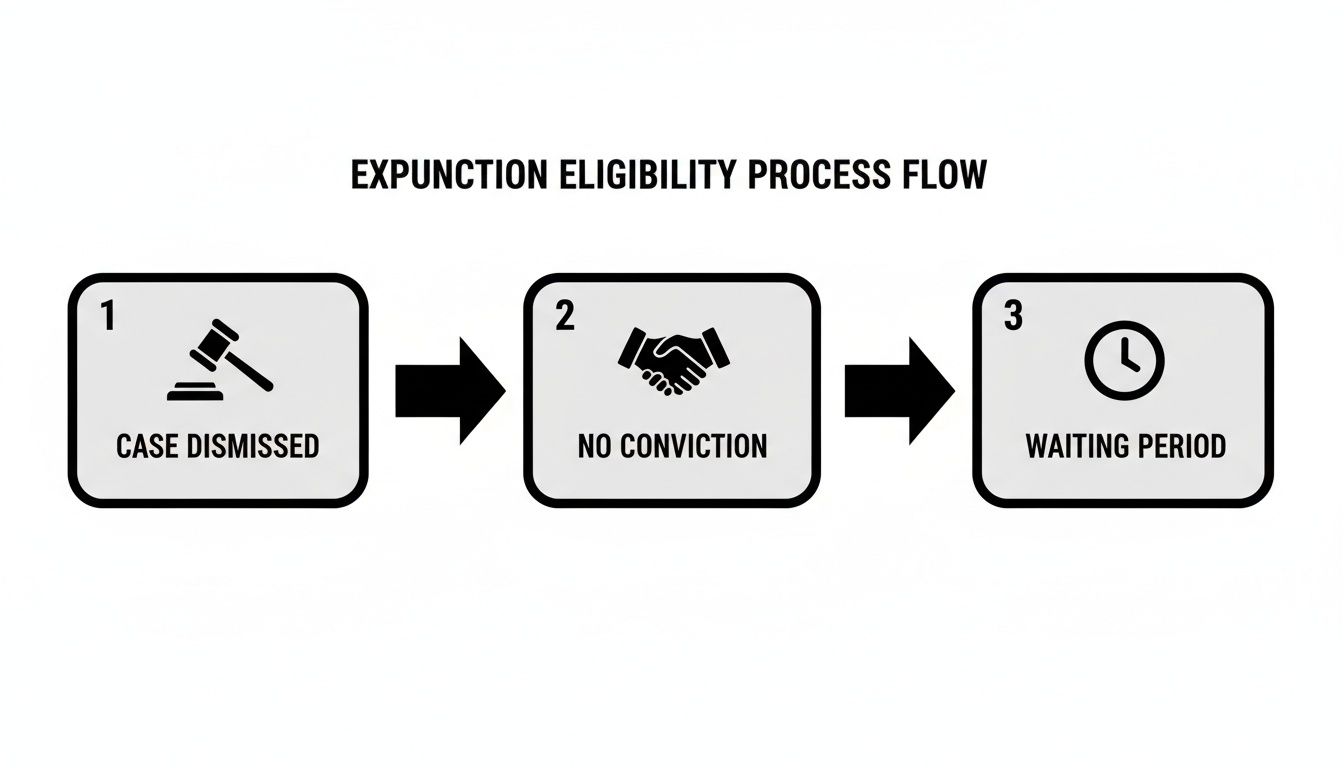
As you can see, hitting all three of these requirements is your green light to start drafting and filing.
Gathering Your Essential Information
Before drafting a legal document, you need to pull together all the raw materials. Accuracy here isn't just important; it's everything. Your petition must have the exact details of your arrest to even be considered.
You’ll need to track down these key pieces of information:
- Your Personal Details: Full name, date of birth, driver's license number, and Social Security number.
- Arrest Information: The date of the arrest, the specific offense you were charged with (like Driving While Intoxicated), and the name of the arresting agency (e.g., Houston Police Department, Harris County Sheriff’s Office).
- Case Details: The court that handled the case (e.g., Harris County Criminal Court at Law No. 5), the case number, and the date the case was finally dismissed or you were acquitted.
If you don't have all this information readily available, don't worry. You can usually get it by contacting the district clerk’s office in the county where the arrest happened. An experienced Texas DUI attorney can also pull these records efficiently, ensuring every detail is correct from the start.
Drafting a Flawless Petition
The Petition for Expunction is a detailed legal document. It officially tells the court who you are, lays out the specifics of the arrest you want erased, and legally argues why you meet the criteria under Texas law. But here's the most critical part: it must also list every single government agency that could possibly have a record of your arrest.
A common—and very costly—mistake is failing to list all the relevant agencies. If an agency holding your record isn't named in the petition and served with the final order, they have no legal duty to destroy it. This can leave bits and pieces of your arrest history floating around, completely defeating the purpose of the expunction.
This list is often way longer than most people expect. It usually includes:
- The arresting police department
- The county sheriff's department
- The county and district attorney’s offices
- The county and district clerk
- The Texas Department of Public Safety (DPS)
- Any other city or state agency that touched your case
This is where an attorney's experience is priceless. They know exactly which agencies are involved in a typical DWI arrest and will make sure nobody gets missed. For a deeper dive into this legal remedy, you can find more in our comprehensive guide on how to expunge your record in Texas.
Filing and Serving the Petition
Once the petition is drafted and double-checked for accuracy, it needs to be officially filed with the district clerk in the county of your arrest. This is the step that formally kicks off the legal process. When you file, you’ll have to pay a filing fee, which usually runs between $300 to $500, though it can vary from county to county.
But filing isn't the finish line. The petition then has to be "served" on every single government agency you listed. This is the formal legal heads-up, letting them know you're seeking to have their records of your arrest destroyed. The District Attorney's office will review your petition and has a set amount of time to object if they think you're not actually eligible.
This is often where having a lawyer in your corner makes a huge difference. A seasoned DWI attorney can see potential objections coming and address them before they become problems, smoothing the path toward getting that signed Expunction Order from the judge.
So, you’ve filed your Petition for Expunction. Congratulations. That’s a huge step, but it’s important to know that you’ve just started the engine—you haven’t reached your destination yet. Once your attorney files the paperwork with the district court, a new clock starts ticking.
This is the phase where the state, usually the District Attorney's office, gets its chance to review your request to expunge your record in Texas.
Legally, the DA's office generally has 30 days to look over your petition and decide if they want to fight it. In a perfect world—where your eligibility is crystal clear, like after a full acquittal or a dismissal well past the statute of limitations—the state might not object at all. That’s the goal, as it paves the way for a much faster and smoother finish.
But if the prosecutor finds a legal reason they think you don’t qualify, they will file what’s called an "Answer." This is their formal objection. It doesn’t mean you’ve lost; it just means your case is now headed for a court hearing where a judge will have the final say.
The Waiting Game and Agency Responses
Once filed, your petition is sent out to every single government agency listed in the document. We’re talking about everyone from the local police department that arrested you to the Texas Department of Public Safety (DPS). Each of these agencies is now officially on notice, waiting for the judge’s final order.
I know the timeline can feel painfully slow, but it's built this way to give every agency a fair chance to respond. During this period, your lawyer will be monitoring the case, staying in touch with the DA's office, and getting ready for any potential fights. It’s a time that demands patience. The legal system simply doesn’t move at the speed of an email.
A common source of anxiety for my clients is the silence after filing. It’s critical to remember that in this context, no news is often good news. An uncontested petition often just needs a judge’s signature, without any dramatic courtroom battle.
This waiting period is also a good time to remember that getting a second chance is becoming more common in the Texas legal system. The numbers prove it. Between September 2018 and February 2025, Texas courts granted a staggering 9,555 expungements. The peak was in 2021, with 2,782 expungements granted in that year alone, showing that this isn't some rare, long-shot legal remedy. You can explore the data on Texas expungement trends yourself to see how courts are handling these cases.
Navigating a Potential Court Hearing
If the state does object, the court will put you on the docket for a hearing. Don’t panic—this isn't a new trial. It's a focused legal argument over one thing: whether you meet the legal requirements for an expunction. You almost certainly won’t have to testify. Instead, your lawyer and the prosecutor will present their sides to the judge.
Why would the DA object? It usually comes down to a few common reasons:
- You filed too soon: The petition was submitted before a mandatory waiting period was over.
- There were other charges: The arrest involved other charges that weren't dismissed.
- They disagree on eligibility: The prosecutor believes the outcome of your case (like a certain type of probation) doesn't qualify.
A seasoned expunction attorney sees these potential roadblocks from a mile away. By drafting a rock-solid petition that addresses any gray areas from the start, your lawyer can often resolve these objections directly with the prosecutor before the hearing date even arrives, saving you a ton of time and stress.
The Final Order and Getting Your Record Cleared
The finish line is a signed Final Order of Expunction from the judge. This is the golden ticket. It's a powerful court order that legally commands every state and federal agency to take action.
Once the judge signs it, the district clerk sends a certified copy of that order to every agency you named in your petition. When they receive it, they are legally required to destroy every record connected to your arrest. The Texas Department of Public Safety (DPS) even takes the extra step of notifying federal agencies like the FBI to clear their databases, too.
This final step ensures a total wipe of the record, giving you the legal right to deny the arrest ever happened. It’s how you truly get to move forward with a clean slate.
How Recent Law Changes Impact Your Case
Texas law is never static, and when it comes to your ability to expunge a record in Texas, some recent changes are absolute game-changers. Keeping up with these updates is critical because they could be the very thing that makes you eligible to clear your record. A law that blocked you last year might be the one that opens the door for you today.

Understanding these reforms is the first move you need to make. The Texas Legislature has been signaling a real commitment to second chances, and these new laws reflect a more modern, practical approach to criminal justice.
The Big Shift: From Chapter 55 to Chapter 55A
One of the most significant changes we've seen is a complete overhaul of the state's expunction laws. Thanks to House Bill 4504, which took effect on January 1, 2025, the old Chapter 55 of the Code of Criminal Procedure was completely repealed. In its place, we now have a brand-new, comprehensive Chapter 55A.
This isn't just some minor edit; it's a fundamental rewrite of the rules that govern how Texans can clear their records. You can get more details on how these legislative pivots are making the process more equitable by reviewing insights on Texas expunction law.
These changes were designed to simplify the process and open up eligibility to more people, directly helping individuals whose lives have been on hold because of an old arrest.
The move to Chapter 55A is more than just renumbering sections of a law book. It signals a philosophical shift, making record clearing less of an uphill legal battle and more of a standard procedure for deserving cases.
This new chapter basically restructures the entire framework. It clarifies language that was once confusing and streamlines procedures that used to be a massive burden for the average person.
Automatic Expungements: A Major Breakthrough
Perhaps the most impactful change is the creation of automatic expungements for certain eligible cases. This is a monumental development. For decades, the burden has always fallen on the individual—you had to hire a lawyer, draft a petition, pay filing fees, and navigate a complex court system just to get your record cleared.
Now, for specific types of cases where you weren't convicted, the process can happen automatically. You might not even need to file a petition. This typically applies to situations where:
- Charges were never filed after you were arrested.
- A grand jury "no-billed" your case, meaning they declined to indict.
- You were acquitted at trial.
This change finally acknowledges that if the justice system has already cleared you, you shouldn't have to spend thousands of dollars and months of effort to get the arrest off your record. While it doesn't apply to every single case, it's a huge step forward for many Texans.
Tackling the Cost Barrier: Reduced Fees and Broader Access
Another crucial reform addresses one of the biggest roadblocks for many people: the cost. Between filing fees and the expense of serving notice to multiple government agencies, an expunction could quickly become financially out of reach.
New legislation, specifically Cost Reduction Senate Bill (C.S.S.B.) 1667, which became effective on September 1, 2025, tackles this problem head-on. The law makes electronic filing free for petitioners and caps the fees for serving agencies at a standard $25 per entity. This dramatically lowers the financial barrier.
To help you see the difference, here's a quick rundown of the major updates to Texas expungement laws.
Key Changes to Texas Expungement Laws
This table summarizes the major updates to Texas expungement laws to help you understand what's new.
| Legal Area | Previous Law | New Law (Post-2025 Reforms) |
|---|---|---|
| Governing Statute | Chapter 55, Code of Criminal Procedure | Chapter 55A, Code of Criminal Procedure |
| Initiating the Process | Petitioner must always file a formal Petition for Expunction. | Automatic expungement for certain qualifying non-conviction cases. |
| Filing & Service Fees | Varied widely by county, often totaling hundreds of dollars. | E-filing is free; service fees are capped at a low, standardized rate. |
| Overall Accessibility | The process could be complex and expensive, creating barriers. | The process is more streamlined, affordable, and accessible to more Texans. |
As you can see, these reforms work together to make the path to a clean slate clearer and much more attainable than it used to be.
Of course, navigating these new laws still requires a deep understanding of the legal system. An experienced Houston DWI lawyer can evaluate your case under these new rules to map out the most effective strategy for you. The opportunities these changes present are just too significant to ignore.
Why an Experienced Attorney Is Your Greatest Asset
On the surface, the process to expunge a record in Texas can look like just a matter of filling out some forms. It's tempting to think you can handle it yourself, but that assumption is a minefield of procedural traps and legal technicalities that can blow up your petition in an instant.
One missed deadline, a single overlooked government agency, or a poorly worded legal argument is all it takes to get a denial. That forces you back to square one, costing you far more time, money, and frustration than you ever imagined.
This is where having a skilled Texas criminal defense attorney in your corner becomes your single most powerful advantage. A seasoned lawyer does more than just fill out paperwork—they build a complete legal strategy from day one, designed to get you across the finish line successfully.
The Precision Required for a Perfect Petition
Drafting a Petition for Expunction isn't an administrative task; it's a legal art form. The document has to be flawless. It must accurately cite the specific articles of the Texas Code of Criminal Procedure that qualify you for an expunction, and it absolutely must identify every single government entity holding a record of your arrest.
This list is almost always longer than people realize. It can easily include:
- The arresting law enforcement agency (like the Houston Police Department)
- The county sheriff’s department
- The prosecutor’s office (at both the county and district levels)
- The court clerk’s office
- The Texas Department of Public Safety (DPS)
- Any other state or local agency that might have accessed your file
If you fail to name even one of these agencies in your petition, they are not legally required to destroy their records of your arrest. An experienced attorney knows exactly who to include, making sure no trace of the incident is left behind. We explain this in more detail in our guide on why you should hire a lawyer for your DWI expungement to handle these crucial details.
Navigating Objections and Courtroom Procedures
Once your petition is filed, the District Attorney's office has the right to review it. If they believe you aren't eligible, they can—and often will—object. An objection isn't the end of the road, but it means you'll have to argue your case in front of a judge at a formal hearing.
Trying to face down a prosecutor alone in a courtroom is intimidating, and frankly, it's a losing battle for most people. An experienced DWI attorney sees potential objections coming a mile away and works to resolve them with the DA's office before a hearing is ever needed.
If a hearing is unavoidable, your lawyer will step up to represent you. They will present a clear, compelling legal argument grounded in Texas law and handle all communications with the court and the state, shielding you from the stress of the process. This professional advocacy is often what separates a successful petition from a denied one.
For example, if a prosecutor objects based on a misunderstanding of a waiting period, your lawyer can immediately cite the relevant statute and case law to get your case back on track.
Ultimately, the entire goal is to get a signed Final Order of Expunction from the judge. This order is the key to your future, and having an attorney ensures it is drafted correctly, signed, and sent to every necessary agency. They follow up to confirm your records have actually been destroyed, giving you the peace of mind that comes with a truly clean slate.
A DWI arrest can feel overwhelming, but reclaiming your future shouldn't be. You’ve taken the first step by learning about your rights. Now, let us help you take the next one with confidence.
Your future is too important to leave to chance. At The Law Office of Bryan Fagan, PLLC, our team is dedicated to helping Texans clear their records and move forward with their lives. We have the experience and strategic insight to navigate the expunction process successfully. Request your free, no-obligation case evaluation today and let us start building your path to a clean slate.