
A DWI arrest can be overwhelming, but you don’t have to face it alone. If you're facing a DWI charge in Texas, it’s easy to feel like the deck is stacked against you. But one of the most powerful tools in a defense lawyer's arsenal is the motion to suppress evidence. This isn't just a piece of paper; it's a formal, strategic challenge to the court, arguing that law enforcement violated your constitutional rights while gathering evidence.
A well-executed motion can completely dismantle the prosecution's case from the inside out.
Your Strongest DWI Defense Starts Here

A DWI charge can feel like a conviction, but it’s not. You have rights, and one of the most fundamental is the Fourth Amendment's protection against unreasonable searches and seizures. The motion to suppress is how we enforce that right in the courtroom.
When your Houston DWI lawyer files this motion, we are putting the government on notice. We’re telling the judge that the evidence they plan to use against you—be it a breathalyzer result, a field sobriety test, or even statements you made—was obtained illegally and must be thrown out.
How This Motion Works in a Real-World DWI Scenario
Let’s play this out. Imagine you're pulled over late one night. The officer claims you swerved, but a review of the dashcam footage shows you were driving perfectly within your lane. Still, the officer moves forward with a DWI investigation and arrests you based on poorly administered field sobriety tests.
In a situation like this, the entire stop was illegal from the get-go. The officer didn't have the reasonable suspicion required by law to pull you over. Because the initial stop was unconstitutional, every piece of evidence gathered after that moment is considered "fruit of the poisonous tree" and is inadmissible in court.
A successful motion to suppress can gut the prosecutor's case before a jury ever hears it. When key evidence gets excluded, the state is often left with no choice but to dismiss the charges or offer a much better deal, like a reduction to a non-DWI offense.
Why This is a Critical Strategy in Texas
Filing a motion to suppress isn't just a legal maneuver; it's a lifeline. It directly attacks evidence like breath test results or video footage by arguing it was obtained without a warrant, probable cause, or valid consent. This is a vital strategy to fight DWI Texas charges, as many cases turn on the legality of the initial traffic stop. For a deeper dive, the Notre Dame Law Review offers academic insight into these legal precedents.
Knowing how to file a motion to suppress evidence is a technical skill that demands a deep understanding of Texas law and courtroom procedure. It’s a multi-step process that a skilled attorney handles for you:
- Thorough Investigation: We dig into everything—police reports, body cam videos, dispatch logs—searching for the constitutional violation that can crack the case open.
- Legal Research: We pinpoint the specific case law and statutes that back up our argument for throwing out the evidence.
- Persuasive Argument: At a formal suppression hearing, we present the facts and law to the judge, making a compelling case for why the evidence against you is tainted.
Challenging the state's evidence is a fundamental part of building a defense that actually works. It's how we protect your rights, your driver's license, and your future.
Identifying Grounds to Suppress DWI Evidence
Before we can file a motion to suppress, we conduct a deep investigation into every single moment of your arrest. The goal here is to find the constitutional violations and procedural mistakes that will become the bedrock of your defense. A winning motion isn’t just thrown together; it's built by meticulously picking apart the facts.
The prosecution’s case might look strong on the surface, but it's often full of weak spots. Pinpointing these grounds for suppression is the first—and most critical—step toward dismantling their arguments and protecting your rights. We examine everything, from the reason you were pulled over to how the chemical tests were handled.
The Legality of the Initial Traffic Stop
The entire DWI case hinges on one moment: the initial traffic stop. An officer can't just pull you over on a whim or a gut feeling. The Fourth Amendment demands they have reasonable suspicion—a clear, specific reason to believe you've committed a traffic violation or are involved in criminal activity.
If that stop was illegal from the get-go, any evidence collected afterward is considered “fruit of the poisonous tree” and can be thrown out. This includes:
- Statements you made to the officer
- The results of any Field Sobriety Tests (FSTs)
- Breath or blood test results
For example, an officer might claim you made a "wide right turn," but that might not be enough to justify the stop if your driving was otherwise safe. A skilled attorney will scrutinize every second of dashcam and bodycam footage to challenge the officer’s story. This is often the first and most powerful line of attack in a DWI case. To get a better handle on the legal standards, you can learn more about the differences between probable cause and reasonable suspicion in our detailed guide.
Flaws in Field Sobriety Testing
Field Sobriety Tests (FSTs) are not simple pass/fail exercises. They're divided-attention tasks that are notoriously tough for anyone to perform perfectly, even when completely sober. The National Highway Traffic Safety Administration (NHTSA) has set very strict, standardized procedures for how these tests must be administered.
When an officer deviates from these protocols, the results become unreliable and are wide open to being challenged in court. Some of the most common mistakes we see include:
- Improper Instructions: The officer mumbles, rushes, or fails to give the clear, standardized instructions required by NHTSA.
- Unsuitable Conditions: The test is done on a sloped or uneven surface, in poor lighting, or during bad weather like high winds or rain.
- Medical and Physical Factors: The officer doesn’t bother to ask about physical injuries, medical conditions, or age that could easily affect your performance.
When an officer improperly administers the walk-and-turn test or the one-leg stand, they are essentially creating invalid evidence. We can argue that these flawed results do not establish the probable cause needed for a lawful DWI arrest.
Challenging Breath and Blood Test Results
Chemical tests, like a breathalyzer or a blood draw, seem scientific and final. The truth is, they're far from infallible. These are highly technical procedures that are susceptible to both human error and machine glitches. A motion to suppress can target all sorts of issues with these tests.
Common Grounds for a Motion to Suppress in Texas DWI Cases
This table breaks down common violations during a DWI arrest that can lead to evidence being suppressed.
| Violation Type | What It Means | Potential Evidence to Suppress |
|---|---|---|
| Illegal Stop | The officer lacked reasonable suspicion for the traffic stop. | All evidence gathered after the stop. |
| Improper FSTs | The officer failed to follow NHTSA-standardized procedures. | FST results and officer's observations. |
| Breathalyzer Error | The machine was uncalibrated or the operator was uncertified. | Breath test results (the BAC reading). |
| Chain of Custody | The blood sample was mishandled, mislabeled, or contaminated. | Blood test results. |
| Miranda Violation | You were questioned in custody without being read your rights. | Incriminating statements made during questioning. |
These are just a few examples of the angles we explore. A successful motion often comes down to identifying small, overlooked mistakes that have huge legal consequences.
A motion can target specific problems, such as:
- Machine Malfunction or Calibration Errors: Breathalyzer machines must be regularly maintained and calibrated. If service records show the device wasn't working correctly, its results are compromised.
- Improper Administration: The officer operating the breathalyzer might not have been properly certified, or they could have failed to follow the mandatory 15-minute observation period before the test.
- Broken Chain of Custody: For blood tests, the sample must be properly collected, labeled, and transported to the lab. Any gap or mistake in this chain of custody can lead to contamination or serious questions about the sample's integrity.
Finally, don't forget about Miranda rights. If you were in police custody and being interrogated without being read your rights, any statements you made in response to questioning can be excluded from evidence. A thorough Texas DUI attorney will analyze every single angle to find the leverage needed to fight your charges effectively.
Navigating the Legal Process for Filing the Motion
Finding a weakness in the state's case is a great start, but it's just the first step. Now comes the real work: turning that weakness into a legal argument a judge will actually listen to. The court system has its own rigid rules and deadlines, but you don't have to face it alone. Understanding the process shows you exactly what we do to fight for you.
It all starts with something called discovery. This is the formal process where we demand every single piece of evidence the prosecutor has against you. This isn't a polite request; it's a legal requirement. We get our hands on the police reports, bodycam footage, breathalyzer service records, and lab results for any blood tests. This evidence file is the raw material for building your defense.
Drafting a Powerful and Persuasive Motion
Once we have everything the state has, we get to work drafting the Motion to Suppress. This isn't some generic form we fill out. It's a custom-built legal argument, tailored specifically to the facts of your arrest. We weave together the events of your case with established Texas law to create a compelling story for the judge.
Every motion must clearly spell out three things:
- The specific evidence we want thrown out (like a breath test result of .09 BAC).
- The constitutional violation that took place (for example, the officer didn't have a valid reason to pull you over in the first place).
- The legal muscle backing up our argument, which means citing the right Texas laws and past court rulings.
One of the most powerful tools in our arsenal is Texas Code of Criminal Procedure Art. 38.23, also known as the Texas Exclusionary Rule. This law is crystal clear: if police get evidence by violating your constitutional rights, it cannot be used against you in court. This statute is the backbone of almost every successful motion to suppress in Texas.
The flowchart below shows the key moments in a DWI stop where we can challenge the evidence.
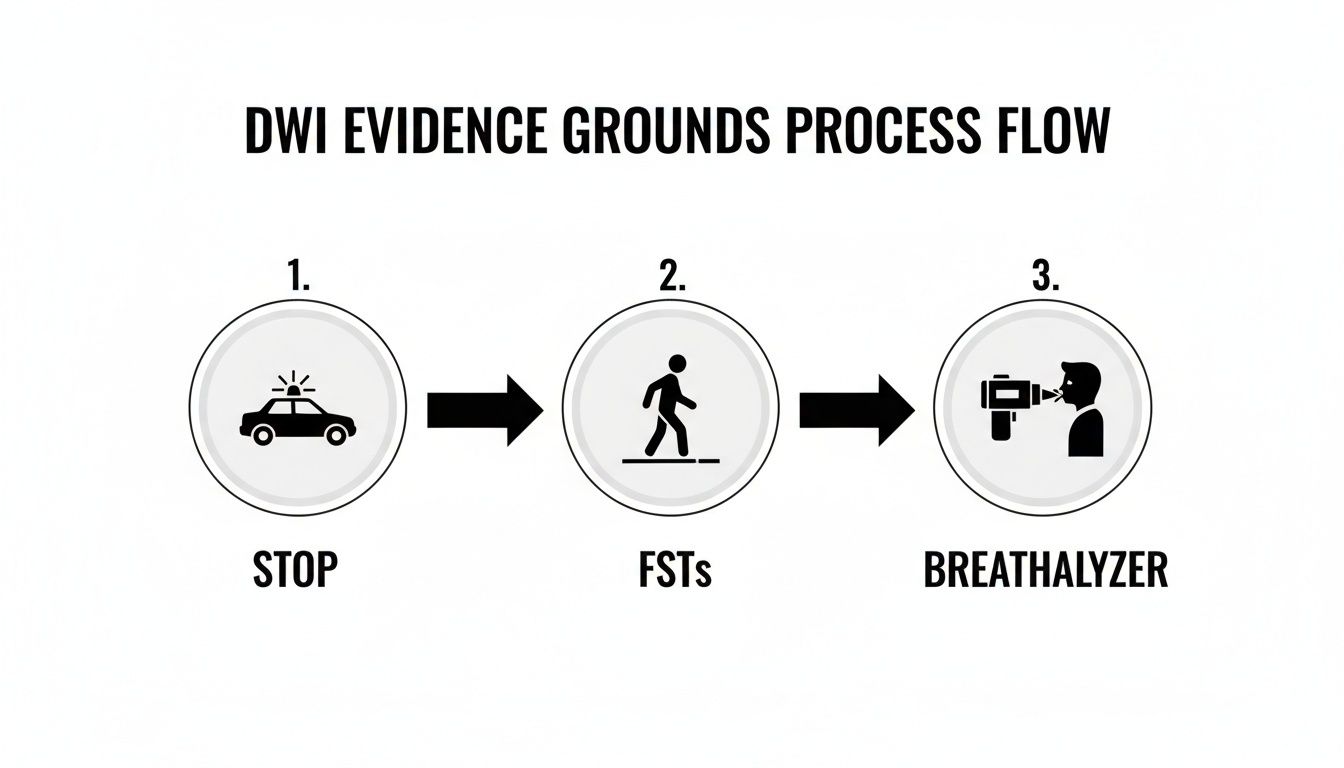
As you can see, every single stage—from the initial traffic stop to the final chemical test—is an opportunity to question whether the evidence was gathered legally and correctly.
Filing, Serving, and Preparing for the Hearing
After the motion is drafted, it has to be officially filed with the court clerk and formally delivered (or "served") to the prosecutor's office. This puts everyone on notice that we're officially challenging their evidence. Missing a filing deadline can mean you lose your right to challenge the evidence forever, which is why having an attorney on top of these details is so critical.
Next, the court schedules a suppression hearing. Think of this as a mini-trial, but without a jury. The only issue is whether the evidence we've challenged is admissible. The judge listens to legal arguments, reviews the evidence, and hears testimony, almost always from the arresting officer.
Our job at this hearing is to put the officer on the stand and cross-examine them. We work to expose the holes in their report, get them to admit they didn't follow proper procedure, and show the judge exactly how your rights were violated.
For instance, we might get the officer to admit they failed to conduct the required 15-minute observation period before administering the breath test. That single mistake can be enough for a judge to throw the breath test results out completely. Winning at these hearings takes a deep understanding of the law and a lot of experience. You can learn more about how we handle these critical steps in our guide to Texas DUI pretrial motions and defense strategies.
Preparing for this hearing is intense. We review every report and video, anticipate what the prosecutor will argue, and map out a sharp, effective cross-examination for the officer. A win at the suppression hearing can completely change the game, often leading to a dismissal or a much better plea offer before you ever see a jury. Your future is too important to leave it to chance.
What to Expect at a Suppression Hearing
This is where all the legal research and paperwork comes to life. A suppression hearing is essentially a mini-trial, but there’s no jury and the only question is whether the police followed the law when they gathered evidence against you.
The judge is the only audience, and our job is to prove, through testimony and evidence, that law enforcement violated your constitutional rights. It's a focused, high-stakes event where your attorney’s skill can make or break your entire DWI case.
The Key Players and Their Roles
When you walk into the courtroom for the hearing, it's a targeted legal showdown between a few key people. You'll be there, of course, but your lawyer will be doing all the heavy lifting.
Here’s who you’ll see and what they’re there to do:
- Your Defense Attorney: We’re on offense. Our job is to execute the game plan laid out in the motion to suppress. We present our evidence (like dashcam video) and, most importantly, cross-examine the arresting officer to expose any procedural mistakes or constitutional violations.
- The Prosecutor: The State's attorney is on defense, trying to protect the evidence. Their goal is to convince the judge that the officer did everything by the book and that the evidence should be fair game for a jury to see at trial.
- The Arresting Officer: The officer is the star witness for the prosecution. They’ll get on the stand and testify about why they pulled you over and what they claim happened during the stop, the tests, and the arrest.
The judge listens to both sides, weighs the evidence and testimony, and acts as the referee, making the final call on whether the evidence was obtained legally.
The Heart of the Hearing: Cross-Examination
By far, the most critical part of any suppression hearing is the cross-examination of the arresting officer. This is where an experienced Houston DWI lawyer really proves their worth. We don’t just ask random questions—we lead the officer through a very specific and targeted line of questioning designed to highlight inconsistencies, errors, and legal missteps.
Our goal is simple: create a conflict between what the officer is saying on the stand, what they wrote in their police report, and what the video evidence actually shows. This is how we dismantle the State's case, piece by piece.
For example, an officer might testify that you failed the walk-and-turn test because you stepped off the line. But under a sharp cross-examination, we can use their own dashcam video to show the "line" was on a sloped, cracked, and poorly lit patch of road, making it impossible for anyone to perform the test fairly.
This isn't about being aggressive; it's about being precise. We use the officer’s own training manuals, reports, and videos to show the judge that the strict, standardized procedures were not followed.
Turning Arguments into a Winning Strategy
Every single question we ask is part of a broader strategy to get a specific piece of evidence thrown out. We might hammer away at a few key areas during the hearing.
Common Cross-Examination Topics:
- Lack of Reasonable Suspicion: We’ll pin the officer down on the exact traffic violation they claim to have seen. Often, the video shows no violation at all.
- Improper FST Administration: We can force the officer to admit they skipped crucial instructions, didn’t check for medical issues, or performed the tests on an unsuitable surface.
- Contradictory Evidence: There’s nothing more powerful than playing video that shows your speech was clear and your balance was fine, right after the officer testified you were slurring and stumbling.
- Breath Test Protocol: We can get the officer to confirm on the record that they failed to follow the mandatory 15-minute observation period before you provided a breath sample, making the result unreliable.
Each successful challenge erodes the legality of the State’s evidence. When we expose enough of these errors, we give the judge the legal justification needed to grant our motion. Winning a suppression hearing often cripples the prosecution's case, forcing them to either dismiss the charges or offer a much better plea deal, like a non-DWI offense. This is how we fight—and win—DWI Texas charges.
How a Successful Motion Impacts Your DWI Case

Winning a motion to suppress evidence isn't just a small procedural victory—it can completely flip the script on your DWI case. When a judge grants our motion, it means the illegally obtained evidence is officially thrown out. The prosecution is now forbidden from using it against you at trial.
This single ruling can cripple the State’s case. Imagine them trying to prove intoxication without their main evidence—like a high BAC (Blood Alcohol Concentration) from a breath test or the dashcam video of a botched field sobriety test. Their argument often crumbles.
A motion to suppress isn't a desperate, last-ditch effort. It is a calculated, strategic move designed to dismantle the case from the inside and secure the best possible outcome for you.
Potential Outcomes After a Successful Motion
When key evidence gets tossed, the prosecutor is forced to go back to the drawing board. They may have walked in with what they considered a slam-dunk case, but now they're left with very little to show a jury. This immediately puts you in a much stronger position to negotiate and can lead to several game-changing outcomes.
Your case could see one of these results:
- Full Dismissal of Charges: If the suppressed evidence was the only real proof of intoxication, the State may have no other choice but to drop the case entirely. This is the ultimate win.
- A Favorable Plea Agreement: The prosecutor might suddenly be willing to offer a deal for a lesser, non-DWI offense like reckless driving. This carries far less severe penalties and protects your driving record from a DWI conviction.
- A Stronger Position at Trial: If the case still goes to trial, we’ll be fighting against a severely weakened prosecution, which dramatically increases your odds of being found not guilty.
The power of this motion comes from a legal doctrine called the "exclusionary rule." This rule doesn't just block the illegally obtained evidence; it also bars any secondary evidence found because of it—what lawyers call the "fruit of the poisonous tree."
Shifting the Balance of Power in Your Favor
A successful motion to suppress shifts all the leverage from the prosecutor's table over to yours. It changes the conversation from "how do we minimize the damage?" to "what will the State offer us to avoid losing at trial?"
It sends a clear message to the court and the prosecution: your rights were violated, and we are prepared to hold them accountable for every single procedural mistake.
A DWI arrest can feel overwhelming, but you have more power than you think. A well-argued motion to suppress is not just a defense tactic—it’s a powerful assertion of your constitutional rights.
This is how we fight DWI Texas charges effectively. We don’t just play defense and react to the prosecutor’s case; we go on offense and attack its very foundation. By challenging the evidence at every step, we create the opportunities needed to protect your license, your reputation, and your freedom. You can learn more about this process by reading our guide on how a DWI can be dismissed in Texas.
Common Questions About Motions to Suppress
When you're facing a DWI, a Motion to Suppress can feel like your best shot. But what does it really involve? Let's break down the questions we hear every day and give you the straightforward answers you need.
What Are My Chances of Winning a Motion to Suppress?
This is often the first question on everyone's mind, and the honest answer is: it all comes down to the specific facts of your arrest. There are no guarantees in court, but a sharp Texas DUI attorney knows exactly where to find the cracks in the prosecution's case.
Success here isn't about luck—it's about a deep, meticulous dive into the evidence. We find our best arguments for suppression in cases where we spot:
- A lack of reasonable suspicion for the initial traffic stop.
- Improperly administered or poorly documented Standardized Field Sobriety Tests (SFSTs).
- Major errors in the chemical testing process, like an uncalibrated breathalyzer or a broken chain of custody for a blood sample.
For instance, if the officer’s dashcam video shows you driving perfectly but his report claims you were weaving all over the road, that’s a massive contradiction. We use that to argue the entire stop was illegal from the jump. Winning a motion to suppress is often the key that unlocks a case dismissal or a major reduction in charges.
How Long Does This Process Usually Take?
The timeline can vary quite a bit, depending on how complex your case is and how busy the court's calendar is. It’s definitely not an overnight process, but every step is deliberate and designed to build the strongest defense possible.
First, your lawyer has to get through discovery. This is the formal process of demanding and receiving all the evidence the prosecution has against you, which can take a few weeks. After a thorough review, we draft and file the motion, making sure we hit every pre-trial deadline the judge sets.
After that, the court will schedule the suppression hearing. Depending on the docket, this could be weeks or even months away. An experienced Houston DWI lawyer who knows the local courts can give you a much more realistic timeline based on your specific situation.
While the process takes time, patience is a strategic advantage. It gives your attorney the room to prepare for the hearing, which is often the single most critical event in your entire DWI case.
Should I Try to File a Motion to Suppress Myself?
While you technically have the constitutional right to represent yourself, filing a motion to suppress on your own is not a sound strategy. This isn't a simple form you can just download and fill out. It's a highly technical legal battle.
To successfully argue a motion to suppress, you need a rock-solid, practical understanding of:
- The Fourth Amendment to the U.S. Constitution.
- The Texas Code of Criminal Procedure, especially Article 38.23 (the Texas Exclusionary Rule).
- Decades of case law from Texas and federal courts.
- The complex rules of evidence and courtroom procedure.
Beyond just the legal knowledge, the hearing itself involves cross-examining a police officer who has been trained to testify in court—a skill that takes years to master. One procedural mistake can get your motion thrown out, and you don’t get a second chance. Hiring an experienced DWI attorney is the only effective way to protect your rights and give yourself a real shot at winning.
What Happens If My Motion Is Denied?
Getting a motion to suppress denied is not the end of the road—not even close. It simply means the evidence we challenged is now fair game for the prosecutor to use at trial. It's a setback, for sure, but a good defense lawyer always has a Plan B and a Plan C.
If the motion is denied, the strategy just shifts. We might pivot to:
- Attacking the evidence's credibility in front of the jury. We can still argue that the breathalyzer is notoriously unreliable or that the officer's interpretation of your field sobriety tests was completely wrong.
- Negotiating a plea bargain for a lesser charge, now that both sides have seen their cards and know what evidence is in play.
- Raising other legal defenses during the trial itself.
The motion to suppress is just one powerful tool in our arsenal. Even when it's not successful, the hearing itself is incredibly valuable. It gives us a "free preview" of the officer’s testimony and the prosecutor's game plan, which we can use to build an even stronger defense for you at trial.
A DWI arrest can feel overwhelming, but you don't have to go through it alone. At The Law Office of Bryan Fagan, PLLC, our team has the strategic experience to challenge the evidence and fight for the best possible outcome for you. Don't wait to start protecting your future.
Request your free consultation at https://texasduilawfirm.com and let's talk about your defense options today.