
A DWI arrest can be overwhelming—but you don’t have to face it alone. When you're dealing with the stress and confusion of an arrest, you’ll hear a lot of legal terms thrown around. But there’s one that sits at the absolute center of your case: probable cause. The entire government’s case against you—from the moment the officer decided to arrest you—is built on this single legal standard. Understanding it is the first step toward building a strategic defense.
Understanding Probable Cause in a Texas DWI Arrest
So, what exactly is probable cause? It's not just a hunch or a gut feeling an officer has. Think of it as a collection of real, observable facts and circumstances that would convince a reasonable person that you've committed the crime of driving while intoxicated. It’s the legal justification required for your arrest.
This isn’t some obscure legal term; it's a fundamental right that protects every single one of us from being arrested without good reason. Let’s say you were pulled over for a minor traffic violation in Houston. That simple stop can only turn into a DWI arrest if the officer gathers enough specific facts to establish probable cause. This is a critical protection, and knowing how to challenge it is a cornerstone of an effective DWI defense.
Your Constitutional Protection
This powerful idea has deep roots in American law. It comes directly from the Fourth Amendment to the U.S. Constitution, which was put in place way back in 1791 to stop the government from conducting "unreasonable searches and seizures." The framers knew that unchecked police power was a threat, so they demanded that law enforcement have a solid, fact-based reason to interfere with a person's freedom.
This means an officer can't just arrest you for DWI on a whim. They must be able to point to concrete evidence they observed, such as:
- Erratic driving, like swerving, weaving, or an unusually wide turn.
- Physical signs they associate with intoxication, like bloodshot eyes, fumbling for your license, or slurred speech.
- Poor performance on Standardized Field Sobriety Tests (SFSTs).
- An admission that you had been drinking alcohol.
An arrest is not a conviction. In fact, a lack of probable cause is often the first and most effective angle a skilled Houston DWI lawyer will use to dismantle the state's case. If the officer made a mistake or overstepped their authority, that error can become the key to your entire defense.
Reasonable Suspicion vs. Probable Cause in a DWI Stop
If you’ve been pulled over for a DWI, you’ll hear a lot of legal terms thrown around by police and prosecutors. Two of the most critical are reasonable suspicion and probable cause. They might sound like interchangeable legal jargon, but knowing the difference is one of the first and most important steps in defending your rights.
These two standards aren't the same. Think of them as two separate hurdles an officer must clear. One lets them start the investigation; the other lets them make an arrest. Confusing them can leave you feeling powerless, but understanding them is how we start finding the weak spots in the State's case against you.
The First Hurdle: Reasonable Suspicion to Pull You Over
The first hurdle is reasonable suspicion. This is the legal standard an officer needs to justify pulling you over in the first place. It’s a lower bar than probable cause.
All it takes are specific, observable facts that would lead a reasonable person to suspect that a crime might be happening. Something as simple as weaving out of your lane, failing to use a turn signal, or even driving unusually slow can be enough to give an officer reasonable suspicion to initiate a traffic stop and begin a DWI investigation.
The Second (and Higher) Hurdle: Probable Cause to Arrest
But an officer can’t arrest you just because they pulled you over. To make a DWI arrest, they must clear a much higher hurdle: probable cause. This is a stronger standard that demands a solid set of facts and circumstances that point to the belief you have actually committed the crime of driving while intoxicated.
Let's break it down with a simple comparison.
To help you see the difference in a real-world context, here’s a quick breakdown of how these two standards play out during a typical DWI stop.
Reasonable Suspicion vs. Probable Cause at a Glance
| Legal Standard | What It Means | What It Allows Police to Do | Example in a DWI Scenario |
|---|---|---|---|
| Reasonable Suspicion | A specific, articulable belief that criminal activity is afoot. It's more than a hunch but less than certainty. | Detain you temporarily for investigation (i.e., a traffic stop). | The officer sees you swerve onto the shoulder of the road. |
| Probable Cause | A reasonable belief, based on the total circumstances, that a specific person has committed a specific crime. | Make an arrest, conduct a search, and seize evidence. | After the stop, the officer smells alcohol, sees open containers, you admit to drinking, and you fail field sobriety tests. |
As you can see, the officer has to build their case step-by-step. The initial stop is just the beginning.
The journey from a simple traffic stop to a DWI arrest is a constitutional one, grounded in the Fourth Amendment, which protects you from unreasonable searches and seizures. An arrest isn't supposed to be an officer's snap judgment; it must be backed by a foundation of facts that meet the probable cause standard.
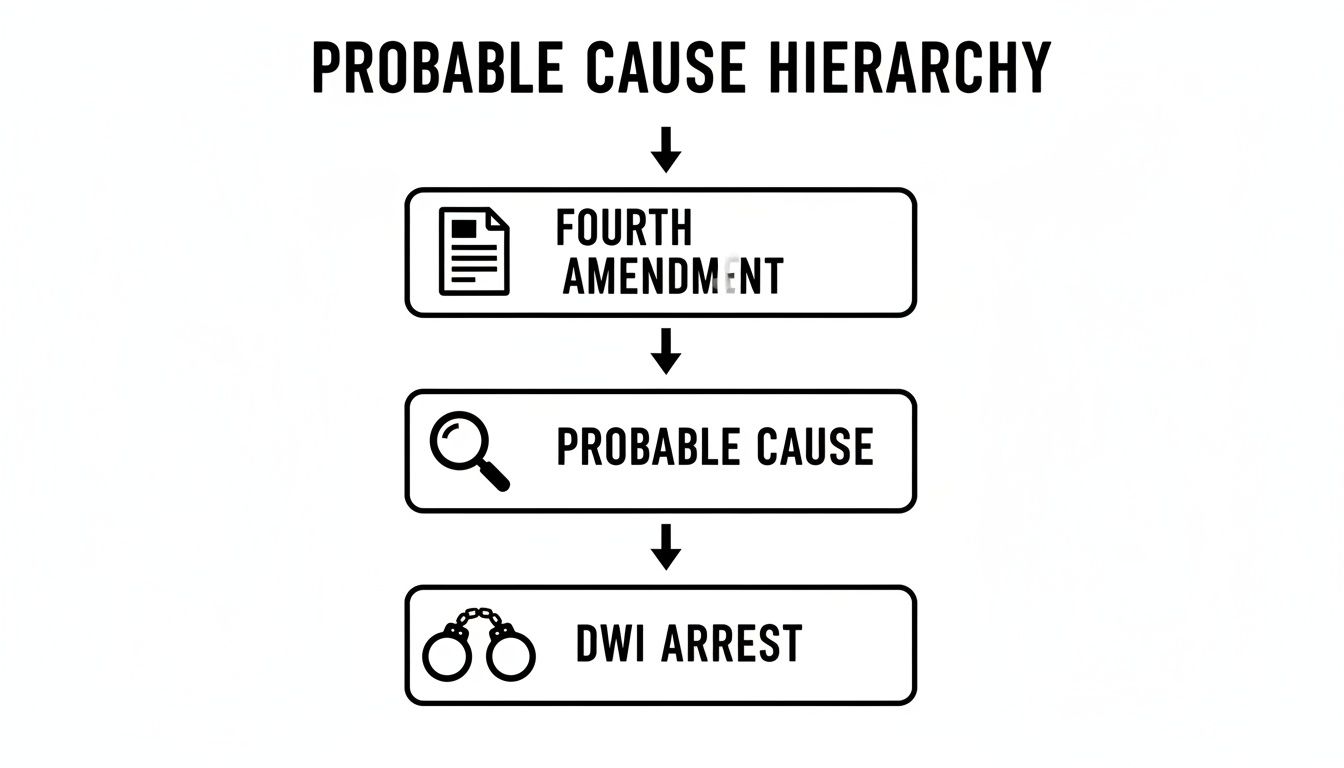
If a police officer jumps the gun and arrests you without building this solid foundation of probable cause, everything that happens after that point—like a breathalyzer result or statements you make—could be thrown out of court.
A sharp Texas DUI attorney will put every second of the officer’s report and body cam footage under a microscope to attack this very issue. It's often the key to getting evidence suppressed and helping you fight your DWI in Texas. You can find out more about how our firm breaks down these crucial differences in our guide on probable cause versus reasonable suspicion. This is where many DWI cases are won or lost.
How Police Build Their Case for Probable Cause
If you've been arrested for a DWI, the whole experience probably felt like it happened in a blur. But from the officer's perspective, it was a methodical process. They can't just arrest you on a hunch; they're trained to build a case, piece by piece, to legally justify putting you in handcuffs.
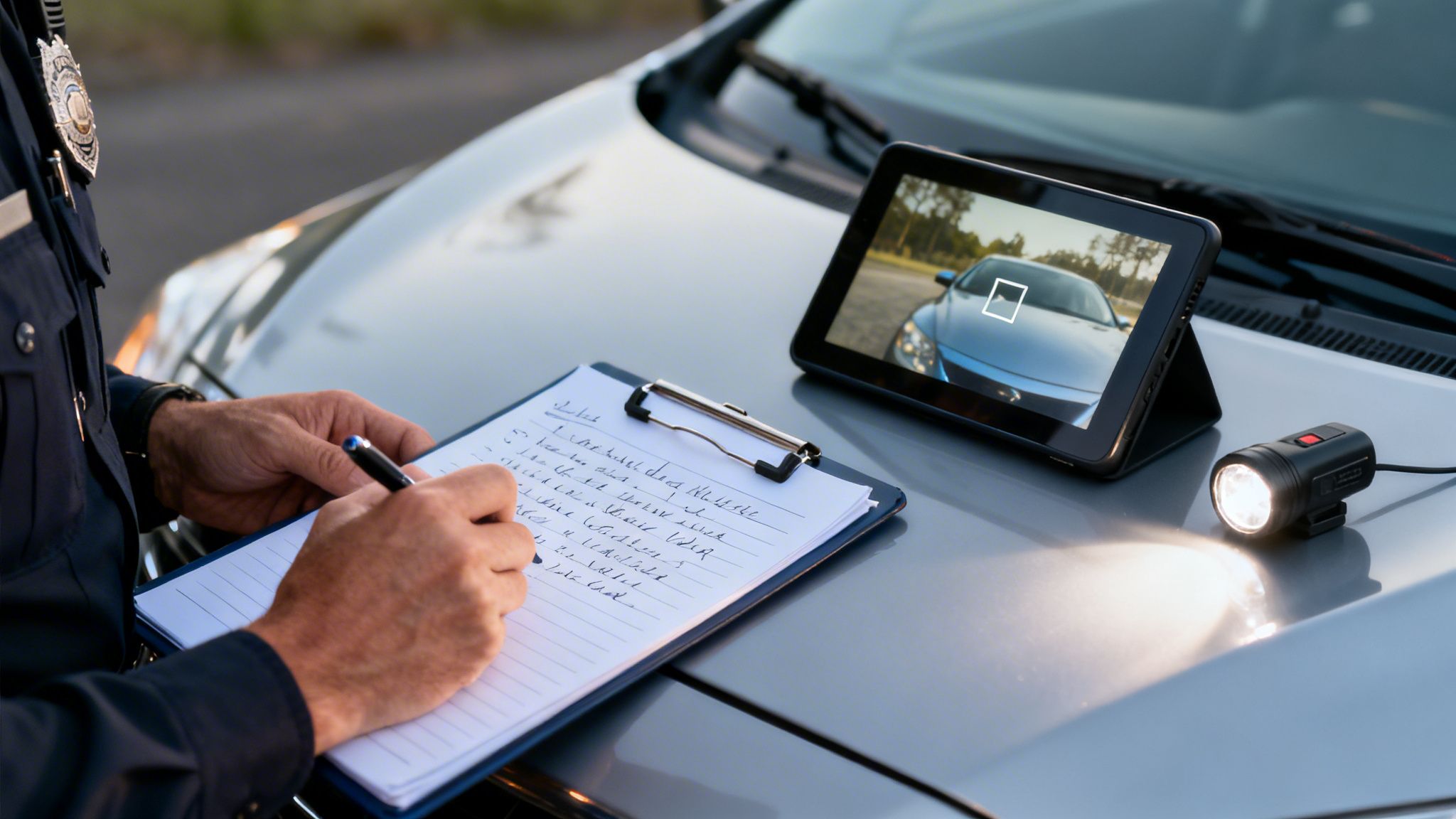
This process starts the second they notice your car. From that moment on, they are looking for specific, observable signs that they can stack on top of one another. It’s not one single thing but the whole picture—what lawyers call the totality of the circumstances—that they use to get to probable cause.
Stacking Observations to Justify an Arrest
Think of it like building a case brick by brick. A single observation isn't much, but as the officer adds more and more, they construct their legal reason for the arrest. This is how a minor traffic mistake can quickly escalate into a full-blown DWI investigation.
Here are the common building blocks officers use to get there:
- Your Driving: This is the first piece. It’s what gave them a reason to pull you over in the first place—weaving, driving way too slow, taking a turn too wide, or straddling the lane lines.
- Your Appearance and Actions: As soon as they're at your window, they're taking notes. They’re looking for things like bloodshot or glassy eyes, a flushed face, or clumsy movements as you search for your license and insurance.
- Smell of Alcohol: The odor of an alcoholic beverage is almost always one of the first things an officer will list in their report. It's a classic and powerful piece of their puzzle.
- Your Own Words: Answering the question "Have you had anything to drink tonight?" with "Just one beer a few hours ago" is not a get-out-of-jail-free card. It's a key admission they will use to justify moving forward.
The Role of Field Sobriety Tests
The biggest and most "official" blocks in their case are the Standardized Field Sobriety Tests (SFSTs). These are the roadside "tests"—the HGN (eye test), Walk-and-Turn, and One-Leg Stand—that are designed to give the officer what looks like objective evidence of your impairment.
Important Takeaway: An officer’s report will present every observation as a clear indicator of intoxication. However, many of these signs can have innocent explanations. Fatigue can cause poor driving and red eyes, medical conditions can affect balance, and nervousness can lead to fumbled movements. A skilled attorney knows how to highlight these explanations.
Once you’re arrested, the prosecutor steps in. They take the officer’s report and any video footage and use it to build their case against you. Our job, as your DWI defense attorney, is to take that exact same evidence and pull it apart, thread by thread.
We look for inconsistencies, procedural mistakes, and those innocent, alternative explanations. Understanding the state's playbook is the first step, and you can learn more about how we deconstruct a Texas DWI probable cause argument to find the weaknesses. This deep dive is often where we find the leverage needed to protect your future.
Real-World Examples of Weak and Strong Probable Cause
The textbook definition of probable cause is one thing, but what does it really look like on the side of a Texas road at 2 a.m.? The truth is, probable cause isn’t a simple yes-or-no question. It’s a spectrum, and the strength of the evidence can range from rock-solid to incredibly flimsy.
To really get a feel for this, let's walk through two different scenarios. One is a clear-cut case, while the other is built on a house of cards. Seeing the difference will help you understand where your own situation might fall and how a defense can be built.
Strong Probable Cause: A Clear-Cut Case
Picture this: An officer is patrolling downtown Houston around 2:15 a.m. and sees a car peel out from a bar district, fly through a red light, and swerve while speeding. Right there, the officer has more than enough reasonable suspicion to pull the driver over.
When the officer gets to the window, the smell of alcohol is overwhelming. They see a few empty beer cans on the passenger floorboard. The driver’s speech is thick and slurred, and they can’t seem to get their driver’s license out of their wallet without fumbling. To top it off, they admit, “Yeah, I had a few with some friends.”
The officer then administers the Standardized Field Sobriety Tests (SFSTs). The driver stumbles through the Walk-and-Turn and can’t hold their balance for more than a few seconds on the One-Leg Stand.
In this story, the officer has methodically stacked one piece of evidence on top of another. The bad driving, the odor of alcohol, the admission, the empty cans, and the obvious SFST failure—all these facts combine to create strong probable cause. A judge would almost certainly agree that a reasonable person would believe this driver was intoxicated.
Weak Probable Cause: A Questionable Arrest
Now, let’s look at a completely different situation. It’s 8 p.m., and you are stopped for an expired registration sticker—a simple administrative issue, not a moving violation. You are polite, clear-headed, and hand over your documents without any trouble.
The officer, however, claims to smell a "faint odor of alcohol" and asks if you've been drinking. You are honest and say you had a single beer with dinner about two hours ago. The officer decides to run you through field sobriety tests.
You do fine on the eye test (the HGN). During the Walk-and-Turn, you take the correct number of steps but make a slightly awkward turn. On the One-Leg Stand, you sway a little but never put your foot down. Despite the minimal clues, the officer arrests you for DWI.
This case is incredibly weak. The stop had nothing to do with dangerous driving. A faint smell and an admission to one beer hours earlier are far from proof of intoxication. The "failures" on the SFSTs could easily be explained by nerves, uneven pavement, or just normal human imperfection.
An experienced DWI attorney would immediately see that the officer was stretching the facts to justify an arrest. This is the exact kind of scenario where we would file a Motion to Suppress, arguing the officer never had probable cause in the first place, making the entire arrest illegal.
How a DWI Lawyer Challenges Probable Cause
Getting arrested for DWI can feel like the end of the story. It's easy to assume the officer's report is the final word and the case against you is airtight. But here's the truth: the arrest is just the beginning, and the police report is nothing more than the officer’s version of events.
This is where a real defense strategy starts. An experienced DWI lawyer doesn't just read the state's story—we take it apart, piece by piece. We start by attacking the very foundation of their case: the probable cause for your arrest.

Our most powerful weapon in this fight is a legal filing called a Motion to Suppress Evidence. This is a formal request we make to the judge, arguing that the police violated your constitutional rights by arresting you without enough probable cause.
If the judge agrees with us, the prosecution’s case often crumbles.
The Power of a Motion to Suppress
Filing a Motion to Suppress kicks off a crucial legal battle. Our argument is direct and powerful: since the arrest was illegal, any evidence the police collected after that illegal arrest must be thrown out. It's a legal concept known as the "fruit of the poisonous tree."
The illegal arrest is the poisonous tree, and all the evidence that came from it is the poisoned fruit. That "fruit" can include:
- The results of your breath or blood test (BAC).
- Any statements or admissions you made after your arrest.
- The officer’s observations of you while in custody.
Without this evidence, the prosecutor is often left with very little. They might only have the officer’s initial opinion that you seemed intoxicated, which is rarely enough to convince a jury to convict you of DWI. A successful motion frequently leads to a complete dismissal of the charges or a favorable plea deal for a lesser offense, like an expunction.
Challenging probable cause isn’t just a legal theory; it gets real results. In DWI defense, a successful challenge to the arrest's legality leads to the exclusion of evidence in 22-28% of Texas cases. That statistic often translates directly into dismissals or deferred adjudication outcomes. Read more about the findings surrounding evidence suppression in criminal cases.
Meticulous Investigation Is Key
To build a winning motion, we launch our own independent investigation into every second of your arrest. We never take the police report at face value. Instead, we scrutinize every piece of the state's evidence looking for inconsistencies, exaggerations, and weak spots.
Our review process is methodical:
- Analyzing Dashcam and Bodycam Footage: We watch the video recordings frame by frame. Does the video actually match what the officer wrote in the report? Did you look and sound more put-together than the officer claimed?
- Deconstructing the Police Report: We hunt for contradictions, boilerplate language, and procedural mistakes. Did the officer administer the field sobriety tests correctly and according to their training?
- Questioning the "Evidence": We challenge the officer’s subjective claims. Red, glassy eyes? Could be allergies or fatigue. Slurred speech? Could be nerves. Unsteady on your feet? Could be an old injury, poor lighting, or uneven ground.
We use this same aggressive strategy in your Administrative License Revocation (ALR) hearing. This is a separate civil case where we fight to stop the Texas Department of Public Safety from suspending your driver’s license. By attacking the probable cause right away, we can work to protect both your criminal record and your ability to drive, addressing a potential DWI license suspension head-on.
You can learn more about the mechanics of this legal tool in our detailed guide on how to file a Motion to Suppress Evidence.
Your Next Move: Turning Knowledge into Action
We’ve covered a lot of ground, from the legal definition of probable cause to how it plays out on the side of the road during a Texas DWI stop. If you’re feeling overwhelmed, that’s completely normal. But what you’ve learned here isn’t just legal theory—it’s the foundation of a strong defense.
Understanding that a lack of probable cause can get your entire case thrown out is the first step. Now, let’s talk about the next one.
What You Should Remember
If you take anything away from this guide, let it be these three points:
- Probable cause isn't just a suggestion. It’s a constitutional requirement under the Fourth Amendment. An officer can’t arrest you on a whim or a hunch; they need solid, believable facts.
- It’s a higher bar than you think. The officer needed more than just a reason to pull you over (reasonable suspicion). To make an arrest, they must have believed a crime was probably committed.
- An arrest is not a conviction. Just because you were arrested doesn't mean the state has a winning case. A skilled Houston DWI lawyer knows how to pick apart the officer’s report and challenge the so-called "facts" they used to justify your arrest.
The moments and days after a DWI arrest are filled with anxiety and uncertainty. We get it. But remember this: an arrest is just the beginning of the legal process, not the end of your story.
Taking the right next step is critical. You need someone in your corner who can turn a moment of panic into a strategic, calculated defense.
The Law Office of Bryan Fagan, PLLC is ready to be that advocate. We invite you to reach out for a free, confidential consultation. Let our teams in Houston, Dallas-Fort Worth, Austin, and San Antonio put years of experience to work protecting your rights, your license, and your future.
Frequently Asked Questions About DWI Probable Cause
When you’re facing a DWI charge, it feels like a flood of confusing legal terms and questions are coming at you all at once. Getting clear, direct answers is the first step to understanding your rights and figuring out the road ahead.
Here, we’ll tackle some of the most common questions our clients ask us about probable cause and what it really means for their case.
What Happens If a Judge Rules There Was No Probable Cause?
If a judge agrees with our argument that the police officer didn’t have probable cause for your arrest, it’s a total game-changer. A ruling like this means the arrest was unconstitutional from the very beginning.
Because the arrest was illegal, any evidence the police gathered after that point gets thrown out. This is called suppression, and it most often applies to the breath or blood test results—the prosecutor cannot use it against you. Without that key evidence, the state’s case often falls apart, leading directly to a dismissal or a much more favorable plea deal.
Does the Smell of Marijuana Create Probable Cause for a DWI?
Not on its own, no. While the smell of burnt marijuana can definitely add to an officer’s suspicion, Texas courts have made it clear that odor alone isn’t enough to establish probable cause for a DWI arrest.
This is truer now than ever before, thanks to the widespread legality of hemp products, which smell identical to marijuana. An officer can’t just rely on a smell; they have to point to other specific, concrete evidence showing you were actually impaired and couldn't operate a vehicle safely.
Key Insight: It’s never just about one observation. An officer needs what’s called the "totality of the circumstances"—a collection of facts that, when viewed together, point to impairment. The smell might be one piece of the puzzle, but it can’t be the whole picture.
Can My Refusal to Perform Sobriety Tests Be Used for Probable Cause?
Yes, it absolutely can. It’s critical to understand the distinction here, because it’s a bit tricky. You have a constitutional right to refuse the Standardized Field Sobriety Tests (SFSTs), and your refusal cannot be used at trial as evidence that you are guilty.
However, the officer can use your refusal, combined with their other observations—like slurred speech, unsteadiness, or the smell of alcohol—to help build their argument for probable cause to arrest you. In the officer’s mind, your refusal becomes just another piece of evidence justifying their decision to take you into custody. This is often a key point of contention in cases involving a first DWI in Texas, where drivers are unfamiliar with their rights.
A DWI arrest can feel overwhelming, but you don't have to navigate the legal system by yourself. The experienced attorneys at The Law Office of Bryan Fagan, PLLC are here to protect your rights and build a powerful, strategic defense. Contact us today for a free and confidential case evaluation to discuss your options.