
A DWI arrest can be overwhelming, but you don't have to face it alone. You may still be replaying the traffic stop in your head: blue lights behind you, an officer giving hurried instructions, and a request to walk heel-to-toe while your future seemed to depend on every step. A poor walk-and-turn performance doesn't automatically prove intoxication, and it doesn't guarantee a conviction.
The walk and turn eight clues Texas DWI defense issue is more precise than most roadside explanations suggest. Officers are trained to score specific observations under National Highway Traffic Safety Administration standards. A Texas DWI lawyer can then examine the surface, instructions, footwear, medical history, video, and the officer's report to determine whether those observations support the State's case.
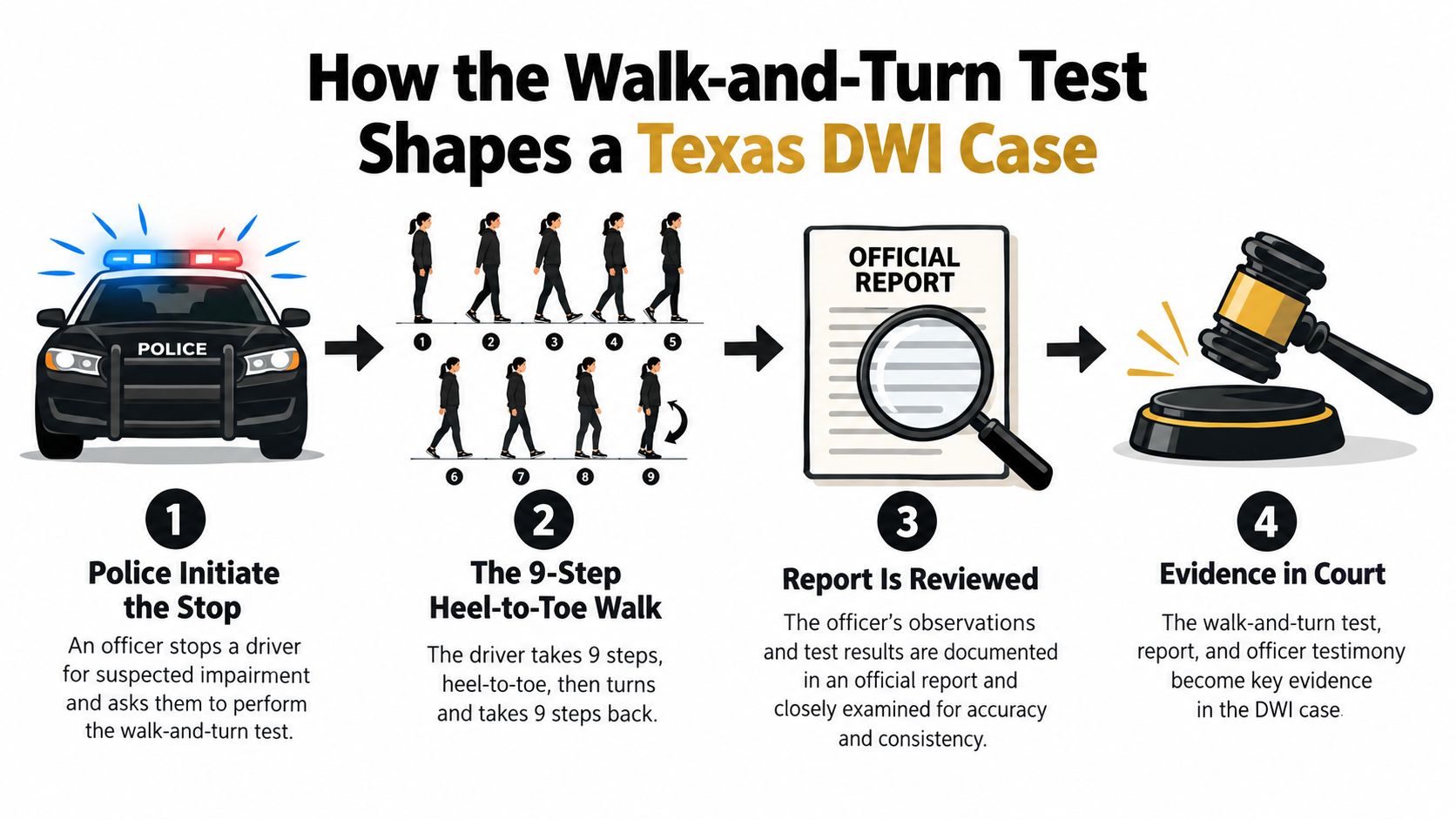
How the Walk-and-Turn Test Shapes a Texas DWI Case
The walk-and-turn, often called the WAT, is a divided-attention field sobriety test. You're asked to listen to instructions, maintain balance, walk in a prescribed pattern, turn, and return. Under the standardized protocol, the sequence is nine heel-to-toe steps out, a turn, and nine heel-to-toe steps back, as shown in NHTSA's participant manual.
Prosecutors often rely on the test because it creates a report that looks objective. Instead of writing only that a driver “appeared unsteady,” an officer can list alleged clues and point to a scoring system. NHTSA materials identify eight clues, and the operational decision point is two or more clues, according to the standardized manual used in field sobriety training (NHTSA refresher manual).
That score can influence what happens next:
- At the roadside, the officer may use the reported clues as part of the decision to arrest.
- At an ALR hearing, the State may rely on the officer's observations when defending a proposed DWI license suspension.
- In criminal court, prosecutors may use the test to argue that you lacked the normal use of your physical or mental faculties.
The test matters, but it isn't self-proving. The officer must give standardized instructions, use a suitable surface, observe the performance accurately, and record the clues correctly. If the test was conducted on uneven pavement, in poor lighting, or while you wore unsuitable footwear, the result may be far less meaningful than the report implies.
Practical rule: The question isn't simply whether you showed a clue. The question is whether the officer created reliable conditions for that clue to mean anything.
A Houston DWI lawyer will usually begin with the original video, the field sobriety worksheet, the officer's training records, and the exact language used during the test. That review can reveal whether the alleged two-clue foundation is solid or whether one or more observations should be excluded, reclassified, or given little weight.
The Eight NHTSA Clues Explained in Plain English
The eight clues are not eight separate tests. They are specific observations within one standardized exercise. NHTSA's scoring framework identifies the following clues and treats two or more clues as the decision point officers use to infer impairment (NHTSA's full SFST manual).
| Clue | What the Officer Looks For | Defense Angle |
|---|---|---|
| Cannot keep balance while listening | You raise an arm, step out of position, or otherwise lose balance during instructions | Was the stance explained clearly, and did the officer distinguish instruction-phase behavior from walking-phase behavior? |
| Starts too soon | You begin before the officer finishes the directions | Did the officer clearly tell you to wait, and does the video show that the instructions were complete? |
| Stops while walking | You stop to regain balance or pause during the sequence | Was it a true stop, or did you make a brief adjustment because the line or surface was unsafe? |
| Doesn't touch heel-to-toe | A gap between heel and toe exceeds 1/2 inch, under the scoring details described in the Texas Criminal Defense Lawyers Association review (TCDLA-referenced manual) | Can the officer identify the exact step and show the gap on video? |
| Steps off the line | Your foot moves off the designated line | Was there a visible line, and did the officer define where the line was? |
| Uses arms for balance | Your arms extend 6 inches or more from your sides, according to the referenced scoring standard (TCDLA-referenced manual) | Were you told to keep your arms at your sides, and did the officer measure or estimate the distance? |
| Improper turn | You pivot incorrectly, lose balance, or fail to follow the demonstrated turn | Did the officer demonstrate the turn accurately, and were you allowed to watch it? |
| Wrong number of steps | You take a number other than the required sequence | Did the officer count correctly, and did the instructions clearly identify the required steps? |
The defenses are often found in small details. A person who raises both arms during the turn generally receives one arm-use clue, not separate clues for each arm. An officer who counts a heel-to-toe gap without a clear view may be recording an assumption rather than an observable fact.
For a deeper discussion of these challenges, review how to challenge field sobriety test results in Texas. Your attorney should compare every alleged clue with the actual footage and the standardized scoring rule. The prosecution's list becomes the defense checklist.
Where Officers Go Wrong Administering the Test
A field sobriety test only has value when the officer administers it under appropriate conditions. NHTSA training materials describe a suitable testing environment as a dry, hard, level, and non-slippery surface, with a clear path, adequate lighting, and no unnecessary obstructions (NHTSA refresher manual). The officer should also account for footwear and demonstrate the instructions rather than merely reciting them.
Roadside reality often doesn't match the manual. Gravel, sloped shoulders, wet pavement, darkness, traffic, emergency lights, and passing vehicles can affect balance and concentration. If the report leaves those conditions out, that omission gives the defense a direct credibility issue.
Administration errors that matter
- Incomplete instructions: If the officer tells you to begin before explaining the entire sequence, a “starts too soon” clue may be unreliable.
- Confusing counting directions: If the officer changes how you should count or adds instructions that aren't part of the standardized exercise, counsel can argue that the test no longer followed the trained protocol.
- Poor demonstration: A vague or inaccurate demonstration can make an improper turn reflect confusion rather than impairment.
- Incorrect scoring: The officer may treat one movement as multiple clues, count steps inaccurately, or identify a heel-to-toe gap without a clear view.
- Missing conditions: Failure to document the surface, lighting, footwear, weather, or obstacles can weaken the officer's later testimony.
The legal response depends on how the error affected the case. Counsel may file a pretrial motion seeking to exclude unreliable evidence, use the deviation to impeach the officer at an ALR hearing, or argue to a jury that the test wasn't administered under conditions that support a dependable conclusion.
When an officer skips the standardized process, the test stops looking like a controlled assessment and starts looking like an opinion formed at the roadside.
An attorney should also compare the officer's report with dispatch records, bodycam audio, dashcam footage, and the SFST worksheet. A Texas DUI attorney doesn't need to claim that every imperfect step is meaningless. The stronger argument is narrower: the State can't rely on a standardized conclusion when the officer didn't follow the standards that make the conclusion useful.
Medical and Physical Conditions That Create False Clues
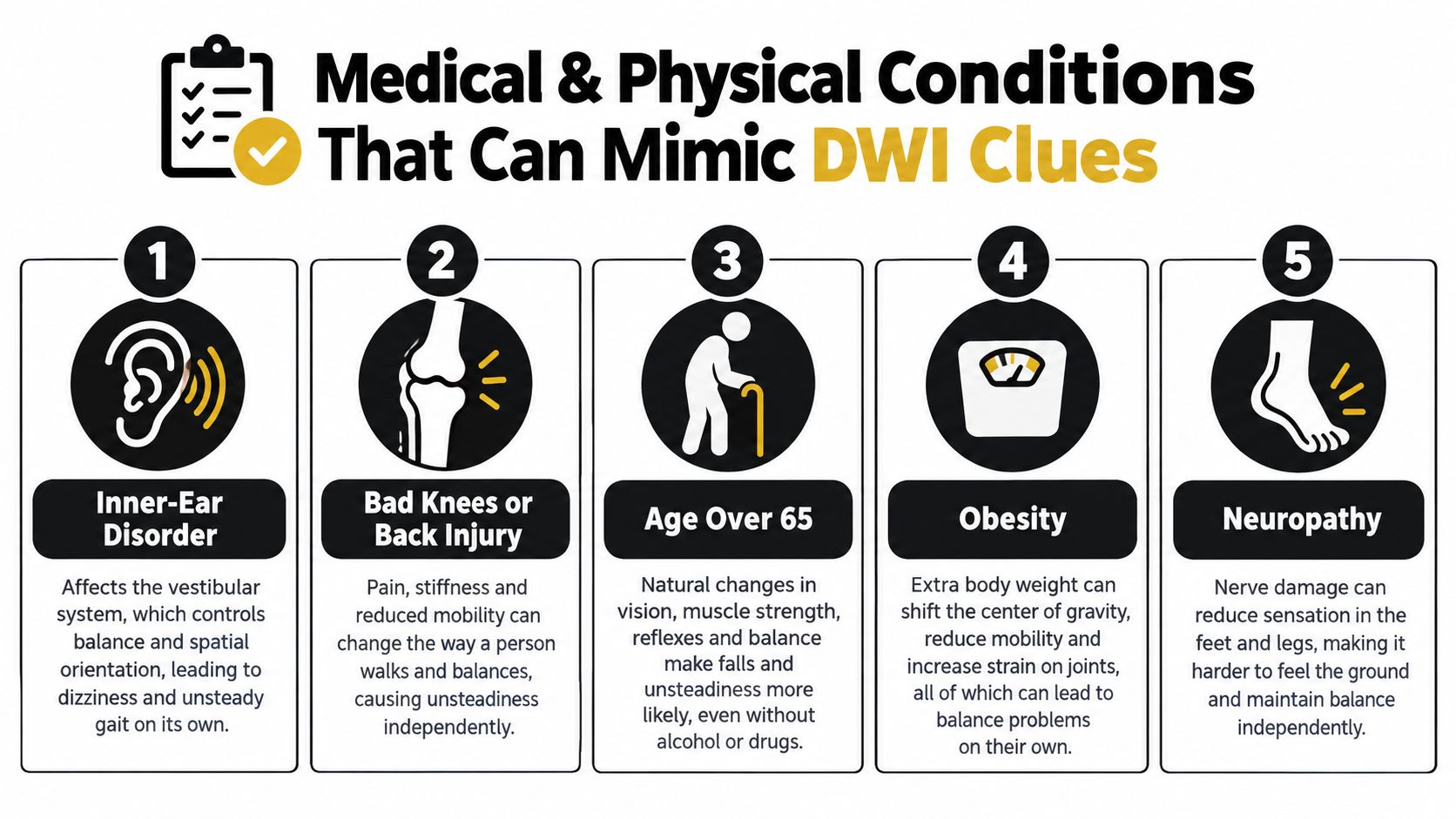
A walk-and-turn result can reflect body mechanics instead of alcohol. A driver with a torn meniscus may miss heel-to-toe because the knee hurts. Someone with an inner-ear disorder may struggle to maintain balance. Neuropathy can affect foot placement, while a prior back injury can make the turn uncomfortable or unstable.
Consider a 60-year-old driver with a damaged knee. During instructions, the driver raises an arm for stability and later steps away from the line. The officer may record two clues, but the defense explanation is visible in the medical history, the driver's gait, and the way the injury affects movement.
A veteran with service-connected vertigo presents a different problem. Inner-ear balance disorders can create instability without alcohol. A nervous executive who hasn't consumed alcohol may also rush the instructions, tense up, or raise the arms while trying not to fall. The video may show anxiety and uncertainty, not intoxication.
A defense lawyer should gather records that explain the physical cause:
- Orthopedic records showing knee, hip, or back limitations.
- VA disability files documenting vertigo, balance disorders, or service injuries.
- Treating physician letters explaining how a condition affects walking or coordination.
- Prescription lists identifying medications or treatment relevant to balance.
- Prior records showing that the same gait or limitation existed before the traffic stop.
The goal isn't to offer a list of possible excuses. It's to connect each alleged clue to a documented condition and show why the officer's alcohol-based interpretation is incomplete. Medical conditions that mimic intoxication in Texas DWI cases can help you identify issues that deserve immediate attention.
A Texas DWI Defense Lawyer may defend drivers charged with DWI under Texas Penal Code 49.04 by developing this medical and physical explanation alongside procedural challenges.
The following video illustrates why physical conditions deserve close review:
Pulling the Video to Challenge the Officer's Report
The officer's report is only one version of what happened. Dashcam and bodycam footage can show the actual instructions, the surface, your footwear, your balance, and whether the claimed clues appear on screen.
Start by preserving the evidence. Ask the arresting agency for the relevant video through an open records request, but don't assume that request alone protects the original media. Tell your lawyer immediately that video exists and ask counsel to pursue preservation, including a subpoena duces tecum when necessary. Request an unenhanced original copy, because editing, compression, or missing audio can hide the details that matter.
The frame-by-frame review
A careful review should answer concrete questions:
- Did the officer finish the instructions before you started?
- Was the walking path level, dry, hard, and visible?
- Did the officer demonstrate the turn correctly?
- How many steps did you take?
- Did you miss heel-to-toe by the required amount, or was the distance only estimated?
- Did an arm movement occur once or repeatedly?
- Does the report identify a clue that the video doesn't show?
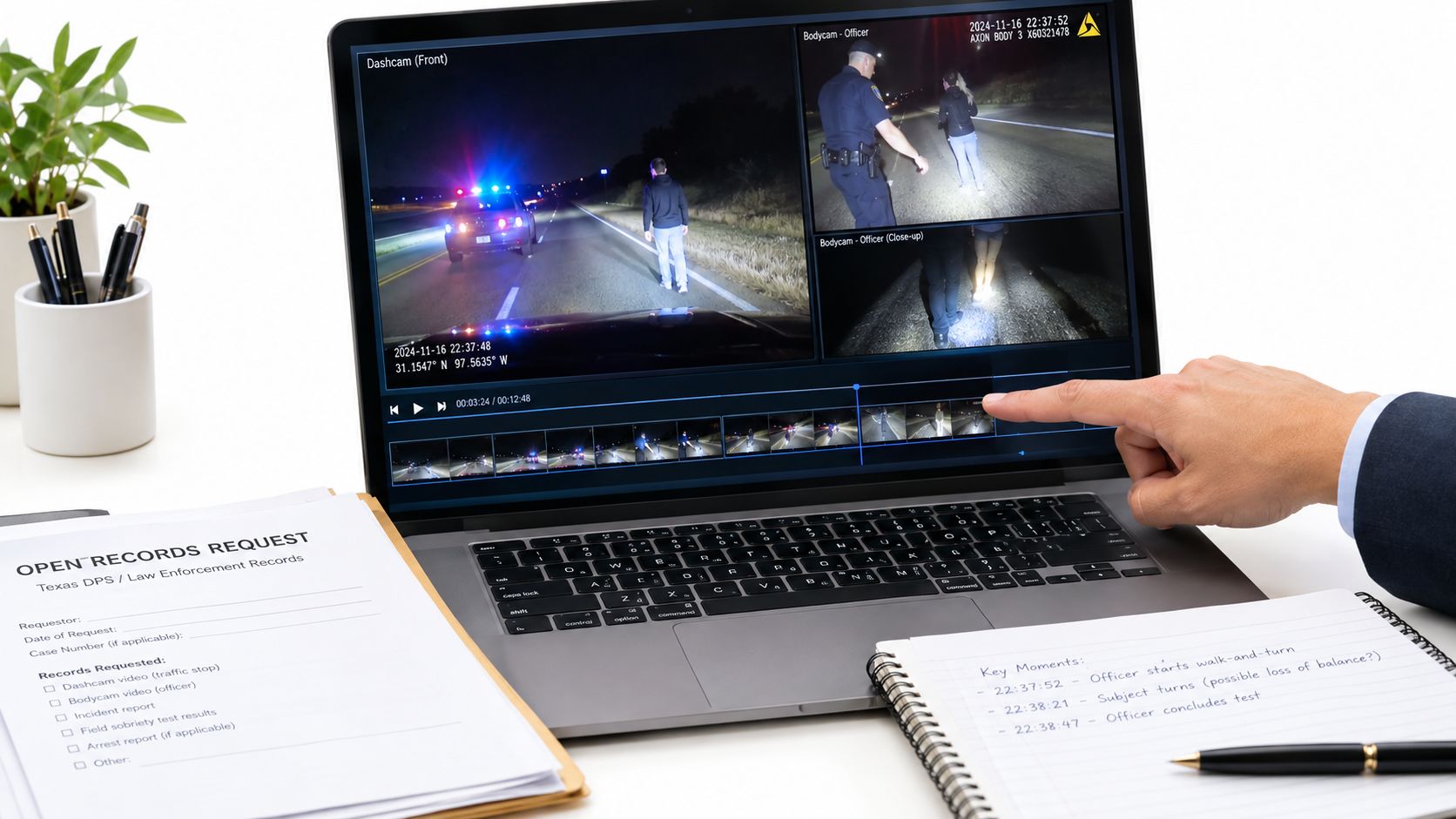
Counsel should compare the video with the report's timestamps, diagram, step count, and narrative. Using bodycam footage in DWI defense isn't about finding a dramatic moment. It's about finding contradictions that affect the foundation of the State's evidence.
Video can also reveal that the officer never asked about an injury, failed to explain the line, or positioned the camera so the feet were difficult to see. Those details can support cross-examination, an objection to the weight of the evidence, or a motion aimed at excluding evidence obtained after an unsupported arrest.
Cross-Examination Scripts for the Arresting Officer
Effective cross-examination starts with the foundation, not the alleged mistake. The objective is to make the officer commit to the standardized rules, then compare those rules with what happened on the roadside.
Training and scoring
Question: “You were trained to score specific walk-and-turn clues, not just decide whether someone looked nervous, correct?”
Expected answer: The officer agrees that the test uses defined clues.
Follow-up: “And the decision point you used was two or more clues, so each individual clue had to be accurately identified and counted?”
This approach makes the scoring system the witness's own framework. The defense then tests its application.
Conditions and instructions
Question: “You documented that the surface was dry, hard, level, and non-slippery?”
Expected answer: The officer may say yes, or may admit the report doesn't specify.
Follow-up: “Where does your report identify the lighting, slope, footwear, and visibility of the line?”
Ask the officer to identify the exact words used to explain the starting position, the turn, the required steps, and the instruction to keep arms down. Then ask whether the officer demonstrated the sequence and whether the video confirms that demonstration.
Individual clues
For heel-to-toe, ask which foot, which step, and how the officer determined that the gap exceeded 1/2 inch, as described in the Texas Criminal Defense Lawyers Association review and referenced NHTSA materials (TCDLA field sobriety review source). For arm use, ask whether the arms moved 6 inches or more and whether the officer measured that distance or estimated it. For the wrong number of steps, make the officer count aloud from the video.
If the report says you stopped, ask whether both feet became stationary and for how long. If it says you used your arms, ask whether one movement during the turn was scored once or treated as multiple clues.
Report versus recording
Question: “Your report says I stepped off the line at that point. The dashcam timestamp shows both feet remained on the visible path, correct?”
Expected answer: The officer may disagree.
Follow-up: “So your testimony depends on your memory and report, even though the recording can be reviewed frame by frame?”
End with the limitation that matters:
Question: “The walk-and-turn is a divided-attention indicator. It isn't, by itself, scientific proof that a person was intoxicated, correct?”
The answer won't decide the case alone. It can, however, prevent the report from being treated as unquestionable fact.
Suppression Motions, ALR Hearings, and Your Next Steps
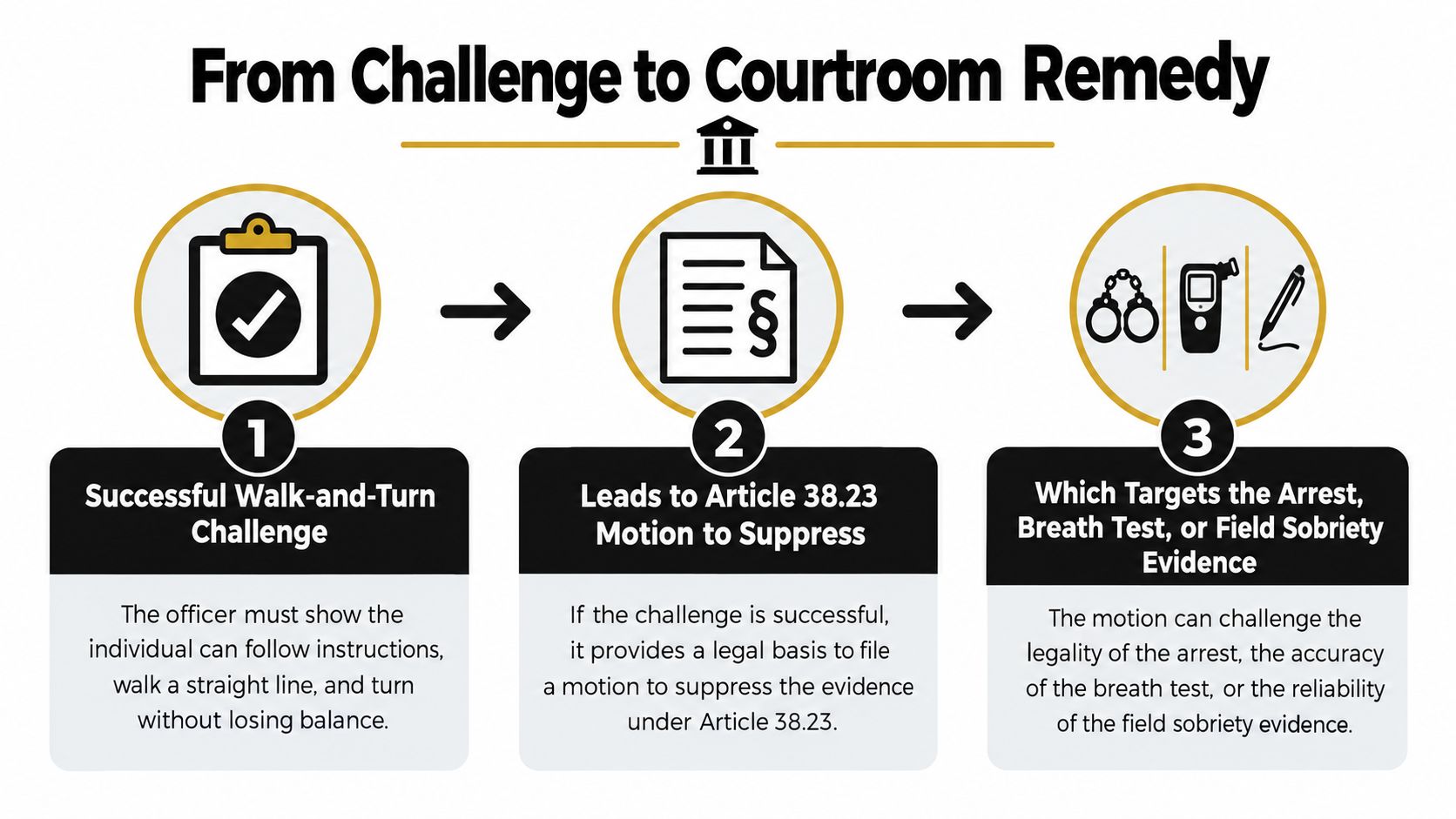
A walk-and-turn challenge becomes useful when it connects to a legal remedy. If the test was improperly administered, the defense may argue that the officer lacked reliable grounds for the arrest. Depending on the facts, counsel may pursue a motion under Texas Code of Criminal Procedure Article 38.23, which addresses evidence obtained in violation of the law.
A successful suppression argument can affect more than the walk-and-turn. If the arrest lacked lawful support, the defense may challenge evidence that followed, including breath or blood testing and statements made after the arrest. The exact remedy depends on the stop, the officer's observations, the timing of the arrest, and the other evidence available.
The criminal and administrative tracks
Texas has an implied-consent rule. In practical terms, driving on Texas roads is treated as consent to breath or blood testing after a lawful DWI arrest. Refusing a test can lead to an Administrative License Revocation, or ALR, case.
An ALR case is the administrative proceeding over a proposed DWI license suspension. Texas Department of Public Safety materials explain that an officer may seize the license, issue a suspension notice, and that the driver has 15 days from notice to request an ALR hearing (Texas DPS-related ALR explanation). Missing that deadline can eliminate an important opportunity to contest the suspension.
A lawyer can challenge the officer's account through the administrative process, then use inconsistencies developed there in the criminal case. The ALR hearing and criminal prosecution are separate tracks, so treat each deadline seriously.
What to do after arrest
- Preserve video immediately. Tell counsel about dashcam, bodycam, booking, and jail footage.
- Write down physical conditions. Record injuries, vertigo, neuropathy, footwear, pain, fatigue, and the surface you remember.
- Request discovery. Ask for the SFST worksheet, original video, bodycam, dashcam, dispatch logs, and related reports.
- Protect the ALR deadline. Request the hearing within the required period after receiving the notice.
- Review the complete case before speaking. Don't explain the facts to prosecutors or investigators before a lawyer has reviewed the evidence.
A BAC, or blood alcohol concentration, is the alcohol level measured in a bodily sample. It's different from field sobriety evidence, which concerns observations of physical and mental performance. A field sobriety test is a roadside assessment, and the walk-and-turn is only one part of the evidence prosecutors may present.
If this is your first DWI in Texas, the charge can still affect your license, record, employment, and insurance. A lawyer should evaluate the entire stop rather than focus only on the final clue count. If you're searching for “fight DWI Texas,” start with the evidence that can still be preserved and tested.
The Law Office of Bryan Fagan, PLLC offers free consultations to review your walk-and-turn performance, video evidence, medical factors, ALR deadline, and criminal DWI exposure. Visit Law Office of Bryan Fagan, PLLC to request a case evaluation and speak with a Texas defense team about the next step in protecting your license and your future.