
A DWI arrest can be overwhelming, especially if it started with flashing lights, a few roadside questions, and an officer asking you to step out of the car. Individuals often don’t know what counts as evidence, what they can refuse, or whether a bad performance on a roadside test means the case is over.
It usually isn’t.
If you’re searching for how to challenge field sobriety test results in Texas, the first thing to understand is simple. These tests are often treated like proof, but they’re really just one part of an officer’s investigation. They can be attacked. They can be limited. In the right case, they can be excluded.
A DWI Arrest Is Overwhelming But You Have Options
A lot of clients remember the same sequence. The officer asks if you’ve had anything to drink. Then comes the flashlight, the request to follow directions, and the feeling that every movement is being judged. If you were nervous, tired, upset, or physically uncomfortable, that matters more than is generally understood.
A field sobriety test is a roadside coordination exercise officers use to help decide whether they believe they have probable cause for a DWI arrest. It is not the same thing as a conviction. It is not even the strongest form of evidence in many cases. A roadside investigation moves fast, but a defense is built carefully.
What often hurts drivers most is the assumption that they “failed,” so nothing can be done. That assumption is wrong. A defense lawyer looks at how the stop happened, how the officer gave instructions, whether the location was suitable, whether the officer followed the required protocol, and whether the video matches the report.
Practical rule: A poor roadside performance is only damaging if the State can show the tests were administered properly and interpreted fairly.
That’s where many cases begin to shift.
A good challenge doesn’t rely on wishful thinking. It relies on details. Was the ground uneven? Did the officer rush? Were you wearing work boots, heels, or restrictive clothing? Did you have a medical issue, an inner ear problem, anxiety, or fatigue? Those facts can change how a judge sees the entire roadside encounter.
If this is your first DWI in Texas, the process may feel unfamiliar and urgent. If you’ve been through the system before, you already know the stakes are real. Either way, the same core principle applies. The State has to prove its case with reliable evidence, and field sobriety testing is often less reliable than it first appears.
Understanding Field Sobriety Tests in Texas Law
Police use field sobriety tests to help build probable cause, meaning enough reason to make a DWI arrest. In Texas, these tests are commonly part of the roadside investigation before an officer requests a breath or blood sample or makes an arrest.
The three standardized tests recognized by the National Highway Traffic Safety Administration are:
- Horizontal Gaze Nystagmus
- Walk-and-Turn
- One-Leg Stand
Here is the roadside setting that is widely familiar.
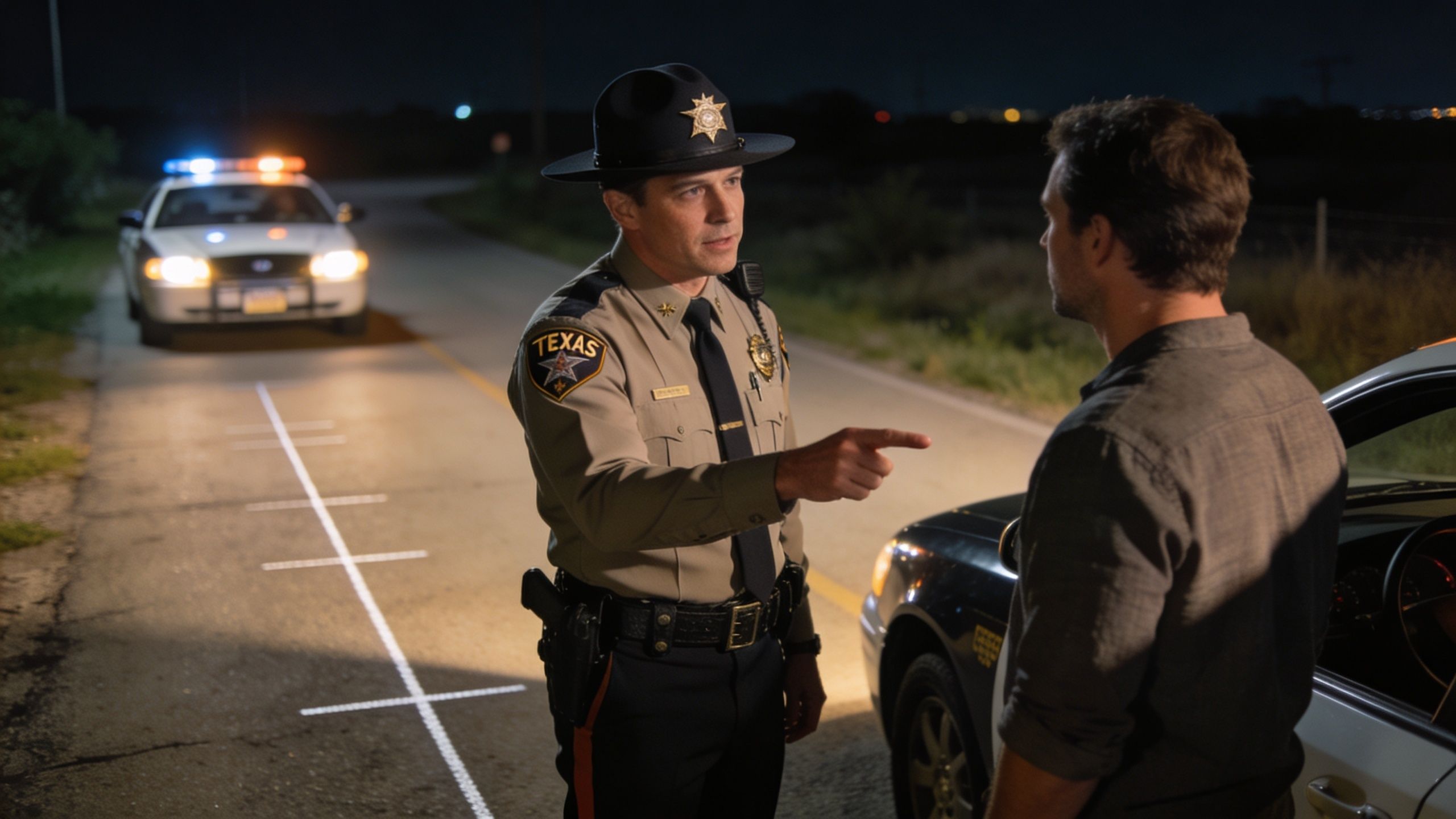
What the three standardized tests are supposed to measure
The Horizontal Gaze Nystagmus, often called HGN, involves the officer moving an object in front of your eyes and watching for involuntary eye movement. Officers are trained to look for specific clues.
The Walk-and-Turn requires you to take a set of heel-to-toe steps, turn in a particular way, and return while following detailed instructions.
The One-Leg Stand requires you to balance on one foot while counting as instructed.
These tests sound straightforward on paper. On the roadside, they often aren’t. You may be on gravel, sloped pavement, poor lighting, or near traffic. You may be confused by the instructions or focused on the officer’s tone rather than the exact sequence you’re being asked to perform.
Why these tests are often challenged
The legal problem with field sobriety tests is that they are often presented as scientific when they are heavily dependent on the officer’s observations and judgment. According to this discussion of Texas field sobriety testing, field sobriety tests in Texas are highly subjective and prone to error, with factors like fatigue, fitness levels, weight, medical conditions, anxiety, and uneven testing surfaces capable of being misread as intoxication.
That matters because many sober people can struggle with balance, divided attention, or quickly processing instructions during a stressful traffic stop.
A field sobriety test is not a true pass or fail event. It’s an officer’s interpretation of how you performed under pressure.
That interpretation can be wrong.
What these tests are not
They are not a reliable shortcut to guilt. They are not immune from challenge. They are not automatically valid because an officer wrote “failed” in a report.
They are also different from a chemical test. A chemical test is a breath or blood test used to try to measure BAC, or blood alcohol concentration. BAC refers to the amount of alcohol in a person’s bloodstream. Field tests don’t directly measure BAC at all. They are observational tools.
That distinction becomes very important later in a case.
Why probable cause matters so much
If the officer relied heavily on field sobriety tests to justify the arrest, then any weakness in those tests can affect the entire case. A challenge may focus on whether the officer had enough reliable evidence to arrest you in the first place.
That’s why defense lawyers don’t just ask whether you did well or poorly. They ask:
- What exactly did the officer say before the test began?
- Did the officer demonstrate the test correctly?
- Did you tell the officer about injuries, medications, or medical conditions?
- Does the video show what the report claims?
When the answers don’t line up, the State’s confidence in the roadside testing often starts to weaken.
The Critical Roadside Decision Refusing FSTs vs Chemical Tests
The most misunderstood DWI decision in Texas happens before anyone gets to court. Drivers often assume every test is mandatory. That isn’t true.
A field sobriety test is generally voluntary. A chemical test is different because Texas applies implied consent rules to breath and blood testing after an arrest request. Implied consent means that by driving on Texas roads, you are considered to have agreed to provide a breath or blood specimen when lawfully requested under the statute. The consequences of refusal are not the same.
According to this Texas guide on refusing field sobriety tests, field sobriety tests are voluntary with no automatic penalties for refusal in Texas, while refusing a breath or blood test can lead to a driver’s license suspension for at least 6 months, even without a DWI conviction.
The side by side difference
| Action | Is it Voluntary? | Penalty for Refusal |
|---|---|---|
| Field sobriety test refusal | Yes | No automatic penalty |
| Chemical test refusal | No, because implied consent applies to the request | Driver’s license suspension for at least 6 months |
This is why the roadside decision needs to be strategic, not emotional.
What refusing a field sobriety test does and does not do
If you politely refuse roadside balancing or eye tests, the officer may still continue the investigation. Refusal does not make the stop disappear. It does not guarantee you won’t be arrested. The officer can still rely on driving facts, odor, speech, admissions, and other observations.
But refusal can limit the amount of performance-based evidence the State collects against you.
That can matter later. Without those roadside exercises, the prosecutor may have less to argue about balance, divided attention, or “clues” on standardized tests. In some cases, that changes the advantage in both license and criminal proceedings.
For a more detailed discussion, review this Texas field sobriety test refusal guide.
Why chemical test decisions are harder
A chemical test usually means a breath or blood test requested after arrest. Refusing that request is a different legal event than refusing roadside exercises. This difference highlights the importance of administrative license suspension.
An administrative license suspension, often discussed in Texas as part of the ALR process, is a civil action against your driver’s license that runs separately from the criminal DWI case. It can happen even if you are never convicted. That’s one of the most frustrating parts of DWI law for many drivers.
So the trade-off is real:
- Refusing a chemical test may reduce one kind of evidence.
- But it can trigger a license fight.
- Taking the chemical test may preserve your license position better in some situations.
- But it may also give the State scientific evidence to use in court.
There is no universal answer that fits every roadside stop. CDL holders, people with prior cases, and drivers whose work depends on mobility often have different priorities than someone focused only on the criminal charge.
The smartest approach is understanding that roadside exercises and station-house testing are not the same decision under Texas law.
What to do in the moment
If you are stopped, keep your behavior controlled. Be respectful. Don’t argue. Don’t volunteer explanations that can be misunderstood. If asked to perform field sobriety tests, know they are not the same as a breath or blood request.
A calm refusal sounds very different from defiance. So does a calm question about whether you are under arrest.
What doesn’t work is trying to talk your way out of the stop with long explanations, jokes, or half-admissions. Those statements often become evidence. Short, polite communication usually protects you better than roadside persuasion.
Building Your Defense Common Grounds for Challenging FST Results
Challenging field sobriety testing works best when it is methodical. The goal isn’t to say, “I disagree with the officer.” The goal is to show exactly why the testing was unreliable, unfairly interpreted, or legally defective.
One of the strongest foundations for this challenge comes from protocol. According to this analysis of Texas FST challenges, the three standardized field sobriety tests are subject to strict NHTSA protocols, and deviations such as unclear instructions, improper demonstrations, or failure to consider environmental factors can support a motion to suppress. Video evidence often reveals discrepancies between the officer’s report and what occurred.
This is the defense checklist many lawyers use when evaluating a roadside investigation.
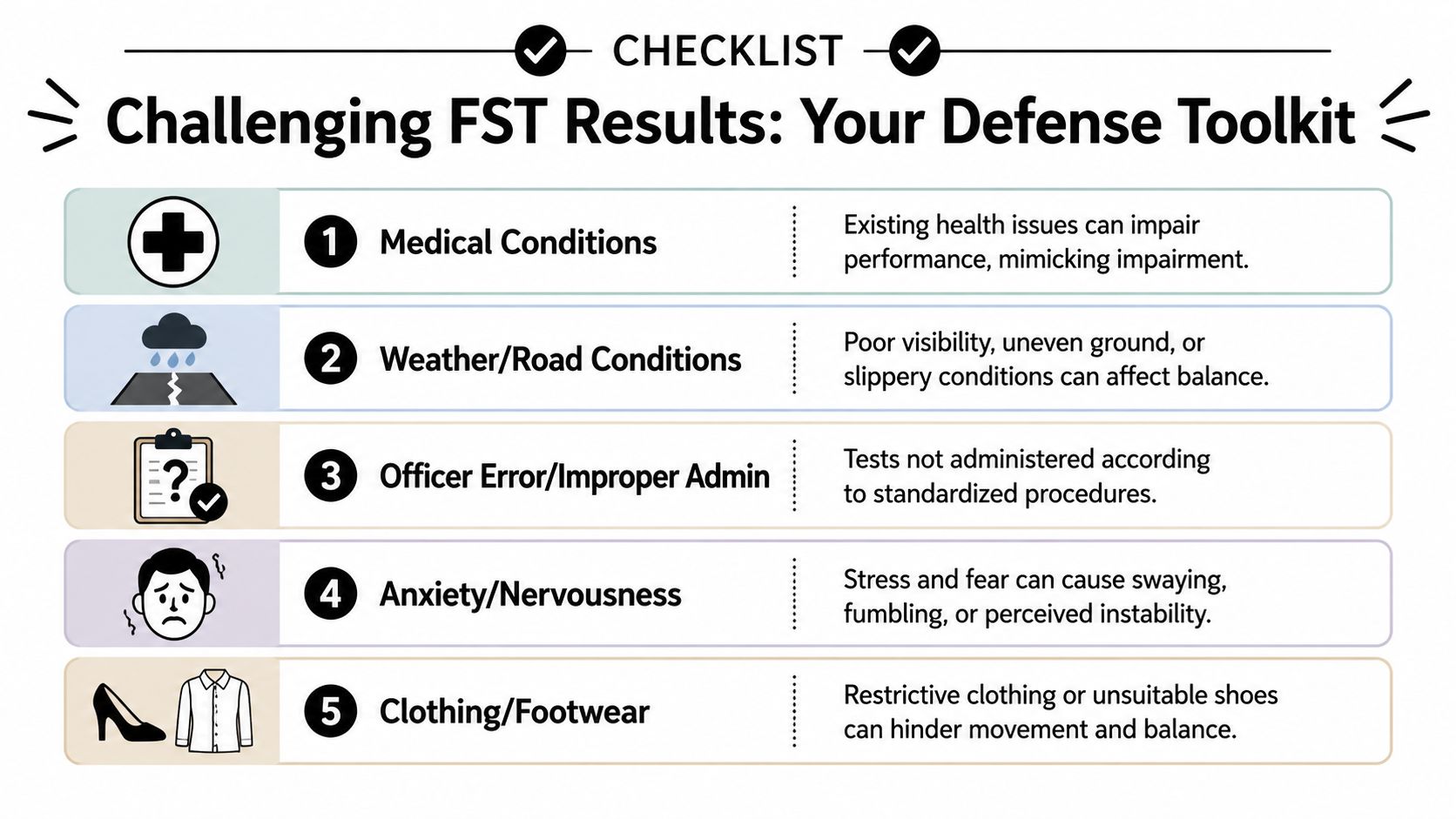
Improper administration can unravel the test
Officers don’t get unlimited freedom in how they administer standardized tests. They are supposed to follow the training protocol closely. Small mistakes can have large consequences because the tests depend on standardization.
Common issues include:
- Unclear instructions that leave the driver guessing about the sequence
- Poor demonstrations where the officer doesn’t properly show what to do
- Rushed administration that creates confusion and sets the driver up to appear noncompliant
- Failure to confirm understanding before the test begins
A defense lawyer compares the report, body camera, dash camera, and any test forms to see whether the officer followed the rules.
Video often matters more than the report
Police reports tend to summarize conclusions. Video shows conduct.
That difference is why camera footage can be the turning point in a DWI case. A report may say you swayed, stumbled, or missed instructions. The video may show you standing steadily, asking reasonable clarifying questions, or trying to comply while traffic passes close by.
When no video exists, that doesn’t automatically help the State. It can leave the prosecution relying heavily on officer memory and courtroom testimony.
What defense lawyers look for: whether the video supports the officer’s claimed clues, whether the officer interrupted the test, and whether the testing location was fair.
The testing location may be part of the problem
A roadside shoulder is not a laboratory. It may be sloped, broken, wet, dark, noisy, or crowded by traffic. Those conditions affect balance and concentration.
Environmental challenges often include:
- Uneven pavement or gravel
- Poor lighting
- Wind, rain, or slick surfaces
- Traffic noise and distractions
- Unsafe proximity to passing vehicles
The legal value of these facts increases when they are visible on video or supported by witness observations.
Your body may explain the result better than alcohol does
Field sobriety testing assumes a person can balance, pivot, listen, process instructions, and divide attention smoothly. Many people can’t do that perfectly even when sober.
Important personal factors may include:
- Medical conditions, including issues affecting balance or neurological function
- Prescription medication effects
- Fatigue
- Anxiety or stress
- Fitness limitations or weight-related balance issues
- Footwear or restrictive clothing
If a client tells me, “I told the officer I had a knee problem,” that detail matters. If medical records already existed before the arrest, that can matter even more.
For drivers facing HGN-related allegations, this overview of the horizontal gaze nystagmus test helps explain why eye-test issues must be reviewed carefully.
Officer qualification is not a minor issue
The State still has to show that the officer was properly trained and certified to administer standardized tests with evidentiary value. That means defense counsel looks at training records, experience, and whether the officer stayed within the standardized methods rather than inventing roadside exercises.
Not every coordination test an officer uses carries the same legal weight. Creative, non-standard tests often receive much more scrutiny.
What helps a challenge and what usually doesn’t
Some defenses are stronger than others.
What often helps:
- Existing medical documentation
- Clear video contradictions
- Recorded procedural errors
- Witnesses who saw the roadside conditions
- Prompt legal review before memories and evidence fade
What usually doesn’t help by itself:
- A general statement that the officer was unfair
- An after-the-fact explanation with no supporting records
- Assuming the judge will distrust police automatically
- Waiting too long to gather video or medical evidence
The strongest cases are built from proof, not frustration. That’s why experienced counsel focuses on records, footage, protocols, and testimony instead of broad complaints.
The Legal Process How FST Challenges Unfold in Texas
After a DWI arrest, two tracks usually begin at the same time. One concerns your license. The other concerns the criminal charge. People often think these are the same case. They aren’t.
Texas uses field sobriety test challenges in both settings. According to this discussion of FST strategy in Texas DWI cases, challenging FSTs is a key strategy in both the ALR hearing and the criminal case, and successful challenges often lead to dismissed charges, reductions, or deferred adjudication. The same source notes that Texas sees over 80,000 DWI arrests annually.
The ALR hearing and your license
The Administrative License Revocation process, often shortened to ALR, focuses on your driving privileges. Within this process, a DWI license suspension fight begins after a refusal or certain test-related events.
At the ALR stage, your lawyer examines whether the officer had a lawful basis for the stop, a sufficient basis for the arrest, and proper grounds for the testing request. If field sobriety tests played a major role in probable cause, weaknesses in those tests can matter here.
This ALR hearing evidence guide for Texas cases gives a useful overview of the records and issues that often come into play.
The criminal case and the motion to suppress
The criminal case is separate from the license case. In criminal court, one of the most important tools is a motion to suppress. That is a request asking the judge to exclude evidence because it was obtained unlawfully or is too unreliable under the circumstances.
When a motion to suppress targets field sobriety testing, the argument may focus on:
- Lack of probable cause
- Protocol violations
- Improper administration
- Unreliable interpretation
- Evidence contradicted by video
If the court excludes key evidence, the prosecution may have a much weaker case. That can affect plea negotiations, trial strategy, and the final outcome.
A successful suppression issue doesn’t have to end the case outright to matter. Sometimes it changes the case enough to produce a much better resolution.
What the timeline usually looks like
The process often unfolds in this order:
Arrest and release conditions
You may deal with bond terms, court dates, and immediate license concerns.License defense decisions
The ALR matter moves on its own timeline and can require quick action.Evidence gathering
Your lawyer seeks reports, videos, dispatch records, and training materials.Pretrial litigation
During this phase, suppression issues are developed and argued.Resolution or trial
Depending on the evidence, the case may resolve through dismissal, reduction, deferred adjudication, or trial.
For someone dealing with a first DWI in Texas, this split-track system can be the hardest part to understand. But it also creates opportunity. A problem in the roadside investigation can affect both your license fight and the criminal prosecution.
Why You Need an Experienced Houston DWI Lawyer on Your Side
At roadside, one choice can shape the whole case. A driver may refuse voluntary field sobriety tests, then face very different consequences if the officer later requests a breath or blood test under Texas implied consent rules. That distinction is easy to miss in the moment, and prosecutors often benefit when drivers do not understand it.
An experienced Houston DWI lawyer or Texas DUI attorney looks at that decision in context. The job is not limited to arguing that you were nervous, tired, or dealing with a bad roadside surface. The job is to identify where the officer exceeded the law, blurred the line between voluntary and mandatory testing, failed to give clear warnings, or drew conclusions the video does not support.
As noted earlier in the article, field sobriety tests are often challenged because they depend heavily on officer interpretation and can be affected by ordinary, non-alcohol factors. A good defense turns those facts into evidence the court can use.
What experienced counsel does that changes the case
A lawyer who regularly handles Houston DWI cases will usually:
- Examine the roadside encounter from the first contact, including whether the officer improperly extended the stop
- Separate voluntary FST issues from chemical test issues, because the legal rules and consequences are different
- Review dashcam, bodycam, and dispatch records for contradictions
- Compare the report to the video frame by frame
- Check whether the officer gave proper instructions and demonstrations
- Investigate medical, physical, and environmental explanations for alleged clues
- Prepare for both the ALR license case and the criminal case, since one can affect strategy in the other
Cross-examination is where many of these cases shift. Officers often write reports in broad, confident terms. In court, they have to answer specific questions about lighting, slope, footwear, traffic, distractions, exact wording of instructions, and whether they told you the field tests were voluntary. Those details matter.
This work is hard to do alone. Judges want legally grounded arguments tied to the record, not general objections. Prosecutors hear generic complaints every week. What gets traction is a focused challenge built around Texas procedure, the officer’s training, the video, and the difference between refusing a voluntary roadside exercise and refusing a chemical test that carries separate license consequences.
That is why some drivers hire firms that regularly handle these cases, including Law Office of Bryan Fagan, PLLC, to review the arrest, test the State’s evidence, and defend both the administrative and criminal sides of the case.
If you want to fight DWI Texas charges effectively, you need more than a general sense that something felt unfair. You need a lawyer who can turn the facts into a strategy.
Frequently Asked Questions About Texas FST Challenges
Can I challenge field sobriety tests if I already took them
Yes. Taking the tests doesn’t waive your right to challenge them. Many strong defenses are built around how the officer administered the tests, how the officer interpreted them, and whether the video supports the report.
Does challenging the tests make me look guilty
No. Challenging evidence is a normal part of criminal defense. The State has the burden to prove that its evidence is reliable and lawfully obtained. Holding the State to that burden is not an admission of guilt.
What if there is no dashcam or bodycam footage
That can be important. Without video, the prosecutor may depend more heavily on officer testimony. In some cases, that makes it harder for the State to prove details about the testing environment, your performance, or the exact instructions given.
Can medical issues really make a difference
Yes, especially when they are documented. Balance issues, neurological problems, prescription medication effects, orthopedic limitations, and similar conditions may provide a non-alcohol explanation for roadside performance.
Is a first DWI in Texas easier to resolve
Not automatically. But first-time cases often present more room for strategic defense, negotiation, and efforts to reduce long-term consequences. The facts still control the outcome.
What should I do right after a DWI arrest
Act quickly. Write down what you remember about the stop, the location, your footwear, weather, surface conditions, and anything the officer said. Then speak with a lawyer promptly so evidence can be preserved and deadlines aren’t missed.
If you were arrested after roadside testing, you don’t have to guess your way through the next step. The attorneys at Law Office of Bryan Fagan, PLLC help clients challenge field sobriety evidence, fight DWI license suspension issues, and defend criminal charges across Texas. If you’re facing a first DWI in Texas or need a strategic Houston DWI lawyer to review your case, request a free consultation and get clear answers about your options now.