
A DWI arrest can turn your life upside down in a single night. If you weren't drinking, or you had only a small amount to drink, the situation feels even more surreal. You know what happened in your body. The officer only saw what it looked like from the roadside.
That gap matters in Texas.
Officers are trained to look for slurred speech, confusion, glassy eyes, balance problems, and trouble following instructions. Those are also classic signs of a medical problem. If your case involves diabetes, GERD, a neurological condition, an inner ear issue, a panic episode, or another health problem, you may be dealing with one of the most overlooked defenses in Texas DWI law.
A DWI Arrest Can Be Overwhelming Especially When You Weren't Drinking
If you're reading this after a Texas arrest, you're probably replaying every second of the stop. Maybe you were shaky, confused, exhausted, dizzy, or struggling to answer basic questions. Maybe your speech sounded off because your blood sugar dropped. Maybe you failed roadside tests because of vertigo, a head injury, or a neurological issue.
That doesn't mean the charge is right.
Texas law lets police arrest for DWI based on observed loss of normal mental or physical faculties. That gives officers room to act quickly, but it also creates room for serious mistakes when a medical issue looks like intoxication. A roadside investigation is not a medical exam.

A documented nationwide review shows this is not rare guesswork. A 2023 UCLA study analyzing 12,000 DUI cases found that 4.1% involved people whose medical conditions were potentially misinterpreted as intoxication by law enforcement, as discussed in this analysis of medical conditions mistaken for DWI.
What that means for your case
The state may say your behavior proved intoxication. Your defense may show your body was doing something else entirely.
Three facts usually drive these cases:
- Police aren't physicians. They make judgment calls based on outward symptoms.
- Medical records can change the entire story. A diagnosis, treatment note, or prescription history can explain what the officer misunderstood.
- Fast action matters. The earlier your lawyer ties your symptoms to a real condition, the stronger your defense becomes.
Practical rule: If a health issue played any role in your stop, tell your attorney immediately, even if it feels unrelated or embarrassing.
You are not stuck with the officer's version
I've seen people assume the arrest report is the final word. It isn't. It's one version of events, usually written by someone who had minutes to assess you on the side of the road.
Your job now is simple. Stop trying to explain this away on your own, stop assuming a breath result ends the case, and start treating your medical history like evidence. That's how you fight medical conditions that mimic intoxication Texas DWI allegations. That's also how you protect your license, your job, and your record.
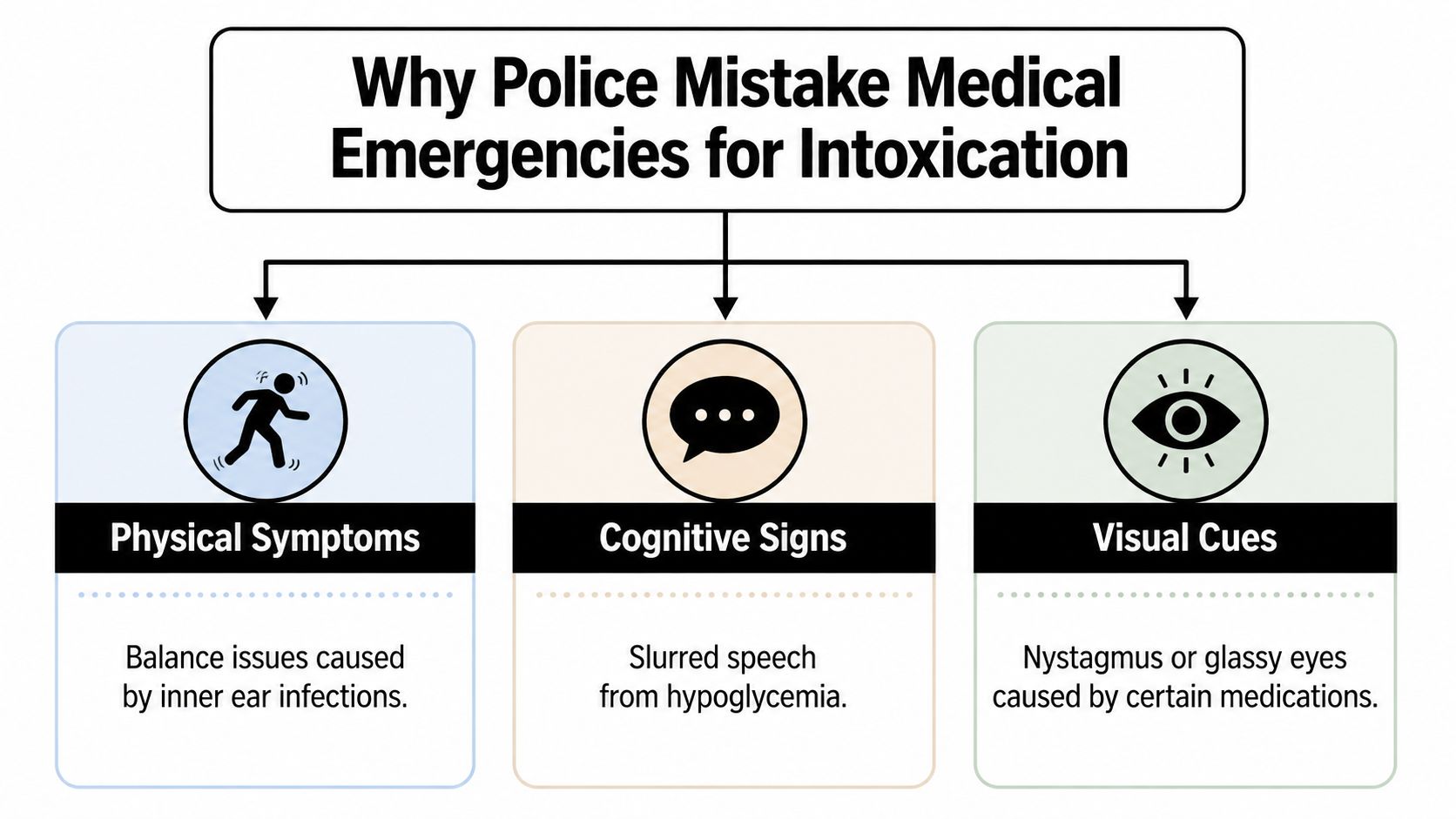
Why Police Mistake Medical Emergencies for Intoxication
Most DWI arrests start with ordinary observations. Drifting in a lane. Delayed responses. Trouble standing still. Red eyes. Confused answers. From the officer's perspective, those signs can build reasonable suspicion for a stop and then probable cause for an arrest.
The problem is obvious. Those signs are not unique to alcohol.
What officers are trained to look for
Once you're pulled over, the investigation usually shifts to field sobriety tests. These are roadside exercises officers use to decide whether they think you're impaired. The most common are the Horizontal Gaze Nystagmus test, the Walk-and-Turn, and the One-Leg Stand.
If you want to understand one of the most criticized tests in these cases, review this explanation of the Horizontal Gaze Nystagmus test.
Here is what officers generally focus on during those tests:
- Eye movement clues like jerking or lack of smooth tracking
- Balance problems such as stepping off the line, swaying, or putting a foot down
- Instruction issues like starting too early, stopping mid-test, or seeming unable to follow directions
- Speech and behavior cues including confusion, delayed responses, or seeming disoriented
Those clues may sound scientific. They're not. They're observational.
Why roadside tests break down in medical cases
A person with vertigo may look unsteady. A person with hypoglycemia may look confused. A person recovering from a seizure may have slurred speech and poor coordination. A person in the middle of a panic episode may struggle to process instructions.
That doesn't mean the officer is acting in bad faith. It means the test itself has limits.
Roadside sobriety tests measure performance under stress. They do not diagnose the cause of poor performance.
Common reasons officers get it wrong
Medical mimic cases often collapse around the same pressure points:
- The officer saw symptoms, not causes. Dizziness, fatigue, and speech changes are visible. The underlying medical reason isn't.
- The setting makes things worse. Flashing lights, traffic noise, late-night fatigue, uneven pavement, and anxiety can magnify symptoms.
- People under stress don't advocate well. If you're scared, low on blood sugar, post-seizure, or short of breath, you may not clearly explain your condition.
- Police reports flatten nuance. The report might say "unsteady" or "confused" without noting you asked for medical help or disclosed a condition.
Key terms you need to know
A few terms matter in nearly every Texas DWI case:
- BAC means blood alcohol concentration. It's the measurement the state uses to claim alcohol in your system.
- Field sobriety test means the roadside physical and mental exercises used to look for signs of impairment.
- Implied consent means that by driving in Texas, you can face consequences if you refuse a lawful breath or blood test request after a DWI arrest.
- Administrative license suspension means the separate civil process that can suspend your license, even before the criminal case is resolved.
You don't beat these cases by arguing that officers should have been doctors. You beat them by showing exactly why their observations were incomplete, unreliable, or medically explainable.
Common Medical Conditions That Can Lead to a DWI Arrest
Some medical conditions that mimic intoxication Texas DWI arrests involve dramatic emergencies. Others involve common, chronic problems that many Texans live with every day. That's why these cases deserve a closer look than the usual "you looked impaired" accusation.
Diabetes and blood sugar emergencies
Diabetes is one of the clearest examples. A blood sugar crash can cause sweating, shakiness, blurred thinking, slurred speech, confusion, and trouble walking. To an officer on the roadside, that can look exactly like alcohol impairment.
Diabetic ketoacidosis, or DKA, creates another layer of risk. In Texas DWI cases, DKA can produce acetone breath with an alcohol-like odor and cause confusion, slurred speech, and ataxia, which are symptoms that overlap with intoxication. A 2018 study found DKA patients can register false-positive breath alcohol concentrations up to 0.1% on non-evidential devices, according to this discussion of medical conditions that mimic intoxication.
That matters because an officer may rely on both what you looked like and what they thought they smelled.
Neurological disorders and post-event confusion
Neurological conditions can wreck a roadside investigation. A seizure disorder, multiple sclerosis, Parkinson's disease, or a head injury can affect speech, reaction time, balance, and coordination. Someone recovering from a seizure may look disoriented and physically unstable for reasons that have nothing to do with drinking.
These cases often hinge on timing. If symptoms flared right before the stop, the officer may have encountered you at the worst possible moment.
If you have a neurological condition, don't assume the prosecutor will understand it from the chart alone. These cases often need a doctor to translate symptoms into plain English.
Inner ear issues and balance disorders
Balance tests are a weak point in many DWI cases. Inner ear problems, vertigo, and vestibular disorders can make standing heel-to-toe or balancing on one leg nearly impossible. Those are exactly the tasks officers use to justify arrest.
A healthy person can struggle with those tests on a dark roadside. Someone with a legitimate balance disorder starts at a disadvantage before the test begins.
Anxiety, panic, and other stress-based symptoms
Panic attacks can produce trembling, rapid breathing, dizziness, confusion, chest tightness, and an inability to process instructions. Those symptoms can look chaotic to police. The person experiencing them may seem evasive when they're overwhelmed.
That's one reason clients should stop minimizing anxiety as "just stress." If it affected your stop, it belongs in the defense file.
Gastrointestinal and reflux-related problems
GERD and severe acid reflux can create issues that go beyond physical symptoms. They can also interfere with how some alcohol testing methods read your breath. I address the testing side in the next section, but from a behavioral standpoint, chronic reflux can pair with sleep disruption, fatigue, discomfort, and distress during a stop.
A simple comparison of what officers see
| Observable Sign | Officer's Interpretation (Intoxication) | Potential Medical Cause |
|---|---|---|
| Slurred speech | Alcohol impairment | Low blood sugar, neurological event, post-seizure symptoms |
| Unsteady walking | Loss of normal physical faculties | Vertigo, inner ear disorder, injury, DKA |
| Confusion | Mental impairment from alcohol | Hypoglycemia, panic attack, seizure recovery, head trauma |
| Alcohol-like or fruity breath | Recent drinking | DKA or other metabolic issue |
| Trouble following instructions | Intoxication or refusal to cooperate | Anxiety episode, neurological disorder, cognitive overload |
| Glassy or abnormal eyes | Intoxication clue | Medical condition, fatigue, medication effects |
What to do if one of these conditions applies to you
Don't wait for the state to "figure it out." Prosecutors usually won't.
Start gathering:
- Diagnosis records from your doctor, specialist, or hospital
- Medication lists that show what you were prescribed at the time of arrest
- Recent treatment notes if you had a flare-up, ER visit, or ongoing management issue
- Witness accounts from anyone who saw your symptoms before or after the stop
The state will try to reduce your case to a few observations on a police report. Your defense has to rebuild the full picture.
How Medical Conditions Affect DWI Breath and Blood Tests
A lot of people think the chemical test ends the argument. It doesn't. Breath and blood evidence can be challenged, especially when health conditions affect what the machine detects or how the body presents alcohol-like compounds.
Texas doesn't require a case to rise or fall only on a reading. A person can still be prosecuted based on alleged impairment. That's exactly why chemical evidence must be tested hard, not accepted blindly.

Breath tests are not the same as truth
A breathalyzer estimates alcohol concentration from your breath. The legal number widely recognized is 0.08 BAC, but in Texas, a DWI conviction can still happen even when the reading is below that level if the officer claims you were impaired.
That makes medical interference even more important. According to this Texas discussion of breathalyzer accuracy issues, breath testing is vulnerable to challenge when the reading doesn't match the full picture.
A related legal reality matters here too. In Texas, a DWI conviction is possible even below 0.08% BAC if impairment is observed, and GERD can cause falsely increased breathalyzer readings from stomach acid. An estimated 5% to 10% of U.S. DUI arrests may involve underlying medical conditions, as explained in this analysis of Texas DWI charges without failing a breath test.
How GERD and similar conditions skew the picture
GERD can push stomach contents and acid upward during deep exhalation. That can affect what a breath machine captures. If the machine detects alcohol from the mouth or upper digestive tract rather than deep lung air, the result may not reflect actual intoxication the way the state claims.
That's one reason I never treat a printed number as the end of the conversation. I want to know whether you have reflux, whether you burped, whether you coughed, whether you were recently sick, and whether the officer followed observation rules before the test.
A machine reading only matters if the testing conditions were reliable. Medical conditions can attack reliability from the start.
Blood tests can also be challenged
People hear "blood test" and assume it's unbeatable. That's lazy thinking.
Blood testing raises different questions:
- Who drew the blood
- How the sample was labeled and stored
- Whether the chain of custody is clean
- Whether the lab report fits the rest of the evidence
- Whether a medical condition complicates interpretation
This short video gives useful context on why scientific evidence in DWI cases deserves scrutiny:
What clients should stop saying
Don't say, "I blew over, so I guess I'm done." Don't say, "My blood came back, so there's no defense." Those assumptions hand the state a victory it hasn't earned.
A Houston DWI lawyer looking at a medically complicated case should examine the officer's observations, the testing method, your medical records, and whether the science lines up with the accusation. That's how you fight DWI Texas cases involving reflux, diabetes, sleep issues, and other hidden drivers of false suspicion.
Building Your Defense After a Medically-Related DWI Arrest in Texas
You need a defense plan immediately if your arrest was tied to a medical condition. Texas gives the state two ways to hurt you fast. One is your license. The other is the criminal case. If you wait, the officer's version hardens, the prosecutor builds around it, and your medical proof gets treated like an excuse instead of evidence.
Start with the license fight
The first deadline that matters is the Administrative License Revocation hearing, or ALR hearing. That proceeding is separate from the criminal case, and it gives you an early chance to challenge the stop, the arrest, and any refusal or test result.
Request the hearing before the deadline runs out. Do not assume you can deal with it later.
A well-used ALR hearing can help in several ways:
- Question the officer under oath early about what they saw, what they missed, and what they never asked
- Preserve testimony before details start changing
- Attack probable cause for the stop and arrest
- Show that obvious medical symptoms were treated like drinking
- Create useful testimony for the criminal case
That matters even more if you drive for a living, hold a CDL, or need a clean record for work. Delay costs people in those jobs real money.
Build the medical file before the state writes your story for you
Do not wait for a routine follow-up. Get the records now.
In these cases, timing matters. A prosecutor will usually frame the arrest as simple intoxication unless your medical evidence is organized early and tied to the officer's observations. You want records that explain slurred speech, poor balance, confusion, flushed skin, odor issues, vomiting, fatigue, eye movement, or unusual behavior.
Start collecting:
Emergency room or urgent care records
If you got treatment near the time of arrest, those records may document low blood sugar, dehydration, reflux, seizure activity, panic symptoms, or another medical event.Primary care and specialist records
Endocrinologists, neurologists, gastroenterologists, cardiologists, sleep specialists, and mental health providers may all matter, depending on your symptoms.Prescription records
Medications can affect coordination, speech, alertness, and eye movement. The state may call that intoxication unless the medical file explains it first.A doctor letter or expert opinion
A clear medical explanation can reframe "clues of intoxication" as expected symptoms of diabetes, GERD, a vestibular problem, a neurological condition, or another health issue.
If you are diabetic or deal with reflux, say that clearly to your lawyer on day one. Those are two of the most overlooked issues in Texas DWI cases, and both can affect how you looked to the officer and how a breath test is interpreted.
Challenge the officer's conclusions
Police reports often read like the case is already proven. It is not. Your lawyer should test every conclusion against the actual evidence.
That review usually includes:
- Dashcam and bodycam footage
- Dispatch logs and 911 notes
- Field sobriety test instructions, scoring, and conditions
- Breath or blood testing records
- Your statements about your health at the scene
- Jail video or booking video if your condition continued after arrest
If field tests are a big part of the case, review this guide on how to challenge field sobriety test results in Texas.
A strong defense uses medical evidence to create doubt about probable cause, test reliability, and the state's entire theory.
Know what the defense should be doing next
Clients get less anxious when they know what should happen after the arrest. Here is the short version.
Booking and bond
You are processed, released, and given bond conditions. Follow them exactly.ALR case
Your license case moves on its own track and needs immediate attention.Evidence collection
Your attorney should get reports, videos, maintenance records, lab paperwork, and your medical records.Defense review
The defense should compare the officer's claims to the video, the testing procedure, and your documented health condition.Motions, negotiation, or trial
If the stop was weak, the tests were unreliable, or the medical proof is strong, the defense can push for suppression, reduction, dismissal, or trial.
Do not plead early just because you feel embarrassed or tired. That is how people with valid medical defenses get convicted.
Get legal help that fits a medically complicated case
A case like this needs more than generic DWI advice. It requires legal work and medical proof that fit together. That means reviewing the stop, pressing the ALR case, getting the right records quickly, and, when needed, using a doctor or expert who can explain why the officer got it wrong.
The Law Office of Bryan Fagan, PLLC represents clients in Texas DWI matters, including ALR hearings, field sobriety challenges, and defenses involving medical conditions.
If this is your first DWI in Texas, treat it seriously anyway. And if the case is later reduced or dismissed, ask your lawyer early whether clearing the record may be possible.
Special Considerations for CDL Holders and Licensed Professionals
If you hold a commercial driver's license or a professional license, this is not just a criminal case. It's a livelihood case. You need to treat it that way from day one.

CDL holders face faster damage
Texas law is brutal on commercial drivers. Texas Transportation Code §521.204 mandates immediate CDL disqualification for one year upon a DWI arrest, long before the case is resolved. A 2024 TxDPS report also showed CDL holders made up 12% of DWI arrests but faced 45% higher license suspension rates, as explained in this Texas overview of medical-issue defenses in DWI cases.
That means a truck driver with diabetes, GERD, or a neurological condition can lose income before the court ever decides guilt.
The practical lesson for commercial drivers
If you're a CDL holder, you cannot afford a passive defense. You need immediate action on the administrative side, fast collection of medical records, and a plan to explain the health condition before the state hardens its position.
Focus on these priorities:
- Request the ALR hearing fast so you have a chance to challenge the basis for suspension.
- Document the condition clearly with records that connect symptoms to the date of arrest.
- Protect your employment file by understanding what your employer requires and what should be communicated through counsel.
Licensed professionals have a separate risk
Nurses, teachers, pilots, lawyers, and other licensed workers often face reporting rules or disciplinary consequences that have nothing to do with whether the case is eventually dismissed. A weak DWI accusation can still trigger employer review, board scrutiny, or credential questions.
That is why these cases should be defended aggressively from the start. Delay can cost more than fines. It can cost years of work.
You Are Not Alone We Can Help You Fight This
A medical issue can make you look impaired when you aren't intoxicated. That's the core truth in these cases. Police can misread symptoms. Field tests can punish physical limitations. Breath and blood evidence can be challenged. None of that is theoretical. It's the ground your defense stands on.
If you're dealing with medical conditions that mimic intoxication Texas DWI accusations, stop treating the arrest like a lost cause. Start treating it like a case that needs evidence, strategy, and speed. The right records, the right timeline, and the right legal attack can change everything.
You don't have to sort this out by yourself. You don't have to guess what to file, what to say, or what matters. Get your case reviewed, protect your license, and make the medical facts part of the defense before the state writes your story for you.
If you were arrested for DWI in Houston, Dallas-Fort Worth, Austin, San Antonio, or a nearby Texas county, get answers now from the Law Office of Bryan Fagan, PLLC. We offer a free consultation so you can discuss your arrest, your medical history, your license risk, and the next steps to fight the charge with a clear strategy.