 Skip to content
A DWI arrest can be overwhelming, but you don't have to face it alone.
If you're reading this after a stop, an arrest, or a night in jail, you're probably asking practical questions. What does the State have against me? Will they show my lawyer everything? Can a Houston DWI lawyer challenge a breath or blood result? Those questions all point to one part of the case that matters more than is commonly understood: discovery.
In plain language, discovery is the process your defense attorney uses to get the evidence in your Texas DWI case and test whether that evidence holds up. It's how your lawyer learns what the officer wrote, what the video shows, what the machine recorded, what the lab did, and where the State's case may be weak.
That matters whether this is your first DWI in Texas, whether you're worried about a DWI license suspension, or whether you need to fight DWI Texas charges because your job, license, or reputation is on the line. A strong defense usually doesn't start with courtroom drama. It starts with records, video, reports, logs, and careful review.
Your Guide to Navigating a Texas DWI Arrest
Those arrested for DWI don't typically have a clear plan in mind. They're shaken up, worried about their driver's license, and unsure what happens next. Some are already thinking about work. Others are thinking about family, insurance, immigration issues, or a professional license.
One of the biggest sources of stress is not knowing what the government has. You may remember only parts of the stop. You may not know what the officer put in the report. You may not know whether there's dashcam footage, bodycam footage, a breath record, or blood paperwork. That uncertainty is exactly why discovery matters.
What is discovery in a Texas DWI case? It is the formal process your attorney uses to obtain the evidence the State plans to rely on. Once that evidence is in hand, your defense stops being guesswork and starts becoming strategy.
Why this process matters so early
Discovery affects almost every part of a DWI case. It can reveal whether the stop was lawful, whether field sobriety testing was fairly described, and whether a chemical test was handled correctly. It can also show whether the prosecutor's theory matches the actual evidence.
Practical rule: The officer's report is only one version of events. Discovery lets your lawyer compare that version to video, test records, and other documents.
That's why experienced defense attorneys focus on facts first. Before deciding whether to negotiate, challenge evidence, or prepare for trial, they need the file. In many cases, the file tells a very different story than the arrest itself.
Understanding the Legal Discovery Process in Texas
Discovery in a criminal case is the exchange of information between the State and the defense. In a Texas DWI case, that means your attorney formally asks for the evidence, and the prosecution must turn over discoverable material tied to your case.
You shouldn't have to walk into court blind while the State holds the reports, videos, statements, and testing records. Discovery is the process that helps level the field.
Texas discovery became much stronger after the Michael Morton Act took effect in 2014, expanding Article 39.14 of the Texas Code of Criminal Procedure. Before that change, defense lawyers often had to rely on limited “open file” practices. After the reform, the State must, on timely request, produce and allow inspection of discoverable material “as soon as practicable,” including offense reports, officer and witness statements, lab results, breath-test records, dashcam or bodycam video, and other evidence tied to probable cause and intoxication, as explained in this discussion of Texas DWI discovery under Article 39.14.
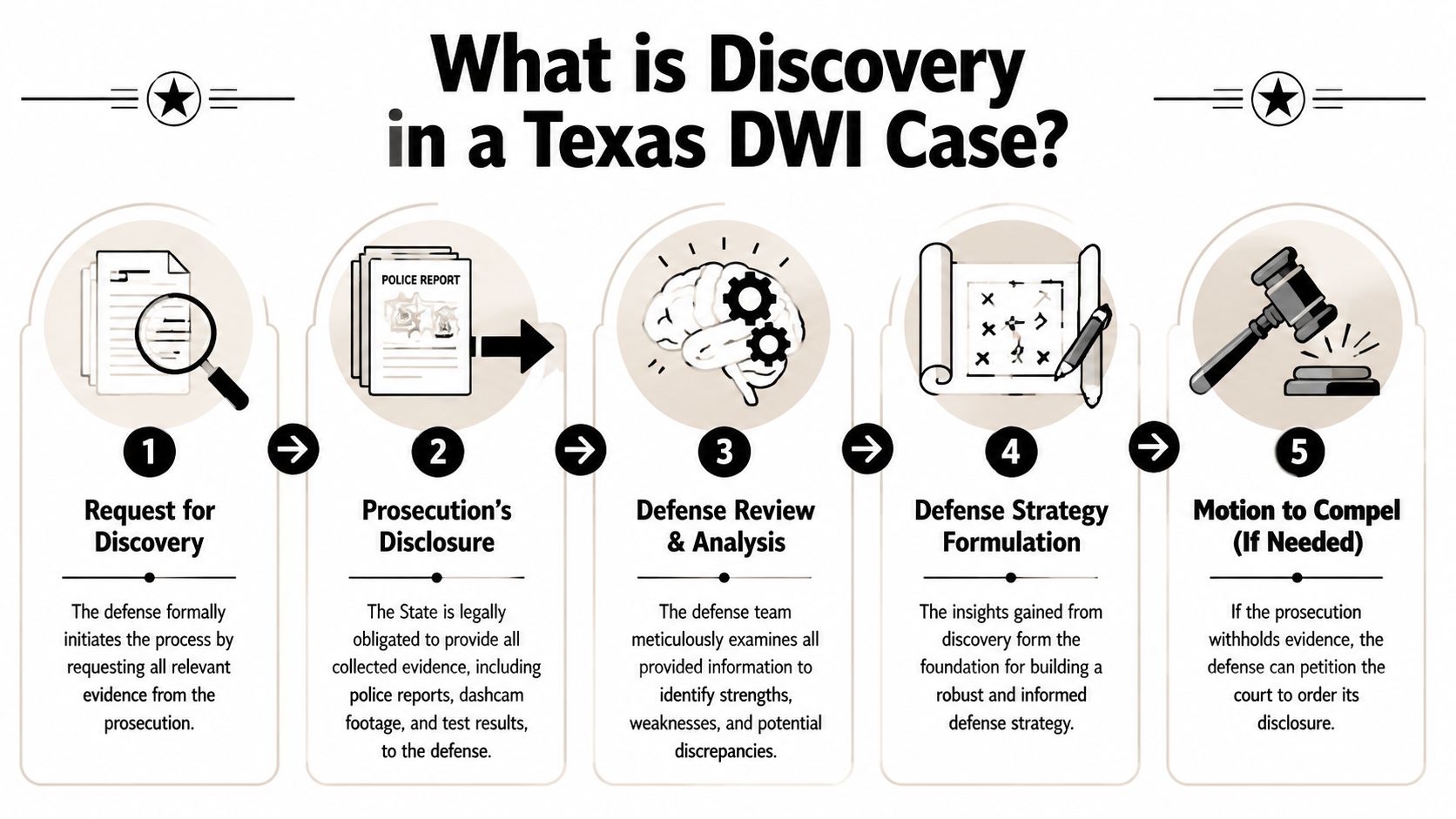
What your lawyer actually does
Your attorney doesn't just wait for documents to show up. A good defense lawyer makes a formal request, follows up, reviews what's missing, and pushes for more when necessary.
That process often looks like this:
- File a discovery request so the duty to disclose is clear.
- Review what the prosecutor provides for gaps, contradictions, and missing items.
- Compare evidence against evidence instead of taking any one report at face value.
- Decide whether additional motions are needed if important records or media haven't been produced.
If the case involves a key hearing early on, discovery can also shape the defense approach there. For example, the issues raised in an omnibus DWI hearing in Texas may overlap with what the State has or has not disclosed.
What confuses clients most
Many clients assume discovery is one document. It usually isn't. It's a set of materials gathered from different sources, sometimes at different times. Another common misunderstanding is timing. “As soon as practicable” does not always mean immediate delivery, and some items arrive later than others.
That doesn't mean your lawyer is powerless. It means part of the defense work is staying on the prosecutor's office until the file is complete enough to evaluate the case properly.
Discovery isn't a formality. It's the part of the case that tells your attorney what can be challenged, what can be excluded, and what can be used in your favor.
Why this changes the defense
When discovery was weaker, prosecutors had more room to control the flow of information. The current framework gives defense counsel a stronger basis to scrutinize the stop, the field sobriety evidence, and any chemical testing.
For a person accused of DWI, that matters in practical ways. If the State says the officer had probable cause, the defense wants to see the video. If the State says a breath or blood result proves intoxication, the defense wants the records behind that claim. If a witness statement matters, the defense wants the exact statement, not just a summary.
That is how a Texas DUI attorney begins turning a charge into a defendable case.
The Evidence Arsenal Key Items in DWI Discovery
A DWI file is usually a bundle of separate records, media, and technical documents. Each item tells part of the story. Your lawyer's job is to read them together and ask whether they actually support the charge.
Texas DWI discovery is not just one document. It is a package of evidence that can determine whether the State can prove intoxication beyond a reasonable doubt. Commonly disclosed materials include police reports, field notes, witness statements, video recordings, and breathalyzer maintenance logs. Article 39.14 requires disclosure of evidence material to any matter involved in the action, including statements by the defendant, statements by law enforcement, and scientific evidence such as lab reports and test results, as described in this overview of discovery in Texas DWI charges.
Why each item matters
A police report may say you swayed, had slurred speech, or failed field sobriety tests. But bodycam video may show something more nuanced. The officer may describe confusion or poor balance, while the video shows uneven pavement, loud traffic, poor instructions, or a medical issue affecting performance.
A breath record may contain a number the prosecutor likes. But maintenance logs may show why the defense needs to look more closely. The same goes for blood evidence. A lab report may look polished, but the paperwork behind collection, handling, and testing often matters just as much.
Here's a practical way to look at the common evidence.
| Evidence Type | What It Is | Why It Matters for Your Defense |
|---|---|---|
| Police report | The officer's written narrative of the stop, investigation, and arrest | It shows what the State claims happened and gives your lawyer a baseline to test against video and other records |
| Field notes | Notes made during or after the roadside investigation | They may reveal missing details, changed descriptions, or inconsistencies with the final report |
| Dashcam and bodycam video | Video and audio from the stop and investigation | Video can confirm or contradict claims about driving, instructions, demeanor, and field sobriety testing |
| Witness statements | Statements from passengers, civilians, or other officers | These can support or undermine the officer's account |
| Statements by the defendant | Anything the State says you said during the stop or arrest | Your lawyer must review the context, wording, and whether the recording matches the summary |
| Breath test records | The result and related records from the breath testing process | They may raise issues about procedure, timing, or machine-related questions |
| Breathalyzer maintenance logs | Records tied to upkeep and operation of the machine | These help assess whether the machine was properly maintained |
| Lab reports and test results | Scientific records tied to alcohol analysis | These are central if the prosecution relies on BAC-related proof |
A simple example of how lawyers use discovery
Suppose an officer writes that you were weaving badly and nearly struck a curb. Then the dashcam shows only a wide turn and normal lane travel. That doesn't automatically win the case, but it changes the conversation. It gives the defense a specific basis to challenge the reason for the stop and the officer's credibility.
Or imagine the report says you did poorly on field sobriety tests because you were intoxicated. The bodycam may show the officer gave rushed instructions, interrupted you, or tested you on a sloped shoulder with flashing lights and traffic flying by. Discovery turns broad accusations into specific facts the court can evaluate.
For a fuller look at the kinds of materials prosecutors often rely on, see this guide to what evidence prosecutors use in Texas DWI cases.
Evidence isn't equal
Some pieces of evidence carry more weight than others, but none should be accepted without review. In DWI cases, the State's proof often centers on a few checkpoints:
- The stop itself. Did the officer have a lawful reason?
- Roadside observations. Are they backed up by video and context?
- BAC-related proof. Was the science collected and documented reliably?
A good defense doesn't argue with every line in the file. It identifies the lines that matter most and tests whether the proof behind them is solid.
That is why discovery often becomes the tactical foundation of the defense. It gives your attorney the raw materials to challenge weak assumptions and focus on the evidence that can move the case.
Challenging Breath and Blood Test Evidence
A lot of people think the case is over if a breath or blood result comes back over the legal limit. That's one of the most common mistakes I hear from new clients. The reported number matters, but the process behind the number matters too.
Breath and blood evidence are technical. They depend on people following procedures, machines working properly, samples being collected correctly, and records being complete. Discovery is how the defense checks those things instead of taking them on faith.
This visual breaks down the common pressure points in chemical-test evidence.

Breath test challenges
In a breath-test case, your attorney may want the machine records, the associated logs, and the testing records tied to your sample. The defense reviews whether proper procedures appear to have been followed and whether the supporting records create questions about reliability.
That review can include issues such as:
- Machine history. Whether maintenance and calibration records raise concerns.
- Testing procedure. Whether the process appears consistent with required steps.
- Observation period questions. Whether the surrounding records or video support how the test was administered.
- Medical or physical factors. Whether something in your condition could affect how the result should be interpreted.
If your case involves breath evidence, obtaining the underlying records is often one of the first technical steps your attorney takes. This guide on how to obtain DWI breathalyzer records gives a practical overview of that process.
Blood test challenges
Blood cases are often more document-heavy and more technical. The defense may seek the laboratory's standard operating procedures, analyst qualifications, collection logs, and chain-of-custody documentation to evaluate contamination, handling error, and analytic reliability. If a blood sample was drawn through an indwelling IV line, mixed with IV solutions, or lacked a clean custody trail, the result may become vulnerable to attack even if the BAC number appears strong on its face, as outlined in this handout on discovery in DWI blood-test cases.
A short video can help you understand why these issues matter in real cases.
Why lawyers ask for more than the final result
The final lab report is only the endpoint. It doesn't tell you by itself who handled the sample, how it was stored, what happened during collection, or whether any abnormality occurred. That's why experienced defense lawyers ask for the surrounding paperwork, not just the headline result.
Here are the records that often matter in a blood case:
- Chain-of-custody records that show who handled the sample and when.
- Collection records that help evaluate how the blood draw occurred.
- Lab procedures that show the standards the lab says it follows.
- Analyst qualifications that identify who performed the work.
- Bench notes or related technical records when available through discovery practice.
The science in a DWI case isn't self-proving. Someone collected it, someone handled it, someone tested it, and someone documented it. Discovery lets the defense examine every step.
When your attorney finds a problem in that chain, the next step may be a focused legal challenge. That challenge can target the result itself, the way the evidence was obtained, or whether the court should allow the jury to hear it at all.
Using Legal Motions to Enforce Your Rights
Discovery only works if the defense can enforce it. In some cases, the State turns over what it should and the review moves forward normally. In others, records are delayed, videos are missing, or key items don't appear until the defense pushes harder.
That's where legal motions come in. These are formal requests asking the court to require action, exclude evidence, or protect your rights. They are not just paperwork. They are how your lawyer turns discovery rights into courtroom consequences.
Motion to compel
A motion to compel asks the judge to order the prosecution to produce material that should have been disclosed. If the State hasn't provided a video, report, or test-related record that falls within discoverable material, this motion tells the court there is a problem that needs to be fixed.
For clients, the key point is simple. Your lawyer does not have to accept “we don't have it yet” forever. If the missing item matters, the defense can ask the court to step in.
Brady material
You may also hear the term Brady material. In plain language, this refers to evidence favorable to the defense. That could be evidence that tends to reduce blame, undermine a witness, or support innocence.
A Brady motion is one way to press the State to disclose information that could help the accused. In a DWI case, that can matter if a record, statement, or prior issue weakens the prosecution's version of events or supports a defense theory.
If evidence can help your defense, your lawyer should be looking for it. If the prosecution hasn't produced it, the court can be asked to address that failure.
Motion to suppress
The most powerful motion tied to discovery in many DWI cases is the motion to suppress. This asks the court to exclude evidence because police obtained it unlawfully or in violation of your rights.
Common examples include arguments that:
- The stop lacked legal justification based on what the video shows.
- The arrest lacked probable cause when the observations don't support intoxication.
- A blood draw was legally defective because the warrant or procedure was flawed.
- Statements or evidence were obtained improperly under the circumstances of the arrest.
If a judge suppresses important evidence, the State's case can become much weaker. Sometimes that changes plea discussions. Sometimes it changes trial strategy. In some cases, it changes whether the prosecution can proceed in any meaningful way.
Why timing and detail matter
Motions work best when they are grounded in specifics. “The officer was unfair” is not a legal argument. “The video does not show the lane violation described in the report” is the beginning of one. “The blood packet shows a custody gap” is another.
That's why discovery comes first. Your attorney needs the records before choosing the best motions to file. Once those materials are reviewed carefully, the defense can make targeted arguments instead of broad complaints.
How Discovery Shapes a Winning DWI Defense Strategy
Discovery doesn't win a case by itself. What it does is tell your lawyer which path gives you the best chance to protect your future. Sometimes that path is a suppression fight. Sometimes it is negotiation from a stronger position. Sometimes it is preparing to cross-examine the officer and challenge the State at trial.
For some clients, the stakes go beyond ordinary inconvenience. A commercial driver may be worried about a CDL. A licensed professional may be worried about disclosure rules at work. A repeat offender may be worried about how one more conviction changes everything. In those cases, details that might seem minor to someone else become central to the defense strategy.
Discovery is not just about seeing the file. It is often the only way to test whether the science is reliable. For higher-stakes defendants such as CDL holders or repeat offenders, demanding details like blood-draw chain-of-custody records, lab bench notes, and maintenance logs can uncover errors that support efforts to suppress or exclude BAC evidence, as discussed in this article on discovery in DUI and DWI cases and why it matters.
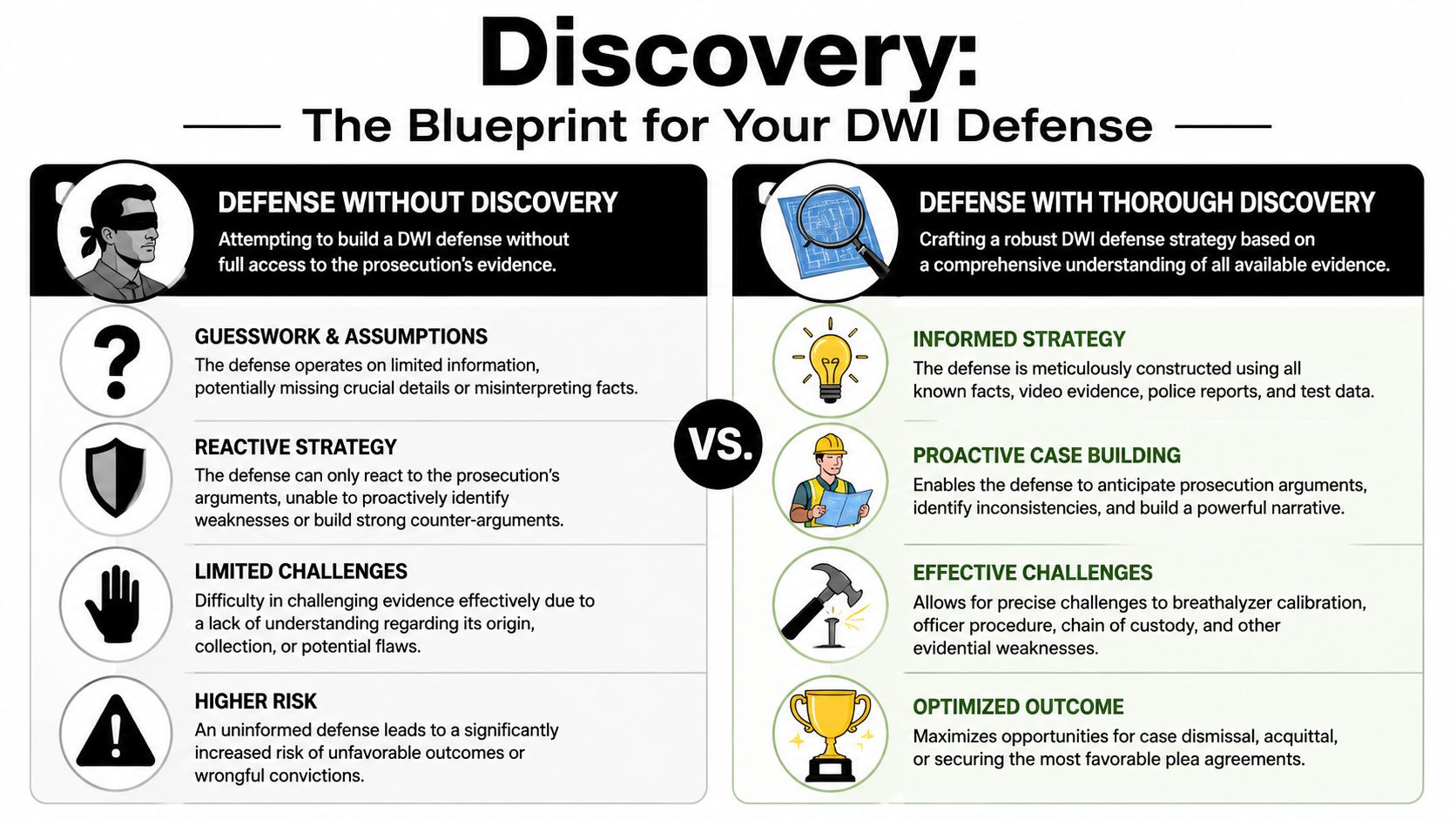
Three ways discovery changes strategy
A defense strategy usually starts taking shape in one of these directions.
The stop becomes the issue
If the records and video show weak grounds for the stop, the defense may focus on whether the officer had a lawful reason to pull you over at all. In that situation, the strongest move may be a suppression argument aimed at the very beginning of the case.
The roadside investigation becomes the issue
If the stop itself appears lawful but the officer's conclusions don't match the video, the defense may attack the reliability of the investigation. That often means focusing on instructions, conditions, camera footage, and the gap between what the officer wrote and what happened.
The science becomes the issue
If the prosecutor leans heavily on breath or blood evidence, the strategy may turn to records, procedures, and technical flaws. That can lead to negotiation, a forensic challenge, or a motion aimed at excluding the result.
Why one size doesn't fit every client
A first-time offender and a CDL holder may face the same charge on paper but very different real-world consequences. The same is true for a nurse, teacher, pilot, contractor, or anyone whose job depends on driving or licensure. Strategy has to account for those risks.
That's one reason some attorneys dig much deeper into the technical side of the case than others. A firm such as Law Office of Bryan Fagan, PLLC handles DWI matters that involve chemical-test challenges, administrative license issues, and criminal court defense, so discovery review often feeds multiple decisions at once.
The best defense strategy usually isn't the loudest one. It's the one built from the actual records, video, and technical details in your case.
When clients ask whether they should “fight it” or “work something out,” my answer is usually the same. First get the evidence. Then decide from a position of knowledge, not panic.
Take Control Your Role and What to Expect Next
Your attorney handles the legal work, but you still play an important role in your defense. The more accurate information your lawyer has, the better they can evaluate the file and spot issues the records may not reveal on their own.
Start by writing down everything you remember while it's still fresh. Include where you were, why you were stopped, what the officer said, whether there were passengers or witnesses, what tests were requested, and whether you saw dashcam or bodycam equipment. Small details can matter later.
What you should do right away
Focus on practical steps:
- Be honest with your lawyer about alcohol use, medication, medical conditions, prior history, and anything you said to police.
- Save paperwork including bond papers, towing information, temporary driving permits, and any notice tied to your license.
- Make a timeline from the stop through release.
- Avoid discussing the facts publicly or posting about the arrest online.
Know the key terms
DWI cases use legal language that can sound more intimidating than it is. Here are a few terms clients often ask about:
- BAC means blood alcohol concentration. It refers to the alcohol measurement the State may try to use in a breath or blood case.
- Field sobriety test usually refers to roadside divided-attention tests officers use to form opinions about impairment.
- Implied consent refers to Texas laws that can trigger consequences when a driver refuses certain chemical testing after a DWI arrest.
- Administrative license suspension refers to the separate license process that can follow an arrest or a test refusal or failure. In Texas, this is often handled through the ALR process.
Remember that there are two cases, not one
A DWI arrest often triggers two separate tracks. One is the criminal case in court. The other is the license case involving administrative license suspension, often called the ALR process.
The timelines are different, and the license issue moves quickly. You have 15 days from the date of arrest to request an ALR hearing if you want to fight the suspension issue. Missing that deadline can hurt your options.
That's why acting early matters. Discovery is mainly part of the criminal case, but the evidence and testimony involved can also affect how your lawyer approaches the driver's license side.
What happens after that
After arrest and release, the usual path may include bond conditions, court settings, discovery requests, evidence review, negotiations, motions, hearings, and possibly trial. Some cases resolve through reduction or dismissal efforts. Others require a more contested defense.
If you're worried about a DWI license suspension, trying to understand a first DWI in Texas, or looking for a Houston DWI lawyer who can help you fight DWI Texas charges with a clear plan, the most important step is getting legal advice quickly.
If you or a loved one is facing a DWI charge, Law Office of Bryan Fagan, PLLC offers free consultations to discuss your case, explain your rights, and help you understand the next steps in both the criminal case and any license-related proceedings.

