
A DWI arrest can be overwhelming — but you don’t have to face it alone. Your first move is simple but critical: you must request an Administrative License Revocation (ALR) hearing within 15 days of your arrest.
This is your first and best opportunity to challenge the automatic suspension of your Texas driver's license. Acting quickly is key to protecting your ability to drive and building a strategic defense for your case from day one. A skilled Houston DWI lawyer can handle this for you, ensuring you don’t miss this crucial deadline.
Understanding Your DWI License Suspension
A DWI arrest in Texas triggers two separate legal processes, and both can result in the suspension of your driver's license.
The first is an administrative process managed by the Texas Department of Public Safety (DPS). The second is the criminal case that proceeds through the court system. It's vital to understand that you can win your criminal case and still lose your license through the administrative process if you don't take immediate action.
This is why the clock starts ticking the moment you are arrested. You have only 15 calendar days to request an ALR hearing. If you miss this deadline, you forfeit your right to challenge the suspension, and your license will be automatically suspended on the 40th day after your arrest.
The Two Paths to Suspension
After a DWI arrest, your license is at risk in two distinct ways. Understanding the difference is crucial, as you and your attorney must address both challenges simultaneously.
Here's a brief overview of the two types of license suspensions you may face after a DWI arrest in Texas.
| Texas DWI License Suspension at a Glance |
| :— | :— | :— | :— |
| Suspension Type | What Triggers It | Your Critical Deadline | What's at Stake |
| Administrative License Revocation (ALR) | Refusing a breath/blood test OR failing a test with a BAC of 0.08% or higher. | 15 days from arrest to request a hearing. | Your license, starting 40 days after arrest. |
| Criminal Court Suspension | Being convicted of the DWI charge in court. | The timeline of your criminal case. | A judge-ordered suspension as part of your sentence. |
Let's break down what each of these means for you.
Administrative License Revocation (ALR)
This is an immediate civil action initiated by the DPS. An administrative license suspension is triggered automatically if you either refuse a chemical test (breath or blood) or provide a sample showing a Blood Alcohol Concentration (BAC) of 0.08% or higher. A BAC is the measure of alcohol in your bloodstream.
This process is governed by Texas's “implied consent” law. In simple terms, this law states that by holding a Texas driver's license, you have already agreed to provide a breath or blood sample if you are lawfully arrested for DWI.
Criminal Court Suspension
This suspension is a potential penalty if you are convicted of the DWI charge in criminal court. The length and specific terms are determined by a judge as part of your sentence if you are found guilty.
This flowchart illustrates the critical first steps you must take immediately after a DWI arrest to protect your driving privileges.
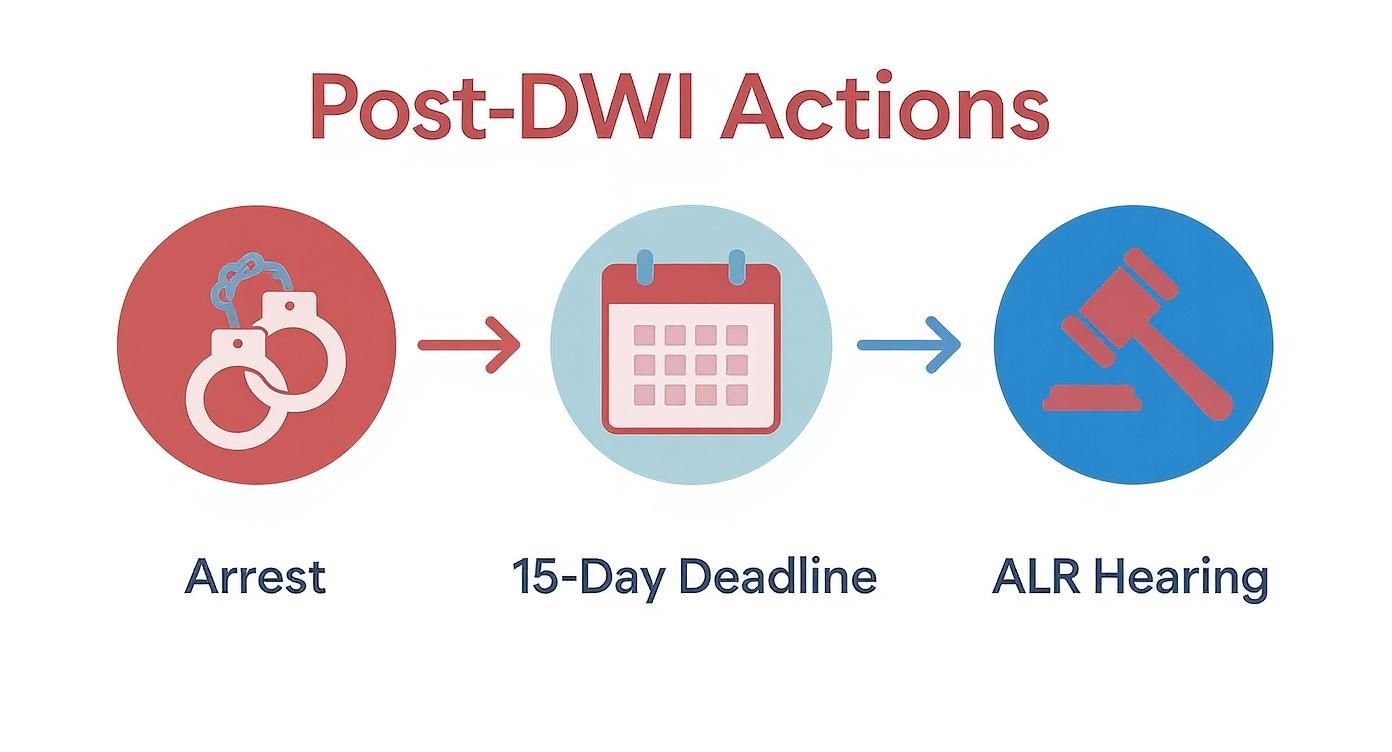
As you can see, that 15-day deadline to request your ALR hearing is the most urgent item on your to-do list after an arrest.
Why the ALR Hearing Is Your First Line of Defense
Requesting an ALR hearing does more than just give you a chance to save your license from automatic suspension. It's a powerful strategic tool that a skilled Houston DWI lawyer can use to build a much stronger defense for your criminal case.
By requesting the hearing, your attorney gets an invaluable opportunity to subpoena the arresting officer and cross-examine them under oath. This testimony can expose weaknesses in the prosecution's case—like an improper traffic stop or incorrectly administered field sobriety tests—which can be used to your advantage later.
Failing to request this hearing doesn't just lead to an automatic suspension; it means you lose a critical chance to gather evidence and test the state's case against you before the criminal trial even begins. Your first move sets the tone for your entire defense—make it a strategic one.
Challenging Your Suspension in an ALR Hearing

The ALR hearing is your first—and most important—opportunity to fight the automatic suspension of your driver's license. Many people mistakenly dismiss it as a formality, but that is a significant mistake.
Think of the ALR hearing as the first battleground. Requesting this hearing within the crucial 15-day deadline forces the Texas Department of Public Safety (DPS) to prove its case. This is a civil proceeding, entirely separate from your criminal DWI case, that deals only with your driving privileges.
What the DPS Must Prove
At the hearing, a DPS attorney will present evidence to an Administrative Law Judge. What they need to prove depends on whether you refused a chemical test or provided a sample over the legal limit.
- If you refused the test, DPS must show the officer had reasonable suspicion for the stop, probable cause for the arrest, properly requested a sample, and warned you of the consequences for refusing.
- If you failed the test (BAC of 0.08% or higher), DPS must prove the same elements and show that your BAC was at or over the legal limit while you were driving.
Each of these points is a potential weakness in the state's case. A strategic Texas DUI attorney knows precisely where to apply pressure to challenge the evidence.
The Strategic Value of an ALR Hearing
This hearing is about much more than just keeping your license in the short term. It's a risk-free opportunity to gather intelligence and lock the arresting officer into their story long before your criminal trial begins. This is where an experienced Houston DWI lawyer can gain a major advantage.
During the ALR hearing, your attorney can subpoena the officer and question them under oath. This allows your lawyer to dig into details and identify inconsistencies or procedural errors.
For example, was the initial traffic stop lawful? Did the officer administer the field sobriety tests correctly? Were you read your rights properly? The officer's sworn testimony can become powerful evidence to challenge your DWI charge later.
Winning the ALR hearing means the suspension is dismissed and you keep your license. Even if you lose, the officer's testimony can be invaluable for negotiating with the prosecutor or fighting for a "not guilty" verdict. Our firm has created a complete Texas ALR hearing process guide that walks you through every step.
Common Defenses Used in ALR Hearings
A successful defense requires a thorough examination of the facts. An attorney will scrutinize every report and piece of evidence to find grounds for dismissal.
Common defense strategies include:
- Challenging the Traffic Stop: If the officer lacked a valid reason to pull you over, all subsequent evidence may be suppressed.
- Contesting Probable Cause: Arguing the officer lacked sufficient evidence to justify a DWI arrest.
- Improper Test Administration: Showing that field sobriety tests were administered incorrectly or the breathalyzer was not properly calibrated.
- Chain of Custody Issues: Questioning how a blood sample was collected, stored, and tested.
This hearing is not something to handle alone. The rules are complex, and the DPS will have its own attorney fighting to suspend your license. Having a strategic advocate in your corner is essential to protect your rights and your ability to drive.
Tackling the Court's Requirements to Get Your License Back
While the ALR hearing addresses the administrative suspension, the criminal court process is where you face the actual charge of driving while intoxicated. If you are convicted, the court will impose its own set of penalties and requirements that you must complete before you can get your license fully reinstated.
This is a separate hurdle from any ALR suspension. It may feel like an overwhelming checklist, but the key is to tackle each requirement methodically. These conditions are not suggestions; they are legal orders you must fulfill.
Completing Probation and Paying Off Fines
For most DWI convictions, especially a first DWI in Texas, you can expect to be placed on "community supervision," also known as probation. This typically lasts from six months to two years and comes with strict rules.
You will be assigned a probation officer and must adhere to conditions such as:
- Regular check-ins with your probation officer.
- Abstaining from alcohol and illegal drugs.
- Submitting to random drug and alcohol tests.
- Maintaining steady employment or school enrollment.
In addition to probation, you will be ordered to pay fines and court costs, which can amount to several thousand dollars. It is critical to make these payments on time. Falling behind can lead to a probation violation, which could result in jail time and further complications.
This isn't just a Texas issue. Across the country, millions of driver's licenses are suspended because people cannot keep up with court debt. In Texas and four other states alone, a staggering 4.2 million licenses were suspended for failure to pay. This practice disproportionately affects people with fewer financial resources. You can find more insights on this from the Prison Policy Initiative.
Knocking Out Mandatory Classes and Evaluations
The court wants to ensure you understand the dangers of impaired driving. To do so, you will almost certainly have to complete state-mandated educational programs.
- DWI Education Program: This is a 12-hour class required for all first-time DWI offenders. You must complete it within 180 days of your probation start date, or your license will be suspended again.
- DWI Intervention Program: If this is not your first offense, you will be required to complete a more intensive 32-hour "repeat offender" program.
- Substance Abuse Evaluation: A judge may also order an evaluation to determine if you have a dependency issue. If so, you may be required to attend counseling or treatment as part of your probation.
It helps to view these requirements not as punishments, but as steps Texas requires to keep the public safe. Completing them promptly shows you are committed to responsible driving and is a crucial part of the reinstatement puzzle.
Getting an Ignition Interlock Device (IID) Installed
For many, a DWI conviction means installing an ignition interlock device (IID) in their vehicle. This device is a breathalyzer connected to your car's ignition. Before the car will start, you must provide an alcohol-free breath sample.
An IID is often a mandatory condition of probation, especially if your BAC was 0.15% or higher, if it was a second offense, or if the DWI involved an accident. You are responsible for all costs, including installation, monthly calibration, and removal. Successfully completing your required time with the IID is a non-negotiable step toward getting your full, unrestricted license back.
Getting an Occupational License to Stay on the Road
A license suspension can feel like your life has come to a standstill. How will you get to work, take your kids to school, or make it to a doctor's appointment?
Fortunately, in Texas, a suspension doesn't have to mean completely losing your ability to handle these essential tasks. You may be able to obtain an Occupational Driver's License (ODL), a special, restricted license designed to bridge the gap.
An ODL allows you to drive legally for specific, necessary purposes, ensuring you can keep your job and manage your family's needs while your regular license is suspended. It's a critical tool for minimizing the disruption a DWI license suspension can cause.
What Is an Occupational License?
An ODL is a temporary, essential-use permit granted by a judge after you petition the court and prove a genuine need to drive. This is not a right; it's a privilege you must actively justify.
The law defines an "essential need" as driving for activities like:
- Work: Commuting to and from your job.
- School: Attending your classes or driving a family member to theirs.
- Essential Household Duties: This includes necessary trips for groceries, medical appointments, or court-ordered classes.
Without an ODL, people often face a difficult choice: break the law by driving to work or risk losing their job. This is a practical, legal solution that helps you stay on your feet.
How to Petition for an ODL in Texas
Getting an occupational license is a formal legal process that requires filing a petition with the court. It is best handled by an experienced attorney who knows what the judge needs to see for approval.
The first step is gathering the right documents. Your lawyer will help you assemble a complete packet, which must include:
- A Sworn Petition: This legal document details your essential need to drive, including your work schedule, school hours, and other necessary travel.
- An SR-22 Certificate: Before a judge will consider the order, you must prove you have the minimum required liability insurance. The SR-22 form from your insurance company serves as this proof.
- A Court Order: Your attorney will draft this order for the judge to sign, outlining the specific rules and restrictions of your ODL.
Once the judge signs the order, you will receive a certified copy. You must keep this document and your SR-22 proof with you at all times when driving. It acts as your temporary license until the physical ODL card arrives from the DPS.
Understanding ODL Restrictions
An occupational license comes with strict limitations. The court order will spell out the exact conditions you must follow.
Common restrictions include:
- Limited Hours: You can typically only drive for up to 12 hours per day.
- Specific Counties: Your driving may be restricted to certain counties relevant to your essential duties.
- Logbook Requirement: The judge might require you to keep a detailed log of all your driving activities.
Violating any of these restrictions is a serious offense that can lead to new criminal charges and the immediate revocation of your ODL.
For a closer look at the process, you can find a detailed breakdown of the requirements for a DWI occupational license in Texas on our site. Navigating this process correctly is key to regaining your mobility and independence.
The Home Stretch: Finalizing Your License Reinstatement

You’ve completed all the requirements. The suspension period is over, the court-ordered classes are done, and the fines have been paid. Now you are in the final phase: dealing directly with the Texas Department of Public Safety (DPS).
Details matter at this stage. A small mistake can cause frustrating delays. Think of this as your final checklist to ensure you can get back on the road without any last-minute surprises.
Paying All Required Reinstatement Fees
Before the DPS will process your reinstatement, you must pay all outstanding fees. These are separate from any court fines you’ve already paid.
You should be prepared for several charges, which typically include:
- The standard license reinstatement fee, currently $125.
- Any other administrative fees tied to your suspension.
- The cost of issuing a new physical driver's license.
The fastest way to handle this is through the Texas DPS online portal. You can see what you owe and pay it directly, receiving immediate confirmation.
Securing and Filing Your SR-22 Certificate
This is a critical step. An SR-22 is not an insurance policy; it's a certificate of financial responsibility that your insurance company files with the DPS on your behalf. It proves you carry at least the state-mandated minimum liability coverage.
For a DWI-related suspension, you are required to maintain an active SR-22 on file for two years from the date of your conviction. Contact your insurance agent to get this process started.
If your insurance coverage lapses, even for a day, your provider is required to notify the DPS, which will trigger an immediate re-suspension of your license.
Pro Tip: Don't wait until the last minute. It can take several business days for your insurance company to process the SR-22 and for the DPS system to reflect it. Start the process early to avoid delays.
Submitting All Your Compliance Documents
Once your fees are paid and the SR-22 is on file, the final step is to provide the DPS with proof that you’ve completed all other requirements.
Your compliance packet should include:
- Proof of SR-22 Insurance: A copy of the certificate.
- Reinstatement Fee Receipts: Proof of payment.
- Certificates of Completion: Official documents from your DWI education classes.
- Ignition Interlock Device Compliance: Paperwork showing you successfully completed your IID term, if required.
You can submit these documents online, by mail, or in person. The online portal is usually the most efficient route.
This final stage can be a bottleneck. Research shows that administrative red tape and fees are significant barriers for drivers. One study found that only 13.3% of drivers with suspended licenses successfully got them back after meeting their conditions, highlighting how tricky these final steps can be. You can learn more about these challenges in the reinstatement process.
An experienced DWI attorney can be invaluable here. They ensure your paperwork is flawless, preventing the bureaucratic delays that can keep you off the road longer than necessary.
Why a Houston DWI Lawyer Is Your Best Ally
Trying to get your license back after a DWI in Texas feels like navigating a maze. The rules are complex, the deadlines are strict, and one mistake can set you back months. This isn't just about losing your driving privileges—it's about protecting your livelihood.
This is not a journey to take alone. Partnering with an experienced Houston DWI lawyer is a critical strategic move. Your attorney acts as your advocate, ensuring every piece of the puzzle fits together perfectly.
Taking Control of Your Case from Day One
From the moment you hire them, a skilled lawyer takes charge. Their first move is to file the request for your ALR hearing, knowing the 15-day deadline is unforgiving.
An attorney also handles other essential tasks, such as:
- Petitioning for an Occupational License: If a suspension is unavoidable, your lawyer can build a compelling case to get you a restricted license, allowing you to drive for essential needs.
- Ensuring Flawless Paperwork: From the initial petition to the final DPS compliance documents, your attorney ensures every form is filled out correctly and submitted on time, preventing frustrating delays.
- Dealing with the Courts and DPS: Your lawyer handles all communication with prosecutors and administrative agencies, saving you from immense stress.
A DWI charge threatens more than just your driver's license. It can impact your job, your reputation, and your future. A good lawyer’s role is to protect all of it by building a defense that minimizes the consequences at every turn.
Your future is too important to leave to chance. A knowledgeable Houston DWI lawyer can be the difference between a minor disruption and a long-term crisis. To fight DWI Texas charges effectively, we invite you to request a free, confidential consultation to discuss your case and learn how we can help protect your rights and get you back on the road.
Common Questions About Texas License Suspensions
Facing a DWI-related license suspension brings uncertainty. Getting clear answers is the first step toward regaining control. Here are some of the most common concerns Texans have.
How Long Will My License Be Suspended for a First DWI in Texas?
For a first DWI in Texas, you could face two separate suspensions. The first is an administrative suspension from the DPS for failing or refusing a chemical test, which typically lasts 90 to 180 days.
Additionally, if you are convicted in criminal court, a judge can order a suspension ranging from 90 days to one year. An experienced DWI attorney can fight to prevent both suspensions from happening.
Can I Refuse a Breathalyzer or Blood Test in Texas?
Yes, you have the right to refuse, but it has immediate consequences. Texas operates under an “implied consent” law, meaning you’ve already agreed to submit to a chemical test if lawfully arrested for DWI.
Refusing the test triggers an Administrative License Revocation (ALR). For a first-time refusal, your license will be suspended for 180 days. While this forces the prosecution to work harder, you must still challenge the automatic suspension at an ALR hearing.
What Is an SR-22 and How Long Do I Need It?
An SR-22 is a certificate from your insurer that proves to the Texas DPS that you meet the state's minimum liability coverage requirements. It's a guarantee that you're insured.
After a DWI-related suspension, you are typically required to maintain an active SR-22 filing with the DPS for two years from the date of your conviction. Any lapse in coverage can trigger an immediate re-suspension of your license.
Remember, the SR-22 requirement is non-negotiable for getting your license back. It is your responsibility to ensure the certificate remains active for the full two-year period without interruption.
What Happens If I Miss the 15-Day ALR Hearing Deadline?
This is one of the most critical deadlines in a DWI case. If you miss the 15-day window to request your ALR hearing, you automatically waive your right to challenge the administrative suspension.
As a result, your license will be suspended on the 40th day after your arrest. This is why it is so important to contact a Houston DWI lawyer immediately after an arrest to ensure this crucial deadline is not missed.
Navigating the complexities of a license suspension can feel overwhelming, but you don't have to do it alone. The skilled attorneys at the Law Office of Bryan Fagan, PLLC are here to protect your rights and guide you through every step of the process. For a free and confidential case evaluation, contact us today through our website.
