A DWI arrest can be overwhelming—but you don’t have to face it alone. The Horizontal Gaze Nystagmus (HGN) test is often the first field sobriety test an officer uses during a Texas DWI stop. It's the "eye test," where you're asked to follow a pen or light, and the officer looks for involuntary eye-jerking as supposed evidence of intoxication.
Understanding what this test is, how it’s flawed, and what your rights are is the first step toward building a powerful defense.
What is the Horizontal Gaze Nystagmus (HGN) Test?
When you’re pulled over for a suspected DWI, the situation can be stressful and confusing. Knowing what the officer is looking for during the HGN test helps you protect your rights. This test might seem simple, but it is a standardized procedure that law enforcement must follow perfectly for the results to be considered valid.
The reality is, it's far from a perfect science. The accuracy of the HGN test depends entirely on the officer's training and their ability to follow a strict protocol—something that rarely happens perfectly on the side of a busy Texas road.
The term nystagmus simply means an involuntary jerking of the eyes. This can happen for dozens of reasons that have nothing to do with alcohol consumption. However, police are trained to identify a specific type—horizontal gaze nystagmus—which they claim is worsened by intoxication.
The Three Clues an Officer Looks For
When an officer administers the HGN test, they are trained by the National Highway Traffic Safety Administration (NHTSA) to look for six "clues" in total (three in each eye). If they observe four or more clues, they will likely mark it as a "fail" and use it as probable cause to arrest you for DWI.
Here are the three clues they look for in each of your eyes:
- Lack of Smooth Pursuit: As you follow the stimulus (like a pen or fingertip), the officer watches to see if your eyes track it smoothly. If they bounce or jerk, that is considered one clue.
- Distinct Nystagmus at Maximum Deviation: The officer will hold the stimulus at the very edge of your peripheral vision for at least four seconds. They look for a distinct and sustained jerking motion when your eye is as far to the side as it can go.
- Onset of Nystagmus Prior to 45 Degrees: The officer slowly moves the stimulus from the center of your face toward your shoulder, watching for the point where your eye starts to jerk. If this begins before the stimulus reaches a 45-degree angle, it counts as another clue.
For example, if your left eye shows a lack of smooth pursuit but your right eye does not, that is one clue. If both of your eyes show all three clues, that is a total of six clues.
The Strict Protocol Officers Must Follow
For HGN test results to have any scientific validity, the officer must perform them exactly as they were trained. Any mistake or shortcut can render the results unreliable, giving a skilled Houston DWI lawyer a powerful angle to challenge the evidence. We meticulously scrutinize dashcam and bodycam footage for these exact errors.
An officer must hold the stimulus 12 to 15 inches from your nose and slightly above eye level. They must also move it at specific speeds—a total of 16 seconds for the smooth pursuit check and at least 32 seconds for the maximum deviation check. Rushing the test invalidates it.
Imagine you're on the side of a Houston highway, with your heart pounding and flashing lights everywhere. Even in a perfect lab setting, the HGN test is far from foolproof. According to the landmark study that standardized it, the test is only 77% accurate at detecting a BAC of 0.10 or higher. You can review the science and legal history yourself in the NHTSA's own documentation.
That means the test is wrong nearly one out of every four times. Those are not odds you want to bet your freedom on.
Knowing the rules of the HGN test is your first line of defense. An experienced attorney can spot procedural mistakes and argue that the test results are junk science that should be thrown out. It is also crucial to remember that you are not required to take this test. You can learn more by reading our answers to common questions regarding field sobriety tests. Protecting your rights begins the moment an officer asks you to step out of your vehicle.
The Unreliable Science Behind The HGN Test
The State of Texas presents the Horizontal Gaze Nystagmus (HGN) test as scientific, objective proof of intoxication. It’s important to know that this test is shaky at best, especially when administered on the shoulder of a busy highway with patrol car lights flashing in your eyes.
A "failed" HGN test is nothing more than an officer's subjective opinion. It is not a fact, and it is certainly not a conviction.
Nystagmus—the involuntary jerking of the eye—is a natural phenomenon. While alcohol can cause it, so can dozens of other factors. Your eyes might jerk because you’re tired, stressed, looking at passing headlights, or have one of many underlying medical conditions. The entire test is built on the faulty premise that an officer can isolate this common physical response and blame it only on illegal intoxication, ignoring all other possible causes.
How Accurate Is the HGN Test? Lab vs. Roadside Reality
The National Highway Traffic Safety Administration (NHTSA), the agency behind these tests, claims a 77% accuracy rate in its original studies. While that might sound convincing, there's a huge catch: that accuracy was achieved in a controlled laboratory setting. It has almost nothing to do with what happens during a real-world DWI stop in Texas.
Think about the conditions of your traffic stop. Were you standing on perfectly flat ground? Was the lighting ideal? Were there zero visual distractions like flashing lights or passing cars? Any of these real-world factors can compromise the test and lead an officer to see "clues" that are not actually present.
A 77% accuracy rate means that even in a perfect environment, the test is wrong almost a quarter of the time. Now imagine that test being done on the side of a chaotic Houston freeway. The accuracy plummets, making the results highly questionable.
This is exactly where a strong DWI defense begins. We attack the idea that a test performed under stressful, uncontrolled, and distracting conditions can be passed off as reliable science.
This flowchart breaks down the three clues an officer is supposed to look for during the HGN test.
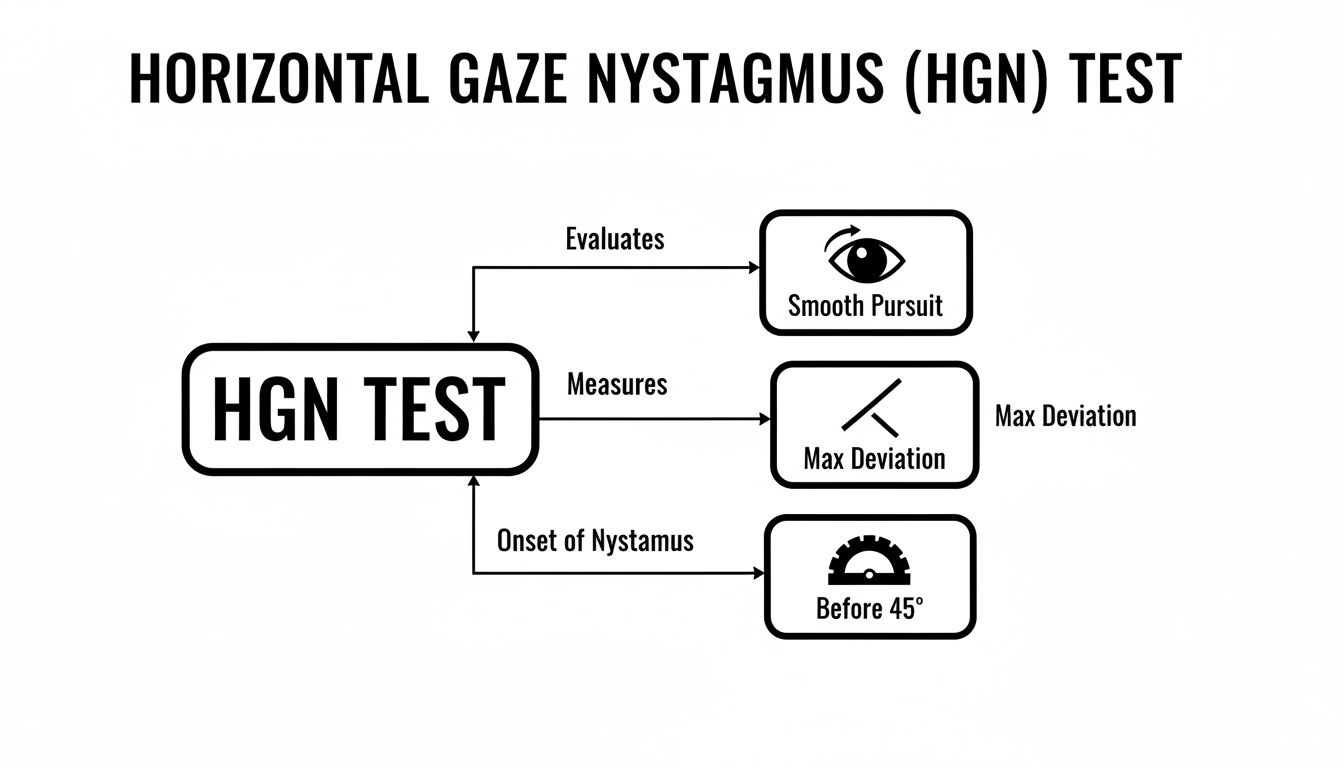
As you can see, the test is divided into specific phases. For the results to have any claim to validity, the officer must perform each step perfectly. Any mistake in timing, distance, speed, or angle can create a false positive.
The HGN test follows a strict, standardized procedure. Officers are trained to look for three specific clues in each eye, for a total of six possible clues. However, the roadside environment is far from a sterile lab, and officers frequently make procedural errors that can completely invalidate their findings.
HGN Test Clues And Common Officer Errors
| Standardized Clue | What the Officer Looks For | Common Administration Error |
|---|---|---|
| Lack of Smooth Pursuit | The officer moves a stimulus (like a pen) back and forth and watches to see if your eye follows it smoothly or if it jerks or "jumps" along the way. | Moving the stimulus too fast or too slow (it must be a 2-second pass). |
| Distinct and Sustained Nystagmus at Maximum Deviation | The officer holds the stimulus at the very edge of your field of vision and checks if your eye exhibits clear, sustained jerking for at least 4 seconds. | Not holding the stimulus at maximum deviation for the full 4-second count. |
| Onset of Nystagmus Prior to 45 Degrees | The officer slowly moves the stimulus from the center of your face toward your shoulder, looking for the exact angle where the nystagmus begins. | Misjudging the 45-degree angle or moving the stimulus too quickly to accurately spot the onset. |
These are not minor slip-ups; they are fundamental errors that violate NHTSA's own protocol. An experienced Texas DUI attorney knows how to spot these mistakes on camera and use them to dismantle the officer's testimony.
Subjective Observation, Not Objective Measurement
Ultimately, the HGN test is not like a breathalyzer that produces a specific number. It's a series of subjective observations made by an officer who may have already presumed you are impaired. This creates a high risk of confirmation bias—the officer sees the jerking they expect to see.
What one officer calls "distinct" jerking, another might see as normal. This is a critical weak point that a skilled defense attorney can exploit. To go deeper into the problems with these tests, you can learn more about the accuracy and reliability in the science of DWI testing in our comprehensive guide.
Our legal team meticulously reviews every piece of evidence, especially dashcam and bodycam footage. We are experts at identifying these built-in flaws and officer errors, and we use those mistakes to build a powerful defense designed to get the HGN evidence thrown out of court.
Medical Conditions That Can Cause a False Positive on the HGN Test
When an officer administers the Horizontal Gaze Nystagmus (HGN) test, they are looking for one thing: involuntary eye-jerking they’ve been trained to link with alcohol. But here’s the problem police and prosecutors often overlook—alcohol is far from the only cause of nystagmus.
A key part of a successful DWI defense strategy is determining if an underlying medical issue, a legal prescription, or even exhaustion was the real reason your eyes didn’t follow the officer’s stimulus perfectly. An arrest is not a conviction, and "failing" the HGN test is not concrete proof of intoxication. It is often a symptom of a completely innocent physical condition, and a sharp DWI attorney will investigate this to protect you.

Common Non-Alcoholic Causes of Nystagmus
The list of factors that can cause nystagmus is surprisingly long. The central nervous system, which controls eye movement, can be affected by many things. It is crucial to explore whether you have any pre-existing conditions that could explain the officer’s observations.
Consider your own medical history. Have you ever been diagnosed with any of these conditions?
- Neurological Conditions: Issues like multiple sclerosis, a brain tumor, a past stroke, or even an old head injury can directly trigger nystagmus.
- Inner Ear Disorders: Your sense of balance is closely tied to your eye movements. Problems with the vestibular system—like Meniere's disease, labyrinthitis, or a simple inner ear infection—can cause your eyes to jerk.
- Vision Problems: Sometimes the cause is right in the eyes themselves. Certain eye conditions, including cataracts or even a congenital issue you’ve had since birth, can produce nystagmus.
- Other Medical Issues: A Vitamin B1 (thiamine) deficiency is another known cause.
This is just a small sample, but it illustrates a clear point: many roads lead to nystagmus, and most have nothing to do with alcohol. Your attorney needs your complete medical history to build the strongest possible defense.
Prescription and Over-the-Counter Medications
Many people are surprised to learn that their legally prescribed medications can cause a false positive on the HGN test. Police officers are supposed to ask if you are taking any medication, but in reality, they often forget or fail to understand the implications of your answer.
A significant number of legally prescribed drugs are known to cause nystagmus. If an officer fails to rule out the effects of your medication, they cannot definitively say alcohol caused the jerking motion of your eyes.
For instance, some of the most common prescriptions can interfere with the HGN test, including:
- Antidepressants and Anti-Anxiety Medications: Drugs like Valium, Xanax, or other benzodiazepines are well-known culprits.
- Seizure Medications: Anticonvulsants such as Phenytoin (Dilantin) are a very common trigger.
- Barbiturates: These are often prescribed for sedation or controlling seizures.
- Pain Relievers: Certain high-dose or long-term pain medications can easily affect the central nervous system.
Even some over-the-counter drugs can have an impact. This is why it's essential to give your lawyer a full and honest list of everything you were taking around the time of your arrest.
Environmental and Physical Factors
Finally, let's not forget the environment of the traffic stop itself. Picture it: you're on the side of a dark Texas road, late at night, with patrol car lights flashing in your eyes. This chaotic scene is ripe with factors that can produce the very "clues" the officer is trained to look for.
These physical and environmental factors include:
- Fatigue and Stress: Being pulled over is incredibly stressful. That stress, combined with simple exhaustion, can cause eye strain and twitching that mimics nystagmus.
- High Caffeine Intake: Consuming too much coffee or an energy drink can stimulate your nervous system enough to cause nystagmus.
- Visual Distractions: This is a big one. The flashing red and blue lights of a patrol car can cause something called "optokinetic nystagmus," which is your eyes’ natural reflex to a moving visual stimulus.
Challenging the HGN test results on medical or environmental grounds is a powerful strategy to fight DWI in Texas. It introduces reasonable doubt by showing the State cannot prove beyond a shadow of a doubt that alcohol—and not some other perfectly legal and valid reason—was the true cause of the nystagmus. Our team at The Law Office of Bryan Fagan, PLLC, will meticulously review your health history and the circumstances of your stop to find the key to your defense.
How HGN Test Evidence Is Used In Texas Courts
Just because an officer claims you "failed" the Horizontal Gaze Nystagmus (HGN) test doesn't mean a jury will ever hear about it. Texas law sets a high bar for prosecutors who want to use HGN results as evidence. This is a critical detail, and it is often where the foundation of a strong defense is built.
The results of any field sobriety test are not automatically admissible in court. The landmark Texas case, Emerson v. State, established a strict two-part rule that the State must satisfy. If they fail to meet either part of this rule, a judge can—and should—suppress the HGN evidence entirely.
This demanding legal standard provides an experienced Houston DWI lawyer a major opportunity to challenge the State's case. We don't just accept the officer’s report at face value; we force the prosecutor to prove every single element.
The Two-Pronged Test for Admissibility
For the State to present HGN evidence to a jury, the prosecutor must prove two key things to the judge:
- The underlying science of the HGN test is valid. The courts have generally agreed that, in theory, a link exists between alcohol consumption and nystagmus.
- The officer administered the test perfectly, following the standardized procedures laid out by the National Highway Traffic Safety Administration (NHTSA) to the letter.
While the first part is often conceded, the second one is where the battle is truly fought. The officer is expected to perform like a scientist in a sterile lab, but they are actually on the side of a busy road, often in the dark, with cars flying by. This is where mistakes happen, and it’s exactly where our defense strategy kicks in.
Under Texas law, "substantial compliance" is not good enough. The officer must follow the NHTSA protocol with precision. Any meaningful deviation from these strict procedures can make the test results invalid and inadmissible.
Scrutinizing the Officer’s Every Move
As your defense attorneys, our first step is to obtain all video evidence from the arrest—dashcam, bodycam, everything. We don't just watch it; we dissect it frame by frame, comparing every single action the officer takes against the official NHTSA training manual they swore to follow.
We hunt for common but critical mistakes that officers often make under pressure. These errors can completely dismantle the State's argument and are frequently the basis for a motion to suppress the HGN evidence.
Here are some of the key procedural flaws we look for:
- Improper Stimulus Position: Was the stimulus (a penlight or finger) held at the correct distance? It must be 12 to 15 inches from your nose and positioned slightly above eye level. Holding it too close or too far away invalidates the entire test.
- Incorrect Timing: Did the officer move the stimulus too fast? For the smooth pursuit check, they are required to take exactly two seconds to move from the center of your face to the side. Rushing this step is a fatal flaw in the procedure.
- Failure to Check for Medical Issues: The officer is required to ask you about potential head injuries or medical conditions that could cause nystagmus. If they don't rule out other causes, their conclusion that alcohol is the culprit is nothing more than a guess.
- Holding the Gaze for the Wrong Duration: During the "maximum deviation" portion of the test, the officer must hold the stimulus at the very edge of your vision for a minimum of four seconds. Many officers rush this part, making any observation of nystagmus completely unreliable.
When we find these errors—and we often do—we have a powerful legal argument to get the HGN evidence thrown out. If the judge agrees, the prosecutor's case becomes significantly weaker, sometimes leaving them with little more than the officer's subjective opinion. This is a huge step toward getting your charges reduced or dismissed and a core part of how we fight a DWI in Texas.
How We Fight Your HGN Test Results in Court
An arrest isn't a conviction. That’s especially true when the state’s case hinges on a piece of evidence as shaky as the Horizontal Gaze Nystagmus (HGN) test. At our firm, we don’t just defend against the prosecution's case—we systematically take it apart.
A DWI charge feels overwhelming, but a flawed HGN test is often the first domino to fall in a weak prosecution. Our job is to find the weak spots and push until that domino drops. We know officers are human and they make mistakes, especially when trying to follow a complex, multi-step test on the side of a dark road. We use those mistakes to protect you.
Filing a Motion to Suppress the Evidence
Our first strategic move is often a legal challenge designed to keep the jury from ever hearing about the HGN test. We do this with a Motion to Suppress, a powerful legal tool arguing the evidence was gathered illegally because the officer failed to follow the strict NHTSA protocol.
Even small deviations can render the test invalid. If the officer moved the pen too fast, held it at the wrong distance, or failed to perform the passes for the correct amount of time—it takes at least 82 seconds for a properly conducted test—we argue the results are scientifically unreliable.
You can learn more about how we use these formal challenges by reading our guide on how to file a motion to suppress evidence. Winning this motion can cripple the prosecutor's case before trial even begins.
Using the Officer’s Own Video Against Them
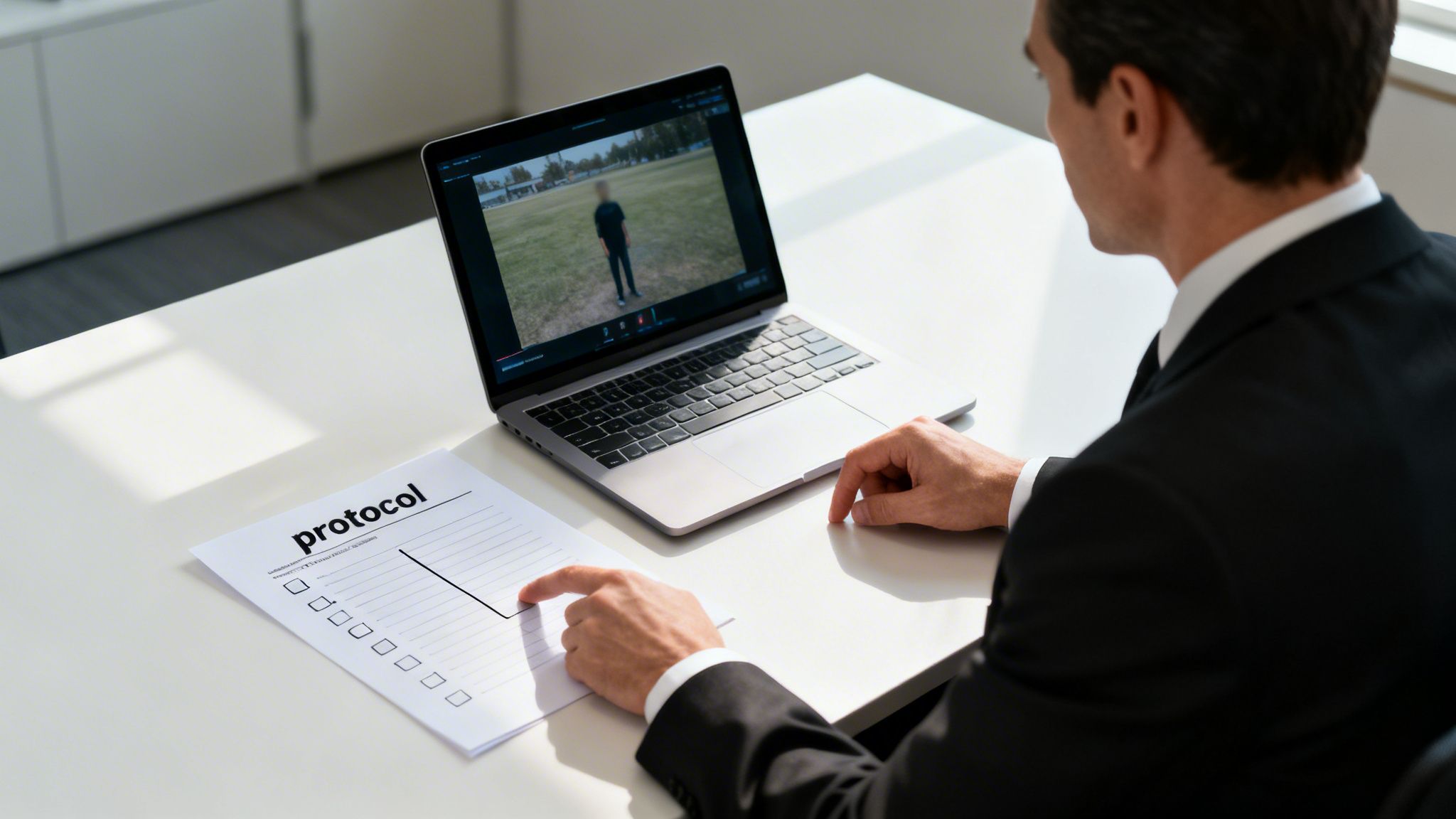
In DWI defense, dashcam and bodycam video isn’t just for the prosecution; it’s often our best evidence. We meticulously review every second, watching the officer just as closely as they were watching you. We pull out a stopwatch to time their movements and a checklist to spot every procedural flaw.
Was the stimulus held for the full four-second count at maximum deviation? Did the officer move their hand in a smooth, straight line? These might sound like minor details, but in the eyes of the law, they are everything. We use this footage to show the judge or jury exactly how the officer failed to meet the required standards.
An officer might write in their report that they performed a perfect HGN test. Video doesn't lie. We frequently expose major contradictions between the officer’s report and what the camera actually recorded, which can completely destroy their credibility.
Cross-Examining the Officer on the Stand
If the HGN evidence is allowed in court, our next step is to challenge the officer directly through aggressive cross-examination. We question their training, their certification, and their specific memory of your arrest. Most officers have conducted hundreds of these tests and can't recall the details of any single one without relying on their often-inaccurate reports.
We ask pointed questions to get them to admit, in front of the jury, that they are not doctors and that dozens of other medical conditions cause nystagmus. We make them try to explain the complex science behind the test—something many are unable to do clearly.
This entire process exposes the HGN test for what it really is: a subjective opinion, not an objective medical diagnosis. A skilled Texas DUI attorney can turn the state's key witness into a witness for the defense, helping the jury see the reasonable doubt that was there all along.
Your Next Steps To Protect Your Rights And License
After a DWI arrest, your head is probably spinning with questions about the HGN test and what comes next. However, there is one urgent deadline you absolutely cannot miss.
In Texas, you have just 15 days from the date of your arrest to request an Administrative License Revocation (ALR) hearing. This is a strict, non-negotiable deadline. If you let it pass, the Texas Department of Public Safety (DPS) will automatically suspend your driver's license, regardless of what happens in your criminal DWI case. Fighting this DWI license suspension must be your top priority.
Take Control of Your Case Today
That ticking clock can feel overwhelming, but taking immediate, decisive action is the best way to regain control. You don't have to navigate this alone, but you should take a few steps right away.
Here’s your initial action plan:
- Mark the 15-Day ALR Deadline: Get out your calendar right now, calculate the date, and set multiple reminders. Missing this window is one of the most common and damaging mistakes people make after a DWI arrest.
- Gather Your Documents: Locate all the paperwork the police gave you, including your notice of suspension (the DIC-24 form), any bond paperwork, and the citations you received.
- Write Everything Down: While the memory is fresh, write down every detail you can recall about the traffic stop, the officer's instructions for the HGN test, and the arrest itself. No detail is too small.
Your most urgent priority is requesting an ALR hearing to save your license. This is a separate civil process from your criminal DWI charge, and it requires immediate, independent action.
A Strategic Defense Starts Now
Effectively challenging a DWI charge requires a proactive, intelligent approach from day one. Whether this is your first DWI in Texas or you have prior offenses, the foundation of a strong defense is built in these first few days with an experienced legal team in your corner.
The time to protect yourself is now. At The Law Office of Bryan Fagan, PLLC, we understand the stress and uncertainty you're facing, and we are here to lift that burden. Contact us 24/7 for a free, confidential consultation. Let our experienced Texas DWI attorneys review your case, explain your options, and start working immediately to protect your rights, your license, and your future.
Answering Your Top Questions About The HGN Test
After a DWI stop, your mind is probably racing with questions about what just happened. The Horizontal Gaze Nystagmus (HGN) test, in particular, can feel confusing and subjective. Getting clear answers is the first step to understanding the evidence against you—and figuring out how to fight it.
Here are the questions we hear most often from clients who are in the exact same spot you are.
Can I Refuse The HGN Test In Texas?
Yes. You have an absolute right to refuse any and all field sobriety tests, including the HGN test. This is a critical point that many people don't realize in the heat of the moment.
Unlike refusing a chemical test (breath or blood), there is no automatic driver's license suspension for saying "no" to field sobriety tests in Texas. While an officer might still arrest you based on other observations, you are never legally required to perform these tests and give them evidence to use against you.
Is The HGN Test Alone Enough To Convict Me?
On its own, almost never. An HGN test is just one piece of evidence, and frankly, it is often one of the weakest pieces for the prosecution.
The HGN test is nothing more than one officer's subjective opinion about how your eyes moved. A sharp Texas DUI attorney knows exactly how to pick apart the science, the shoddy administration of the test, and the officer's lack of qualifications, making it carry very little weight with a jury.
Without other solid evidence—like a high BAC from a breath test, erratic driving on video, or an admission of drinking—the HGN test is rarely enough to secure a conviction.
What If I Have A Medical Condition That Caused The Nystagmus?
This is an incredibly strong defense. If you have any pre-existing medical issue known to cause nystagmus, the officer's test results are immediately cast into doubt.
Your attorney can use your medical records and even testimony from your doctor to show the jury there is an innocent, medical explanation for what the officer observed. It's a key strategy we use to fight DWI Texas charges because it introduces reasonable doubt by proving the "clue" the officer found wasn't a clue related to intoxication at all.
How Does A Lawyer Get HGN Evidence Thrown Out?
Attorneys challenge HGN evidence by filing a "Motion to Suppress." This is a formal legal request asking the judge to exclude the HGN test from the case because it was obtained improperly.
Most often, the motion argues that the officer failed to follow the strict, standardized procedures required by the National Highway Traffic Safety Administration (NHTSA). Officers make mistakes with this test all the time. If the judge agrees the errors were significant, the HGN results are deemed unreliable and cannot be used against you, which can cripple the prosecutor's case.
A DWI arrest can make you feel like your world is collapsing, but this is just the start of the legal fight—not the end. At The Law Office of Bryan Fagan, PLLC, our team of dedicated DWI defense attorneys is ready to stand by your side. We dig into every detail, from the HGN test to the breathalyzer calibration logs, to find the weaknesses in the state's case. Don't let the prosecution build its case unanswered. Contact us 24/7 for a free, confidential case evaluation at https://texasduilawfirm.com.