 Skip to content
Neurontin, which is gabapentin, is not a federally controlled substance, and as of 2024, eight states have still chosen to classify gabapentin as Schedule V while at least 12 other states require prescription reporting through PDMP systems. In Texas, that “not controlled” label can give people false confidence, because a DWI charge turns on impairment, not whether your medication sits on a federal drug schedule.
A DWI arrest can be overwhelming, but you don't have to face it alone.
If you were arrested after taking prescribed Neurontin, you're probably asking a fair question: how can I be charged when I took medication my doctor gave me? In Texas, police don't need to prove you used an illegal drug. They only need to claim you lost the normal use of your mental or physical faculties because of a drug, alcohol, or a combination of substances.
That's why this issue matters so much. A valid prescription can help explain why a drug is present in your system, but it doesn't automatically protect you from arrest, prosecution, or a DWI license suspension fight. Prosecutors may even try to use your prescription history against you to argue that you knew the medication could affect you.
A DWI Arrest Can Be Overwhelming Even With a Valid Prescription
You followed your doctor's instructions. You picked up your medication legally. Then a traffic stop turns into handcuffs, a tow truck, a blood draw request, and a criminal case. That shock is real, and you're not overreacting if you feel angry or confused.
A first DWI in Texas can affect your license, your job, your insurance, and your record. If you hold a professional license or a CDL, the stress gets worse fast. The good news is that an arrest is not a conviction, and prescription drug cases often leave room to challenge the officer's conclusions.
What Texas police are really looking for
Texas DWI law focuses on intoxication. In plain English, that means the state claims you didn't have the normal use of your mental or physical faculties because of alcohol, a drug, or both. That's why someone can face a DWI even when no illegal drug is involved.
A few key terms matter right away:
- BAC means blood alcohol concentration. In alcohol cases, BAC often gets the attention. In prescription drug cases, the state may not have a useful BAC issue at all.
- Field sobriety test means the roadside divided-attention tests officers use to claim impairment. These tests were built around alcohol detection and can be misleading in medication cases.
- Implied consent means that by driving in Texas, you've already agreed to provide a breath or blood specimen under certain circumstances. Refusing can trigger separate license consequences.
- Administrative license suspension means the civil process that can suspend your license apart from the criminal court case. In Texas, this usually shows up in the ALR process.
Your prescription doesn't end the case. It starts a different kind of defense.
What happens after a Texas DWI arrest
A feeling of being lost often arises when several tracks start moving at once. Usually, the process looks like this:
- Arrest and booking happen first. You may be released on bond with conditions.
- ALR deadline starts immediately. If you miss it, your license can be suspended automatically.
- Criminal case filing follows. The prosecutor reviews reports, video, test results, and medical facts.
- Defense investigation begins. Your lawyer looks at the stop, arrest, testing, officer observations, and your medication use in context.
- Court settings and negotiations come next. Some cases move toward dismissal, reduction, or trial based on the evidence.
If you're searching for a Houston DWI lawyer or a Texas DUI attorney, focus on someone who understands that legal medication cases are science-heavy and fact-specific. These cases are rarely as simple as the arrest report makes them sound.
Understanding Controlled Substances and Drug Schedules
A lot of confusion starts with the phrase controlled substance. People hear it and assume the answer tells them whether a DWI charge is valid. It doesn't. Still, you need to understand the label because prosecutors and police often use it to frame the case.
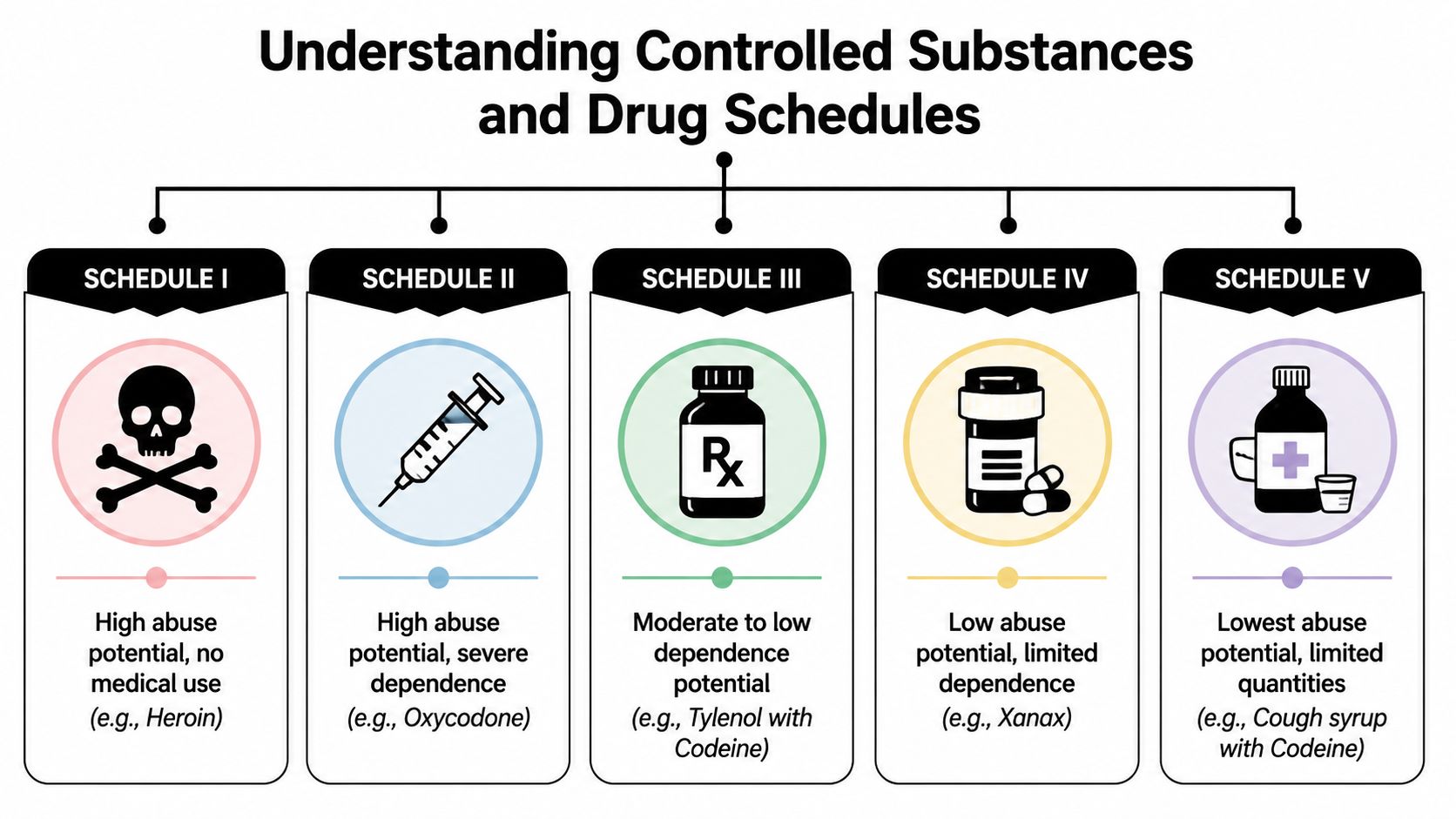
The federal government uses the Controlled Substances Act to sort certain drugs into five schedules. Those schedules reflect abuse potential and accepted medical use. The practical result is simple: the higher the schedule concern, the tighter the rules on prescribing, storing, dispensing, and criminal enforcement.
What the five schedules mean in real life
Here's the easiest way to understand it:
| Schedule | Basic meaning | Practical effect |
|---|---|---|
| Schedule I | High abuse potential, no accepted medical use | Strictest prohibition |
| Schedule II | High abuse potential, accepted medical use | Heavy prescribing and record rules |
| Schedule III | Lower than Schedule II | Significant regulation remains |
| Schedule IV | Lower abuse potential | Still controlled |
| Schedule V | Lowest abuse potential among controlled drugs | Controlled, but less restricted than I through IV |
The schedule doesn't answer whether you were driving safely. It answers how the government classifies the drug for regulation.
Why this matters in a Texas DWI case
If a drug is controlled, the prosecutor may try to make the case sound more serious from the start. If a drug is not controlled, the prosecutor shifts to a different argument: “legal doesn't mean safe to drive on.”
That's why “is Neurontin a controlled substance” is the wrong final question. The better question is whether the state can prove actual impairment at the time of driving.
Practical rule: In Texas DWI court, the fight is usually over impairment, not labels.
And while you sort that out, don't forget the deadline running in the background. The 15-Day ALR Deadline: Save Your License After a DWI Arrest explains why you have only days to request a hearing to stop an automatic license suspension.
Neurontin's Legal Status Federal vs Texas Law
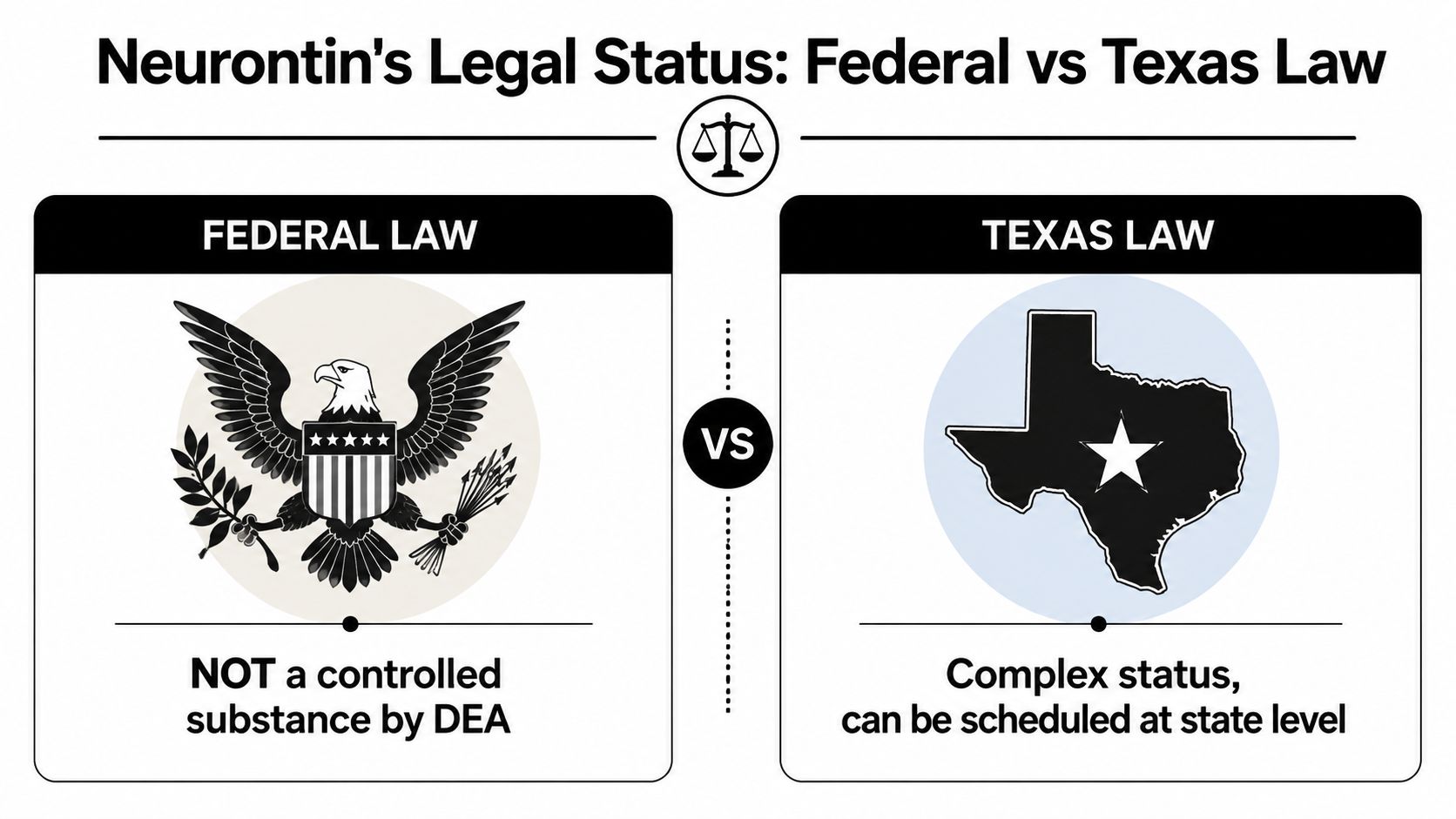
Here is the direct answer. At the federal level, Neurontin is not a controlled substance. The DEA's control status information confirms gabapentin remains non-controlled under federal law, and that federal treatment has remained in place since FDA approval for postherpetic neuralgia and seizure disorders in the DEA gabapentin control status document.
That answer is true, but it is incomplete.
Federal law says no. States can still tighten the rules
States don't have to mirror federal treatment. As of July 2022, gabapentin was still not classified as a controlled substance federally, but by 2024, eight states had independently reclassified it as Schedule V, and at least 12 other states had adopted mandatory PDMP reporting rules for gabapentin, as summarized in GoodRx's review of gabapentin control status.
That patchwork matters because a medication can be non-controlled in one place and tightly monitored or scheduled in another. The legal status is not as uniform as most patients assume.
A state example shows how real this is. Michigan modified its pharmacy rules to categorize gabapentin as Schedule V, effective January 9, 2019, through action described by the state in Michigan's gabapentin scheduling notice.
What Texas drivers need to understand
Texas does not treat gabapentin as a federally scheduled controlled substance because Texas can't change federal law. But Texas DWI prosecutors don't need a controlled-substance label to build a case around impairment. That is the trap.
If the state can show you had Neurontin in your system, had signs the officer interpreted as impairment, and were driving in a way the officer calls unsafe, the prosecution will move forward. In other words, “not controlled” does not mean “irrelevant.”
This short video gives a helpful overview before we get into prosecution tactics.
Why this distinction matters for your record
People often focus only on the immediate arrest and miss the long-term consequences. A DWI case can affect background checks, professional opportunities, and licensing issues even if the medication involved was legal to possess.
That's why it helps to understand Clearing a Texas DWI: Expunction and Nondisclosure, which addresses whether and how a DWI can be removed or sealed from your record.
How a Legal Neurontin Prescription Can Become a DWI Charge
Typically, anxiety turns into anger. You can take Neurontin exactly as prescribed and still get arrested if the officer believes the medication affected your driving.
Take a common scenario. You take your evening dose, feel more tired than usual, drift slightly in your lane, and get stopped. The officer notices slow speech, unsteady balance, or trouble following divided-attention instructions. From there, the report starts reading like a standard DWI case even though no illegal drug is involved.

The state's theory is impairment, not illegality
Texas prosecutors don't have to prove Neurontin is a narcotic. They don't have to prove it's federally scheduled. They only have to argue that it affected your normal use of mental or physical faculties.
Clinical data shows gabapentin is FDA-approved for postherpetic neuralgia and as adjunctive therapy for partial-onset seizures in patients age 3 and older, and that it is not a narcotic or opioid. The same clinical information also warns of severe respiratory depression risk when gabapentin is combined with central nervous system depressants such as opioids, benzodiazepines, or alcohol, as noted in the provided FDA-related gabapentin risk reference.
That combination point matters in court. A prosecutor may argue that even a legal dose became dangerous once alcohol or another depressant entered the picture.
How officers build the roadside case
Most prescription-medication DWI arrests rely on a stack of observations:
- Driving behavior such as weaving, delayed braking, or inconsistent speed
- Physical signs like droopy eyelids, balance issues, or slow responses
- Statements you make about prescriptions, timing, sleep, or alcohol use
- Field sobriety test performance that the officer calls clues of intoxication
Those clues are often less reliable than they sound. Fatigue, pain, anxiety, neurological conditions, and ordinary side effects can all look suspicious on body camera video.
A legal prescription can become the prosecution's exhibit, not your shield.
Why your own words matter so much
If you tell an officer, “I take gabapentin, but it doesn't affect me,” and the report later says you looked drowsy or confused, the prosecutor may claim you knew the risks and drove anyway. That's one reason you need a careful defense strategy built around what the evidence proves.
For a fuller look at this issue, see DWI while on prescription medication under Texas laws.
How to Fight a DWI Charge Involving Gabapentin in Texas
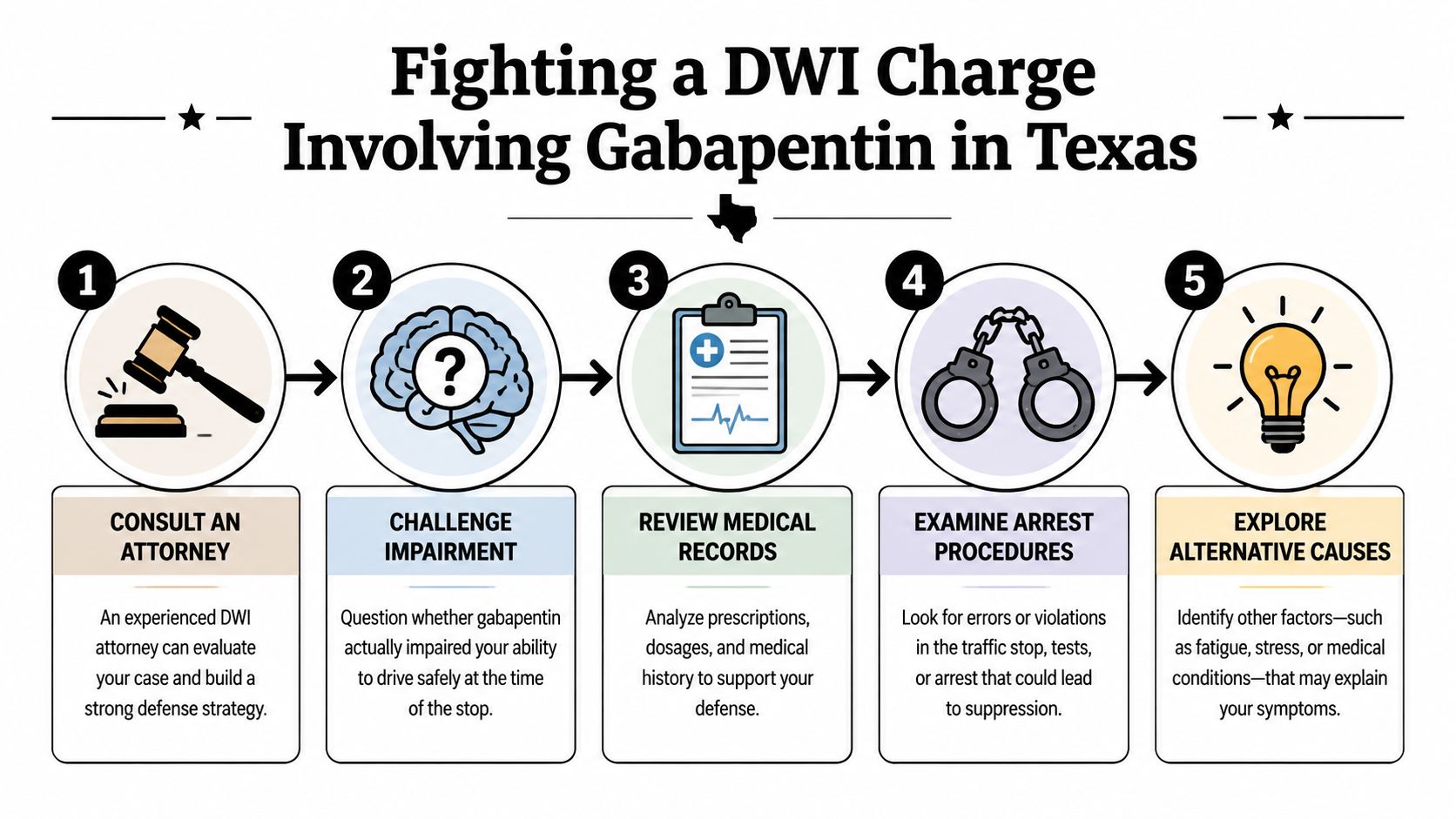
You can have a valid gabapentin prescription, take it exactly as directed, and still find yourself facing a Texas DWI case. That happens because the main fight is not over whether Neurontin is federally controlled. The fight is over whether the state can persuade a jury that your driving and your condition showed impairment at that moment.
Force the case onto proof, not suspicion
Prosecutors like gabapentin cases because the medication sits in a gray area. It is not federally scheduled, but that does not stop the state from treating it like a danger signal. In Texas, that gray area gives the prosecution room to build a story around lawful medication use, pharmacy history, and vague roadside observations.
A serious defense cuts that story apart piece by piece.
Ask the hard questions early:
- Did the officer have a valid legal basis for the stop, or did ordinary driving get dressed up as suspicious conduct?
- Were field sobriety tests fair for your physical condition, age, fatigue level, pain issues, or prescribed medication side effects?
- Did the officer mistake a medical issue for intoxication?
- Did any blood result prove impairment while driving, or only confirm the presence of a medication you were allowed to take?
Those questions win cases. Broad accusations do not.
Do not let PDMP records become the state's shortcut
This is the part many lawyers and almost every online guide miss. In a gabapentin DWI case, the prosecutor may try to use Prescription Drug Monitoring Program data to argue you knew the drug could affect you, took it anyway, and chose to drive. That is a powerful narrative if nobody pushes back.
PDMP records do not prove bad driving. They do not prove you were impaired at the wheel. They do not prove the dose, the timing, your tolerance, or how the medication affected you that day.
The prosecution may also try to use reclassification debates and misuse concerns surrounding gabapentin to make a lawful prescription sound sinister. The PMC article on gabapentin use, abuse, and reclassification arguments shows why the drug draws attention. In court, though, attention is not evidence. Your defense should challenge whether PDMP material is relevant, whether it is incomplete, and whether it unfairly invites the jury to punish you for having a prescription instead of deciding whether the state proved intoxication.
Scrutinize the blood draw and the paper trail
Drug DWI cases often rise or fall on blood evidence. That makes procedure matter.
If police took your blood, examine every step. Why did they think a blood draw was justified? Did they get a warrant? Was the affidavit thin, recycled, or based on weak observations? If you need background on that issue, review when police need a DWI blood draw warrant.
Then look beyond the warrant. Review the chain of custody, the lab paperwork, the timing of the sample, and whether anyone can reliably connect a later test result to your condition while driving. Presence is easy to prove. Impairment is harder.
Build the defense around the facts that actually matter
Strong gabapentin defenses in Texas often focus on a few practical themes:
- Your medical condition may explain the officer's observations. Pain, nerve issues, fatigue, and balance problems can look bad on video.
- Timing may break the state's theory. A prescription history and a lab result do not automatically show impairment during the stop.
- Officer interpretation may be weak. Many officers are not trained to separate medication side effects, health problems, and true intoxication.
- The prosecutor may overplay the prescription. A lawful medication can become a character attack unless the defense keeps the case tied to evidence.
- Any claim about mixing substances still requires proof. The state must show what affected you, not rely on fear or assumptions.
You beat a gabapentin DWI by forcing the state to prove impairment with reliable evidence tied to the time of driving.
That means your lawyer should be reviewing body camera video, dispatch logs, blood draw records, medical history, lab documents, officer reports, and every statement the state says you made. That is the work required to effectively fight a DWI in Texas.
The Law Office of Bryan Fagan, PLLC handles Texas DWI matters, including ALR hearings, blood-test challenges, and drug-related driving cases.
Protect Your Future Your Next Steps After a DWI Arrest
If you've been arrested after taking Neurontin, act fast and stay disciplined. Early mistakes hurt good cases.
Do these things immediately
- Stay quiet about the facts. Don't explain the stop to friends, coworkers, or on social media. Prosecutors use admissions wherever they find them.
- Protect your license. You have 15 days from arrest to request an ALR hearing in Texas if you want to fight an automatic suspension.
- Save records now. Keep your prescription bottle, pharmacy records, discharge papers, and a timeline of when you took your medication.
- Write down what happened. Note what you ate, slept, drank, and took that day, and how the officer described your behavior.
- Get legal advice before court. Drug DWI cases move on technical details. Delay helps the state, not you.
Know the process so you can stay calm
After arrest, you may face bond conditions, court dates, DPS license action, and demands for records. That doesn't mean your case is lost. It means you need a plan.
The ALR hearing deals with your license. The criminal case deals with guilt or innocence. They are connected, but they are not the same. A smart defense treats both seriously.
If you need a practical checklist, review what to do after a DWI arrest in Texas immediately.
A Texas DUI attorney should also explain the range of penalties in plain terms. Depending on the charge and your history, consequences can include fines, probation terms, court requirements, ignition interlock issues, and license consequences. In some cases, people also ask about future cleanup options after resolution. Those questions matter, but the first job is protecting your position now.
The first days after arrest often shape the entire case.
You are not stuck just because you had a lawful prescription. You are not guilty just because an officer wrote “impaired” in a report. And you do not have to figure this out alone.
If you're facing a DWI charge involving Neurontin or any prescription medication, request a free consultation with Law Office of Bryan Fagan, PLLC. Our team helps Texans evaluate the stop, protect against DWI license suspension, prepare for the ALR hearing, and build a defense aimed at reducing or defeating the charge. If you're dealing with a first DWI in Texas or need a Houston DWI lawyer to help you fight DWI Texas, reach out for a confidential case evaluation now.

