
A DWI arrest can be overwhelming, but you don't have to face it alone.
You may have been driving home, using medication exactly as your doctor prescribed, when a traffic stop turned into handcuffs, a tow truck, and a night you never saw coming. Now you're asking the question almost every client asks after this kind of arrest. How can Texas charge me with DWI when I was taking legal medication?
It can. But a charge is not a conviction, and a prescription medication case is often far more fightable than people think.
A Prescription DWI Arrest Is Overwhelming but Not Hopeless
A prescription drug DWI usually starts with disbelief.
You tell the officer you haven't been drinking. You explain that the pill bottle is yours. You may even think that showing the prescription will clear everything up. Instead, the officer focuses on how you looked, how you spoke, whether you seemed tired, confused, unsteady, or slow to respond. Then the arrest happens anyway.
That shock is normal. So is the fear that follows.
You're probably worried about your license, your job, your family, your criminal record, and what happens when your employer or professional board finds out. You may also feel angry, because from your point of view you didn't break the law. You took medicine your doctor gave you.
Texas law doesn't see it that way if the officer claims the medication affected your ability to drive. That's the hard truth. The better truth is that these cases are often built on weak, subjective opinions.
Why this kind of arrest feels so unfair
Alcohol cases at least give people a familiar reference point. The 0.08 BAC number is widely recognized. Prescription medication cases don't work that way.
Instead, you're dealing with an officer's judgment call about whether you had the normal use of your mental or physical faculties. That leaves room for mistakes, exaggeration, bad assumptions, and sloppy police work.
A few common reactions after arrest are completely understandable:
- You blame yourself immediately. Many people assume an arrest means the state already has solid proof. It often doesn't.
- You think the prescription should end the case. It won't, by itself.
- You feel pressured to explain everything. That usually makes things worse, not better.
- You assume the blood test decides everything. It doesn't. Presence of a medication is not the same thing as impairment.
Practical rule: If you were arrested after taking legally prescribed medication, stop trying to talk your way out of it and start preparing to challenge the evidence.
What you need to remember right now
Your case will likely turn on details. Not broad accusations. Details.
The stop. The officer's observations. Your medical condition. The instructions given during field sobriety testing. The timing of the medication. The blood draw. The reports. The video.
That's why panic is the wrong response. Strategy is the right one.
The Unforgiving Standard of Texas DWI Prescription Drug Law
Texas gives prosecutors a simple rule and gives drivers very little room for error.
Under Texas Penal Code §49.01, you can be considered intoxicated if you do not have the normal use of your mental or physical faculties because of a substance. Under Texas Penal Code §49.10, having a valid prescription does not excuse the charge. If the state claims your medication affected your ability to drive, you can be arrested, prosecuted, and punished the same way as any other DWI defendant.
That is the rule you are up against. It is harsh, but it also creates an opening for the defense.
The law asks whether you were impaired, not whether the medication was legal
A prescription proves you were allowed to possess the drug. It does not prove you were safe to drive. In a Texas DWI case, the legal battle centers on impairment.
That word sounds objective. It often is not.
In alcohol cases, jurors expect to hear about a breath score or a blood alcohol number. Prescription medication cases usually do not give the state that kind of clean measurement. For many medications, there is no fixed legal threshold that automatically establishes intoxication. The prosecution usually has to rely on an officer's interpretation of how you looked, how you spoke, how you drove, and how you performed on divided-attention tests.
That is why these cases can be fought aggressively. The state is often selling an opinion, not proving a number.
If you had fatigue, anxiety, a neurological issue, chronic pain, vertigo, or another condition that can look like intoxication, that fact may be central to your defense. Many medical conditions that mimic intoxication in a Texas DWI investigation give police an easy way to misread ordinary symptoms as drug impairment.
Why the standard feels unfair
The officer does not need to prove you abused your medication. The officer does not need to show you took more than prescribed. The officer only needs to claim your faculties were impaired.
That low, subjective standard is where bad arrests happen.
A driver with slow speech after taking medication exactly as directed can be labeled impaired. A driver with poor balance because of a back injury can be labeled impaired. A driver who is nervous, confused, or exhausted during a late-night stop can be labeled impaired. Once that opinion gets written into the report, the state starts building the whole case around it.
Your defense has to attack that opinion early and with precision. Start at the stop. Then the roadside investigation. Then the arrest decision. Then the blood draw, if there was one. Then the officer's training, the body cam, the dash cam, and the medical timeline. The ALR hearing is often the first chance to lock the officer into testimony and expose weak assumptions before the criminal case gets deeper.
What the state usually tries to use against you
Here is how the prosecution typically tries to make a prescription medication case look stronger than it is:
| Evidence the state relies on | Why the defense challenges it |
|---|---|
| Driving behavior | Drifting, slow driving, or delayed reactions can come from fatigue, distraction, pain, illness, or stress |
| Physical appearance | Red eyes, slurred speech, and unsteadiness can have medical or innocent explanations |
| Your statements | Drivers often hand the state damaging sound bites by trying to explain medications on the roadside |
| Field sobriety tests | These tests are not tailored to many prescription drug effects or physical limitations |
| Blood test results | A positive result may show the drug was present. It does not automatically show you lost normal use of your faculties |
That is the practical reality of DWI while on prescription medication Texas laws. These cases often turn on whether a jury believes the officer's interpretation or sees the gaps in it.
What the penalties look like
The stakes are serious. A first-offense DWI can be charged as a Class B misdemeanor, and repeat cases can rise to a Class A misdemeanor or a third-degree felony, depending on your record and the facts. As noted earlier in this article's cited Texas prescription DWI law summary, the punishment range can include fines, jail time, and license suspension.
Do not make the mistake of treating this like a paperwork problem. It is a credibility fight, and you need to approach it that way from day one.
A lawful prescription explains why the medication was in your system. It does not prove the officer was right about impairment.
How Police Build a Subjective Case Against You
You get pulled over, tell the officer you took your medication as prescribed, and expect that to clear things up. It does not. In many Texas prescription DWI cases, that statement becomes part of a story the officer starts building on the roadside and finishes in a report written to sound certain.
That is the core problem in these cases. The state often cannot point to a clean number that proves impairment from a prescription drug. So the prosecution builds the case around the officer's opinion. If you want to beat this charge, you attack that opinion early, at the ALR hearing and again in court.
The officer turns ordinary facts into an impairment narrative
Police reports in these cases are full of loaded wording. Slow answers become "delayed mental processing." Nervousness becomes "confusion." A driver with pain, fatigue, anxiety, vertigo, or a knee injury becomes "unsteady on exit."
That language is not neutral. It is advocacy.
Once an officer decides you are impaired, every detail starts getting filtered through that decision. Your posture, your speech, how long it took to find your insurance, whether you looked away, whether you swayed while standing on the shoulder. The report is written to make those details sound like proof, even when there are innocent explanations.
Your lawyer's job is to break that story apart piece by piece. Start with the stop. Then the body camera. Then the dashcam. Then the timeline. Then the officer's training. Then the gaps between what the video shows and what the report claims. That is how you expose a subjective case for what it is.
Field sobriety tests give officers more opinion, not certainty
Police lean hard on field sobriety tests, or FSTs, because they create more observations the officer can describe later. In a prescription medication case, that is a problem. These tests were not built to measure every medication effect, every medical condition, or every physical limitation.
If you were tired, injured, anxious, overweight, older, recovering from surgery, dealing with a neurological issue, or taking medication that affected balance or speech, your performance may say very little about intoxication.
A strong defense looks closely at issues like these:
- Bad instructions: The officer rushed, interrupted, or explained the test poorly.
- Poor conditions: Uneven ground, traffic, lighting, weather, and footwear affected performance.
- Medical interference: A health condition may explain what the officer called intoxication. Some of the most common examples are covered in these medical conditions that mimic intoxication in Texas DWI cases.
- Confirmation bias: After the officer decides you are impaired, normal mistakes start getting treated as proof.
This is why I tell clients not to panic over a bad roadside performance. FSTs do not decide the case. They give us another area to challenge.
A Drug Recognition Expert still gives an opinion
Sometimes the state tries to tighten up a weak case by calling in a Drug Recognition Expert, or DRE.
A DRE has more training than the arresting officer. That helps the state, but it does not solve the basic problem. The final conclusion is still an opinion from law enforcement about whether you lost the normal use of your mental or physical faculties.
Opinions can be tested. They can be compared against video. They can be measured against medical records, prescription instructions, timing, dosage, fatigue, injuries, and other explanations the officer ignored. They can also be challenged at the ALR hearing, where the officer has to commit to a version of events under oath. That early testimony often gives the defense valuable material for cross-examination later.
In a prescription DWI case, the fight is usually not over whether medication was present. The real fight is whether the officer was right about impairment.
Navigating Chemical Tests Implied Consent and License Suspension
One of the biggest pressure points after arrest is the chemical test.
Texas uses implied consent law. In plain English, that means when you drive on Texas roads, you've already agreed to provide a breath or blood specimen if an officer lawfully arrests you for DWI. You don't sign a separate contract at the roadside. The law builds that consent into the act of driving.
For prescription medication allegations, breath testing usually isn't the state's main tool. Blood testing is.
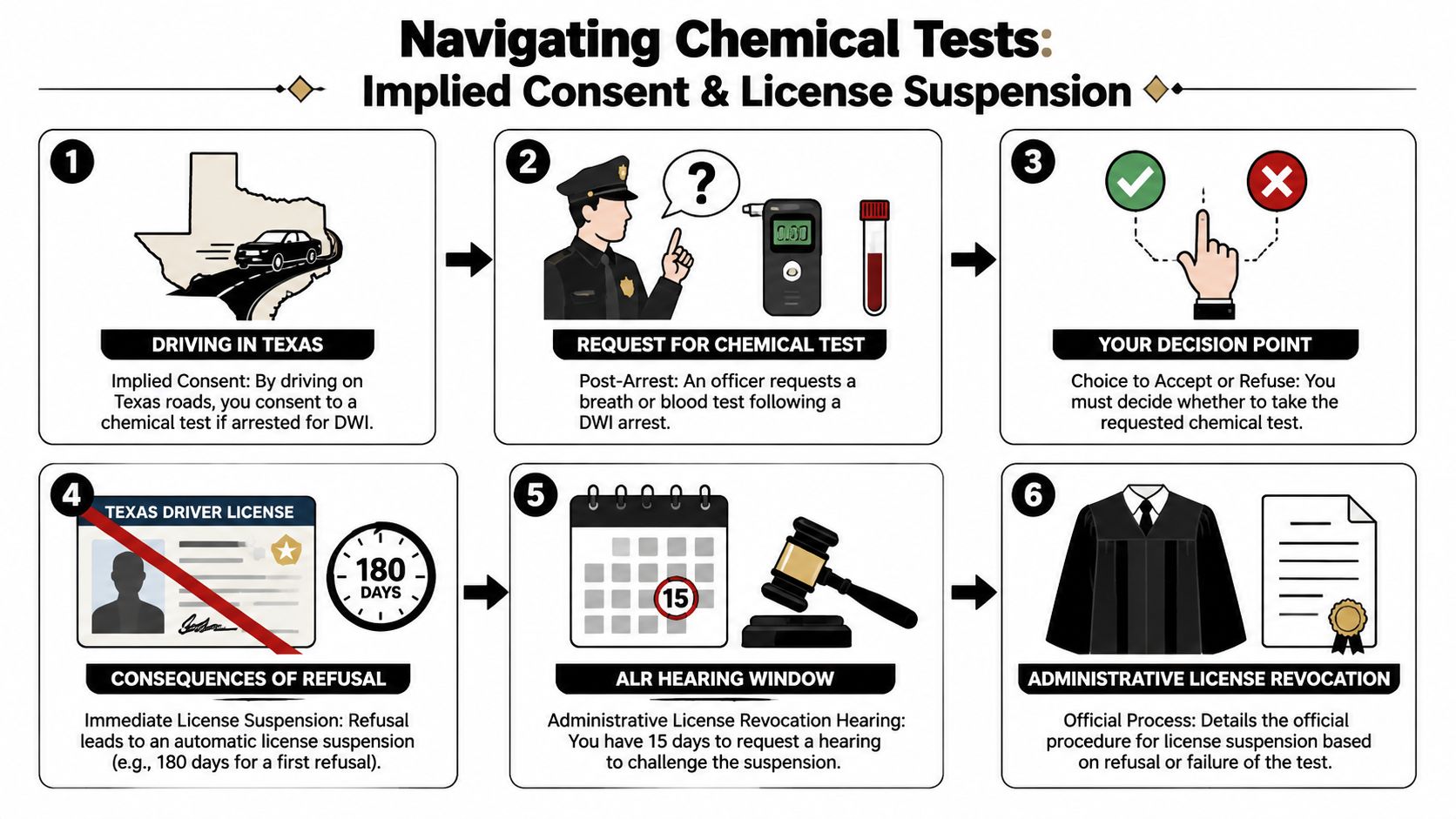
What implied consent means for you
After arrest, the officer may ask for a specimen. If alcohol isn't the focus, the state will often pursue blood.
A blood test measures what substances are present in your blood. A BAC, or blood alcohol concentration, is the alcohol number people usually hear about in drinking cases. In a prescription medication case, the state may still test blood, but the issue often shifts from alcohol level to the presence of medication and the argument that it affected your faculties.
You usually face two tracks after that request:
| Your choice | Likely consequence |
|---|---|
| You provide a specimen | The state may try to use the result to support the criminal case |
| You refuse | The state can move to suspend your license through the administrative process |
The infographic above gives the high-level picture. The details matter fast.
Administrative license suspension is separate from the criminal case
A lot of people miss this. The driver's license fight is different from the criminal DWI prosecution.
That separate process is often called Administrative License Revocation, or ALR. You may also hear people call it an administrative license suspension or DWI license suspension matter. It's the civil side of the case, handled through a different process than your criminal court dates.
Here's the urgent part. You have 15 days to request an ALR hearing after arrest if you want to fight the suspension. Miss that deadline and you can lose the chance to contest it early.
Urgent step: The first battle in many DWI cases is not the criminal court. It's the ALR hearing request. If that deadline is running, act now.
Why the ALR hearing matters so much
This hearing is not just about your license. It's also a discovery tool.
Your lawyer can question the officer early, lock in testimony, and test whether the stop, arrest, and request for a specimen hold up. That can expose weak probable cause, inconsistent observations, and holes in the state's paperwork.
For prescription drug cases, this matters even more because so much depends on subjective observations.
A blood draw also raises legal issues of its own. If officers used a warrant, timing, procedure, and compliance all matter. If you want to understand how those issues can affect a case, review this guide to a Texas DWI blood draw warrant and the issues that can arise.
This video gives added context on the testing and suspension process:
A direct recommendation on test decisions
People always want a simple answer. Should I refuse?
There is no one-size-fits-all answer after the fact, and no honest lawyer should pretend otherwise. Refusing can trigger license consequences. Giving blood can hand the state evidence it wants. What matters now is not relitigating that roadside decision. What matters is examining whether the officer followed the law and whether the state can turn the test result into proof of impairment.
That's where good defense work starts.
Strategic Defenses to Fight a Prescription DWI Charge
A prescription medication DWI case should be attacked from multiple angles. Not one. Not two. Every angle that fits the facts.
The state has to connect a lot of dots in these cases. Your defense works by breaking those connections.

Attack the stop first
If the officer had no legal basis to stop you, that issue can contaminate everything that came after.
Maybe the driving conduct was exaggerated. Maybe the alleged traffic violation never happened. Maybe the dashcam does not match the report. If the stop falls apart, the prosecution's case may lose critical evidence.
This is basic but powerful. Police do not get a free pass because they wrote a confident report.
Challenge the roadside performance evidence
A lot of prescription DWI prosecutions lean heavily on how you did outside the car.
That evidence is often vulnerable because it depends on the officer's instructions, your physical condition, the roadside environment, and the officer's interpretation. A person can perform poorly for many reasons that have nothing to do with criminal intoxication.
Consider how these scenarios play out:
- Ambien was detected in your blood. The state still has to show it impaired you at the time of driving, not just that it was present.
- You seemed sleepy. Sleep deprivation, illness, long work shifts, and certain medical conditions can look similar.
- You were unsteady. Footwear, injury, age, anxiety, and roadside conditions all matter.
Go after the blood evidence
Blood evidence sounds powerful to jurors because it feels scientific. That doesn't mean the result is untouchable.
A defense lawyer should examine whether the draw was lawful, whether the sample was handled properly, whether the lab work is reliable, and whether the result says anything useful about driving ability at the relevant time.
A few pressure points often matter:
| Defense question | Why it matters |
|---|---|
| Was the blood draw legally obtained? | Illegal collection can support suppression arguments |
| Was the chain of custody solid? | Mishandling raises reliability concerns |
| Was the testing method sound? | Lab errors happen, and protocols matter |
| Does the result show impairment or only presence? | Presence alone is not the same as intoxication |
Use experts, not just arguments
In the right case, expert testimony changes everything.
A toxicologist or medical expert can explain that a therapeutic level of a medication is not the same as an intoxicating level. An expert can also explain timing, metabolism, tolerance, interactions, and why a person may test positive long after the impairing effects have changed or passed.
A blood report may tell the jury what was in your system. An expert can tell the jury what that result does and does not prove.
Build a defense around your actual life
The strongest defense is not generic. It is personal.
Maybe you were taking medication exactly as prescribed and had no warning that it would affect you that way. Maybe your doctor adjusted the dosage. Maybe you had a documented medical condition that explains the behavior the officer called intoxication. Maybe the video shows you speaking clearly and following directions better than the report claims.
That's how good defense works. Piece by piece. The officer's conclusions are tested. The scientific evidence is narrowed. The prosecution's story becomes much less certain.
And in criminal court, uncertainty matters.
Heightened Stakes for Professionals CDL Holders and Young Drivers
Some people can weather a standard DWI case better than others. If you hold a commercial license, work in a licensed profession, or you're under 21, the consequences can spread far beyond criminal court.
In these situations, a generic defense isn't enough.
CDL holders face career-level fallout
If you drive for a living, a DWI allegation is not just a legal problem. It is an employment crisis.
A CDL holder depends on driving privileges to earn income. Even before the criminal case is resolved, administrative action and employer policy can put your position at risk. A commercial driver often has less room for error, less patience from an employer, and more pressure to act immediately.
Your defense must be built with that in mind. Protecting your record matters, but protecting your ability to keep working matters just as much.
Licensed professionals have more than one audience
Nurses, doctors, pharmacists, pilots, teachers, and other licensed professionals often have another problem waiting behind the DWI case. Reporting obligations and licensing scrutiny.
Even if the criminal case is eventually reduced, delayed, or resolved favorably, the arrest itself can trigger questions from a board, employer, credentialing office, or compliance department. That means your legal strategy should consider both the courtroom and the professional consequences at the same time.
If that applies to you, review how a DWI can affect a professional license in Texas.
Young drivers face a different kind of exposure
Drivers under 21 may face separate underage alcohol-related issues, but a prescription medication allegation can still create serious trouble.
A young driver has less experience, often says too much during police questioning, and may not understand the long-term impact of a criminal record or license problem. Families also tend to underestimate how quickly an arrest can affect school, insurance, internships, and future applications.
Here is the practical difference among these groups:
- CDL drivers need a defense built around preserving the ability to work.
- Licensed professionals need a plan that considers boards, reporting, and reputation.
- Young drivers and parents need fast guidance before bad decisions turn a difficult case into a much worse one.
If your livelihood depends on a clean record or a valid license, speed matters. Delay helps the state, not you.
Your Roadmap After a Texas Prescription DWI Arrest
Right now you need an action plan, not more anxiety.
The smartest move is to treat the next few days as critical. Not because panic helps. It doesn't. But because deadlines, evidence, and statements made early can shape the entire case.
Step 1 in the first 24 hours
Keep your mouth shut about the facts of the case.
That includes the police, friends, coworkers, and especially social media. You have the right to remain silent. Use it. In practice, that means don't try to explain how much medication you took, when you took it, why you thought you were okay to drive, or what the officer “misunderstood.”
Then write down everything you remember while it is still fresh.
Include things like:
- The stop itself: Where it happened, what the officer said you did wrong, and whether there was dashcam or bodycam.
- Your physical condition: Fatigue, illness, injury, recent meals, stress, or medical conditions.
- Medication details: What you took, when you took it, whether the dose changed, and whether the label included warnings.
- The arrest sequence: Field tests, blood draw, warrant discussion, tow, bond, and release timeline.
Step 2 protect your license immediately
This is the first hard deadline in many cases.
An ALR hearing is your chance to challenge the administrative suspension process. As noted earlier, the request must be made within 15 days. Miss it and you can lose an advantage before the criminal case even starts moving.
Also understand the term administrative license suspension clearly. It does not mean you were convicted. It means the state is trying to suspend your license through a separate administrative process tied to the arrest, refusal, or test result.
Step 3 understand what happens next in court
Individuals often feel less stressed once they know the basic sequence.
A typical path may include:
Release on bond
You may have bond conditions, reporting requirements, or travel restrictions. Follow them exactly.Administrative hearing process
This is the license fight. It can also reveal useful testimony and evidence early.Criminal court settings
These are the court dates where the prosecution and defense address charging, evidence, motions, and negotiation.Investigation and motion practice
Your lawyer reviews reports, videos, testing records, and officer conduct, then challenges weak or unlawfully obtained evidence.Resolution or trial
Some cases are dismissed or reduced. Others require a trial. The right path depends on the evidence, not on fear.
Step 4 gather smart documents, not random papers
Bring useful material together in one place.
That usually includes your bond paperwork, notice of suspension, citation, towing information, medication list, prescription records, and any medical information relevant to the officer's claims. Don't alter anything. Don't annotate reports. Just preserve it.
A short working checklist helps:
| Document or item | Why keep it |
|---|---|
| Bond papers | Shows conditions and court obligations |
| Notice related to suspension | Helps track ALR timing |
| Prescription records | Establishes lawful use and medical context |
| Medical records tied to symptoms | May support alternative explanations |
| Tow and inventory paperwork | Can reveal timeline and procedural issues |
Step 5 stop guessing and get the case evaluated
Do not assume the case is strong because you were arrested.
Do not assume the case is weak because you had a valid prescription.
Both assumptions can hurt you. Prescription medication DWI cases are technical. They often turn on officer credibility, video evidence, toxicology interpretation, and whether the state can prove actual impairment instead of just drug presence.
That's why your next step should be direct and immediate. Talk to a Houston DWI lawyer or Texas DUI attorney who handles these cases, knows how to fight DWI Texas cases built on subjective observations, and understands how to protect you in both the criminal case and the DWI license suspension process.
You have rights. You have defenses. And if this is your first DWI in Texas, you may have more options than you realize.
If you were arrested for DWI while taking prescription medication, request a free consultation with Law Office of Bryan Fagan, PLLC. Their team defends Texans facing drug-related DWI charges, challenges ALR suspensions, and builds strategic defenses aimed at dismissals, reductions, and protecting your future. A free, confidential case evaluation is the fastest way to understand your options and start moving forward.