
Could a breath test fail because the machine's own control check failed, rather than because your breath showed an unlawful alcohol concentration? That question matters in Texas DWI cases involving an Intoxilyzer 9000 reference sample error.
A DWI arrest can be overwhelming, but you don't have to face it alone. The printed result is only one part of the evidence. The machine must complete its internal checks, the officer must follow testing procedures, and the State must establish that the result is reliable enough to use in court. A reference sample error can place that foundation directly at issue.
Understanding the Intoxilyzer 9000 Reference Sample Error
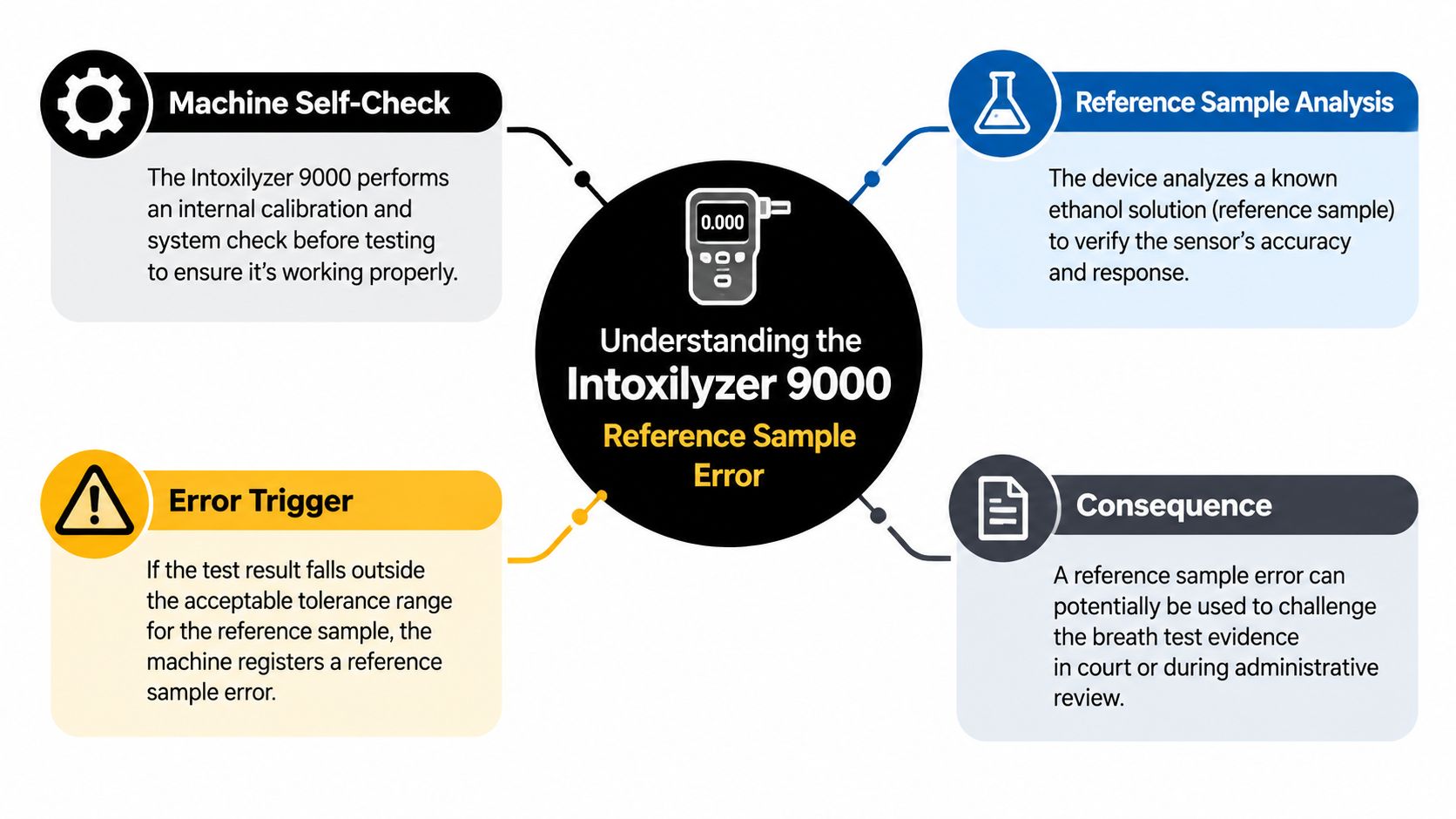
A driver may leave a testing room believing the machine reported a clear BAC result, only to learn that the printout contains an error or invalidation. The confusion is understandable. The Intoxilyzer 9000 doesn't rely only on the breath sample provided by the person arrested. It also analyzes a known reference standard, an alcohol solution used to check whether the instrument is operating within required parameters.
Texas breath-testing protocols require the reference result to fall between 0.070 and 0.090 g/210 L. If the result falls outside that range, the test is invalidated under the applicable protocol. Texas DPS calibration materials describe this reference analysis as part of the test sequence, not as an optional administrative detail.
What the reference sample does
The reference solution gives the instrument a known target. The machine analyzes that solution and compares the result with the permitted range. If the machine can't produce an acceptable reading from a known standard, the defense has a concrete reason to question whether the instrument was ready to evaluate a human breath sample.
That doesn't automatically prove the machine was permanently broken. It does mean the test sequence encountered a quality-control failure. Texas calibration materials also require each of 15 purified-water reference analyses to read 0.000, while the mean for each certified reference material must remain within ±0.0030 or 3%, whichever is greater, of the vapor concentration. These narrow tolerances show why the records behind the printout matter.
Practical rule: An invalid reference check is different from simply receiving a high BAC result. It concerns whether the instrument passed its own accuracy control before the result could be trusted.
Technical Causes Behind Reference Sample Failures
A reference sample error doesn't identify one single cause. It identifies a failure in the control process. The underlying problem may involve the solution, temperature, calibration verification, the instrument, or the operator's setup.
The reference solution must produce a known vapor concentration under controlled conditions. Storage problems, deterioration, contamination, or handling issues can affect what reaches the instrument. A lawyer shouldn't assume the solution was defective, but the defense should obtain records showing the solution's identity, handling, preparation, and use.
Temperature is part of the measurement
Temperature deserves close attention because ethanol moves between liquid and vapor phases in a temperature-sensitive way. Texas training materials specify a calibration-verification solution temperature window of 33.80–34.20°C, and appellate materials have addressed whether the reference sample was shown to be at a known temperature when testing occurred. This technical review of Intoxilyzer 9000 issues discusses why that question can affect both scientific reliability and courtroom admissibility.
The machine's reference result also has a defined acceptance window, 0.070–0.090 g/210 L. A result outside that window may signal a problem with the solution, temperature control, calibration verification, or the instrument's internal measurement system. The correct defense question isn't “Was there an error?” It is, “What caused the error, and did anyone resolve and document that cause before relying on later testing?”
What the records can reveal
A review of Texas breathalyzer calibration errors and DWI defense should compare the error message with the complete test sequence, service history, reference-sample information, and operator documentation. A restart may produce a later printout, but it doesn't erase the earlier failed control check. The later run needs its own foundation.
Useful technical questions include:
- Solution handling: Was the reference material properly identified and stored?
- Temperature verification: Does the record show the solution was within the required temperature window?
- Calibration response: Did the operator follow the prescribed response after the failed check?
- Instrument history: Had the device recently been serviced, repaired, or removed from use?
- Documentation: Does the complete printout preserve the failed reference result and error code?
Chemical-test evidence can also be examined through Challenging Breath and Blood Tests in Texas DWI Cases, which addresses how chemical-test evidence may be questioned in a DWI defense.
What Happens During a Test With a Reference Error
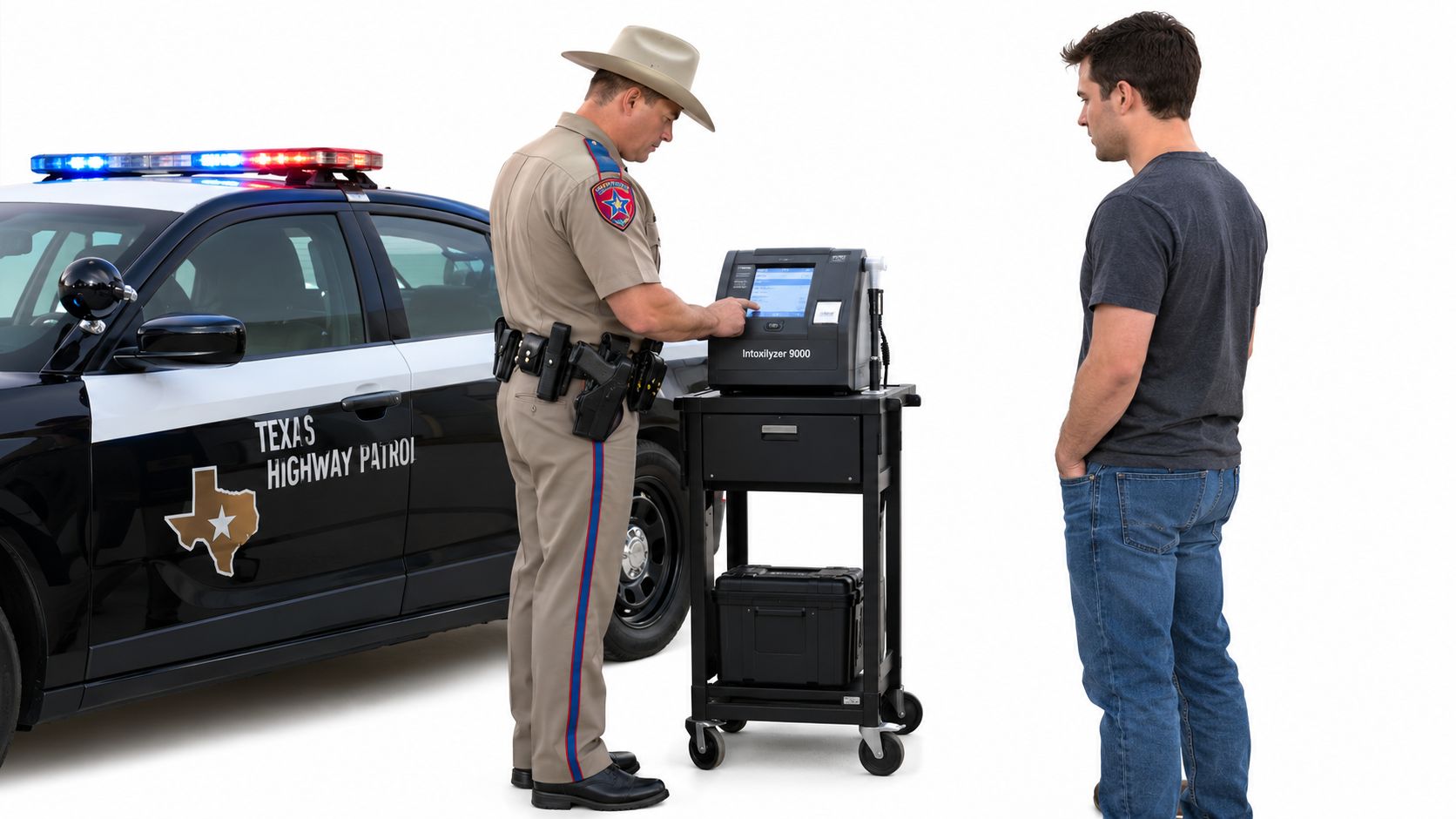
When the Intoxilyzer 9000 detects a reference problem, the immediate sequence follows the machine's control logic rather than the officer's preference. Texas procedures require the reference system to agree within ±0.01 g/210 L of the nominal value, and the calibration verification must fall within 0.070–0.090 g/210 L. If it doesn't, the instrument stops the test. The Texas Intoxilyzer 9000 procedure materials describe that stop as a built-in fail-safe.
The immediate sequence
First, the device records the failed reference check or calibration verification. The machine then stops the run because it hasn't established that the instrument is producing an acceptable result from the known standard.
Second, the officer may document the event, reset the device, or follow agency procedures for another attempt. That later attempt must be examined separately. A reset doesn't explain why the first control check failed, and an officer's statement that the device “worked afterward” isn't a substitute for technical records.
Third, police may pursue another form of chemical testing, including a blood draw, depending on the circumstances. A blood-test result can create a separate evidentiary path, and it may arrive later. Texas DPS explains that when a driver consents to a blood test, the Department doesn't issue a suspension notice until it receives the BAC results, so the administrative process can depend on the laboratory result rather than the arrest alone. Texas DPS's ALR program information explains that distinction.
The error doesn't necessarily mean the entire criminal case disappears. It can, however, remove or weaken the breath result that prosecutors expected to use. The remaining evidence may include driving observations, statements, field sobriety testing, video, or another chemical test.
Impact on Administrative License Revocation Proceedings
Texas DWI cases usually create two separate legal tracks. The criminal case addresses whether the State can prove intoxication or an unlawful BAC in court. The Administrative License Revocation, or ALR, process addresses your driving privileges through the Department of Public Safety.
A reference sample error can be especially important in the ALR case because DPS must establish the legal basis for the suspension. If the State relies on a breath result that the Intoxilyzer 9000 invalidated after failing its reference check, the defense can challenge whether DPS has a reliable BAC basis.
The deadline comes first
You generally have to request the ALR hearing within 15 days of the DWI arrest. If you miss that deadline, the suspension can proceed automatically. Texas ALR hearing guidance explains that DPS must address matters such as reasonable suspicion, probable cause, and the refusal or BAC basis by a preponderance of the evidence.
That deadline is separate from your criminal court date. Waiting for an arraignment or speaking with the prosecutor doesn't preserve the ALR hearing. A lawyer should review the notice immediately and confirm the request was made correctly.
How the error changes the hearing
At the hearing, the defense can focus on the exact test record rather than making a general claim that “the machine may be inaccurate.” The relevant questions may include:
- Did the reference sample fall inside the required range?
- Did the device invalidate or stop the test?
- Did the officer document the error accurately?
- Was another breath test completed, and does that run have an independent foundation?
- Is DPS relying on a blood result instead of the failed breath test?
The ALR judge may consider whether the State proved its required elements. A failed reference check doesn't guarantee a favorable ruling, but it can create a meaningful evidentiary dispute about the BAC basis.
If a blood test becomes the State's evidence, the breath error still helps explain why the testing path changed. It doesn't automatically invalidate the blood result, but it may clarify that the original breath procedure didn't produce a valid result.
Implications for Criminal DWI Defense
The ALR hearing and criminal prosecution serve different purposes. In ALR court, the focus is the statutory basis for an administrative suspension. In criminal court, the State must prove the DWI charge beyond a reasonable doubt and establish that scientific evidence is reliable and admissible.
Texas implied-consent rules mean that a driver who refuses a chemical test can face ALR consequences. A BAC result at or above 0.08 can also trigger administrative action under Texas DWI procedures. Texas DWI ALR information explains why the breath or blood number can matter in both the license and criminal cases.
Administrative hearing versus criminal court
| Issue | ALR proceeding | Criminal DWI case |
|---|---|---|
| Primary concern | Whether DPS proved the basis for license action | Whether the State proved the criminal charge |
| Reference error | Challenges the BAC foundation for suspension | Challenges reliability, admissibility, and weight |
| Evidence review | Test records, officer testimony, and statutory elements | Discovery, expert analysis, motions, testimony, and trial evidence |
| Possible result | License suspension may be prevented or allowed | Evidence may be excluded, weakened, or considered by a fact finder |
The criminal defense should not stop at the error code. Counsel should obtain the complete printout, calibration and maintenance records, operator credentials, and available video. The defense may then argue that the State can't establish the instrument's reliability for that specific test.
A useful review of Texas DWI breathalyzer accuracy should also distinguish between a machine that later passed a check and a machine that passed the required check before the subject sample. Timing matters. A later successful run doesn't necessarily cure an earlier failed control event.
What works and what doesn't
A focused challenge works better than a broad statement that breath machines are imperfect. The strongest arguments tie the error to a missing foundation, an unexplained temperature issue, incomplete documentation, or a protocol failure.
A reference error also doesn't automatically dismiss the charge. Prosecutors may rely on other evidence, and the judge may permit testimony about the event depending on the records and legal arguments. The defense goal is to force the State to prove each link rather than allowing a defective printout to carry the entire case.
Essential Evidence to Request and Preserve
The most useful defense work begins with preservation. Test records can become difficult to interpret when only a summary ticket is available, and memories change after an arrest. Your lawyer should seek the underlying documents before the technical details disappear into a routine file.
Records that deserve immediate attention
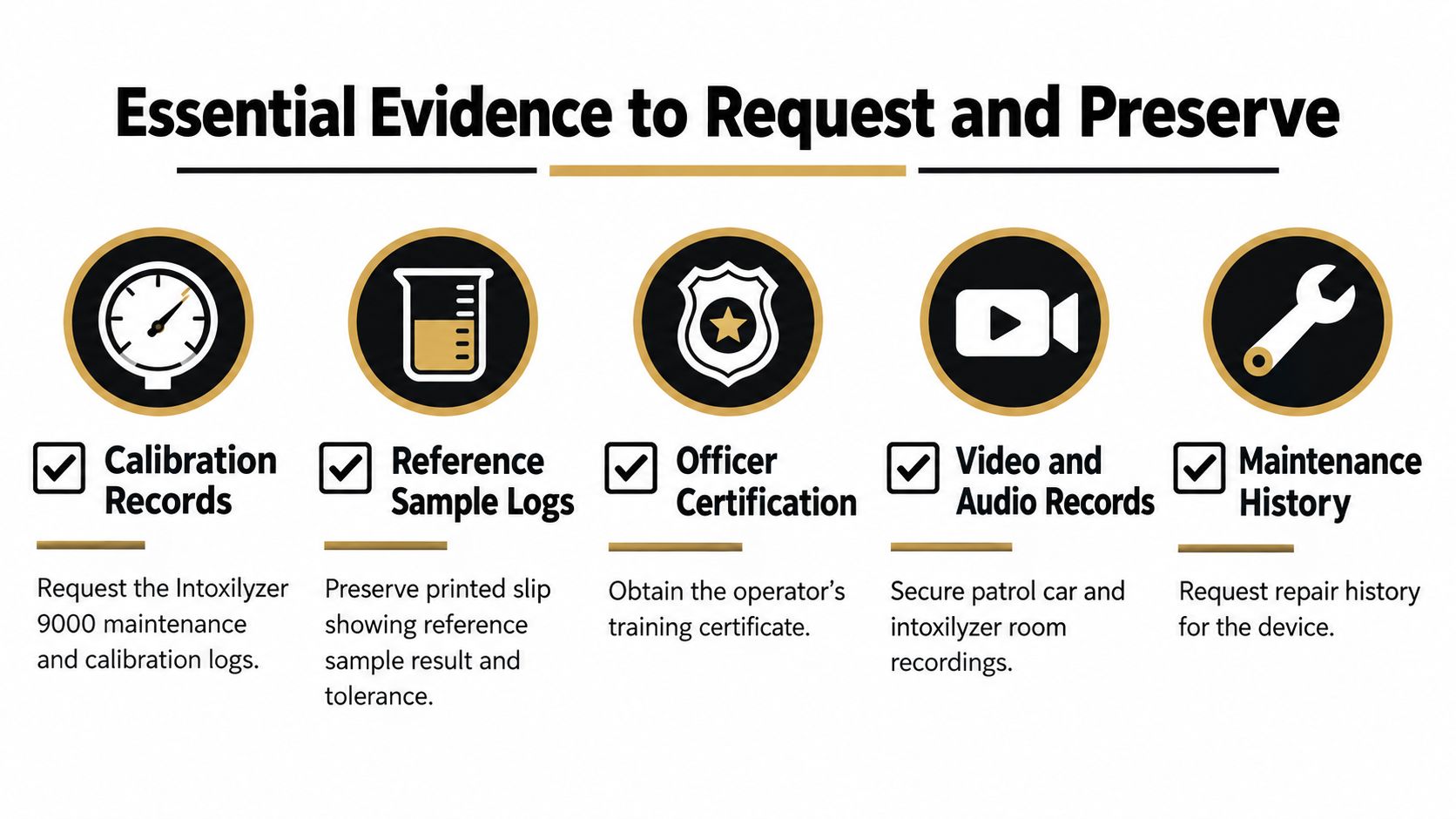
- Complete test printout: Preserve the reference result, error code, air blanks, subject samples, timestamps, and any notation showing that the sequence stopped.
- Calibration and maintenance records: Request records for the specific Intoxilyzer 9000, including service entries and post-repair checks. Intoxilyzer maintenance records in Texas DWI cases can help identify why device history matters.
- Reference-sample documentation: Look for the solution identification, temperature information, expected concentration, measured result, and handling records.
- Operator certification: Confirm the officer's training and authorization for the instrument and procedure used.
- Video and audio: Secure body-camera, patrol-car, booking-area, and testing-room recordings. Video may show whether the observation period was continuous, whether the setup was interrupted, and how the error was handled.
The arrest report matters too, but it shouldn't replace the technical file. Reports often summarize the outcome without explaining the failed control check. The actual printout and machine records may reveal a different sequence.
The circumstances of the stop also remain relevant. Was Your DWI Stop Legal? Reasonable Suspicion and Probable Cause addresses how an unlawful stop can undermine an entire DWI case. A technically defective breath result and an unsupported traffic stop present separate arguments that should be evaluated together without assuming either one automatically wins.
Request the ALR hearing promptly. Texas law gives you 15 days from the arrest to request it, and missing that deadline can allow the suspension to proceed automatically. The hearing can preserve an opportunity to question the State's evidence while counsel continues investigating the criminal case.
Next Steps and Legal Strategies for Your Defense
Start by preserving every notice, printout, bond document, and court paper. Don't discuss the incident publicly or contact the officer to explain what happened. Write down the testing timeline while you remember it, including the error message, any restart, the location of the test, and whether police obtained a blood specimen afterward.
A lawyer should then separate the defense into practical decisions:
- License protection: Request the ALR hearing on time and prepare to challenge the failed reference check.
- Technical review: Compare the error record with calibration, maintenance, temperature, and operator documents.
- Criminal litigation: Evaluate suppression, admissibility, cross-examination, negotiations, and trial strategy.
- Alternative evidence: Identify whether the State has video, field sobriety evidence, statements, or a later blood result that it may use instead.
The Intoxilyzer 9000 has a significant limitation in how its warranty is framed. Texas litigation and technical commentary have noted that the manufacturer's warranty concerns analysis of the manufacturer-provided reference solution, not human breath testing. The accepted spread between the two subject samples is 0.020 g/210 L, so results such as 0.07 and 0.09 can fall within that reported tolerance structure while crossing the 0.08 statutory per se threshold. Technical commentary on the Intoxilyzer 9000 in Texas explains why reference-sample handling and calibration remain central to these challenges.
That doesn't mean every reference error produces the same result. Some cases turn on the failed test itself. Others involve an unexplained restart, missing maintenance records, an operator problem, or an independent issue with the stop. A Houston DWI lawyer or Texas DUI attorney can help determine which arguments fit your evidence, whether this is a first DWI in Texas, and how to fight DWI charges without relying on speculation.
The Law Office of Bryan Fagan, PLLC reviews Intoxilyzer 9000 records, ALR deadlines, testing procedures, and criminal DWI evidence for Texas clients. Request a free case evaluation through Law Office of Bryan Fagan, PLLC to discuss the reference sample error, protect your DWI license suspension rights, and identify the next practical step in your defense.