
A DWI arrest can be overwhelming, but you don't have to face it alone. If you're staring at a breath test result and thinking your case is already over, slow down. In Texas, that number is often the start of a fight, not the end of one.
Breath testing looks scientific, but it's built on assumptions, procedures, and human handling. That gives a skilled Houston DWI lawyer room to challenge the result, protect your license, and push back in court. If you're dealing with a first DWI in Texas or a repeat charge, the right defense starts with the breath test itself.
A Breath Test Result Does Not Define Your Case
A lot of people leave the station or jail convinced that a number above 0.08 means the case is over. That is the wrong conclusion. A breath test is an estimate, and Texas cases are won or lost by showing where that estimate went wrong in science or in procedure.
Texas breath testing rests on an assumption, not a direct blood draw. The machine uses a fixed 2,100:1 partition ratio, even though real human ratios can vary from about 1,100:1 to 3,400:1. That spread matters when the result is close to the legal limit, because some drivers can register higher than their true BAC. DWI breathalyzer accuracy Texas
Practical rule: if the number is close to the limit, do not treat the state's case as airtight.
Texas defense lawyers also attack these results because even a functioning device is not exact. A cited NHTSA study found evidential breath testers meeting model specifications were accurate within ±0.005% BAC at low levels between 0.020% and 0.040%, while other litigation-focused summaries describe a broader practical margin of error around ±0.01% BAC. accuracy of breathalyzers in Texas
That matters in the world. If the reported number sits near 0.08% BAC, small shifts in calibration, physiology, or procedure can change what the test means in court. That is why I tell clients to get a free case evaluation right away, before they assume the breath result decides everything. Texas DWI case evaluation
How the Intoxilyzer 9000 Estimates Your BAC
The Intoxilyzer 9000 does not measure your blood alcohol level directly. It analyzes deep-lung breath with infrared spectroscopy, then turns that breath sample into an estimated BAC by applying a fixed 2,100:1 breath-to-blood partition ratio. That conversion is the weak point, because the machine starts with an assumption about your body, not a direct measurement of your blood.
Texas breath testing also depends on a scientific shortcut that can cut against you. The device treats everyone as if their breath and blood alcohol relationship is the same, even though real people vary. If your personal ratio is lower than 2,100:1, the result can read higher than your actual BAC. The Texas discussions on how the Intoxilyzer 9000 estimates your BAC and the process shown in the step-by-step Intoxilyzer 9000 breath sample infographic both show the same basic problem, the machine is converting a breath reading into a blood estimate through a fixed ratio.

That is why a breath result is attackable in a Texas DWI case. The defense does not have to accept the machine's assumption as if it were medical fact. Challenging Breath and Blood Tests in Texas DWI Cases covers the broader fight over chemical-test evidence, and this is the first place I look, because a clean-looking number can still rest on a bad conversion. A Texas jury sees a BAC printout. A defense lawyer looks at the partition ratio behind it.
The machine gives you an estimate, not the truth. The defense job is to challenge the assumption that produced it.
Error Margins and Calibration Requirements in Texas
Breath-test reliability in Texas depends on more than the machine turning on. The Texas Department of Public Safety sets rules under the Texas Administrative Code, and the program requires calibration and operator compliance. If those records are sloppy, missing, or inconsistent, the result becomes vulnerable even if the display showed a number. Texas breath-test rules and compliance
The practical point is simple. A device can be close to specification and still leave room for a challenge. A borderline reading near the legal limit can move in or out of the danger zone with a small analytical shift, and that's why defense lawyers dig into the paperwork instead of arguing in generalities.
What a defense lawyer looks for
- Calibration logs: These show whether the machine was checked on schedule and whether anything looked off.
- Maintenance records: Repairs, service notes, and malfunction entries can reveal a machine that wasn't operating cleanly.
- Operator compliance: The officer has to follow the required procedures, not improvise.
- Training records: If the person running the test wasn't properly certified, that matters.
The process matters because Texas cases are often won or lost on records, not slogans. A breath result can look solid on paper and still fall apart when the logbook shows gaps. That's why a lawyer should ask for the documentation early, before the state has time to frame the evidence as untouchable.
If you're also thinking about the long-term impact of a charge, Clearing a Texas DWI: Expunction and Nondisclosure is worth understanding later. First, though, you need to attack the result that started the case.
Medical Conditions and Body Chemistry That Skew Results
People often ask whether reflux, diabetes, or another health issue can affect a breath test. The answer is yes, but the better question is whether the condition can be backed up with records and tied to the specific test in your case. Texas lawyers care less about a theory and more about proof.
The medical issues that actually matter
GERD, acid reflux, diabetes, body temperature, mouth alcohol, and shallow breathing can all affect the result in different ways. Mouth alcohol is especially important when someone recently ate, drank, used mouthwash, or had alcohol trapped in the mouth or throat. If the officer didn't properly observe the driver before testing, that can become a serious issue.
Practical rule: if a condition could have affected the sample, the defense needs medical records, timing, and test documentation, not guesses.
Strategy separates from speculation. A person with documented reflux or diabetes may have a real challenge if the records line up with the arrest timeline. A bare claim that “my stomach was bothering me” usually goes nowhere. Courts want a connection between the condition, the observation period, and the reported BAC.
The most useful evidence is ordinary paperwork. Emergency room notes, medication lists, diabetes treatment records, and anything showing recent reflux or vomiting can help. The lawyer then compares that information with the officer's account and the breath-test record. If the timing doesn't fit, the state's version of events gets weaker.
For a deeper look at these health-related issues, Medical Conditions That Mimic Intoxication in Texas DWI Cases is a useful reference point. The main takeaway is that your body chemistry can matter, but only if your defense team can prove it mattered in your case.
How Breath Test Results Are Used Against You in Court and ALR Hearings
A breath result is used in two places, and both matter. Prosecutors use it in the criminal DWI case, and the state also uses it in the Administrative License Revocation, or ALR, process to pursue a DWI license suspension. That's why a result above the limit can hit you twice, once on your driver's license and once in court.
Texas follows implied consent, which means that if you drive on Texas roads, the state expects you to submit to chemical testing after a lawful arrest. Refusing or failing a breath test doesn't make the case disappear, and it can trigger separate license consequences. If you need to protect your driving privileges, the deadline matters fast. The 15-Day ALR Deadline: Save Your License After a DWI Arrest
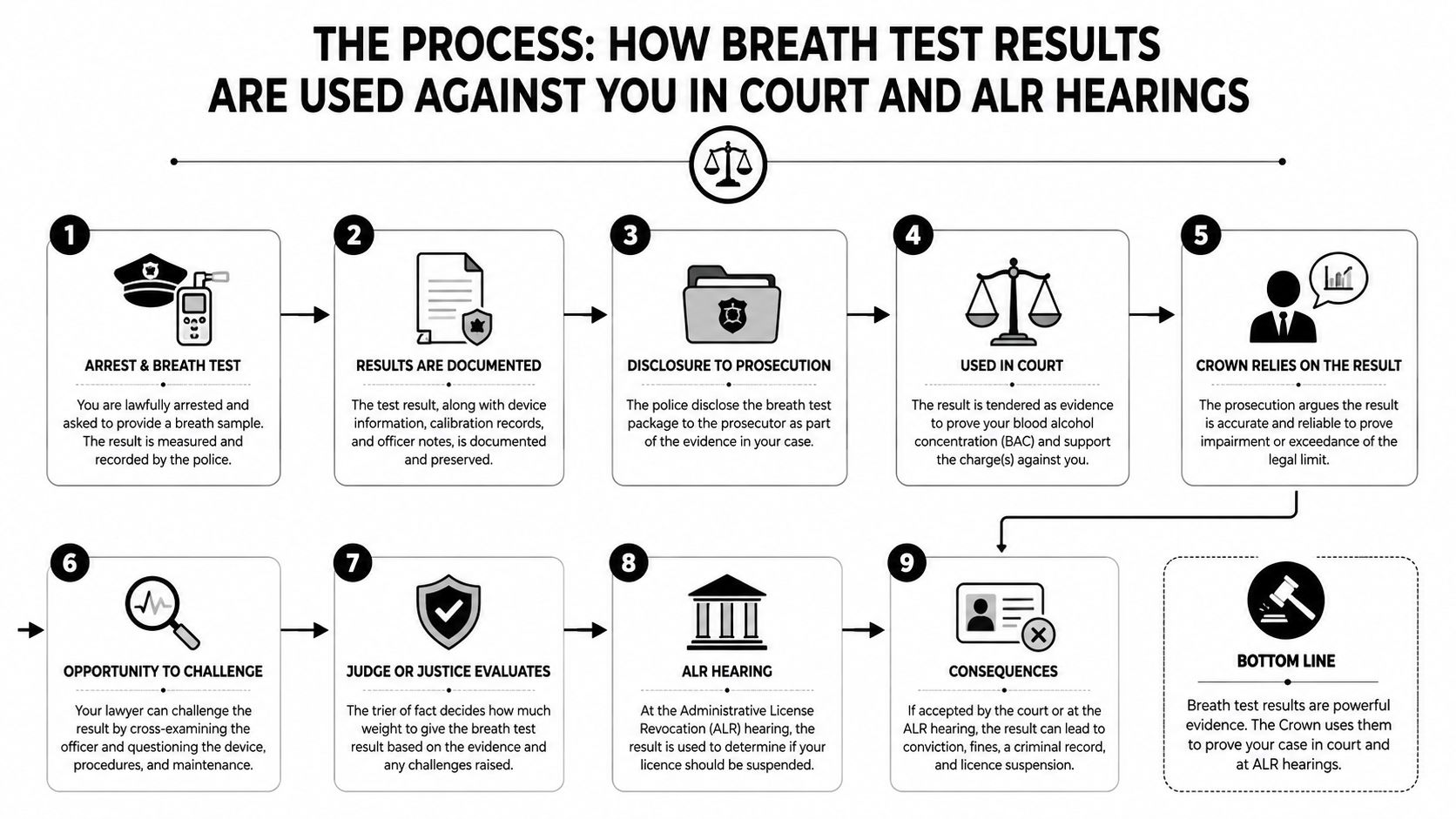
The smart move is to challenge the result early. If your lawyer contests the breath test quickly, that can protect your license defense and create an advantage in the criminal case. Waiting usually helps the state, not you.
A strong defense often starts with one question, what does the paperwork show? If the arrest, the observation period, and the breath record don't line up, the result becomes harder for the prosecutor to sell. That's especially important for a first DWI in Texas, where clients often want the quickest path to damage control and a clear plan for fighting back.
Signs Your Breath Test Result May Be Unreliable
Some breath tests deserve immediate scrutiny. If your result is close to 0.08, that alone is a reason to look harder at the records. Borderline numbers are where small errors and assumptions do the most damage.
Red flags that should trigger a defense review
- Close-to-the-limit result: A number near the threshold deserves a hard look at calibration, observation, and operator steps.
- Missing observation period: If the officer didn't watch you properly before the test, mouth alcohol may have contaminated the sample.
- Incomplete maintenance logs: Gaps in the machine's history can undermine confidence in the result.
- Operator problems: Certification lapses or procedure mistakes can weaken the test.
- Mismatch with field sobriety observations: If the officer's physical observations don't fit the breath number, the defense should press that inconsistency.
- Medical history that fits the timeline: GERD, reflux, diabetes, or recent vomiting can create a factual challenge when documented.
- Recent eating, smoking, or oral products: These can matter when the officer skipped steps or rushed the process.
- Testing documentation that looks rushed or incomplete: Missing entries, odd timing, or sloppy paperwork often point to bigger problems.
An experienced lawyer will request maintenance logs, operator training records, calibration certificates, and testing documentation. Those records show whether the state followed its own rules, and that's where many breath-test challenges succeed.
If you want to understand how this plays out in real defense work, the Texas DWI page on Texas Implied Consent and Refusing a Breath Test explains the legal framework around chemical testing after arrest. That issue often comes up right beside the reliability of the machine itself.
Your Next Steps After a DWI Arrest in Texas
Act fast and stay organized. If you're dealing with a breath test in Texas, the first move is to protect your driver's license, then gather every document tied to the stop, the arrest, and the test. The ALR deadline is short, and missing it can cost you an advantage before the criminal case even starts.
You should also save anything that helps reconstruct the timeline. That includes the officer's paperwork, your medical records if a health issue may have affected the test, and any information about what happened before you were stopped. A Texas DWI attorney can then compare the state's version of events with the actual records.
A good defense is not about panic. It's about pressure, applied in the right place, at the right time. That's why clients often benefit from counsel that handles both the license fight and the criminal case, especially when the breath test is the centerpiece of the prosecution.
If you need a Texas DUI attorney who understands breath-test challenges, the next step is a real case review, not a guess. The sooner you act, the more options you usually keep.
If you've been arrested for DWI, the Law Office of Bryan Fagan, PLLC can review your breath test, your arrest paperwork, and your license deadline with you. We help Texans challenge chemical-test evidence, protect driving privileges, and build a defense strategy around the facts of the stop. Visit Law Office of Bryan Fagan, PLLC to request a free consultation and get started today.