
A DWI arrest can be overwhelming, but you don’t have to face it alone.
If you were given a breath test in Texas and the printout showed a number over the legal limit, you may feel like the case is already decided. Many people sit in jail, get out on bond, look at that result, and assume there’s nothing left to fight.
That’s not how a strong DWI defense works.
A breath test result is only one piece of evidence. It has to be collected the right way, on a machine that was maintained the right way, by an operator who followed the right rules. If the State can’t prove those steps, a result that looks powerful on paper can become much weaker in court.
Breathalyzer calibration errors Texas DWI defense evolves beyond a search phrase. It becomes a practical legal strategy. In the right case, we don’t attack the number with guesswork. We dismantle the foundation under it, piece by piece.
A DWI Arrest Is Overwhelming But a Breath Test Is Not Final
Most new clients come in with the same concern. They’re not asking whether the stop was frustrating or whether the night was embarrassing. They want to know one thing.
Can a breath test still be challenged?
Yes.
Why that printed number doesn’t end your case
Texas prosecutors often treat a breath result like a clean answer to a messy event. But a DWI case is rarely that simple. Machines require maintenance. Officers must follow procedure. Records must be complete. Courtroom proof matters.
A number on a receipt doesn’t explain whether the officer watched you properly before the test. It doesn’t show whether the machine had a complete maintenance history. It doesn’t prove the State can lay the legal foundation needed to admit that result.
Practical rule: A breath test can look convincing and still be vulnerable.
The first terms you need to know
A few terms come up in almost every Texas DWI case:
- BAC means blood alcohol concentration. In a breath case, the machine estimates alcohol concentration from your breath sample.
- Field sobriety test usually refers to roadside tests such as balance and divided-attention exercises. These are different from a breath test.
- Implied consent means Texas drivers are considered to have agreed to provide a breath or blood specimen after a lawful DWI arrest, subject to Texas law and the consequences of refusal.
- Administrative license suspension refers to the civil process that can affect your driver’s license apart from the criminal court case. In Texas, this is often handled through the ALR process.
What works and what doesn’t
What works is a disciplined review of evidence. That means video, reports, breath records, maintenance logs, and the officer’s training and timing.
What doesn’t work is relying on general complaints like “the machine must have been wrong” without proof. Judges respond to specifics. Good defense work finds those specifics.
If this is your first DWI in Texas, you may also be worried about your job, your license, professional consequences, and whether you’ll have a permanent record. Those concerns are real. They’re also exactly why your defense has to start early and stay focused.
Understanding the Intoxilyzer 9000 and Texas Breath Test Rules
Texas uses the Intoxilyzer 9000 in many DWI cases. If your case involves a station-house breath test, this is often the machine at the center of the State’s evidence.
What the machine is supposed to do
The machine analyzes a breath sample and produces an estimated alcohol reading. Prosecutors use that result to argue that your BAC was at or above the legal threshold, or that alcohol affected your normal use of mental or physical faculties.
That doesn’t mean the machine gets a free pass.
For a breath result to help the State, prosecutors still need a reliable testing process. They have to show the device was approved for use, properly maintained, and operated according to the applicable rules. If you want a basic overview of reliability issues, this guide on breathalyzer accuracy in DWI cases is a useful starting point.
Key legal terms that matter in your case
Clients often hear these words from officers, judges, or bond paperwork without getting a clear explanation.
Implied consent
Under Texas law, driving on public roads carries implied consent to provide a specimen after a lawful DWI arrest. That doesn’t mean every request by police is automatically valid. It means refusal can trigger separate consequences involving your license.
Administrative license suspension
This is the license side of the case. It’s separate from whether you’re convicted in criminal court. A person can fight the criminal charge and still face a license suspension issue unless that process is handled correctly.
Field sobriety test
These are roadside exercises used by police to claim signs of impairment. They are not the same thing as a breath test, and poor performance on one doesn’t automatically prove the other.
The rules matter more than people think
Breath testing in Texas is supposed to follow a protocol. That includes proper observation, proper operation, and proper recordkeeping. In court, defense lawyers don’t just ask, “What was the result?” We ask, “How was that result obtained, documented, and preserved?”
That difference changes cases.
Here’s a short overview that helps many clients understand the process:
Why “by the book” is the State’s burden
In a Texas DWI case, the State wants the judge to treat the breath result as scientific evidence. Scientific evidence only helps if the underlying process is dependable. That’s why defense work focuses so heavily on procedure.
A breath machine doesn’t convict you. People do. And those people have to prove they followed the rules.
If you’re looking for a Houston DWI lawyer or a Texas DUI attorney, this is one of the first distinctions to pay attention to. Some lawyers treat the breath result as a fixed fact. Stronger defense work tests whether the State can prove that result belongs in evidence at all.
How We Uncover Hidden Breathalyzer Calibration and Maintenance Errors
A machine problem usually isn’t obvious from the arrest report. It’s buried in records. That’s why one of the most important parts of a DWI defense happens after the arrest, during discovery.
In Texas, breathalyzer devices like the Intoxilyzer 9000 must undergo mandatory calibration checks every 30 days, and a 2022 Texas appellate ruling, No. 13-21-00075-CR, noted that incomplete or missing calibration logs can cast significant doubt on a device’s reliability.
What we demand from the State
A good machine challenge starts with records, not assumptions. We subpoena and request the documents that show whether the machine was in compliance when your test was taken.
If you want to understand the document trail in more detail, this page on how to obtain DWI breathalyzer records explains the process.
| Key Breathalyzer Records We Demand in Discovery | What We Look For |
|---|---|
| Calibration logs | Whether checks were done on time and whether entries are complete |
| Maintenance history | Repairs, service notes, recurring issues, and whether fixes were documented |
| Operator records | Whether the person running the test held current authorization for that device |
| Test run documents | Whether the machine recorded the required sequence and whether the paperwork is internally consistent |
| Reference standard information | Whether the records identify what standard was used and whether the entries are complete |
| Agency log details | Dates, times, operator names, test results, and any adjustments noted in the record |
Why missing records matter
A lot of people assume that if the State doesn’t have a log, the prosecutor can explain it away. That’s not usually how reliability challenges work.
When DPS rules require detailed records, those records are part of the foundation for admitting the breath test. Missing dates, incomplete entries, undocumented adjustments, or gaps in maintenance can create real evidentiary problems. The issue isn’t paperwork for paperwork’s sake. The issue is whether anyone can trust the machine’s result.
Small record problems can become big trial problems
Here are common examples of what can weaken the State’s position:
- Overdue checks: If the machine wasn’t checked within the required cycle, the defense can argue the result lacks a reliable scientific foundation.
- Incomplete entries: Missing operator information, dates, or results can undercut chain of reliability.
- Repair without clear follow-up: If a device was serviced but the records don’t clearly show post-service compliance, the State may struggle to prove the machine was dependable on your test date.
- Log gaps: A gap in the paperwork can become a gap in admissibility.
How the challenge is built piece by piece
This part of the case is methodical. We compare dates. We compare logs. We compare machine records with the offense report and booking timeline. Then we look for conflicts.
For example, if the State claims the machine was working properly, but the records are incomplete, the defense doesn’t have to prove the machine definitely malfunctioned. The stronger argument is often that the State failed to prove reliability well enough for the result to come into evidence.
Courts don’t admit breath evidence because the State says the machine usually works. They admit it when the State proves this machine was reliable in this case.
What helps and what usually falls flat
Helpful arguments are document-based. If the records show a problem, that problem can be turned into a suppression issue or a cross-examination point.
Weak arguments are generic. Saying “machines make mistakes” won’t move a judge very far by itself. Showing that the State’s own records are incomplete or out of compliance is much stronger.
This is also where national breath test failures become relevant as context. The same linked authority above notes that a Massachusetts court dismissed 27,000 DWI cases in 2017 due to uncalibrated and poorly maintained breathalyzers. That doesn’t decide a Texas case by itself, but it reminds courts that breath testing programs are only as strong as their maintenance culture.
In practice, I look at calibration issues as a strategic advantage. Sometimes they support a full attack on admissibility. Sometimes they don’t knock the test out by themselves, but they weaken the State’s confidence enough to improve negotiations. Either way, they matter.
When the Machine Is Fine But the Operator Makes Mistakes
Some of the best breath test defenses have nothing to do with broken hardware. A machine can be in working order and still produce an unreliable result because the officer didn’t follow procedure.
That distinction matters. If the operator cut corners, the problem isn’t the machine alone. The problem is the test.
The observation period is not optional
Texas law requires a 15-minute continuous observation period before the breath test to help prevent mouth alcohol contamination under 37 Tex. Admin. Code § 19.3, as discussed in this Texas breath test overview. That rule exists for a reason.
If you burp, belch, regurgitate, or otherwise introduce residual alcohol into the mouth, the machine may read alcohol that doesn’t reflect deep lung air. The same source notes that NHTSA studies have shown false readings as high as 0.20% to 0.40% from this kind of contamination.
What mouth alcohol looks like in real life
This issue is more common than many people think. A person may not even realize something happened that could affect the sample.
Examples include:
- Belching during observation: The officer may not notice it, or may notice it and fail to restart the period.
- Vomiting or regurgitation: Even a brief event can matter if the test proceeds anyway.
- Recent use of alcohol-containing products: Depending on the facts, residual mouth alcohol may become part of the defense analysis.
- Poor video review by the State: The body cam or intox room video may show events the report leaves out.
Video often tells the real story
Officers sometimes write that they observed the subject continuously. Then the video shows they were typing, talking to other officers, walking away, or handling other tasks. If the observation was broken, the defense has a concrete argument.
That’s one reason this page on mistakes police make during Texas DWI arrests is relevant. The strongest challenges often come from procedure, not from dramatic misconduct.
Other operator errors that can damage the case
The same authority identifies several technical requirements that can become issues in litigation.
Inconsistent samples
The Intoxilyzer EC/IR-8000 requires duplicate blows within ±0.01 g/210L according to the linked authority above. If the required consistency isn’t there, the defense will want to know why and how the State plans to justify the result.
Radio frequency interference
The same source states that radio frequency interference from police radios at 2.4 GHz can induce spikes of ±0.015% under manufacturer validation data. In a contested case, surrounding equipment and testing conditions may matter more than the report suggests.
Operator certification
The same authority says DPS requires certification renewal every 2 years with 80% proficiency on proficiency testing. If the person operating the machine wasn’t properly certified, the result may be vulnerable.
A clean printout doesn’t answer whether the officer followed the rules that make the printout meaningful.
What usually helps the defense most
The best operator-error challenges are grounded in objective evidence:
- intox room video
- body camera footage
- test ticket timing
- operator certification records
- breath test technical documents
What usually helps less is arguing from memory alone when video exists. Your memory still matters, especially early in the case, but we want to match it against records and footage.
In these situations, a fight DWI Texas strategy becomes practical instead of abstract. We’re not just claiming the officer made mistakes. We’re showing where the procedure broke down and why that breakdown affects reliability.
The Legal Strategy Turning Breath Test Errors into a Dismissal
Finding flaws is only half the job. The other half is using them at the right time, in the right forum, for the right legal purpose.
Texas DWI cases usually involve two separate tracks. One affects your license. The other affects the criminal charge.
The ALR hearing and why it matters fast
The Administrative License Revocation, or ALR, process deals with your driving privileges. This is often the first real opportunity to question the State’s witnesses under oath.
For many clients, the ALR hearing is where the defense begins to lock in testimony. An officer who gives a loose explanation there may have trouble cleaning it up later in criminal court. A technical witness who can’t explain records clearly may expose weakness early.
If your concern is DWI license suspension, this hearing matters even if the criminal case is still in its early stages.
How the criminal case is different
The criminal case is where the State tries to use the breath test as evidence of intoxication. That’s where motions, hearings, and trial strategy become critical.
One of the main tools is a motion to suppress. This is a formal request asking the judge to exclude evidence because it was obtained or handled in a legally defective way. In a breath test case, suppression arguments often focus on reliability, procedure, and foundational proof.
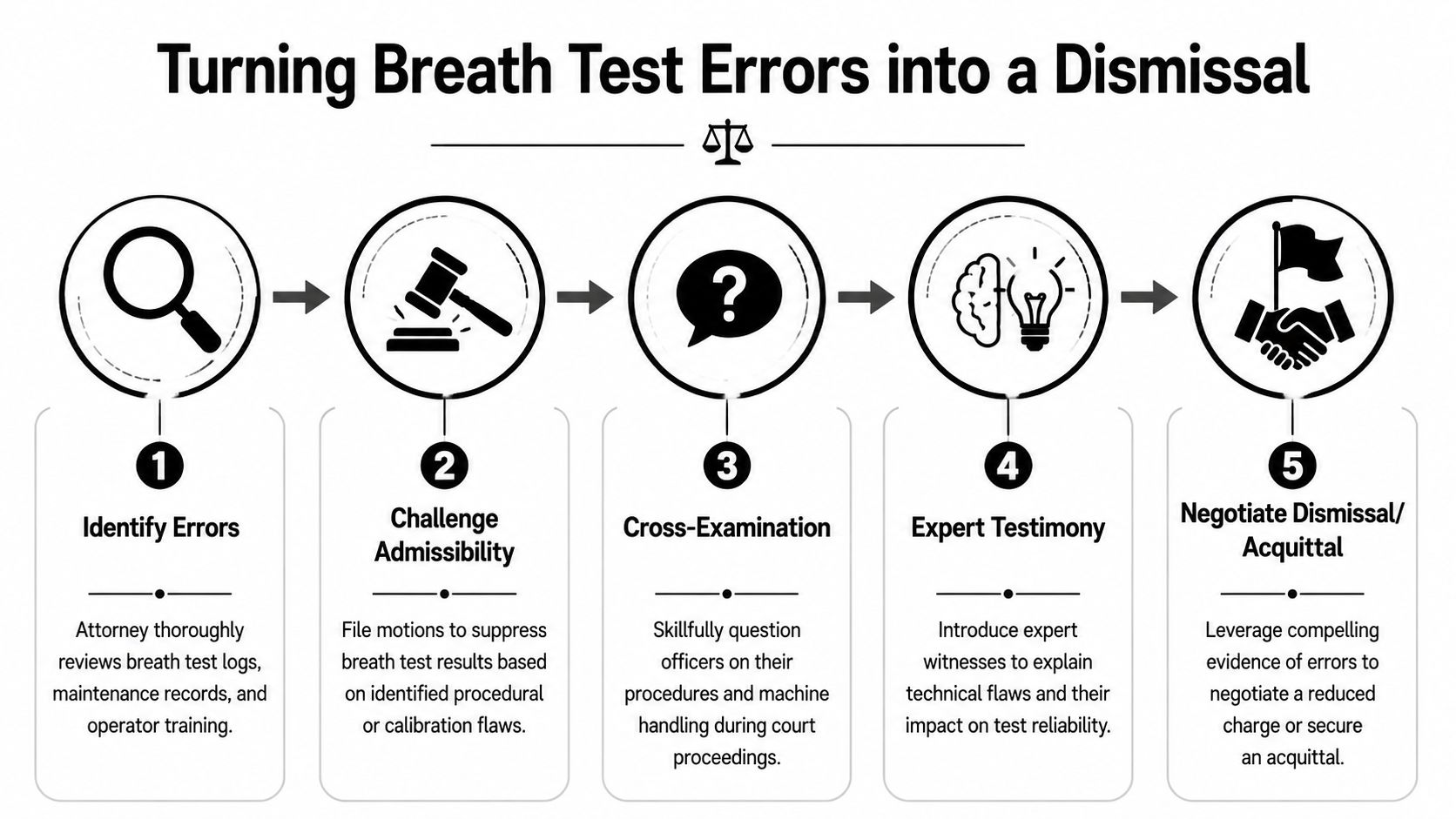
What the litigation process looks like
The process is strategic, not theatrical. It usually builds in stages.
Collect the records
We gather maintenance logs, test documents, certification records, video, reports, and timeline evidence.Identify the strongest defect
Not every issue deserves equal attention. Some cases are strongest on maintenance. Others are strongest on observation failures or officer testimony.Use the ALR hearing to test witnesses
This can expose contradictions and preserve testimony.File targeted motions
A focused motion is usually more effective than throwing every possible complaint at the judge.Cross-examine with documents in hand
The goal is to force clear answers on dates, procedures, observations, and missing records.
What a good cross-examination actually does
Good cross-examination doesn’t ask witnesses to agree that your client should win. It narrows them into admissions they can’t escape.
An officer may have to admit he looked away during the observation period. A technical witness may have to admit the log is incomplete. A prosecutor may then face a practical problem. If the breath result is shaky, the rest of the case may not look nearly as strong.
Trade-offs that clients should understand
Not every flaw leads to dismissal. Sometimes the breath result is suppressed and the State still tries to proceed on driving facts, statements, or field sobriety allegations. Sometimes a flaw is enough to improve a plea offer rather than end the case outright.
That doesn’t mean the defense failed. It means strategy is about gaining an advantage.
The Law Office of Bryan Fagan, PLLC handles both ALR hearings and criminal DWI defense work, including challenges to breath tests, officer procedure, and admissibility issues, which is often what clients need when they want one coordinated plan instead of separate responses to separate problems.
The strongest DWI defense doesn’t rely on one dramatic moment. It builds pressure until the State has to confront the weaknesses in its own evidence.
Why clients feel more in control once the process is clear
A lot of stress comes from not knowing what your lawyer is doing. When you understand that the defense is actively comparing records, preparing witness examination, and forcing the State to prove reliability, the case becomes more manageable.
That doesn’t guarantee a specific outcome. It does mean you’re no longer just reacting to the arrest. You’re building a response.
Your Immediate Action Plan After a Texas DWI Arrest
The first days after an arrest matter. Deadlines arrive quickly, and early mistakes can make a case harder than it needs to be.
Start with the deadline that can affect your license
You generally have 15 days after the arrest notice to request an ALR hearing. If that deadline is missed, you can lose an important chance to challenge the basis for your administrative license suspension.
Don’t assume the criminal court date protects your license. It doesn’t. These are different tracks.
What to do in the next day or two
Write things down while they’re still fresh. Small details become valuable later.
Focus on:
- Timeline details: When you last drank, when you were stopped, when you were arrested, and when the breath test happened.
- Observation details: Whether you burped, coughed, vomited, used mouthwash, or were left alone before testing.
- Officer behavior: Whether the officer was watching you continuously or multitasking.
- Location details: Whether you were tested in a patrol area, booking area, or intox room with other equipment and activity around you.
Preserve anything that helps establish context
Keep receipts, ride-share records, restaurant records, messages, and GPS history if they help establish timing. Save bond paperwork and any notice you received about your license.
If there’s a passenger or witness who saw what happened before the stop or during the arrest, make a note of that now. Memories fade faster than people think.
Say less, protect more
After an arrest, many people want to explain. That urge is understandable. It usually doesn’t help.
Don’t discuss the facts of your case with friends, coworkers, or on social media. Don’t call the officer to “clear things up.” Don’t assume you can explain away a detail without creating a new problem.
Instead:
- Use your right to remain silent
- Request the ALR hearing on time
- Get your paperwork organized
- Speak with a Texas DWI attorney before making statements
If you’re worried about a first DWI in Texas, your professional license, or whether this can be reduced or dismissed, early legal review gives you more options. Delay usually gives you fewer.
Frequently Asked Questions About Texas Breathalyzer Tests
Clients often ask practical questions that don’t fit neatly into the case file. Here are some of the most common ones.
| Texas DWI Breath Test FAQs | Answer |
|---|---|
| Can I still fight my case if I blew over the legal limit? | Yes. A breath result can still be challenged based on maintenance problems, operator error, observation failures, and other legal issues. |
| What is implied consent in Texas? | It means Texas drivers are considered to have agreed to provide a breath or blood specimen after a lawful DWI arrest, with separate license consequences for refusal under Texas law. |
| Is a field sobriety test the same as a breath test? | No. A field sobriety test is a roadside set of physical and mental tasks. A breath test is a chemical test intended to estimate alcohol concentration. |
| What is an administrative license suspension? | It is the civil process affecting your driver’s license after a DWI arrest, separate from the criminal prosecution. |
| Does a calibration problem automatically dismiss the case? | Not automatically. It can support suppression, improve negotiations, or significantly weaken the State’s proof, but the result depends on the full evidence picture. |
| If the machine was maintained, is the breath test unbeatable? | No. The operator still had to follow the required procedures, including the observation period and proper testing steps. |
| Should I request an ALR hearing if I plan to fight the criminal case? | Usually yes. The ALR hearing can protect your license interests and give your defense an early chance to question witnesses. |
| Can a first-time arrest still have serious consequences? | Yes. Even a first case can affect your license, criminal record, employment, insurance, and professional standing. |
A few answers in plain English
Do judges really care about technical issues
Yes, when those issues affect reliability and admissibility. Judges hear breath test evidence all the time, but that doesn’t mean they ignore defects in the State’s foundation.
Is refusing a test always better
Not always. It depends on the facts, and by the time you’re reading this, that decision has usually already been made. What matters now is building the strongest defense based on what happened.
What if I felt fine but the number was high
That can be important, but it usually isn’t enough by itself. Your lawyer will want to compare your appearance, driving, speech, field sobriety performance, video, and test procedure to see whether the breath result fits the rest of the evidence.
Many clients feel relief when they learn their case doesn’t rise or fall on one receipt-sized printout.
When should you call a lawyer
As soon as possible. Early review helps protect deadlines, preserve evidence, and shape the defense before the State has fully settled into its version of events.
That matters whether you’re looking for a Houston DWI lawyer, a Texas DUI attorney, or help anywhere else in the state. The sooner your defense starts, the more room there is to work with the facts.
Take Control of Your Defense and Protect Your Future
A breath test result is not a conviction. It’s evidence, and evidence can be challenged. In many Texas DWI cases, the main fight is about whether the State can prove the machine was maintained properly, the officer followed procedure, and the result deserves to be admitted at all.
If you want to fight the charge, protect your license, and move forward with a clear strategy, take action now. The earlier your defense begins, the more effectively you can challenge the State’s case.
If you’re facing a DWI charge and want a clear plan for your license, your court case, and your defense options, contact the Law Office of Bryan Fagan, PLLC for a free and confidential consultation. You don’t have to sort through calibration records, ALR deadlines, and suppression issues alone. A focused review of the facts can show where the State’s case is strong, where it’s weak, and how to protect your future.