
A DWI arrest can be overwhelming, but you don't have to face it alone.
Individuals who call after an arrest are often asking some version of the same question. Can this be dismissed? They're worried about jail, their license, their job, and what this charge will look like on a background check. They also want a straight answer.
The honest answer is this. Yes, a Texas DWI case can be dismissed. No, dismissal is never automatic. Your case is not just a number in a statewide report. It rises or falls on facts, timing, and defense strategy.
A DWI Arrest Is Overwhelming But Not a Final Verdict
The first day after a DWI arrest is usually a blur. You may have bonded out, your car may still be impounded, and you may already be hearing advice from friends that ranges from “just plead it out” to “they can't prove anything.” Neither response helps much.
What matters is what happened during the stop, the investigation, the arrest, and the testing.
A dismissal can happen. So can a reduction of the charge. So can a not guilty verdict at trial. But those outcomes usually come from careful legal work, not wishful thinking.
What you're really asking
When people ask how often are DWI cases dismissed in Texas, what they usually mean is this: Do I have a real chance to avoid a conviction? That's the right question.
A dismissal means the prosecution drops the charge or the court throws it out. A conviction means you're found guilty or plead guilty to the original charge. In some cases, the result is something in between, such as a plea to a lesser offense.
Practical rule: Don't judge your case by what happened to a coworker, cousin, or neighbor. Small factual differences can change everything.
The process starts fast
Texas DWI cases move on two tracks right away.
- Criminal case: This is the court case where the State tries to prove you were operating a motor vehicle in a public place while intoxicated.
- License case: This is the separate Administrative License Suspension process, often called an ALR hearing. It deals with your driving privileges, not guilt or innocence.
You also need to understand a few terms early:
- BAC: Your blood alcohol concentration, usually measured through a breath or blood test.
- Implied consent: Texas law says that by driving on Texas roads, you've given implied consent to provide a breath or blood specimen after a lawful DWI arrest, subject to the legal rules that apply.
- Field sobriety test: These are roadside coordination tests officers use to look for signs of impairment.
- Administrative license suspension: A civil process that can suspend your license after a failed or refused test.
If you want the best possible result, the focus shouldn't stay on abstract odds. The focus should shift to what can still be challenged, preserved, and improved.
The Real Numbers Behind Texas DWI Dismissal Rates
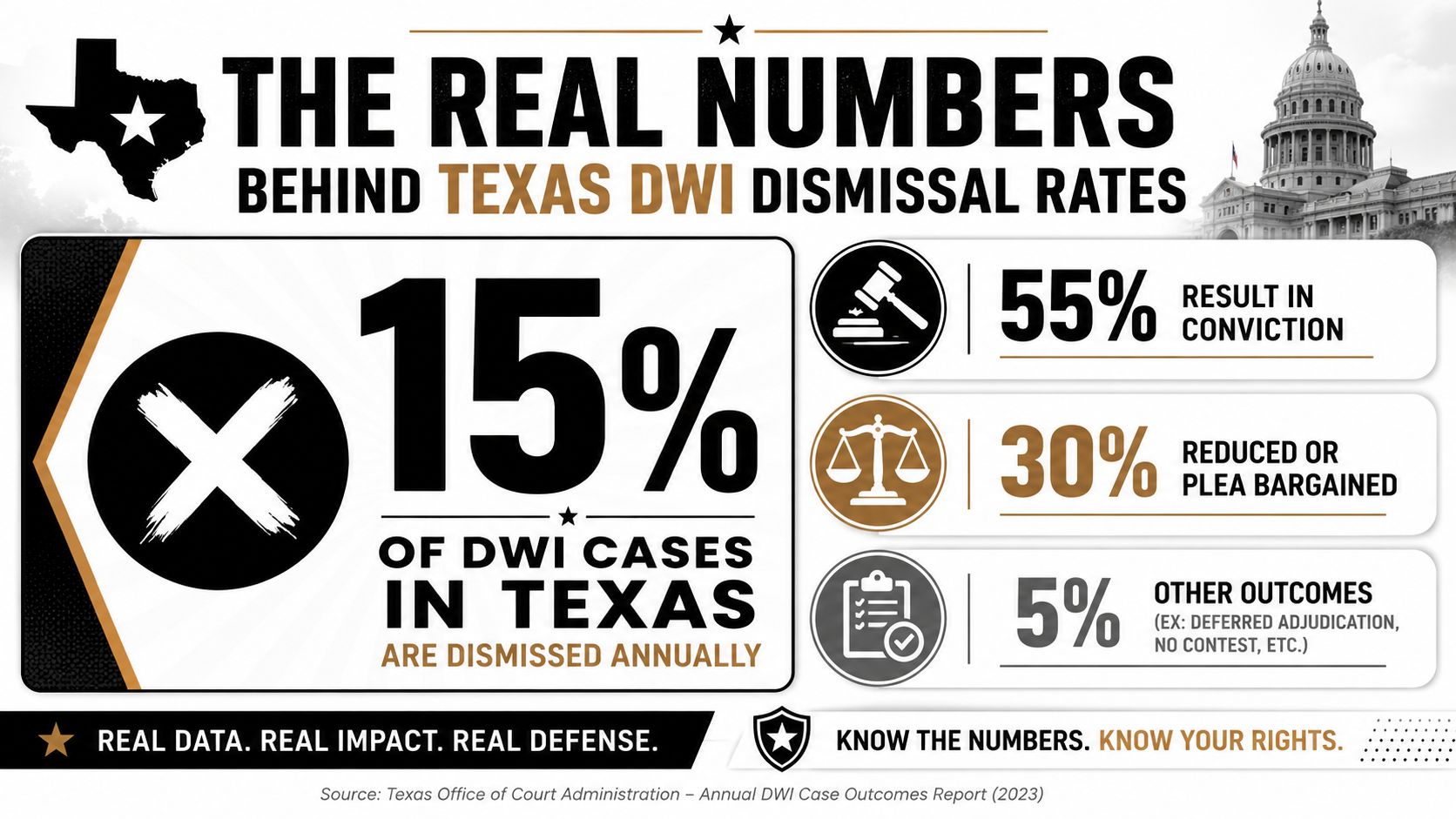
If you want the short answer, the statewide baseline is lower than generally hoped.
One widely cited analysis of Texas DPS arrest outcomes for 2021 reported 89,457 DWI arrests and 1,917 dismissals, which works out to roughly 2.1% statewide. The same analysis reported 8,044 convictions for the original offense and 3,834 convictions on a different offense, showing dismissals were a relatively small share of outcomes compared with convictions, according to this Texas DWI dismissal analysis.
Why that number can mislead people
Statewide numbers are useful, but they flatten important differences.
Some people plead guilty quickly. Some never challenge the stop. Some cases involve strong blood evidence, crashes, or prior offenses. Others have weak police work, incomplete video, poor testing procedures, or legal issues that make the evidence vulnerable.
That's why the statewide average is a starting point, not a prediction.
What the numbers do and don't tell you
Here's the practical takeaway:
| Outcome term | What it means in real life |
|---|---|
| Dismissal | The DWI charge is dropped or legally removed from the case |
| Conviction on original offense | You're convicted of the charged DWI offense |
| Conviction on different offense | The case ends with guilt on another charge instead of the original DWI |
A low statewide dismissal figure doesn't mean your case can't be fought successfully. It means Texas prosecutors often secure convictions when cases aren't exposed to serious challenge.
Statewide data answers, “What happened overall?” A defense lawyer has to answer, “What can be attacked in your file?”
What happens after the arrest
After a Texas DWI arrest, most clients face a sequence like this:
- Booking and bond
- Notice of a possible license suspension
- Arraignment or first court setting
- Evidence review and motion practice
- Negotiation, dismissal, reduction, or trial
That timeline matters because some of the best dismissal issues show up early. Dashcam footage, bodycam footage, dispatch records, maintenance records, and blood paperwork can all matter. Delay can make a defense harder.
Four Paths to a DWI Dismissal in Texas
There isn't just one way a DWI case gets dismissed. Several different pressure points can lead to that result.
Prosecutorial dismissal after evidence review
Sometimes the prosecutor reviews the file and sees the problem. The officer may have a weak reason for the stop. The video may not match the report. The field sobriety evidence may be thin. A witness may not show. A lab issue may weaken the chemical test.
In that situation, the State can choose to dismiss before trial.
This often happens only after the defense pushes hard enough to expose the weakness.
Suppression of key evidence
A motion to suppress asks the judge to exclude evidence that was obtained unlawfully.
If the stop was illegal, the arrest lacked probable cause, or a test was collected in violation of legal requirements, the judge may keep that evidence out. Once critical evidence is suppressed, the prosecution may not have enough left to continue.
This is one of the clearest examples of how legal strategy changes outcomes.
Here is a short explanation of how these issues often develop in practice:
ALR leverage and parallel defense
The ALR hearing deals with your license, but it can also help the criminal case. It gives your attorney a chance to question the officer under oath early, preserve testimony, and identify inconsistencies.
That early testimony can provide an advantage later if the officer changes positions or if the basis for the stop and arrest starts to look shaky.
Resolution through an alternative outcome
Not every favorable result is a straight dismissal on day one. In some counties, a person may qualify for a program or negotiated path that ends with the DWI charge being dismissed if conditions are met. If that may apply, it's worth understanding how pretrial diversion in Texas works and whether your county allows it in DWI-related cases.
A good defense doesn't chase one magic argument. It creates pressure from several angles until the prosecution has a problem it can't ignore.
Key Factors That Can Lead to a Dismissal
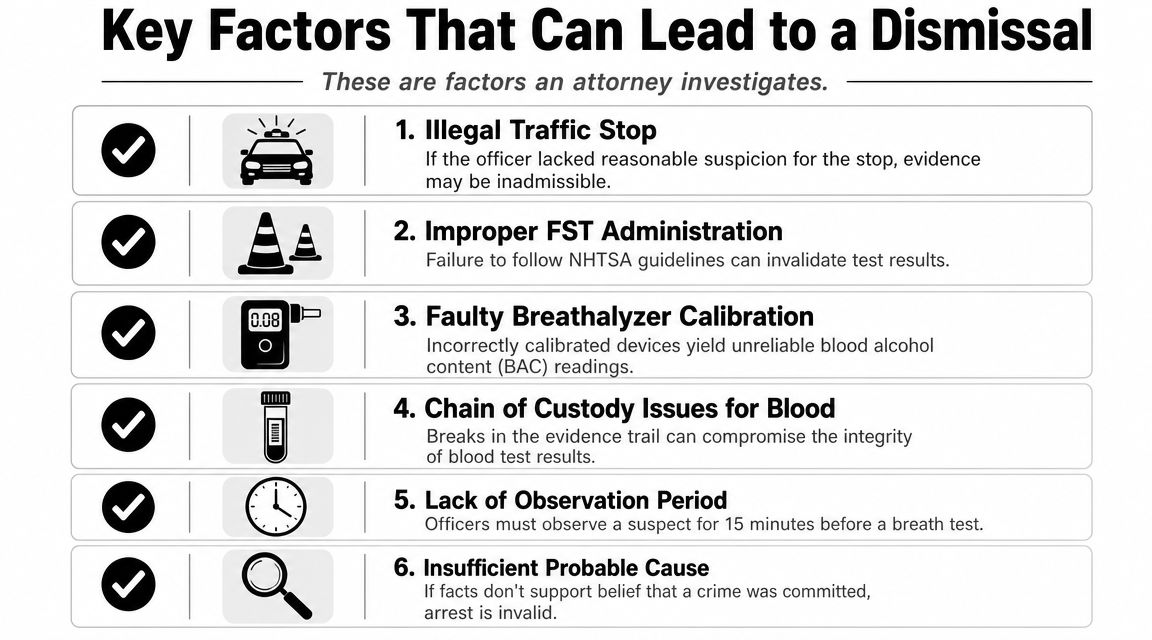
When a DWI lawyer reviews a case, the question isn't “did the officer arrest you?” It's “can the State prove this case with admissible, reliable evidence?”
A separate Texas analysis of defendants who did not plead guilty found a much stronger outcome spread. About 10% to 15% of those cases ended in dismissal, and about 30% ended in conviction on a lesser charge. That same dataset reportedly showed prosecutors convicted 37,000 of about 53,000 non-guilty-plea cases on the original charge, with 7,000 dismissed and 16,000 reduced to lesser charges, according to this review of Texas contested DWI outcomes.
The stop has to be legal
Police need a lawful reason to stop your car. If the officer lacked reasonable suspicion, everything that followed may be challengeable.
That issue can decide the entire case. If the stop falls apart, the State may lose the observations, the tests, and the arrest itself. This is one reason many people ask whether a DWI can be dismissed due to lack of evidence in Texas.
Field sobriety testing is not as simple as it looks
A field sobriety test is not a machine result. It's an officer's interpretation of performance on roadside exercises.
Those tests can be affected by:
- Medical conditions: balance issues, injuries, fatigue, or neurological conditions
- Scene conditions: poor lighting, gravel, slope, traffic noise, or weather
- Instruction errors: unclear or incorrect directions from the officer
If the tests weren't administered correctly, their value drops.
Breath and blood evidence can be challenged
A reported BAC number may look powerful, but it still has to survive scrutiny.
Key issues often include:
- Breath testing problems: machine maintenance, operator procedure, and observation requirements
- Blood draw concerns: collection procedure, storage, transport, and chain of custody
- Refusal cases: whether the officer followed proper procedures before seeking further testing
Procedure matters more than most people think
Some DWI cases weaken because officers or prosecutors miss legal steps.
That can include custodial questioning issues, discovery problems, or delays that affect the defense. Sometimes a case doesn't collapse because one dramatic fact appears. It weakens because several smaller defects add up.
Case focus: The strongest dismissal arguments usually come from documents, video, and timelines, not from broad claims that the arrest “was unfair.”
Why Dismissal Rates Vary by County and Offense Level
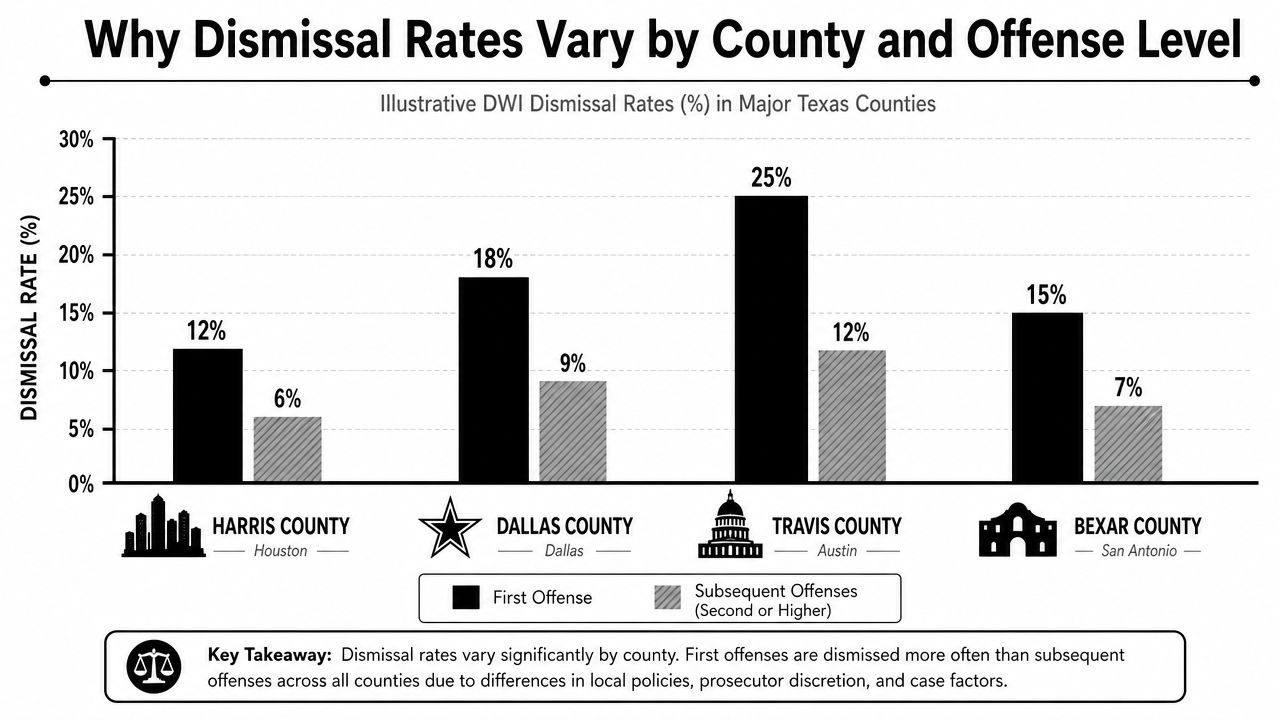
There is no single Texas answer to how often are DWI cases dismissed in Texas. County practice matters. Offense level matters even more.
One independent compilation of 2024 data from the five largest Texas counties reported a 34.2% dismissal rate for first-time DWI cases, 15.2% for second-offense DWI cases, and 6.17% for felony DWI cases, according to this county-level Texas DWI dismissal compilation.
Why first offenses and felony cases look so different
A first DWI in Texas often gives the defense more room to work with. There may be no prior record, fewer aggravating facts, and more flexibility in how the prosecutor evaluates the case.
A felony DWI is different. Prior history alters the dynamic. Prosecutors usually treat those files more aggressively, and the stakes are much higher.
County culture matters too
A Houston DWI lawyer, a Texas DUI attorney in Austin, and defense counsel in San Antonio may all face different local realities.
Those differences can include:
| Local factor | Why it matters |
|---|---|
| Charging policy | Some offices negotiate more readily than others |
| Diversion availability | Some counties offer alternatives that others don't |
| Judicial approach | Some courts are more receptive to suppression issues |
| Docket pressure | Heavy dockets can affect timing and leverage |
That doesn't mean one county is “easy” and another is hopeless. It means local experience matters when deciding how to fight DWI in Texas.
Severity changes strategy
If your case involves a high BAC allegation, an accident, a child passenger, a prior conviction, or serious injury allegations, the dismissal path gets narrower. The defense often has to be more technical, more document-driven, and more trial-ready.
That's why generic online odds don't help much. A first-offense misdemeanor in one county is not the same legal problem as a repeat or felony file in another.
What a DWI Dismissal Looks Like in a Real Case
Real cases usually turn on details that looked minor at first.
One common example is the traffic stop itself. An officer writes that the driver failed to maintain a lane and appeared unsafe. Then the dashcam gets reviewed closely. The video shows normal driving or facts that don't support the report. Once the basis for the stop is challenged, the prosecutor may decide the case is too weak to keep.
Another example involves roadside testing. A person with knee problems, back issues, or balance limitations performs poorly on field sobriety tests. The officer treats that performance as intoxication. But the bodycam also shows uneven pavement, confusing instructions, and no real effort to account for the medical issue. The defense doesn't need to prove perfect driving. It needs to show that the State's interpretation is unreliable.
A third pattern shows up in blood cases. The report may look polished on paper, but the file can still have gaps in collection records, labeling, handling, or lab documentation. If the chemical evidence becomes vulnerable, the prosecutor may be left with little more than an officer's opinion.
What these examples have in common
These cases aren't won by arguing in general terms that DWI charges are unfair. They turn on specifics.
- Video compared to reports
- Officer testimony compared to paperwork
- Testing procedures compared to required protocol
- Observed behavior compared to alternative explanations
The best defense work often looks less dramatic than people expect. It's careful, technical, and relentless.
That's why an experienced attorney doesn't start by asking whether your case “feels bad.” The better question is whether the State's evidence holds up once somebody tests it.
How a Texas DWI Attorney Maximizes Your Chance of Dismissal
A strong DWI defense starts with speed. Evidence has to be requested. Video has to be preserved. The officer's stated reason for the stop has to be compared against what the footage shows. The license case has to be addressed before deadlines pass.
What your attorney should actually be doing
You should expect concrete action, not vague reassurance.
- Review the stop and arrest: Was there reasonable suspicion, probable cause, and a lawful arrest sequence?
- Audit the evidence: Bodycam, dashcam, dispatch notes, breath records, blood paperwork, and witness statements all need review.
- Challenge weak points early: That may include filing and litigating a motion to suppress evidence.
- Prepare for both tracks: The criminal case and the DWI license suspension process can affect each other.
- Negotiate from strength: Prosecutors take defenses more seriously when the case is ready for hearing or trial.
What happens after you hire counsel
Most cases follow a practical pattern:
- Immediate case intake and timeline review
- ALR deadline analysis and hearing decision
- Discovery requests and evidence gathering
- Strategic motions and negotiation
- Trial preparation if needed
Experienced defense work can materially change your position. The Law Office of Bryan Fagan, PLLC represents Texans in DWI criminal cases and related license proceedings, including evidence review, suppression challenges, and trial defense.
Realistic but encouraging
No honest attorney should promise a dismissal. The facts may be too strong, the testing may hold up, or the county may take a hard line.
But a DWI arrest is not the same thing as a conviction. If you want to improve your odds, the controllable factors are clear. Act quickly. Protect your license. Preserve evidence. Challenge assumptions. Gain an early advantage.
If you're searching for a Houston DWI lawyer or Texas DUI attorney because you want to know whether you can fight DWI in Texas, the answer is yes. The right strategy may lead to dismissal, reduction, or a stronger trial posture than you thought possible.
If you've been arrested for DWI, get answers specific to your case, not someone else's. The Law Office of Bryan Fagan, PLLC offers a free consultation so you can understand your options, protect your license, and start building a defense right away.