
A DWI arrest can be overwhelming, but you don’t have to face it alone.
You’re probably dealing with the same questions others ask in the first 24 hours. Will I lose my license? Will this stay on my record? Is there any way to keep this from turning into a conviction? Those are the right questions, and you need straight answers.
One of the most important answers is this. Pretrial diversion in texas can sometimes give you a path to dismissal instead of conviction. It is not automatic. It is not available in every DWI case. And it is not something you should try to handle casually. But when it fits, it can protect your job, your reputation, and your future.
If you were recently arrested for DWI in Texas, your next moves matter. A lot. The prosecutor’s office, the court, and the Texas Department of Public Safety each create separate problems after a DWI arrest. A smart defense looks at all of them at once.
Your Guide to Navigating a Texas DWI Arrest
You get booked on a DWI, make bond, and wake up the next morning thinking the court date is the only problem. It is not. Your license, your job, your insurance, and your criminal record can all be affected before the case is ever resolved.
A Texas DWI case moves on more than one track at the same time. You may be dealing with bond conditions, an administrative license suspension, and the criminal charge itself. If you were recently arrested for DWI in Texas, the right response is fast, organized action.
Here is what I want clients to understand early. A DWI case is rarely just about whether alcohol was involved. It is also about whether the stop was legal, whether the officer followed proper procedure, whether any field sobriety test was performed and interpreted correctly, whether the breath or blood evidence holds up, and whether the prosecutor’s office offers a realistic path to dismissal through pretrial diversion.
That last point gets missed all the time.
Pretrial diversion for DWI is not a statewide promise. It is a local policy decision, and counties handle it very differently. One prosecutor’s office may consider first-time DWI cases under strict conditions. Another may refuse them outright. A third may call it diversion but attach requirements that make acceptance a strategic decision, not an automatic yes. If your lawyer does not know the local practice, you can miss an opportunity or walk into a bad deal.
A few terms matter right away:
- BAC means blood alcohol concentration. The State uses it to argue alcohol impaired your ability to drive.
- Implied consent means driving in Texas can trigger a lawful request for a breath or blood sample during a DWI investigation. A refusal can create a separate fight over your license.
- Field sobriety test means roadside exercises officers use to support an intoxication claim, including balance and eye movement tests. These are often open to challenge.
- Administrative license suspension usually refers to the ALR process. That is separate from the criminal case and can affect your ability to drive even if the DWI charge is still pending.
Here is the practical rule. Do not assume a DWI charge will end in a conviction. Do not assume diversion is available either. County policy, the facts of your stop, your record, and the prosecutor assigned to the case all matter.
In Houston, Dallas-Fort Worth, Austin, San Antonio, and the surrounding counties, the same DWI arrest can lead to very different options. Generic advice will not protect you. A county-specific defense plan will.
What Exactly Is Pretrial Diversion in Texas
Pretrial diversion is a deal offered before your case goes to trial and before a conviction is entered. You complete a structured program, follow the rules, and if you finish successfully, the charge can be dismissed.
That’s the clean definition. Here’s the better one. It functions as a supervised second-chance contract. You prove, over time, that you’re someone the system can trust not to reoffend. In exchange, the State agrees not to push the case through to a conviction if you do your part.

What pretrial diversion is and is not
Pretrial diversion is not the same thing as being found not guilty. If you win at trial, the State failed to prove the charge. If you complete diversion, the case is resolved through compliance instead of trial.
That distinction matters, but from a practical standpoint, many clients care about the end result. They want to avoid a criminal conviction, preserve professional opportunities, and keep one mistake from defining them. Pretrial diversion can do that in the right case.
Why prosecutors use it
Prosecutors don’t offer diversion out of generosity. They use it because it can resolve lower-risk cases without the time and expense of a full prosecution. Counties also use it to push defendants toward education, treatment, monitoring, and accountability instead of defaulting to punishment in every eligible case.
The hard truth is that this is still a discretionary system. One county may treat a first-time DWI as a strong diversion candidate. Another may push the same driver toward a different outcome. Some offices are flexible. Some are rigid. Some will only consider diversion after a defense lawyer presents a complete package showing why you’re a low-risk candidate.
Why local practice controls everything
Texas law gives counties room to shape how these programs operate. That’s why pretrial diversion in texas is never just a statewide issue. It’s a local issue.
A prosecutor in one county may want proof of counseling enrollment, proof of employment, proof of community ties, and a clean background. Another may care more about whether there was an accident, whether there was a refusal, or whether the facts make the case politically hard to dismiss.
The real fight often isn’t just whether diversion exists. It’s whether your lawyer knows how that specific county actually uses it.
That’s the point many people miss. The statute matters. The prosecutor’s internal policy matters more. If you’re serious about dismissal, you need both the legal argument and the local strategy.
Are You Eligible for Pretrial Diversion for a DWI
Misconceptions about eligibility are widespread. They hear “first offense” and assume that means they qualify. That’s wrong.
The basic rule is narrow. Texas PTD programs generally limit eligibility to first-time, non-violent offenders under Texas Government Code §76.011 and local prosecutorial discretion. If your case doesn’t fit that narrow profile, the odds get harder fast.

The baseline requirements
Most counties start with a similar screening mindset. They want someone who looks like a low-risk candidate for supervision and dismissal.
You’re usually in a stronger position if:
- This is your first criminal case and you have no prior felony history.
- The charge is non-violent and the facts don’t involve injury.
- You have stable ties such as work, school, family responsibilities, or community involvement.
- You’re out of custody and cooperative with the process.
- You can complete conditions like classes, supervision, treatment, testing, or community service without constant compliance problems.
Those aren’t guarantees. They are pressure points. A good defense lawyer uses them to argue that giving you diversion serves the county’s interests.
Why DWI cases are harder than other cases
DWI cases sit in a tougher category than many other misdemeanors because prosecutors see them as public safety cases. Even when no one was hurt, a DWI charge can trigger more resistance than a low-level theft or possession case.
That’s why county-by-county differences matter so much. In one county, a first-time DWI might still be considered if the facts are clean. In another, the office may steer most DWI defendants toward deferred adjudication or another negotiated result instead of true pretrial diversion.
Counties and prosecutors often look closely at issues like these:
- Alcohol concentration issues and whether the State claims a high BAC
- Crash facts including whether there was property damage or injury
- Children in the vehicle
- Refusal issues tied to implied consent and license consequences
- Your statements to police
- Your driving pattern as described in the report
- Any prior alcohol-related contacts even if they didn’t end in conviction
What can block you quickly
Some facts make diversion less likely from the start.
A prosecutor may reject diversion if the case includes aggravating facts, prior offenses, poor behavior after arrest, or a record that suggests supervision won’t work. If you missed court, violated bond, picked up a new charge, or tested dirty while trying to get into a program, you’ve made the State’s argument for them.
That doesn’t mean the case is hopeless. It means diversion may no longer be the best primary target.
Here’s a quick video that helps explain how defense strategy can shape the outcome in a DWI case:
What helps your lawyer make the ask
The smartest way to pursue diversion is to make the prosecutor comfortable saying yes.
That often means assembling useful material early, such as:
- Proof of employment because it shows structure and responsibility
- Records of voluntary counseling or alcohol education because it shows insight
- Character letters from credible people who know you well
- A clean compliance record on bond because prosecutors notice who follows rules
- A clear personal narrative that explains the incident without excuses
If diversion is possible, waiting around usually hurts you. Prosecutors respond better when your lawyer shows them a complete, organized case for why you should get one chance, not two.
If you’re asking whether you qualify, the answer is this: You might. But in a DWI case, eligibility isn’t just a box-checking exercise. It’s an argument, and the quality of that argument matters.
The Pretrial Diversion Process From Application to Dismissal
Once diversion is on the table, the process becomes practical. Forms, deadlines, conditions, supervision, and follow-through decide whether this becomes a dismissal or a disaster.
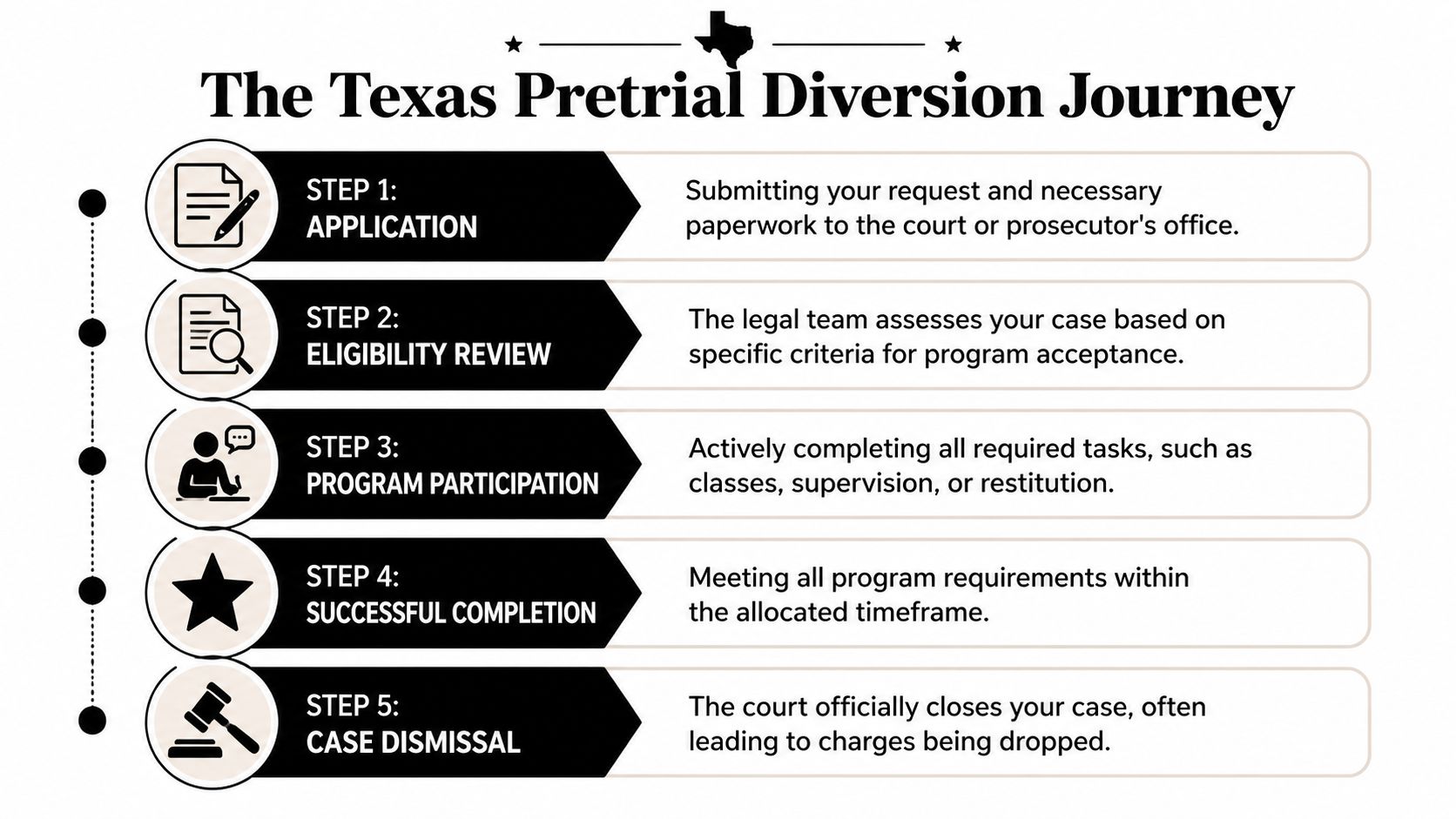
Step one starts earlier than most people think
Diversion usually has to be pursued early. In many counties, the defense needs to open the conversation with the prosecutor before the case hardens into a standard prosecution track.
That means your lawyer reviews the police report, video, breath or blood issues, and your background. Then the lawyer decides how to approach the county. In some cases, the right move is to highlight weaknesses in the State’s evidence. In others, the better move is to emphasize your suitability for supervision and dismissal.
The application stage is strategic, not clerical
People think the application is just paperwork. It isn’t. It is your first presentation to the prosecutor.
A strong submission may include proof that you’re employed, enrolled in counseling, meeting bond conditions, and taking the charge seriously. The goal is simple. Make it easy for the prosecutor to conclude that you are a manageable candidate who will complete the program and stay out of trouble.
The agreement is a contract with real teeth
If you’re accepted, you’ll sign a pretrial diversion agreement. Read it carefully. This is not a symbolic promise.
Many counties require conditions such as:
Reporting and supervision through a designated office or officer
You may need regular check-ins, progress updates, and approval for changes in address or employment.Alcohol or substance-related education
DWI education classes, assessments, or treatment are common in alcohol-related cases.Community service and financial obligations
Some agreements require service hours, program fees, restitution, or administrative costs.No new arrests or violations
This is the core rule. If you pick up a new case, your diversion can collapse.Testing and behavior-based conditions
Some counties require testing, abstinence, ignition interlock, or counseling depending on the facts.
Client advice: Don’t sign a diversion agreement because it sounds good in court. Sign it only after your lawyer explains what happens if you miss a requirement.
Violation consequences are serious
Participants often experience adverse outcomes. Diversion sounds forgiving, but the supervision terms are often strict. Texas PTD programs can refer you back for prosecution if you violate conditions, and terms often run up to 18 months.
That means missed appointments, failure to complete treatment, skipped community service, new arrests, or other violations can send your case back into the prosecution lane. In some programs, the violation decision is heavily controlled by the prosecutor’s office rather than a full-blown court hearing.
Here’s what that means in plain English:
- You do not get endless second chances
- Technical violations still matter
- Good intentions don’t fix noncompliance
- Your lawyer should stay involved during the program, not disappear after the paperwork is signed
Successful completion leads to dismissal
If you complete every condition, the case is dismissed under the agreement. That is the reward you’re working toward.
For many clients, the next question is record clearing. Depending on the outcome and the county, your attorney may then evaluate whether you qualify to pursue expunction or another form of record relief. That part matters because dismissal is powerful, but cleaning up the paper trail matters too.
A realistic timeline looks like this:
| Stage | What happens |
|---|---|
| Early defense review | Your lawyer evaluates facts, county practice, and timing |
| Application | The defense submits a diversion request and supporting material |
| County review | The prosecutor decides whether to offer PTD |
| Program period | You complete supervision terms and stay compliant |
| Dismissal and cleanup | The charge is dismissed, then record-relief options are reviewed |
The biggest mistake is treating diversion like easy probation. It isn’t. It’s a high-value opportunity with strict rules. If you take it seriously, it can protect your future. If you coast through it, it can put you right back in front of the prosecutor.
Pretrial Diversion Compared to Deferred Adjudication
People mix these up all the time. They shouldn’t. Pretrial diversion and deferred adjudication can both help you avoid a final conviction, but they are not the same tool.
The biggest difference is simple. With pretrial diversion, you usually avoid entering a guilty or no contest plea at the front end. With deferred adjudication, you typically must enter that plea first. That changes the legal posture of the case and the long-term record consequences.
If you want a fuller discussion of deferred adjudication for DWI in Texas, compare it carefully against diversion before you choose a path.
The side-by-side difference that matters
| Feature | Pretrial Diversion (PTD) | Deferred Adjudication |
|---|---|---|
| When it happens | Before the case goes to trial | After a plea is entered |
| Plea required upfront | Usually no | Usually yes, guilty or no contest |
| If you complete successfully | Charge is dismissed under the agreement | Court dismisses proceedings after supervision is completed |
| If you fail | The prosecution resumes the criminal case | The court can proceed to adjudication and sentencing |
| Record impact | Often offers a stronger path toward later record cleanup | Usually leaves a record that may need sealing rather than destruction |
| Strategic value | Best for clients seeking a true dismissal path without an upfront plea | Useful when diversion is unavailable but a conviction can still be avoided |
Why PTD is often the better result
If you can get true pretrial diversion, I usually see it as the cleaner outcome. You’re trying to keep the case from maturing into something that follows you long term. For employment, licensing, housing, and reputation, that difference is real.
A deferred result can still be very useful. It may be the right answer in a county that doesn’t offer PTD for DWI or in a case where the prosecutor won’t agree to diversion. But if a client can reasonably pursue PTD, I want that option examined first.
Deferred adjudication is often the fallback plan. Pretrial diversion is often the stronger first choice.
How to think about the decision
Don’t treat this like a generic plea decision. Treat it like record protection planning.
Ask the questions that matter:
- Will I have to plead before the case is dismissed?
- What happens if I violate the terms?
- What will future employers or licensing boards see?
- Can this result be expunged, sealed, or neither?
- Does this county offer PTD in DWI cases like mine?
Those questions are more important than the label on the agreement. Lawyers and prosecutors can use similar-sounding language for very different outcomes. You need the actual legal effect explained in plain English before you agree to anything.
The Rewards and Risks of a Diversion Program
Pretrial diversion can be a strong result. It can also go sideways if you treat it casually. Both things are true.
The reward is obvious. If you complete the program, you can avoid a conviction and move forward with a dismissed case. For a nurse, teacher, CDL holder, office professional, or parent trying to protect family stability, that outcome matters.

The rewards are worth fighting for
The main benefit is control over the future. You’re not just reducing punishment. You’re trying to avoid the conviction itself.
That matters in real life:
- Employment gets easier when you can say you were not convicted.
- Professional licensing issues become more manageable when the final record is stronger.
- Housing and background checks often become less damaging.
- Personal credibility is easier to rebuild when the case ends in dismissal.
There is also long-term value in diversion outcomes. Research on Texas diversionary programs found participants had 75% fewer reconvictions over a 10-year period than those receiving traditional felony convictions. That doesn’t mean every DWI diversion case guarantees the same result. It does show why diversion is taken seriously as a future-protecting option.
The risks are real and immediate
Diversion is not a free pass. It is a compliance test.
Common risks include:
- Strict conditions that interfere with work, travel, or daily life
- Program costs and obligations that add pressure over time
- Waivers and timing issues that can affect how your case moves
- Failure consequences that can return you to prosecution quickly
If your life is unstable right now, that matters. A person juggling job changes, childcare, transportation problems, or untreated substance issues may struggle with a strict supervision contract. In that situation, the right legal advice may be to negotiate a different outcome instead of chasing an option you’re unlikely to finish.
My opinion on the tradeoff
For the right client, diversion is usually worth pursuing. Not because it’s easy. Because the upside is big enough to justify a disciplined effort.
But I never tell clients to enter PTD unless they can complete it. False optimism causes bad decisions. If you take diversion, take it seriously from the first day to the last day.
A good diversion offer can protect your future. A bad fit can hand the prosecutor a cleaner path to punish you later.
That’s why legal advice matters before you accept the deal, not after you violate it.
How a DWI Defense Attorney Can Secure Pretrial Diversion
A prosecutor in one Texas county may seriously consider pretrial diversion for a first-time DWI with strong mitigation. A prosecutor in the next county may reject the same case on sight. That is why a DWI lawyer does more than ask whether diversion exists. Your lawyer builds a county-specific plan to make you the right candidate, or pushes for a better result if diversion is a bad fit.
That work starts with pressure. A good defense attorney reviews the stop, field sobriety testing, breath or blood issues, video, officer reports, and your personal history together. If the evidence has problems, your lawyer uses those weaknesses in negotiation. If the evidence is stronger, your lawyer shifts to mitigation and shows the prosecutor why giving you one controlled chance makes sense.
Local practice often decides the outcome. Some counties want an application before formal motions. Some expect treatment records, proof of employment, character letters, or early alcohol education. Some offices care about clean driving history. Others focus on whether there was an accident, a high BAC, or a child passenger. A lawyer who already knows that office can avoid wasting time on the wrong pitch and put the right material in front of the right person.
As noted earlier, Texas research on diversion participants found that stability markers such as employment were tied to better outcomes. Prosecutors know that. A defense lawyer uses those facts the right way by presenting you as organized, accountable, and likely to finish the program. That is how you turn a generic request into a serious proposal.
Timing matters too. In some counties, asking too late hurts you. In others, asking too early without supporting documents makes you look unprepared.
Your lawyer also protects you from signing a bad deal. Some diversion contracts include strict reporting rules, treatment demands, travel limits, ignition interlock terms, waiver language, or fast termination provisions if you slip. You need someone to read every line, explain the risk, and negotiate terms you can complete.
If you want a practical starting point, review these Texas DUI defense attorney strategies and then get a county-specific case review. The Law Office of Bryan Fagan, PLLC handles Texas DWI defense issues including diversion analysis, ALR defense, plea negotiations, and record-related follow-up.
Frequently Asked Questions About Texas Pretrial Diversion
Can you get pretrial diversion for a felony DWI
Sometimes, but it’s much harder. Felony cases bring more scrutiny, and many counties reserve diversion for narrower categories of defendants. If your DWI is enhanced to a felony, you need an immediate, county-specific review.
What happens if you get a new charge while on diversion
That can destroy the deal. Most diversion agreements require no new arrests or law violations. A new charge often gives the prosecutor grounds to terminate the program and restart prosecution on the original case.
Is pretrial diversion available for out-of-state drivers
It can be, but logistics matter. If you live outside Texas, your lawyer needs to address reporting, travel, class requirements, and how the case result may affect your home-state license. Out-of-state drivers should never assume a Texas dismissal automatically solves every licensing issue elsewhere.
Will pretrial diversion save my CDL
Not automatically. CDL holders face stricter consequences, and even a strong criminal outcome may not fix every licensing problem. If you hold a commercial license, your defense has to account for the criminal case and the license consequences together.
Is diversion better than fighting the DWI at trial
Not always. If the stop was illegal, the officer lacked probable cause, or the testing is unreliable, the trial advantage may be stronger than a diversion request. The right answer depends on the facts, the county, and your risk tolerance.
Should I ask for diversion myself
No. That’s a mistake. Prosecutors judge not only your eligibility but also how the request is presented. A lawyer knows when to ask, what to submit, and what facts should be emphasized or held back.
If you’re facing a DWI charge, don’t guess your way through it. The right strategy can involve fighting the stop, protecting your license, seeking pretrial diversion, negotiating deferred adjudication, or preparing for trial. Law Office of Bryan Fagan, PLLC helps Texas drivers evaluate those options and move quickly after arrest. Request a free consultation to get a clear plan for your case, your record, and your next step.