
A DWI arrest can be overwhelming. You may be replaying the stop in your head, worrying about your license, your job, your insurance, and what happens if this ends up on your record.
The good news is that an arrest is not the same thing as a conviction. In Texas, the state still has to prove its case, and sometimes it can't. If you're searching can a DWI be dismissed due to lack of evidence Texas, the answer is yes. In Texas, DWI charges are dismissed in about 13% of cases, and another 30% are reduced to lesser offenses, according to Texas DWI dismissal data discussed here.
That matters because many DWI cases look stronger on paper than they really are. A police report may sound polished. A breath result may look scientific. Field sobriety tests may seem official. But each piece of evidence has to hold up under close legal review.
A seasoned Houston DWI lawyer or Texas DUI attorney doesn't start by assuming the case is airtight. We start by asking harder questions. Did the officer have a lawful reason to stop you? Were the field sobriety tests done correctly? Was the chemical test handled by the book? If the answer to any of those questions is no, the prosecution may have a serious problem.
A DWI Arrest Is Overwhelming But Not a Conviction

After a DWI arrest, individuals often don't feel calm. They feel embarrassed, angry, confused, and pressed for time. That reaction is normal.
What often makes the situation worse is the false idea that the officer's version of events is the final word. It isn't. A DWI case is only as strong as the evidence behind it, and Texas law gives your defense lawyer room to challenge that evidence at every stage.
The first thing to understand
When police arrest you for DWI, they begin a process. They don't finish one. The prosecutor still has to prove that you were intoxicated, which in Texas generally means either:
- BAC. Your blood alcohol concentration, measured through a breath or blood test, was at or above the legal limit.
- Loss of normal faculties. The state claims alcohol, drugs, or a combination caused you to lose the normal use of your mental or physical faculties.
Both theories can be challenged.
Why lack of evidence matters so much
A DWI case can weaken in small ways or collapse all at once. Sometimes the stop itself was unlawful. Sometimes the body camera doesn't match the report. Sometimes the field tests were done on uneven pavement, in poor lighting, with confusing instructions. Sometimes the breath or blood evidence has technical defects.
Practical rule: If the state can't present reliable, admissible evidence, it can't simply fill the gaps with suspicion.
That is why "lack of evidence" doesn't mean there was no arrest. It means the evidence the prosecutor wants to use may be too weak, too flawed, or too legally tainted to prove guilt beyond a reasonable doubt.
What you should focus on right now
If this is your first DWI in Texas, don't assume the outcome is fixed. If you're worried about a DWI license suspension, that issue may move on a separate track from the criminal case. If you're trying to fight DWI Texas charges, timing matters early.
A smart defense begins by slowing the panic and examining the record. Police reports, dispatch records, body cam video, dash cam footage, test logs, and lab paperwork often tell a more complete story than the arrest itself.
Understanding the Prosecution's Burden of Proof
A lot of people walk into a DWI case thinking they need to prove they weren't intoxicated. That's not how the system works. The burden belongs to the government.
The prosecutor is the lawyer representing the state. The prosecutor has to prove every required part of the DWI charge. You don't have to prove your innocence, explain away every accusation, or fix the weaknesses in the state's case for them.
What beyond a reasonable doubt really means
The legal standard in a criminal case is beyond a reasonable doubt. In plain language, that means the evidence must leave a jury firmly convinced of guilt. It does not mean "maybe," "probably," or "the officer seemed credible."
Think of the state's case like a wall built brick by brick. Each brick has to hold. If one major brick cracks, the wall becomes unstable. In a DWI case, those bricks often include:
| Part of the case | What the state tries to show |
|---|---|
| The stop | The officer had a lawful reason to pull you over |
| The investigation | The officer observed signs of intoxication |
| The tests | Field or chemical tests were properly done |
| The arrest | There was probable cause to arrest you |
| The courtroom evidence | The judge can legally admit that evidence |
If one section fails, the prosecutor's case gets harder. If multiple sections fail, dismissal becomes a real possibility.
Key terms people confuse
A few terms matter early in any Texas DWI case:
- Implied consent means that by driving on Texas roads, you are considered to have agreed to provide a breath or blood specimen after a lawful DWI arrest in certain circumstances. Refusing a request can trigger license consequences.
- Administrative license suspension or ALR stands for the civil process that can suspend your driver's license after a failed or refused test. This is separate from the criminal case.
- Field sobriety test means roadside tests used by officers to look for signs of impairment.
- BAC means blood alcohol concentration.
The prosecutor doesn't win because an arrest happened. The prosecutor wins only if the evidence survives legal challenge and persuades the court or jury.
Why this changes your mindset
Once you understand the burden of proof, the case looks different. The question stops being, "How do I explain everything?" It becomes, "Can the state prove this?"
That shift matters. It helps you stay focused on what moves cases. Video evidence. officer credibility. testing records. procedure. timing. chain of custody. legal motions.
What happens after a DWI arrest in Texas
Many clients also want a clear picture of the process. While every county handles scheduling a little differently, the usual path looks like this:
- Arrest and booking. You may be photographed, fingerprinted, and released on bond.
- Bond conditions. A judge may set conditions such as alcohol monitoring or travel limits.
- ALR deadline. If your license is at risk, you may need to act quickly to challenge the suspension.
- Court settings. The case moves through arraignment or first appearance, then pretrial hearings.
- Discovery and motions. Your lawyer requests evidence and challenges weak or unlawful evidence.
- Negotiation or trial. If the case isn't dismissed, it may resolve through a reduction, plea, or trial.
That process gives your defense room to work. Good results often come from careful pressure applied at the right moment.
Challenging the Initial Traffic Stop for Lack of Evidence
You are driving home after dinner. An officer pulls you over, asks a few questions, and within minutes the stop turns into a DWI investigation. In that moment, it can feel like everything that happens after the flashing lights is set in stone. It is not.
One of the first technical cracks we look for is whether the officer had a lawful reason to stop your car in the first place. Before police can start building a DWI case, they need specific, articulable facts that justified the stop. Texas law calls that reasonable suspicion. It is a modest standard, but it still requires real facts, not guesswork, assumptions, or a generalized hunch.
That distinction matters more than people realize. If the stop was unlawful, the defense may be able to ask the court to suppress everything that flowed from it under Texas Code of Criminal Procedure Article 38.23. In plain English, the prosecution can lose the very evidence it planned to rely on.
What reasonable suspicion actually looks like
Reasonable suspicion is the legal version of showing your work. An officer must be able to explain what they saw, when they saw it, and why those facts pointed to a traffic violation or possible crime.
A vague conclusion is weak. A specific observation is stronger.
| Likely valid stop | Potentially invalid stop |
|---|---|
| Speeding measured by radar | Leaving a bar parking lot late at night |
| Running a stop sign | Driving in an area the officer labels high crime |
| Crossing clearly marked lanes | Statement that the driver seemed unusual |
| Failing to signal when required | Report language that video does not support |
Often, a case's vulnerabilities become apparent. The report may sound polished, but the report is only one piece of the record. A defense lawyer compares it against the dash cam, body cam, dispatch notes, and timeline. If those pieces do not match, the stop may not hold up.
For a closer look at how lawyers attack that issue, this guide on an illegal traffic stop DWI defense strategy in Texas explains the process in more detail.
Video often changes the case
Here is a common pattern. The officer writes that your car was weaving, drifting, or nearly leaving the roadway. On paper, that sounds like strong justification. Then the video shows a different story. Maybe the vehicle stayed in its lane. Maybe there was one brief touch of the line. Maybe the camera starts too late to show the alleged violation at all.
That gap is not minor. It can become the center of a suppression fight.
A good defense does not accept the officer's summary at face value. It tests each claimed observation the way a mechanic tests a part that may be cracked. If the foundation gives way, the rest of the case becomes harder for the state to prove.
A legal stop can still become an illegal detention
The stop itself is only the first checkpoint. Even if the officer had a lawful reason to pull you over for speeding or another traffic issue, the officer cannot stretch the encounter longer than necessary without developing new facts.
That is where timing becomes strategic.
Suppose the original traffic matter is complete, but the officer keeps asking questions, delays the citation process, or extends the stop to investigate intoxication without fresh reasonable suspicion. That extended detention may be unlawful. Courts examine whether the officer was still handling the purpose of the stop or had shifted into a broader investigation without enough legal support.
A simple way to look at it is this. A stop has a lane and a speed limit. If the officer goes beyond both without a lawful reason, later evidence may be vulnerable.
What the defense tries to remove
If a judge finds the stop or detention was illegal, the prosecution can lose key parts of its case, including:
- Officer observations made after the unlawful stop, such as odor of alcohol, red eyes, or alleged slurred speech
- Roadside statements you made in response to questioning
- Field sobriety test results obtained after the detention began
- Breath or blood evidence gathered as a result of the stop
- Video tied to the investigation that followed the unlawful detention
Once that evidence is suppressed, the case can weaken quickly. Sometimes the remaining proof is too thin to support prosecution. That is how a DWI dismissal can begin, not with a dramatic moment, but with a careful attack on the first decision the officer made and every step that followed.
How Field Sobriety Tests Can Fail the Prosecution
Field sobriety tests often carry more weight in people's minds than they should. Many drivers assume these tests are scientific and objective. In reality, they're heavily affected by human judgment, roadside conditions, and your own physical limitations.
The three common standardized field sobriety tests are the Horizontal Gaze Nystagmus, the Walk-and-Turn, and the One-Leg Stand. Officers use them to look for clues they associate with impairment. But these are not magic truth machines.
The three tests in plain English
Horizontal Gaze Nystagmus involves following an object, usually a pen or finger, with your eyes. The officer looks for jerking in the eyes at certain angles.
Walk-and-Turn asks you to take heel-to-toe steps in a straight line, turn a certain way, and walk back while following instructions.
One-Leg Stand requires you to balance on one foot and count for a period of time while the officer watches for swaying, hopping, or putting your foot down.
Each test sounds simple. Roadside reality is different.
Why sober people can appear to fail
A person can perform poorly on these tests without being intoxicated. That happens for many reasons:
- Medical issues such as back pain, knee injuries, ankle problems, vertigo, or inner-ear conditions
- Environmental conditions including gravel, sloped pavement, rain, wind, poor lighting, or flashing patrol lights
- Personal factors like age, weight, fatigue, anxiety, or certain medications
- Officer mistakes such as rushed instructions, interruptions, or demonstrating the test incorrectly
One of the biggest misunderstandings in a DWI case is this. Field sobriety tests don't measure alcohol concentration. They produce observations, and observations can be challenged.
The officer's instructions matter
A field test is only useful if the officer gives clear, standardized instructions and gives you a fair chance to perform. If the officer talks too fast, cuts you off, fails to ask about injuries, or conducts the test in a poor location, the results become less reliable.
A good defense lawyer looks for details such as:
- whether the officer asked about leg, back, eye, or neurological issues
- whether traffic noise made instructions hard to hear
- whether the video shows confusion that came from the officer, not the driver
- whether the surface was level and safe
- whether footwear affected balance
If you want a closer look at this kind of defense, this guide on how to challenge field sobriety test results in Texas breaks down common issues.
The roadside test is often less about science and more about whether the officer created a fair testing environment. Many times, the answer is no.
How juries and judges view these tests
Field sobriety tests become more vulnerable when video doesn't match the officer's narrative. If the report says you "could not maintain balance" but the footage shows minor movement and steady compliance, that gap can reduce the officer's credibility.
Defense attorneys also use cross-examination to expose how subjective these tests can be. For example, what one officer calls "swaying," another might call normal balancing. What one officer treats as confusion may be a driver trying to follow multiple instructions under stress on the side of a busy road.
When field tests are the main evidence
Some DWI cases rely heavily on field sobriety tests because the chemical evidence is weak or absent. That makes these tests more important, but it also makes them a bigger target for challenge.
If the arrest depends on roadside observations alone, your defense may focus on how ordinary behavior was turned into signs of intoxication. Nervousness. tiredness. imbalance from a medical issue. confusion from unclear commands. Those are not the same thing as intoxication.
Finding Flaws in Breath and Blood Test Evidence
A breath or blood test can look like the hardest evidence to beat. Many people see a number and assume the case is over. It isn't.
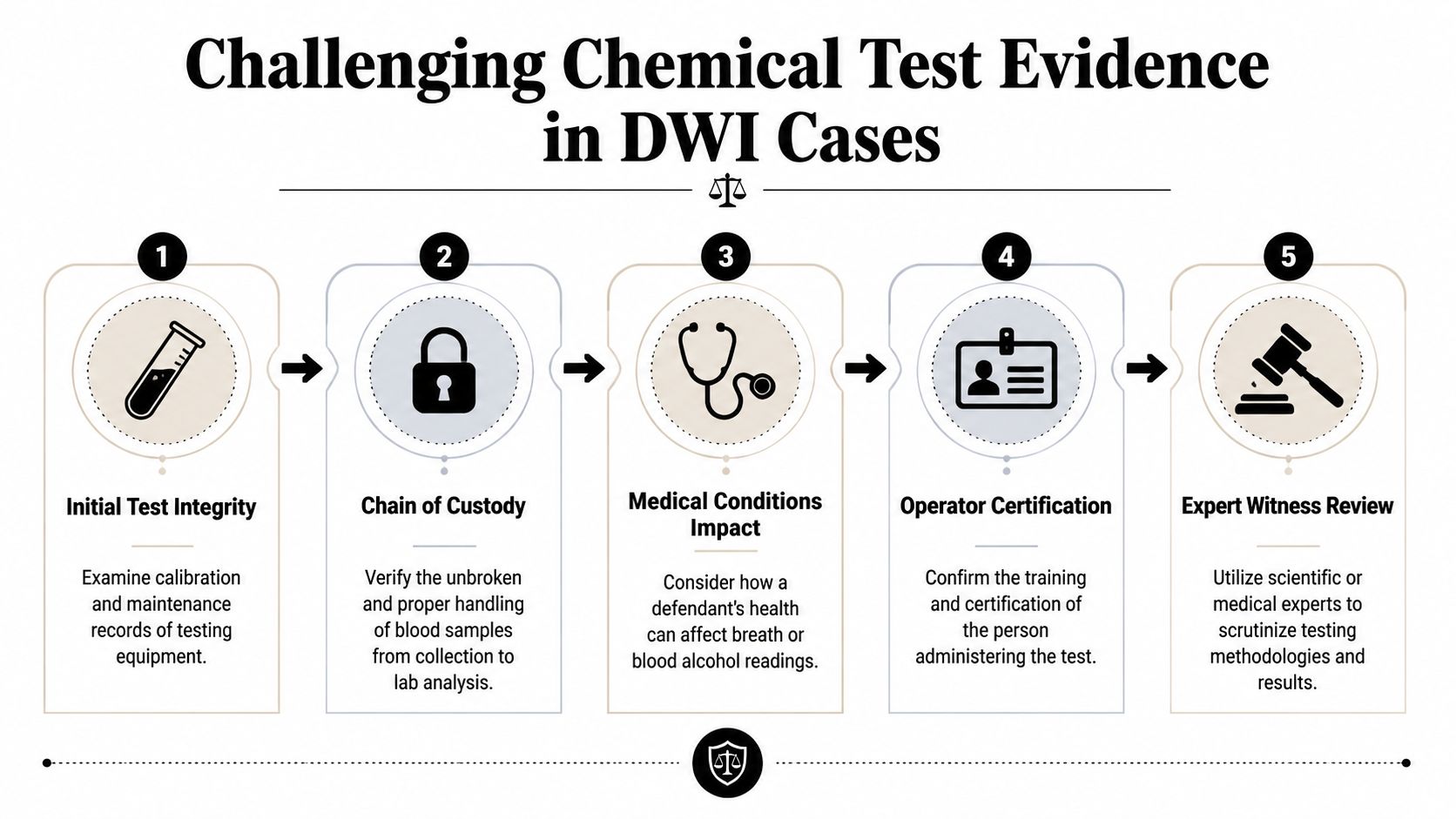
Chemical test evidence is only useful if the state can show the test was obtained, handled, and analyzed according to the rules. In Texas, breath and blood test deficiencies are a major path to dismissal because strict procedures apply under Texas Administrative Code §19.4. Improper calibration, uncertified operators, or a broken chain of custody can make the evidence inadmissible, as explained in this overview of common DWI dismissal reasons in Texas.
Start with implied consent
Texas uses implied consent rules. That means when you drive on Texas roads, you are deemed to have consented to providing a specimen after a lawful arrest under certain circumstances. But implied consent doesn't erase your constitutional rights, and it doesn't guarantee the state handled the testing process correctly.
This often confuses people because there are two separate problems to think about:
| Issue | What it affects |
|---|---|
| Refusing or failing a test | Your administrative license suspension case |
| Defects in how the test was obtained or handled | The criminal case against you |
A driver can lose ground in one area and still have strong defenses in the other.
Breath test problems
Breath machines must be maintained and operated correctly. The person running the test must also be properly certified. If those requirements aren't met, the result can be attacked.
Common issues include:
- Calibration defects that raise doubt about whether the machine was producing reliable readings
- Operator certification issues if the person administering the test lacked proper qualifications
- Environmental interference that may affect the machine's reading
- Observation problems if the officer did not properly observe the driver before the test
- Medical conditions that can distort the result
For example, GERD can affect breath testing because mouth alcohol may interfere with the sample. Diabetes and other conditions can also complicate how a result is interpreted in a DWI case.
If you're dealing with breath evidence, this page on the accuracy of breathalyzers is a useful starting point.
Blood test problems
Blood evidence often seems more solid because it goes through a lab. But blood cases can fail too. A blood sample has to be drawn lawfully, labeled correctly, stored properly, transported securely, and tested with documented reliability.
A defense attorney may examine:
- How the blood was obtained. Was there valid consent or a legally sufficient warrant?
- Who handled the sample. Every transfer should be documented.
- How it was stored. Improper storage can affect integrity.
- Whether the lab records are complete. Missing paperwork can create doubt.
- Whether contamination or mix-up is possible. That goes directly to admissibility and weight.
Chain of custody is not a technicality
Chain of custody means the documented path of the evidence from collection to testing. If a blood vial changes hands, the records should show who had it, when they had it, and what happened to it.
If part of that paper trail is missing, the prosecutor may still try to use the evidence. But the defense can argue that the state cannot prove the tested sample was preserved and handled properly. In a close case, that can be enough to weaken the heart of the prosecution's proof.
Chemical evidence doesn't become reliable because a machine printed a number. The state still has to prove the process was trustworthy from start to finish.
Why expert review matters
Some DWI cases require technical review by people who understand machine maintenance, lab procedures, toxicology, or medical conditions. That kind of review can uncover flaws a general reading of the police report won't catch.
This is one area where legal strategy becomes highly case-specific. A lawyer may compare maintenance logs, operator records, lab worksheets, video evidence, and the timeline of your arrest to see whether the testing story holds together.
The Law Office of Bryan Fagan, PLLC reviews stop records, test records, officer reports, and video in Texas DWI cases to identify these types of evidentiary weaknesses and prepare suppression challenges when appropriate.
Using Legal Motions to Get Evidence Thrown Out
A weak point in the evidence does not remove itself from the case. Someone has to bring that problem to the judge in the right form, at the right time, and with the right legal basis. That is what motions do.
In a Texas DWI case, two motions often matter most. A motion to suppress asks the court to keep specific evidence out. A motion to dismiss asks the court to end the case altogether. They are related, but they do different jobs.
Motion to suppress
A motion to suppress is often the first serious attack on the prosecution's proof. It tells the judge that certain evidence should not come in because police obtained it unlawfully or because the state cannot satisfy the rules for admitting it.
That matters because DWI cases are built in layers. The stop leads to the roadside investigation. The roadside investigation leads to the arrest. The arrest leads to the breath or blood test. If an early layer is unlawful, the layers built on top of it may fall with it.
A suppression motion may argue that:
- The officer lacked legal grounds for the stop
- The detention lasted longer than the law allows
- The officer did not have probable cause to arrest
- The state cannot lay a proper foundation for test evidence
One common issue is an officer stretching a traffic stop past its original purpose without a legally valid reason. If that happened, the defense can ask the court to exclude what came after that point. In practical terms, that can mean statements, field observations, or chemical test evidence become much harder for the prosecutor to use.
Motion to dismiss
A motion to dismiss asks for a different result. Instead of excluding one piece of proof, it argues that the case should be thrown out.
Sometimes dismissal is requested directly because the charging document is defective or the state cannot proceed. More often in DWI cases, dismissal becomes realistic after the defense removes a major part of the evidence. If the stop was illegal, or the arrest lacked probable cause, or the test result is excluded, the prosecutor may be left with too little to prove intoxication beyond a reasonable doubt.
That is why experienced DWI defense work is often sequential. First, identify the crack. Then file the motion that targets it. Then force the state to defend that part of its case in court.
What a suppression hearing often looks like
A suppression hearing is usually less dramatic than a trial, but it can decide the case's direction.
The judge may watch body camera or dash camera footage, read reports, compare timestamps, and hear testimony from the officer. Your lawyer is looking for disconnects. Does the video match the report? Did the officer describe clues that do not appear on camera? Did the timeline support the length of the detention? Small inconsistencies can matter because DWI cases often turn on procedure as much as proof.
At this stage, the defense is not asking the judge for sympathy. The defense is asking for rules to be enforced.
When a judge excludes a key piece of evidence, the prosecution's case can shrink fast. Some DWI filings continue. Others no longer have enough support to survive.
Why motions can change the case early
Strong motions do more than raise objections on paper. They force the prosecutor to commit to a theory of the case early. They lock officers into sworn testimony. They test whether the state's timeline, video, reports, and records fit together.
That process often exposes the technical cracks that lead to dismissals. A report may sound polished until the body cam shows a different sequence. A blood draw may look routine until missing records leave gaps in the foundation. An arrest may appear justified until cross-examination shows the officer relied on broad conclusions instead of specific facts.
For a client, this part of the process can feel slow. For the defense, it is where strategy takes shape. The goal is not to file motions for appearance's sake. The goal is to remove unreliable evidence, narrow the prosecution's options, and put the case in the strongest position for dismissal or another favorable result.
Favorable Outcomes Besides Dismissal P lea Bargains and Reductions
Not every DWI case ends in a full dismissal. That doesn't mean the defense failed. In many cases, exposing weaknesses in the evidence creates room for a result that still protects your future in important ways.
A plea bargain is an agreement between the defense and the prosecutor to resolve the case without trial. In a weak DWI case, the prosecutor may consider reducing the charge rather than risk losing outright. Even when dismissal isn't available, evidence problems can lead to favorable plea deals. That is especially important for CDL holders, because a dismissal is often the only way to avoid a one-year disqualification under 49 CFR § 383.51, as noted in this discussion of Texas DWI dismissals for CDL drivers.
What a reduction can accomplish
A reduction may change the legal label of the offense and lessen the long-term damage. Depending on the county and facts, the substitute charge may avoid some of the worst consequences tied to a DWI conviction.
Potential benefits can include:
- A better record outcome than a straight DWI conviction
- Less damage to employment prospects
- A stronger position in future background checks
- More flexibility in court terms or sentencing conditions
For many people, that result is practical and worthwhile.
Why leverage matters in negotiation
Prosecutors negotiate differently when they think the defense can win suppression issues, challenge the stop, undermine the field tests, or attack the chemical evidence. Weakness changes bargaining power.
That is why a strong DWI defense is not only about trial. It is also about building enough pressure that the state has a reason to offer something better.
Special concerns for CDL holders and professionals
If you hold a commercial driver's license, your case needs special attention. A reduction that may help another driver may still leave you facing serious licensing consequences under commercial rules. Licensed professionals face similar concerns because even a reduced outcome can affect reporting obligations, background checks, or professional standing.
For those clients, the strategy often focuses less on fast resolution and more on protecting the record as much as possible.
Dismissal is not the only kind of win
A smart defense asks what outcome best protects your license, your job, and your long-term options. Sometimes that is dismissal. Sometimes it is a reduction. Sometimes it is positioning the case for trial because the offer doesn't reflect the weakness in the evidence.
If you're facing a first DWI in Texas, don't assume you must accept the first offer placed in front of you. If the evidence has cracks, those cracks can shape a much better result.
You Are Not Alone How We Fight for Your Dismissal
A DWI charge can make you feel isolated fast. Many people keep it to themselves, lose sleep, and assume the system has already decided what happens next. That isn't true.
Strong DWI defense starts with careful review, not guesswork. The key questions are straightforward. Was the stop lawful? Did the officer investigate properly? Were the field sobriety tests reliable? Can the state prove the breath or blood result is trustworthy? If the answer to any of those questions is shaky, the case may be weaker than it appears.
What we look at early
A strategic defense often includes review of:
- Dash cam and body cam footage
- Police reports and supplemental narratives
- Dispatch and timing records
- Breath machine maintenance and operator records
- Blood draw paperwork and chain-of-custody materials
- Bond conditions and ALR deadlines
That work can affect both the criminal case and the separate administrative license suspension track.
Why early action matters
DWI cases move quickly. Evidence can be easier to gather early. Video requests, witness memories, and license deadlines all matter. If you're trying to protect your driving record, challenge a DWI license suspension, or pursue a later cleanup option such as Texas expunction guidance, timing can make a real difference.
You don't have to sort through all of this alone. A calm, focused legal review can turn confusion into a plan.
The right first step isn't panic. It's getting the evidence in front of someone who knows how to test it.
If you need help from a Houston DWI lawyer or Texas DUI attorney, the most useful conversation is the first one. Bring what you have. The citation, bond paperwork, notice about your license, and any details you remember from the stop can help shape the defense.
If you've been arrested and you're asking whether can a DWI be dismissed due to lack of evidence Texas, the answer may depend on details that aren't obvious from the arrest alone. The Law Office of Bryan Fagan, PLLC helps Texans review DWI stops, challenge weak evidence, fight ALR license issues, and pursue dismissals, reductions, and other strategic outcomes. Request a free, confidential consultation to get clear answers about your case and your next step.