
A DWI arrest can be overwhelming, but you don't have to face it alone.
You may be reading this after a traffic stop, after a night out that ran later than planned, or the morning after when you're asking the question almost everyone asks in private: If I feel fine, can I still fail a breath test in Texas? The honest answer is yes. That gap between feeling sober and testing over the limit is where many Texas DWI cases begin.
That's also where many good defenses begin.
People often assume a breath test gives a simple, final answer. In practice, it gives a number taken at a specific moment, with a machine, under procedures that must be followed carefully. It does not automatically prove what your alcohol level was when you were driving. It also does not erase your rights.
If you're trying to understand how long after drinking can you fail a breath test Texas, the key point is this: alcohol can remain detectable much longer than most drivers expect, and Texas prosecutors still have to connect a breath result back to the time of driving. That time gap matters. So do the officer's actions, the testing rules, the machine's maintenance, and your body's own chemistry.
Practical rule: If you were arrested after blowing over the limit, don't assume the case is unwinnable. A breath result is evidence. It is not the same thing as a conviction.
Introduction A DWI Stop Is Overwhelming But You Have Options
A stop usually begins fast. Flashing lights. A few questions. Then the officer starts looking for signs of drinking, asks whether you've had anything to drink, and may ask you to perform field sobriety tests, which are roadside coordination exercises officers use to look for alleged impairment. Before long, you may be facing a request for a breath sample.
That moment can make people feel trapped. Many drivers think the process is already decided. It isn't.
In Texas, a breath result above the legal limit can create serious problems, but a DWI case still has to be built correctly. Officers must have a lawful basis for the stop. They must follow proper procedures. The State must prove intoxication under Texas law, and in many cases the most important legal issue is not just what the machine read later, but what your condition was when you were behind the wheel.
Why this question matters so much
The question isn't just scientific. It's legal.
A lot of people wake up after drinking, drink coffee, shower, eat breakfast, and believe they've waited long enough. Then a stop happens, a test is taken later, and they're shocked by the number. Others are arrested after a late dinner, drinks close together, and a station-house test that occurs long after the traffic stop. Those facts matter because alcohol levels don't always move in a straight line at the time police test you.
Here's the reassuring part. Breath test cases often contain details worth challenging.
- Timing matters: The result may reflect a different point in your body's alcohol curve than the time you were driving.
- Procedure matters: Breath testing in Texas involves specific observation and machine requirements.
- Your rights matter: A DWI arrest triggers both a criminal case and a possible administrative license suspension, which is a separate license action by the State.
If you're dealing with a first DWI in Texas, a repeat allegation, or a commercial license issue, the right response is not panic. It's fast, strategic action.
Understanding How Your Body Processes Alcohol and How Breathalyzers Work
Alcohol doesn't leave your system the moment you stop drinking. Your body has to absorb it, circulate it through your bloodstream, and then eliminate it over time. A breath machine measures part of that process, not your judgment, not your intentions, and not the whole story of your night.
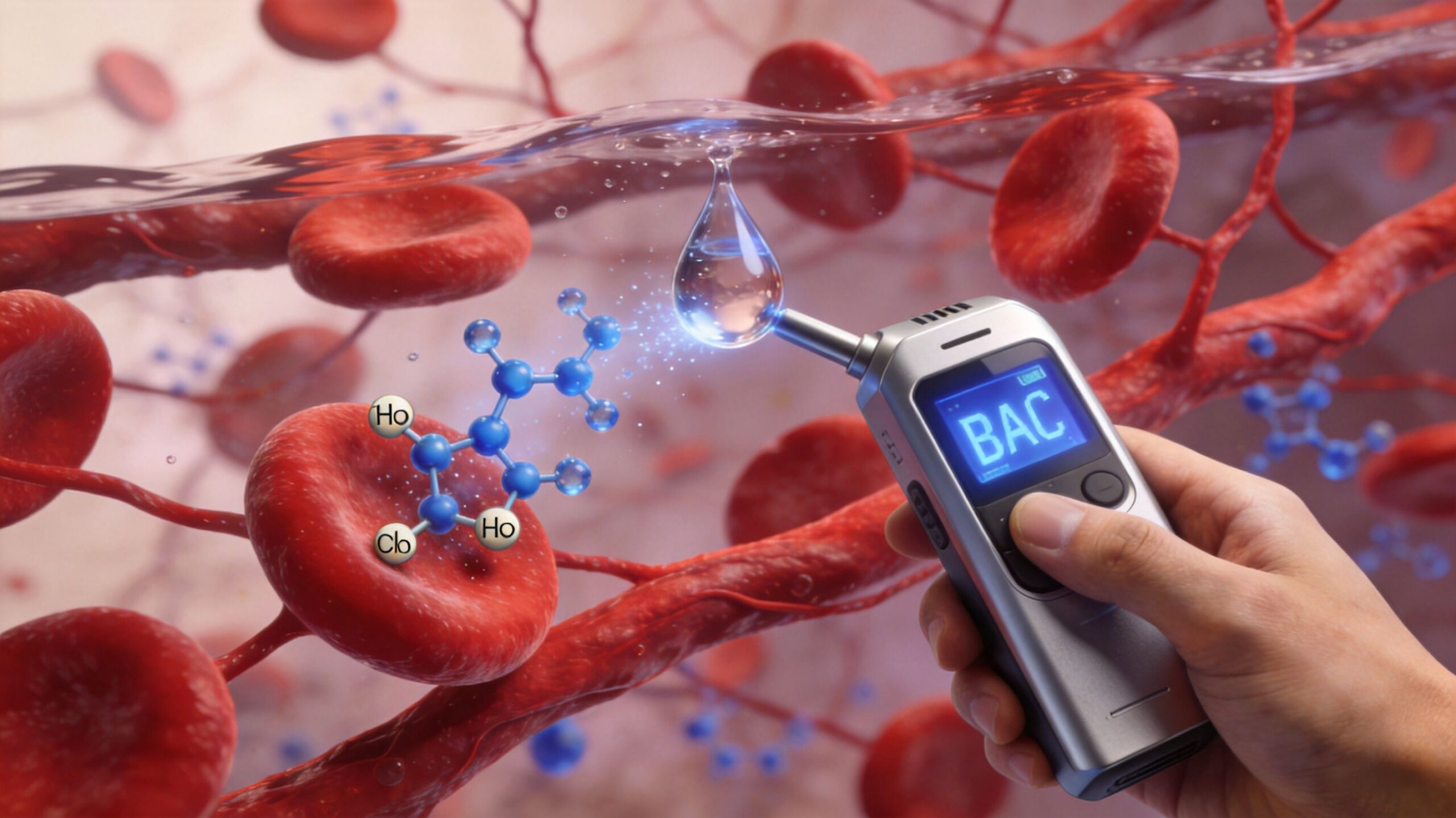
BAC is the number everyone talks about
BAC means blood alcohol concentration. In plain terms, it is the concentration of alcohol in your bloodstream. A breath test estimates that blood alcohol level by measuring alcohol vapor in deep lung breath.
That matters because the machine is not just smelling alcohol on your breath the way a person might. It is trying to estimate alcohol in your blood through what you exhale. If the sample is contaminated or the process is mishandled, the number can become far more open to challenge than people expect.
Your body goes through two different phases
After drinking, your body usually goes through an absorption phase and then an elimination phase.
During absorption, alcohol is still entering your bloodstream. Your BAC may still be rising even though you stopped drinking a while ago. During elimination, your body is gradually clearing the alcohol. That's why the same person can test differently at different points in the night or morning.
A helpful way to think about it is a sponge. When the sponge is still taking in water, the amount inside it is changing quickly. Once the water source stops, the sponge still takes time to dry out. Your body works the same way with alcohol, except the timing depends on many personal variables.
The machine can still detect alcohol longer than people think
A 2023 Medical News Today review on how long a breathalyzer can detect alcohol reports that average BAC declines about 0.015 to 0.02 percent per hour, but breath tests can still register alcohol for roughly 12 to 24 hours after the last drink. That's why people can fail a breath test the next morning even when they no longer feel impaired.
This is one of the biggest misunderstandings in Texas DWI cases. Feeling normal and testing clear are not the same thing.
Many clients are stunned to learn that a “morning after” result is possible. The law doesn't care whether you felt rested, ate breakfast, or thought the alcohol had worn off.
Why this creates real defense issues
The legal problem is that the machine captures a number at the testing time. The central question in court is often narrower: what was your condition when you were driving?
That difference becomes especially important in cases where the stop happened not long after the last drink, or where there was a long delay before the breath sample was taken. If you're trying to understand how long after drinking can you fail a breath test Texas, the better question is often this: what was happening in your body between the last drink, the stop, and the test?
For a closer look at why timing changes these cases, this discussion of how alcohol absorption rates affect DWI cases in Texas is worth reviewing.
Texas BAC Legal Limits and Alcohol Elimination Timelines
A common fact pattern looks like this. Someone stops drinking late, sleeps a few hours, drives to work, and gets stopped on the way. They feel fine. The machine may say otherwise.
That gap between feeling sober and testing under the legal limit drives a lot of Texas DWI cases. Prosecutors focus on the number printed by the breath machine. A defense lawyer looks harder at timing, because the legal issue is not just what the machine showed later, but what was happening in your body when you were driving.
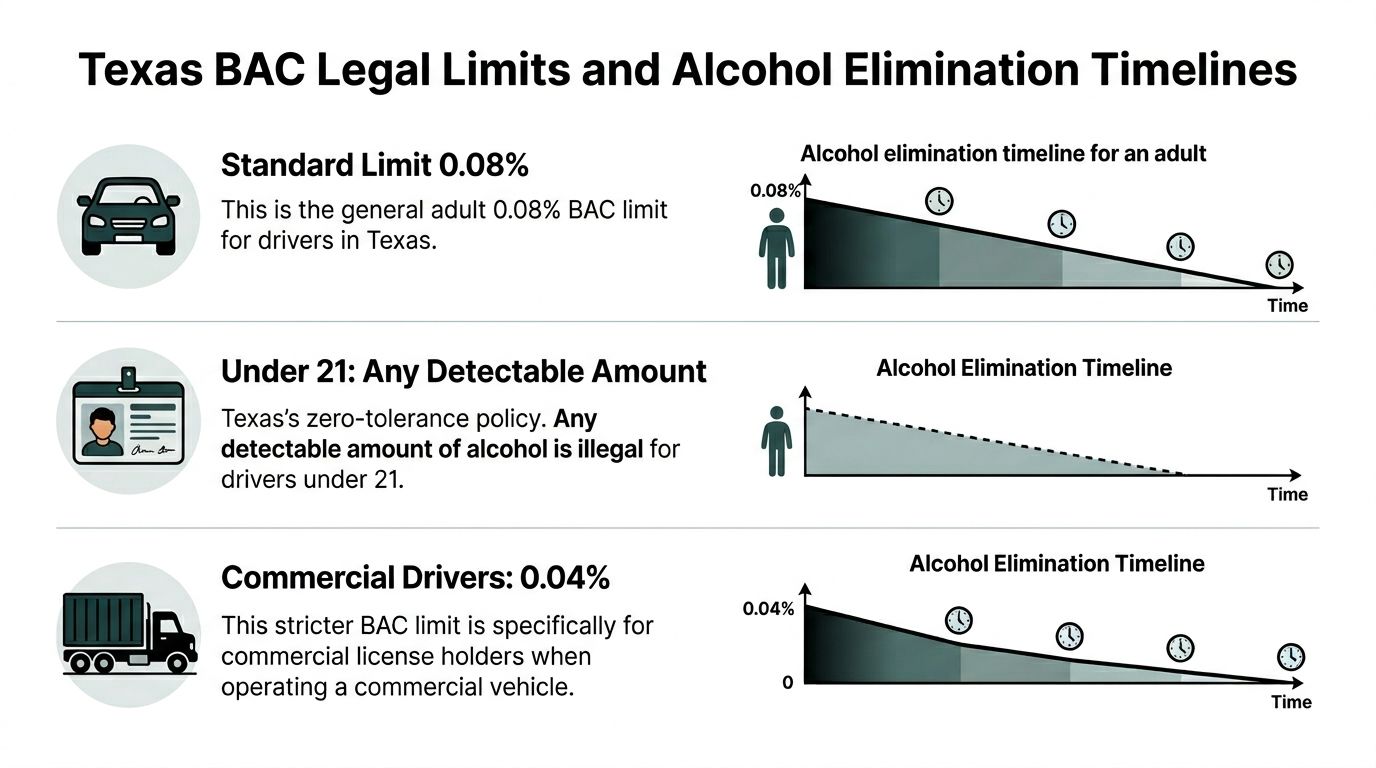
The basic Texas legal limits
Texas sets different alcohol limits depending on the driver and the vehicle involved.
| Driver Type | Legal BAC Limit | Notes |
|---|---|---|
| Adult standard driver | 0.08% | General Texas DWI benchmark |
| Commercial driver | 0.04% | Lower threshold applies when operating a commercial vehicle |
| Driver under 21 | Any detectable amount | Texas uses a zero-tolerance approach for underage alcohol-related driving matters |
Those limits matter, but they do not end the analysis. In Texas, the State can also pursue a DWI case by claiming you lost the normal use of your mental or physical faculties, even without a breath result at or above 0.08.
Elimination timelines create legal exposure long after the last drink
Alcohol does not leave the body quickly just because you ate, slept, showered, or had coffee. Elimination is gradual, and that is why next-morning arrests happen.
The practical problem is simple. A person may believe the alcohol is gone because the obvious signs have faded. The breath test only measures what is present when the sample is taken. If there was a delay after the stop, that number may not cleanly answer the actual courtroom question: what was your BAC, or your level of impairment, at the time of driving?
That time gap can cut both ways. If BAC was still rising, a later test may overstate what was present while the car was in motion. If BAC was falling, the State may argue the earlier level was even higher. Either way, the timeline becomes a contested issue, not a footnote.
Assumptions that get drivers in trouble
Clients often rely on rules of thumb that do not hold up in a DWI case:
- “I slept it off.” Sleep may reduce fatigue. It does not speed alcohol elimination in any reliable way.
- “I only drank the night before.” Morning breath results are still possible.
- “I was under the limit because I felt normal.” Feeling normal is not the legal test, and it is not how the machine works.
- “If I'm below 0.08, the case goes away.” Texas law allows the State to proceed under a loss-of-faculties theory.
For a practical companion read, see this guide on how long to wait to drive after drinking.
Why the timing issue matters in a defense case
From a defense standpoint, the most useful question is often not “How long does alcohol stay in your system?” It is “What happened between the last drink, the stop, and the breath test?”
That is where cases are won and lost. If officers waited before testing, if the stop came shortly after the last drink, or if the State cannot reliably connect the test result back to the driving time, there may be room to challenge how much weight that number deserves. A breath test is evidence. It is not the whole story.
Personal Factors That Make Every Breath Test Unique
People want a universal formula. There isn't one.
The common “one drink per hour” advice is far too simple for real DWI cases because bodies don't process alcohol the same way. Two people can drink the same amount, over the same evening, and still produce very different breath test results.
Why one-size-fits-all advice fails
A breath test captures a moment shaped by your biology, your drinking pattern, and what happened before the stop. That means broad internet rules often do more harm than good.
Several variables can affect how alcohol is absorbed and eliminated:
- Body weight and composition: A larger person may process alcohol differently than a smaller person, but that does not create a reliable safe timeline.
- Food intake: Drinking on an empty stomach can change absorption and push alcohol into the bloodstream faster.
- Metabolism and liver function: Some people eliminate alcohol more quickly than others, while others do so more slowly.
- Type and amount of alcohol consumed: Concentrated drinks, quick drinking, and late-night heavy intake can complicate any estimate.
- Health conditions and medications: Medical issues can affect both the body's processing and the way a breath result appears.
Mouth alcohol is not the same as true deep-lung alcohol
Another reason breath tests aren't as simple as they look is that contamination can happen. If alcohol remains in the mouth or upper digestive tract, the machine may not be measuring only the deep-lung sample it is supposed to measure.
This issue comes up with things like burping, reflux, regurgitation, and other events that can introduce alcohol into the mouth area close to testing time. That does not automatically invalidate a result, but it gives a defense attorney a very specific place to investigate.
The legal value of these differences
From a defense standpoint, these personal factors matter because they show why a single breath number should not be treated like perfect truth.
A prosecutor may want the case to sound straightforward. A skilled defense lawyer looks at the full picture instead:
- When did you finish drinking?
- Had you eaten recently?
- Were you still in an absorption phase?
- Did you have reflux, burping, or another contamination issue?
- How long was the gap between driving and testing?
A breath test is a snapshot. DWI defense is about the full timeline.
That's why experienced counsel does more than review the printout. The right defense looks at the stop video, the officer's report, the testing sequence, and the biological explanation that best fits your case.
The Texas DWI Stop Your Rights and the Rules Police Must Follow
A lot of clients tell me the same thing. The stop felt decided before they ever got out of the car.
That feeling is common, but it is not the law. A Texas DWI case is built step by step, and each step creates rules the officer has to follow and records your lawyer can examine later. The stop itself. The roadside investigation. The arrest. The breath or blood request. The paperwork that starts the license suspension case. Small mistakes in that sequence can matter more than people realize.
What implied consent means in Texas
Texas has an implied consent law. If you are lawfully arrested for DWI, the officer can request a breath or blood specimen. That does not give police a free pass to ignore procedure, and it does not erase your right to challenge the arrest, the request, or the testing process afterward.
The practical problem is that the license consequences begin on a different track from the criminal case. The ALR case, short for Administrative License Revocation, can move fast. A person can be fighting the DWI charge in court while also dealing with a license suspension issue that needed immediate attention.
Roadside tests are part of the officer's case, not the final word
Field sobriety tests are roadside coordination exercises used to build probable cause. They are influenced by lighting, traffic, fatigue, footwear, injuries, anxiety, uneven pavement, and the officer's instructions.
I tell clients not to assume the roadside portion proves the case. It often does not. Video can conflict with the report. Instructions may be unclear. Physical conditions may explain what the officer called clues of intoxication.
That matters because the legal gap in these cases often starts here. A person may feel steady enough to drive, speak politely, and still later give a breath sample the State claims was over the limit. The machine only captures one point in time. The officer still has to justify everything that happened before that number appeared.
The breath test procedure has to be done correctly
Breath testing in Texas is supposed to follow a controlled process. If the observation period was sloppy, if the operator missed events that could affect the sample, or if the machine had maintenance issues, the result becomes harder to trust.
That is one reason lawyers examine the testing record closely, including breathalyzer calibration errors in Texas DWI defense. The State may present the result as clean science. In practice, the defense looks at whether the sample was collected properly, whether the machine was working properly, and whether the reported number really matches your condition at the time of driving.
A breath result is only as reliable as the procedure behind it.
Refusing and taking the test both carry risk
Refusing a breath test can trigger a separate license suspension case. Taking the test can give the prosecution a number it will try to center the whole case around.
Neither choice guarantees a result. What matters after an arrest is protecting the record early. The officer's basis for the stop, the timing of the arrest, the warnings given, the video, the test records, and the deadlines in the ALR case all need attention quickly. In close cases, the time gap between driving and testing can be one of the most useful defense issues because feeling sober and being machine-clear are not the same thing under Texas law.
A short overview can help you understand how these stops are built in practice:
What happens after the arrest
Several things usually start at once.
Booking and bond
You may be taken to jail, photographed, fingerprinted, and released on bond with conditions you must follow.The ALR deadline begins
The license case does not wait for the criminal court to catch up. Missing that deadline can cost you options.The criminal case opens
Reports are written, videos are preserved or lost, and the State starts building its version of events. Early defense work matters because this is the stage where the stop, the testing procedure, and the timing issues can be examined before the file hardens into a prosecution narrative.
For anyone trying to fight DWI Texas, this is the point where the case should become organized and strategic.
How a Houston DWI Lawyer Can Fight Your Breath Test Results
A client blows over the limit at the station, then tells me, "I did not feel drunk when I was driving." That gap matters more than people realize. Texas does not convict based on how sober you felt. It tries to convict based on whether the State can prove intoxication at the time of driving, often with a machine result taken later under controlled conditions that may not reflect what was happening on the road.
That difference between feeling sober and testing over the limit is where many strong defenses begin. A breath number is evidence. It is not the whole case.
Observation problems and mouth alcohol issues
One of the first things I examine is the period before the test. The officer or breath test operator is supposed to watch for anything that could affect the sample, such as burping, vomiting, chewing gum, or putting anything in the mouth. If that observation was sloppy, interrupted, or not documented well, the reading becomes easier to challenge.
This matters most in close cases. A small amount of residual mouth alcohol can make a borderline result look stronger than it really is.
The defense point is practical. If the State wants the jury to trust the machine, the State has to show the test was done the right way from start to finish.
The real fight is often the time gap
Breath tests are usually taken well after the stop. Sometimes well after driving. That delay creates one of the best defense angles in a Texas DWI case because the legal question is not, "What did the machine say at the jail?" The question is whether the State can connect that later number back to the time you were operating the vehicle.
Prosecutors often try to do that through retrograde or retroactive extrapolation. In plain terms, they ask an expert to work backward from the later result. That sounds neat in a report. In court, it often depends on assumptions about when you stopped drinking, whether alcohol was still being absorbed, what you ate, your body chemistry, and how much time passed before testing.
If those assumptions are weak, the opinion is weak. I have seen cases where the timeline helped the defense more than the State because a later breath result did not cleanly answer what the BAC was at the earlier driving time.
Machine records can change the case
Breath machines have maintenance histories, software data, operator records, and quality control documents. Those records often tell a more useful story than the printed ticket handed to the driver.
A careful defense review looks at questions like these:
- Was the machine working properly on the test date?
- Was it checked and maintained according to protocol?
- Did the operator follow each required step?
- Do the records show unusual errors, inconsistent readings, or other warning signs?
- Was there anything in the sequence of testing that raises doubt about contamination or sample quality?
In some cases, the strongest argument is not that the machine failed completely. It is that the State cannot prove this specific test was reliable enough to deserve much weight. A close review of breathalyzer calibration errors in Texas DWI defense shows why those records are worth demanding early.
The breath test is only one part of the defense
A good defense does not get tunnel vision. Even if the breath result comes in, other parts of the case may still be vulnerable.
Depending on the facts, a lawyer may challenge:
- The basis for the stop, if police lacked a valid legal reason to pull you over
- The arrest decision, if the officer moved from suspicion to arrest without enough reliable evidence
- Field sobriety testing, if the instructions were poor or your performance was affected by fatigue, injury, age, footwear, anxiety, or road conditions
- The timeline in the reports, if body camera video, dispatch logs, and test records do not match
- The State's theory of intoxication, if the prosecution tries to treat a later machine result as automatic proof of guilt at an earlier time
That is the larger strategy. Break the State's confidence in the number, then force the prosecutor to prove the rest of the case with evidence that also has to hold up. In many Houston DWI cases, that is where the defense starts to gain ground.
Your Immediate Next Steps After a Texas DWI Arrest
The first days after a DWI arrest matter more than is often understood. Waiting usually helps the State, not you.
If you want to protect your license, your job, and your defense options, take these steps quickly.
Step one is the most urgent
Request or have counsel request your ALR hearing immediately. Texas drivers generally have 15 days from the arrest date to act if they want to challenge the license suspension. If that deadline passes, the suspension can move forward automatically.
This is why people dealing with a DWI license suspension issue should not sit on the paperwork and hope the court date will cover everything. It won't. The ALR process is separate.
What to do in the first few days
Use this checklist:
- Read every document carefully: Look for the arrest date, any temporary driving permit, bond conditions, and court information.
- Write down your timeline: Record when you started drinking, when you stopped, what you ate, when you were stopped, and anything that happened before the breath test.
- Preserve evidence: Save receipts, rideshare records, text messages, photos, and names of anyone who saw you before the stop.
- Avoid discussing the case casually: Don't post about it online and don't try to explain it away to people who may later become witnesses.
- Speak with a qualified DWI defense attorney fast: Early legal review often shapes the case before mistakes become permanent.
What the process usually looks like
After release on bond, your case generally moves on two tracks.
The first is the license case through the ALR system. The second is the criminal DWI prosecution in court. Your lawyer may request evidence, evaluate the stop, review video, analyze the breath procedure, and start identifying suppression issues early.
That early stage is also when lawyers often spot whether a case may be suitable for a reduction, a dismissal fight, pretrial motions, or a trial-centered defense. In some cases, later relief options may also matter, including record-clearing possibilities such as expunctions, depending on the outcome.
The first smart move after arrest is not guessing what will happen. It's getting the file, protecting the license, and preserving the evidence before it disappears.
You Are Not Defeated Take Control with a Strategic Defense
A failed breath test can feel final. It isn't.
Texas DWI cases are built on timing, procedure, science, and proof. That means they can also be challenged on timing, procedure, science, and proof. The machine doesn't decide your future. The State still has to prove its case, and your defense can expose weak links the arrest report won't mention.
If you're asking how long after drinking can you fail a breath test Texas, the actual answer is that there is no safe guesswork formula. What protects you now is not internet math. It's a strategic review of the stop, the testing process, and the legal timeline.
Whether this is a first DWI in Texas, a case tied to a commercial license, or a more serious repeat charge, you still have options. The right defense can protect your license, challenge the breath result, and put you in a far stronger position than you may think today.
If you were arrested for DWI and need clear answers fast, the Law Office of Bryan Fagan, PLLC offers free consultations to review your case, explain your options, and help you act before critical deadlines affect your license and defense. A Texas DWI case moves quickly, but you don't have to handle it alone.