
A DWI arrest can be overwhelming, but you don’t have to face it alone.
If you’re reading this after getting out of jail, posting bond, or seeing a breath or blood result that looks bad on paper, take a breath. A DWI charge is not the same thing as a conviction. In many Texas cases, the most important issue isn’t just what your test showed. It’s when that test happened, how your body was processing alcohol, and whether the State can connect a later number to the moment you were driving.
That’s where people get blindsided. They assume BAC is a fixed number, like a speed reading. It isn’t. It changes over time. If you had a drink near the end of the evening, your BAC may still have been rising when the officer stopped you. That matters. It can change how a breath result should be interpreted, how a toxicologist analyzes your case, and how your lawyer challenges the prosecution’s theory.
This is the practical side of how alcohol absorption rates affect DWI cases Texas. It is more than science for its own sake; it is a defense tool. Used correctly, it can challenge the reliability of a breath test, weaken retrograde extrapolation, and create reasonable doubt about whether you were intoxicated while driving.
A DWI Arrest Is Overwhelming But You Are Not Alone
The first day after a DWI arrest usually feels chaotic. You’re trying to figure out your court date, whether your license is in danger, what happens to your job, and whether one test result just decided your future. It didn’t.
Texas DWI cases often look stronger at arrest than they do after a careful review. Officers make assumptions. Machines produce numbers without context. Prosecutors often present a breath or blood result as if it settles everything. It doesn’t, especially when timing is a real issue.
Why timing matters right away
If you drank shortly before driving, your BAC may have been climbing during the stop, the roadside investigation, the ride to jail, and the test itself. That means the number collected later may not reflect your BAC while you were operating the vehicle.
That’s not a loophole. It’s basic biology.
Practical rule: In a DWI case, the timeline is evidence. The time of your last drink, the stop, the arrest, and the chemical test all matter.
A smart defense starts by locking down those details early. Receipts, text messages, surveillance video, ride history, witness names, and even when you ate can become useful. If you wait too long, that information disappears.
What a new client should focus on first
You don’t need to master toxicology tonight. You do need to protect yourself.
- Write down the timeline: Include when you started drinking, what you drank, when you finished, when you ate, when you were stopped, and when testing happened.
- Preserve anything that shows timing: Bar receipts, restaurant bills, event check-ins, and texts can support a rising BAC defense.
- Stay off social media: Don’t explain, joke, or argue about the arrest online.
- Talk to a Houston DWI lawyer early: The defense gets stronger when the facts are gathered before they vanish.
A seasoned Texas DUI attorney looks at a DWI case differently than the general public. We don’t just ask what the machine said. We ask whether the machine tested you during absorption, whether the stop was lawful, whether the officer overstated your symptoms, and whether the State can prove intoxication at the legally relevant time.
That’s how you start to fight DWI Texas cases the right way.
The Science of Your BAC Absorption and Elimination Explained
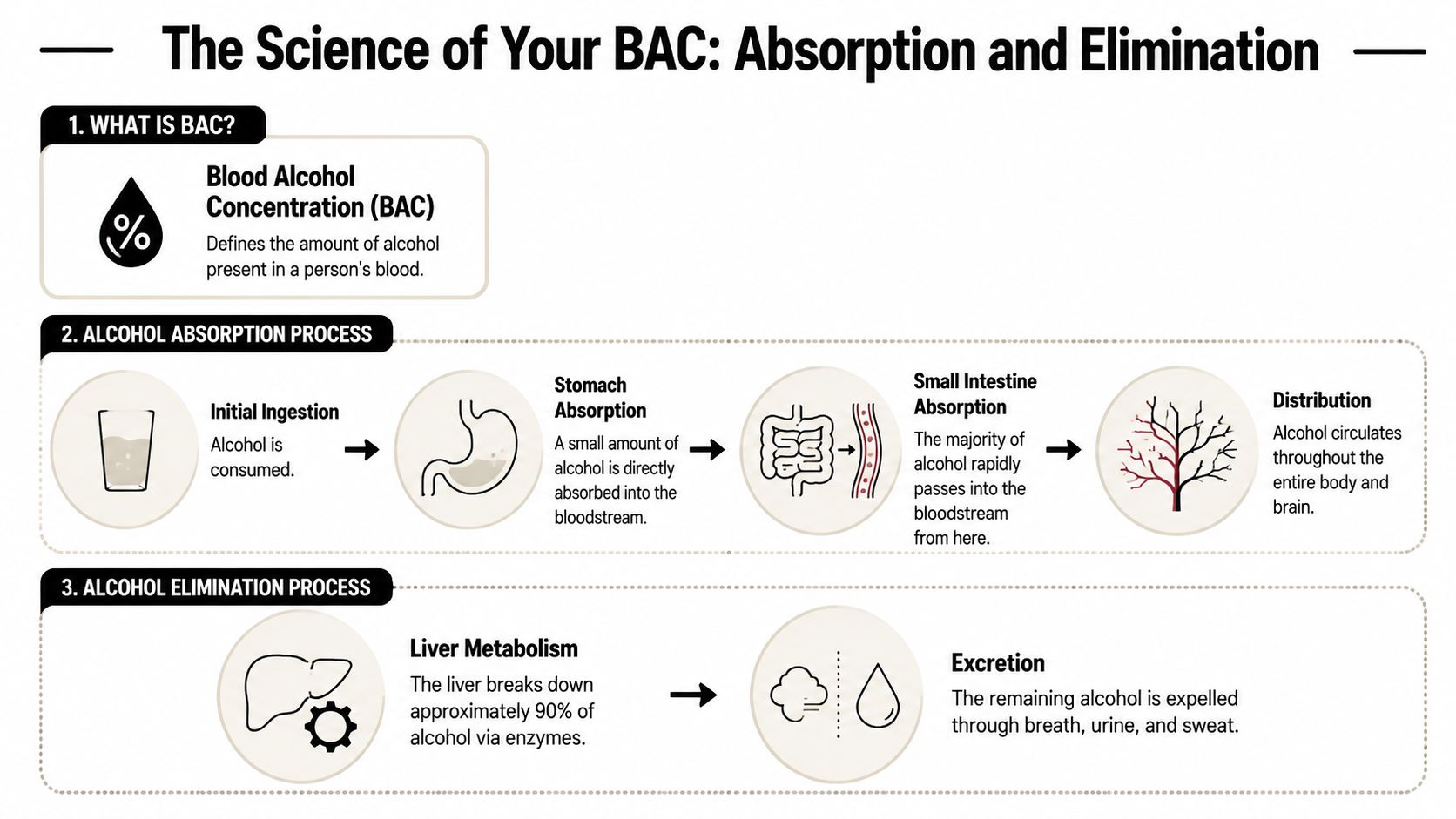
BAC means blood alcohol concentration. It refers to the amount of alcohol present in your blood. In a DWI case, BAC becomes central because the State often uses a breath or blood test to argue you were intoxicated.
But alcohol doesn’t enter and leave your system all at once. Your body goes through stages. If you understand those stages, you understand why a later test result can be misleading.
BAC rises before it falls
Think of your body like a sponge under a slow stream of water. At first, the sponge is soaking up liquid. It hasn’t reached its fullest point yet. Only later, after the stream stops and enough time passes, does the sponge stop gaining water and start losing it.
Alcohol works in a similar way. After you drink, your body absorbs alcohol through the stomach and small intestine. It then circulates through your bloodstream and brain. Only after absorption and distribution does your body move fully into elimination.
According to this discussion of the rising blood alcohol defense in Texas DWI cases, peak BAC can occur anywhere from 30 minutes to 2 hours later, depending on the person and the circumstances.
The three phases that matter in court
Absorption phase
This is when your BAC is still going up. You may have stopped drinking, but the alcohol is still entering your bloodstream. If police test you during this phase, the result can be higher than your BAC was while you were driving.
This is the phase defense lawyers care about most in rising BAC cases.
Peak phase
This is the high point. Your body has absorbed the alcohol, and your BAC reaches its maximum level. Depending on the timing, a chemical test may catch you near this point even if you were lower earlier.
Elimination phase
This is when your liver is breaking alcohol down and your BAC is trending downward. In general terms, this is the phase prosecutors prefer when they try to estimate backward, because they want to argue the later test supports a higher BAC earlier.
BAC is not a snapshot of the entire night. It’s a reading taken at one point on a moving curve.
Why this science changes a DWI defense
The State often presents chemical testing as clean and simple. Real life isn’t clean and simple. If your test happened after a delay, the key question becomes whether you were still absorbing alcohol.
That’s why a strong DWI defense doesn’t stop at the printed result. It asks:
- When was your last drink consumed
- How long after driving were you tested
- Had you eaten
- Were you still in the absorption phase
- Does the officer’s timeline support the prosecution’s theory
Those questions can turn a case. They’re especially important in a first DWI in Texas, where people often assume they should just plead out because the result looks bad on paper.
Factors That Change Your Alcohol Absorption Rate
No two people absorb alcohol the same way. That’s one reason prosecutors oversimplify these cases. They want the court to treat BAC as if every body works on the same schedule. That’s not how human physiology works.
Alcohol absorption depends on what was happening in your body that night. It also depends on what happened around you. Food, pace of drinking, beverage type, body composition, medications, and stress can all affect the curve.
Why one BAC number doesn’t tell the whole story
If two people drink the same amount over the same evening, they can still be in different phases at the same time. One may already be near peak. The other may still be absorbing. That difference matters if both are tested later.
In court, this matters because the prosecution usually wants a straight-line story. They want the judge or jury to hear one number and stop thinking. Your defense has to force the harder question. What did that number mean at the relevant time?
How different factors influence your BAC
| Factor | Effect on Absorption Rate | Example |
|---|---|---|
| Food in your stomach | Food can slow absorption, especially if you ate before or while drinking | You drank during dinner and tested later, after alcohol had more time to enter your bloodstream |
| Speed of drinking | Drinking quickly can concentrate alcohol intake over a short period, affecting the rise in BAC | You finished drinks near closing time and drove soon after |
| Type of beverage | Different drinks may absorb differently depending on concentration and how fast they were consumed | Shots taken late in the evening may affect the timing curve differently than slower drinks with a meal |
| Body weight and composition | Body size and composition can influence how alcohol distributes in the body | Two people with the same drink count may not have the same BAC pattern |
| Sex and metabolism | Individuals process alcohol differently | A later test may not reflect the same timeline for every driver |
| Medications or medical issues | Some conditions or substances can affect absorption or test interpretation | Prescription medication or digestive issues may complicate the timeline |
| Stress and adrenaline | A stressful stop or accident scene can complicate how symptoms appear to officers | An officer may confuse nervousness with intoxication signs |
Facts your lawyer should collect early
A useful alcohol absorption defense is built from specifics, not guesses. Start gathering the details that can help reconstruct your BAC curve.
- Meal timing: When did you last eat, and was it a full meal or just a snack?
- Drink sequence: What did you drink first, what did you drink last, and how close was the last drink to driving?
- Physical condition: Were you tired, sick, anxious, or taking medication?
- Witness support: Who saw you eating, drinking, paying the bill, or leaving?
The prosecution likes simple stories. The science of absorption usually isn’t simple, and that helps the defense.
These details can also matter when challenging field observations. Red eyes, unsteady balance, slow responses, or nervous behavior don’t automatically prove intoxication. Fatigue, stress, footwear, medical issues, and the setting of the stop can all affect what the officer claims to have seen.
How Texas Law Defines and Tests for Intoxication
Texas doesn’t limit DWI cases to one theory. The State can try to prove intoxication in more than one way, and you need to understand both.
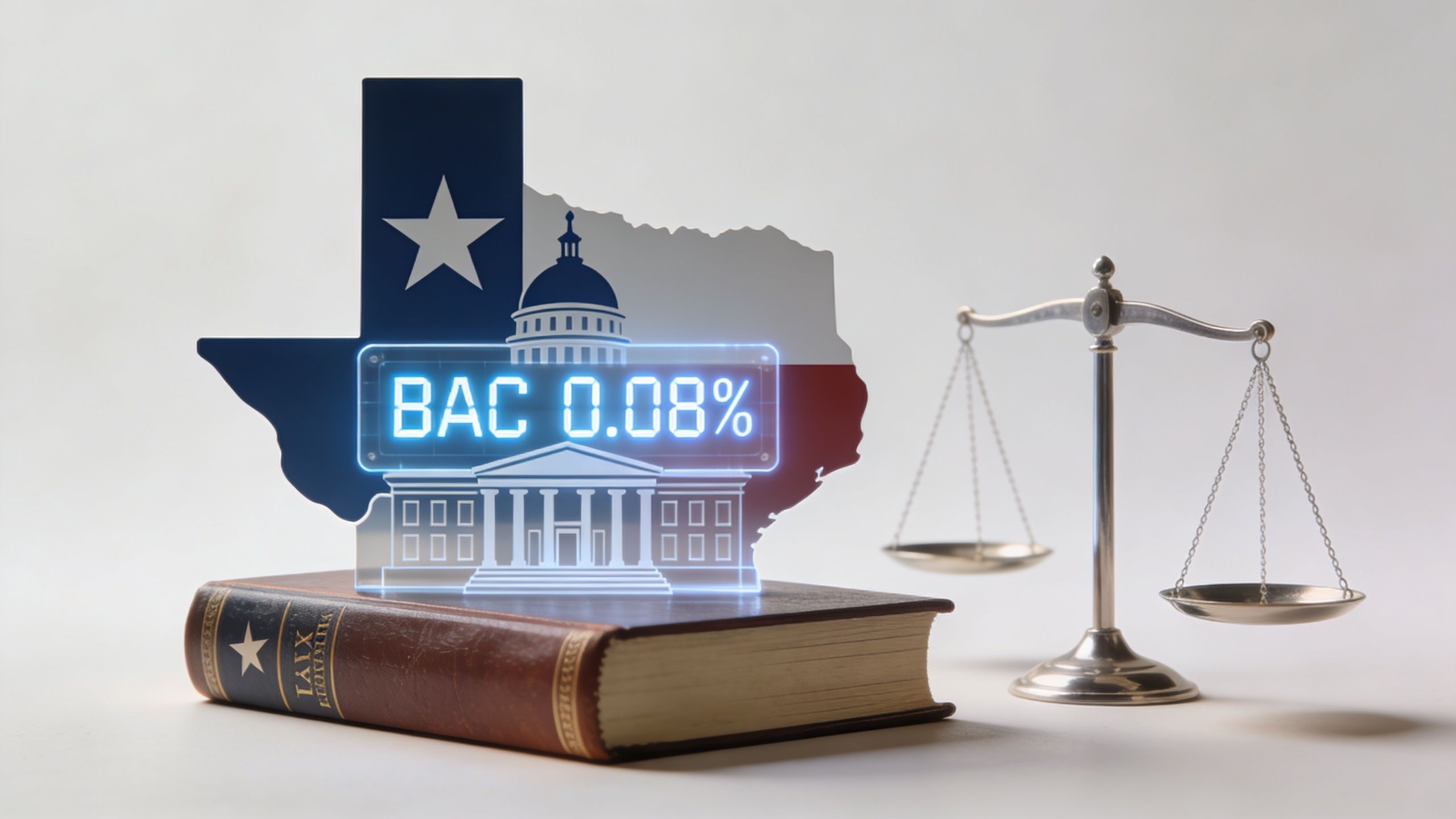
Under Texas law, intoxication generally means either a BAC of 0.08 percent or higher or the loss of the normal use of mental or physical faculties because of alcohol or drugs. If you want a fuller breakdown, review the legal definition of intoxication in Texas.
BAC and loss of faculties are different theories
That distinction matters. If your breath test is vulnerable, the prosecution may lean harder on the officer’s opinion that you didn’t have normal use of your mental or physical faculties. That usually means they’ll point to driving behavior, speech, balance, or field sobriety tests.
A strong defense attacks both theories when needed. It challenges the chemical result and also questions whether the officer drew conclusions too quickly from ordinary behavior, fatigue, stress, or roadside conditions.
Key terms you need to know
BAC
BAC stands for blood alcohol concentration. In a DWI case, it is the amount of alcohol in your blood as measured by a chemical test.
Field sobriety test
A field sobriety test is a set of roadside exercises officers use while investigating DWI. These tests are often presented as objective. They aren’t. They depend heavily on officer instructions, road conditions, lighting, footwear, medical issues, and the officer’s interpretation.
Implied consent
Implied consent means that by driving on Texas roads, you have agreed to provide a breath or blood specimen under certain circumstances after a DWI arrest. Refusing a requested specimen can trigger a separate license consequence through the administrative process, even apart from the criminal case.
Administrative license suspension
An administrative license suspension, often handled through the ALR process, is a license action by the Texas Department of Public Safety that can follow a failed or refused chemical test. It is separate from the criminal charge.
What happens after a DWI arrest
The arrest starts two tracks. One is the criminal case. The other is the license case.
Booking and bond
After arrest, you may be taken to jail, booked, and later released on bond. Bond conditions can include travel limits, alcohol restrictions, or testing requirements.ALR hearing issue
If your license is at risk, you may need to request an ALR hearing quickly to challenge the suspension and preserve your right to drive while the matter is pending.Evidence review
Your lawyer obtains reports, video, testing records, and other discovery to examine the stop, the arrest, and the test.Court settings and motions
The case can involve pretrial hearings, negotiations, motions to suppress, expert issues, and possibly trial.
Your DWI license suspension issue and your criminal charge are connected, but they are not the same fight.
Breath tests, blood tests, and your rights
Breath and blood tests are both used in Texas DWI cases, but they raise different legal and scientific issues. Breath tests often raise questions about timing, machine procedures, and whether the result reflects deep lung air in a meaningful way during active absorption. Blood tests can raise issues involving collection, storage, handling, and the chain of custody.
You also need to remember this. A DWI stop is still a constitutional event. The officer must have had a lawful reason to stop you, a lawful basis to continue the investigation, and enough evidence to justify arrest. If those steps break down, the State’s case can weaken fast.
The Rising BAC Defense and Retrograde Extrapolation
The rising BAC defense is one of the most misunderstood tools in a Texas DWI case. It isn’t magic. It’s targeted, fact-driven, and powerful when the timeline supports it.
The basic idea is straightforward. You may have been below the legal limit while driving, then over the limit when police tested you later. If that happened, the prosecution’s chemical evidence doesn’t tell the whole story.
What prosecutors try to do with retrograde extrapolation
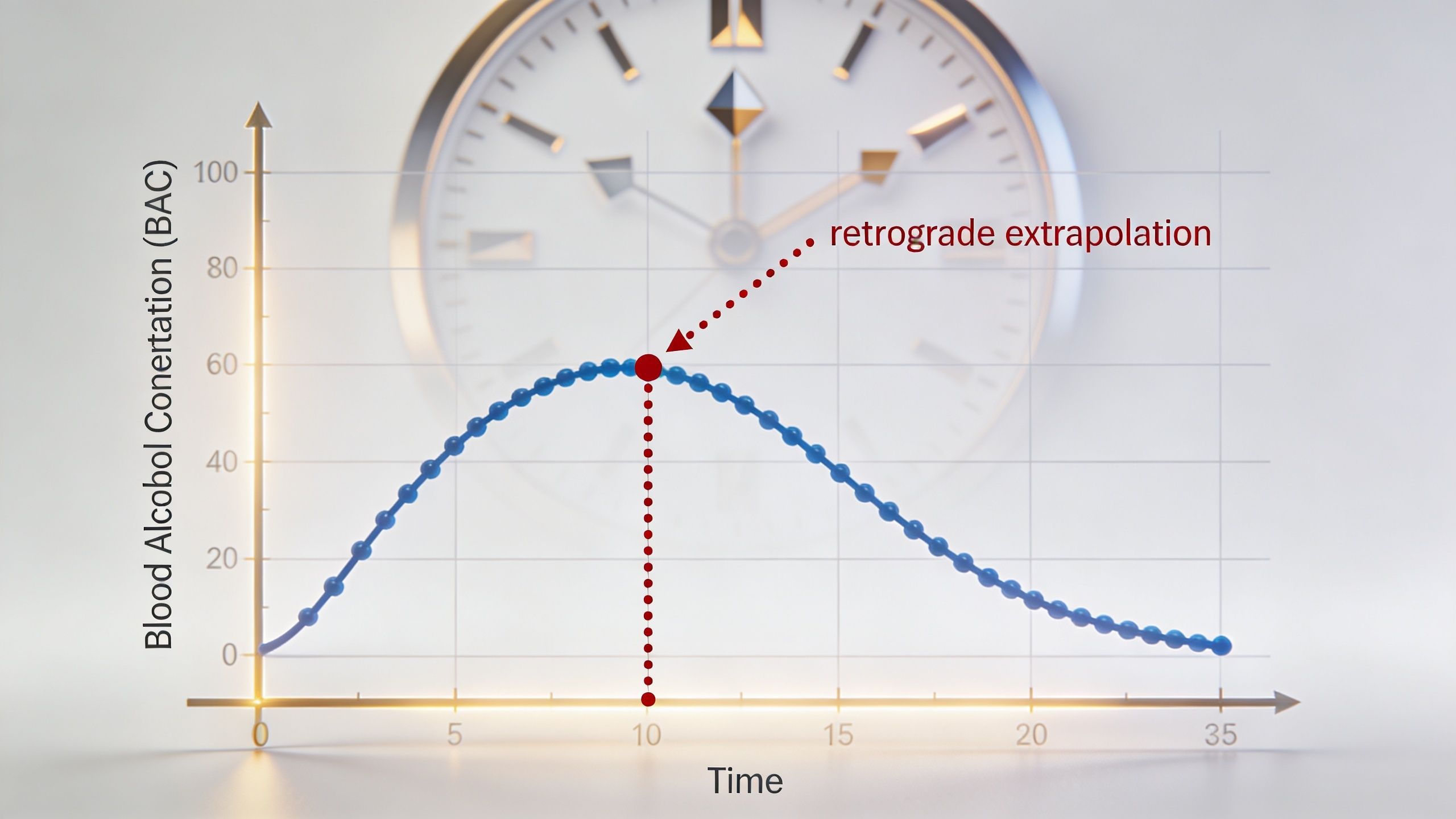
Retrograde extrapolation is the process of working backward from a later chemical test to estimate what your BAC was earlier, at the time of driving. Prosecutors use it because the test rarely happens the moment you were behind the wheel.
That sounds scientific, but it becomes shaky fast if key facts are missing. If the State doesn’t know exactly when you stopped drinking, what you consumed, whether you ate, and whether you were still absorbing alcohol, the backward estimate can become little more than an educated guess.
A real timeline that shows why this matters
According to this Texas discussion of the rising BAC defense, timing can change the entire case. One example involves a Dallas professional who left an event at 9:15 p.m., was stopped at 9:20 p.m., and gave a breath test at 10:05 p.m. that showed 0.09 percent. The point is simple. A driver can be under the legal limit while operating a vehicle but over the limit when tested later. The same source explains that this timing is vital because Texas Penal Code Section 49.01 defines intoxication based on BAC at the time of testing, creating a critical window for a rising BAC defense.
That example matters because it mirrors what happens in real arrests. The stop happens. The officer asks questions. Field sobriety tests take time. Transport takes time. Testing takes more time. A later number may reflect ongoing absorption, not the BAC at the moment of driving.
Why this defense works when the facts are there
A rising BAC defense gets traction when the timeline is tight and the drinking pattern supports ongoing absorption. Cases become stronger when there is evidence that the last drink was close to the time of driving.
Useful evidence can include:
- Receipts and tabs: They help show when drinks were ordered or closed out.
- Witness statements: Friends, servers, or event staff may confirm timing.
- Video footage: Restaurant, parking lot, or business cameras can help place your last drink in time.
- Officer timestamps: Dispatch logs, body cam, and breath room records often reveal delays.
Here’s a short explanation that may help before you watch the video below. The issue is not whether alcohol was in your system. The issue is whether the prosecution can prove your level at the legally important time.
Why prosecutors often resist this argument
They resist it because it complicates a simple narrative. A breath result over the legal limit is easy to present. A rising BAC analysis requires context, toxicology, and a careful look at the timeline.
A later test result is evidence. It is not the whole case.
That’s why your lawyer has to force the issue. If no one challenges the timing, the court may never hear the primary weakness in the State’s proof.
Challenging Breath and Blood Test Results in Court
You get pulled over after dinner, give a breath sample at the station much later, and the number comes back over the limit. The State will present that result like the case is over. It is not. In court, the core fight is whether that test can reliably prove intoxication at the time you were driving.
That distinction wins cases.
Prosecutors often downplay absorption-phase science because it disrupts their clean story. A later test number is simple. A rising BAC argument forces them to deal with timing, physiology, machine limits, and whether their expert can connect the test result back to the moment of driving. If your lawyer does not force that issue, the judge may hear a number without hearing its weaknesses.
Courts do not sort this out on their own. Defense counsel has to make the science impossible to ignore.
How a lawyer forces the court to confront the science
A good challenge is built step by step. It starts with the records, then turns into a legal attack on reliability and relevance.
- Pin down the exact timeline: Stop time, arrest time, the observation period, transport, and the actual test time all matter. A meaningful delay can make the reported number less persuasive on the issue that matters most, your alcohol level while driving.
- Expose what the officer does not know: Many officers cannot say when the last drink was finished, what food was consumed, or whether absorption was still underway. That gap matters because they are still asking the court to trust a later chemical result as proof of an earlier condition.
- Challenge the machine and its assumptions: Breath testing has built-in limits. A lawyer should examine maintenance records, operator compliance, and whether the test conditions make the result less reliable. This review often overlaps with broader breathalyzer accuracy issues in Texas DWI cases.
- Use the right expert at the right time: A toxicologist can explain why a test taken during active absorption may overstate the alcohol concentration that existed earlier.
- File focused pretrial motions: Focused pretrial motions often alter the course of cases. A motion in limine can stop the State from oversimplifying the test result in front of the jury. A Kelly challenge can force the prosecution to show that its scientific evidence is being applied reliably to the facts of your case, not just offered in the abstract.
Here is what that looks like in practice. The State wants the jury to hear, "He blew over the limit." Defense counsel files a pretrial motion and argues that the breath result, taken well after driving, has limited value without proof that the defendant had finished absorbing alcohol. At the hearing, the officer admits he never asked about the last drink or food intake. The State's witness cannot explain the defendant's BAC at the time of driving without assumptions not grounded in the evidence. Now the court has a real reliability problem in front of it. That does not guarantee dismissal, but it can limit the State's presentation, strengthen cross-examination, and shift plea negotiations in your favor.
Breath tests and blood tests create different courtroom fights
Breath tests are often the better target in absorption-phase cases because they can be more sensitive to testing conditions and may overstate alcohol concentration while absorption is still active. Blood tests avoid some breath-specific issues, but they do not fix the timing problem. If blood was drawn later, the prosecution still has to prove what your level was when you were driving, not just when the needle went in.
That is where many prosecutors overreach. They treat a later number as if it answers an earlier question. A disciplined defense does not let that slide.
The court needs a record that shows why the test may be less reliable or less relevant than the State claims. That record can include body cam, dispatch logs, room video, test slips, maintenance files, lab records, witness statements, and expert analysis. The Law Office of Bryan Fagan, PLLC handles those issues as part of a broader Texas DWI defense strategy, including chemical testing challenges, ALR consequences, and suppression issues.
Your Next Steps to Fight a DWI Charge in Texas
At 1:30 a.m., the arrest feels finished. It is not. The actual fight starts after the paperwork, and the first days matter because this is when your lawyer can build the timeline the State will try to ignore.
Prosecutors often brush off absorption-phase evidence for a simple reason. It complicates an otherwise clean story. They want the judge to focus on one number from one test taken later. Your defense has to force the case back to the fundamental issue: what your alcohol level was when you were driving, and whether the State can credibly prove it without guesswork.
Start doing the work that makes that argument possible.
Do these things first
Get defense counsel involved immediately
Early representation helps preserve body cam footage, dispatch records, room video, testing records, and witness accounts before they disappear. It also lets your lawyer shape the case around timing, not around the State's preferred summary of events.Protect your license right away
The ALR case runs on its own deadline. If you miss the chance to challenge a suspension, you lose a valuable hearing where your attorney may question the stop, the arrest, and the testing timeline under oath.Write out the entire night in detail
List when you started drinking, when each drink was finished, what you ate, when you left, when you were stopped, and when any breath or blood test happened. That timeline is not busywork. It can become the foundation of a rising BAC defense and a direct attack on any retrograde extrapolation theory.Save every record and identify every witness
Keep receipts, bank charges, rideshare logs, parking records, text messages, and event confirmations. Identify the people who saw you eat, drink, leave, and interact with police. Those details can pin down the absorption window better than the police report ever will.
County practice also matters. Outcomes vary sharply from one Texas county to another because judges, prosecutors, plea policies, and motion practice are not the same everywhere. A lawyer who knows the local court can do more than explain the science. That lawyer can present it in a way the judge will take seriously and can press the prosecution when it tries to dismiss the timing issue as a distraction.
That matters even more if this is your first DWI in Texas, if you have a CDL, or if a professional license is at risk. A generic defense wastes opportunities. You need a defense built around your timeline, the test timing, the county, and the weak assumptions in the State's proof.
Do not make decisions based only on the arrest report.
Police reports are accusation documents. They are written to justify the arrest, not to test whether the later BAC result can be tied reliably to the time of driving. Officers often leave out the very facts that matter most in absorption-phase cases, including the last drink, food intake, delayed testing, and gaps in observation.
Law Office of Bryan Fagan, PLLC can review the stop, explain your ALR deadlines, assess whether a rising BAC defense fits your facts, and start building the record needed to challenge the State's timeline in court.