
A DWI arrest can be overwhelming—but you don’t have to face it alone. It often starts with a simple question: How long should I wait to drive after drinking? You’ve probably heard the "one hour per drink" rule, but that's a dangerously simple guess. The only truly safe answer is to wait until your body has completely metabolized all the alcohol, a process that takes much longer than most people think and can't be rushed.
The Only Safe Answer When You're Behind the Wheel
Facing a DWI arrest in Texas can turn your world upside down. Understanding your rights is the first step toward protecting yourself, and the most critical fact to grasp is this: feeling sober and being legally sober are two completely different things. Your judgment and reaction time can be impaired long after the buzz wears off, putting you at risk for a DWI charge even when you feel perfectly fine to drive.
This infographic gives you a basic idea of how long it might take for a single, standard drink to clear your system. But remember, this is just the starting point.
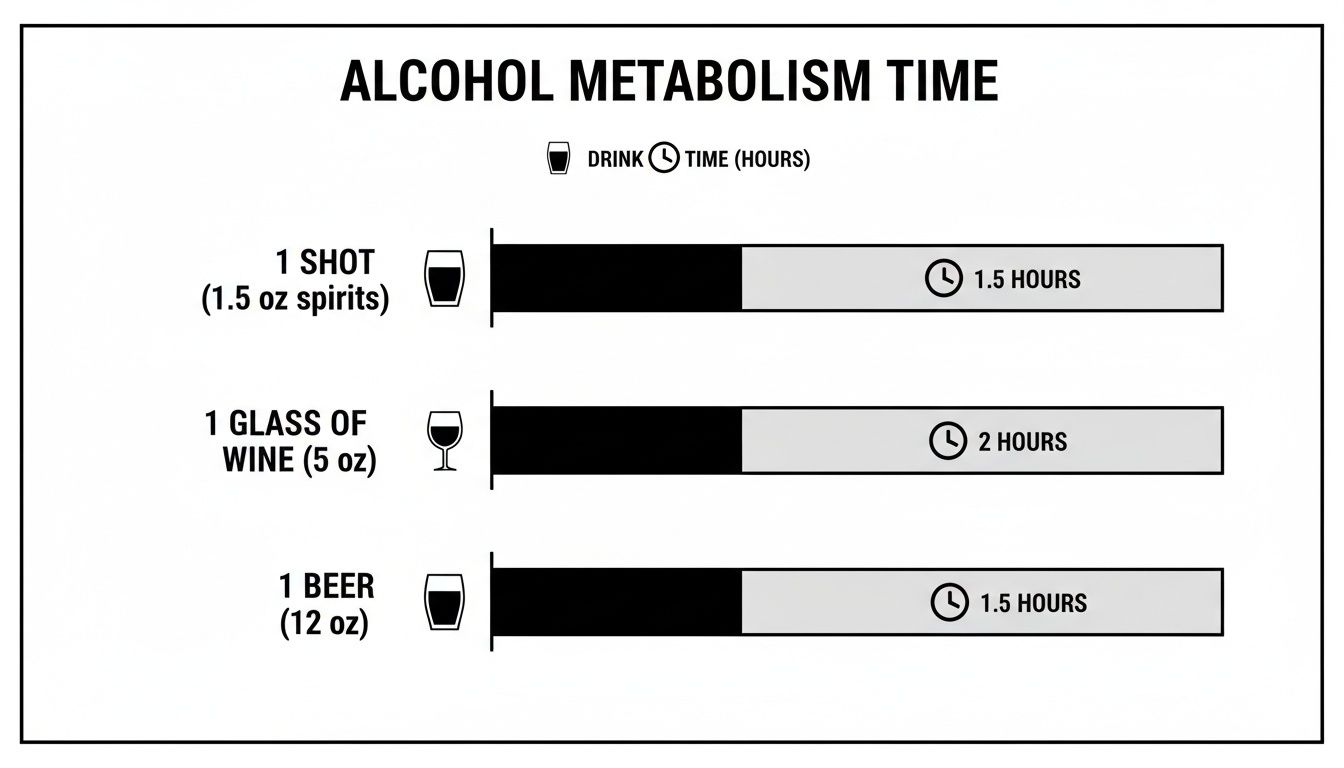
As you can see, every drink adds more time to the clock. That time stacks up quickly, and your body can only process it at a fixed rate.
Estimated Time to Metabolize Alcohol (Not a Legal Guide)
The only safe BAC for driving is 0.00%. This table shows rough estimates for a 150lb person to metabolize alcohol. Do not use this to decide if you are safe to drive.
| Number of Standard Drinks | Estimated Peak BAC | Estimated Hours to Reach 0.00% BAC |
|---|---|---|
| 1 Drink | 0.02% | ~1.5 Hours |
| 2 Drinks | 0.05% | ~3.5 Hours |
| 3 Drinks | 0.08% (Legally Intoxicated) | ~5.5 Hours |
| 4 Drinks | 0.10% | ~7 Hours |
| 5 Drinks | 0.13% | ~8.5 Hours |
| 6 Drinks | 0.15% (Enhanced Penalties) | ~10 Hours |
| 8 Drinks | 0.20% | ~13.5 Hours |
| 10 Drinks | 0.25% | ~17 Hours |
These are just estimates. Factors like your weight, gender, metabolism, and what you've eaten can all change how long it takes for your BAC to return to zero. The bottom line is that even after just a few drinks, it can take 6-12 hours or more for the alcohol to completely leave your system.
Why Guessing Is a Gamble
Relying on how you feel or trying to do "sober math" in your head is a gamble with devastating consequences. The stakes couldn't be higher. Impaired driving isn't just a legal issue; it's a major cause of preventable deaths.
According to the CDC's latest findings, drivers with a Blood Alcohol Concentration (BAC) of 0.08% or higher were responsible for 13,524 deaths in 2022. That accounted for 32% of all traffic fatalities in the United States.
A simple miscalculation doesn't just put you at risk of causing a tragic accident—it can lead directly to a DWI arrest. A conviction brings serious penalties, including steep fines, jail time, and a DWI license suspension.
Here’s the hard truth: your body metabolizes alcohol at a fixed rate, and there are no shortcuts. Coffee can't sober you up. A cold shower won't help. A big meal might slow absorption, but it won't lower your BAC any faster. The only thing that works is time.
This biological reality is at the very heart of how Texas laws regarding alcohol and driving are enforced. If you are facing DWI charges, a skilled Houston DWI lawyer can scrutinize every detail of your case—from the initial traffic stop to the chemical test results—to build the strongest defense possible.
Understanding How Your Body Processes Alcohol
When you’re trying to time your drive home after a few drinks, you’re up against your body’s internal clock—and it doesn’t work on your schedule. It’s critical to understand that your body gets sober by following a fixed, biological process that no amount of coffee, cold showers, or wishful thinking can speed up.
Think of your liver as a small factory with a single assembly line dedicated to processing alcohol. This line works at a steady, non-negotiable pace. As soon as alcohol hits your bloodstream, that factory starts working, but it can only handle one "unit" of alcohol at a time.
The Science of Sobering Up
The number that matters in any DWI case is your Blood Alcohol Concentration (BAC). This is a precise measurement of the percentage of alcohol in your blood. A BAC of 0.08% means you have 0.08 grams of alcohol for every 100 milliliters of blood.
Your liver eliminates alcohol from your system at a remarkably consistent rate: about 0.015% BAC per hour. This speed is the same for almost everyone, and you can't make it go any faster.
This is where dangerous myths take over. Many people believe they can sober up quickly by drinking black coffee, taking a cold shower, or eating a big meal after they've been drinking. These things do absolutely nothing to lower your BAC. They might make you feel more awake, but you are just as intoxicated and just as impaired.
The only thing that reduces your BAC is time. Period. Every drink you have is another item in the queue for your liver's assembly line, and all you can do is wait. This is also why knowing how long alcohol stays on your breath can be tricky; breathalyzers measure the alcohol that has already been absorbed into your blood and is now escaping through your lungs.
Texas Legal BAC Limits
In Texas, the law doesn't care how you feel. It cares about the numbers. The legal BAC limits are black and white, and they change based on who you are and what you’re driving. Knowing these limits is essential because they are the entire basis for a DWI charge.
There are three thresholds you absolutely must know:
- 0.08% BAC: This is the legal limit for drivers 21 and over operating a regular passenger vehicle. If your BAC is at or above this number, you are legally intoxicated.
- 0.04% BAC: For commercial drivers (trucks, buses, etc.), the limit is cut in half. A commercial driver can face a DWI at a BAC that would be perfectly legal for someone in a personal car.
- Any Detectable Amount: Texas has a Zero Tolerance policy for anyone under 21. If an underage driver has any measurable amount of alcohol in their system, they can be charged with Driving Under the Influence (DUI) of Alcohol by a Minor.
The devastating reality of these numbers is reflected in national statistics. In 2021 alone, 13,384 people were killed in alcohol-impaired driving crashes in the U.S.—that’s one death every 39 minutes. Even more shocking, 67% of those deaths happened in crashes where at least one driver had a BAC of 0.15 g/dL or higher, which is nearly double the legal limit. As you can see in the full NHTSA crash report, a person at that level of intoxication would need more than 10 hours to become completely sober.
This isn't just trivia; it’s the foundation of every DWI defense in Texas. A skilled DWI attorney understands the science behind BAC and, more importantly, knows how to scrutinize the way it was measured. From challenging how a breath test was administered to questioning the chain of custody for a blood sample, every detail matters. This is why relying on how you "feel" is the riskiest gamble you can take—your subjective sense of sobriety has zero standing against a chemical test result in court.
Personal Factors That Affect Your BAC Level

Ever wondered why your friend can have two beers and seem fine, while you have the same amount and feel dangerously close to the limit? The answer isn't tolerance—it's biology. There’s no magic formula for figuring out how long to wait to drive, because a whole host of personal factors dramatically alters how your body handles alcohol.
This is exactly why trying to "feel" out your sobriety is so unreliable. Guessing your Blood Alcohol Concentration (BAC) based on a friend’s condition or what you drank last weekend is a recipe for a DWI arrest. Understanding just how different we all are is the first step toward realizing the only truly safe bet is to not drive at all after drinking.
Your Body Weight and Composition
It’s not just about what you weigh; it’s about what your body is made of. Alcohol is water-soluble, which means it gets diluted by the water in your body. A heavier person usually has more water to spread the alcohol around, often leading to a lower BAC than a lighter person who drank the same amount.
But it gets more complicated than that. It's really about body composition.
- Muscle vs. Fat: Muscle tissue holds a lot more water than fat tissue does. A lean, muscular individual can typically process alcohol more efficiently than someone of the same weight with a higher percentage of body fat.
- The Impact: Since fat doesn’t absorb alcohol well, the alcohol stays concentrated in the bloodstream. This causes a person with more body fat to experience a faster and higher spike in their BAC.
Gender Differences in Alcohol Metabolism
Biological sex is one of the biggest variables influencing BAC. On average, women tend to reach a higher BAC more quickly and from fewer drinks than men, even when they weigh the same. This isn't about "tolerance;" it's about clear physiological differences.
Women generally have:
- Lower Body Water Content: With a lower percentage of body water, there's less H2O to dilute the alcohol. This leads directly to a higher concentration of alcohol in the blood.
- Less ADH Enzyme: Women also tend to have lower levels of alcohol dehydrogenase (ADH). This is the main enzyme in your stomach and liver responsible for breaking down alcohol. Less ADH means more pure, unprocessed alcohol gets a direct pass into the bloodstream.
These biological realities mean that if a man and a woman of the same weight drink the exact same amount, the woman's BAC will almost always be higher and stay elevated for longer. This is precisely why comparing your sobriety to anyone else is a critical mistake.
The Role of Food and Medications
What you eat—and when you eat it—can completely change how quickly alcohol hits your system. Drinking on an empty stomach is like opening the floodgates. The alcohol passes almost instantly from your stomach into the small intestine, where it’s rapidly absorbed into your bloodstream, causing a sharp, sudden spike in your BAC.
On the other hand, having food in your stomach acts like a buffer. A meal, especially one rich in proteins, fats, and carbs, slows down how fast your stomach empties. This delay gives your body more time to process the alcohol, leading to a much lower and more gradual peak BAC.
And don't forget about medications. Many common prescription and over-the-counter drugs can seriously interfere with your body's ability to metabolize alcohol, leading to unexpected impairment and a higher-than-normal BAC. You should always talk to your doctor or pharmacist about the risks of mixing alcohol with any medication. Don't assume you're safe just because you've done it before—a new prescription could change everything.
While a Houston DWI lawyer can look into these factors to see how they might have affected your arrest, the best strategy is always prevention.
What to Do During a DWI Stop in Texas

It’s a moment no driver wants: the sudden flash of red and blue lights in the rearview mirror. Your heart pounds, and a wave of anxiety hits. But what you do in these next few moments is absolutely critical—it can set the entire tone for what happens next and drastically shape the outcome of a potential DWI case.
The first rule is to stay calm. Pull over to a safe spot, turn off the engine, and turn on your interior lights so the officer can see inside. Roll your window down and place both hands clearly on the steering wheel. This isn't about admitting fault; it's about showing the officer you're cooperative and not a threat, which can help de-escalate the situation from the very start.
Your Right to Remain Silent
When an officer approaches your window, they're not just making small talk. Questions like, "Have you been drinking tonight?" or "Where are you coming from?" are designed to gather evidence. You have a constitutional right to remain silent, and this is the time to use it. You’re only legally required to provide your name, driver's license, and proof of insurance.
You can politely—but firmly—decline to answer questions that could incriminate you. A simple, respectful statement works best.
"Officer, I'll provide my license and insurance, but I am exercising my right to remain silent and will not be answering any questions."
This isn't an admission of guilt. It’s a smart, legal move that prevents you from accidentally saying something that could be twisted or used against you later.
Understanding Texas Field Sobriety Tests
Next, the officer will likely ask you to get out of your vehicle to perform Standardized Field Sobriety Tests (FSTs). These are the familiar roadside tests you’ve probably seen on TV—the walk-and-turn, the one-leg stand, and the HGN (eye-tracking) test.
Here’s the most important thing to know: these tests are optional in Texas. They are notoriously subjective, surprisingly difficult for anyone to perform perfectly (even when sober), and are often administered on uneven ground in the dark. In short, they are designed to be failed.
Politely refusing to perform these tests is almost always the best strategy. For a deeper look, you can learn about the questions and tasks involved in sobriety tests and see just how challenging they are.
The Truth About Implied Consent
This is where things get tricky. Texas operates under an "implied consent" law. This law means that by holding a Texas driver's license, you have already agreed to provide a breath or blood sample if you are lawfully arrested for DWI. Refusing this chemical test carries immediate and serious penalties.
If you refuse the chemical test after a lawful arrest, the state will automatically move to suspend your driver's license through a process called Administrative License Revocation (ALR).
- First Refusal: Triggers a 180-day license suspension.
- Second Refusal: Results in a 2-year license suspension.
This ALR suspension is a civil matter handled by the Texas Department of Public Safety (DPS), and it happens completely separately from your criminal DWI case. So even if your DWI charges are eventually dropped, you could still lose your license if you don't fight the ALR suspension.
So, should you refuse the test? It's a tough call with no easy answer. Submitting to the test gives the prosecution hard evidence—your BAC number—to use in court. Refusing denies them this crucial evidence but comes with the automatic license suspension.
An experienced Houston DWI lawyer can fight the ALR suspension, but you have a very short window: you must request a hearing within 15 days of your arrest. If you miss this deadline, your license is suspended automatically. A skilled attorney can use the ALR hearing as a powerful first move to question the officer under oath, find weaknesses in the state's case, and work to save your driving privileges. Your choices during the stop and immediately after lay the foundation for your entire defense.
Navigating the Texas DWI Legal System After an Arrest
From the moment the handcuffs click, your world can shrink to the back of a police car, a booking desk, and a jail cell. The flashing lights and the confusing questions can leave you feeling lost, disoriented, and completely unsure of what comes next. This is the moment when an experienced legal guide becomes your most important call, helping turn a chaotic experience into a series of clear, manageable steps.
The process kicks off the second you're taken into custody. You'll be "booked," which involves fingerprints, photos, and a mountain of paperwork. Shortly after, the question of bail or bond comes up—this is the process for getting released from jail while your case moves forward. Getting out quickly is a top priority, as it lets you get back to your family and job, and more importantly, it allows you to start building your defense.
While it feels like your life has slammed to a halt, the legal system just hit the accelerator. The clock is now ticking on some of the most critical deadlines you will face.
The Most Important 15 Days of Your Case
From the day of your arrest, you have precisely 15 days to request an Administrative License Revocation (ALR) hearing. This isn't part of your criminal case; it's a separate civil proceeding with the Texas Department of Public Safety (DPS). It is your one and only chance to prevent the state from automatically suspending your driver's license.
If you miss this deadline, you lose your right to a hearing, and a DWI license suspension is guaranteed. This is why calling a Houston DWI lawyer right after an arrest is so critical. We can file the request for you, preserving your ability to drive and using the hearing as a powerful first move in your defense.
The ALR hearing is often our first opportunity to question the arresting officer under oath. We can challenge the reason for the traffic stop, how the field sobriety tests were given, and whether there was probable cause for your arrest. This testimony can uncover key weaknesses in the state's case that become invaluable in your criminal trial.
A strong defense starts with immediate, decisive action. Don't let that 15-day window slam shut without a fight.
Texas DWI Penalties Explained: Misdemeanor vs. Felony
Not all DWI charges are the same in Texas. The seriousness of the charge—and the penalties you face—is based on the specifics of your arrest and your past record. Knowing the difference is the first step to understanding what you’re up against.
- First-Time DWI: Usually charged as a Class B Misdemeanor. This carries penalties of up to 180 days in jail, a fine of up to $2,000, and a license suspension.
- Felony DWI: A DWI gets elevated to a felony in several ways. This includes having two or more prior DWI convictions, driving with a child passenger under 15, or causing an accident that results in serious bodily injury (Intoxication Assault) or death (Intoxication Manslaughter).
Felony convictions bring life-altering consequences, including mandatory prison time and losing civil rights like the ability to own a firearm. The stakes couldn't be higher, which makes it essential to have a defense attorney who has deep experience with these serious and complex cases.
While progress has been made in reducing drunk driving fatalities since the 1980s, 12,429 people still lost their lives in alcohol-impaired crashes in 2023. At the legal limit of 0.08 g/dL, it takes the average person about 5-6 hours for their BAC to get back to zero. A deep dive into drunk driving statistics shows that many fatal accidents involve far higher BAC levels, which can take over 15 hours to clear from the body—a stark reminder of how long impairment can truly last.
How a DWI Attorney Fights for You
An arrest is not a conviction. The State of Texas has the burden to prove every single element of its case beyond a reasonable doubt. A skilled DWI attorney's job is to take that case apart, piece by piece, to protect your rights and your future. We dig into every shred of evidence to find the holes.
Here’s how we fight your DWI Texas case:
- Challenge the Traffic Stop: Did the officer even have a legal reason to pull you over? If the stop was invalid, any evidence gathered after that point—including the breath test—could be thrown out.
- Scrutinize the Sobriety Tests: We pick apart how the Field Sobriety Tests were conducted. Were the instructions confusing? Was the ground uneven? Did the officer account for your medical conditions or footwear?
- Investigate the Chemical Test: Whether you took a breath or blood test, we put it under a microscope. We review the breathalyzer's maintenance logs and calibration records. For blood tests, we challenge everything from the draw procedure to the lab's chain of custody.
Facing a DWI can feel like an isolating and frightening journey, but you don't have to walk it alone. From questioning the initial stop to defending you in the courtroom, we are here to guide you, fight for you, and work toward the best possible outcome for your case.
Your Pressing DWI Questions Answered
Getting arrested for a DWI sends your world into a tailspin. Suddenly, you're flooded with questions and uncertainty. The legal system feels like a maze, the stakes are incredibly high, and it's easy to feel lost and alone. We get it.
This section tackles the most urgent questions we hear from people just like you. Our goal is to cut through the confusion and give you the clear, straightforward answers you need to figure out your next steps.
Can I Get a DWI in Texas If My BAC Is Below 0.08 Percent?
Yes, you absolutely can. This is one of the biggest and most dangerous misconceptions about Texas DWI law. While a Blood Alcohol Concentration (BAC) of 0.08% is the legal limit that makes you per se—or automatically—intoxicated, it's not the only way the state can charge you.
Texas law has another definition of intoxication: not having the “normal use of your mental or physical faculties” due to alcohol or drugs. If an officer pulls you over and claims to see erratic driving, smell alcohol, hear you slurring your words, or watch you stumble during the stop, that's enough. They can arrest you for DWI based on their subjective opinion, even if a breath test later shows your BAC was only 0.06%.
This is why you need an experienced lawyer to fight DWI Texas charges. A sharp attorney knows how to challenge the officer’s subjective judgments and question whether their observations were even valid in the first place.
What Is an Administrative License Revocation (ALR)?
The Administrative License Revocation (ALR) is a civil penalty, handled by the Texas Department of Public Safety (DPS), that runs completely separate from your criminal DWI case. Its only purpose is to suspend your driver's license.
This process kicks in automatically if you refuse a chemical test (breath or blood) or if you provide a sample that registers a BAC of 0.08% or higher.
You have only 15 days from the date of your arrest to request an ALR hearing to fight this automatic suspension. If you miss that deadline, your license is suspended. No exceptions.
This hearing is often your lawyer's first chance to cross-examine the arresting officer under oath. It’s a critical opportunity to gather testimony and evidence that can be a game-changer for your criminal defense. An aggressive Houston DWI lawyer can represent you at the ALR hearing to protect your right to drive while building a stronger case for you.
How Does a DWI Affect My Commercial Driver's License (CDL)?
For a commercial driver, a DWI isn't just a legal problem—it's a potential career-ender. The rules are much, much stricter. The legal BAC limit is just 0.04% when you're operating a commercial vehicle.
Worse yet, a DWI conviction—even if it happens in your personal car on your day off—triggers a one-year disqualification of your CDL for a first DWI in Texas.
If you get a second DWI conviction at any point in your life, you face a lifetime ban from holding a CDL. With your entire livelihood on the line, you need an immediate and powerful legal defense from an attorney who understands the unique fight CDL holders are up against.
Should I Just Plead Guilty to a First-Time DWI?
Absolutely not. Walking into your first court date and pleading guilty without a fight is almost always a huge mistake. A DWI conviction is forever. It creates a criminal record that can haunt you for years, impacting your job prospects, professional licenses, and insurance rates. In most situations, you can't just get it removed later through an expunction or order of non-disclosure.
A skilled Texas DUI attorney never takes the state's evidence at face value. They dig into every detail of your case, looking for the weaknesses and errors that can turn the tide in your favor.
- Was the traffic stop even legal to begin with?
- Did the officer administer the field sobriety tests by the book?
- Were there mistakes made during the breath or blood testing process?
- Is the breathalyzer machine's maintenance and calibration history clean?
The goal is always to secure the best possible outcome, whether that means getting the charges dismissed completely, negotiating a reduction to a lesser offense like reckless driving, or finding a plea deal that minimizes the long-term damage. You owe it to your future to talk to an attorney before you make a decision that will follow you for the rest of your life.
A DWI charge is serious, but it doesn't have to ruin your future. At the Law Office of Bryan Fagan, PLLC, our team is here to stand up for your rights and guide you through the legal storm. We provide the strategic, assertive representation you need to protect what matters most.
Don't go through this alone. Request a free and confidential case evaluation with our experienced DWI defense attorneys today. Visit us at https://texasduilawfirm.com to get started.