
A DWI arrest can be overwhelming, but you don’t have to face it alone.
You may be sitting at home right now staring at paperwork from jail, replaying the stop in your head, and thinking one thing: the breath or blood result says you were over the limit, so the case must be over. That reaction is common. It’s also often wrong.
In Texas, the number from a chemical test is important, but it isn’t the whole case. A skilled Houston DWI lawyer or Texas DUI attorney looks at when you were driving, when the officer stopped you, when testing happened, what you had to drink, what you ate, and whether the State can prove intoxication at the legally relevant moment. That is where the rising BAC defense Texas how it works issue becomes so important.
A DWI Arrest Is Not a Conviction
A lot of people call a lawyer after hearing a test result like 0.09%, with the legal limit in Texas being 0.08% under Texas Penal Code Section 49.04, and assume they have no defense. But a reading above the limit at the station or hospital doesn’t automatically prove you were above the limit while driving. That distinction matters.
Take a simple example. A person leaves dinner, gets pulled over not long after the last drink, and doesn’t give a sample until later. The test may show alcohol in the body at a higher level than it was during the drive. If your body was still absorbing alcohol, your BAC may have been rising during that gap.
A DWI case turns on proof, not panic. The question is what the State can prove, not what the machine printed.
That’s why an arrest isn’t a conviction. It’s the start of two fights. One is the criminal case. The other may involve your license.
A few key terms help right away:
- BAC means blood alcohol concentration. It’s the measurement used in breath and blood testing.
- Field sobriety test means roadside exercises officers use to claim they observed impairment.
- Implied consent means Texas drivers are considered to have consented to breath or blood testing under certain circumstances after a lawful DWI arrest, though refusing can trigger separate consequences.
- Administrative license suspension refers to the separate process that can affect your driving privileges after an arrest or refusal.
For someone facing a first DWI in Texas, this can feel very personal. For a CDL holder, nurse, teacher, or licensed professional, it can also feel urgent. The good news is that a strategic defense can challenge the timeline, the science, and the State’s assumptions.
Understanding the Science of Alcohol Absorption
The rising BAC defense starts with a basic point. Alcohol doesn’t hit your bloodstream all at once. Your body absorbs it over time.
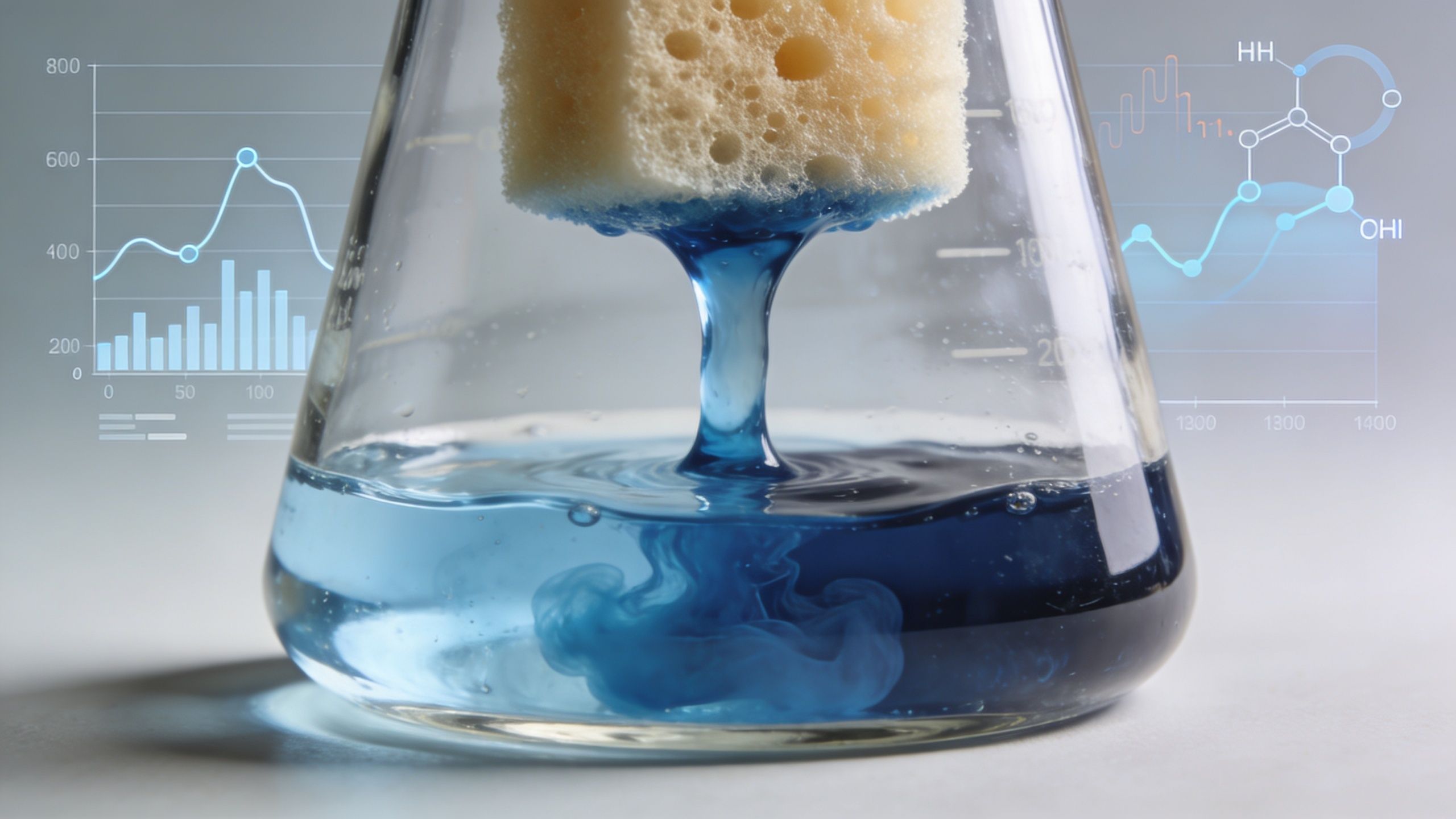
Alcohol absorption is a process
Think of your body like a sponge soaking up liquid. The drink goes in quickly. The full effect does not.
The verified data for this topic states that alcohol absorption can take approximately 30 minutes or longer depending on individual factors, and in a typical Texas DWI scenario, law enforcement may administer testing anywhere from 45 minutes to over one hour after the initial traffic stop. That creates a window where BAC can keep rising after you stop drinking, as described in this discussion of alcohol absorption timing in Texas DWI cases.
That delay is where people often get confused. They assume the test captures their BAC while they were driving. Often, it captures their BAC later.
The three phases that matter
A simple way to understand it is to break alcohol metabolism into three parts:
Absorption
Alcohol moves from your stomach and small intestine into your bloodstream. During this stage, BAC is going up.Peak
BAC reaches its high point. This doesn’t always happen right after the last drink.Elimination
Your body starts clearing alcohol, and BAC begins moving downward.
The rising BAC defense focuses on that first stage. If you were still in absorption during the stop and testing window, the later result may not match your BAC while you were behind the wheel.
Why two people can drink the same amount and test differently
BAC isn’t just about how many drinks someone had. Individual factors matter.
- Body size and composition can affect how alcohol is distributed.
- Food intake can slow absorption.
- The timing of your last drink can be critical.
- Personal metabolism can change the pace of absorption.
That’s why lawyers and toxicologists don’t look only at the final number. They study the timeline around it.
Practical rule: A chemical test is a snapshot. It is not always a replay of what your BAC was while driving.
A plain-language example helps. If someone finished a drink shortly before leaving a restaurant, got stopped on the way home, and tested later, the BAC at the test could be higher than the BAC during the drive. That doesn’t mean every case has a rising BAC defense. It means the science allows that possibility when the facts support it.
This is also why a confident defense doesn’t start with excuses. It starts with physiology, timing, and proof.
Why Timing Is Everything in Texas DWI Law
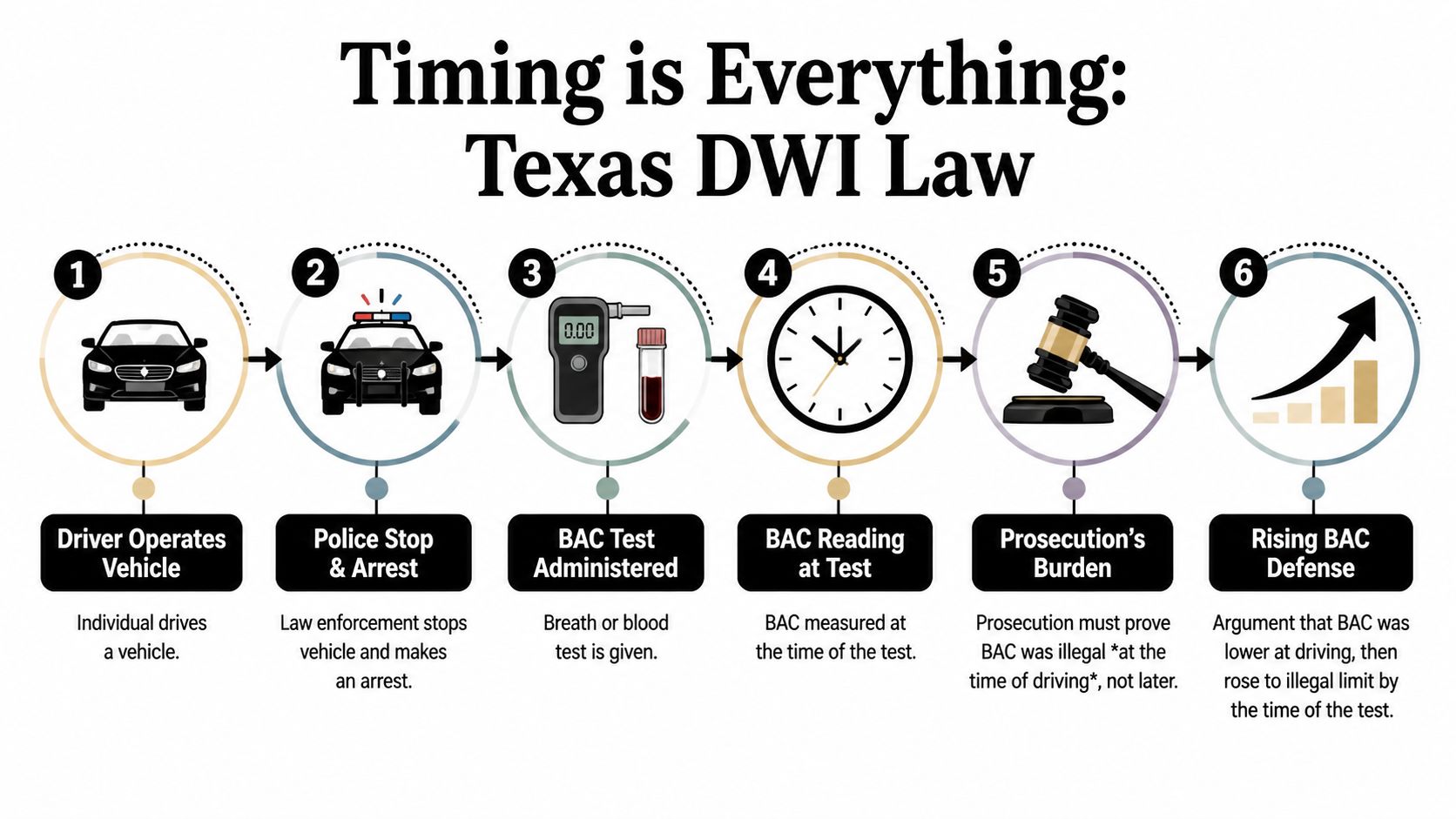
Texas law doesn’t require the State to prove you were intoxicated at some later point in the night. It must prove intoxication when you were operating the vehicle. That single legal point is what makes timing so powerful in a DWI case.
What prosecutors try to do
When the test happens later, prosecutors often try to work backward. That process is called retrograde extrapolation.
In simple terms, retrograde extrapolation is an attempt to estimate what your BAC was earlier based on a later breath or blood result. The problem is that this only works reliably when the expert has enough personal information to make the estimate scientifically sound.
If you want a practical overview of how alcohol timing can affect driving and testing issues, this guide on how long to wait to drive after drinking gives useful background.
What Mata v. State changed in Texas
The major Texas case here is Mata v. State. The verified data states that the Texas Court of Criminal Appeals held that retrograde extrapolation is only scientifically reliable when the expert knows specific personal factors such as the driver’s weight, last meal, and the exact time alcohol consumption stopped. Without that information, the calculation may be little more than guesswork, as explained in this summary of Mata v. State and rising BAC challenges.
That ruling matters because many DWI cases don’t include all of that detail. Officers may know when the stop happened and when the test happened, but they often don’t know enough about the person’s drinking pattern, food intake, or exact last-drink timing to support a reliable backward estimate.
That gives the defense a clear legal path. If the State’s expert lacks the necessary information, your lawyer can challenge the reliability of the opinion itself.
A simple timeline example
Here is the kind of timeline jurors can understand:
| Event | Time |
|---|---|
| Driver finishes last drink | shortly before driving |
| Driver operates vehicle | earlier point |
| Officer makes stop | after driving begins |
| Chemical test is given | later point |
| BAC reading appears over legal limit | at testing, not necessarily at driving |
The legal issue is not whether the BAC was over the line at the final box in the chart. The issue is whether the State can prove it was over the line at the driving box.
If your BAC was still rising, a later test may be accurate for that later moment and still fail to prove the earlier one.
Why delay helps create reasonable doubt
The longer the gap between driving and testing, the more room there is to challenge assumptions. But even shorter windows can matter when the drinking timeline supports active absorption. The heart of the defense is not delay by itself. It’s delay plus evidence that alcohol had not yet fully absorbed when you were driving.
A Houston DWI lawyer can shift the whole case narrative. Instead of treating the test result as the final word, the defense forces the State to prove the missing part of its timeline. In some cases, it can’t.
That is the core meaning of rising BAC defense Texas how it works. It isn’t a loophole. It’s a challenge to whether the prosecution can connect a later test result to the earlier moment that the law is concerned with.
How a Lawyer Builds Your Rising BAC Defense Step by Step
A rising BAC defense is built the same way a trial is won. One fact at a time, in the right order, with proof that holds up under cross-examination.

Here is the practical problem your lawyer is solving. The State has a test result from later in the evening. The jury still has to decide what your alcohol level was earlier, when you were driving. A careful defense focuses on that missing link. Texas courts also require expert opinions in this area to rest on a reliable foundation, which is why lawyers often examine whether the State can satisfy the standards discussed in cases such as Mata v. State.
Step one starts with a minute by minute timeline
The first job is reconstruction.
Your lawyer sits down with you and rebuilds the evening as precisely as possible, almost like putting together a receipt trail after a storm scattered the papers. The goal is not to create a story. The goal is to find timestamps that can be checked.
That usually includes:
- When you started drinking
- When you finished each drink
- When you ate, and how much
- When you left the location
- When the stop happened
- When the arrest happened
- When the breath or blood sample was taken
Small details matter here. A text sent from the parking lot, a tab closed at the bar, or a food order placed late in the evening can help anchor the timeline in a way jurors understand.
Step two looks for records that confirm your memory
Memory helps. Records persuade.
A lawyer building this defense tries to match your account against outside evidence, because a rising BAC argument becomes much stronger when the timeline does not depend on your word alone.
Useful records often include:
- Restaurant or bar receipts
- Bank or credit card timestamps
- Surveillance video
- Ride-share logs
- Phone location data or messages
- Statements from friends, staff, or family members
This is also where case preparation matters. A lawyer who knows how Texas DWI cases are built will look beyond the police report and gather the documents that support the science. This guide on what experienced DUI representation should cover in Texas gives a practical picture of that process.
Step three audits the State's timeline for weak spots
Police records often look neat on first review. A closer look can show gaps.
Your lawyer studies the arrest paperwork, video, dispatch logs, warrant records, and lab documents to answer a simple question. How much time passed between driving and testing, and what happened during that gap?
The review often focuses on:
- The exact stop time
- The transport time
- Any waiting period at the jail or hospital
- The exact sample time
- Whether a warrant delayed a blood draw
- Whether body cam and dash cam timestamps match the written report
This step matters because prosecutors often present the final number as if it answers the whole case. It does not. If the State cannot account for the time gap with reliable science and reliable assumptions, that gap can become reasonable doubt.
Step four brings in the science the right way
This defense usually needs more than common sense. It needs science that is tied to the actual facts of your case.
A forensic toxicologist may review your drinking pattern, food intake, body characteristics, and the testing timeline to decide whether alcohol absorption was still underway when you were driving. That expert can also evaluate whether the State's retrograde extrapolation rests on missing assumptions, such as not knowing when your last drink was or whether you had recently eaten.
That is where Mata v. State often becomes important in real courtroom practice. The issue is not whether an expert can use technical terms. The issue is whether the expert has enough reliable facts to work backward from a later test result to an earlier driving time.
Some defendants look for counsel that already handles both the criminal case and the license consequences, along with toxicology-centered preparation and record review. Law Office of Bryan Fagan, PLLC is one example of a firm name clients may encounter in that search.
A short overview can help visualize how defense preparation works in practice.
Step five turns that preparation into courtroom proof
By the time trial approaches, the lawyer is not just arguing a theory. The lawyer is presenting a sequence the judge and jury can follow.
That may include motions challenging the reliability of the State's expert, objections to opinions based on incomplete facts, and cross-examination designed to show how much guesswork sits inside the prosecution's timeline. If the expert does not know when you finished drinking, when absorption ended, or how food affected the process, those are not small omissions. They go to the heart of whether the opinion is dependable.
At trial, the defense often builds the argument in a clear order:
- Your drinking happened close enough to driving that absorption may still have been in progress
- The chemical test came later
- The State must connect that later number back to the earlier driving time
- Its witnesses may lack the facts needed to do that reliably
- The jury can reasonably doubt whether you were over the legal limit while driving
Jurors do not need a chemistry degree to understand this. They need a timeline, a reliable explanation, and a clear reason to question the State's shortcut from a later test result to an earlier moment on the road.
Challenging Breath Blood and Field Sobriety Test Evidence
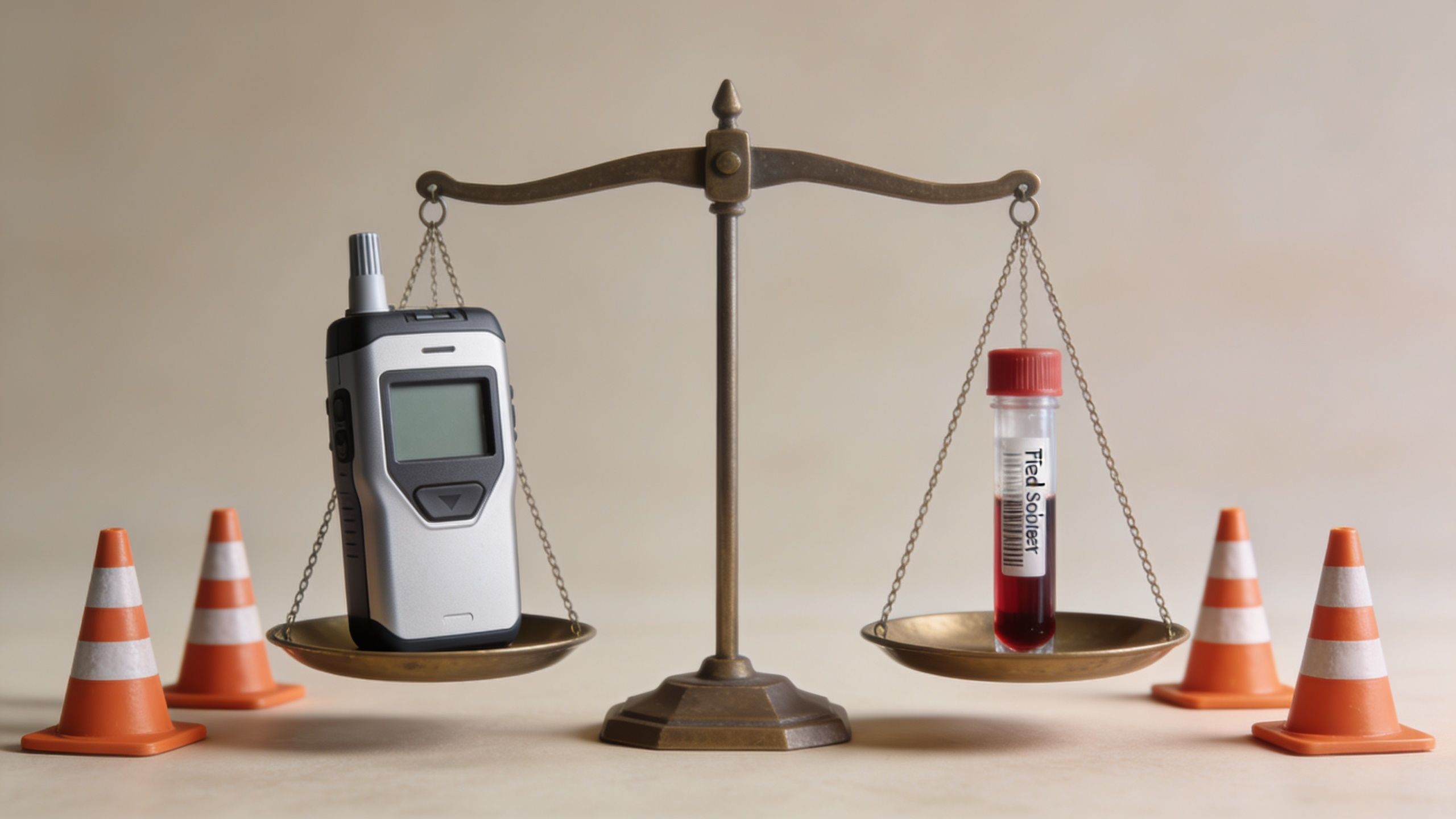
Not all test evidence works the same way. A breath test, a blood test, and roadside field sobriety evidence each raise different issues. A smart defense compares them side by side instead of treating them as one bundle.
Breath tests and their weak points
Breath tests are often central in a fight DWI Texas strategy because they are vulnerable to both timing and procedure challenges. They measure alcohol indirectly, and the defense often studies whether the officer followed proper protocol, whether the machine was maintained, and whether the reading fits the rest of the evidence.
A separate issue is that some medical conditions may affect breath testing. If the reading is only one piece of the puzzle and your conduct looked more sober than the number suggests, that conflict matters. Readers looking into machine-related issues may find this overview of the accuracy of breathalyzers helpful.
Blood tests and their weak points
Blood tests usually carry more weight with juries because they sound more scientific. That doesn’t make them untouchable.
Defense review may focus on:
- Chain of custody and who handled the sample
- Storage and transport conditions
- Collection procedures
- Whether the timing still supports a rising BAC theory
Even when a blood test is technically valid, the defense can still argue it reflects a later point in time and not the moment of driving.
Field sobriety tests can help the defense
Field sobriety tests often get overlooked by defendants because they assume those roadside exercises only hurt them. That’s not always true.
If the officer’s own report shows you followed instructions well, stood steadily, answered appropriately, and did not show strong physical signs of intoxication, that can clash with a later chemical result. The defense may argue that the more sensible explanation is rising BAC, not intoxication at the wheel.
Good performance on roadside tests doesn’t erase a chemical result. But it can make a later high reading look less connected to the earlier driving.
The verified data for this topic explains that the rising BAC defense attacks a core flaw in retrograde extrapolation. It assumes a constant decline in BAC. But if the last drink came just minutes before driving, BAC may have been actively rising during the stop and testing period, meaning the actual BAC while driving could have been below 0.08% even if a later test read 0.09% or more. It also notes alcohol absorption typically takes 30 minutes to reach peak concentration, as discussed in this explanation of retrograde extrapolation and rising BAC.
Comparison at a glance
| Evidence type | Common defense focus |
|---|---|
| Breath test | protocol, machine issues, timing, medical conditions |
| Blood test | chain of custody, handling, timing, sample integrity |
| Field sobriety test | whether officer observations match the later BAC result |
The strongest cases often use all three categories together. If the chemical result came later, the timeline supports absorption, and the roadside evidence was not dramatic, the defense story becomes much more persuasive.
Strengths Weaknesses and Common Prosecution Tactics
A rising BAC defense can be powerful, but it isn’t automatic. Some cases fit it well. Others require a more blended strategy.
When the defense tends to be stronger
This defense usually gains traction when the facts support a clean, believable timeline. That may include drinking close to departure, a meaningful gap before testing, and evidence that doesn’t show obvious impairment while driving.
It can also be stronger when the State relies too heavily on a single chemical number without enough personal data to support a reliable backward estimate.
When the defense gets harder
Some facts make the argument more difficult. If the BAC result is far above the legal limit, or the driving behavior and officer observations are severe, jurors may be less receptive to a timing-based explanation.
That doesn’t mean the defense disappears. It means your lawyer may need to combine it with other challenges, such as the stop itself, the testing process, or the officer’s interpretation of your behavior.
How prosecutors often respond
Prosecutors rarely accept a rising BAC theory without a fight. They may say the timeline is incomplete, that your drinking history is self-serving, or that your body processed alcohol in an atypical way.
The verified data also states that prosecutors may use medical conditions such as GERD or diabetes, or medications such as antacids, to argue that your alcohol absorption was unusual and that a standard rising BAC model doesn’t apply. It further notes that a thorough strategy can involve a board-certified toxicologist reviewing medical records ahead of time to anticipate those attacks, as discussed in this analysis of medical issues in rising BAC defenses.
That point surprises many clients. They assume medical history is private and unrelated. In reality, it can become a courtroom issue if the State argues it changes how your body absorbed alcohol.
Bring up your medical conditions and medications early with your lawyer. Silence helps the prosecution more than it helps you.
A realistic way to think about it
The best use of this defense is careful and honest. A credible lawyer won’t force a rising BAC theory onto facts that don’t support it. Instead, the lawyer asks whether the timing, science, and evidence line up well enough to create reasonable doubt.
That approach protects your credibility, which is often as important as any single piece of evidence.
Protect Your Rights and Your Future Starting Today
After a Texas DWI arrest, you’re dealing with more than one problem. There is the criminal case in court, and there may also be a separate fight over your license through an Administrative License Revocation, often called an ALR hearing.
You also need to know what happens next in practical terms. After arrest, many people face bond conditions, court settings, evidence requests, and deadlines that come quickly. If your license is at risk, the timing to respond can be short, and delay can cost you options.
If you’re worried about a DWI license suspension, a first DWI in Texas, or how to fight DWI Texas charges without making costly mistakes, focus on immediate action:
- Preserve your timeline by writing down when you drank, ate, left, and were stopped.
- Save records such as receipts, messages, and account activity.
- Avoid casual explanations to police or anyone else before getting legal advice.
- Ask about the ALR hearing quickly so your license defense doesn’t fall behind the criminal case.
- Get your medical information organized if you have conditions or medications that could affect testing arguments.
If your case involves a breath or blood number that seems hard to overcome, remember the central point of this article. A later BAC result is not always proof of BAC at the time of driving. That is why rising BAC defense Texas how it works matters so much. It gives your lawyer a structured way to challenge timing, science, and the State’s burden of proof.
You don’t need to solve this yourself. You need a plan.
If you’re facing a DWI charge and want clear answers about your options, contact Law Office of Bryan Fagan, PLLC for a free consultation or case evaluation. Our team can review the stop, the testing timeline, the ALR hearing issues, and whether a rising BAC defense may fit your case. You deserve a calm, strategic defense that protects your rights, your license, and your future.