
A DWI arrest can be overwhelming, but you don't have to face it alone.
If you're searching for HGN six clues what the officer is scoring in Texas, you're probably replaying a roadside stop in your head. You remember the flashlight or pen moving side to side. You remember trying to keep your head still. What you likely don't know is what the officer was marking down, and whether that eye test really proves what the State says it proves.
In Texas, the horizontal gaze nystagmus test, usually shortened to HGN, has real influence in a DWI investigation. But it isn't magic, and it isn't the same thing as a breath or blood test. The officer is looking for a set of specific eye movements, scoring them in a specific way, and then using that score as one part of a larger arrest decision. That score can also be challenged later, both in a DWI license suspension case and in criminal court.
What the Officer Is Doing When You See the Flashlight
You are on the shoulder of the road. Cars are passing. An officer holds up a pen or flashlight and tells you to keep your head still and follow the tip with your eyes.
At that point, the officer is not just "seeing if you look drunk." The officer is running a scored roadside test with a checklist learned in training. Each eye is observed for the same set of signs, and those observations can later show up in a police report, an ALR hearing, and a criminal DWI case.
What the officer is actually watching
The HGN test focuses on involuntary eye movement. As your eyes track a moving object, the officer is watching for jerking at specific stages of the movement.
A simple way to picture it is this. The officer is not grading effort, attitude, or whether you seem nervous. The officer is watching for whether your eyes move smoothly like windshield wipers on a clean windshield, or whether they jump and twitch at points the officer has been trained to mark as clues.
Those clues have names, and the names matter later. In court, the question is often not "Did the officer do an eye test?" It is "What clue did the officer claim to see, in which eye, at what point, and under what conditions?"
How the setup usually happens
The officer usually places the stimulus slightly in front of your face and tells you to follow it with your eyes only. Head still. Eyes only. That instruction matters because if you move your head, the officer may claim the test was affected, and if the officer gives poor instructions, the defense may argue the test was not administered correctly.
Then the officer moves the light or pen side to side and pauses at certain points. Those pauses are part of the scoring process. The officer is not supposed to wave the light around randomly. The movement is meant to follow a trained pattern so the officer can decide whether a clue is present in the left eye, the right eye, or both.
That is where roadside reality and courtroom reality start to separate. On the roadside, it can look quick and routine. In court, every part of the setup can matter: the angle, the speed, the pauses, the lighting, nearby flashing patrol lights, traffic passing in your peripheral vision, and whether the officer checked for anything that could affect the eyes before scoring clues.
Why drivers often feel lost during this test
Drivers are at a disadvantage here for a simple reason. You cannot watch your own eyes while the test is happening.
So the officer becomes the only person claiming to see the clues in real time. The officer may write those observations on a worksheet, describe them in a report, or testify about them later from memory. That testimony often sounds technical, which can make the score seem more certain than it really is.
Three practical problems come up again and again:
- You cannot independently verify the observation at the scene. You have to rely on what the officer says was visible.
- The score is built clue by clue while you stand there. What feels like a flashlight exercise is evidence collection.
- Small mistakes can change the value of the result. If the officer rushes, skips steps, or creates distracting conditions, the defense may challenge whether the scoring means much at all.
Why this moment matters
For many Texas DWI cases, this is one of the first moments where the officer starts turning observations into a number. Not a breath number or a blood number. A clue count.
That count can help the officer justify continuing the investigation, making an arrest, and later defending that arrest at an ALR hearing. It can also become a target for cross-examination. A Texas DWI defense lawyer will often start with the basics: what the officer used, where you were standing, what instructions were given, how the stimulus was moved, and what exactly was scored in each eye.
The flashlight matters because it is the beginning of the paper trail.
How the HGN Test Fits Into Texas DWI Stops
You are on the shoulder of a Texas road at night. The officer has already asked for your license and insurance, watched how you answered questions, and now raises a pen or small light in front of your face. To you, it can feel like a quick eye check. To the officer, it is one part of a larger DWI investigation that is being built piece by piece.
HGN fits into the stop as an observation test, not a chemical measurement. It sits alongside the walk-and-turn and the one-leg stand as one of the standardized field sobriety tests recognized in DWI investigations, as described in the Texas Department of Transportation overview of DWI laws.
That distinction matters because drivers often mix up two very different stages of a case. A roadside eye test is not the same thing as a breath test or a blood test. One asks the officer to observe and score what he believes he sees. The other is supposed to measure alcohol concentration through a specimen.
Here is the practical way to separate them:
- Field sobriety tests are roadside tasks or observations used to help an officer decide whether more investigation or an arrest is justified.
- HGN is the eye test within that group.
- BAC refers to alcohol concentration in blood or breath.
- Implied consent deals with breath or blood specimens after a lawful DWI arrest, not with roadside balancing or eye exercises.
- Administrative license suspension is the license case that can follow a refusal or failed specimen result, separate from the criminal prosecution.
In Texas, the HGN test often does two jobs at once. First, the officer uses it at the roadside to help decide whether to arrest. Second, the officer later uses the score to explain that arrest at an ALR hearing and in criminal court. That is the part many articles skip. The number of clues is not just a checklist. It becomes testimony.
A good way to view HGN is this: the officer is turning eye movement into a score, then turning that score into a story about impairment. If the scoring was done the way the training requires, the State will argue the test supports probable cause. If the scoring was rushed, done under poor conditions, or tied to bad instructions, the defense has room to challenge both the score and the conclusion built from it.
That is why this test keeps showing up later. Prosecutors use it to support the stop, the arrest, and the officer's judgment. Defense lawyers examine how the officer positioned the stimulus, how each eye was scored, whether medical or environmental factors were ruled out, and whether the officer is describing actual training or filling gaps after the fact.
If your case later raises questions about record cleanup, Clearing a Texas DWI: Expunction and Nondisclosure discusses whether and how a DWI can be removed or sealed from your record.
At the roadside, HGN can look simple. In a Texas case, its real role is larger. It is an officer-scored test that can help support an arrest, trigger a license fight, and become a technical point of attack in court.
The HGN Six Clues Explained One by One
You are on the shoulder of a Texas road at night. An officer raises a pen or small light, tells you to keep your head still, and starts watching your eyes. What looks simple from the driver's side is a scored test. The officer is trained to check three clues in the left eye and the same three clues in the right eye, for six total.
This graphic helps show the sequence.
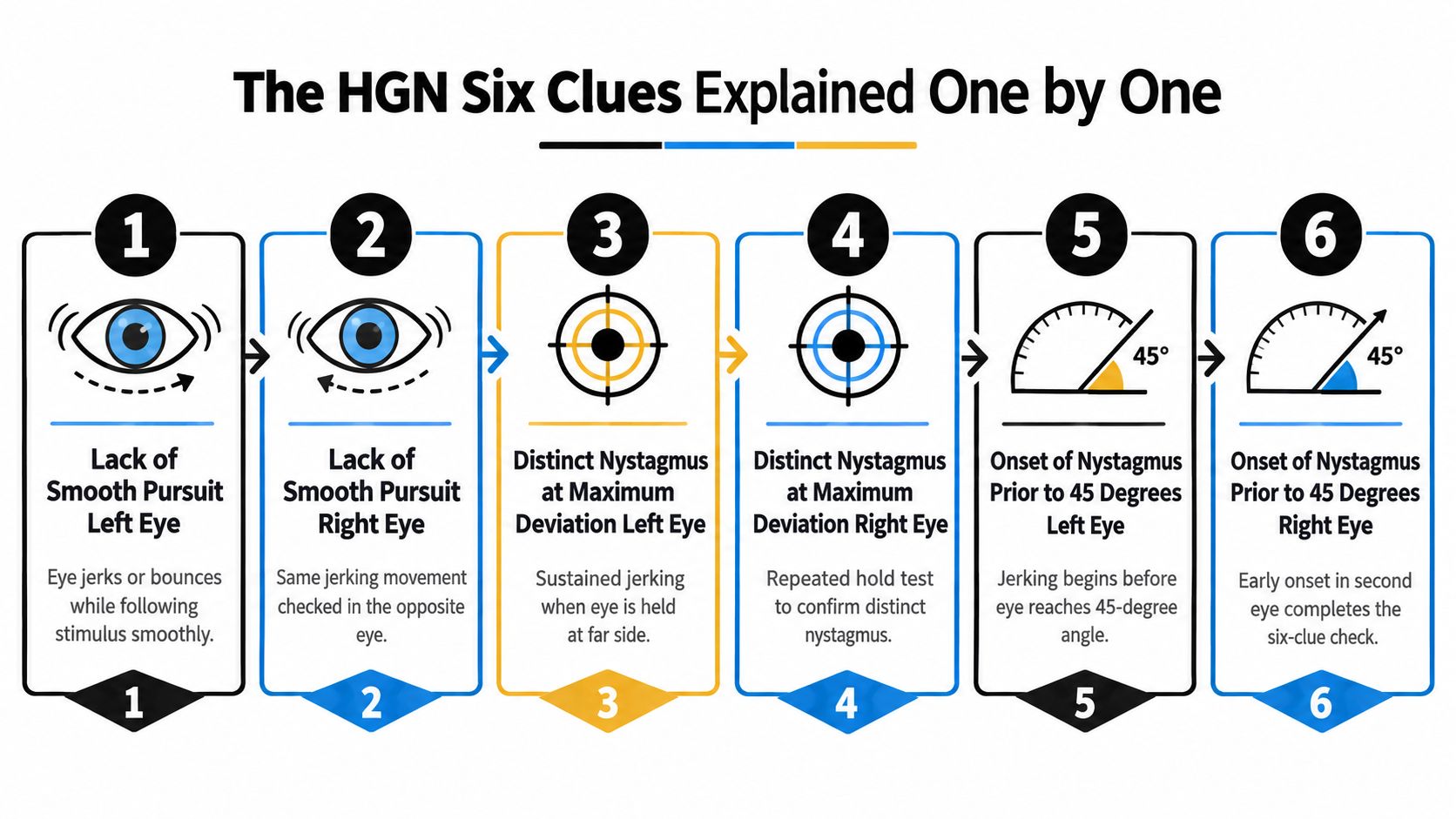
A helpful way to understand HGN is to treat it like a two-column scorecard. The officer is not grading your eyes as a pair. Each eye gets its own set of observations. Later, in an ALR hearing or a DWI case, that detail matters because the officer should be able to explain where each clue appeared, how it was observed, and how it was marked.
Clues one and two, lack of smooth pursuit
The first clue asks a basic question. Does each eye follow the stimulus in a smooth, steady way?
If the officer says there was a lack of smooth pursuit, the officer is saying the eye did not glide evenly. It appeared to jerk or bounce during tracking. Picture a shopping cart wheel that rolls with a wobble instead of a clean line. That is the kind of movement the officer claims to see.
These are scored separately:
| Clue | What the officer is scoring |
|---|---|
| Left eye smooth pursuit | Did the left eye track smoothly or show visible jerking? |
| Right eye smooth pursuit | Did the right eye do the same thing independently? |
That separate scoring is more than paperwork. In court, a defense lawyer often compares the report, the worksheet, and the bodycam to see whether the officer really made two distinct observations or wrote down one broad conclusion for both eyes.
Clues three and four, distinct and sustained nystagmus at maximum deviation
The next pair of clues happens when the officer moves the stimulus out toward the side and holds it there. At that far edge, the officer watches for distinct and sustained nystagmus at maximum deviation.
In plain English, the officer is saying the eye kept jerking while turned as far to the side as it could comfortably go. “Distinct” means noticeable. “Sustained” means it continued long enough to count as an actual clue rather than a brief flicker.
Again, each eye gets its own score. Left eye. Right eye.
This part often becomes a cross-examination point. The training method calls for holding the eye at that outer position long enough to observe whether the jerking is sustained. If the officer rushed through the pass, moved the stimulus too fast, or failed to hold the position long enough, the score becomes harder to defend later.
Clues five and six, onset of nystagmus prior to 45 degrees
The last two clues are usually the hardest to picture, and they are often the easiest to argue about.
Here the officer moves the stimulus outward and tries to decide whether the jerking begins before the eye reaches about a 45-degree angle. In other words, the officer is estimating when the movement starts. There is no roadside measuring tool. There is no protractor held up to your face. It is a visual judgment made in real time.
That does not mean the clue is meaningless. It does mean the officer should be able to explain how the estimate was made and whether the stimulus was positioned and moved the way training requires.
A simple walkthrough looks like this:
- Left eye onset. The officer watches for when jerking begins before the eye reaches the target angle.
- Right eye onset. The officer repeats the same process for the other eye.
- Separate scoring. Each eye is marked on its own before the clues are added later.
Here's a short video if you want to see how the eye test is commonly described in practice.
Why the six clues matter later
Drivers often hear a simple phrase like “four out of six” and assume the whole test is just a pass-fail box. That is not how these cases are litigated in Texas.
Each clue depends on a specific observation, in a specific eye, made in a specific part of the test. Then the officer turns those observations into a score. At an ALR hearing, that score is used to help justify the arrest and license suspension effort. In criminal court, the same score becomes testimony, and the defense gets to ask whether the officer followed the method closely enough for the result to mean much.
That is where HGN cases are often won or lost. Not in the phrase “six clues,” but in the details behind each mark on the sheet.
How Officers Turn Six Clues Into a Score in Texas
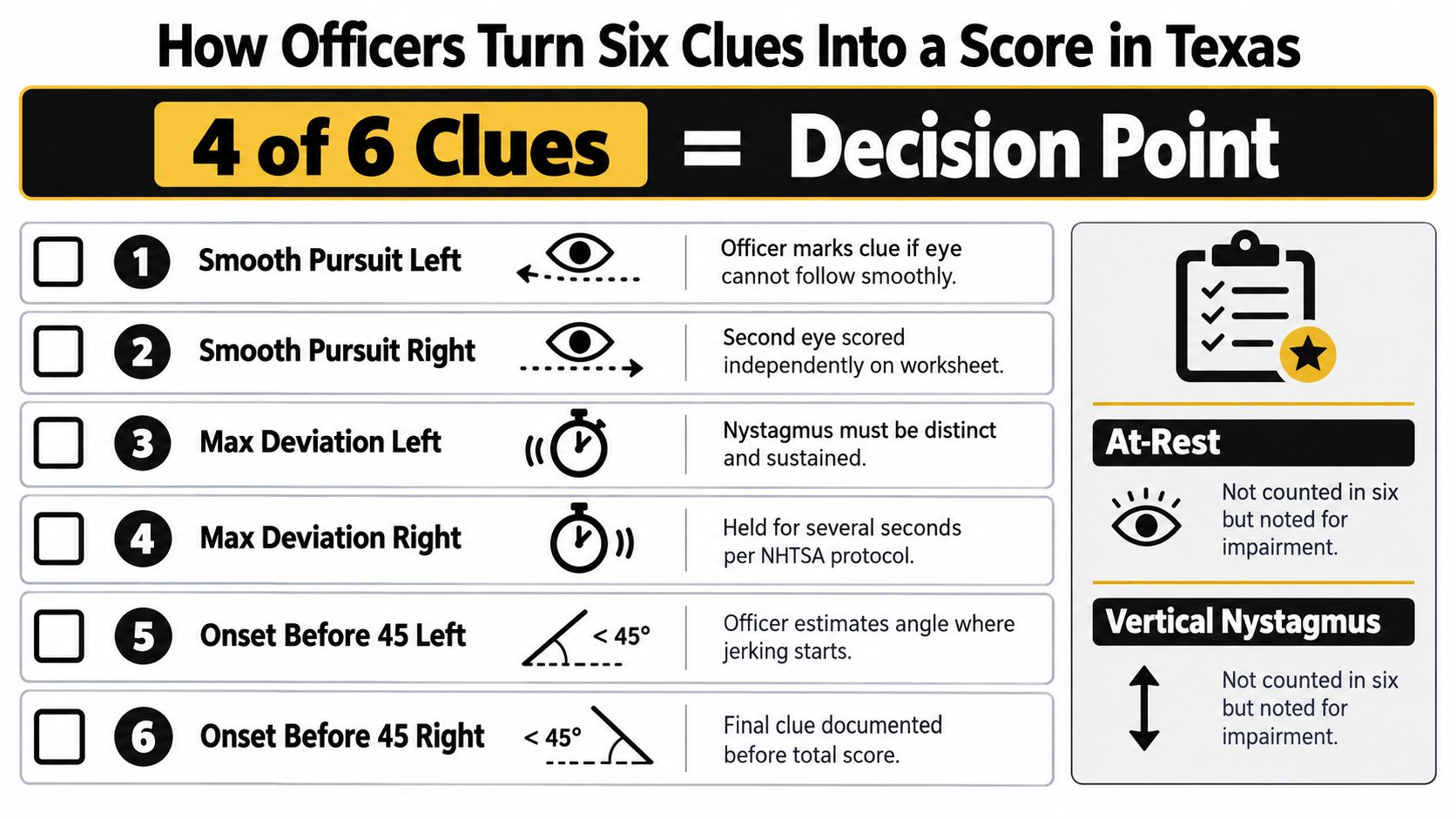
You are standing on the shoulder, the officer lowers the pen, and a simple label starts to form in the report: pass or fail. On paper, though, HGN scoring is more mechanical than that. The officer is adding up six possible marks, then using that total as one piece of the probable-cause story.
This visual shows how the checklist format usually works.
How the score is actually counted
The scoring method is simple in form. Each eye can produce three clues, for a total of six. An officer marks what was seen in the left eye, marks what was seen in the right eye, and then adds the marks together.
That total matters because officers are trained to treat four or more clues as a sign that alcohol impairment may be present. As noted earlier, that roadside threshold is where the familiar phrase "4 out of 6" comes from.
A worksheet with four, five, or six clues often gets described on the roadside as a failed HGN. In practice, it is closer to a screening score than a laboratory result.
What the score means in Texas, and what it does not mean
Texas courts allow HGN testimony as evidence of intoxication, but they do not treat the score as a shortcut to an exact alcohol number. That limit shows up in cases like Emerson v. State.
That distinction matters more than drivers usually realize.
At the roadside, the officer uses the total to help decide whether the investigation keeps going and whether an arrest follows. At an ALR hearing, the same score gets used to support the claim that the officer had reasonable grounds to believe you were intoxicated. In criminal court, the prosecutor may offer it as one sign of impairment, but the defense can press on whether the scoring method was followed closely enough for the number to carry weight.
So the question is rarely, "Did the officer write down a four?" The better question is, "What observations support each one of those marks, and can the officer explain them clearly under oath?"
How a defense lawyer reads the score sheet
A calm way to picture it is this: the final number is the sum on the front of the page, but the case is often won or lost in the math underneath. If one clue was marked in the wrong eye, if one phase was rushed, or if the officer cannot describe when a clue appeared, the total may stay the same on paper while its value drops in court.
Common trouble spots include:
- Boxes checked without detail about what the officer observed
- Left-eye and right-eye entries that mirror each other too neatly, suggesting copying instead of separate scoring
- Report language that does not match testimony, especially about timing, angle, or sequence
- Video that conflicts with the worksheet, including body position, distractions, or how long the stimulus was held
That is why experienced Texas DWI lawyers do not stop at the phrase "six clues." They examine how each clue was scored, how that score was later described at the ALR hearing, and whether the officer can still defend every mark in criminal court.
From a Failed HGN Score to an ALR Hearing in Texas
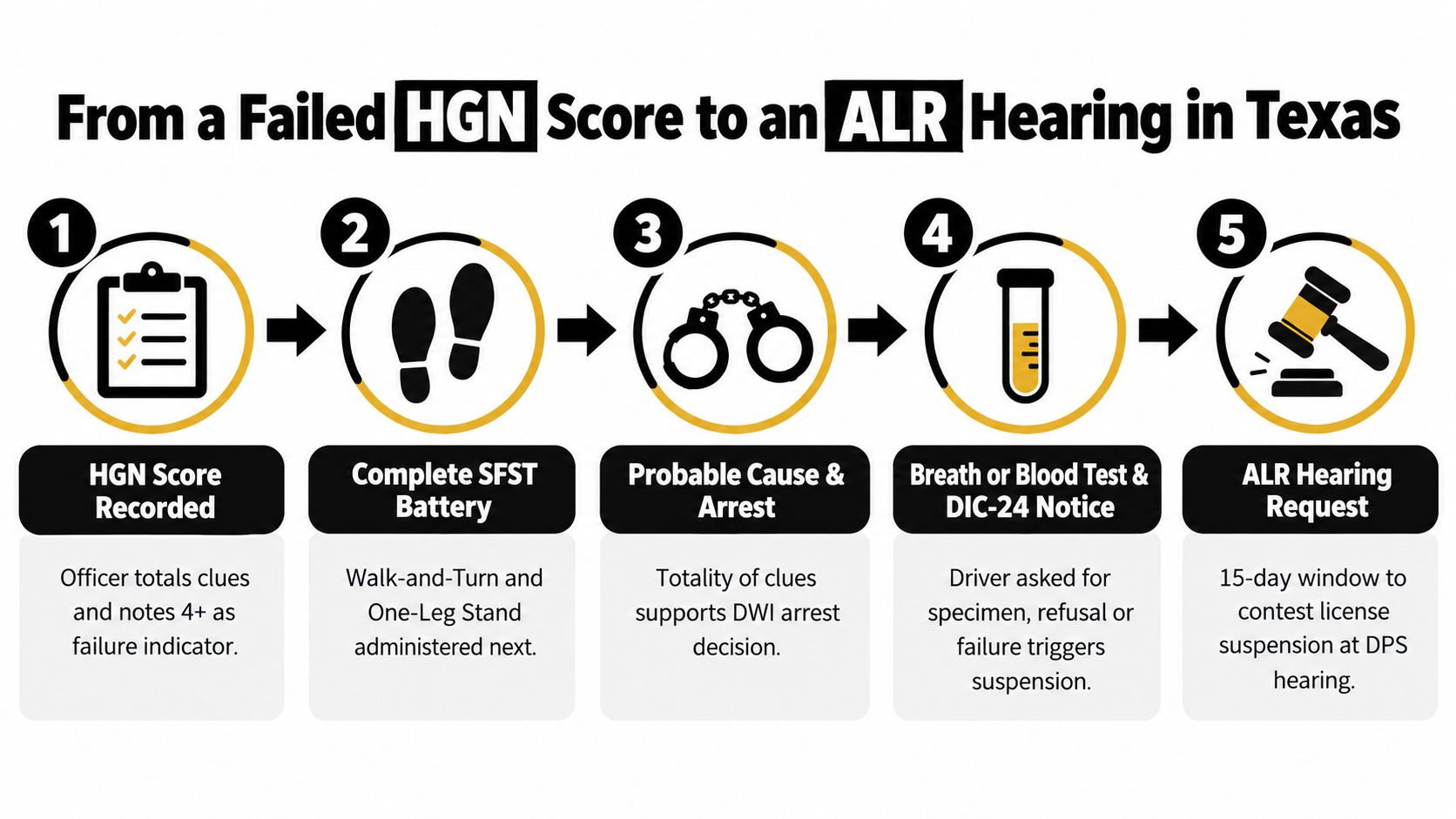
Once an officer decides your HGN performance supports impairment, the stop usually moves into the next stage. The officer may continue with the other standardized field sobriety tests, then decide whether there is probable cause to arrest.
This flowchart captures that progression.
What happens after arrest
After a DWI arrest, Texas uses implied consent. That means by driving on a public road, you're treated as having consented to a breath or blood specimen if you're lawfully arrested for DWI. Refusing the test can trigger an administrative license suspension, and a first refusal is commonly tied to a 180-day suspension under the ALR system (Texas implied consent overview).
Many people first hear about a DWI license suspension.
The license case is separate from the criminal case. Texas's administrative license revocation, or ALR, process is a civil administrative proceeding handled through DPS and the State Office of Administrative Hearings. A driver generally has 15 calendar days from arrest to request an ALR hearing, and if no request is made, the license is automatically suspended on the 40th day after arrest (Texas ALR suspension guide).
Why the ALR hearing matters
The ALR hearing often becomes the first real chance to test the officer's version of events. The HGN worksheet, bodycam, dashcam, and the officer's training can all become important.
If you want a step-by-step overview, the Texas ALR hearing process explains how that separate license case works. If timing is your main concern, The 15-Day ALR Deadline: Save Your License After a DWI Arrest addresses why you have only days to request a hearing to stop an automatic license suspension.
The criminal case keeps moving too
At the same time, the criminal DWI case proceeds on its own track. You may deal with booking, bond conditions, court dates, evidence review, negotiation, and possibly trial.
For a first DWI in Texas, this separation surprises people. They assume beating one process ends the other. It doesn't. The ALR case and the criminal case are related, but they are not the same proceeding.
Where the HGN Score Falls Apart in Court
An HGN score can sound clean on paper. In real cases, it often has stress points.
Medical and physical issues
Not every eye movement clue points to alcohol. Defense lawyers often look for other explanations, including inner-ear problems, neurological conditions, naturally occurring nystagmus, or prescription medications that can affect eye movement.
If a driver has a relevant medical history, that can change how the HGN result should be viewed. A court may still hear the evidence, but the weight of that evidence can shrink when another explanation fits the facts better.
Scene conditions and officer mistakes
The roadside setting matters more than one might think.
Common issues include:
- Distracting lights from patrol cars or passing traffic
- Poor stimulus control if the flashlight or pen wasn't held steadily
- Skipped screening checks before the officer began scoring
- Report language problems that don't match standardized scoring terms
If you want a more focused explanation of the eye test itself, the horizontal gaze nystagmus test in Texas is worth reviewing alongside your police report.
A strong HGN challenge usually isn't about one dramatic flaw. It's about small departures that add up and make the officer's conclusion less reliable.
Qualification and courtroom use
HGN testimony also depends on whether the officer was properly trained to administer and explain the test. If the State can't lay the right foundation, or if the officer's testimony drifts beyond what Texas law allows, the defense may challenge admissibility or attack credibility.
That's one reason people charged under Texas Penal Code 49.04 often review their case with a Texas DWI Defense Lawyer. The issue isn't just whether the officer wrote “6 clues.” The issue is whether the State can turn that notation into reliable courtroom evidence.
What to Do Next After an HGN Score in Texas
If an officer scored HGN clues against you, treat that as an evidence issue, not a final verdict. The eye test can support an arrest decision, but it can also be challenged.
Start with the practical steps. Save every paper you received. Write down what you remember about the stop, including lighting, traffic, instructions, and any medical issues that may have mattered. Ask about bodycam, dashcam, and the officer's field notes.
If your license is at risk, move quickly on the ALR side. The deadline is short, and waiting can cost you ground. If you're trying to fight DWI Texas, it also helps to review how to challenge roadside testing through this guide on challenging field sobriety test results in Texas.
A calm defense plan usually looks at both tracks at once: the license case and the criminal case. That includes the arrest reason, the HGN scoring, any chemical test issues, bond conditions, and longer-term options if the case is reduced, dismissed, or later becomes eligible for record relief.
If you were arrested after an HGN test, the Law Office of Bryan Fagan, PLLC can review the stop, the officer's scoring, your ALR deadline, and the larger defense strategy in your case. You can request a free consultation through Law Office of Bryan Fagan, PLLC to discuss your roadside tests, your license risk, and the next steps available under Texas law.