
A DWI arrest can be overwhelming, but you don't have to face it alone. If you're staring at a notice of suspension, worried about work, or trying to understand what the officer's report really means, the first thing to know is this, your case is not just one case. In Texas, a DWI usually runs on two tracks at the same time, the criminal case and the license case, and each one has its own deadline, evidence rules, and strategy.
That's why a careful DWI case evaluation Texas lawyers perform starts early and stays organized. The arrest itself is only the beginning. What matters next is whether the stop was lawful, whether the State can prove intoxication, whether the testing was reliable, and whether your license fight is being handled before the clock runs out.
What a DWI Case Evaluation Really Means in Texas
You may still be replaying the night in your head, the flashing lights, the roadside questions, the handcuffs, and the long drive home from jail or the station. That stress is normal. What helps most right now is a clear map of what the State has to prove and where the defense can push back.
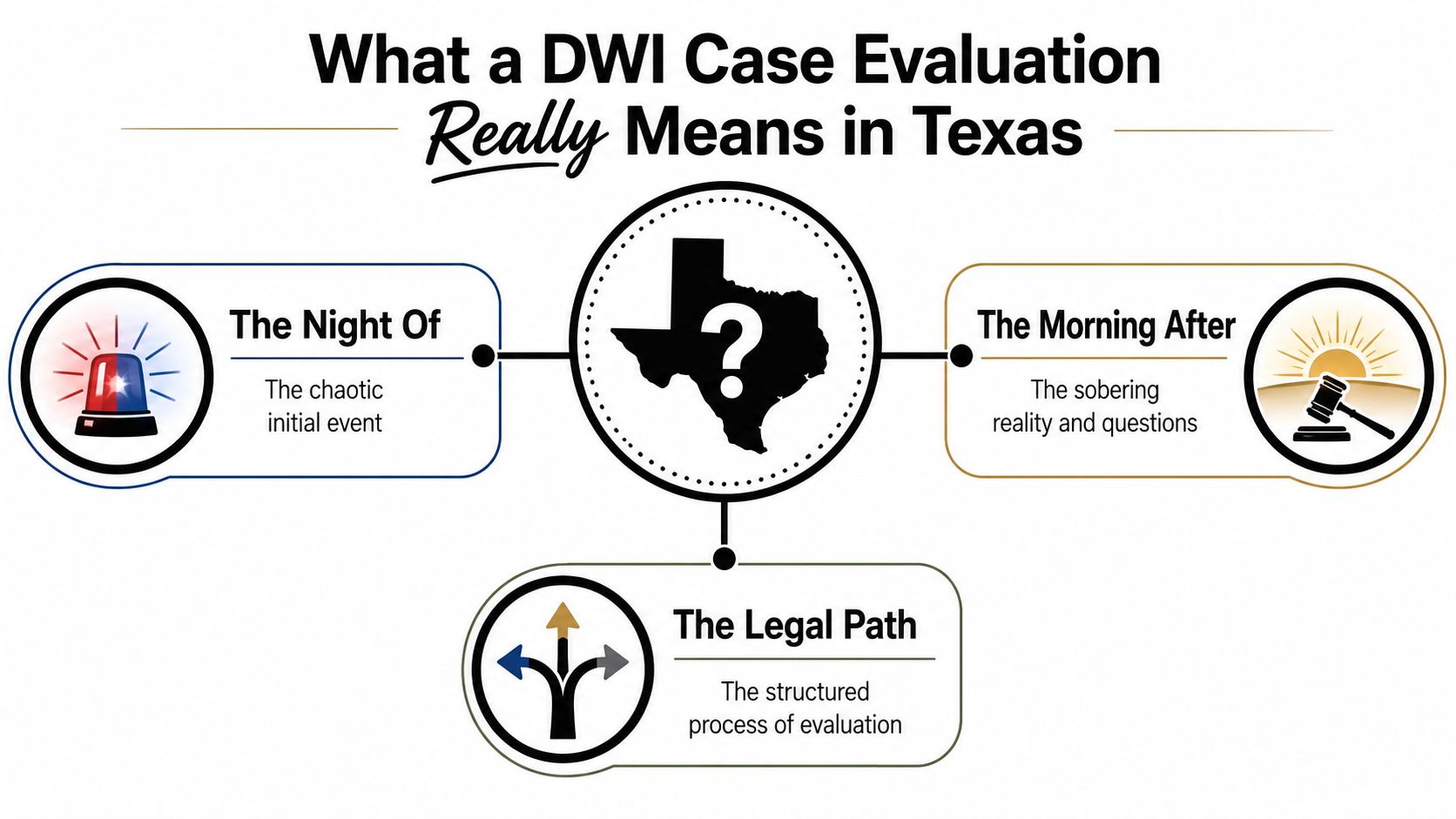
Two cases move at once
The criminal case decides guilt, punishment, and whether the arrest becomes part of your record. The license case decides whether you can keep driving while the criminal matter is still pending. Texas DPS reporting shows DWI case outcomes are mixed, with 85,858 DWI charges in 2024 and 85,002 in 2023, plus outcomes that included 1,990 releases with no charges, 14,476 guilty pleas, 10,388 convictions of the original offense, 4,279 convictions of a different offense, and 2,555 dismissals in 2024 (Texas DPS 2025 DWI Summary).
That mix matters because a DWI arrest does not point to a single ending. Some cases are dismissed. Some are reduced. Some end in conviction after plea negotiations. The result depends on the evidence, the charging decision, and the posture of the defense, not just the arrest report.
Practical rule: the first job is not guessing the outcome, it's preserving the evidence that can change it.
Why the first 15 days matter most
Texas treats the license fight as urgent. If a driver gets a Notice of Suspension, there's generally only 15 days to request an ALR hearing, and a timely request can preserve driving privilege until the hearing is decided (Collin County DWI process overview). Miss that deadline, and the case can shift from a dual-track defense to a criminal-only strategy. That's a bad trade if your job, school, or family life depends on your license.
A solid evaluation looks at both tracks together. If the hearing is set promptly, counsel can often lock in the officer's version of events early and see where the stop, the roadside investigation, or the testing record may be weak. That's why this moment matters more than later worry. The file starts to take shape in the first days after arrest.
The Legal Elements That Define a Texas DWI Charge
Texas law doesn't convict people just because an officer smelled alcohol or saw red eyes. The State still has to prove the legal elements of the charge. In plain English, that means it has to show you were operating a motor vehicle in a public place while intoxicated.
What intoxication means under Texas law
Texas defines intoxication in two ways, either a BAC of 0.08% or more, or losing the normal use of mental or physical faculties because of alcohol, drugs, or a mix of substances (TxDOT impaired driving guidance). That matters because a DWI defense is not only about the number on a machine. It can also be about whether the officer's story about speech, balance, eyes, and driving behavior proves impairment.
The State also has to prove operation and a public place. Texas law uses “operating” in a broader way than many people expect, and a person can be charged even when the case doesn't involve a simple on-the-road stop (TDCAA, “New to DWI Prosecution”). If the vehicle was not in a public place, or if the facts don't show operation, those can be real defense issues.
Why implied consent changes the license side
Texas uses an implied consent framework. If you drive on a Texas public road, you're treated as having consented to breath or blood testing after a DWI stop, including if you're visiting from another state (Texas DWI arrest guide). That doesn't mean the criminal case is over. It means the testing decision can create an immediate administrative consequence that has to be evaluated separately.
A first DWI in Texas is often treated as a Class B misdemeanor when there's no chemical test or the BAC is under 0.15, and as a Class A misdemeanor when BAC is over 0.15 (TxDOT impaired driving guidance). That distinction affects possible punishment, and how the case should be approached from day one.
Client takeaway: the defense isn't just “fight the test.” It's “challenge every element the State must prove.”
When I sit down with someone after a DWI arrest, I want the facts that match each element. Where was the car? Was it moving? What exactly did the officer see? Was there a test, and if so, what type? Those questions shape the whole case.
Probable Cause, the Stop, and Field Sobriety Tests
A lot of people think the case begins with the arrest. It doesn't. It begins when the officer first decides to follow, stop, and question the driver. That early sequence is where a Texas DWI lawyer often finds the strongest factual problems.
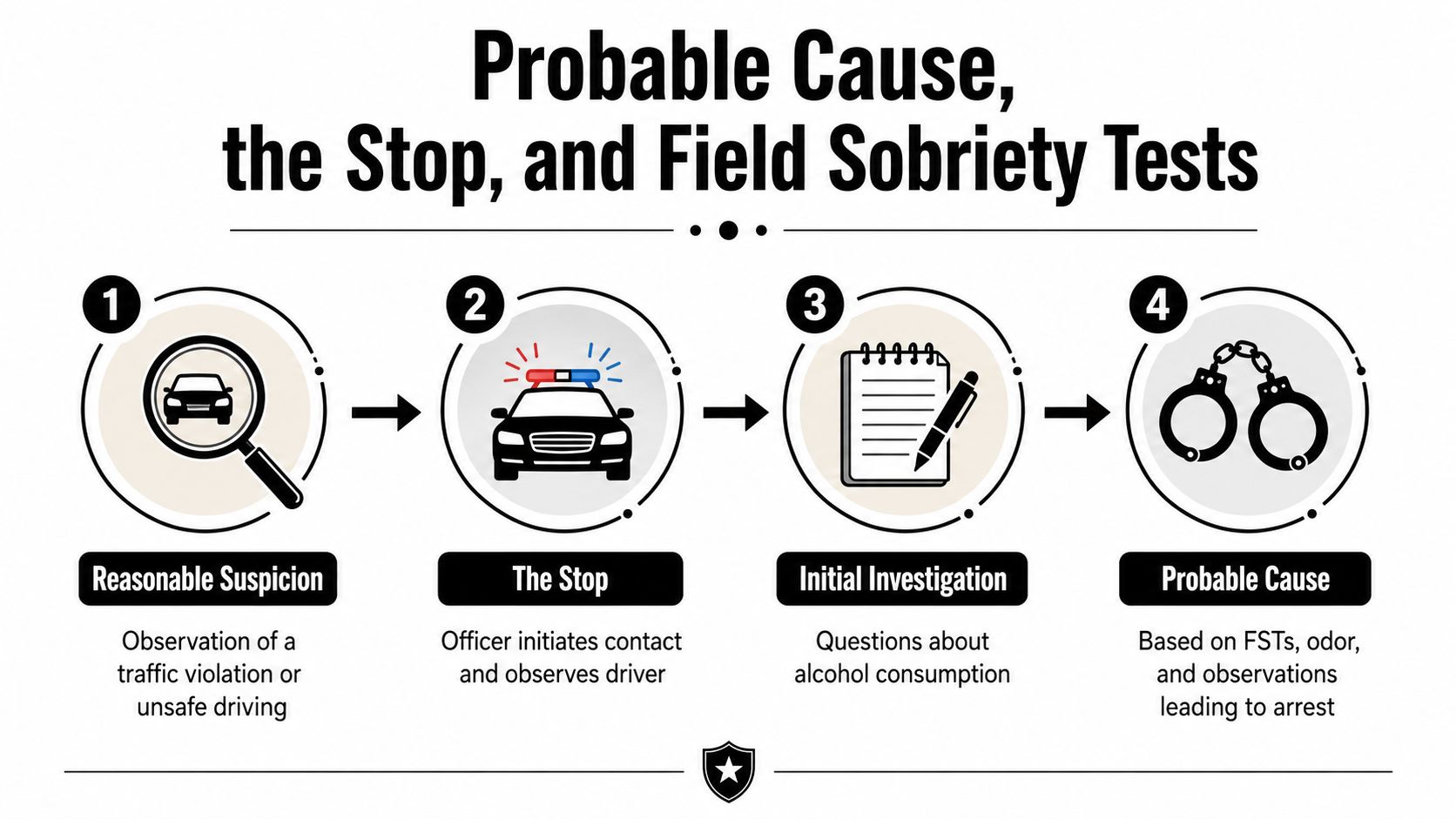
The stop must start with a lawful reason
The officer needs a valid basis to initiate the stop, usually a traffic violation or observable unsafe driving. After that, the officer's observations matter. Things like the way you spoke, whether you fumbled with your wallet, or how you stood by the car can become part of the probable-cause story. If those details are thin, inconsistent, or missing from the video, the case can weaken fast.
For a deeper breakdown of that legal checkpoint, see what gives police probable cause for a DWI arrest in Texas. That analysis matters because probable cause isn't automatic. It has to be built from what the officer observed.
Field sobriety tests are not magic
Standardized field sobriety tests usually include the walk-and-turn, the one-leg stand, and the horizontal gaze nystagmus test. In real life, those tests can be affected by poor lighting, uneven pavement, nervousness, medical issues, weather, and simple misunderstanding of the instructions. That's why Field Sobriety Tests and How They Are Challenged is a useful reference point, because standardized tests can be more contestable than they first appear.
The important part is not just whether you “passed” or “failed.” It's whether the officer administered the tests correctly, whether the instructions were clear, and whether the dashcam or body-cam video matches the written report. Defense lawyers also look at training records and whether the officer followed the protocol.
The first 30 minutes of the encounter often tell the story better than the arrest report does.
Evidence preservation has to happen early
Dashcam video, body-cam footage, and the written report can show whether the officer jumped ahead, missed details, or filled gaps later. If that material isn't requested and reviewed quickly, the defense can lose a strategic advantage before the case even reaches court. That's why an early DWI case evaluation always starts with the stop, then moves to the roadside investigation, then to the arrest decision.
Chemical Tests, ALR Hearings, and the 15-Day Deadline
Chemical testing is often the point where a client feels the case tighten around them. A breath result or blood result can look decisive on paper, but it is still evidence that has to be tested for how it was collected, how it was handled, and whether the State can rely on it. A DWI lawyer looks at both tracks at once, the criminal case and the driver's license case, because they move on different timelines and raise different questions.
Breath, blood, and the separate license fight
Texas implied consent means a refusal or a failed test can trigger a separate administrative license suspension issue (Texas DWI arrest guide). That administrative case is civil, not criminal, and it has its own rules. What Is an ALR Hearing in Texas? helps explain how that civil license-suspension case runs apart from the criminal DWI case, and this ALR hearing process guide shows the steps in more detail.
The license deadline is short. Texas guidance says you generally have 15 days from arrest to request the ALR hearing, and if you miss it, the suspension begins automatically (Texas DWI site). That is easy to overlook when a person is focused on the criminal charge, the bond paperwork, and the fear of what happens next.
What the ALR hearing does
An ALR hearing is not just a paper check. It gives the defense a chance to challenge the suspension, question the State's proof, and create an early record of the officer's testimony. It can also expose weaknesses that matter later in the criminal case, especially if the stop, detention, or testing process has gaps.
The officer's testimony under oath can matter a great deal. If the facts do not line up, or if the witness is unsure, that can shape negotiations in both tracks. The civil case and the criminal case are separate files, but they still affect each other in practical ways.
Why missing the deadline hurts leverage
If you miss the ALR deadline, the State gets the upper hand on the license issue without having to prove as much right away. That does not end the criminal case, but it can remove options that are hard to rebuild later. For many clients, being able to drive is not a convenience, it is how they keep working and taking care of family.
A hearing can become a turning point because it forces the State to show what it has. The question is not only whether the test result looks bad. It is whether the result was collected, stored, and used in a way that can survive close review.
Prior Record, the 10-Year Lookback, and Felony Exposure
Many people walk into a first consultation thinking an old DWI is behind them for good. That assumption can be expensive. Texas enhancement law makes prior history a major part of the evaluation, and the difference between a misdemeanor and a felony can turn on records from years ago.
Why old cases still matter
Recent Texas DWI case-law updates say prior DWI convictions are available for enhancement so long as they fall within a ten-year lookback period (TDCAA DWI caselaw update). That means a file that looks like a routine arrest can become much more serious once prior convictions are confirmed.
Texas DPS recidivism data shows this is not a rare issue. In the 2024 Q3 report, there were 22,023 DWI arrests, and 6,723 of those involved a previous DWI arrest, which produced an arrest recidivism rate of 30.53%. On the conviction side, 531 DWI convictions included 157 prior convictions, for a conviction recidivism rate of 29.57% (Texas DPS DWI Recidivism Report). In practical terms, roughly 3 in 10 Texas DWI arrests and convictions in that period involved someone with a prior DWI history.
How a prior changes the charge
A prior record can affect punishment, negotiation posture, and whether the State pushes the case into a more serious category. In the table below, the point is not to predict every file. It's to show how BAC and history change the legal conversation.
| Texas DWI Charge Classification by BAC and Prior Record | |||
|---|---|---|---|
| Offense Tier | Typical Classification | Key Trigger | License Loss Range |
| First DWI with no chemical test or BAC under 0.15 | Class B misdemeanor | Intoxication proof without the higher BAC threshold | Up to a year |
| First DWI with BAC over 0.15 | Class A misdemeanor | BAC result above 0.15 | Up to a year |
| Repeat DWI with qualifying priors | Enhanced exposure | Prior-record history within the lookback period | Can be longer and more restrictive |
The exact punishment depends on the file, but the message is simple. Prior history changes the math.
Practical rule: before discussing plea options, screen every prior conviction and every prior arrest.
That screening includes more than a quick database search. Counsel needs the judgment, the dates, the charging papers, and the exact way the prior was resolved. If the priors are there, they can change whether a reduction is realistic or whether the case needs a different strategy entirely.
Likely Outcomes, Realistic Defenses, and Plea Posture
A first DWI meeting often starts with a simple question: what can be changed in this case? The answer depends on two tracks running at the same time, the criminal case and the license case. They share some facts, but they do not follow the same deadline, the same rules, or the same strategy. A careful DWI case evaluation sorts those tracks out before anyone talks seriously about plea posture.
No lawyer can promise dismissal, and anyone who does is selling hope instead of strategy. What a thorough DWI case evaluation can do is identify the strongest defenses, the pressure points that matter most, and the realistic range of outcomes. That is how you make a better decision in a hard case.
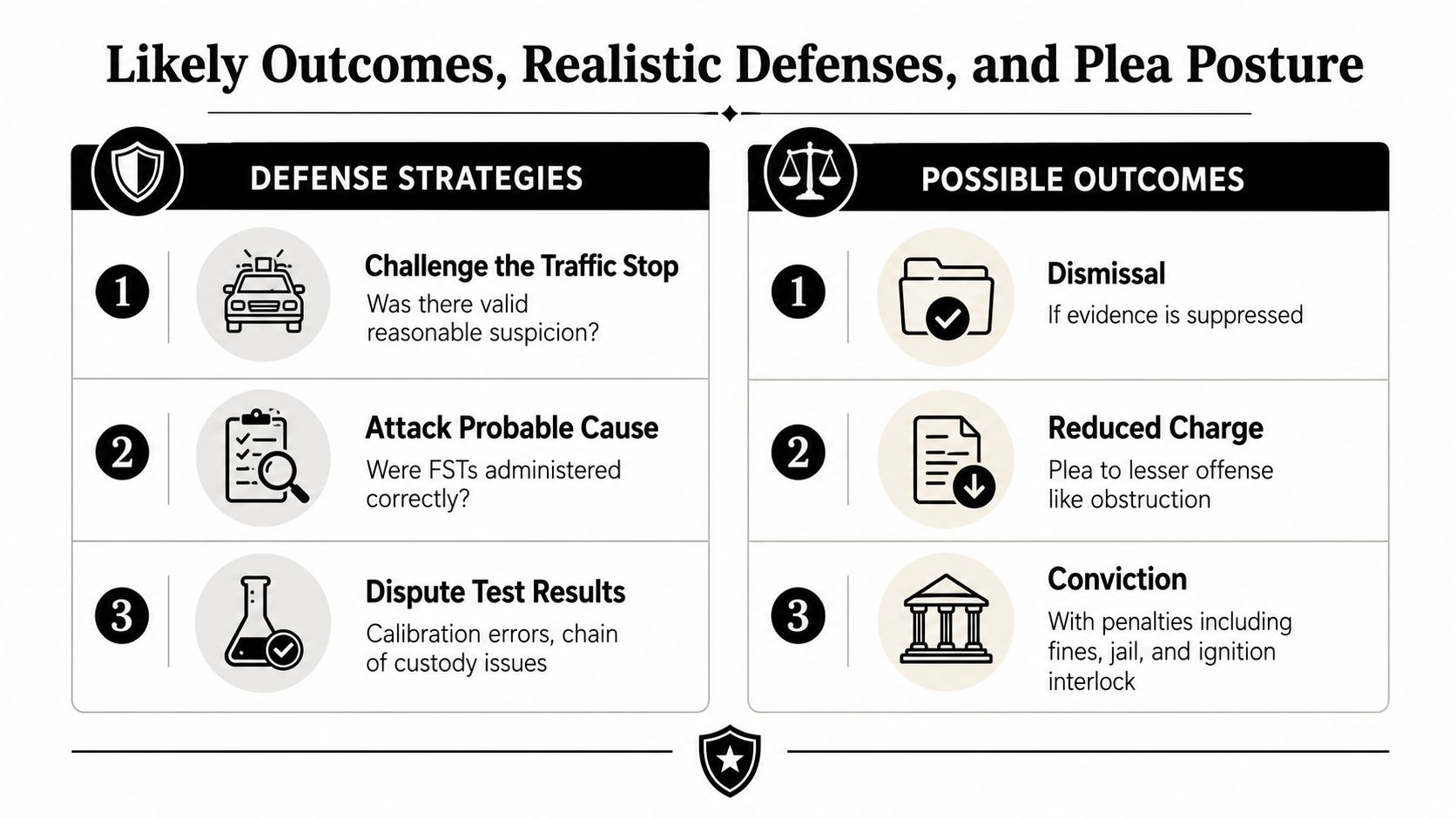
The main defense categories
The first question is often the stop. If the officer did not have a lawful reason to pull you over, that issue can affect everything that comes after it. The next question is probable cause, which is where field sobriety tests, roadside observations, and the officer's report get compared with the video and the surrounding facts.
Chemical testing creates a third lane of defense. Breath cases can raise calibration and observation problems. Blood cases can raise chain-of-custody questions. Medical conditions can also mimic intoxication or make a test less reliable. Those issues are fact-specific, but they often make the difference between a strong plea position and a weak one.
The criminal case and the driver's license case need different attention. A case can look fragile on the evidence side and still create immediate license trouble if the deadline on the administrative side is missed. That is why the evaluation has to treat both tracks separately, the way a mechanic checks the engine and the brakes before saying what the repair plan should be.
What the Texas numbers say about outcomes
Texas DPS reporting shows a range of results, not one fixed pattern. In the 2025 Texas DWI Summary, the State reported 14,476 guilty pleas, 10,388 convictions of the original offense, 4,279 convictions of a different offense, and 2,555 dismissals in 2024, plus 1,990 releases with no charges (Texas DPS 2025 DWI Summary). That mix tells you something important. Outcome depends on how the evidence holds up and how the case is negotiated.
A first DWI in Texas may be resolved in several ways, depending on the file. Sometimes dismissal is realistic. Sometimes a reduction or a negotiated plea makes more sense. Sometimes the issue is whether the case should go to trial at all. The answer usually depends on what was preserved in the first 15 days and whether the defense can keep both tracks, criminal and administrative, from working against each other.
A smart defense goal is not always to beat every issue at once. Sometimes it is to reduce the damage, protect the license while the criminal case is pending, and keep the record exposure as low as the facts allow.
How this fits a real client's decision
A worried driver usually wants one of three things, fast. They want to keep driving, keep the record clean if possible, and avoid jail. A Houston DWI lawyer or Texas DUI attorney should be able to explain which of those goals is realistic based on the evidence, the priors, and the prosecutor's posture. If the case is weak, the strategy looks different than if the case has strong video and a valid chemical test.
The right strategy comes from the evidence map, not fear. That is how you handle DWI Texas cases with clarity instead of panic.
Before a first consultation, many people ask whether it is even worth talking about plea posture yet. It is, but only after the lawyer has separated the two tracks, reviewed the stop, and checked whether a prior record changes the pressure on the case. If you want to see how an initial review is handled, the Texas DWI attorney consultation page shows what that first conversation can cover.
Your First Steps, What to Bring, and How a Texas DWI Attorney Helps
A first consultation goes better when the lawyer can see the case the way the State will try to present it. Bring your Notice of Suspension, the ticket or release paperwork, any dashcam or body-cam footage you already have, prior driving or criminal records, insurance and employment information, and a written timeline of the night in question. If you have witness names or phone video, bring those too.
What to do in the first 15 days
If the ALR deadline is still open, request the hearing right away. Save texts, videos, rideshare receipts, and any messages that help show where you were, when you drove, and what happened before the stop. Leave social media out of it, because posts often create more confusion than clarity, and the officer's report rarely tells the whole story.
Those early details give a lawyer a way to work both tracks at once, the criminal case and the license case. A careful review usually starts with probable cause, then moves to video and report analysis, testing record requests, prior-record screening, ALR strategy, and negotiation or trial planning. The Texas DWI attorney consultation page shows what an initial review can cover.
The Law Office of Bryan Fagan, PLLC handles DWI defense by examining the stop, the testing, the officer's reports, and the administrative deadline together. That kind of review matters whether this is a first DWI in Texas or a repeat case with enhancement risk. It also helps people who are dealing with a DWI license suspension or trying to fight DWI Texas charges because the first move can shape both tracks.
Bring the facts, along with the arrest story. The documents usually tell us more than memory does.
If your case also raises questions about expunction or record-clearing later on, that can be discussed after the immediate defense issues are protected. For now, keep your options open and keep the deadlines from closing them for you.