 Skip to content
Yes, you can refuse field sobriety tests in Texas, and in most cases that is the smarter move because those roadside tests are voluntary. That is very different from refusing a post-arrest breath or blood test, which can lead to a DWI license suspension that may last six months or longer.
A DWI stop can rattle anyone. You see the lights, your stomach drops, and suddenly an officer is asking questions, watching every movement, and telling you to step out of the car. In that moment, what's needed aren't lectures. They need clear answers about what works, what doesn't, and how to protect themselves.
If you're asking can you refuse field sobriety tests in Texas, the short answer is yes. The more important answer is what happens next. Refusing roadside balance and eye tests doesn't end the stop. It doesn't guarantee an arrest either. It changes the evidence the officer can gather, and that distinction matters.
A strategic defense starts with understanding the difference between field sobriety tests, chemical tests, implied consent, BAC, and administrative license suspension. It also starts with saying less, not more. If you've already been arrested, your next steps still matter a great deal.
A DWI Stop Can Be Overwhelming But You Have Rights
A DWI arrest can be overwhelming, but you don't have to face it alone.
Most stops begin the same way. An officer says they noticed something about your driving. Then come the questions: where are you coming from, have you had anything to drink, would you step out of the vehicle? A few minutes later, the officer is asking you to do roadside tests under flashing lights, with traffic moving beside you and nerves already high.
That setting is not neutral. It is stressful, public, and built around observation.
What people get wrong in the moment
Many drivers believe they have to cooperate with everything the officer requests or they will make things worse. That isn't how Texas DWI investigations work. Some requests are mandatory. Some are not. If you don't know the difference, it's easy to give the State more evidence than necessary.
One of the biggest mistakes is trying to talk your way out of suspicion. Another is treating roadside tests like a fair exam you can "pass."
Practical rule: Be polite, provide identifying information as required, and avoid volunteering explanations that can later appear in a police report or courtroom testimony.
Statements matter. Officers often use your own words to support their impressions about drinking, timing, or impairment. If you want a fuller explanation of why limiting your answers matters, review this guide on statements to police during a Texas DWI stop.
The real issue is strategy, not pride
By the time an officer asks for field sobriety tests, the investigation is already moving. The question isn't whether you can convince the officer you're fine by balancing on one leg. The key question is whether participating helps your case later. In most situations, it doesn't.
Here's the practical view:
- Roadside tests create evidence: They give the officer more observations to write down and more material for prosecutors to use.
- Refusal changes the proof: It can limit one category of evidence, even if the officer continues the investigation.
- The stop still continues: The officer may rely on driving behavior, speech, odor, appearance, or other observations.
If you've already said yes to the tests, that doesn't mean your case is lost. If you refused, that doesn't mean the case disappears. Either way, there is still a path forward, and much of your defense will turn on how the stop, arrest, warnings, and testing were handled.
Field Sobriety Tests Are Voluntary in Texas
Field sobriety tests are roadside physical and mental exercises officers use when they suspect intoxication. The common examples are the Horizontal Gaze Nystagmus test, the Walk-and-Turn, and the One-Leg Stand.
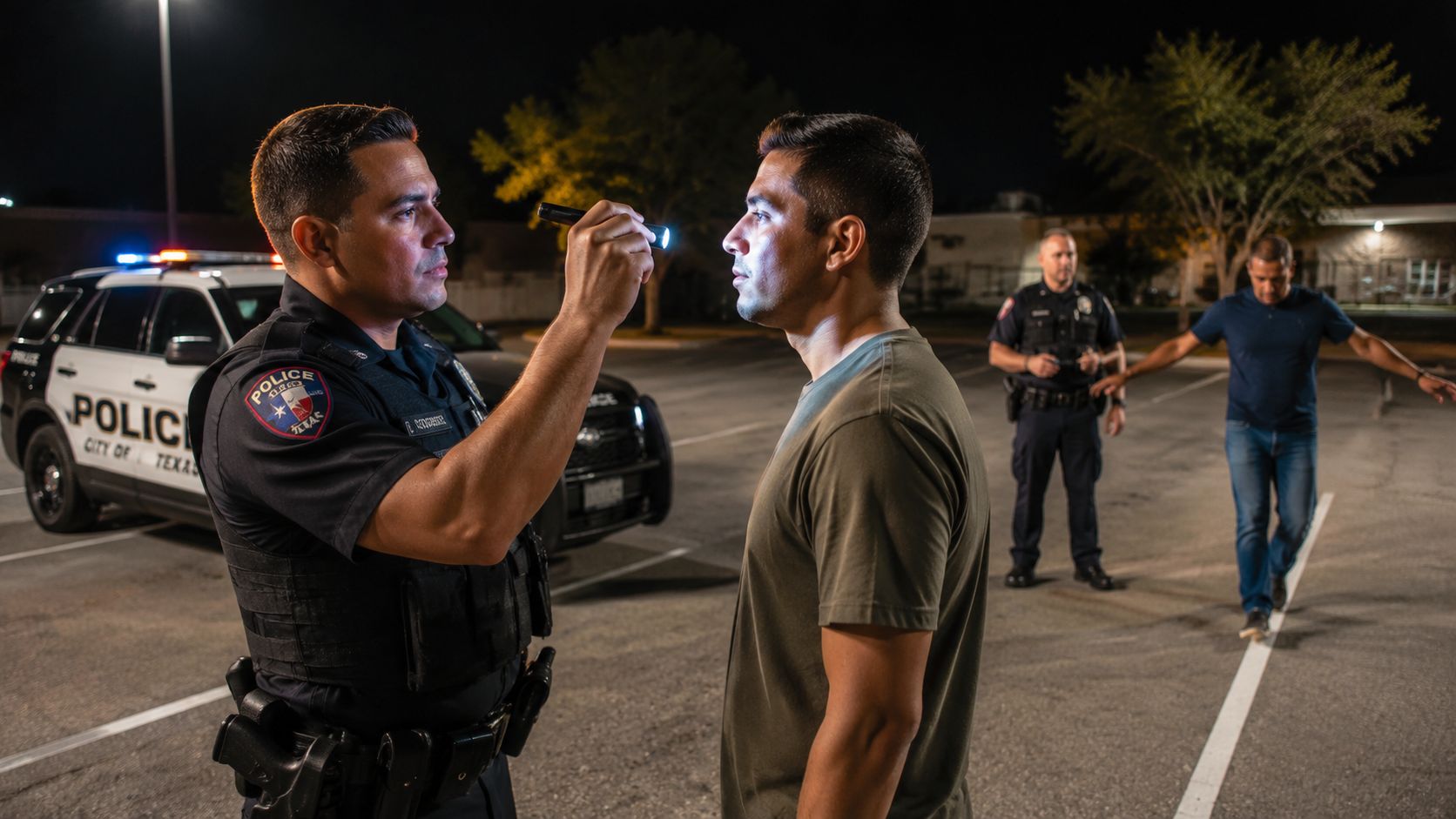
In Texas, these tests are voluntary. As Biederman & Burleson explain regarding Texas field sobriety testing, field sobriety tests are not part of the state's implied-consent system, so refusing them does not trigger the automatic administrative license suspension that applies to refusing post-arrest chemical testing.
What these tests really are
Drivers often assume these are objective pass-or-fail tests. They aren't. They are performance-based screening tools used at the roadside, and the officer is the person evaluating your performance in real time.
That matters because a lot can affect how a person looks on camera or to an officer:
- Physical limitations: old injuries, balance issues, back pain, or dizziness
- Conditions at the scene: uneven pavement, poor lighting, traffic noise, weather
- Simple stress: shaking hands, confusion, or trouble following multi-step instructions under pressure
The eye test deserves its own scrutiny. If you want to understand one of the most discussed parts of a DWI investigation, read more about the Horizontal Gaze Nystagmus test in Texas.
Why refusal is often the better choice
When clients ask me what works, the answer is usually simple. Don't give the officer extra roadside evidence unless the law requires it. Field sobriety tests are designed to produce observations that support probable cause and, later, prosecution arguments.
A polite refusal can sound like this:
"Officer, I want to be respectful, but I do not wish to perform field sobriety tests."
That response is calm, clear, and non-argumentative. You're asserting a right, not picking a fight.
What doesn't work is debating science on the roadside, arguing about fairness, or trying to negotiate your way out of the stop. The roadside is not where you win a DWI case. The defense work comes later, when your attorney reviews video, reports, probable cause, test procedures, and the officer's decisions.
FSTs vs Chemical Tests A Critical Distinction
A lot of confusion in DWI cases comes from treating all "tests" as if they are the same. They are not.
A field sobriety test is a roadside coordination or eye exercise used before arrest as part of the officer's investigation. A chemical test is typically a breath or blood test used after arrest to measure BAC, which stands for blood alcohol concentration. Texas also uses the term implied consent, which means that by driving on Texas roads, you are considered to have agreed to certain chemical testing after a lawful DWI arrest.
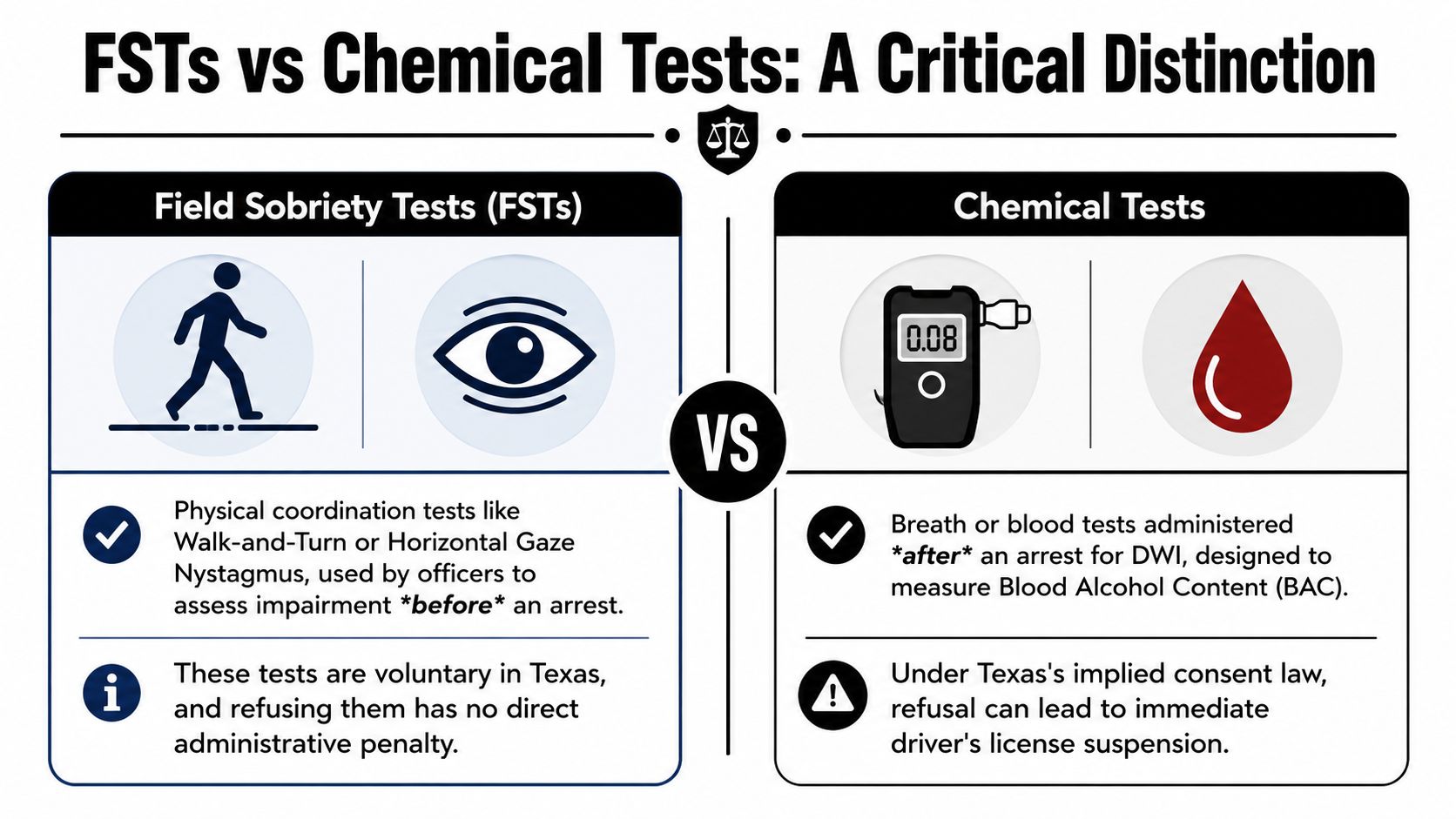
As Kyle Whitaker notes in his discussion of Texas DWI testing consequences, the critical distinction is this: refusing field sobriety tests removes one source of evidence for probable cause, while refusing a lawful post-arrest breath or blood test can trigger the administrative license suspension process.
Side by side comparison
| Attribute | Field Sobriety Tests (FSTs) | Chemical Tests (Breath/Blood) |
|---|---|---|
| When used | During roadside investigation, usually before arrest | After arrest |
| Purpose | Observe balance, coordination, eye movement, and ability to follow instructions | Measure BAC |
| Voluntary or not | Voluntary in Texas | Covered by implied consent after lawful arrest |
| Main effect of refusal | Limits one category of evidence | Can trigger administrative license consequences |
| How they fit the case | Helps officer build probable cause | Creates or supports intoxication evidence tied to BAC |
Why this distinction matters to your defense
Strategy is key. If an officer asks for roadside tests, you're dealing with evidence gathering. If an officer asks for a post-arrest breath test, you're dealing with a different legal framework altogether.
For many people, that difference gets blurred in the moment. If you want a closer look at that second category, this page on refusing a breathalyzer in Texas helps explain the separate issues that arise after arrest.
The mistake I see most often is not bad intent. It's confusion. Drivers think refusing one kind of test has the same consequence as refusing the other. It doesn't.
That doesn't mean there is one perfect answer for every case. It means you should make decisions based on the type of test being requested and the risks attached to that stage of the investigation.
What Happens After You Refuse Field Sobriety Tests
Refusing roadside tests doesn't end the encounter. The officer still has to decide whether there is enough evidence to continue the DWI case, make an arrest, or seek additional testing later.
According to Texas DWI guidance from Ned Barnett, Texas drivers can legally refuse roadside field sobriety tests because they are voluntary, but that refusal does not prevent an arrest if officers have other signs of impairment, and the refusal itself is not a crime.
What the officer may rely on instead
Once you decline, the investigation usually shifts to the officer's other observations. In practical terms, that can include:
- Driving conduct: the reason for the stop in the first place
- Physical appearance: red eyes, unsteady movement, or other claimed signs
- Speech and responses: slurred speech, delayed answers, confusion, or inconsistent statements
- Odor and admissions: whether the officer reports smelling alcohol or hearing you admit drinking
This is why silence and restraint matter. You may not be able to control what the officer says they observed, but you can avoid adding more material through roadside statements and test performance.
A minute by minute reality check
Here is what usually doesn't happen. You politely refuse the tests, and the officer says, "Fair enough, have a nice night." That's not how these stops typically unfold.
Here is what often does happen:
- The officer keeps watching. How you stand, walk, speak, and respond all become part of the report.
- The officer keeps asking questions. Casual conversation can become evidence.
- The officer decides on probable cause. That decision can be based on the totality of what the officer claims to have seen.
- An arrest may still follow. Refusal reduces one stream of evidence, but it doesn't block the officer from acting on other observations.
Refusal is a shield against giving more roadside evidence. It is not a guaranteed ticket home.
That distinction is important for anyone trying to fight DWI Texas charges. Good strategy means understanding both what refusal protects and what it doesn't.
Consequences of Refusing a Breath or Blood Test
Texas law becomes much less forgiving.
A chemical test is a breath or blood test requested after arrest to measure BAC. Under Texas implied consent rules, refusing that post-arrest request can trigger an Administrative License Revocation, often shortened to ALR. An ALR case is separate from the criminal DWI prosecution. It focuses on your driving privileges, not whether you are ultimately convicted in criminal court.
Early in this process, many drivers also hear the term administrative license suspension. That refers to the license action pursued through the ALR system.
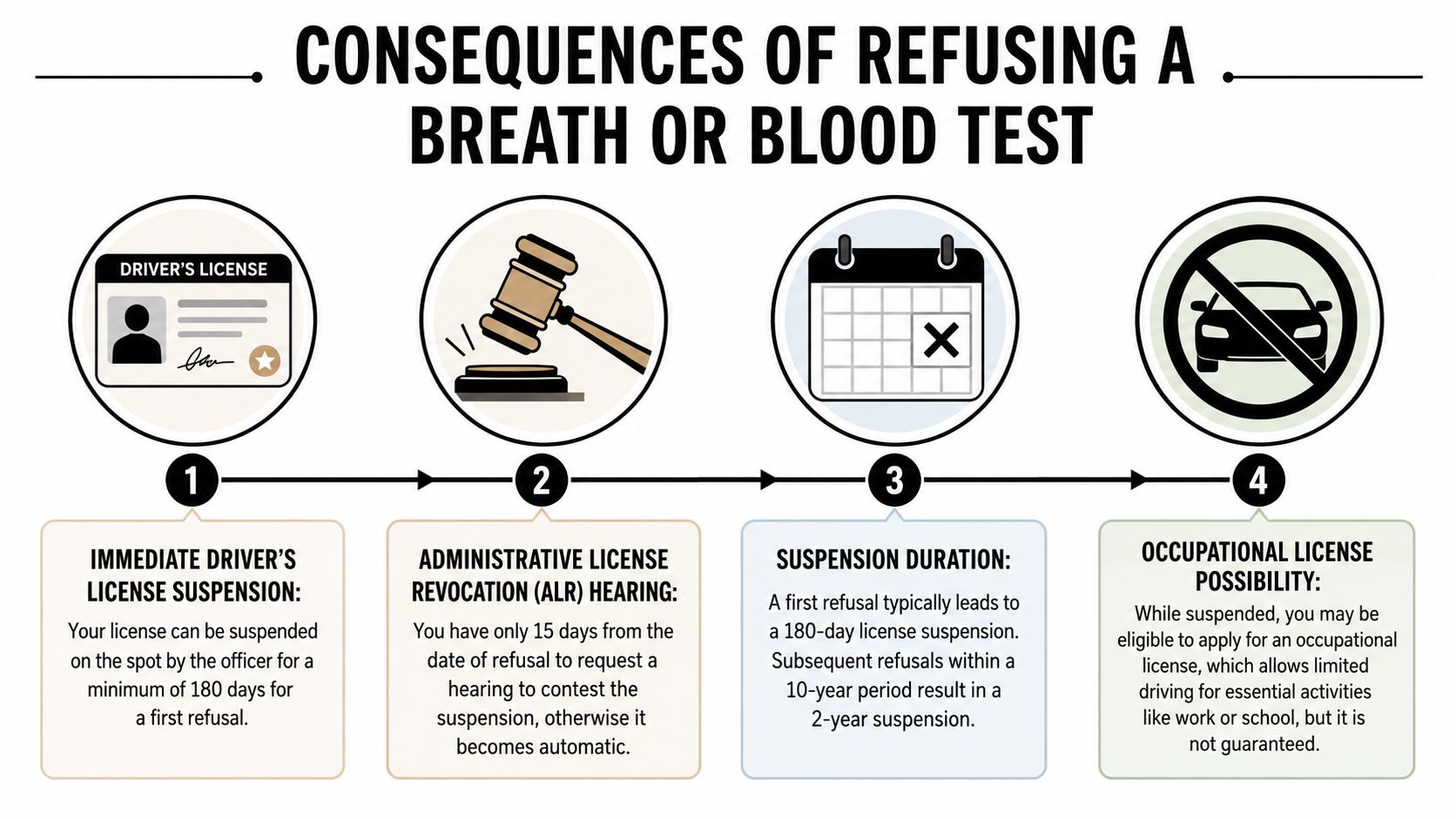
One Texas legal source, R.B. Isenberg's explanation of test refusal consequences, states that refusing a post-arrest breath or blood test can trigger an ALR suspension that can last six months or longer under Texas Transportation Code § 724.015.
What happens after a DWI arrest
After an arrest, several tracks can begin at once. That is why quick legal advice matters.
- Criminal case: You may be booked, released on bond, and given a court setting.
- License case: DPS may move forward with an ALR suspension based on the alleged refusal.
- Evidence review: Video, reports, warnings, and testing procedures all become important.
A short video can help make that sequence easier to follow.
The process after arrest in practical terms
Once the arrest happens, your case usually moves through stages that can include:
Booking and release conditions
You may be taken to jail, processed, and released under bond terms.ALR hearing decision
Your attorney can evaluate whether to challenge the license suspension through the administrative process.Court appearances
The criminal case may involve settings for evidence review, negotiations, motions, and possibly trial.Defense investigation
A lawyer reviews probable cause, video footage, witness issues, officer procedure, and testing problems.
If this is a first DWI in Texas, don't assume the outcome is automatic. Many cases turn on details that are not obvious during the stop itself.
How a Houston DWI Lawyer Can Protect Your Future
If you are reading this after a stop or arrest in Houston, you are probably worried about your license, your job, and what happens when this charge shows up in court. That reaction is normal. A DWI case feels personal right away, but it is still a case that can be examined, challenged, and defended.

One point often gets lost after an arrest. Refusing field sobriety tests and refusing a breath or blood test do not create the same issues, and a lawyer should treat them differently. As Mike Howard's Texas DWI article explains, refusal can affect the evidence the State relies on, the officer's report, and the license consequences that follow. That is why the defense starts with the details of your stop, not a generic answer about whether refusal was allowed.
What to do right away
The first hours and days matter. Small mistakes can make a manageable case harder to defend.
- Keep your communication controlled: be polite with officers, court staff, and anyone else involved. Statements made in frustration can show up in reports, recordings, or bond conditions.
- Write down the timeline: note why you were stopped, what the officer said about tests, whether you refused anything, whether warnings were read, and what happened before the arrest.
- Save every document: bond papers, notice of suspension forms, towing paperwork, inventory sheets, and court dates all help your lawyer reconstruct the case.
- Get legal advice early: quick review of the stop, the arrest paperwork, and any license deadline can shape the defense before the State has the advantage.
What a defense lawyer actually does
A DWI defense lawyer's job is to test the State's case at every stage. That includes the traffic stop, the officer's observations, the arrest decision, the testing process, and the license suspension effort.
In practice, that often means reviewing:
- Whether the stop was legal
- Whether the officer had probable cause to arrest
- Whether refusal warnings and paperwork were handled correctly
- Whether bodycam, dashcam, or jail video matches the written report
- Whether field sobriety testing, breath testing, or blood draw procedures can be challenged
- Whether your case has separate defense opportunities in the criminal court and the ALR process
The Law Office of Bryan Fagan, PLLC handles DWI defense work that includes reviewing field sobriety issues, chemical test disputes, and administrative license hearings.
A client often asks me whether refusing field tests hurt the case. The honest answer is that refusal can help in one way and hurt in another. It may limit poor roadside evidence, but it does not prevent arrest, and it can shift the officer's focus to other observations or later testing. Good defense strategy looks at what the refusal kept out, what evidence still came in, and where the State overreached.
"Officer, I want to be respectful, but I choose not to perform field sobriety tests and I don't want to answer questions without legal advice."
That kind of response is usually safer than arguing, volunteering explanations, or trying to talk your way out of an arrest.
The practical goal is to protect more than one part of your future. A lawyer can work to reduce the damage to your license, challenge the evidence, press for dismissal when the facts support it, and position the case for negotiation or trial if needed. If your case involves a suspended license risk, a first offense, or later record-clearing options, those choices should be made as part of one defense plan, not piece by piece.
If you were stopped or arrested for DWI, you do not have to sort this out alone. The Law Office of Bryan Fagan, PLLC offers free consultations so you can get clear answers about your rights, your options, and the best way to protect your license, record, and future. If you need a Houston DWI lawyer to help you fight DWI Texas charges, challenge a DWI license suspension, or defend a first DWI in Texas, request a free case evaluation today.

