 Skip to content
A DWI arrest can be overwhelming — but you don’t have to face it alone. Yes, you can refuse a breathalyzer in Texas. However, that decision comes with immediate and automatic consequences for your driver's license. It’s a choice you have the right to make, but doing so triggers a civil process that is completely separate from any criminal DWI charge you might be facing. Understanding this difference is the very first step toward protecting your rights and your ability to drive.
Your Rights and What Happens During a DWI Stop
Seeing flashing lights in your rearview mirror is enough to make anyone's heart pound. When an officer suspects you of Driving While Intoxicated (DWI), that stress can feel overwhelming. It’s in these critical moments that you need to remember you have rights. The most important thing is to remain calm and polite, but you are not required to answer questions that could incriminate you.
Once an officer suspects you of DWI, they will likely ask you to perform a series of tests. Their goal is to gather enough probable cause to arrest you. This is where knowing your options becomes absolutely essential.
The Two Types of Tests You May Face
During a DWI stop, you could be asked to submit to two very different kinds of tests: Field Sobriety Tests (FSTs) and a preliminary breath test on the roadside.
It’s crucial to know that in Texas, you have the right to refuse both of these pre-arrest tests without any automatic penalty to your driver’s license. These roadside evaluations are notoriously subjective and are primarily used to build a case against you.
The test that triggers immediate consequences is the official chemical test—either a breath or blood sample—that is offered after you have been formally arrested. This is the test directly tied to Texas's "implied consent" law.
What is Implied Consent?
By accepting a Texas driver's license, you have already—in the eyes of the law—given your consent to provide a breath or blood sample if you are ever lawfully arrested for DWI. This isn't a choice you make on the side of the road; it's a condition you agreed to when the state granted you the privilege to drive.
The Immediate Consequence: The ALR Process
When you refuse this post-arrest chemical test, the officer will take your physical license and issue you a notice of suspension. This action kicks off a civil administrative process known as an Administrative License Revocation (ALR).
This is not a criminal penalty. It is a separate, civil action taken by the Texas Department of Public Safety (DPS) to suspend your driving privileges.
Here’s what that means for you in practical terms:
- A Separate Civil Case Begins: The ALR process runs parallel to your criminal DWI case but is completely independent. You can win your ALR hearing and keep your license, yet still face criminal charges—or vice-versa.
- Your License is on the Line: For a first-time refusal, the automatic suspension period is 180 days.
- You Have a Critical Deadline: You have only 15 days from the date of your arrest to request an ALR hearing to fight this automatic suspension. If you miss this deadline, you forfeit your chance to challenge it.
Breathalyzer Refusal vs. Consent Quick Comparison
To make sense of this, let's look at the immediate outcomes side-by-side. The table below breaks down what happens right after a DWI arrest depending on your choice.
| Your Choice | Immediate Impact on Your Driver's License | Effect on Your Criminal DWI Case |
|---|---|---|
| Refuse the Test | Automatic suspension process (ALR) begins. You have 15 days to request a hearing to fight the DWI license suspension. | The prosecutor won't have a BAC number to use against you, but they can use your refusal as evidence of guilt. |
| Consent to the Test | No automatic suspension, but if your BAC is 0.08% or higher, a suspension process will still begin. | The prosecutor has a specific BAC number, which is powerful evidence against you. |
This table highlights the trade-off: refusing the test protects you from giving the state hard evidence for the criminal case, but it triggers an immediate and definite fight to save your license in a civil process.
Knowing the full scope of what happens during a DWI stop can empower you to make more informed decisions under pressure. An experienced Houston DWI lawyer is essential for navigating both the ALR hearing and the criminal proceedings. They can work to protect your license while simultaneously building a strong defense to fight the charges against you.
Understanding Texas Implied Consent Law
So, why does refusing a breath test automatically put your driver’s license at risk? The answer lies in a legal concept called implied consent. This law is a fundamental part of the agreement you make with the state the moment you accept the privilege of driving on Texas roads.
Think of it this way: getting a Texas driver's license is like signing a contract. Buried in the terms and conditions is a clause stating that you agree to provide a breath or blood sample for testing if a police officer lawfully arrests you with probable cause for driving while intoxicated.
Your "consent" isn't something you give on the side of the road while you're stressed out and confused; it was legally given the day you got your license. This is exactly why the state can take civil action against your driving privileges, even if you’re never found guilty of a criminal DWI. For a deeper dive, our guide on Texas implied consent laws breaks this crucial legal framework down even further.
Two Very Different Breath Tests
One of the biggest points of confusion during a DWI stop is the type of breath test being offered. There are two, and knowing the difference is critical to protecting your rights.
First, there’s the Portable Breath Test (PBT). This is a small, handheld gadget an officer might ask you to blow into during the traffic stop itself, right there on the roadside.
- It's Voluntary: You have the absolute right to refuse this roadside PBT.
- No Direct Penalty for Refusal: Saying "no" to this preliminary test does not trigger an automatic license suspension.
- Its Purpose: Officers use the PBT as a tool to build probable cause for a DWI arrest. The results are notoriously unreliable and are generally not admissible in court as direct evidence that you were intoxicated.
The second, and far more serious, test is the official evidentiary breathalyzer test. This one is offered after you've been arrested and are usually back at the police station. This is the test that falls under the implied consent law, and refusing it is what kicks off the Administrative License Revocation (ALR) process.
A refusal of the official, post-arrest breathalyzer is what triggers the automatic 180-day license suspension for a first-time DWI in Texas. The results from this machine, unlike the PBT, are considered strong evidence and are used by prosecutors to prove your Blood Alcohol Concentration (BAC) was over the legal limit of 0.08%.
What Implied Consent Means for You
The implied consent law essentially splits a DWI arrest with a test refusal into two separate legal battles.
- The Civil Case (ALR): This is the immediate, administrative action taken against your driver’s license, handled by the Texas Department of Public Safety (DPS). It only cares about one thing: whether you broke the implied consent rule by refusing the test.
- The Criminal Case (DWI): This is the criminal charge of Driving While Intoxicated, prosecuted by the state. This case is all about proving beyond a reasonable doubt that you were operating a vehicle while intoxicated.
These two cases run on parallel tracks. Winning one doesn't automatically mean you'll win the other. This is precisely why having a skilled Houston DWI lawyer in your corner is so vital. An attorney can fight for you at the ALR hearing to save your license while simultaneously building a powerful defense strategy against the criminal DWI charge.
The Consequence of Refusal: Administrative License Revocation
Exercising your right to refuse a breathalyzer doesn't just make the DWI charge disappear. Instead, it kicks off an entirely separate civil process known as an Administrative License Revocation (ALR).
Think of your case now running on two parallel tracks. One track is the criminal case, heading toward a potential trial for the DWI itself. The other is a civil track, aimed squarely at taking away your driving privileges. This ALR process happens completely independently of what happens in criminal court.
The moment you refuse the official test, the officer can take your physical driver’s license on the spot. They’ll hand you a temporary driving permit and a Notice of Suspension. This single action puts your license in immediate jeopardy, regardless of whether you are ever actually convicted of DWI.
The Automatic Suspension Periods for Refusal
The Texas Department of Public Safety (DPS) doesn't take refusals lightly. The penalties are strict, and the length of the suspension is based entirely on your driving history.
- First-Time Refusal: If this is your first DWI-related run-in, refusing the test triggers an automatic 180-day license suspension.
- Subsequent Refusals: If you have a prior DWI conviction or a previous refusal on your record within the last 10 years, the penalty skyrockets to a two-year license suspension.
These aren't just suggestions; they're automatic administrative penalties. Without taking immediate legal action, your ability to drive to work, pick up your kids, or just live your life will be gone.
This flowchart breaks down how implied consent works in Texas, from the moment you get your license to the choice you face after a DWI arrest.
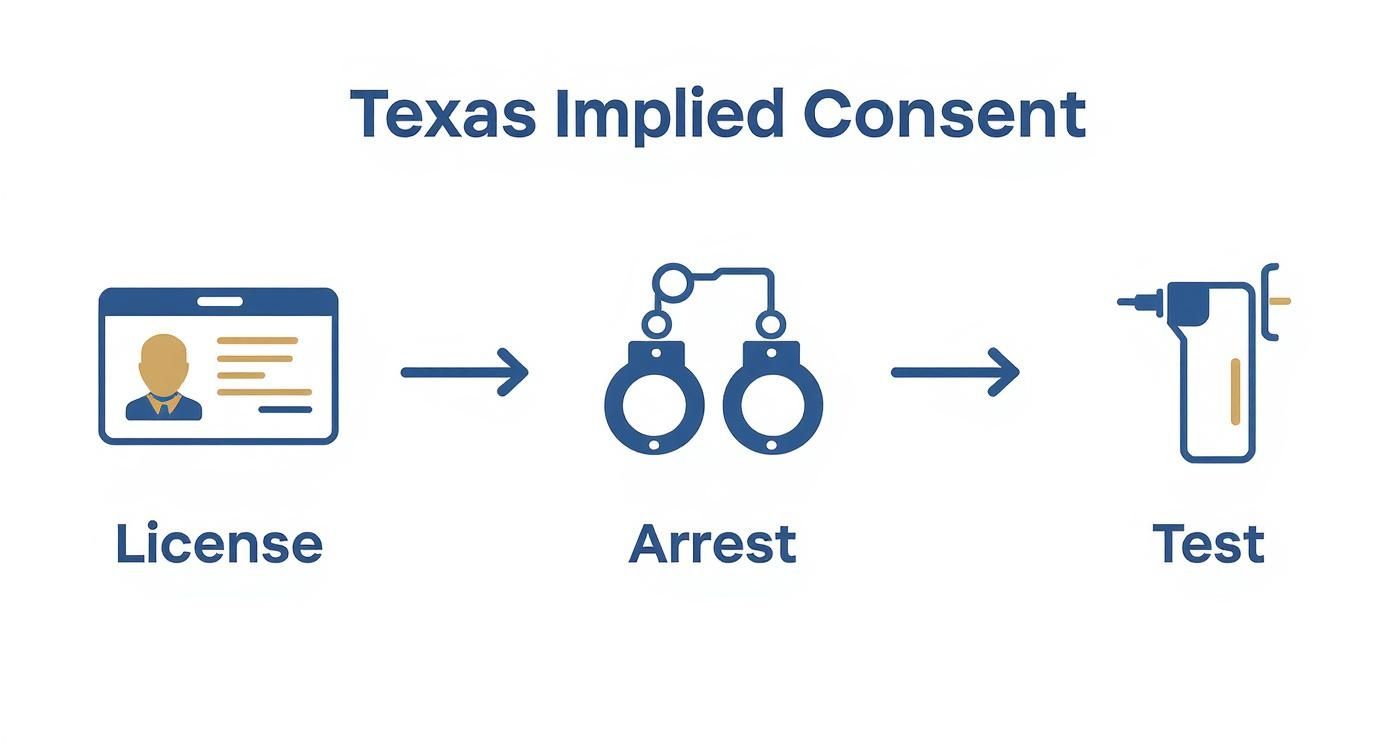
As you can see, the privilege of holding a Texas driver's license is legally tied to the expectation that you'll agree to a chemical test if lawfully arrested for DWI.
Your Most Critical Deadline: The 15-Day Window
Once you're arrested, a clock starts ticking. Loudly. You have exactly 15 days from the date on your Notice of Suspension to formally request an ALR hearing.
This is, without a doubt, one of the most important deadlines you will face in your entire DWI case.
If you miss the 15-day deadline, you lose your right to challenge the suspension. Period. Your license will be automatically suspended on the 41st day after your arrest, and there is nothing anyone can do to stop it.
Filing the hearing request on time freezes the suspension until the hearing takes place. This not only gives your attorney time to build a defense to save your license but also provides a golden opportunity to gather evidence and question the arresting officer under oath. It’s like a "test run" that can expose major weaknesses in the state’s criminal case against you.
How a Houston DWI Lawyer Can Fight for You
The ALR hearing is your one shot to prevent this automatic suspension. A skilled DWI defense attorney can challenge the state’s attempt to suspend your license on several grounds. We will work to show that:
- The officer had no reasonable suspicion to pull you over in the first place.
- There was no probable cause to arrest you for DWI.
- You were not properly placed under arrest before the officer requested a test.
- The officer failed to read you the required legal warnings about the consequences of refusing.
Winning the ALR hearing is a huge victory. It means you keep your license, but it also gives your legal team invaluable insight into the officer's testimony and the strength (or weakness) of the evidence. This information is priceless for building a stronger defense against the criminal DWI charge. To get a better handle on the specifics, you can learn more about the Administrative License Revocation process in Texas in our detailed guide. Don't let a simple calendar mistake cost you your freedom to drive—contact a Texas DUI attorney right away.
How a Refusal Impacts Your Criminal DWI Case
Many people think that refusing a breathalyzer is a get-out-of-jail-free card. It's not. Refusing to provide a breath sample doesn't make a DWI charge magically disappear. What it does do is change the kind of evidence the prosecution has to work with.
Without a specific Blood Alcohol Concentration (BAC) number, the state can't rely on scientific proof. So, they pivot. The case against you shifts from being about a number to being about everything the officer saw, heard, and smelled from the moment they pulled you over. Your driving, your appearance, how you spoke, and your performance on field sobriety tests—it all becomes evidence.
The Prosecution's New Game Plan
When there’s no BAC number to point to, a prosecutor has to convince a jury you were intoxicated by proving you lost the “normal use of your mental or physical faculties.” They build this story using two primary tactics.
- The Officer’s Observations: The arresting officer becomes the star witness. They will take the stand and paint a picture for the jury based on their report: red, glassy eyes; slurred speech; the smell of alcohol; fumbling for your license; an unsteady walk. Every detail is used to build a narrative of intoxication.
- Using Your Refusal Against You: This is a powerful psychological tactic. The prosecutor will argue that your decision to refuse the test is, by itself, a sign of guilt. They’ll suggest to the jury, "Why would an innocent person refuse to prove it? Because they knew they were drunk and wanted to hide the evidence."
This isn't a new strategy for them. Prosecutors in Texas have become masters at trying "no-test" cases, partly because so many drivers refuse. Historically, around half of all DWI suspects in Texas have refused chemical tests, forcing the state to get very good at arguing cases based on observation alone. You can read more about the challenges this presents for law enforcement in Texas.
The Strategic Edge a Refusal Gives Your Defense
While the state builds its case on subjective observations, your refusal hands your defense a major strategic advantage. By taking a specific BAC number off the table, you force the prosecution to rely on opinions—and opinions can be challenged.
A DWI case without a breath or blood test result is not a slam dunk for the prosecution. Instead, it becomes a case built on opinions and observations, which can be questioned, dissected, and dismantled by a skilled legal team.
Suddenly, your defense has room to create reasonable doubt. This is where a confident Houston DWI lawyer can step in and effectively counter the state’s claims, protecting your freedom and your future.
How a DWI Lawyer Fights a "No-Test" Case
An experienced Texas DWI attorney knows exactly how to attack a case built on subjective evidence. When there's no chemical test, a strong defense strategy will often involve:
- Challenging the Officer’s Observations: We poke holes in the officer's story. Were your eyes red from allergies or lack of sleep? Was your speech slurred because you were nervous and tired? Did you seem unsteady because you were standing on an uneven, poorly lit shoulder of the road?
- Discrediting the Field Sobriety Tests: SFSTs are notoriously unreliable and hard to pass even when sober. We can show a jury how the officer gave the instructions incorrectly or how outside factors—like flashing lights, passing traffic, your footwear, or a medical condition—made it impossible for you to perform as expected.
- Providing Alternative Explanations: Your refusal doesn't automatically mean you were guilty. We can argue that you refused based on sound legal advice, a general distrust of the accuracy of breathalyzer machines, or because you were simply confused and intimidated during a stressful traffic stop.
Ultimately, refusing a breathalyzer shifts the battlefield. It takes the case out of the black-and-white world of numbers and moves it into a grey area where legal strategy, cross-examination, and persuasive arguments can make all the difference. To fight your DWI charge in Texas, having an attorney who excels in this specific arena is absolutely critical.
What Happens When a Refusal Leads to a Blood Test Warrant?
Refusing a breathalyzer in Texas doesn’t always end the conversation. In fact, in many places like Houston, it often just starts a new one. This is because of what are commonly called “No Refusal” policies, which are becoming more and more common—not just on weekends, but all the time.
A “No Refusal” policy means that if you say no to a breath test, law enforcement won’t just let it go. Instead, they will immediately start the process of getting a search warrant from a judge. If the judge agrees the officer had probable cause to arrest you, they’ll sign a warrant that legally forces you to provide a blood sample.
In this scenario, your refusal doesn't actually stop a test from happening. It just changes the type of test you’re about to face.
The Shift from Breath to Blood
Once an officer has a warrant in hand, the game changes. The focus is no longer on a breath sample; it’s on a blood draw. This is a big deal, and knowing the difference between the two is key to understanding the evidence the state might try to use against you.
- Breath Tests: These are indirect measurements. They test the alcohol in the air you breathe out from your deep lungs and use a scientific formula to estimate your Blood Alcohol Concentration (BAC).
- Blood Tests: A blood test is a direct measurement of the alcohol in your bloodstream. It’s generally considered far more accurate and scientifically reliable than a breath test.
Here’s a crucial point: a blood test can also detect other things. It can find prescription medications or illegal drugs that could also lead to a DWI charge. While a breathalyzer is only looking for alcohol, a blood test gives prosecutors a much more detailed chemical picture.
How Accurate Are Breathalyzers Anyway?
The breathalyzer devices used by Texas law enforcement, like the Intoxilyzer models, are designed to estimate your BAC from a breath sample. But even after decades of use, their accuracy is constantly challenged. These machines can be thrown off by reliability issues, outdated software, or even outside factors like your body temperature or certain medical conditions.
If you want to dive deeper into how these devices work and where their weaknesses lie, you can discover more insights about breathalyzer technology.
You Can—and Should—Still Fight a Blood Test Result
Even if the police get a warrant and take your blood, it is not an automatic conviction. A skilled Houston DWI lawyer knows that every single step of this process has to be legally perfect, and every step can be challenged. An effective defense means digging into the entire procedure, from start to finish.
A warrant does not make the state's evidence untouchable. From the paperwork to the blood draw itself, every detail is an opportunity to build a strong defense and protect your rights.
We will meticulously investigate several critical questions:
- Was the Warrant Valid? Did the affidavit the officer gave the judge actually contain enough probable cause? Was it signed and executed correctly? Any mistake in the warrant could be grounds to get the blood evidence thrown out.
- Was the Blood Drawn Correctly? Texas has very strict rules about who can perform a blood draw and how it must be done. Was the person qualified? Was the area properly sterilized? An improper draw can contaminate the sample and make the results completely unreliable.
- What About the Chain of Custody? From the moment your blood is drawn until it gets tested at a lab, there must be a perfect, unbroken record of who had the sample and where it was. Any gap or mistake in this "chain of custody" can compromise the integrity of the evidence.
A refusal that ends in a blood test might feel like you've lost, but it actually opens up new avenues for a strategic defense. By challenging the warrant, the procedure, and the handling of the evidence, we can fight to have the results suppressed, which can significantly weaken the state’s case against you.
Higher Stakes for CDL Holders and Young Drivers
While any driver in Texas faces serious consequences for refusing a breathalyzer, the penalties aren't one-size-fits-all. For some people, saying "no" to a chemical test triggers immediate and uniquely damaging outcomes that can put their livelihood and future on the line.
The stakes are significantly higher if you hold a Commercial Driver's License (CDL) or if you're under 21. For these drivers, a refusal is more than just a 180-day suspension—it can be a career-ending or life-altering event.
The Career-Ending Consequences for CDL Holders
For a commercial truck driver, a CDL is their key to earning a living. Texas law recognizes this and holds CDL holders to a much stricter standard, even when they're off the clock and driving their personal vehicle.
If you have a CDL and are arrested for DWI, refusing a breathalyzer test results in an immediate one-year disqualification of your commercial driving privileges. This happens whether you were driving a big rig or your family sedan at the time of the stop.
This is a critical point: a DWI stop in your personal vehicle on a Saturday night can cost you your commercial license—and your career—for an entire year. A second offense or refusal will result in a lifetime disqualification.
Texas Zero Tolerance for Underage Drivers
Texas has a strict “Zero Tolerance” policy for drivers under the age of 21 who consume any amount of alcohol. While the adult BAC limit is 0.08%, for a minor, any detectable amount of alcohol in their system is illegal while behind the wheel.
This tough stance extends directly to breathalyzer refusals. The penalties for an underage driver who refuses a chemical test are designed to be severe and send a clear message.
- First Refusal (Under 21): A driver under 21 who refuses a breath test faces a license suspension of 180 days—the same as an adult.
- Previous Offenses: If the minor has any prior alcohol-related driving offenses on their record, that refusal can trigger a suspension lasting up to two years.
These extended suspension periods, combined with the other penalties of a DUI conviction, can have a profound impact on a young person’s ability to get to school, go to work, and build a future. Because the consequences are so severe for both CDL holders and young drivers, it is essential to contact a Houston DWI lawyer who understands the unique challenges you face. A strategic legal defense is your best tool to protect your license, your career, and your future.
Frequently Asked Questions About Breathalyzer Refusals
When you’re pulled over and refuse a breathalyzer, the questions start piling up fast. It’s a confusing and stressful situation. Let's clear the air and tackle some of the most common questions we hear from people just like you.
If I Refuse the Breathalyzer, Will I Automatically Go to Jail?
Not for the refusal itself. Let's be clear: the act of refusing a breath test isn't a separate crime that lands you behind bars. It's a civil issue that triggers an automatic suspension of your driver's license.
You will almost certainly still be arrested, but that arrest will be based on the officer's suspicion of DWI from other observations—like your driving, how you spoke, or your performance on field sobriety tests. The refusal just kicks off the separate Administrative License Revocation (ALR) process, which a skilled DWI lawyer can help you fight alongside the criminal charge.
Can I Get an Occupational License if Mine Is Suspended for a Refusal?
Yes, in most cases, you can get an occupational driver's license (ODL). Think of it as a restricted license that allows you to drive for essential, court-approved reasons like getting to work, school, or handling necessary household duties during your suspension.
But there's a catch. Refusing a breath test comes with a mandatory "hard suspension" period where you can't drive at all. You're not even eligible to apply for an ODL until this waiting period is over. This is where an experienced attorney is invaluable—they can navigate the petition process to get you back on the road legally as soon as possible.
Is It Ever a Good Idea to Take the Breathalyzer Test?
This is the million-dollar question, and there’s no single right answer. It’s a strategic decision that depends entirely on your situation.
On one hand, if you are 100% certain you are sober and well under the legal limit, blowing a clean sample could get you released without charges. But that's a big "if." Breathalyzer machines are notoriously unreliable and can be challenged in court for all sorts of reasons, from improper calibration to user error.
Because of this, many defense attorneys advise politely refusing all chemical tests. Why? Because you avoid handing the prosecutor what they see as concrete evidence—a number. By refusing, you don't accidentally give them a flawed piece of evidence they can use to build a case against you. More often than not, a refusal puts you in a stronger position to fight a DWI charge in Texas.
A DWI arrest can feel like your world is caving in, but you have the power to fight back and protect your future. The team at The Law Office of Bryan Fagan, PLLC is here to stand with you, defend your rights, and build a powerful defense strategy designed to secure the best possible outcome. We handle every single aspect, from the administrative license hearing to the criminal court proceedings, so you can have peace of mind.
Don’t let this mistake define your future. Contact us 24/7 to request a free and completely confidential evaluation of your case. Let us show you how we can help.

