
A DWI arrest can be overwhelming. You may still hear the patrol lights in your head. You may be replaying every question the officer asked and every answer you gave.
That reaction is normal. Individuals often want to explain themselves. They want to sound respectful, cooperative, and harmless. In a Texas DWI case, though, statements to police can affect both your criminal charge and your ability to keep driving.
If you were arrested in Houston, Dallas-Fort Worth, Austin, San Antonio, or anywhere else in Texas, this is the practical rule to remember: your case is not over because you talked. But what you said matters, and what you do next matters even more. A skilled Houston DWI lawyer or Texas DUI attorney can review the stop, the body cam, the reports, the testing process, and the administrative paperwork to look for ways to limit the damage and fight back.
The Ways Your Words Can Be Used After a DWI Arrest
It usually starts with a simple question.
“Have you had anything to drink tonight?”
Most drivers don't hear that as a legal trap. They hear it as a chance to clear things up. So they say something like, “Just one with dinner,” or “I’m fine to drive,” or “I’m tired, not drunk.”
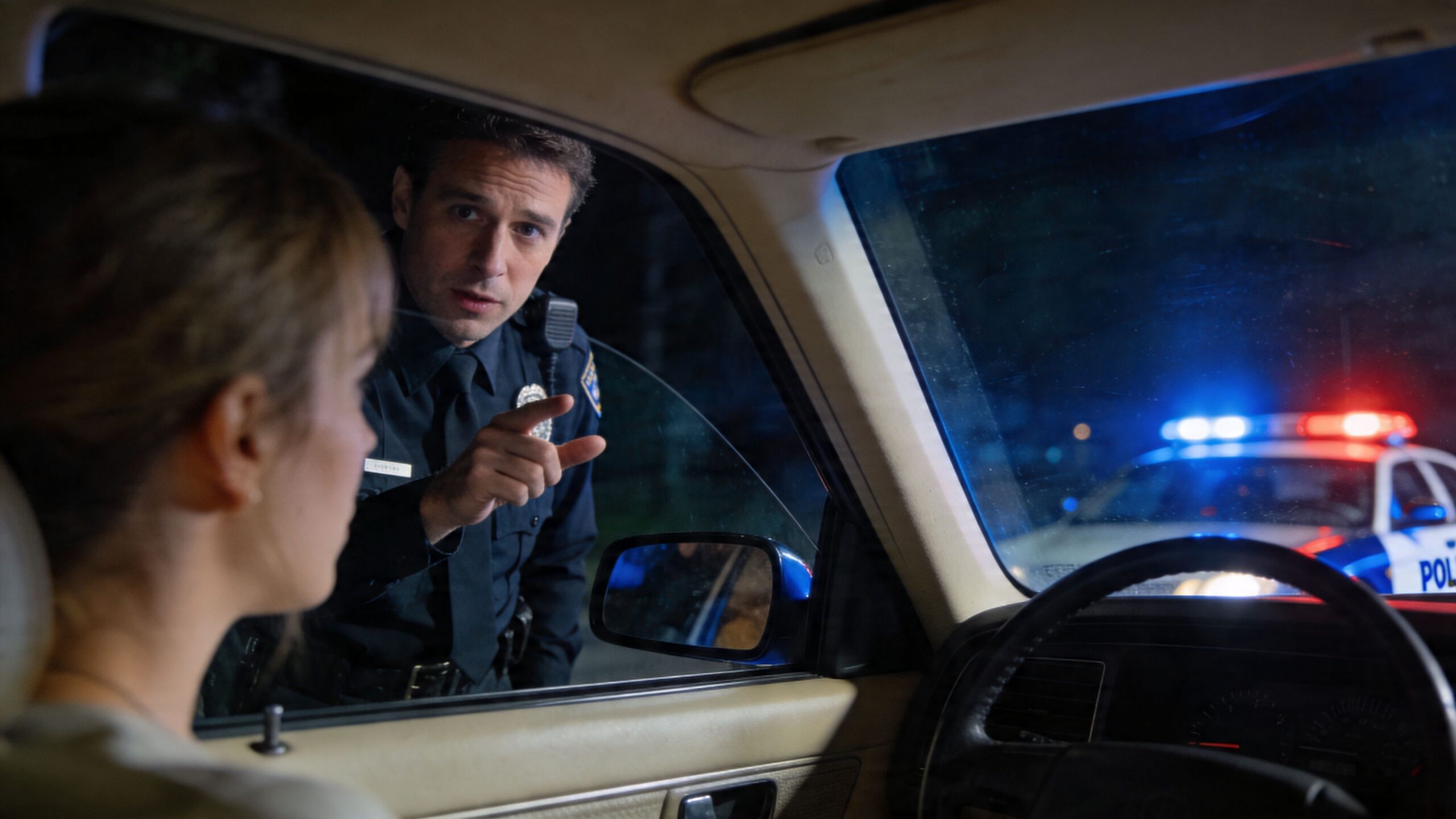
Those words may feel harmless in the moment. Later, they can be written into a report as evidence of alcohol consumption, timing, and state of mind. A prosecutor may use them to argue that you admitted drinking, admitted driving, and showed consciousness of guilt by trying to minimize it.
Why the roadside conversation matters
A DWI stop is stressful. You're standing on the side of the road. Cars are passing. An officer is watching your face, your hands, your speech, and your balance. Under pressure, people fill silence with explanations.
That's often where the damage begins.
A short exchange can become part of the state's narrative:
What you said
“I had two drinks earlier.”What the report may say
Driver admitted consuming alcohol before operating a vehicle.What the prosecutor argues
The defendant confirmed drinking before driving.
Practical rule: The officer is gathering facts for a case, not helping you explain your way out of one.
Officer interpretation isn't always neutral
Another problem is that courts often give substantial weight to the officer's version of events. Legal scholarship has noted that courts often prioritize officer narratives over citizen counter-stories, and that implicit bias can shape how ambiguous conduct or statements are interpreted, especially when decision-makers are working with incomplete information, as discussed in this analysis of ignored citizen narratives in police encounters.
That means even an innocent comment can be reframed. “I’m nervous” may be heard as panic. “I only live five minutes away” may sound like an admission that you knew you shouldn't be driving farther. “I had one drink” can become the sentence the state repeats most.
If this happened to you, take a breath. There are still defenses. A lawyer can compare the report to body cam footage, challenge how your words were characterized, and work to protect both your record and your license.
What Counts as a Statement to Police in Texas
Many people think a statement to police means a signed confession at the station. In real life, it's much broader than that.
In a Texas DWI case, a “statement” can include almost any communication that the officer can document, record, or describe later. To illustrate, consider different file types on a phone. A voice memo, a text, a video clip, and a typed note are all different formats, but they still store information. Police and prosecutors treat your communications the same way.
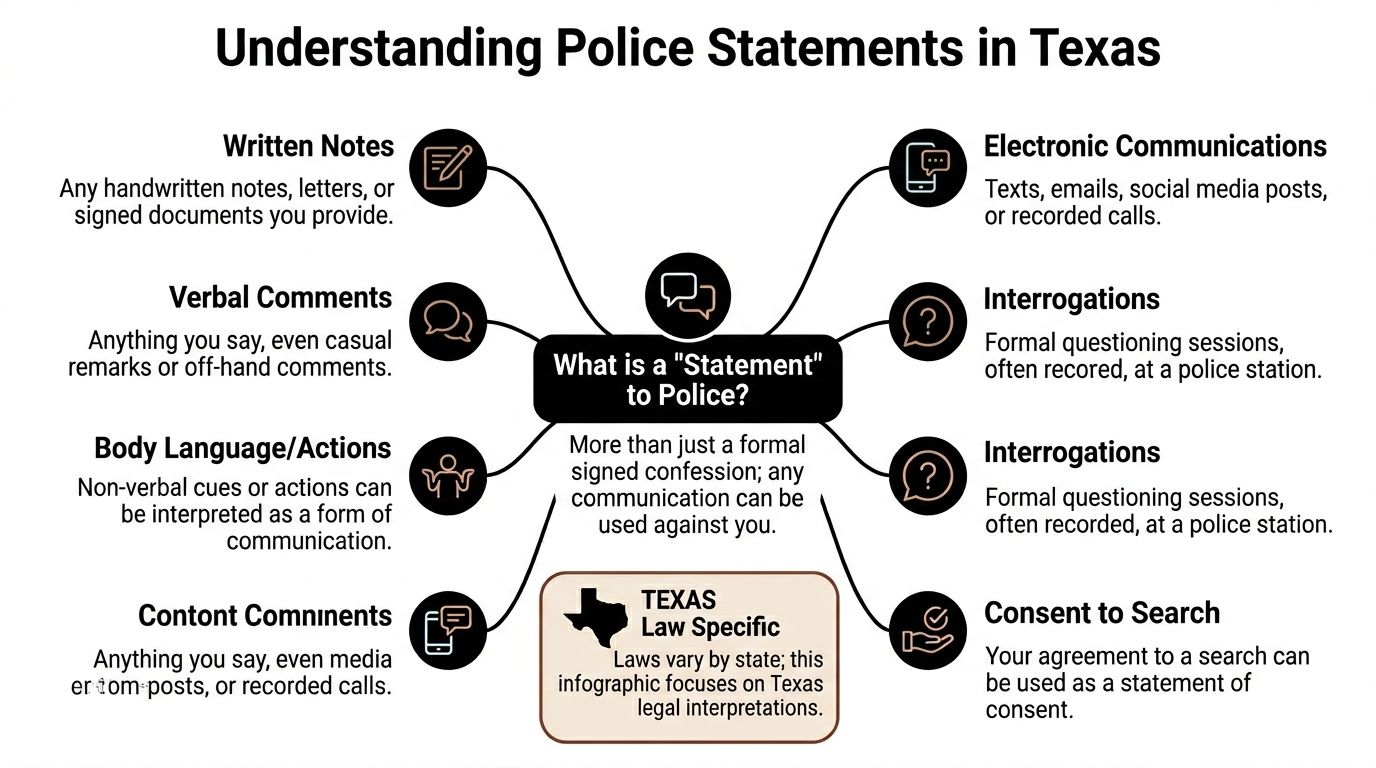
Verbal statements count, even casual ones
The most obvious category is spoken words.
That includes your answers to direct questions, but it also includes offhand comments like:
Minimizing remarks
“I only had a couple.”Explanations
“I was swerving because I'm tired.”Timeline comments
“I left the bar an hour ago.”
None of those feels like a confession. All of them can be used to build a timeline and support an officer's conclusions.
Written and recorded statements count too
Sometimes a driver gives a written statement after an accident or at the jail. Sometimes the only “statement” is on body cam, dash cam, a jail phone recording, or a voicemail left for someone else.
In practical terms, statements may include:
| Type | Example | Why it matters |
|---|---|---|
| Spoken | Answers during the stop | Can be quoted in the report |
| Written | A note, form, or signed explanation | Can be introduced as your own words |
| Recorded | Body cam or station video | Preserves tone, timing, and wording |
| Electronic | Texts or social media posts | May be used to infer drinking or driving |
Even your conduct can be treated as communication
Not every statement is verbal.
An officer may describe your gestures, hesitation, refusal to answer, nodding, pointing, or your response to instructions as meaningful conduct. Consent is another example. If you agree to a search or to certain testing procedures, that can be presented as a form of communication showing awareness or cooperation.
A “statement” in a DWI case isn't limited to a formal confession. It's often a collection of small comments and reactions that the state pieces together.
The same words can show up in two places at once. They may appear in the criminal case and in the administrative license suspension process. If you're dealing with a first DWI in Texas, understanding that early can help you avoid making the problem worse after release.
Your Constitutional Shield Understanding Your Rights
Your rights existed before the officer ever turned on the lights. Miranda warnings don't create those rights. They remind you of rights you already have.
One of the most important is the Fifth Amendment right to remain silent. Another is your right to counsel. In plain language, that means you don't have to answer investigative questions designed to help build a case against you, and you can ask for a lawyer.
What Miranda does and doesn't do
People often say, “They never read me my rights, so the case gets dismissed.”
Usually, it doesn't work that easily.
Miranda warnings are generally required during custodial interrogation. That means two things are happening at once:
You are in custody
A reasonable person in your position wouldn't feel free to leave.Police are interrogating you
They are asking questions or using tactics likely to produce incriminating answers.
If police ask routine roadside questions before that point, the legal analysis may be different than it is after an arrest. That's why your attorney has to examine the exact timing, location, and wording of the encounter.
How to use your rights clearly
The law gives you rights. You still have to invoke them in a way that is clear.
Good examples include:
Remain silent
“I am going to remain silent.”Ask for counsel
“I want to speak with my lawyer.”Repeat if needed
If questioning continues, calmly repeat the same request.
Don't argue. Don't explain why. Don't fill the silence because it feels awkward.
The safest sentence in many DWI cases is short: “I want a lawyer, and I'm remaining silent.”
If you want a simple explanation of how the privilege against self-incrimination works in court, this page on pleading the Fifth in court is a useful starting point.
Key terms that confuse people
Some DWI terms get tossed around so often that people nod without really knowing what they mean. Here's the plain-English version.
BAC
Blood alcohol concentration. This is the measurement the state uses when it talks about alcohol level in your breath or blood.Implied consent
Texas law says that by driving on Texas roads, you are deemed to have consented to requested breath or blood testing under certain conditions. That doesn't mean every search is automatically lawful. It does mean a refusal can trigger separate consequences.Field sobriety test
These are roadside divided-attention exercises officers use to look for signs of impairment. Common examples include the walk-and-turn, one-leg stand, and eye test. They are not the same thing as a breath test.Administrative license suspension
This is the civil process, separate from the criminal case, where the state tries to suspend your license after a failed test or refusal. In Texas, people often call this the ALR process.
A short video can help if this still feels abstract.
Why invoking your rights early matters
Once you start talking, you give the state material to work with. Once you clearly stop talking and ask for counsel, your lawyer has a stronger foundation to challenge what happened after that point.
That doesn't mean silence fixes everything. It means silence prevents new damage. And after a DWI arrest, preventing new damage is often the first strong move in a defense strategy.
How Your Words Become Weapons in a DWI Case
A prosecutor doesn't need your statement to be dramatic. They need it to be useful.
In many Texas DWI cases, the state builds its argument one brick at a time. A statement about where you were. A statement about when you drank. A statement about how much you had. A statement about whether you felt okay to drive. By trial, those pieces are presented as if they tell one clean story.
One sentence can prove several points at once
Take this common answer: “I had two beers a few hours ago.”
That single sentence may be used to argue all of the following:
Consumption
You admitted drinking alcohol.Timing
You connected the drinking to the period before driving.Control
You placed yourself behind the wheel after drinking.Credibility
If a chemical result or officer observations suggest something different, the state may claim you were minimizing.
That's why trying to sound reasonable can backfire. You think you're limiting the damage. The state hears an admission.
Statements can help support probable cause
Police don't arrest someone for DWI based on one thing alone. They usually point to a combination of observations and answers.
Your speech, odor, driving pattern, balance, and roadside comments may all be listed together to justify arrest. If you want to understand how officers frame that decision, this explanation of probable cause in Texas gives useful context.
A statement can also influence the officer's next steps. If you admit drinking, the officer may decide to push harder on field sobriety testing, request breath or blood testing, or note that your own words supported an intoxication investigation.
The police report isn't the final truth
Many people assume the report is neutral because it looks official. It isn't always reliable.
Research on police reports has documented reliability concerns and noted that some departments have misclassified offenses, such as logging a robbery as a simple assault, which shows how official records can be shaped by categorization choices and reporting practices, as discussed in this analysis of police reports and their reliability problems. In a DWI case, the practical lesson is straightforward. Your words can be shortened, paraphrased, or taken out of context in a report that later gets treated like a clean summary of what happened.
If the officer writes, “Driver admitted drinking,” the real fight may be over the missing details around that sentence.
The ALR case is separate from the criminal case
This part surprises many people. After a DWI arrest in Texas, you may be dealing with two proceedings:
| Process | What it deals with | Why your statements matter |
|---|---|---|
| Criminal case | Guilt, punishment, court outcome | Statements may be used as evidence of intoxication or probable cause |
| ALR hearing | Your driver's license | Statements may support suspension after refusal or alleged failure |
The ALR hearing stands for Administrative License Revocation. It is not your criminal trial. It focuses on license consequences. A statement you made during the stop can still matter there because the state may use it to support the officer's justification for the arrest, the request for testing, or the paperwork tied to a refusal or result.
How prosecutors use your words later
If your case goes deeper into litigation, your statement can resurface in several ways:
At pretrial
To defend the legality of the stop and arrest.During plea negotiations
To strengthen one's position by pointing to your own admissions.At trial
To cross-examine you if your testimony differs from the officer's account.
This is why a smart defense starts with reconstruction. Your attorney compares body cam, dash cam, dispatch records, forms, and timelines to see whether the state's version matches what happened.
Common and Costly Mistakes When Speaking to Officers
Most mistakes happen because people are trying to help themselves.
They think if they sound polite, honest, and calm, the officer will let them go. In a DWI stop, the opposite often happens. The more you talk, the more material you provide.
Trying to talk your way out of it
A driver says, “Officer, I know how this looks, but I’m not drunk.”
That statement usually doesn't help. It places the idea of intoxication right into the conversation and invites more questions. Then comes, “How much did you have?” and “Where were you drinking?” and “What time did you leave?”
The better move is simple and respectful. Provide identification if required. Don't volunteer explanations.
Admitting “just a couple”
This is one of the most common traps.
People think “just a couple” sounds safe because it sounds moderate. The problem is that it still admits alcohol use. It also sounds vague, which gives the prosecutor room to argue you were minimizing.

Giving answers during roadside test chatter
Officers often ask questions while setting up or discussing field sobriety tests. Drivers treat that as casual conversation. It isn't.
A common sequence sounds like this:
Officer asks
“Any medical issues? What have you had to drink? Are you okay to do these tests?”Driver answers too broadly
“No medical issues. I had two beers. I’m just tired from work.”
Each answer can become a separate note in the report. If you're trying to understand the kinds of questions officers ask around these exercises, this guide on sobriety test questions shows how these conversations often unfold.
People often think the danger is the breath machine. In many cases, the first damage happened in the conversation before that.
Telling a small lie that turns into a bigger problem
Another common mistake is denial that doesn't hold up.
A driver says, “I haven't had anything to drink.” Later, the body cam captures the driver saying they came from a bar, or a receipt appears, or a witness says something different. Now the state argues not only intoxication, but dishonesty.
That doesn't mean you should confess. It means you shouldn't guess, minimize, or lie. Silence is safer than a story you can't control later.
Speaking after the arrest because it feels hopeless
Some people stay quiet during the stop, then start talking in the patrol car or at the jail because they think the decision has already been made.
That is another costly mistake.
Conversations after arrest can be recorded. Statements made out of frustration, embarrassment, or exhaustion may still be used. Saying “I knew I shouldn't have driven” or “I only messed up because I was upset” can become powerful evidence for the prosecution.
A calm response is better. Ask for a lawyer. Stop discussing the facts. Save your explanation for your defense team.
Special Considerations for CDL and Out-of-State Drivers
If you hold a commercial driver's license, or if you were arrested while visiting Texas, the statement issue gets more serious fast.
For a regular driver, bad statements can hurt the criminal case and the DWI license suspension process. For a CDL holder or out-of-state driver, those same words may create job, travel, and home-state problems that reach beyond the county where the arrest happened.
CDL holders face stricter practical consequences
Commercial drivers often assume, “I blew under the normal limit, so I should be okay.”
That can be a costly misunderstanding. Legal commentary on police-suspect interactions notes that for CDL holders in Texas, a statement admitting alcohol consumption can trigger administrative consequences even if the driver is below the standard .08 BAC, and it also notes growing concerns about surveillance tools that can later be used to contextualize a stop, which is especially risky for commercial and visiting drivers, as discussed in this article on police and suspects.
For a commercial driver, that means a roadside comment like “I had one drink with dinner” may carry far more weight than expected.
Out-of-state drivers don't leave the case behind in Texas
Visitors often think the problem stays local. It doesn't always work that way.
Your Texas arrest can affect your home-state driving status, your insurance situation, and your ability to drive for work. If you refused testing or made statements that support the officer's paperwork, those issues can follow you after you go home.
A practical checklist for these drivers looks different:
CDL holder
Protect your job records, gather every DPS-related paper, and get legal advice immediately.Out-of-state driver
Don't assume your local license agency won't hear about the arrest. Treat the Texas case seriously from day one.Anyone who drives for a living
Avoid discussing the facts with employers before you speak with counsel. Loose explanations can create new problems.
If your livelihood depends on driving, your defense has to account for both courtroom risk and licensing risk at the same time.
How a DWI Attorney Fights Back Against Your Statements
You may have answered a few questions because the officer sounded casual. Then, days later, those same words show up in a report as proof you had been drinking, proof you were confused, or proof you admitted guilt. That is where a defense lawyer goes to work.
A strong DWI defense starts by treating your statements like evidence that must be tested, not accepted at face value. In Texas, that matters in two places at once. Your words can affect the criminal case under the Penal Code and Code of Criminal Procedure, and they can also show up in the ALR record that DPS uses to argue for a license suspension. One conversation can create two problems, so your lawyer has to address both.
The first job is to reconstruct the full scene. A DWI attorney compares body camera footage, dash camera video, dispatch times, offense reports, implied consent paperwork, intoxilyzer records, jail recordings, and any witness account. A police report often reads like a clean story with neat quotes and clear admissions. Real roadside encounters are rarely that clean. People are tired, nervous, interrupted, and sometimes talking over traffic noise or multiple officers.
That context matters a lot. An officer may write, “Driver admitted drinking.” Video may show something much different, such as a vague answer to a confusing question, or a statement that was cut off and later paraphrased in the officer's own words. Lawyers look for those gaps because juries and ALR hearing officers often get the written version first.
A motion to suppress can shut the statement out
One of the main tools is a motion to suppress. That asks the judge to exclude a statement the State should not be allowed to use.
The challenge may focus on several issues:
Custodial questioning without proper warnings
If the encounter had become custodial and the officer kept interrogating without the required protections, the statement may be excluded.Involuntary statements
Texas law does not allow the State to use a statement that was the product of coercion, threats, confusion, or improper pressure.An illegal stop or arrest
If the initial detention or arrest was unlawful, later statements may also be vulnerable.Poor proof of what was said
If the officer's summary does not match the recording, the defense can attack accuracy and credibility.
This is not just a technical exercise. If the statement gets suppressed in the criminal case, the prosecution may lose one of the facts it planned to use to explain field sobriety tests, justify the arrest, or argue intoxication. If the same statement appears in the ALR file, the lawyer can also challenge how much weight it deserves there.
A lawyer also tests the officer's interpretation
Officers do not just repeat statements. They interpret them.
That is where bias can creep in. A tired driver who says, “I'm nervous,” may be described as showing confusion. A driver with an accent may be quoted inaccurately. A polite answer like “I had a drink earlier” may be framed as an admission tied to intoxication, even though the timing, quantity, and surrounding facts were never pinned down. In a DWI case, a lawyer has to separate what you said from what the officer assumed you meant.
That work often happens through cross-examination. The attorney can press the officer on exact wording, tone, timing, interruptions, and whether the report uses polished language that no one used on the roadside. Small differences matter. “I drank earlier” is not the same as “I was intoxicated while driving.”
Reports and recordings often tell different stories
Paper compresses a messy encounter into a few lines. Video slows it back down.
A good defense lawyer watches for missing details. Was the officer asking rapid-fire questions? Did you ask for clarification? Were you standing on the shoulder with headlights flashing in your face? Did the officer ask a compound question and later write your answer as an admission to only one part of it?
Those details can change how a judge, prosecutor, or ALR hearing officer sees the statement. They can also support an argument that the officer overstated certainty, left out qualifying language, or drew conclusions not supported by the recording.
The State's opinion evidence can be challenged too
Sometimes the prosecution tries to pair your statements with officer opinion testimony. The officer may claim your answers showed confusion, divided attention problems, or consciousness of guilt. Those opinions are not automatically reliable just because they come from a uniform.
A defense attorney can challenge whether the opinion is based on enough facts and whether the officer is stretching ordinary behavior into signs of intoxication. Nervousness after an arrest is ordinary. Trouble answering questions on a dark roadside is ordinary. Saying something awkward after being stopped by police is ordinary. The State still has to prove more than suspicion.
Good defense work also protects the license side
The criminal case is only half the problem. In Texas, your statements can also become part of the ALR fight over your driver's license. A lawyer can request the hearing, review the officer's sworn reports, lock in testimony early, and look for inconsistencies between the ALR file and the criminal case file.
That early testimony can be useful later. If the officer changes the story, adds new details, or gives a cleaner version at trial than the one given under oath in the ALR process, your lawyer may be able to use that inconsistency to challenge credibility.
The Law Office of Bryan Fagan, PLLC handles DWI defense work that includes review of probable cause, suppression issues, ALR hearing preparation, and challenges to field sobriety and chemical test evidence. If you already made statements, the goal is no longer to wish them away. It is to examine how they were obtained, limit the damage, and force the State to prove every word the hard way.
Your Next Steps Protect Your Rights and Your Future
A lot of people make the hardest mistake in the first 24 hours. They keep talking because they want to sound honest, cooperative, or harmless. In a Texas DWI case, that instinct can hurt both tracks of your case at once. The criminal charge and the license suspension process can each use your words in different ways.
Your job right now is simple. Stop giving the government more material to work with.
Start with these steps:
Stop discussing what happened
Do not explain the stop or arrest to police, jail staff, insurance adjusters, friends, coworkers, or online. A casual text like "I only had two drinks" can later be treated like an admission. Even a statement meant to sound responsible can be taken out of context.Collect every paper you received
Put your bond paperwork, citation, notice connected to your driver's license, tow or inventory forms, and any test-related documents in one place. Those papers often contain dates, officer names, and deadlines that matter early.Write a private timeline for your lawyer
Do it while the details are still fresh. Include where you were, when you were stopped, what questions were asked, whether you were read any warnings, what tests were requested, and what you said in response. Memory fades fast after a stressful arrest. A simple timeline helps your lawyer compare your recollection to the officer's report and any video.Treat the license issue as urgent
In Texas, the ALR process has its own clock. If you wait too long, you can lose the chance to challenge the suspension in a useful way. That hearing is not just about driving privileges. It can also give your lawyer an early look at the officer's version of events under oath.Get legal advice before you try to explain yourself
Early advice matters whether this is a first arrest or not. A lawyer can spot when a "harmless" statement may affect probable cause, a breath or blood case, or the license side under the Transportation Code.
One more point matters for certain drivers. If you hold a CDL or you were arrested while traveling through Texas with an out-of-state license, the fallout can spread beyond this county and beyond this court. Your ability to drive for work, keep insurance, or deal with your home state's licensing agency may depend on what gets done early.
You do not need to solve the whole case today. You need to stop the avoidable damage, preserve the facts, and make sure no one uses your own words as a shortcut to suspend your license or build the criminal case.
If you are dealing with statements to police after a DWI arrest, contact the Law Office of Bryan Fagan, PLLC for a free, confidential consultation. A lawyer can review the stop, explain the ALR deadlines, assess how your statements may be used, and build a clear plan to protect your rights and your future.