
A DWI arrest can be overwhelming, but you don’t have to face it alone.
One minute you’re driving home. The next, you see flashing lights in your mirror, step onto the shoulder, answer a few questions, and suddenly your car is being towed and you’re sitting in a holding cell wondering whether your license, job, and record are about to take a permanent hit.
That panic is real. So is the confusion. A common reaction is to replay the breath test, the roadside questions, or the field sobriety test. I look earlier. I look at the stop itself.
Introduction: Your DWI Arrest Started with a Traffic Stop, So Does Your Defense
Every Texas DWI case starts with a seizure. An officer stopped you. That stop had to be legal. If it wasn’t, the entire case may be built on a broken foundation.
That’s why an illegal traffic stop DWI Texas defense strategy is not some technical loophole. It’s one of the most practical and effective ways to fight a DWI case. If the officer had no lawful reason to pull you over, the state may lose the evidence it needs to convict you.
Texas files a huge number of DWI cases. In 2020, Texas recorded 83,088 DWI charges, and over 90% of arrests led to formal charges. At the same time, skilled defense attorneys have used procedural flaws, including unlawful stops, to achieve dismissal rates around 10% to 15% according to Texas DWI dismissal statistics discussed here.
Bottom line: If the stop was illegal, your defense may start before the officer ever asked whether you had been drinking.
That matters whether this is your first DWI in Texas, whether you hold a CDL, or whether you’re a licensed professional worried about background checks and a DWI license suspension. A charge is serious. It is not the same thing as a conviction.
I want you to think about your case the right way. Not as a foregone conclusion. As a sequence of decisions, police actions, video evidence, deadlines, and legal challenges. The stop is often the first place the state gets exposed.
What Makes a Traffic Stop Illegal in Texas?
A traffic stop is legal only if the officer had reasonable suspicion before activating the lights. In plain English, that means the officer must be able to point to specific facts showing a traffic violation or criminal activity.
A hunch doesn’t count. A stereotype doesn’t count. “It was late and the driver came from a bar area” doesn’t count by itself.
Reasonable suspicion versus probable cause
Think of reasonable suspicion as the minimum legal basis to stop your car. Think of probable cause as the higher standard for an arrest or search. Officers often blend those ideas together in reports. Judges shouldn’t.
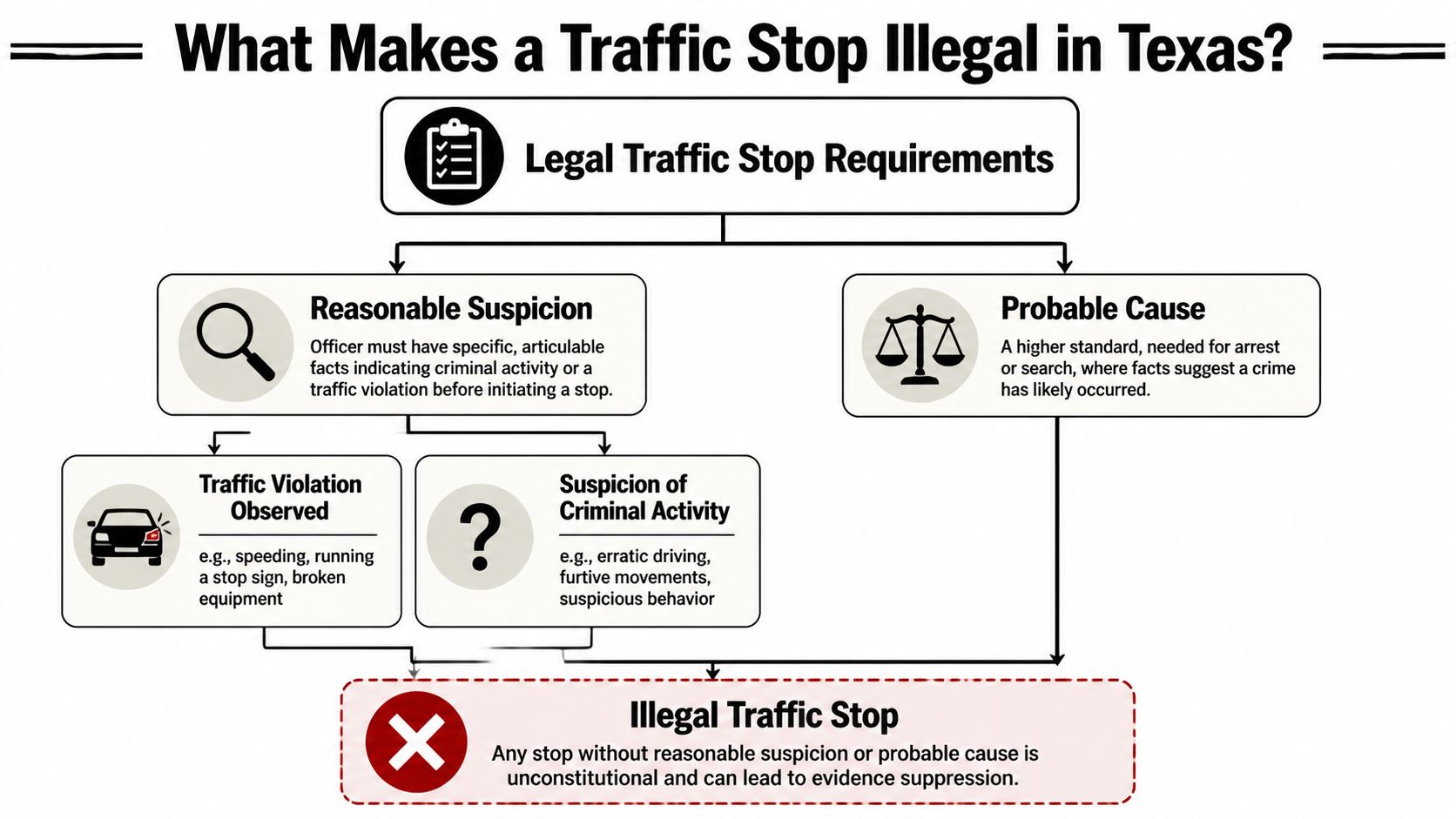
Under Texas law, a lawful stop requires specific, articulable facts. The standard comes from Terry v. Ohio. An officer cannot stop you on a hunch. The officer must identify an objective basis such as speeding under Texas Transportation Code §545.351 or failing to maintain a single lane under Texas Transportation Code §545.060. When that legal basis is missing, the evidence can be excluded, as explained in this Texas reasonable suspicion guide and in these reasonable suspicion examples in Texas DWI cases.
What usually supports a valid stop
Some stops are plainly valid. If the officer saw a clear violation, that may be enough.
- Speeding: Even a small speed violation can justify a stop.
- Lane violations: Repeated drifting or failure to maintain a lane can support reasonable suspicion.
- Equipment problems: A non-functioning headlight or similar issue can support a stop.
- Observed dangerous driving: Clear swerving, wide turns, or other specific conduct may be enough.
What often points to an illegal stop
Other stops are much weaker than officers make them sound in a report.
- Leaving a bar or restaurant: That is not a traffic violation.
- Driving late at night: Time of night alone does not create reasonable suspicion.
- A vague claim of “suspicious behavior”: Courts want facts, not labels.
- An unsupported hunch: Officers can’t legally pull you over because something “felt off.”
- A thin anonymous report with no follow-up observation: The officer still needs a lawful basis.
A legal stop starts with facts the officer can describe. If those facts are missing, the stop is vulnerable.
Why this matters to your case
When I review a DWI arrest, I don’t assume the report is accurate. I compare the written reason for the stop to the evidence. Did the dashcam show weaving? Did the bodycam audio match the claim? Did the officer describe a violation that Texas law recognizes?
That early review can change the entire direction of your case. It can also shape how a Houston DWI lawyer or Texas DUI attorney attacks the state’s evidence from day one.
The Fruit of the Poisonous Tree Doctrine in DWI Cases
Once a stop is illegal, the next question is simple. What happens to everything that came after it?
Usually, it becomes vulnerable to suppression.
The tree and the fruit
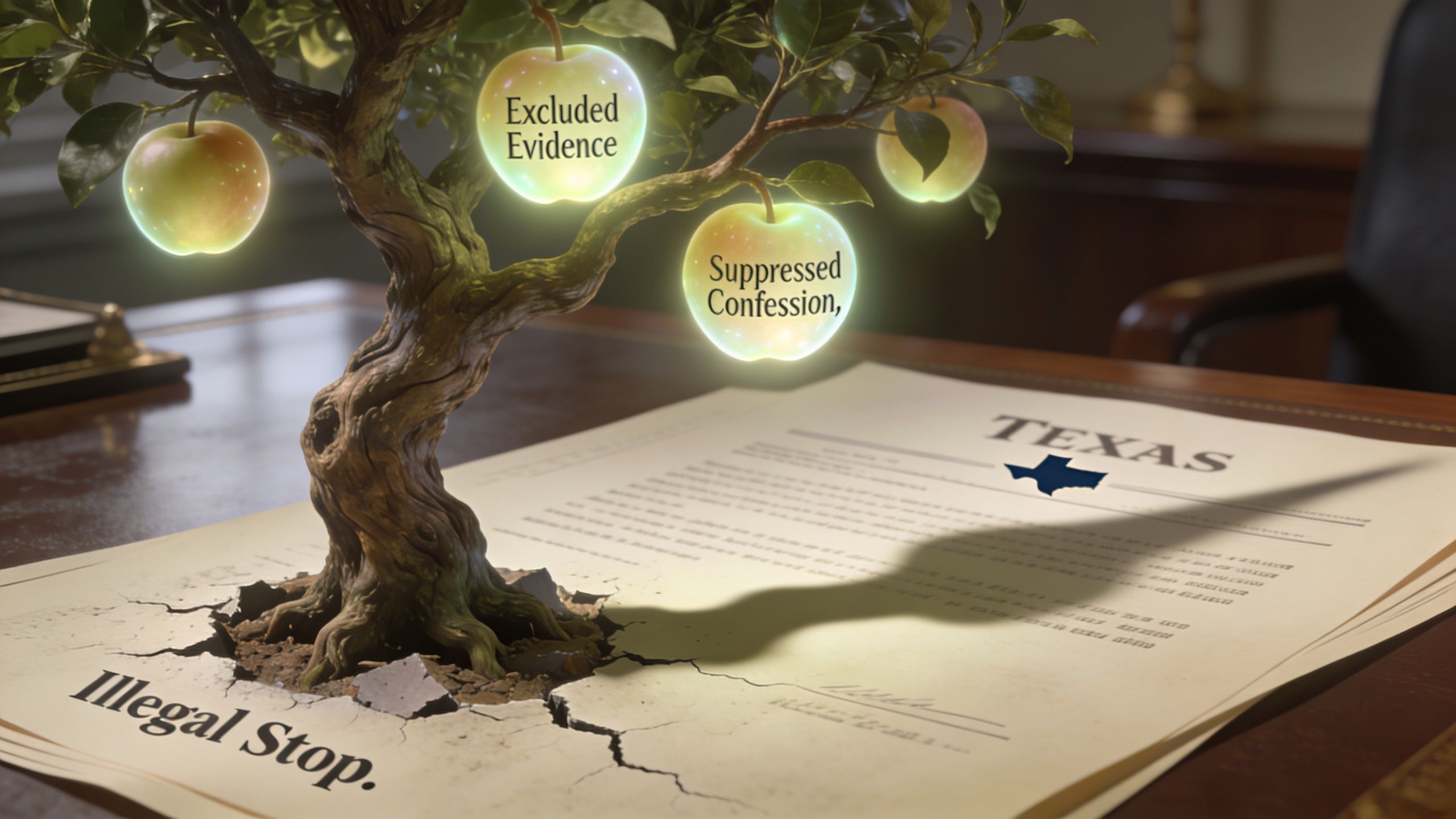
Lawyers call this the fruit of the poisonous tree doctrine. The image is useful because it gets to the point fast. If the tree is poisoned, the fruit growing from it is poisoned too.
In a DWI case, the “tree” is the stop. The “fruit” is the evidence the officer gathered after stopping you. If the stop violated the Fourth Amendment, the state may lose the very evidence it planned to use against you.
What evidence can be thrown out
In many DWI cases, an illegal stop puts all of this at risk:
- The officer’s observations: Odor of alcohol, bloodshot eyes, slurred speech, and balance issues.
- Field sobriety test evidence: Walk-and-turn, one-leg stand, horizontal gaze nystagmus, and related observations.
- Breath test results: If the stop was unlawful, the breath evidence can become suppressible.
- Blood test results: The same problem applies to blood draws that flowed from an illegal detention.
- Your statements: Admissions about drinking or where you came from may be challenged too.
An illegal stop significantly strengthens the defense. It doesn’t just trim the edges off the prosecution’s case. It can remove the center of it.
Why prosecutors care so much about suppression hearings
Prosecutors can try DWI cases when they have strong video, officer testimony, and chemical test results. They struggle when a judge strips that evidence away.
Texas law allows exclusion of unlawfully obtained evidence through Article 38.23, and the doctrine traces back to Wong Sun v. United States. In practical terms, if the officer had no legal basis to stop you, there may be nothing left to prove intoxication beyond a reasonable doubt.
If the court suppresses the stop, the state may lose the roadside investigation, the arrest evidence, and the test results in one ruling.
This affects more than guilt or innocence
Suppression can also change negotiations. A case that looked strong on paper can become a case the prosecutor wants to reduce, rework, or dismiss.
That matters if you’re trying to fight DWI Texas charges without destroying your ability to work, drive, or protect your professional license. It also matters if your immediate concern is the practical side of the case, such as an administrative license suspension, an ignition interlock requirement, or the long-term impact of a DWI conviction.
How We Build Your Defense Around an Illegal Stop
You were pulled over, the officer started asking questions, and within minutes a routine drive turned into a DWI arrest. That first decision to stop your car is often the pressure point that can break the case open. We start there, fast.
A strong illegal-stop defense comes from records, video, timing, and pressure in the right places. Guesswork loses. A disciplined review gives you a real chance to cut out the state’s evidence and put the prosecutor in a weaker position.
First, we lock down the evidence
The first step is usually a not guilty plea and a demand for every piece of evidence tied to the stop and detention. That keeps your defense open while we examine what the officer claims happened against what the records and video reveal.
Then we collect the full file:
- Police report
- Dispatch details
- Dashcam footage
- Body-worn camera footage
- Breath or blood records
- Any warrants or affidavits
- ALR paperwork

Next, we test the officer’s reason for stopping you
This step often changes the direction of a case. Officers write short reports that sound tidy and certain. Video often exposes gaps, exaggerations, or flat contradictions.
I compare the report to the footage frame by frame. If the report says you failed to maintain a lane, I want the exact moment on camera. If the officer says you were speeding, I want to know how speed was measured and whether the video supports that claim. If the report falls back on vague phrases like “weaving” or “unsafe movement,” I press for details because judges should not accept labels in place of facts.
The questions are simple, but they matter:
- Was there an actual traffic violation before the lights came on?
- Does the dashcam show the conduct described in the report?
- Did the officer give a different reason later?
- Did the stop drag on before any DWI investigation began?
- Do the bodycam and dashcam match, or do they conflict?
Video problems can become defense opportunities
Bodycam review matters because missing footage and delayed activation can expose weak police work. A 2025 DPS report showed that 28% of reviewed DWI stops had BWC activation issues or footage gaps, and a more targeted defense strategy cross-referencing those gaps with dashcam evidence produced a 42% dismissal rate in certain Harris County hearings, according to this discussion of body-worn camera strategy in Texas DWI defense.
That does not mean every gap gets a case thrown out. It means the officer’s version is only the starting point. We verify it. If the claimed violation is not on video, or the footage starts too late to confirm the stop, that issue needs to be pushed hard.
Practical rule: If the video does not show the violation the officer says justified the stop, the defense should force that issue in court.
Then we file the motion that puts the judge to work
The main tool is a Motion to Suppress. That asks the judge to exclude evidence obtained through an unlawful stop, detention, or search.
Done right, this is not boilerplate. It is a targeted attack on the stop itself. The motion lays out why the officer lacked reasonable suspicion, why the detention exceeded legal limits, and why the evidence that followed should be kept out. If you want a plain-English explanation, read this guide on how a motion to suppress evidence works in a Texas DWI case.
What careful defense work looks like in practice
The Law Office of Bryan Fagan, PLLC handles DWI cases by reviewing reports, dispatch records, dashcam, bodycam, and pretrial motions to identify whether the stop or detention can be challenged.
That method gives you negotiating power because it forces the state to defend the stop with specifics instead of assumptions. Good defense work means preserving evidence early, finding inconsistencies, pinning the officer to one version of events, and building a record a judge can act on.
If you are looking for a Texas DUI attorney, ask one direct question: “What exactly are you doing to test whether the stop was legal?” If the answer is vague, keep looking.
Common Scenarios That Point to an Unlawful DWI Stop
It's often unknown whether a stop was legal because the judgment is based on how the night felt. That’s the wrong standard. The legal question is narrower. What specific facts did the officer have before stopping you?
The late-night driver
You leave dinner or a bar area around midnight. An officer follows you for a short distance, then stops you. The report says something vague like “suspicious activity” or notes that the stop happened near businesses serving alcohol.
That’s weak by itself. Being out late isn’t illegal. Leaving a place that serves alcohol isn’t illegal. An officer still needs a traffic violation or specific facts pointing to criminal activity.
A defense challenge here focuses on the absence of objective driving facts. If the video shows normal driving before the lights came on, the stop may be vulnerable.
The anonymous tip stop
Police receive a call about a possible drunk driver. They find a vehicle matching the description and pull it over without seeing any violation first.
That scenario can be a problem for the state. Anonymous information can help start an investigation, but it doesn’t automatically justify a seizure. Officers usually need their own observations to support the stop.
A good defense approach asks:
| Issue | Why it matters |
|---|---|
| Did dispatch provide details? | Vague reports are easier to challenge |
| Did the officer verify anything personally? | Independent observation often matters |
| Did the driver commit any visible violation? | If not, the stop may rest on thin ground |
The minor weave
This is common. The officer writes that you “weaved” or “failed to maintain lane,” but the video shows only a momentary drift or a touch of the line without danger to anyone.
Not every movement inside or near a lane is a legal basis for a stop. Officers often overstate ordinary driving movements, especially at night. Courts look for more than a buzzword in a report.
Small movements aren’t the same thing as illegal driving. The court should look at what actually happened, not just the label the officer used.
The prolonged detention
Sometimes the initial stop may have been valid, but the officer stretches it out beyond its original purpose. You’re kept roadside while waiting for another unit, more questioning, or a DWI investigation that doesn’t flow from any new facts.
That can create a separate Fourth Amendment problem. An officer cannot turn every traffic stop into an open-ended fishing expedition.
The pretext that falls apart on video
This is the stop where the officer says one thing in the report and the recording suggests another. Maybe the lane violation never happened. Maybe the broken taillight appears to be working. Maybe the timing on the video undercuts the officer’s explanation.
Those cases are often stronger than people realize because credibility starts to shift. Once a judge sees a mismatch between the report and the footage, the state’s case can weaken fast.
If any of these scenarios sound familiar, don’t guess about your chances. Preserve the evidence and let a lawyer test the stop against the actual legal standard.
The Critical 15-Day Deadline for Your ALR Hearing
A DWI arrest usually creates two separate fights. One is the criminal case. The other is the case against your driver’s license.
That license case is called an Administrative License Revocation hearing, or ALR hearing. If you miss the deadline to request it, you can lose important rights before your criminal defense even gets moving.

The deadline is strict
In Texas, you have 15 days from your arrest to request an ALR hearing under Tex. Transp. Code §524.031. That hearing can help protect your license and gives your attorney an early chance to subpoena the officer and video evidence, as explained in this Texas ALR hearing overview after a DWI arrest and in this guide on what to do if you were arrested for DWI in Texas.
Miss that deadline and you give up your advantage. You also make it easier for the state to control the timeline.
Why the ALR hearing matters even beyond your license
The ALR hearing is often thought of as a license issue only. That’s too narrow. Used correctly, it’s an early discovery tool.
At the hearing, your attorney may be able to:
- Question the officer under oath: That locks in testimony before criminal court.
- Request records and video: Early evidence preservation matters in DWI cases.
- Test the stop theory: If the officer’s reason for the stop is weak, that can come out early.
- Create impeachment material: If the story changes later, the prior testimony matters.
Key terms you should know
A DWI case throws a lot of legal language at you fast. Here are the terms that matter most:
- BAC: Blood alcohol concentration. This refers to the alcohol level the state may try to prove through breath or blood testing.
- Field sobriety test: Roadside coordination tests officers use to claim impairment. These are not the same as chemical testing.
- Implied consent: Texas law says that by driving, you’ve agreed to certain chemical-testing rules after a lawful DWI arrest, subject to Texas procedures and consequences.
- Administrative license suspension: A license action handled through the ALR process, separate from the criminal case.
Here’s a short video that explains more about this part of the process.
What happens after arrest
A typical DWI timeline looks like this:
- Arrest and booking
- Bond and release conditions
- ALR deadline starts immediately
- First court setting in the criminal case
- Evidence review and defense motions
- Negotiation, suppression hearing, or trial
If your goal is to keep driving and build the strongest possible defense, the ALR hearing is one of the first strategic moves you should make. Waiting usually helps the state, not you.
What Happens After a Successful Challenge?
A successful stop challenge can lead to several outcomes, and the best one depends on what evidence remains after suppression.
The strongest result is dismissal
If the judge suppresses the stop and the evidence that followed, the prosecutor may have no practical way to prove intoxication. That often leads to dismissal.
This is the clearest example of why an illegal traffic stop defense matters. It attacks the case at the foundation instead of arguing around the edges.
Sometimes the state shifts to a reduced charge
Not every win ends with a full dismissal. Sometimes suppression damages the state’s case enough that the prosecutor offers a reduced resolution instead of risking trial on a weak DWI.
Texas DWI data from 2020 show 23,258 convictions on original charges, 10,302 convictions on reduced charges, and 6,771 dismissals, which demonstrates that strong defense work can produce meaningful outcomes short of a straight guilty plea, as outlined in this review of Texas DWI charge reductions and dismissals.
That matters because a reduced charge can mean avoiding a DWI conviction itself. In many cases, that changes the long-term impact on employment, professional licensing, insurance, and future background checks.
The case may become more defensible at trial
Even if the prosecutor doesn’t dismiss or reduce the charge right away, suppression can still strip out damaging evidence and improve your trial posture. A jury that doesn’t hear the chemical test, doesn’t see the roadside evidence, or doesn’t get key officer observations is hearing a very different case.
A successful motion to suppress doesn’t just create leverage. It can take away the state’s main proof and force a complete rethink of the case.
That’s why I tell clients not to measure a case by the night of the arrest. Measure it by what evidence will still be admissible after the defense does its work.
Take the First Step to Protect Your Future Today
A DWI arrest feels personal because it is. Your license, record, job, and peace of mind are all on the line. But the state still has to prove its case legally, and that process starts with whether the officer had the right to stop you at all.
If the stop was illegal, your case may be far stronger than you think. The officer’s report is not the final word. The video matters. The timeline matters. The ALR deadline matters. The motion to suppress matters.
That’s true whether you’re dealing with a first DWI in Texas, trying to stop a DWI license suspension, or looking for a Houston DWI lawyer or Texas DUI attorney who knows how to challenge police procedure instead of just negotiating from a weak position.
You don’t need to solve this alone. You need a strategy, fast evidence preservation, and a clear plan for the criminal case and the license case.
If you’ve been arrested and you want to fight DWI Texas charges the right way, act now while the evidence is still available and the deadlines are still open.
The Law Office of Bryan Fagan, PLLC helps Texas drivers challenge unlawful stops, protect their licenses, and build a smart DWI defense from the start. If you need answers about your traffic stop, your ALR deadline, your field sobriety tests, or your options for dismissal or reduction, request a free and confidential case evaluation today.