
A DWI arrest can be overwhelming, but you don’t have to face it alone.
If you’re reading this after a night in jail, a phone call from a family member, or a bond release in Harris County, you’re probably asking the same questions many people ask first. Will I lose my license? Am I going to court? What should I say? What should I do today?
A houston drunk driving lawyer helps you handle both the immediate damage control and the longer legal fight. That matters in Houston, where drunk driving enforcement is aggressive and the system moves quickly. In 2023, drunk drivers in the Houston area caused 223 fatalities and 4,665 DUI-alcohol related crashes, according to TxDOT data discussed here. Those numbers explain why prosecutors and police take these cases seriously. They also explain why your response has to be organized from day one.
The good news is that a DWI arrest is not the same thing as a conviction. Many cases can be challenged. Some can be reduced. Some can be dismissed. The key is understanding that your case usually splits into two separate paths at the same time. One path deals with your driver’s license. The other deals with the criminal charge.
First Steps After a Houston DWI Arrest
The first day or two after a DWI arrest feels chaotic. You may be tired, embarrassed, angry, or unsure what happened during the stop. Start with a simple rule. Protect your rights before you try to explain yourself.

What to do in the first 24 to 48 hours
Get your paperwork together. Keep the citation, bond papers, notice of suspension, temporary driving permit, and any property receipt from the jail. Those papers often contain deadlines and court information.
Write down what happened. Do it while it’s fresh. Where were you stopped? What did the officer say? Did you take field sobriety tests? Did you give a breath or blood sample? Were there passengers or dash cameras nearby? Small details matter later.
Don’t discuss the case with anyone except your lawyer. That includes texting friends, posting online, or trying to “clear things up” with police. Prosecutors can use your own words against you.
Check the license deadline immediately. In many Texas DWI cases, you have a short window to request an Administrative License Revocation hearing. If you miss it, your license can be suspended automatically. You can learn how that process works in this Houston ALR hearing guide.
Practical rule: If you remember only one urgent task, remember the ALR deadline. It can affect your ability to drive long before the criminal case is resolved.
What not to do
Some mistakes make a defensible case harder.
- Don’t assume the officer got it right. An arrest is only an accusation.
- Don’t plead guilty just to “get it over with.” A DWI can affect your license, work, insurance, and future options.
- Don’t skip court or ignore notices from DPS. Missing a hearing creates avoidable problems.
- Don’t rely on internet guesses about your case. Texas DWI cases turn on specific facts, not general advice.
A lot of people think the whole case is just about whether they “blew over.” It’s often more complicated than that. The stop itself, the officer’s observations, the testing process, and the paperwork all matter.
Your immediate goal
Your first goal isn’t to prove everything at once. It’s to stop yourself from losing ground. That means preserving evidence, staying quiet, meeting deadlines, and getting legal help early enough to challenge the license suspension and the criminal charge in a coordinated way.
The Two Paths of a Texas DWI Your Case Timeline
A Texas DWI often leads to confusion because it usually creates two cases running side by side. They start from the same arrest, but they’re handled differently and can end on different schedules.
One path is administrative. It deals with your license through the state process commonly called an Administrative License Revocation, or ALR. The other path is criminal. It deals with whether the state can convict you of DWI in court.
If you think of your case as two roads that begin at the same intersection, it becomes much easier to follow.
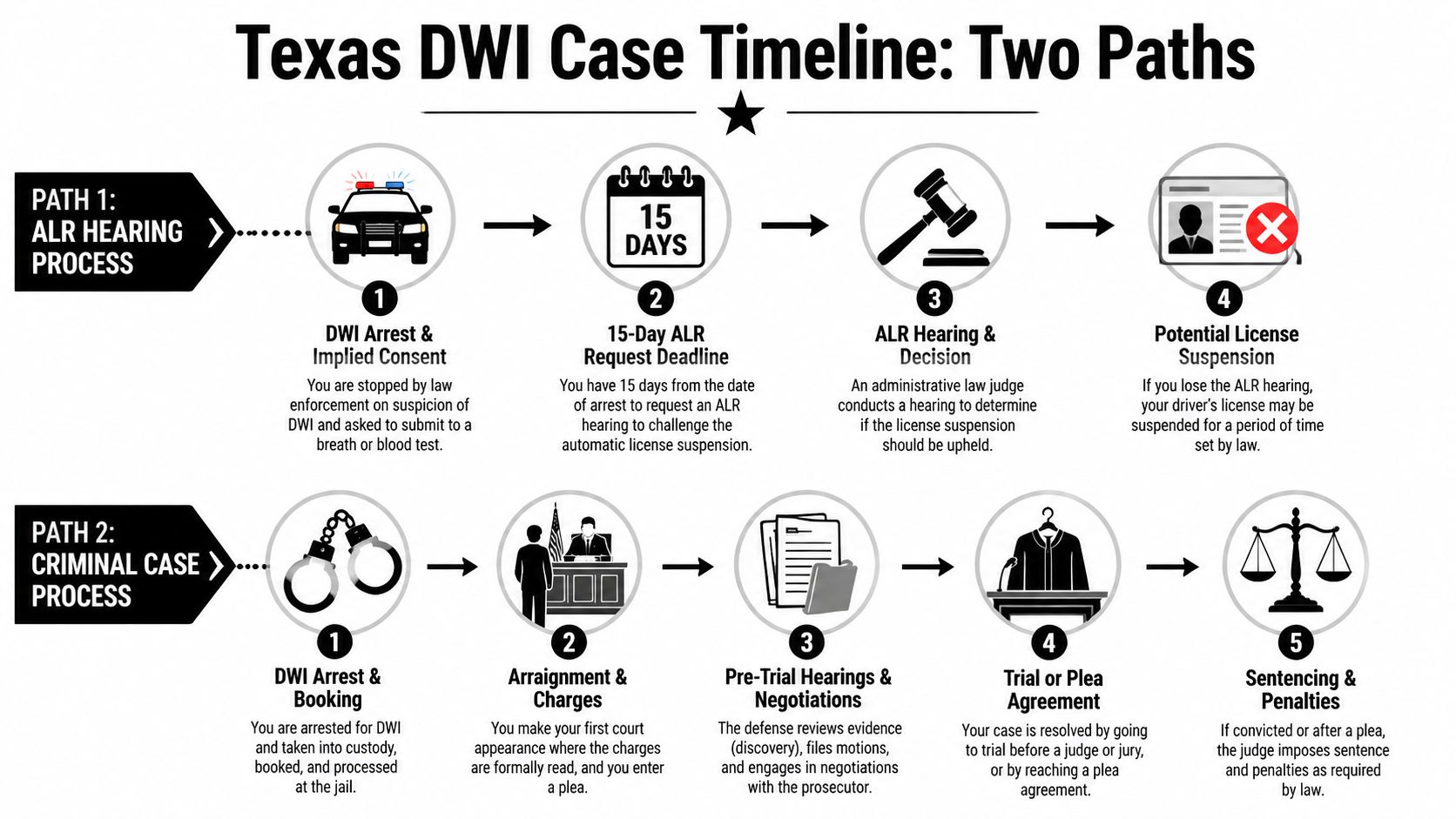
Path one is your license case
The administrative side begins almost immediately after the arrest.
A DWI stop often triggers Texas implied consent rules. Implied consent means that by driving on Texas roads, you’ve accepted certain legal consequences tied to requests for breath or blood testing after a lawful DWI arrest. It doesn’t mean police can do anything they want. It means a refusal or failed test can lead to a license suspension process.
The ALR path usually looks like this:
- Arrest and notice. After the stop, the officer may issue paperwork that acts as notice of a pending suspension.
- Request for hearing. You must act quickly if you want to challenge that suspension.
- ALR hearing. This is not your criminal trial. It’s a separate proceeding focused on license issues and certain legal questions tied to the stop and arrest.
- Decision. The hearing officer decides whether the suspension stands.
Path two is your criminal court case
The criminal side follows its own schedule. It often moves more slowly, but it carries its own risks and opportunities.
A typical timeline includes:
- Booking and bond
- First court setting or arraignment
- Review of police reports, videos, lab records, and witness statements
- Pretrial motions
- Negotiations or trial
- Final outcome, which might be a dismissal, reduction, plea, or verdict
Key terms that confuse people
Here are the words that matter most early on:
| Term | Plain-English meaning |
|---|---|
| BAC | Blood Alcohol Concentration, the amount of alcohol measured in a person’s blood or breath |
| Implied consent | A Texas rule that connects driving privileges to chemical test requests after a lawful DWI arrest |
| Administrative license suspension | A separate state action that can suspend your license apart from the criminal charge |
| Arraignment | An early court appearance where the charge is addressed and the case begins moving through court |
The biggest misunderstanding in DWI cases is thinking, “If I deal with court later, my license will sort itself out.” It usually won’t.
How the two paths overlap
These paths are separate, but they can still help or hurt each other.
For example, the ALR hearing may give your attorney an early chance to question the arresting officer under oath. That can reveal problems with probable cause, timing, or procedure. Those issues may later become useful in the criminal case.
At the same time, winning one side doesn’t automatically win the other. You can still have to fight in criminal court even if the license issue goes well. You can also face a license problem even if the criminal case later improves.
A simple example
Say an officer stops you, arrests you for DWI, and claims you failed roadside tests. You’re released on bond the next day. At that point:
- your ALR clock may already be running
- your criminal case is already pending
- your statements, test results, body cam footage, and paperwork are already becoming evidence
That’s why experienced defense lawyers treat the case as one strategy with two fronts.
Understanding Texas DWI Penalties
Texas uses the term DWI, or Driving While Intoxicated, for adult impaired driving cases. Texas also uses DUI, or Driving Under the Influence, in some underage alcohol-related driving situations. People often use the terms interchangeably, but they aren’t always the same charge.
A first DWI in Texas may be charged as a misdemeanor, while repeat allegations or aggravating facts can raise the stakes. Aggravating factors can include a prior history, a child passenger, an accident involving injury, or other circumstances that prosecutors treat more seriously.
Basic penalty terms to understand
Before looking at the comparison table, it helps to know what the state is usually trying to impose:
- Jail time means actual confinement, though the final result depends on the charge, the court, and the defense strategy.
- Fine means a court-imposed financial penalty if there’s a conviction or plea.
- License suspension is different from jail or fines. It can arise through the criminal case, the ALR process, or both.
Texas DWI Penalties At-a-Glance
| Offense | Jail Time | Fine | License Suspension |
|---|---|---|---|
| First-offense DWI | Possible | Possible | Possible |
| Second-offense DWI | Increased exposure compared with a first case | Increased exposure | Possible and often a major concern |
| Third-offense DWI | May be treated as a felony | Greater exposure | Possible |
| DWI with aggravating facts, such as a child passenger or injury-related allegations | Can become much more severe | Can become much more severe | Possible |
Because the exact penalties depend on the charge and the facts, it’s important to review the law carefully. A broader overview is available on this Texas DWI penalties page.
Why the penalty chart doesn’t tell the whole story
A penalty chart helps you see the risk, but it doesn’t show what a defense lawyer is trying to prevent.
A conviction can create problems outside the courtroom. People worry about driving to work, keeping a professional license, dealing with employer background checks, or explaining the case to family. Those concerns are real, and they’re often just as important as the formal court sentence.
What prosecutors still have to prove
Even in a serious DWI case, the state still has to prove its case lawfully. It isn’t enough for the government to say the officer smelled alcohol or thought you looked unsteady. The defense can challenge:
- whether the stop was legal
- whether the arrest was supported by probable cause
- whether tests were administered properly
- whether the evidence conclusively proves intoxication at the time of driving
That’s where strategy matters. The legal issue isn’t only “What can happen if I’m convicted?” The better question is “What can be challenged before that happens?”
How to Fight Your DWI Charge in Houston
You get pulled over after dinner in Houston. The officer asks a few questions, has you step out, runs roadside tests, and later the paperwork makes the case sound straightforward. By the time you read the report, it can feel like the outcome is already decided.
It is not.
A strong DWI defense starts by separating assumption from proof. In many Houston cases, the report is only one version of events. The actual work is comparing that version to video, test records, dispatch logs, lab documents, and the timeline. Your case also has to be handled on two tracks at once. The criminal charge in court, and the license suspension fight through the ALR process. If you ignore either path, you can lose ground quickly.

Houston courts see DWI cases every day. That volume matters for one reason. A charge like this follows patterns, and experienced defense lawyers know where the weak points often appear. Common does not mean hopeless. It means the evidence needs to be tested carefully.
Start with the stop
The first question is simple. Why were you stopped in the first place?
An officer needs a legal basis to pull you over. That might be a traffic violation, a report from another driver, or specific observations that create reasonable suspicion. If the stop was weak or unsupported, the defense may be able to challenge what came after it, including observations, tests, and statements.
A lawyer will often review:
- the dash cam and body cam footage
- the offense report and any later supplements
- dispatch or 911 records
- the timing between the stop, questioning, and arrest
That review can reveal problems that do not show up on the first page of the report. Sometimes the driving facts are thin. Sometimes the officer extends the detention before there is enough evidence for a DWI investigation. Sometimes the video and the written report do not match.
Examine the roadside investigation
Field sobriety tests often sound more exact than they are. In practice, they depend on instructions, conditions, and the officer's scoring.
The three standard tests are the Horizontal Gaze Nystagmus test, the Walk-and-Turn, and the One-Leg Stand. Each has rules. If the instructions are rushed, the surface is uneven, the area is loud, or the driver has a medical issue, the result can look worse than it should. Nerves matter too. So do fatigue, age, back injuries, inner-ear problems, and certain medications.
A roadside test is closer to a balance-and-divided-attention exercise than a simple pass-fail science exam. If the conditions were poor, the result may say more about the setting than about intoxication.
That is why the video matters so much. A defense lawyer compares what the officer wrote against what the camera shows, step by step.
Test the breath or blood evidence
Many clients come in believing the chemical test decides the case. It does not.
Breath and blood evidence can be powerful, but only if the state can show the sample was taken, handled, and interpreted correctly. Breath testing raises questions about machine maintenance, operator procedures, observation periods, and whether something other than alcohol could have affected the reading. Blood testing raises its own chain-of-custody and lab-process questions.
Timing is often one of the most important issues. The state must prove intoxication at the time of driving, not only at the time of testing. If there was a delay between the stop and the breath or blood sample, the timeline deserves close attention. Alcohol absorption does not happen all at once, and that can change how the evidence should be interpreted. The Texas Department of Public Safety outlines the administrative side of alcohol-related license enforcement on its Administrative License Revocation Program page.
Here’s a short video that helps explain how DWI defense strategy often focuses on the details behind the arrest and testing process.
Build the defense around the timeline
A good DWI defense is not one argument. It is a timeline analysis.
Picture the case as two rails running side by side. One rail is the criminal prosecution. The other is the ALR case affecting your license. On both rails, timing and documentation matter. A statement made during the stop can affect the criminal case. A missed hearing deadline can hurt your ability to keep driving. The strategy has to account for both at once.
That often means asking questions like these:
- What did the officer know before the stop?
- When did the detention turn into a DWI investigation?
- When were field tests given, and under what conditions?
- How much time passed before a breath or blood sample was taken?
- Are the videos, reports, and lab records consistent with each other?
- What facts help in court, and what facts help at the ALR hearing?
At this point, many people get overwhelmed. That is normal. The process feels confusing because it is really two cases sharing the same facts.
What a defense lawyer reviews
A careful DWI review is detailed and methodical. It often includes the following:
- Police narrative and sequence: Does the officer describe a clear progression from stop to arrest, or are key details vague or added later?
- Video evidence: Do the recordings support the claims about driving, balance, speech, and coordination?
- Testing records: Are the breath test logs, maintenance history, lab materials, and operator records complete?
- Medical and personal factors: Could anxiety, injury, exhaustion, GERD, diabetes, or another condition explain what the officer interpreted as intoxication?
- ALR and court deadlines: Were the license-related deadlines protected while the criminal case strategy was being developed?
The Law Office of Bryan Fagan, PLLC handles DWI matters including ALR hearings, first-time charges, repeat cases, and evidence challenges for drivers facing Houston-area prosecutions.
A defense is a plan, not a guess
The state still has to prove its case lawfully. Your lawyer's job is to test every part of that proof, protect your position on both the criminal and license sides, and look for the point where the government's version stops matching the evidence.
Many clients feel defeated in the first week because the arrest was embarrassing and the paperwork sounds certain. A DWI case is rarely decided by first impressions. It is decided by whether the evidence holds up under close review.
Special Circumstances in DWI Cases
Not every DWI case creates the same risk. The law may be the same at the core, but the practical consequences can look very different depending on who you are and what’s at stake in your life.
For the commercial driver
If you hold a CDL, a DWI charge can feel like a threat to your paycheck before it ever reaches trial. You may be worried about missed shifts, employer reporting, and whether you’ll still be allowed to drive for work.
In that situation, timing matters even more. The license side of the case can affect your livelihood quickly. A defense strategy often has to focus on preserving driving privileges where possible, challenging the stop and testing, and preparing for the employment consequences that can arise even before the criminal case ends.
For the parent of an underage driver
Parents often call after an underage driver is stopped and the family doesn’t know whether the case is a DWI, a DUI, or something else. The first concern is usually practical. Can my child still drive to school or work? The second is long-term. Will this stay on their record?
A young driver may not understand that roadside statements, consent issues, and deadlines matter right away. Parents help most by slowing the situation down, keeping documents organized, and making sure no one casually admits facts that the state still has to prove.
Parents often want to “fix it” by having the teenager explain everything to the court. That usually creates more risk, not less.
For the licensed professional
Nurses, teachers, pilots, engineers, and other licensed professionals often ask a different question than most defendants ask. They don’t start with jail. They start with reputation.
If that’s your concern, your defense has to account for both the courtroom result and the paper trail the case creates. The right strategy may involve challenging the charge early, avoiding unnecessary admissions, and considering outcomes that reduce record-related harm where the facts allow.
For the out-of-state visitor or worker
This is one of the most misunderstood DWI situations in Houston. People assume they can go home and deal with Texas later. That assumption can create a license problem in two states.
Out-of-state drivers arrested for DWI in Houston can face reciprocal license impacts under the Interstate Driver License Compact, and DPS 2025 stats discussed here state that 40% of out-of-staters are unrepresented and many miss the 15-day ALR hearing deadline, according to this Houston DWI discussion focused on non-resident consequences.
If you were visiting for work, passing through on I-10, or in Houston for a short stay, you still need to treat the Texas deadline as urgent. Distance doesn’t pause the process.
For the person with a prior case
A prior alcohol-related case changes how prosecutors evaluate risk, plea discussions, and punishment exposure. It can also affect how a judge views bond conditions and compliance expectations.
That doesn’t mean your defense disappears. It means your lawyer has to be even more precise. Prior history makes the details more important, not less.
How to Choose the Right Houston DWI Attorney for Your Case
You are back home after a Houston DWI arrest, your car may still be impounded, and your phone is filling up with ads from lawyers who promise fast answers. This is usually the moment people make a rushed hiring decision. In a DWI case, that can be a mistake because your lawyer is not just handling one court date. Your lawyer should be ready to manage two tracks at the same time: the ALR license case and the criminal case.

A good attorney helps you see the whole map early. One path deals with your ability to drive. The other deals with the charge itself. Those paths can affect each other, but they do not run on the same schedule. If a lawyer talks only about “beating the case” and says little about the ALR hearing, that is a warning sign.
What to look for
Start with fit, not flash. The right lawyer should be able to explain your case in plain English, identify the next deadline, and tell you what evidence matters first.
Use a checklist so stress does not make the decision for you:
- DWI-focused case work: Ask whether the attorney regularly handles breath test records, blood test issues, field sobriety challenges, ALR hearings, and motions to suppress.
- A two-track strategy: Ask how the lawyer coordinates the license case and the criminal case. This article has explained those as parallel paths because that is how they work in real life.
- Harris County experience: Local practice affects scheduling, negotiation, and courtroom expectations.
- Clear answers: You should be able to understand what happens next after one conversation.
- Candid advice: Be careful with anyone who promises a dismissal before reviewing video, reports, test records, and the stop itself.
- Long-term planning: A careful lawyer should also discuss record consequences and possible cleanup options if the law allows them later.
You can compare attorneys more carefully with this guide on how to choose a criminal defense attorney.
Questions worth asking in a consultation
A consultation should tell you how the lawyer thinks under pressure. Ask questions that reveal process, not just confidence.
| Question | Why it matters |
|---|---|
| Have you handled ALR hearings and criminal DWI cases together before? | You want one plan for both paths, not two disconnected reactions |
| What evidence do you ask for first? | A prepared lawyer usually starts with the report, video, testing records, and timeline |
| How do you review field sobriety tests and chemical test issues? | Many DWI cases turn on technical details, officer instructions, and whether procedures were followed |
| Who will appear with me in court and at hearings? | You should know whether the person you hire is the person handling your case |
| What are the immediate deadlines in my case? | This shows whether the lawyer is focused on action, not just sales |
Why lawyer choice can affect the result
DWI outcomes are not automatic. Some cases are weak on the stop. Others have problems with the investigation, the testing process, or the officer’s observations. Some need negotiation. Some need litigation. A strong attorney knows the difference and adjusts the strategy instead of forcing every case into the same script.
That matters in Houston because these cases move through a busy system. A lawyer who is organized, prepared, and familiar with local practice can spot issues early, protect your position in the ALR case, and help you avoid decisions made out of panic.
You are hiring someone to do more than stand beside you in court. You are hiring someone to examine the state’s evidence, protect your license position, explain your options clearly, and help you make smart decisions at each stage.
Frequently Asked Questions About Houston DWI Cases
A lot of Houston clients reach this point with the same feeling. They understand they were arrested, but they still do not know what happens to their record, their license, or their options. That confusion makes sense because a DWI usually creates two problems at once. The criminal case and the ALR license case run on parallel tracks, and the right answer in one area can affect the other.
Can I get a DWI removed from my record in Texas
Sometimes. The result usually depends on how the case ends.
If your case is dismissed or you are found not guilty, you may be able to seek an expunction, which is the process used to clear eligible records. In other situations, nondisclosure may limit who can see the case, but it does not erase it the way an expunction can.
This is why the end of the case matters as much as the beginning. A plea that seems convenient today can affect jobs, licensing, housing, and background checks later.
What is deferred adjudication
Deferred adjudication means the court places you on community supervision without entering a final conviction at that point. If you complete the terms successfully, the case may end in a way that is different from a standard conviction.
That does not mean it fits every DWI case. Eligibility depends on the charge, the facts, and the prosecutor’s position. It is a strategy decision that should be weighed against your record concerns, license issues, and the strength of the evidence.
Will I lose my license if I refused the test
You may face a license suspension through the Administrative License Revocation, or ALR, process. Refusal can trigger that separate case, but it does not end the discussion.
The ALR case works like a second track running beside the criminal case. If a hearing is requested on time, the state has to prove its basis for the suspension. That hearing can also give your defense lawyer an early chance to question the officer under oath, which may help later in the criminal case.
Are field sobriety tests enough to convict me
They can be part of the state’s case, but they are not automatic proof of intoxication.
Field sobriety tests are only useful if they were administered correctly and interpreted fairly. Instructions matter. Road conditions matter. Footwear, injuries, fatigue, anxiety, age, and medical issues matter too. A roadside test is closer to a balancing exercise done under pressure than a laboratory measurement, which is why defense lawyers examine every detail of how the officer gave the test and how you were scored.
Should I take a plea offer right away
A plea offer should be reviewed in context, not in panic.
Early offers often arrive before the defense has seen all the important evidence, such as body camera footage, testing records, maintenance logs, dispatch information, and the full arrest timeline. In a Houston DWI, you also need to look at how that plea decision may affect the parallel ALR license case and any future record-clearing options.
How much does a good DWI lawyer cost
Fees vary based on the amount of work the case requires. A straightforward review is different from a case involving expert consultation, contested hearings, or trial preparation.
Ask what the fee covers. Does it include court appearances, ALR representation, motions, negotiation, and trial work if needed? That question gives you a clearer picture than price alone.
Do I need a lawyer if this is my first arrest
A first arrest still puts a lot at risk. You may be dealing with a criminal charge, a possible license suspension, court conditions, insurance consequences, and a permanent record issue, all at the same time.
People facing a first DWI often assume being cooperative will solve everything. Sometimes cooperation helps. Sometimes it gives the state statements or evidence that are hard to take back. A defense lawyer helps you slow the process down, understand both tracks of the case, and make decisions that protect your future instead of reacting out of fear.
If you’re dealing with a Houston DWI, you don’t have to sort out the license hearing, court dates, testing issues, and record concerns on your own. Law Office of Bryan Fagan, PLLC offers free consultations and case evaluations for Texans facing DWI and DUI charges. If you want clear answers, a practical defense strategy, and help taking the next step, reach out and ask for a case review today.