
A DWI arrest can be overwhelming, but you don't have to face it alone.
Individuals who call after a Texas DWI arrest often find themselves in the same situation. They are replaying the stop in their head, wondering what the officer wrote down, whether the breath test means the case is over, and how a single night turned into court dates, license problems, and a criminal charge. They usually assume the prosecutor has a stack of airtight proof.
That assumption is exactly why it helps to understand the prosecution's playbook.
In Texas, DWI cases often look powerful on paper because the state presents them as a mix of police observations, test results, and official reports. To a judge or jury, that package can sound scientific and settled. But once you slow it down and inspect each part, the picture changes. Officers can misread behavior. Field tests can be poorly administered. Breath and blood evidence can have procedural weaknesses that matter.
If you're asking what evidence do prosecutors use in DWI cases Texas, the better question is this: which parts of that evidence can be tested, limited, or excluded?
That is where a defense strategy begins.
A DWI Arrest is Overwhelming But The Evidence is Not Unbeatable
A common situation goes like this. You were stopped late at night. The officer says you drifted, rolled through a light, or changed lanes oddly. A few minutes later, you're standing on the roadside answering questions you weren't prepared for. By morning, you're holding paperwork that makes the state's case seem much stronger than it felt in real time.
That first impression is misleading.
Prosecutors don't walk into court with one magic piece of evidence. They build a story. They take the officer's report, add field sobriety test claims, add a breath or blood result if they have one, and present all of it as if each part confirms the others. When you're the person accused, that can feel impossible to fight.
A DWI case often looks strongest before the evidence is fully examined.
The truth is calmer and more practical. Every part of a DWI case comes from people, procedures, machines, and records. People make assumptions. Procedures get skipped. Machines require proper operation and maintenance. Records sometimes reveal gaps the state would rather not emphasize.
That doesn't mean every case gets dismissed. It does mean you should never assume a charge proves guilt.
A good defense starts by separating what the officer claims from what the video shows, what the machine printed from how the test was handled, and what the prosecutor argues from what the law requires. Once you understand how the state tries to prove intoxication, you're in a much better position to protect your license, your record, and your future.
The Three Pillars of a Texas DWI Prosecution
A Texas DWI case usually rests on three kinds of proof. Prosecutors present them like three legs of a stool. If one leg looks strong, the other two are used to steady it. If all three are repeated enough, the case can sound more certain than it really is.
Texas law gives the state two main ways to argue intoxication. One path is to claim you lost the normal use of your mental or physical faculties because of alcohol or drugs. The other is to claim your BAC, or blood alcohol concentration, was 0.08% or higher. Those are the legal theories. The evidence is how the prosecutor tries to make one of those theories feel like settled fact.
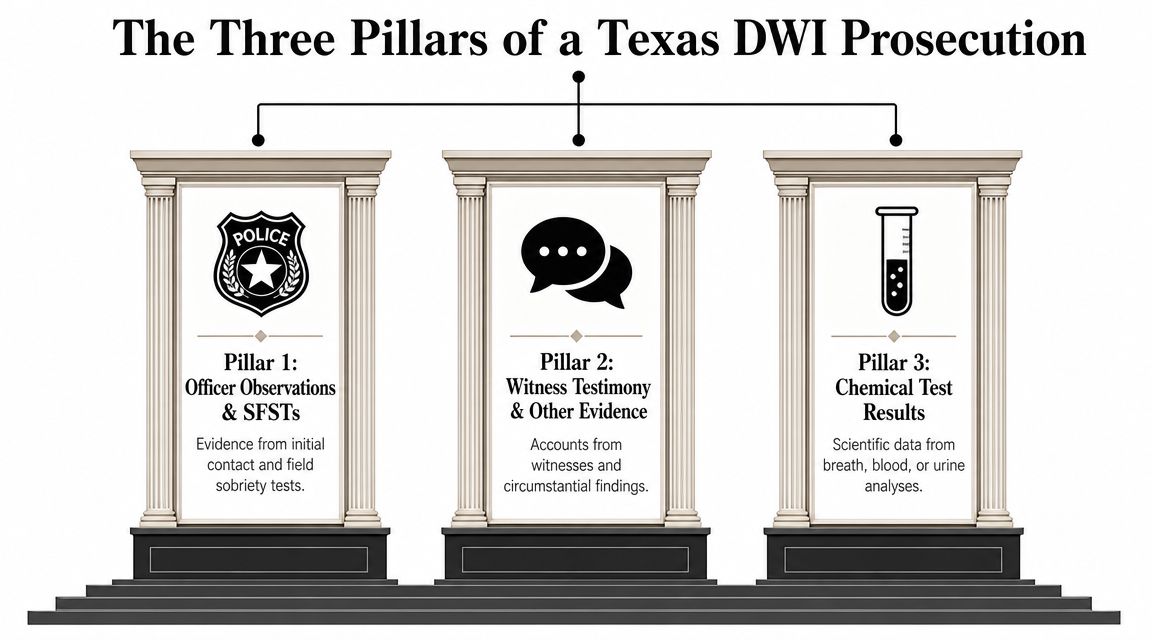
Pillar one includes what the officer says happened
The first pillar is the officer's account. In many cases, that account sets the tone for everything that follows. A report may describe your driving, your speech, your balance, your eyes, your attitude, and anything you said during the stop.
Prosecutors use that report to do two jobs at once. First, they use it to justify the stop and arrest. Second, they use it to frame every later piece of evidence through the same lens. Once a report says "slurred speech" or "unsteady balance," the state will often treat later tests as confirmation instead of asking whether the first impression was accurate.
Common examples include:
- Driving behavior: drifting, braking late, speeding, or failing to maintain a lane
- Personal observations: odor of alcohol, bloodshot eyes, fumbling with documents, or slow responses
- Statements: comments about drinking, where you were coming from, or what you had consumed
- Behavior during the stop: nervousness, irritation, confusion, or trouble following directions
That may sound persuasive on paper. It is still human observation, and human observation is not the same as certainty. Fatigue, anxiety, uneven pavement, allergies, injury, or simple stress during a traffic stop can all be described in a way that makes ordinary behavior look incriminating.
Pillar two focuses on field sobriety testing and other surrounding evidence
The second pillar is usually the field sobriety testing process, along with any surrounding facts the state thinks support the arrest. Through this process, prosecutors often try to convert roadside impressions into something that sounds standardized and scientific.
That framing matters.
A field sobriety test is not a lab test. It is a set of divided-attention tasks administered by an officer on the roadside. The state often presents those tests as objective because they have names, steps, and scoring clues. A defense lawyer looks at them differently. Were the instructions clear? Was the demonstration correct? Was the surface uneven? Was traffic rushing by? Did a medical condition, age, footwear, fatigue, or weather affect performance?
Other facts may be folded into this pillar too. Open containers, statements from passengers or other witnesses, and body camera or dash camera footage are often grouped together so the jury hears one repeated message: everything pointed toward intoxication.
That is the prosecutor's theme. A careful defense tests whether those pieces come from separate sources, or whether they all trace back to the same officer's interpretation.
Pillar three is the chemical test result
The third pillar is the chemical test. This may be a breath test, a blood test, or less commonly another type of sample. Prosecutors often treat this pillar as the strongest one because numbers look precise and machines look neutral.
In court, that number is often presented as if science settled the case.
A good defense starts with a different question. What had to happen for that number to be reliable? Chemical testing only looks powerful if every step was handled correctly. Timing matters. Machine maintenance matters. Observation periods matter. Blood draws must follow proper procedures. Samples must be labeled, stored, and tracked correctly. Police also have to obtain the sample in a lawful way.
That is why evidence needed for a Texas DUI conviction is rarely just one report or one test result. Prosecutors build a layered story. Defense counsel pulls that story apart piece by piece and checks whether the foundation supports the conclusion.
Here is a practical way to read the state's case:
| Pillar | How prosecutors frame it | What the defense examines |
|---|---|---|
| Officer observations | The officer recognized obvious signs of intoxication | Whether the observations were subjective, incomplete, or contradicted by video |
| Field sobriety tests | Standardized roadside testing showed impairment | Whether the tests were explained, performed, and scored correctly under fair conditions |
| Chemical testing | A scientific result proves intoxication | Whether the sample, device, procedures, and legal steps were reliable |
Once you see these three pillars for what they are, the case starts to look less like an ironclad conclusion and more like a construction project. Every part has seams. Every seam can be checked.
Decoding the Officer's Observations and Report
The police report is often written in a way that makes ordinary behavior sound incriminating. That doesn't happen by accident. Officers are trained to record facts that support arrest decisions, and prosecutors later use that language to make intoxication seem obvious.

Common phrases in a DWI report
If you've read your paperwork, you've probably seen familiar phrases. "Strong odor of alcohol." "Bloodshot and glassy eyes." "Slurred speech." "Unsteady balance." "Confused answers." These phrases appear again and again because they help the state frame the stop before anyone watches the video.
But each one raises questions.
- Odor of alcohol: An odor may suggest a person drank something. It doesn't identify how much, when, or whether the person was intoxicated.
- Bloodshot eyes: Late hours, contact lenses, wind, fatigue, allergies, and stress can all affect eye appearance.
- Slurred speech: Some people speak softly, rapidly, nervously, or with an accent the officer may misread.
- Balance issues: Uneven pavement, poor footwear, injury, age, and roadside conditions matter.
A report is not a neutral document. It is an advocacy document written from the officer's perspective.
Video often tells a more balanced story
Bodycam and dashcam footage can change everything. A report may say you were confused, yet the video shows clear answers. A report may claim you stumbled, while the recording shows you stepping off a curb or standing on gravel. A report may describe aggressive behavior when the video really shows frustration or fear.
That is why defense lawyers don't stop with the paper file.
A careful review usually looks for:
- The reason for the stop and whether the driving matched the allegation
- The tone of the encounter and whether the officer escalated it
- Your speech and movement as seen and heard
- Whether instructions were clear before any roadside testing
- Any mismatch between the report and the recording
Police reports are persuasive because they sound factual. Many of their most important details are still interpretations.
Statements made during the stop can be misunderstood
Drivers often hurt themselves by trying to be polite. You may answer questions casually, guessing about the number of drinks you had or saying you're tired, stressed, or coming from dinner. Prosecutors can use those statements later as admissions.
That doesn't always make them reliable. People estimate poorly under stress. Some answer questions they didn't fully hear. Some officers summarize statements rather than quote them exactly.
A strategic defense reviews not just what was allegedly said, but when, how, and under what pressure. The difference between "I had a drink earlier" and "I was intoxicated while driving" is enormous. The state may try to blur that difference. Your lawyer's job is to sharpen it.
Challenging Standardized Field Sobriety Tests
You are pulled onto a road shoulder after dark. Cars are passing. Red and blue lights are flashing behind you. An officer gives a string of instructions, watches every movement, and writes down "clues" that sound technical and precise. By the time those tests are described in court, the prosecutor often presents them as if they were roadside science.
They are not that simple.
Standardized field sobriety tests are screening tools. They depend on the officer giving the right instructions, demonstrating the test correctly, choosing a reasonable location, and scoring what happened instead of what the officer expected to see. A defense lawyer looks at those tests the way a mechanic inspects a claimed engine failure. You do not just accept the dashboard warning light. You check the wiring, the calibration, and the person who read the gauge.
The three tests officers usually rely on
In many Texas DWI cases, the officer leans on three standardized tests.
The Horizontal Gaze Nystagmus, or HGN, involves following a stimulus with your eyes while the officer looks for certain movements.
The Walk-and-Turn asks you to balance, remember instructions, walk heel to toe, turn a specific way, and keep counting.
The One-Leg Stand requires balance, timing, counting, and coordination while the officer watches for listed clues.
Prosecutors often describe these tests with the language of training manuals. That can make them sound automatic and objective. The critical question is whether the officer followed the standardized method. If the method breaks down, the state's confidence in the result should break down too.
Why these tests can look worse than they are
A roadside test measures more than alcohol. It also measures stress, fatigue, age, weight, footwear, injuries, balance issues, confusion, and the conditions chosen by the officer.
That is why sober drivers can perform poorly.
The setting matters. Gravel, uneven pavement, poor lighting, loud traffic, and flashing patrol lights can affect concentration and balance. So can a rushed explanation. Some tests require a person to divide attention between listening, remembering, balancing, counting, and moving in a very specific way. That is hard for many people even in a quiet parking lot.
The officer may still mark each misstep as a sign of intoxication. Prosecutors then stack those marks together and argue that the pattern proves impairment. A good defense breaks that pattern apart and asks a simpler question. Was this alcohol, or was this a difficult exercise given under poor conditions?
Where the state's story often starts to crack
These cases often turn on details that sound small until you see how the tests are supposed to work. If the officer gives incomplete instructions, cuts off the test early, fails to ask about injuries, or scores clues the video does not show, the test becomes much less reliable.
A careful review usually asks:
- Was the surface reasonably level and safe
- Did the officer ask about medical issues, injuries, age, or physical limitations
- Were the instructions complete and understandable
- Did the officer demonstrate the test correctly
- Did the officer allow the person to finish
- Do the bodycam and dashcam support the officer's scoring
One clue does not mean much by itself. Several clues do not mean much either if the officer created the problem through poor instructions or unfair conditions.
How defense lawyers deconstruct these tests
The prosecution wants the jury to hear "standardized" and assume "scientifically trustworthy." Those are not the same thing. Standardization only has value if the officer followed the standard.
That is why defense lawyers compare the report, video, training requirements, and testimony line by line. If an officer says you stepped off line three times, the video should show it. If the officer says you were told to keep your arms at your sides, the recording should capture that instruction clearly. If the HGN test was done with passing headlights, poor positioning, or an improper stimulus distance, the defense should expose that.
For a more detailed explanation of how lawyers attack these issues, see this guide on how to challenge field sobriety test results in Texas.
The larger point is simple. Field sobriety tests are often presented as neutral proof. In practice, they are human observations filtered through training, assumptions, and roadside conditions. That makes them contestable evidence, not a final answer.
The Scientific Evidence Behind BAC and Chemical Tests
A common turning point in a DWI case comes when the prosecutor points to a breath number or a blood report and treats it like the case is over. To someone facing charges, that can feel like walking into a room where everyone else has already accepted the machine's answer as truth.
That reaction is understandable. Scientific evidence sounds neutral. It sounds final. Prosecutors know that, and they often present chemical testing as if it leaves no room for doubt.
A defense lawyer reads it differently. A BAC result is not just a number. It is the last link in a chain of decisions, procedures, records, and equipment. If one link is weak, the state's claim of certainty starts to weaken too.
What BAC means and why prosecutors build around it
BAC means blood alcohol concentration. In court, the state uses that measurement to argue you were at or above the legal limit at the relevant time.
Breath and blood tests get there in different ways. A breath test estimates alcohol concentration from a breath sample. A blood test measures alcohol in a blood sample taken from your body. Both are chemical tests, but they create different opportunities for error, and different legal fights.
That distinction matters. Prosecutors often present both under the same broad label of "scientific evidence," but the science only carries weight if the underlying process was done correctly.
The legal theory sounds simple. The real process is not.
Texas uses implied consent, which means a person driving on Texas roads can be asked to provide a breath or blood specimen after a lawful DWI arrest. A refusal can lead to a separate driver's license problem even before the criminal case is resolved.
That license case is the ALR process, short for Administrative License Revocation. It is separate from the criminal prosecution. Clients regularly assume the court case and the license case are the same fight. They are two different tracks, with different deadlines and different consequences.
That separation matters in chemical-test cases because the state may use the same alleged refusal or failed test in both places, while the defense may challenge the legality of the request, the arrest, or the testing procedure.
Why "machine evidence" still gets challenged
Prosecutors like chemical testing because numbers look clean. Jurors may hear 0.08 or higher and assume the result came from a process with no judgment calls. Real testing does not work that way.
A breath result depends on the machine, the operator, the required observation period, the timing of the test, and the records showing the device was working as it should. A blood result depends on lawful collection, proper storage, accurate labeling, documented transfers, and reliable lab analysis. The report may look polished, but polished paperwork is not the same as reliable evidence.
That is why defense lawyers break the process apart piece by piece.
| Issue | Why it matters |
|---|---|
| Observation period problems | The operator usually must watch the person for a set period before testing to reduce the chance of mouth alcohol or other contamination affecting the sample |
| Maintenance and calibration questions | A machine can only produce a trustworthy result if testing, inspection, and upkeep records show it was functioning properly |
| Operator training | The person administering the test must know and follow the required procedure, not improvise it |
| Timing | A later test result may not prove what your alcohol concentration was at the time of driving |
| Chain of custody | A blood sample must be tracked from draw to lab so the state can show the sample tested was actually yours and was handled properly |
| Collection and lab process | Problems during the draw, storage, transport, or analysis can affect both admissibility and credibility |
For a closer look at the machine side of these cases, see this explanation of breathalyzer accuracy challenges in Texas DWI cases.
A BAC result is only as reliable as the procedure that produced it.
Breath tests often sound stronger than they are
Breath machines are not lie detectors. They are measuring devices operated by people under rules. If the officer did not follow those rules, the state may still try to present the number as settled science, but the defense should force the state to prove every step.
That review usually starts with basic questions. Was the observation period completed? Did the video match the operator's report? Were maintenance records current? Was there anything that could have affected the sample before the test was given?
Those are not technical side issues. They go straight to whether the jury should trust the result.
This short video helps explain how these issues come up in real cases.
Blood tests can be powerful evidence, but they are not automatic proof
Blood evidence often carries extra weight with juries because it sounds more direct. Prosecutors know that and often frame a blood result as the gold standard. The defense approach is more careful.
A blood test works like a relay race. One person draws the sample. Another labels it. Another stores it. Another transports it. Another tests it. If the state cannot clearly account for those handoffs, the jury has reason to question the result.
The legal side matters too. A defense lawyer may examine whether the draw was authorized, whether proper procedures were used, whether the sample was preserved correctly, and whether the lab can explain its methods in plain, credible terms. If the state cannot do that, the science stops looking automatic and starts looking vulnerable.
That is the lesson of chemical evidence in a Texas DWI case. Prosecutors present the result as a final answer. A skilled defense lawyer tests the foundation underneath it, step by step, until the jury can see the difference between a scientific label and a reliable result.
After the Arrest What Happens Next
You get out of jail, pick up your phone, and see messages about court, towing, work, and family. At that moment, many people focus only on the criminal charge. The state, however, often starts working on two tracks at once: the court case and your driver's license.

That matters because the days after an arrest shape the rest of the case. Prosecutors want the evidence to feel settled early. A defense lawyer treats this period differently. It is the first chance to preserve deadlines, secure records, and test whether the state's version of events holds together under close review.
Step one is dealing with release and bond
After booking, release usually comes with bond conditions. Some are routine, such as appearing in court. Others may limit travel, alcohol use, or contact with certain people.
Read every condition carefully.
A bond violation can create a new problem before your lawyer has even received the police report, bodycam video, or lab paperwork. In practice, bond is not just paperwork. It is a set of rules that can affect how the judge views you from the beginning.
Step two is protecting your license
The license case often moves faster than people expect. In Texas, the administrative license suspension process is separate from the criminal prosecution. The prosecutor in court may later argue that the arrest was supported by strong evidence, while the license process can begin before that evidence has been fully tested.
You usually have a short window to request an ALR hearing. Miss that deadline, and the suspension can move ahead without your side being heard.
That hearing matters for more than driving privileges. It can serve as an early test of the state's foundation. A careful defense lawyer looks at questions such as:
- whether the officer had a lawful reason for the stop
- whether the officer had legal grounds to make the arrest
- whether the request for breath or blood was handled correctly
- whether the paperwork is complete, accurate, and supported by admissible evidence
In some cases, the ALR hearing also gives the defense an early chance to question the officer under oath. That can be valuable because details tend to harden over time. An officer's first explanation may reveal gaps, assumptions, or inconsistencies that later become central in the criminal case.
Step three is preparing for criminal court
Once the court case begins, the file starts to grow. Reports, videos, dispatch records, breath test records, blood draw documents, and lab materials may all come into play. This is the point where a smart defense shifts from reacting to examining.
Prosecutors often present the post-arrest process as orderly and scientific. The report says one thing. The video may suggest another. The machine printout looks precise. The maintenance records may raise a different question. A seasoned defense lawyer compares each piece the way a mechanic checks an engine, part by part, because one weak component can affect how the whole system is viewed.
If this is a first DWI, your concerns may include license consequences, court settings, insurance, employment, and whether the charge can be reduced or dismissed. If the case involves prior convictions or an accident, the stakes and strategy can change. Either way, the right approach is organized and deliberate.
The first days after arrest are about preserving options. Deadlines can be fixed. Missed opportunities are harder to repair.
Step four is reviewing defenses and possible outcomes
A DWI case can change direction quickly once the evidence is examined closely. Some cases turn on a bad stop. Others on an arrest that lacked probable cause. Others on a breath or blood result that looked persuasive until the records exposed missing steps, poor maintenance, weak chain of custody, or legal defects in how the sample was obtained.
That is the larger point after arrest. The state begins building a story of certainty. The defense begins checking whether that certainty is earned.
Possible outcomes depend on what that review shows. The defense may ask the court to exclude evidence, challenge the legality of the stop or arrest, negotiate from a stronger position, or prepare the case for trial. If the final result later makes it available, you may also want to ask about record-clearing options such as expunctions in Texas.
How a Houston DWI Lawyer Fights The Evidence
After a DWI arrest, you may hear the prosecution's case described as if it runs on machines, checklists, and official reports, implying the result must be correct. That is the story the state wants the judge or jury to accept. A defense lawyer's job is to test whether that story holds up in practice, where officers miss steps, devices need maintenance, lab work depends on people, and legal rules matter.
A good Houston DWI lawyer approaches the case the way an auditor approaches a file that looks complete at first glance. The question is not whether the paperwork exists. The question is whether each step was done correctly, documented accurately, and obtained lawfully enough for a court to trust it.
That review usually starts by putting the pieces side by side. Body camera footage, dash camera video, dispatch logs, offense reports, breath test records, blood draw records, lab documents, and witness statements should tell the same story. If they do not, the gap matters. A time stamp may conflict with an officer's report. A video may show instructions different from what the report claims. A blood record may reveal a break in handling that the prosecutor hopes no one notices.
From there, the defense attacks the case at its pressure points:
- Motions to suppress evidence: asking the court to exclude evidence from an unlawful stop, detention, arrest, or search
- Cross-examination of the officer: exposing assumptions, memory problems, exaggerations, and departures from training
- Challenges to breath or blood testing: questioning maintenance records, observation requirements, timing, contamination risks, chain of custody, and lab procedure
- Targeted negotiation: using identified weaknesses to push for dismissal, reduction, or another resolution based on the actual proof, not the prosecutor's version of it
The strategy is systematic. If the stop was weak, the lawyer examines whether the officer had a legal basis to pull you over at all. If the arrest was rushed, the lawyer examines whether probable cause existed before handcuffs went on. If the state leans heavily on a breath or blood result, the lawyer looks past the number and studies the process that produced it, because a scientific label does not make flawed testing reliable.
That is where many cases change. Prosecutors often present chemical testing as neutral science. In practice, the result depends on machines being maintained, protocols being followed, samples being collected properly, and records being complete. One missing step can turn a confident presentation into a credibility problem.
The Law Office of Bryan Fagan, PLLC represents Texans in DWI cases by reviewing these categories of evidence, challenging improper police procedure, and addressing both the criminal case and related license issues.
If you want to fight DWI Texas, the first question is not whether the accusation sounds serious. It is whether the state can prove each part of its case with evidence that survives close examination. That is how a Texas DUI attorney turns a case that looks settled on paper into one the prosecution still has to prove in court.
Frequently Asked Questions About Texas DWI Evidence
Can I be convicted if my BAC was below 0.08
Yes. Texas doesn't require the state to prove only a number. Prosecutors can also try to prove you lost the normal use of your mental or physical faculties. That usually means they rely more heavily on officer observations, driving facts, statements, and field sobriety allegations.
What happens if I refused a breath or blood test
A refusal can affect your license through the ALR process even though it does not automatically prove the criminal case. The prosecutor may still proceed using other evidence, such as the officer's report and video. Refusal cases often require quick attention because of the separate DWI license suspension issue.
Is a breath test enough to prove guilt by itself
Not always. Prosecutors treat chemical testing as strong evidence, but the defense can still question procedure, timing, machine reliability, and whether the officer followed required steps before and during the test. A breath result is one part of a case, not the entire case.
What is implied consent in simple terms
Implied consent means Texas drivers are considered to have agreed in advance to provide a breath or blood specimen after a lawful DWI arrest. That rule mainly matters because refusing a request can trigger license consequences separate from the criminal court process.
What is a field sobriety test
A field sobriety test is a roadside physical and mental exercise the officer uses to look for signs of impairment. These tests are not the same as a breath or blood test. They depend on instructions, conditions, and officer scoring, which is why they can be challenged.
Can a DWI be removed from my record
Sometimes, but not automatically. Whether a case can be cleared through an expunction depends on how the case ends and whether you meet the legal requirements. If record clearing matters to you, ask about that early so your defense strategy takes future options into account.
If you were arrested and you're trying to understand what evidence do prosecutors use in DWI cases Texas, don't assume the paperwork tells the whole story. A charge is not a conviction, and "scientific" evidence still has to be collected, handled, and presented correctly. You can speak with the Law Office of Bryan Fagan, PLLC about your DWI case, your ALR deadline, and possible defenses in a free consultation or case evaluation.