
A DWI arrest can be overwhelming, but you don't have to face it alone.
If you're reading this, you may be replaying the same moment in your head. The stop. The questions. The request for a breath test. Your refusal. Then the words that made everything feel worse: the officer is getting a warrant for your blood.
That moment scares a lot of people because the word “warrant” sounds final. It isn't. In a Texas DWI case, a blood draw warrant gives police a path to collect evidence, but it doesn't erase your rights. A Houston DWI lawyer or Texas DUI attorney can still challenge how that warrant was requested, issued, and carried out. In many cases, the fight turns on procedure.
Facing a DWI Blood Draw Warrant You Are Not Alone
You refuse a breath test because you think that's your right, and it is. A little later, an officer tells you a judge approved a blood draw. Now you're sitting in a holding area, exhausted and confused, wondering if your case is already lost.
That reaction is completely normal. Many individuals don't know the difference between refusing a test and stopping the investigation. They also don't know that a signed warrant can still be challenged in court.

Why the word warrant causes so much anxiety
A warrant sounds like a judge has already decided you were intoxicated. That's not what happened. A magistrate only decides whether the officer's sworn paperwork shows enough facts to permit a blood draw.
That distinction matters. The judge is not deciding guilt. The judge is authorizing a search.
A blood draw warrant is not the end of your case. It's one stage in a process that still has to meet constitutional rules.
What readers usually get wrong
Many Texans assume three things after a blood draw:
- The blood result can't be challenged. It can.
- A refusal automatically proves guilt. It doesn't.
- A judge's signature fixes police mistakes. It doesn't.
Your case may involve more than just the blood test. It can also involve field sobriety tests, which are roadside exercises officers use to claim they saw signs of impairment. It can involve BAC, or blood alcohol concentration, which is the measurement the state often relies on after a chemical test. It can also trigger a DWI license suspension process that runs separately from the criminal charge.
A first DWI in Texas is serious, but serious doesn't mean hopeless. The right approach is to slow down, get clear on the process, and look closely at every step the state took.
Understanding Implied Consent and the Need for a Warrant
Texas uses a rule called implied consent. In plain language, by driving on public roads, you're treated as having agreed in advance to provide a breath or blood specimen if you're lawfully arrested for DWI.
That doesn't mean you lose all choice. You can still refuse testing after an arrest. When you do, the officer doesn't automatically get to force a blood draw in a standard case. Your refusal is what often pushes the officer to ask a magistrate for a warrant. The Texas implied consent law overview is useful if you want a closer look at how refusal affects both your license and the investigation.
What implied consent means in real life
Think of implied consent as a rule with two parts.
First, Texas says drivers have already agreed to chemical testing under certain arrest conditions. Second, Texas still recognizes that a person may refuse when the moment comes. Once that refusal happens, the legal issue changes from consent to search authority.
A blood draw warrant is a court order signed by a neutral magistrate that lets police require a blood sample after a refusal. Without consent, and without a valid warrant or a narrow exception, forcing a blood draw would violate the Fourth Amendment in the ordinary DWI setting.
Refusal starts two different problems
Refusing a test doesn't make the case disappear. It usually starts two separate tracks:
- The license track. You may face an administrative license suspension, often called an Administrative License Revocation or ALR case. This is the civil process involving your driver's license.
- The criminal track. Police may seek judicial permission to collect blood anyway.
That's why refusal feels so confusing. People often think they made one decision, but legally they may have triggered two proceedings.
Practical rule: Refusal may protect you from giving immediate consent, but it often leads to a fight over your license and a separate fight over whether the state can still get your blood.
If you want a plain-language explanation focused on what happens after you refuse chemical testing, Texas Implied Consent and Refusing a Breath Test covers that exact issue.
Key terms that matter early
A few definitions can make the process much easier to follow:
| Term | Plain-English meaning |
|---|---|
| Implied consent | Texas treats driving on public roads as prior agreement to chemical testing after a lawful DWI arrest |
| BAC | Blood alcohol concentration, the alcohol measurement the prosecution may use in court |
| Field sobriety test | Roadside exercises officers use to claim they observed impairment |
| Administrative license suspension | The license consequence that can follow a refusal, separate from the criminal case |
If you want to fight DWI Texas cases effectively, start here. A lot of later issues make more sense once you understand that refusal and forced testing are related, but they are not the same thing.
How Texas Police Get a Blood Draw Warrant
Officers don't get a Texas DWI blood draw warrant just because a driver said no. The law requires a process, and that process matters because mistakes in it can become part of your defense.
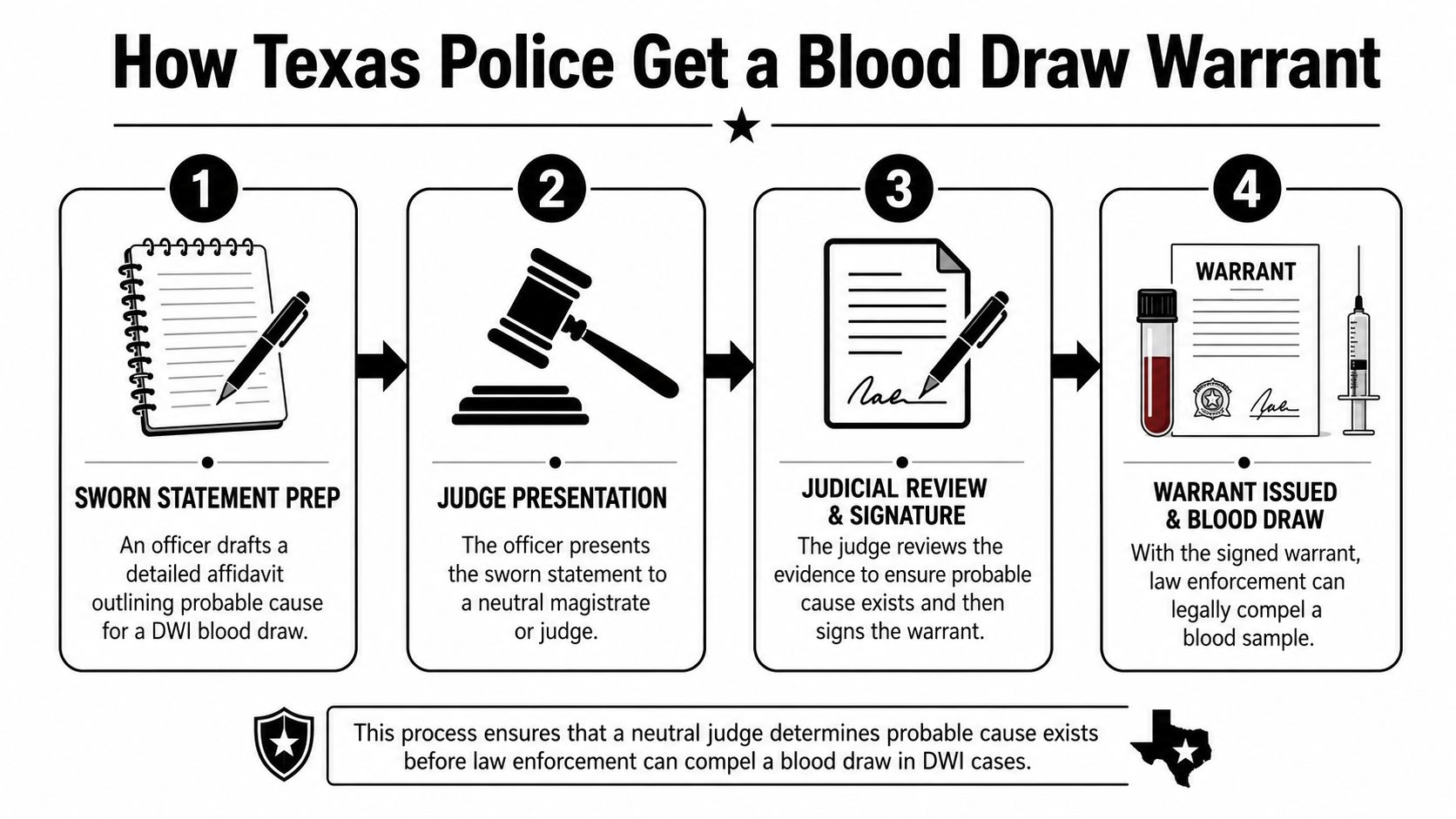
The four basic steps
Here is the usual sequence in a standard refusal case:
- The officer prepares a sworn affidavit. This document must lay out facts supporting probable cause.
- The affidavit goes to a magistrate. Texas practice often allows electronic submission.
- The magistrate reviews the facts. The judge decides whether the affidavit contains enough detail.
- If approved, the warrant is executed. Only then can a medical professional legally draw blood.
According to the Texas Justice Court Training Center handout on blood search warrants, the process requires a sworn affidavit with “sufficient facts” to satisfy probable cause, and an officer typically sends it electronically to a judge before a medical professional may legally extract the sample, making judicial oversight a key constitutional protection (Texas blood search warrant handout).
What probable cause is supposed to look like
Probable cause is one of those legal phrases people hear all the time without getting a real explanation. It means the affidavit has to contain enough factual detail for a magistrate to reasonably believe the person was driving while intoxicated.
That usually means the officer includes observations such as:
- Driving facts like drifting, speeding, or other behavior the officer says drew attention
- Physical observations such as odor of alcohol, bloodshot eyes, or balance issues
- Statements by the driver if any were made during the stop or arrest
- Field sobriety test details if the officer claims the tests showed signs of impairment
The important point is that the affidavit should contain facts, not just conclusions.
Refusal by itself is not enough. The warrant application still needs actual facts pointing to intoxication.
A common weak point most guides ignore
One of the most overlooked issues is this: a “no refusal” weekend policy does not remove the need for a legally sufficient affidavit. The issue came into sharper focus in the Farhat line of discussion. Refusal alone cannot establish intoxication without a sworn affidavit that includes detailed facts beyond the refusal itself, a point discussed in this analysis of Texas DWI blood draw challenges.
That matters because many people hear “no refusal” and assume the warrant is automatic. It isn't supposed to be. A magistrate still has to see enough information in the four corners of the affidavit.
What happens after approval
If the magistrate signs the warrant, officers may transport the person to a hospital or other medical setting, or use a mobile phlebotomist, depending on the circumstances. Once a warrant is issued based on probable cause, Texas law also allows the later chemical analysis of the blood sample.
For a reader trying to make sense of the night of the arrest, that's the key sequence: affidavit, magistrate review, warrant, draw.
Warrant vs No Warrant Mandatory Blood Draws Explained
Most refusal cases require police to get a warrant. But Texas law has narrow situations where officers can require a blood draw without one. These nuances often confuse many individuals, as broad statements online frequently do not align with the actual rule.
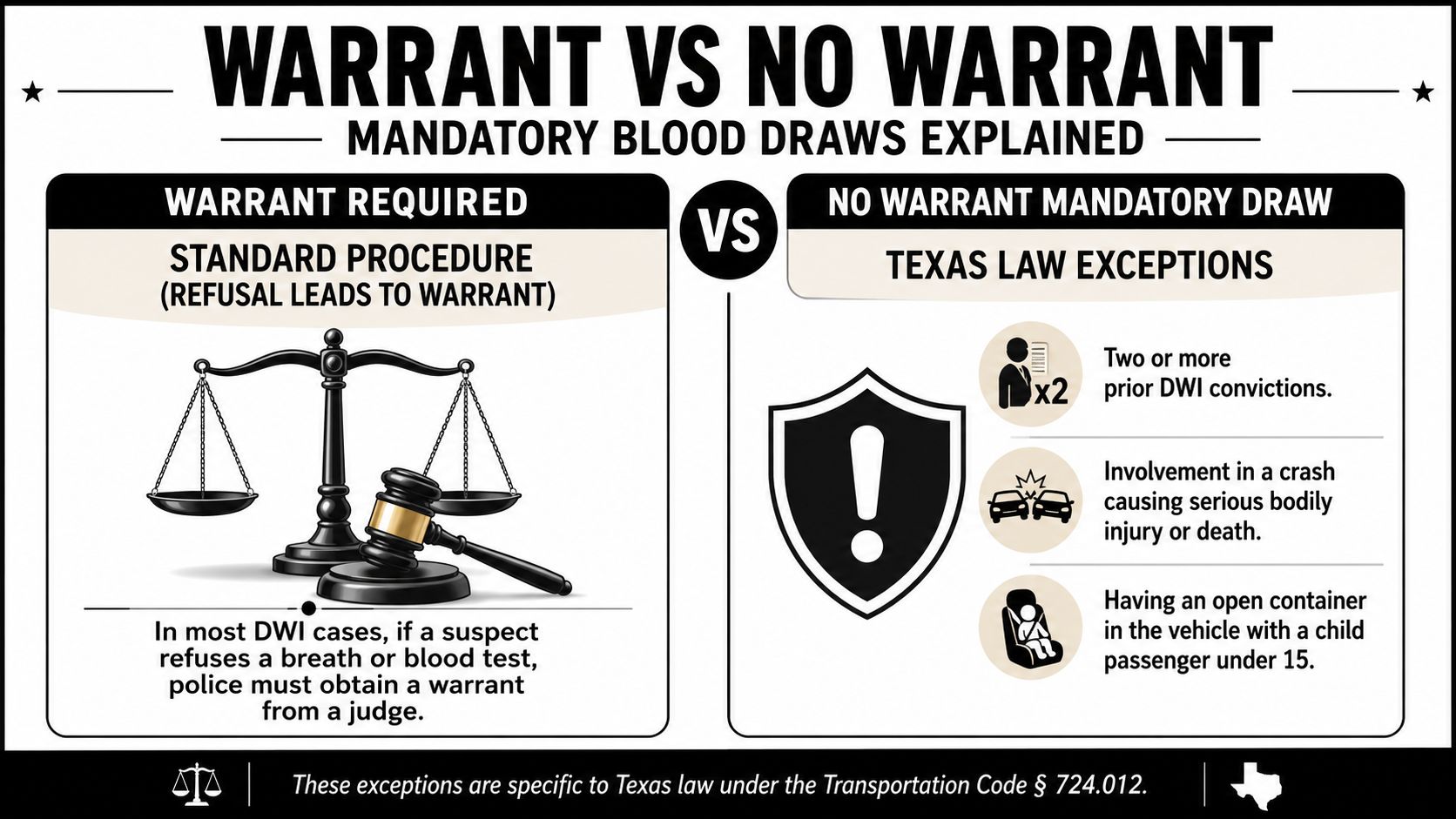
The side by side comparison
| Situation | Is a warrant required |
|---|---|
| Standard refusal case with no qualifying exception | Yes |
| Specific felony DWI scenarios listed by statute | No, in limited circumstances |
Texas law permits warrantless mandatory blood draws only in certain felony DWI situations, including when a person suffered bodily injury requiring hospital transport, when the arrest is for DWI with a child passenger, or when the officer credibly believes felony charges apply because of qualifying prior intoxication offenses. In ordinary refusal cases outside those scenarios, officers must get a warrant (Texas mandatory blood draw discussion).
When no warrant may be used
These exceptions are not broad. They are tied to aggravating facts the law treats more seriously.
Examples include:
- Injury cases where a person suffered bodily injury requiring transport to a hospital
- DWI with child passenger cases under the Penal Code provision identified in the statute
- Certain repeat-offense situations where the officer credibly believes the case qualifies as felony-level because of prior qualifying intoxication offenses
That's very different from a routine first-time stop with no accident and no child passenger.
A lot of confusion also comes from “no refusal” programs. The phrase often refers to faster warrant procedures, not a free pass to skip the Constitution. The Texas no refusal weekend explanation gives context for how those operations are commonly discussed.
To see the distinction another way, this short video helps frame the issue:
Why this distinction matters to your defense
If police treated your case like an exception when it was a standard refusal case, that can become a major issue. It can affect whether the blood draw was lawful in the first place.
The United States Supreme Court has also made clear that the natural dissipation of alcohol does not automatically create an emergency that excuses the warrant requirement in ordinary cases. So when people ask whether officers can “just take blood because alcohol fades,” the answer in a standard case is no. They still need proper legal authority.
For anyone trying to fight DWI Texas charges, this is one of the first questions to sort out: was your case in fact one of the narrow no-warrant situations, or should officers have gone through the full warrant process?
The Consequences of a Warrant Based Blood Test
A warrant-based blood draw creates pressure in two different arenas. One involves your driver's license. The other involves the criminal prosecution.
If you refused the initial request for testing, the Department of Public Safety may move to suspend your license. This is the Administrative License Revocation process, often shortened to ALR. It is separate from the criminal case, and it moves fast.
The license side of the case
You have 15 days from the arrest to request an ALR hearing if you want to contest the suspension, a deadline discussed in Texas DWI license-suspension materials and one that often catches people off guard.
That hearing matters for practical reasons. If you drive to work, take children to school, or depend on your license for daily life, the suspension issue can't wait until the criminal case is over.
The criminal side of the case
The blood test gives prosecutors scientific evidence they often treat as the center of the case. Under Texas DWI law, a BAC result of .08 or higher supports the legal theory of intoxication. A result of .15 or higher can raise the charge to a more serious Class A misdemeanor in the typical misdemeanor framework.
That doesn't mean the case is unwinnable. It means the defense has to be organized and strategic.
The state will often present the blood number as if it ends the discussion. It doesn't. The number only matters if the state obtained and handled the evidence lawfully.
What usually happens after arrest
The post-arrest process often includes several stages:
- Bond and release conditions that may limit driving, alcohol use, or travel
- ALR hearing decisions involving your DWI license suspension
- Court settings where the prosecution provides reports, video, and lab records
- Pretrial motions challenging the stop, the warrant, or the blood evidence
- Trial or negotiated resolution depending on the strength of the legal issues
If this is your first DWI in Texas, the process may still feel intimidating, but it helps to separate the problems. License issues are one track. Criminal exposure is another. A Texas DUI attorney should evaluate both from the start.
How a Houston DWI Lawyer Can Fight Blood Warrant Evidence
A signed warrant doesn't make the evidence untouchable. In many cases, the strongest defense work starts after the blood has already been drawn.
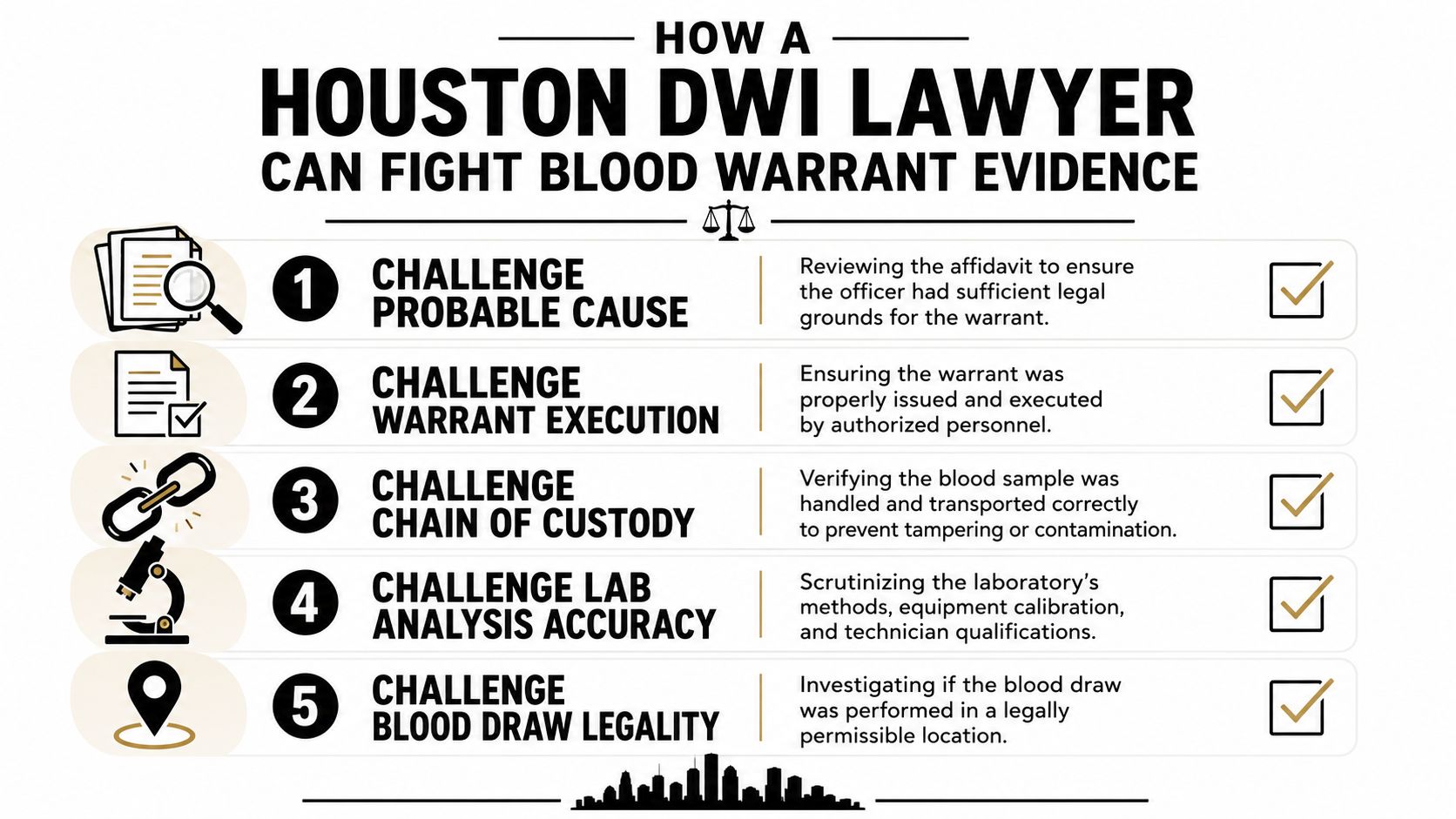
The first challenge is often the affidavit itself
A defense lawyer usually starts with the warrant affidavit. The court generally looks at the “four corners” of that document to decide whether it showed probable cause.
That review asks practical questions:
- Did the officer include specific facts, or mostly broad conclusions?
- Did the affidavit rely too heavily on refusal?
- Did the timeline make sense?
- Did the affidavit contain inconsistencies that weaken credibility?
If the affidavit was thin, vague, or internally flawed, the warrant may be vulnerable.
Execution mistakes also matter
Even a warrant that looks valid on paper can still be challenged if police or medical staff didn't follow the required steps when carrying it out.
That review can include:
| Area of review | Why it matters |
|---|---|
| Issuing magistrate | The warrant must come from a proper judicial officer |
| Who drew the blood | The draw must be performed by a qualified person |
| How the sample was handled | Chain-of-custody problems can raise reliability issues |
| How the blood was tested | Laboratory procedures and analysis can still be contested |
A lawyer may also look at whether the testing stayed within the legal scope of the warrant and whether the sample handling created admissibility problems.
Texas gives the defense an important tool
One of the most important Texas-specific issues is Article 38.23. Texas's exclusionary rule does not include the federal “good faith exception.” That means if the blood warrant was constitutionally defective, the evidence must be suppressed even if officers believed they were acting lawfully, as explained in this Texas blood warrant discussion.
That rule is a big reason these cases deserve close review. In some jurisdictions, the state might try to save defective evidence by arguing the officer acted in good faith. Texas gives the defense a stronger position.
A defective warrant in Texas is not automatically rescued by an officer's good intentions.
The motion that often drives the case
Suppression practice takes on central importance. A lawyer may file a motion asking the court to exclude the blood evidence because the warrant lacked probable cause, the affidavit was defective, or the warrant was improperly executed. If you want to understand that procedure in practical terms, how a motion to suppress evidence works in Texas DWI litigation is a useful reference.
In a blood warrant case, one option available to drivers is working with the Texas DWI Defense Lawyer team for defense under Texas Penal Code 49.04. The legal work in these cases often focuses on probable cause, suppression issues, and trial strategy.
A Houston DWI lawyer who understands both warrant procedure and blood-test litigation can sometimes change the whole posture of the case. If the blood result is suppressed, the prosecution may lose the evidence it was counting on most.
Protect Your Rights and Your Future Contact Us Today
If police obtained your blood through a warrant, you may feel like the case is already decided. It isn't. A Texas DWI blood draw warrant only works if the officer, magistrate, medical personnel, and prosecutors all followed the required legal rules.
Your defense may focus on the stop. It may focus on the affidavit. It may focus on the warrant's execution, the blood analysis, or the ALR case tied to your refusal. What matters is getting someone to examine the full chain, not just the final lab result.
The sooner you act, the more options you may have. That is especially true if your license is at risk and the ALR deadline is approaching. A Houston DWI lawyer or Texas DUI attorney can help you identify weak points, protect your rights, and build a plan to fight the case with clear priorities.
If you want to fight DWI Texas charges with a steady, informed strategy, start by getting your records reviewed and your deadlines identified. Waiting usually helps the state, not you.
If you're dealing with a DWI arrest, a blood draw warrant, or a looming DWI license suspension, the Law Office of Bryan Fagan, PLLC offers free consultations and case evaluations for Texans who need guidance on the criminal case and the ALR process. Reach out to discuss your options, protect your rights, and take the next step with local defense counsel.