
A DWI arrest can be overwhelming, but you don't have to face it alone.
If you saw signs about a No Refusal Weekend and now you're wondering whether you lost your rights, you're not the only one. Many Texas drivers hear that phrase and assume it means police can automatically force testing, skip steps, or make a case impossible to fight. That's not what it means.
What matters is the procedure. A no refusal weekend doesn't create a new DWI charge. It changes how fast officers move from a refusal to a warrant. That faster timeline can affect the evidence, your license, and the defense strategy that follows.
If you're dealing with a stop, an arrest, or a blood draw after refusing a test, clear information helps you regain control. You need to know what the officer could do, what still had to be proven, and where your case can still be challenged.
Introduction You Don't Have to Face This Alone
A no refusal weekend often catches drivers at the worst possible moment. You're stressed, the officer is asking questions, and every decision feels loaded. Then you hear that refusal won't matter because a judge is standing by to sign a warrant.
That situation feels intimidating, but it isn't the end of the story. Even during a no refusal weekend, the police still have to follow legal steps. They still need a lawful stop, a valid arrest, and a proper warrant process if they want a compelled blood draw. If they cut corners, those details matter.
The practical issue isn't whether the State suddenly got new power for one weekend. The issue is that the system is set up to move faster. That speed changes how evidence gets collected, and it can change how quickly you need to act after release.
Practical rule: Treat a no refusal weekend arrest like a time-sensitive legal problem, not a hopeless one.
You still have rights. You still have choices. And you still may have defenses involving the stop, the field investigation, the arrest decision, the warrant affidavit, the blood draw, or the handling of the sample.
A few terms come up again and again in these cases:
- Implied consent means Texas says that by driving on public roads, you have agreed in advance to chemical testing after a lawful DWI arrest, subject to legal procedures and consequences for refusal.
- BAC means blood alcohol concentration. It's the alcohol concentration the State may try to prove through breath or blood testing.
- Field sobriety test usually refers to roadside tasks officers use to claim impairment, such as balance, eye movement, and divided-attention exercises.
- Administrative license suspension means a license action handled separately from the criminal case, often through the Administrative License Revocation process, commonly called an ALR hearing.
If you're trying to figure out what this means for your case, the focus should be simple. Understand the procedure. Protect your license. Challenge weak points early. Build a defense that fits the facts, not the slogan on a holiday enforcement campaign.
What a No Refusal Weekend Really Means in Texas
A driver is stopped late on a holiday weekend, declines a breath test, and assumes that buys time or limits what police can collect. In many Texas counties, the opposite is what changes. During a no refusal operation, the case often moves into a faster warrant track.
The label causes confusion. A no refusal weekend still allows a person to refuse voluntary testing. What changes is the procedure that may follow. Officers, prosecutors, and judges are often set up to move warrant requests quickly, so a refusal can lead to a blood warrant much sooner than drivers expect.
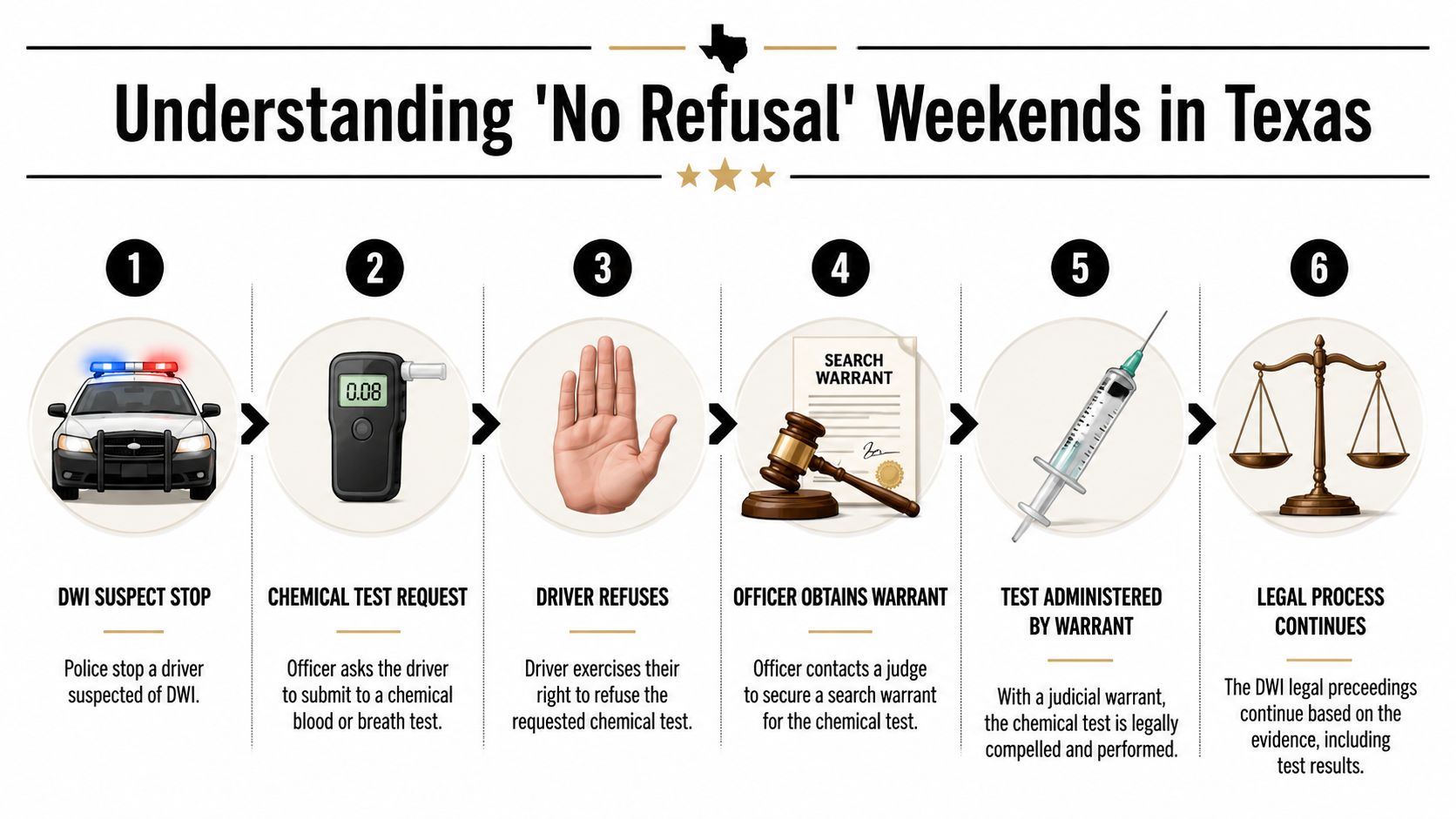
A concise explanation appears in this discussion of Texas no refusal policy and what it means for drivers. The point for your case is procedural. This is not a separate offense, and it does not give police a free pass. It is a faster enforcement pipeline for collecting evidence.
It changes the timing more than the law
A no refusal weekend is an enforcement protocol. Agencies increase DWI patrols and coordinate with judges who are available to review warrant applications on short notice, as described in this overview of how no refusal weekend works.
That distinction matters. I often have to correct the same assumption: "If it was no refusal, they could do whatever they wanted." They could not. Officers still needed a lawful stop, facts supporting an arrest, a legally sufficient warrant affidavit if they sought blood, and a proper draw procedure after the warrant issued.
Speed helps the State in one obvious way. A quicker warrant can mean a blood sample taken closer in time to the driving allegation.
Speed also creates pressure points for the defense. Fast paperwork can produce thin affidavits, copied language, timing gaps, and chain-of-custody problems that deserve close review. In practice, the defense question is rarely the slogan used for the weekend. The question is whether each step held up under the rules that still applied.
A no refusal weekend compresses the timeline. It does not erase your rights.
That is why these cases should be evaluated early and carefully. The smartest response is to treat the arrest as a procedural case from day one: examine the stop, examine the warrant path, and preserve every issue before the State turns a fast-moving investigation into a stronger prosecution.
To make the timeline easier to visualize, this video helps show how the process tends to unfold:
Texas Implied Consent and Warrant Procedures
No refusal cases make more sense once you separate three legal ideas: implied consent, probable cause, and a search warrant. They work together, but they are not the same thing.
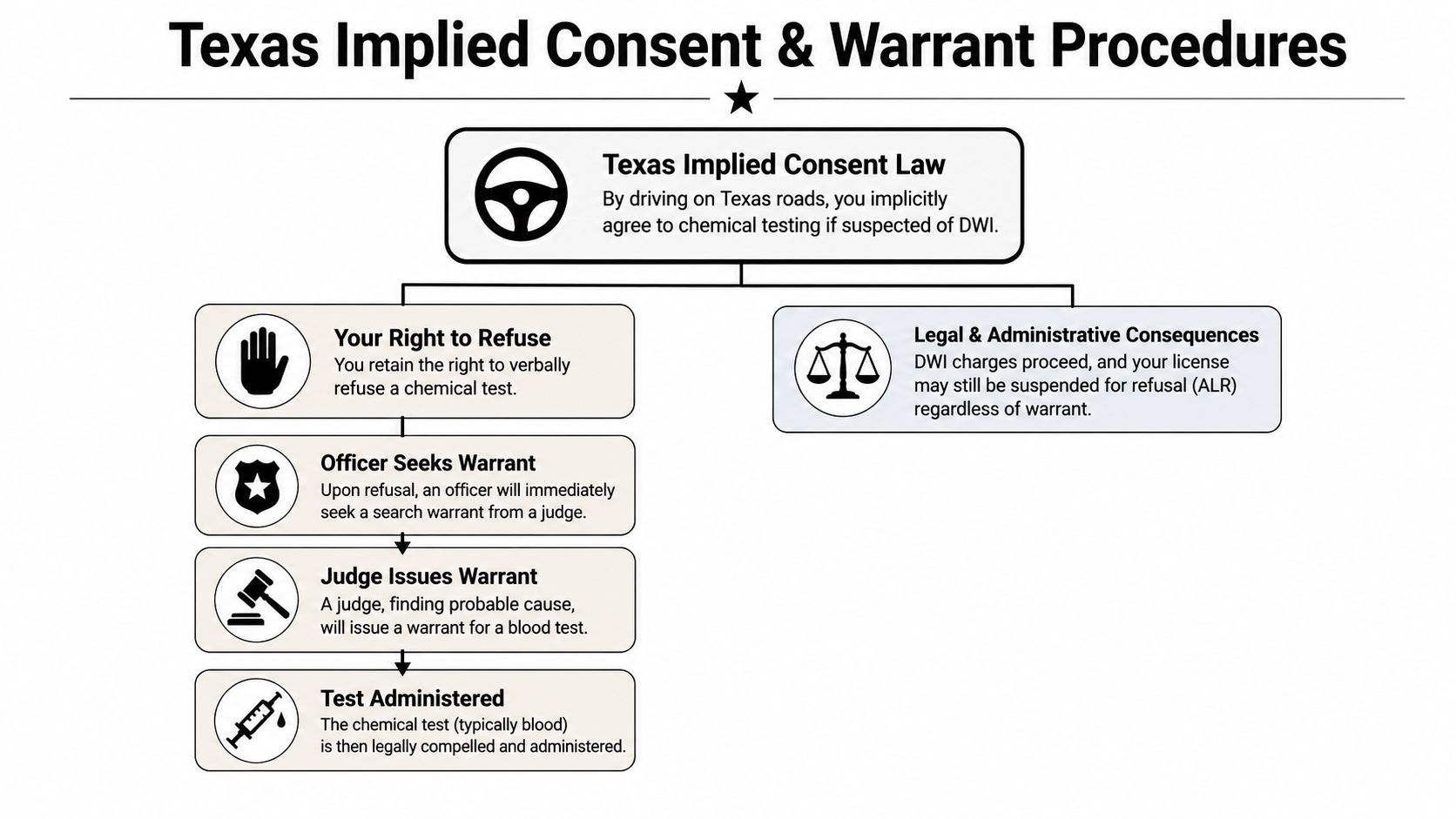
A focused discussion of when police need a DWI blood draw warrant in Texas is useful here because the warrant step is where many no refusal cases turn.
Implied consent in plain English
Implied consent means Texas treats the act of driving on public roads as advance agreement to chemical testing after a lawful DWI arrest. It doesn't mean you physically can't refuse. It means refusal has consequences and may lead to a warrant request.
If you're looking for a simpler explanation of what follows a refusal, Texas Implied Consent and Refusing a Breath Test covers what happens when you refuse chemical testing after a DWI arrest.
The three legal pillars
Here is how the sequence usually works:
The officer claims probable cause for the stop and arrest
Probable cause is the legal basis the officer must have to justify the arrest and request testing. Without it, the later steps may be vulnerable.You may refuse voluntary testing
A driver can still refuse the officer's request for a breath or blood sample. That refusal doesn't end the encounter. It changes what the officer does next.The officer asks a judge for a warrant
If the judge agrees the affidavit shows probable cause, the warrant authorizes a compelled blood draw.
The refusal is not the final step. In a no refusal operation, it's often the step that triggers the paperwork.
Texas's modern no refusal model emerged in 2005, after several jurisdictions began the initiative in response to a statewide chemical-test refusal rate of about 50%, and the programs were designed to speed up warrant-based blood draws rather than create a new refusal offense, according to the NHTSA fact sheet on no refusal initiatives.
Why this matters in a real case
Defense work in these cases often starts with the links between those steps. Did the officer really have a lawful reason to stop the car? Did the arrest affidavit rely on vague observations instead of concrete facts? Did the warrant request contain boilerplate language that didn't match what happened?
Those aren't technicalities. They go to whether the blood evidence should be admitted at all.
How to Handle a Traffic Stop During a No Refusal Weekend
If you're stopped during a no refusal weekend, your goal is to stay calm, stay respectful, and avoid making the case easier for the officer. Most damage in a DWI stop comes from talking too much and trying to explain things away.
Start with the basics. Pull over safely. Keep your hands visible. Provide your license and insurance when asked. Don't argue on the roadside, and don't volunteer details about where you were, what you drank, or how much you think you're "okay to drive."
What to say and what not to say
You can be polite without helping build the case against you.
A practical approach looks like this:
- Be respectful: Use a calm tone and follow basic safety instructions.
- Be brief: If an officer asks investigative questions, you don't have to turn the stop into an interview.
- Don't guess: If you're tired, nervous, or confused, don't try to talk your way out of it with shaky explanations.
- Ask for counsel after arrest: Once you're arrested, it's usually time to stop answering questions and ask for a lawyer.
Field sobriety tests and chemical tests are different
Drivers often lump everything together, but roadside field sobriety tests are different from chemical testing. Field sobriety tests are the balancing, eye, and coordination exercises officers use to collect more observations. In many cases, declining those roadside tests is the safer choice because they are difficult to perform well under stress, on uneven ground, in poor lighting, or while tired.
BAC, by contrast, refers to blood alcohol concentration, which the State may later try to prove through a breath or blood test.
If the officer asks for a breath or blood sample, understand the trade-off. You can refuse voluntary chemical testing, but during a no refusal weekend a warrant may follow quickly. That means the decision is not "test or no test." It may be "voluntary test now or warrant-backed blood draw later."
If you choose to refuse, say it clearly and calmly. Don't physically resist, and don't turn a DWI investigation into an additional charge.
What usually works and what doesn't
What helps:
- Staying composed
- Limiting statements
- Avoiding roadside performance tests
- Remembering details after release, including where the stop happened, what the officer said, and whether body camera or dash camera may exist
What doesn't help:
- Trying to persuade the officer you've had only a little to drink
- Making jokes about alcohol
- Arguing legal theories on the shoulder of the road
- Physically resisting a warrant-backed blood draw
The roadside part of the case feels urgent because it is. But once the arrest happens, the focus shifts from saying the perfect thing to preserving issues your attorney can later challenge.
Navigating the System After a No Refusal DWI Arrest
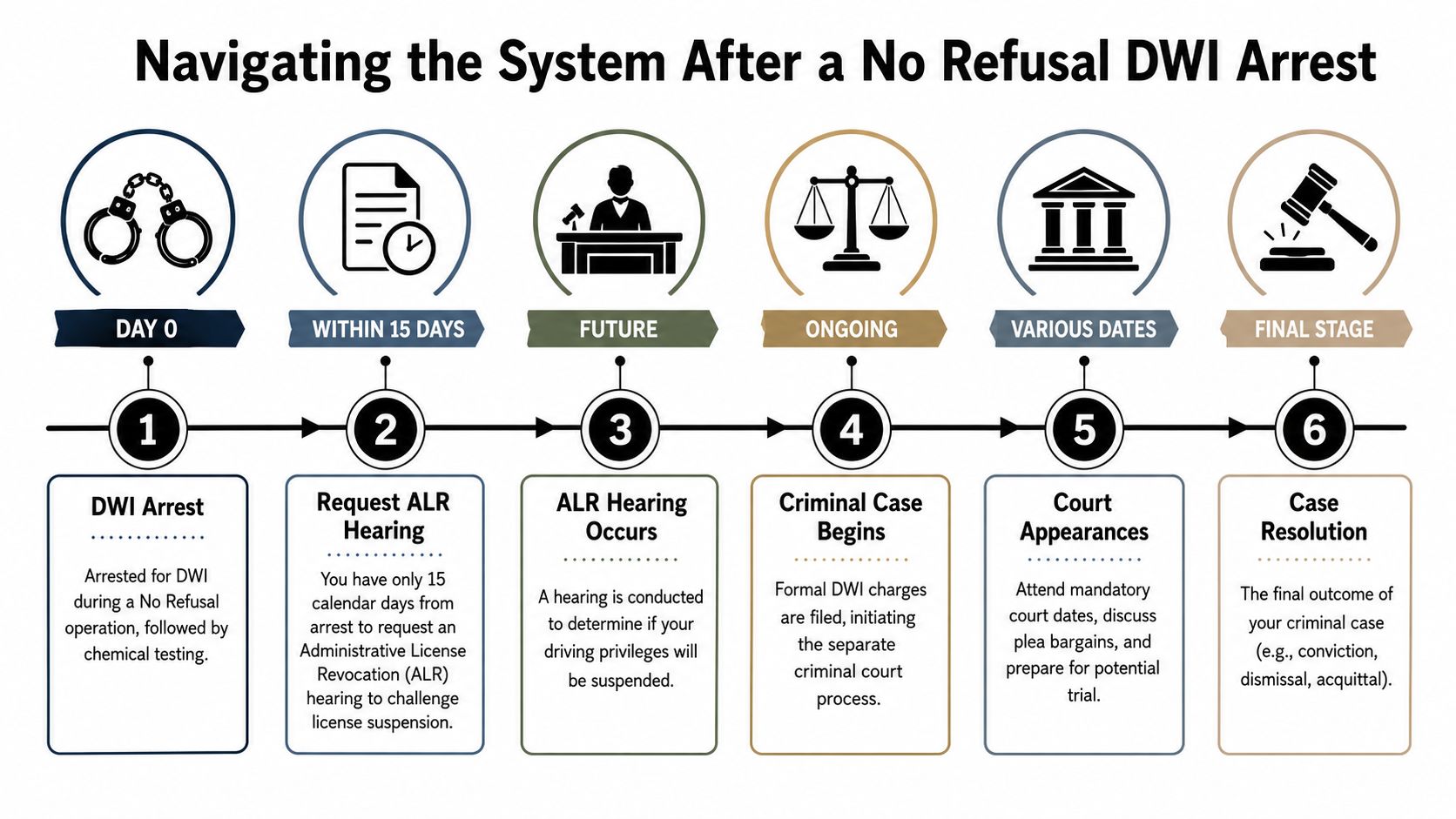
You get out of jail, check your paperwork, and assume the next court date is the main issue. In many no refusal cases, the first problem is somewhere else. The license case starts running on its own timeline, and that timeline can move faster than the criminal case.
The first deadline to protect your license
After a refusal, Texas can seek to suspend your license through a separate administrative process. That issue does not wait for the criminal court to sort out guilt or innocence. As Responsibility.org's review of no refusal programs discusses, no refusal enforcement is built around getting evidence quickly, and that same speed often carries over into the early license consequences.
The practical point is simple. You may have only 15 days after arrest to request an ALR hearing, short for Administrative License Revocation. If that deadline is missed, the suspension process becomes much harder to fight, even if the criminal case later develops real weaknesses.
A first refusal can lead to a lengthy suspension, and a later refusal can bring a much longer one. The exact period depends on your history and the type of allegation, but the bigger defense concern is timing. Early action protects options.
What the case looks like after release
A no refusal arrest usually creates four immediate areas to address:
- Bond conditions: You may be ordered not to drink, not to drive, to install an interlock, or to follow travel and reporting limits.
- License proceedings: The ALR case moves on its own schedule and has its own hearing rules.
- Criminal prosecution: The State reviews the reports, lab request, and charging decision.
- Evidence preservation: Video, dispatch records, warrant paperwork, and blood draw records should be identified and requested early.
That last point matters more in a no refusal case than many drivers realize. The procedure is faster, paperwork is often assembled under pressure, and multiple officers or medical personnel may be involved. Those are not technical side issues. They are places where mistakes happen.
Where the defense usually starts
No refusal does not change the State's burden. It changes how quickly the State tries to build the evidence.
That procedural difference shapes the defense. Instead of focusing only on the test result, the first review often centers on how the case moved from stop, to arrest, to warrant, to blood draw.
| Issue | Why it matters |
|---|---|
| The traffic stop | The officer still needs a lawful basis to stop the vehicle. |
| The arrest decision | The facts must support probable cause for a DWI arrest, not just a hunch. |
| The warrant affidavit | Fast warrant applications can contain boilerplate language, omissions, or weak factual support. |
| The blood draw process | Collection, storage, and chain of custody problems can affect reliability and admissibility. |
| The timeline | Gaps, delays, and inconsistent timestamps can undercut the State's version of events. |
Early in the case, the defense often gets its best opportunities by securing records, requesting the ALR hearing on time, and comparing every report to the video and warrant documents.
For a first-time defendant, waiting to see what happens is usually a mistake. A no refusal arrest creates a faster enforcement pipeline, and the response has to be just as organized. The right approach is to protect the license case, gather the records before they disappear into routine processing, and examine whether the State followed each required step.
Special Rules for Commercial Underage and Out of State Drivers
Some drivers face consequences that go beyond the ordinary DWI case. If you hold a commercial license, are under age 21, or live outside Texas, the same arrest can create different problems.
Commercial drivers
For CDL holders, a DWI charge is also a job-risk case. The criminal court outcome matters, but so do the licensing and employment consequences that can follow quickly. Even when the arrest happened in a personal vehicle, the effect on a commercial career can be serious.
That changes defense strategy. A commercial driver often needs a coordinated plan that considers the court case, the license case, employer reporting concerns, and the practical need to keep working if possible.
Underage drivers
For drivers under 21, alcohol-related driving allegations can create added complications because Texas applies a different framework to underage alcohol enforcement. Parents are often surprised to learn that a case can involve both immediate practical concerns and long-term record concerns.
If you're a parent, don't treat an underage arrest as something that will automatically disappear because your child is young or has no prior record. Early case review matters just as much here.
Out of state drivers
An out-of-state driver often assumes, "This happened in Texas, so I'll deal with it later at home." That approach can create avoidable problems. The Texas court case still has to be handled, and Texas license consequences can affect your ability to drive depending on how your home state responds.
These cases also create logistical issues:
- Court management: Travel, scheduling, and local counsel matter more.
- License overlap: Texas action and home-state consequences may interact.
- Documentation: It is important to track notices, deadlines, and mailing addresses carefully.
For all three groups, the underlying lesson is the same. The arrest may look like an ordinary DWI on paper, but the actual consequences can be very different. A defense strategy should match the driver's actual risk, not just the charge label.
Why You Need a Strategic Houston DWI Defense Lawyer
A no refusal weekend case often turns on paperwork, timing, and procedure as much as the traffic stop itself. An officer makes an arrest, a magistrate reviews a warrant request, medical personnel collect blood, and the prosecutor later tries to present that chain as clean and reliable. A good defense tests each step instead of treating the case like a routine DWI.
That procedural focus matters because no refusal does not erase your rights. It usually means the State moved faster to get a warrant and secure evidence. For your defense, the question is whether that faster pipeline followed the rules at every stage.
Strong representation starts with a close look at details such as:
- whether the stop was lawful
- whether the officer gave specific facts supporting probable cause
- whether the warrant affidavit fits the actual timeline
- whether the blood draw followed proper collection and handling procedures
- whether the license suspension deadline was protected
Those issues can affect both negotiation posture and trial strategy. They can also affect the separate license case, which is easy to mishandle if no one addresses it early.
If you are looking for local help, Houston drunk driving defense information explains the kind of representation these cases call for. Law Office of Bryan Fagan, PLLC handles DWI matters, including license hearings, chemical test challenges, and criminal court defense.
One practical point matters here. A blood test does not end the case. Blood evidence still raises questions about the warrant, the draw, the storage, the lab work, and whether the government can connect each step without gaps.
The right next step is simple. Get the stop, warrant, blood draw records, video, and license deadlines reviewed early. Stop discussing the facts with friends, coworkers, or on social media. Build your defense around the actual record, not around assumptions about what no refusal weekend is supposed to mean.