
A DWI arrest can be overwhelming, but you do not have to face it alone.
If you are reading this after a late-night stop, a trip to jail, or a bond release, you are probably asking one question in plain English: can you plead the fifth in court? The answer is yes. But in a Texas DWI case, the better answer is this: you need to know where, when, and how to use that right.
That is where people get into trouble. A DWI case is not just one case. It usually creates two separate fights. One is the criminal charge. The other is the fight over your driver’s license through an Administrative License Revocation hearing, often called an ALR hearing. The Fifth Amendment works very differently in those two places.
Your Guide to Navigating a DWI Arrest and Your Rights
A lot of clients remember the same first few hours.
They see lights in the mirror. The officer asks if they have been drinking. Then come questions about where they were, how much they had, whether they will do roadside tests, and whether they will blow into a machine or give blood. By the time they get home, they are replaying every word they said.

A Texas DWI case moves fast. Your license, your job, your insurance, and your criminal record can all be affected before you have had a chance to think clearly. If you need a practical first-step guide after an arrest, review what to do after a DUI arrest.
Two legal tracks start almost immediately
Many assume the whole case will be decided in criminal court.
That is only part of the story. In Texas, you may also face an administrative license suspension, which is a separate process about your driving privileges. That hearing is not about guilt or innocence in the same way a criminal trial is.
Here is the strategic problem:
- In the criminal case: your silence is strongly protected.
- In the license case: your silence can carry real downside.
- In both: what you say early can shape the entire defense.
Tip: The Fifth Amendment is a shield. It is not a script you repeat blindly in every setting.
Why this matters in a DWI case
A DWI charge often includes evidence the State already wants to use, such as officer observations, a claimed odor of alcohol, field sobriety tests (roadside balance and coordination exercises officers use to look for signs of impairment), and a reported BAC or blood alcohol concentration, which is the amount of alcohol measured in your breath or blood.
That means the prosecution may not need much from your mouth to build its case. But one bad answer can still hand them exactly what they were missing.
The right move is not to guess. The right move is to treat silence as strategy and let your defense be built deliberately.
What Does Pleading the Fifth Mean
Pleading the Fifth means using the Fifth Amendment right against self-incrimination. In simple terms, the government cannot force you to provide testimonial evidence against yourself in a criminal case.
Think of it this way. The State has to build its own case. It does not get to make you carry bricks for them.
This right is older than your case by a long shot
The Fifth Amendment was part of the U.S. Constitution ratified on December 15, 1791, and the protection against self-incrimination became fully enforceable in state courts through Malloy v. Hogan in 1964. The U.S. Supreme Court also held in Griffin v. California in 1965 that juries cannot treat a defendant’s silence as evidence of guilt, with jury instructions required in 100% of applicable criminal trials, as described in this discussion of pleading the Fifth and Fifth Amendment protections.
That matters in Texas because DWI cases are usually filed in state court, not federal court. Your Fifth Amendment protection still applies.
What the Fifth protects, and what it does not
The key word is testimonial.
The Fifth mainly protects you from being forced to communicate statements that could incriminate you. It does not block every part of a police investigation, and it does not erase every legal duty you have during a stop.
A few examples make this easier:
- Protected: answering a question like “How much did you drink?”
- Protected: explaining where you were before the stop
- Usually not protected: providing identifying information required by law
- Not the same thing: refusing to speak versus refusing every police request
That distinction is why broad internet advice often fails people. “Just plead the Fifth” is too simple for a real DWI stop.
Why innocent people use it too
Invoking the Fifth often raises concerns about appearing guilty.
That is backwards. The right exists because even truthful people can be misunderstood, pressured, interrupted, or quoted selectively. In a DWI case, a person may think they are giving a harmless explanation and end up confirming key facts the State needed.
Here is the practical version:
- The officer asks casual questions.
- You try to sound cooperative.
- Your answers become part of the arrest report.
- Those statements later appear in court as admissions.
Key takeaway: Pleading the Fifth is not a loophole. It is a constitutional rule that forces the government to prove its case without your compelled help.
The phrase itself matters less than the legal effect
You do not need to sound dramatic. You do need to be clear.
Saying “I’m not talking” can create confusion. Saying “I am exercising my right to remain silent” is better. Pairing that with a request for counsel is stronger.
And in court, “pleading the Fifth” is not magic language. It is an assertion of a constitutional privilege against answering a question that could incriminate you.
Using Your Right to Silence in a Texas DWI Criminal Case
In the criminal side of a Texas DWI case, your silence is protected in a way many people do not fully appreciate.
That protection is strongest when the government is trying to prove you committed a crime. The prosecutor cannot tell the jury to treat your silence as proof of guilt.
Silence is not evidence of guilt in criminal court
The U.S. Supreme Court in Griffin v. California held that no adverse inference of guilt can be drawn from a defendant’s silence in criminal proceedings. The Court also recognized in Ohio v. Reiner that even innocent people may reasonably invoke the Fifth, as discussed in this explanation of pleading the Fifth in criminal and civil contexts.
That rule is one reason a smart DWI defense does not depend on the client taking the stand. Many cases are won by attacking the stop, the arrest, the testing process, and the officer’s conclusions.
How this plays out from stop to trial
Your criminal exposure can begin before handcuffs ever go on.
An officer may ask questions during the stop that sound harmless:
- “Where are you coming from?”
- “Have you had anything to drink?”
- “When was your last drink?”
- “Do you feel okay to drive?”
Every answer can become evidence. If the case reaches trial, your defense lawyer may challenge whether the officer had lawful grounds for the stop, whether the arrest was supported by probable cause, and whether evidence should be suppressed.
A clean silence helps. A talkative explanation often hurts.
Miranda rights and what they really do
The phrase Miranda rights is widely known. In plain terms, these are warnings police give before custodial interrogation, including the right to remain silent and the right to an attorney.
Do not make the common mistake of thinking Miranda is the source of your rights. It is not. The Constitution gives you the right. Miranda warnings are the notice.
Once questioning becomes custodial, you should be direct.
- State that you want to remain silent.
- State that you want a lawyer.
- Stop trying to explain.
- Do not fill awkward silence with extra details.
Practical advice: Be polite. Be calm. Be firm. The officer does not need your life story, and your criminal defense does not improve because you kept talking.
Terms you should understand
A few DWI terms confuse people and lead to bad decisions.
- Field sobriety test: Roadside exercises, such as balance and divided-attention tasks, used by officers to claim signs of impairment.
- BAC: Blood alcohol concentration, usually reported from breath or blood testing.
- First DWI in Texas: Often charged as a misdemeanor, but it can still carry serious consequences for your record, license, and employment.
- Fight DWI Texas: A real defense means examining the legality of the stop, the officer’s observations, the testing procedure, and whether evidence can be excluded.
A criminal DWI case is where your Fifth Amendment protection does its best work. That does not mean silence solves everything. It means silence keeps you from making the case easier for the prosecution.
The High-Stakes Difference in Civil and ALR Hearings
The biggest misunderstanding in Texas DWI practice is this: people assume the Fifth Amendment works the same everywhere.
It does not.
Your DWI charge is criminal. Your ALR hearing is administrative and civil in nature. That one difference changes the risk completely.
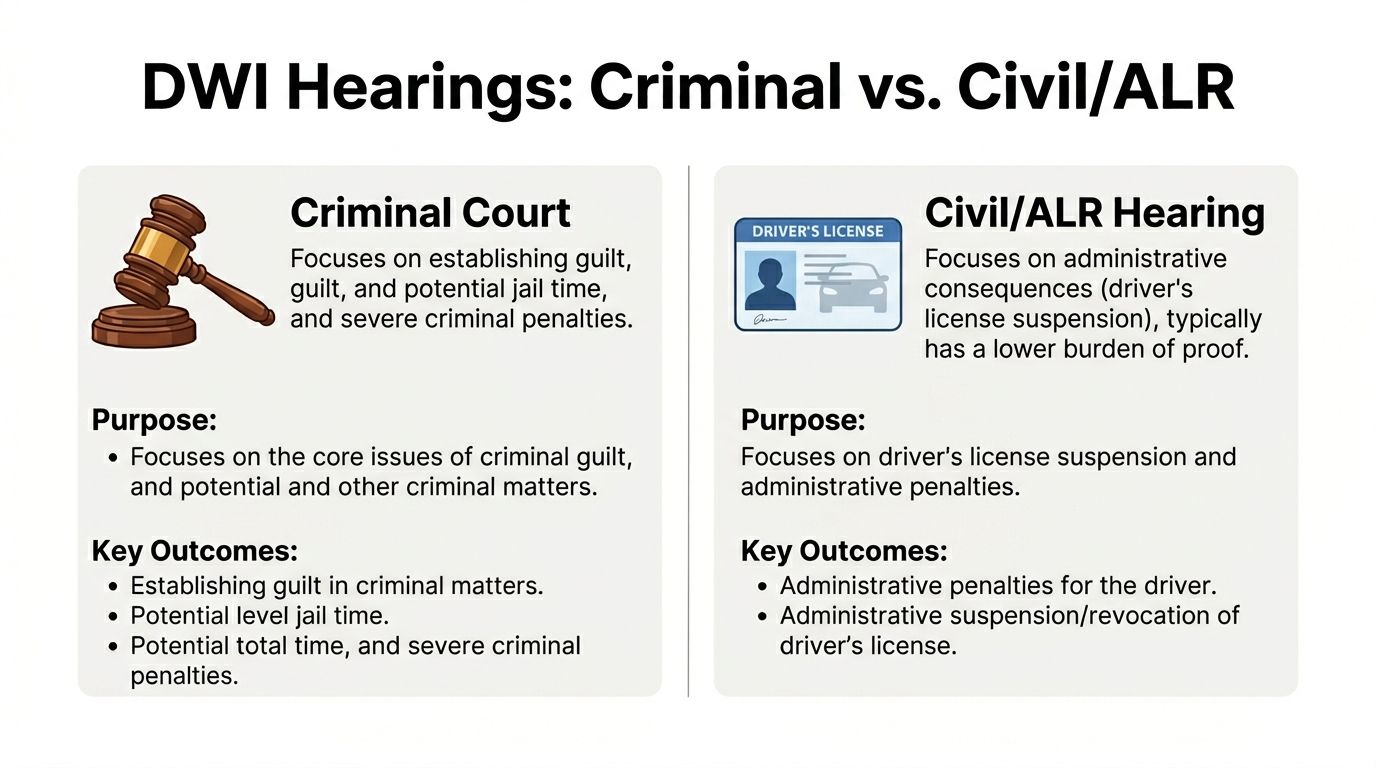
If you want a closer look at the split between the criminal case and the license case, read ALR hearing vs criminal case in Texas.
Why the ALR hearing is different
An administrative license suspension is the possible loss of your driving privileges through a separate process handled apart from your criminal prosecution.
In Texas DWI cases, this usually comes up after a failed test or a refusal. The State may try to suspend your license even while the criminal charge is still pending.
The legal danger is this. In a civil setting, a factfinder may draw an adverse inference from your silence. That means the hearing officer can treat your refusal to answer as a sign the answer would have hurt you.
The Supreme Court allowed that distinction in Baxter v. Palmigiano. In Texas DWI-related ALR matters, a test refusal can trigger a 90-day automatic suspension under Texas Transportation Code §524.021, and a 2024 Texas DPS audit found that 74% of ALR affirmances after invocation were due to inferred guilt on intoxication elements, as summarized in this discussion of Fifth Amendment use in civil proceedings.
The strategic trap
Unrepresented drivers often encounter difficulties at this stage.
If you speak freely at the ALR hearing, you may help the State in the criminal case. If you invoke the Fifth, you may protect the criminal side but make the license fight harder.
That does not mean you should always testify in ALR. It means you should never make that choice casually.
Key takeaway: In criminal court, silence is protected. In an ALR hearing, silence can carry a cost.
Pleading the Fifth in two different rooms
| Aspect | In Criminal Court (for the DWI charge) | In an ALR Hearing (for your driver's license) |
|---|---|---|
| Main purpose | Determine criminal guilt | Decide license consequences |
| Effect of silence | Jury cannot treat silence as guilt | Hearing officer may draw an adverse inference |
| Main risk | Losing chance to tell your side directly | Damaging your license case by not answering |
| Main benefit | Avoids self-incrimination | Can still protect the criminal defense |
| Best approach | Strategic silence is often smart | Requires careful case-by-case planning |
What to focus on at the ALR stage
A strong ALR defense is usually less about dramatic testimony and more about the paper trail and the officer’s basis for action.
Look closely at issues like:
- The stop itself: Was there lawful reason to pull you over?
- The arrest decision: Did the officer have probable cause?
- The warning process: Were you properly advised about refusal consequences?
- The test request: Was the demand for breath or blood handled lawfully?
Because the criminal case and ALR hearing affect each other, every statement matters twice. Once for the license. Again for the prosecution.
Implied Consent Chemical Tests and the Fifth Amendment
A lot of confusion starts with one decision at roadside or at the station. Do you take the breath test? Do you refuse? Does the Fifth Amendment let you refuse everything?
Not exactly.
What implied consent means in Texas
Implied consent means that by driving on Texas roads, you are deemed to have agreed to provide a breath or blood specimen if lawfully arrested for DWI under circumstances allowed by Texas law.
That does not mean police can do anything they want. It means refusal has separate consequences, especially for your license.
For a fuller explanation, review this page on an example of implied consent.
Testimonial evidence versus physical evidence
This is the cleanest way to understand the issue.
The Fifth Amendment protects you from being forced to say things that incriminate you. It generally does not protect you from providing physical evidence.
In DWI cases, that distinction usually looks like this:
- Testimonial evidence: your answers to questions
- Physical evidence: your breath sample or blood sample
- Officer observations: what the officer claims to have seen, heard, or smelled
So if you ask, “Can I plead the Fifth instead of blowing?” the legal answer is not the one many expect. The Fifth is much stronger against compelled statements than against the collection of physical evidence.
Why refusal is still a real decision
Even though the Fifth does not usually block a chemical test request the way it blocks questioning, refusal is still a strategic issue because it can affect the ALR case and the criminal case differently.
Constitutional arguments and technical DWI defense work meet at this point.
That is why your lawyer may examine several separate questions:
- Was the stop lawful?
- Was the arrest lawful?
- Was the request for testing proper?
- Was there a warrant for blood, if blood was taken?
- Can the result be excluded because the process was flawed?
A few practical definitions
- BAC: The concentration of alcohol measured in your system.
- Breath test: A machine-based estimate of alcohol concentration from breath.
- Blood test: A chemical analysis of a blood sample, often used when the State wants a more formal measurement.
- DWI license suspension: The possible loss of driving privileges through the ALR process, separate from the criminal court case.
Practical advice: Do not assume “I refused” or “I took the test” decides your case. It creates issues. It does not end the defense.
A seasoned Texas DUI attorney looks for weak links in the stop, the arrest, the warrant process, the machine procedure, the blood draw, the chain of custody, and the way the State tries to interpret the result.
How to Properly Invoke Your Right to Remain Silent
Knowing your rights is one thing. Using them correctly in a tense traffic stop is another.
Most mistakes happen because people try to be half-cooperative and half-protective. That approach usually fails.
Use clear words
If an officer starts asking investigative questions, keep it simple.
Say this:
“Officer, I am exercising my right to remain silent, and I want to speak with an attorney.”
That sentence does two jobs. It invokes silence, and it invokes counsel.
Do not argue your rights
You do not need a roadside debate.
You do not need to lecture the officer about the Constitution, challenge every statement, or make sarcastic comments. That only creates more problems and never improves your defense.
A better approach looks like this:
- Provide required identifying information.
- Be respectful in tone.
- Do not volunteer explanations.
- Repeat your request for counsel if questioning continues.
Silence is not the same as obstruction
Many people worry that staying silent will make them look difficult.
There is a major difference between refusing to answer incriminating questions and becoming combative. Your goal is to shut down questioning, not escalate the stop.
Good examples:
- “I want a lawyer.”
- “I am choosing not to answer questions.”
- “I will not discuss my evening.”
Bad examples:
- Insults
- Physical resistance
- Arguing every instruction
- Rambling explanations after invoking
A roadside script that works
- Hands visible, documents ready. Stay calm and keep the contact professional.
- Answer basic identification questions. Do not turn a lawful stop into a new issue.
- When questioning turns investigative, invoke clearly. Use the exact sentence above.
- Stop talking. Do not undercut your own invocation with chatter.
- Ask for counsel again if needed. Consistency helps.
This short video gives a practical overview of protecting yourself during a stop:
Best single sentence to remember: “I am exercising my right to remain silent, and I want to speak with an attorney.”
That line is calm, lawful, and useful. If you only remember one thing after reading this article, remember that.
Let a Houston DWI Lawyer Build Your Defense Strategy
A Texas DWI case is not just about whether you can plead the Fifth in court.
It is about using the right protection in the right place. In the criminal case, silence can protect you. In the ALR hearing, the same silence can create a different risk. Add chemical testing, implied consent, officer reports, and license suspension issues, and this becomes a strategy problem, not a guessing game.
That is why waiting and hoping is a mistake.
A Houston DWI lawyer or Texas DUI attorney should review the stop, the arrest, the test request, the ALR timeline, and every statement already made. In some cases, the best move is aggressive silence. In others, the case calls for targeted testimony, fast ALR preparation, or a suppression attack on unlawfully obtained evidence.
If this is your first DWI in Texas, do not assume the consequences are minor. If you are trying to fight DWI Texas, start by getting legal advice before making more statements that cannot be taken back.
Your defense should be built with purpose. Not panic.
Frequently Asked Questions About Pleading the Fifth
Does pleading the Fifth make me look guilty
In criminal court, the law does not allow the jury to treat your silence as guilt. That is the legal rule.
In real life, people still worry about appearances. That is why your lawyer must decide whether silence helps more than testimony in your specific case.
Can I answer some questions and refuse others
Sometimes, but selective answering is risky.
If you start explaining key facts and then stop when the questions get dangerous, you may create waiver arguments or give the State enough admissions to hurt you anyway. Consistency is usually safer.
Can a witness plead the Fifth
Yes, if a truthful answer could incriminate that witness.
But a witness does not get to ignore court completely. The witness usually must appear and assert the privilege when necessary.
Does the Fifth stop a breath or blood test
Not in the same way it stops questioning.
The Fifth is strongest against testimonial self-incrimination. Breath and blood evidence are generally treated differently from spoken answers.
What is the smartest move after a DWI arrest
Stop talking about the facts of the case to police and to anyone else who might repeat your statements.
Then get legal counsel quickly, especially if your license is at risk and you need to respond to the ALR process.
If you were arrested for DWI and need clear answers about your criminal case, your DWI license suspension, or whether to testify, contact the Law Office of Bryan Fagan, PLLC for a free, confidential consultation. A strong defense starts early. The right strategy can protect your record, your license, and your future.