
A DWI arrest can be overwhelming, but you don't have to face it alone.
If you're reading this, you're probably asking the question almost every Texas driver asks after an arrest: should I fight my DWI charge in Texas, or should I just try to get it over with? My answer is simple. In most cases, you should seriously explore fighting it before you make any decision that follows you for years.
That doesn't mean every case goes to trial. It means you should treat your case like a problem to be analyzed, not a mistake to be surrendered to. A DWI charge is often more negotiable, more technical, and more vulnerable to challenge than people think.
A DWI Arrest Is Overwhelming But You Have Options
The first night after a DWI arrest usually brings similar feelings. You replay the stop. You worry about your job, your family, your license, and whether one bad night is about to define you. That reaction is normal.
What matters now is control. You do not need to decide today that you're guilty, that the officer must be right, or that pleading out is your only realistic path. A DWI charge in Texas creates choices, and good decisions early often shape everything that happens later.
A smart response starts with a short list:
- Protect your deadlines: Some parts of a DWI case move fast, especially anything involving your driver's license.
- Stop guessing about the evidence: You may think the case is strong because you were arrested. That's not the same as the State being able to prove it cleanly.
- Get organized immediately: Save paperwork, bond conditions, towing information, and anything you remember about the stop.
- Read a practical next-steps guide: The first 24 hours after a Texas DWI arrest are often where avoidable mistakes happen.
Practical rule: Don't make a plea decision while you still don't know the full evidence, the license deadline, or whether the stop can be challenged.
People often ask me whether fighting a DWI makes sense only if they believe they were completely innocent. That's the wrong standard. You fight a DWI when the State's proof deserves pressure, when the consequences are serious, or when the process itself may have gone wrong. In Texas, that is often enough to justify a real defense.
The Two Legal Battles You Face After a DWI Arrest
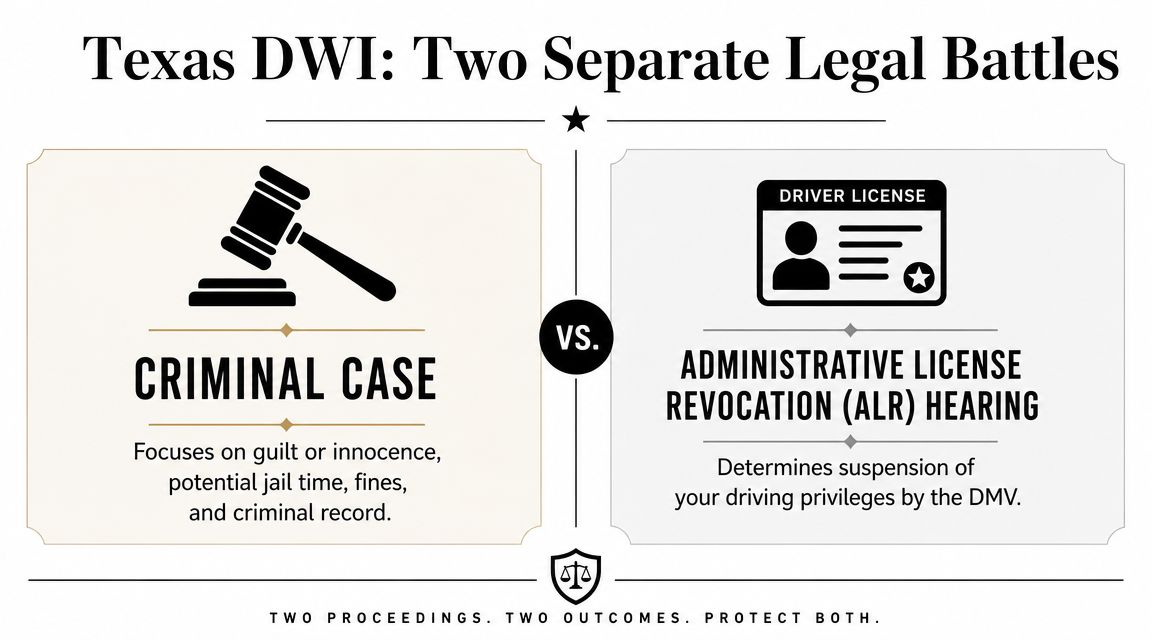
Texas DWI cases are confusing because you're not dealing with just one case. You're dealing with two.
One is the criminal case, where the court decides whether the State can prove the offense. The other is the Administrative License Revocation, or ALR, case, which is the civil process tied to your driving privileges. Texas DWI defense resources explain that these are commonly separate proceedings, and a person can win one track while losing the other, which is why the stop, arrest, or testing procedure often has to be challenged in both forums through a coordinated defense strategy in Texas DWI defense resources.
What the criminal case decides
The criminal case is often the primary concern. Here, the prosecutor aims to prove that you were driving while intoxicated. If the State wins, the result can affect your criminal record and lead to court-imposed penalties.
This case also gives your lawyer room to challenge the stop, the arrest, the officer's observations, field sobriety testing, and any breath or blood evidence.
What administrative license suspension means
Administrative license suspension means the State is trying to suspend your license through the ALR process after the arrest. This is separate from whether you are ultimately convicted in criminal court.
That distinction matters. A person can walk away with a better result in court but still lose ground on the license side if the ALR case isn't handled correctly.
Here's the practical difference:
| Proceeding | Main issue | Typical focus |
|---|---|---|
| Criminal case | Whether the State can prove the DWI offense | Guilt, evidence, motions, plea negotiations, trial |
| ALR case | Whether your license should be suspended | The stop, arrest basis, test refusal or failure, DPS procedure |
The biggest mistake I see is treating the license case like an afterthought. It isn't.
Why this split changes the decision to fight
Once you understand there are two battles, the question becomes more strategic. If the stop was weak, if the officer's report is sloppy, or if the testing process has problems, fighting may create an advantage in both places. If you ignore one track, you can give up ground you might have preserved.
That's why a Houston DWI lawyer or Texas DUI attorney should evaluate the full picture right away, not just the court date on your paperwork.
Understanding the Full Scope of Texas DWI Penalties
Before you decide whether to contest the charge, you need a clear view of what's at stake. Not vague fear. Real exposure.
Texas law gives different penalty ranges depending on the level of the charge. According to a Texas DWI penalty overview, a first DWI is generally a Class B misdemeanor with a maximum criminal fine of $2,000, but that ceiling rises to $4,000 if the driver's BAC is 0.15 or higher. A second DWI is automatically a Class A misdemeanor with the same $4,000 maximum fine, and felony DWI fines can reach $10,000 as explained in this breakdown of Texas DWI fine ranges.

What BAC means in your case
BAC means blood alcohol concentration. In a DWI case, it becomes important because prosecutors may try to use a chemical test result to argue that you were over the legal limit, or use it to seek a more serious penalty range.
That's one reason I don't like casual advice such as “just take the deal if it's your first DWI in Texas.” A first offense can still carry meaningful consequences, and the stakes increase if the State alleges a higher BAC.
Why the penalty chart is only the starting point
The fine range tells you something important, but it doesn't tell you everything. A conviction can also create pressure on your driving privileges, your employment, your insurance situation, and any professional licensing issue you may have. If you hold a job that depends on driving, travel, background checks, or a reputation for judgment, the analysis changes quickly.
That is why the right question isn't “Can I survive this?” The better question is “What does a conviction cost me compared with the cost of fighting?”
For many people, the long-term cost is the bigger problem.
To understand how defense strategy fits into that reality, this short video gives helpful context:
A blunt recommendation
If your charge involves an alleged high BAC, a prior DWI, or facts that could push the case into a harsher category, don't assume the outcome is fixed. Those details often become the exact points a defense lawyer examines first.
- First-time charge: You may have more room to negotiate than you think.
- Higher alleged BAC: The number matters, but the testing process matters too.
- Repeat allegation: Prior history impacts your standing, which makes early strategy even more important.
How a DWI Defense Attorney Challenges the Evidence
A DWI arrest is not proof. It is an accusation backed by evidence that still has to hold up.
The State usually tries to prove intoxication in one of three ways: observed loss of mental faculties, observed loss of physical faculties, or a BAC of 0.08 or higher. Texas DWI analysis also notes that when there is no breath or blood sample, prosecutors often lean harder on the officer's observations, which makes the stop, field sobriety testing, and procedure especially important to examine in this discussion of Texas DWI proof pathways.
Start with the traffic stop
A good defense often begins before the arrest itself. Why did the officer stop you? Was there a valid basis for the detention? Did the report clearly explain it, or does it rely on vague language?
If the stop was unlawful, that can affect everything that came after it. A weak stop can turn a case that looked strong on paper into a case worth pressing hard.
Then examine the officer's observations
Officer observations matter in almost every DWI case. But they are still human observations. They can be incomplete, exaggerated, or shaped by assumptions.
Look closely at issues such as:
- Speech and demeanor: Nervousness, fatigue, stress, and medical conditions can be mistaken for impairment.
- Balance and coordination: Uneven pavement, weather, shoes, injuries, age, and physical limitations can affect performance.
- Driving facts: A minor traffic mistake does not automatically prove intoxication.
What a field sobriety test actually is
A field sobriety test is a roadside set of physical and mental tasks an officer uses to claim signs of impairment. These tests are often presented as objective, but they depend heavily on how they were explained, demonstrated, and scored.
That means your lawyer should ask basic but important questions. Were instructions clear? Was the surface appropriate? Did body camera or dash camera footage match the report? Were there signs the officer skipped steps or overstated clues?
Good DWI defense work is detail work. Cases often turn on procedure, language, and what the video does or doesn't show.
Breath, blood, and implied consent
If there was a breath or blood request, another issue comes into play: implied consent. In plain English, implied consent means that by driving on Texas roads, you are considered to have agreed to chemical testing rules under Texas law after a lawful DWI arrest. That does not mean every test result is automatically reliable or every request was properly handled.
A lawyer will still ask whether the sample collection, machine use, chain of handling, and legal paperwork were done correctly.
If you want a fuller picture of what the State may try to use against you, review what evidence prosecutors use in Texas DWI cases.
What this means for your decision
When people ask me whether they should fight, I ask a different question first: where is the State vulnerable? If the answer is “in several places,” then fighting isn't stubborn. It's rational.
That includes cases where the video is better for the defense than the police report, where the stop was questionable, or where the testing story has gaps.
Deciding to Fight Your DWI A Strategic Framework
You get arrested on a Friday night. By Monday morning, you are asking the question that matters: do I fight this, or do I cut a deal and move on?
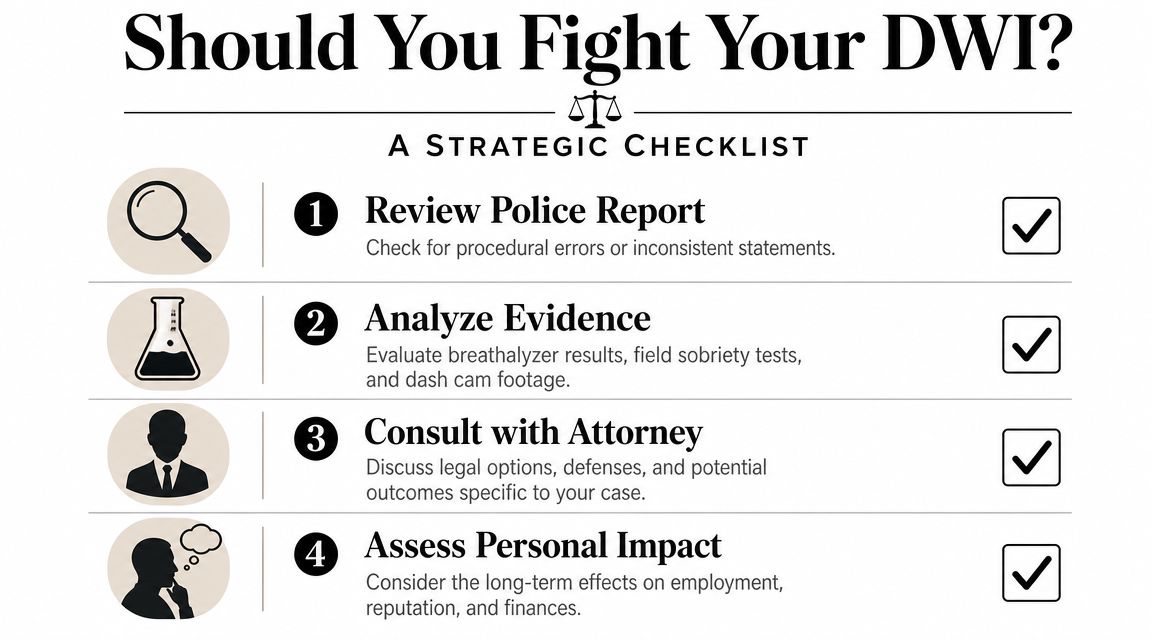
That decision should be strategic, not emotional. A good defense lawyer weighs the strength of the State's proof against the cost of a conviction, then decides where a fight makes sense and where it does not.
Factor one is the strength of the State's case
Start here. Every DWI case is an evidence problem.
Some cases look solid on paper and fall apart once the defense gets the full record. Others look minor at first and get harder once testing records, witness statements, or prior history come into focus. The right question is simple: how much can the prosecutor prove, and how cleanly can they prove it?
Focus on points like these:
- Was the stop legally justified?
- Are the officer's descriptions specific, or copied from a standard script?
- Does the video support the report, or undercut it?
- Do the test records show careful procedure, or mistakes and gaps?
If the answer shows weak proof, you fight. If the proof is stronger, you still may fight, but now the goal may be damage control, a better plea position, or preserving your license and record as much as possible.
Factor two is your personal exposure
The same charge does not carry the same price for every person. For some people, a DWI is a serious hassle. For others, it threatens work, licensing, insurance, custody issues, or immigration status.
That changes the analysis.
You should treat the case as high-stakes if you are:
- A commercial driver or someone who drives for income
- A licensed professional
- Facing an employer review or background check
- In the middle of a custody or divorce dispute
- Carrying prior alcohol-related allegations or convictions
If a conviction can damage your career or restrict how you support your family, fighting usually makes more sense. The long-term cost is too high to plead early just because the process feels uncomfortable.
Factor three is whether pressure on the case can improve the outcome
A fight does not always end in trial. In many Texas DWI cases, the value of fighting is what it does before trial.
Once the defense demands records, examines the stop, tests the State's paperwork, and prepares motions, the prosecutor has to evaluate the file more seriously. Weak spots matter more when the defense is prepared to expose them. That is often how better plea offers happen.
Law Office of Bryan Fagan, PLLC handles DWI defense and ALR-related strategy, which matters when the criminal case and license case need to be assessed together. If you want to see how that process usually unfolds, review this timeline of a Texas DWI case from arrest to trial.
Factor four is the real cost of not fighting
Here, people make expensive mistakes. They focus on the immediate cost of hiring counsel and ignore the longer bill that comes with a conviction.
Use this comparison:
| Question | If you fight | If you surrender too early |
|---|---|---|
| Evidence review | You find out where the case is weak or strong | You may never test the State's proof |
| License strategy | You may preserve options on the ALR side | You may lose options quickly |
| Negotiation position | Preparation can improve outcomes | Quick pleas often come from pressure, not strategy |
| Long-term consequences | You may reduce or avoid damage | You accept consequences without making the State earn them |
Here is my advice. Do not plead first and investigate later. Get the evidence, measure the risk, and make a deliberate decision. Unless the State's case is plainly strong and the offer is plainly good, fighting your DWI charge is often the smarter move.
Your DWI Case Timeline and How to Prepare
A DWI case feels chaotic because several things start moving at once. The way to settle that chaos is to understand the sequence.
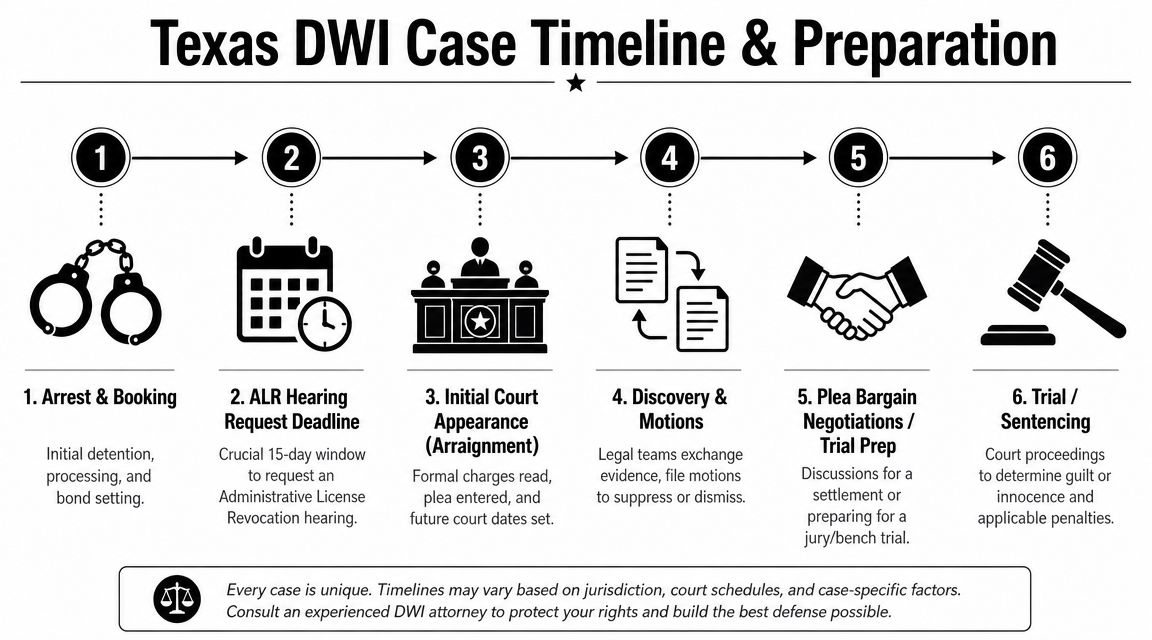
Texas DWI arrests can trigger an administrative license suspension ranging from 90 days to two years, and one Texas DWI defense source states that drivers typically have 15 days from arrest to request the ALR hearing that contests the suspension in this guide on fighting a DWI in Texas. That deadline is one of the first things I would check in any case involving possible DWI license suspension.
What usually happens next
After the arrest, most cases move through a familiar pattern:
Booking and release
You are processed, given paperwork, and released under bond conditions.ALR deadline review
This is the early license issue. Missing the hearing request window can cost you the chance to challenge suspension.First court appearance
The court handles initial procedural matters and sets the case on track.Discovery and motions
During this stage, the defense obtains reports, video, testing records, and other evidence, then files motions where appropriate.Negotiation or trial preparation
Some cases resolve through stronger negotiation after evidence problems are exposed. Others move toward trial.
How to prepare without hurting your case
Your job now is simple. Be useful to your lawyer and stay disciplined.
- Write down the stop: Include where you were, what the officer said, what you were asked to do, and anything unusual about the scene.
- Keep every document: Bond forms, notice paperwork, tow papers, and court information all matter.
- Follow bond conditions carefully: Don't create a second problem while trying to solve the first.
- Avoid discussing facts casually: Loose statements to friends, coworkers, or online can come back to hurt you.
- Bring questions to your consult: Good consultations are specific, not emotional guesswork.
Bring your paperwork, your memory of the stop, and your questions. Leave panic at the door.
Questions to ask a Houston DWI lawyer
A consultation is more useful when you ask direct questions:
- Do you see any issue with the traffic stop?
- Was the officer relying mostly on observations or chemical testing?
- What should I expect on the license side of the case?
- What evidence do you want immediately?
- Does this case look like a negotiation case, a motion case, or a trial case?
- What are the pressure points that could improve the outcome?
If you want a broader roadmap of the process, review the timeline of a Texas DWI case from arrest to trial.
The bottom line
If you're still asking, “Should I fight my DWI charge in Texas,” my advice is yes. At least far enough to understand the evidence, protect your license options, and measure the true cost of a conviction. Don't hand the State a win before your lawyer has tested the case.
If you were arrested for DWI in Texas, now is the time to act. The Law Office of Bryan Fagan, PLLC offers a free, confidential consultation to review your charge, explain your options, and help you decide on a defense strategy that fits your case. If you want clear answers from a Houston DWI lawyer or Texas DUI attorney, request your case evaluation today.