
A DWI arrest can be overwhelming—but you don’t have to face it alone. One of your first concerns is likely the potential fine, a major source of anxiety. For a first-time DWI in Texas, the criminal fine can reach $2,000, and that number jumps to $4,000 if your blood alcohol concentration (BAC) was 0.15 or higher. For subsequent offenses, the stakes get much higher, with fines climbing to $10,000 for a felony DWI.
Understanding the True Cost of a Texas DWI
Facing a DWI arrest is stressful enough without the added burden of financial uncertainty. While many people focus on the court-ordered fine, that figure is only the beginning. The total financial impact of a Texas DWI conviction includes a complex mix of fines, mandatory state fees, court costs, and other long-term expenses that can quickly spiral into thousands of dollars.
It's natural to feel discouraged when looking at these potential costs. However, it is crucial to remember that an arrest is not a conviction. You have rights, and a strong defense can protect your future. This guide will provide a clear, straightforward breakdown of every potential cost you may face, helping to replace uncertainty with a solid, strategic plan.
The Components of a DWI Financial Penalty
The financial consequences of a DWI charge come from multiple sources. The fine a judge imposes is just one part of a much larger and more costly picture. Let’s review the various costs you could be facing, which we will explore in more detail.
- Criminal Fines: These are the base penalties defined in the Texas Penal Code for the specific DWI offense.
- Court Costs: Separate from the fine, these are administrative fees that cover the expense of processing your case through the legal system.
- DPS Surcharges: The Texas Department of Public Safety (DPS) imposes mandatory annual fees for several years following a conviction simply to maintain your driver's license.
- License Reinstatement Fees: After a suspension period ends, you must pay a fee to have your license reinstated.
- Ignition Interlock Device (IID): If the court requires an IID, you are responsible for installation and monthly monitoring fees.
- DWI Education and Intervention Programs: Mandatory classes and evaluations each come with their own costs.
- Increased Insurance Premiums: A DWI conviction will cause your auto insurance rates to increase significantly for several years.
A common mistake is assuming the court-ordered fine is the final bill. In reality, the total financial cost often doubles or even triples when you account for administrative fees, surcharges, and long-term expenses like insurance hikes.
A strategic legal defense is about more than just fighting the charges—it's about protecting your financial future. By challenging the evidence and negotiating on your behalf, a skilled Houston DWI lawyer can work to reduce or even eliminate these significant financial penalties.
Before we break down the fines for each offense level, it's helpful to see how these costs accumulate. The court-ordered fine is just the starting point.
Quick Look at Potential Texas DWI Financial Penalies
| Expense Category | Typical Cost Range | What It Covers |
|---|---|---|
| Criminal Court Fine | $0 – $10,000 | The direct penalty for the DWI offense, set by the judge. |
| Court Costs | $200 – $500 | Administrative fees for filing and processing your case. |
| DPS Surcharges | $3,000 – $6,000 | Annual fees paid to the state for three years to keep your license. |
| License Reinstatement Fee | $125 | One-time fee to get your driver's license back after suspension. |
| Ignition Interlock Device (IID) | $1,000 – $2,500+ (per year) | Installation and monthly monitoring for the court-ordered device. |
| Probation Fees | $60 – $100 (per month) | Monthly fees paid to the county to supervise your probation. |
| DWI Education Program | $70 – $200 | Enrollment fees for mandatory alcohol education classes. |
| Increased Car Insurance | $1,500 – $3,000+ (per year) | The hike in your annual premiums after a DWI conviction. |
This table illustrates how quickly the costs add up beyond the initial fine. Each category represents another financial obstacle, which is why a defense focused on minimizing your total financial exposure is so important.
Texas DWI Penalties Explained
The potential fines for a DWI in Texas are not arbitrary. State law provides a clear framework where penalties increase based on the specifics of your case and whether you have prior offenses. Understanding where your case fits within this structure is the first step toward building a defense that protects your finances.
For most people, the first question is, "What's the fine for a first DWI in Texas?" The answer depends on the specific charge. A standard first-offense DWI is a Class B Misdemeanor, for which the law caps the criminal fine at $2,000. However, this is just the baseline.
First-Time DWI Fines
A first-time DWI charge is serious, but it is also the level where a strong defense has the greatest opportunity to reduce penalties. The court considers many factors when determining the final fine, but the Texas Penal Code establishes the maximum amount.
- Standard First DWI (Class B Misdemeanor): The maximum fine is $2,000. This applies if your Blood Alcohol Concentration (BAC) was under 0.15 and there were no other aggravating factors, such as having a child passenger.
- First DWI with High BAC (Class A Misdemeanor): If your BAC test result is 0.15 or higher, the charge is elevated. With this enhancement, the maximum fine doubles to $4,000. This significant increase shows how much more seriously the state treats a DWI with a high BAC.
This infographic effectively illustrates how the court-ordered fine is just one piece of the larger financial puzzle you are now facing.
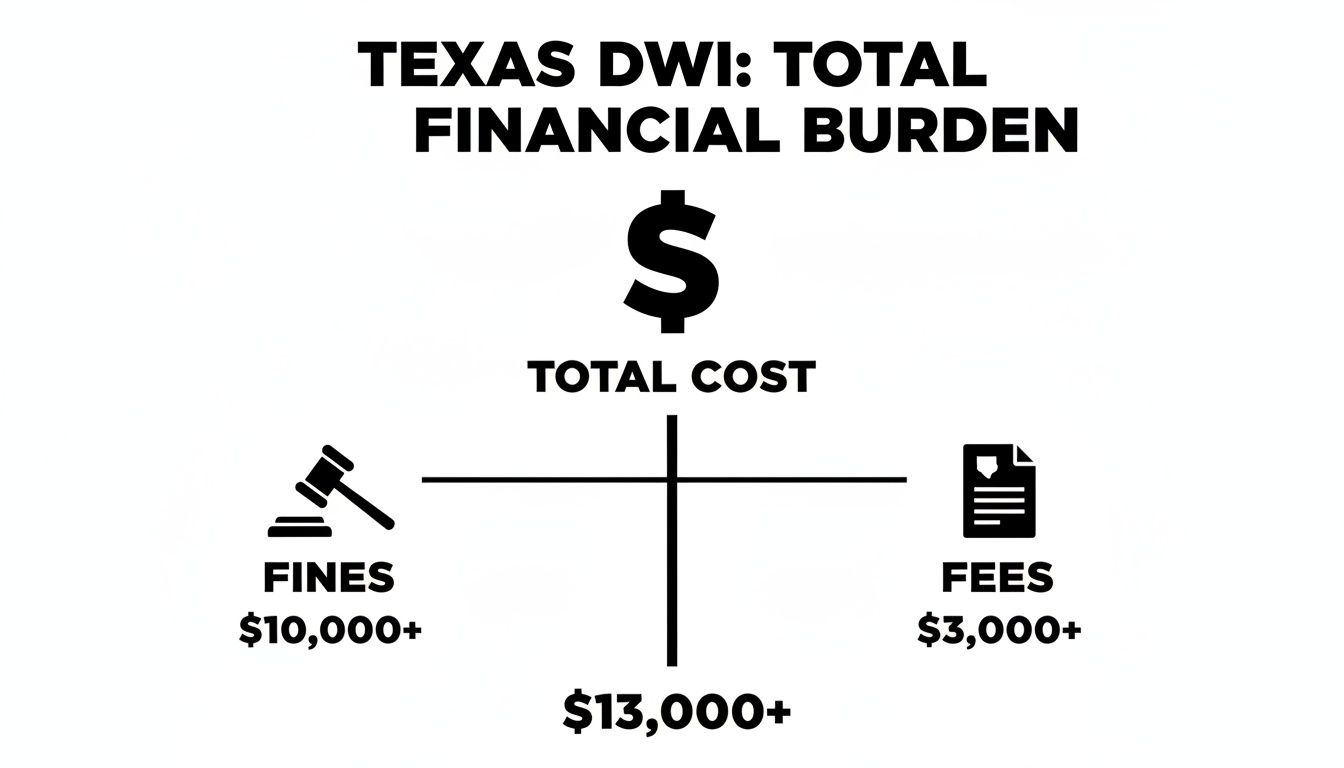
As you can see, the total cost extends far beyond what the judge orders, incorporating various administrative fees and other expenses that often catch people by surprise.
Repeat and Felony DWI Fines
If you have a prior DWI conviction, Texas treats a second charge much more severely. This is directly reflected in the higher fines. The justice system views a repeat offense not as an isolated mistake but as a pattern of behavior requiring more significant consequences.
A second DWI is automatically classified as a Class A Misdemeanor, regardless of your BAC. This means the maximum fine immediately increases to $4,000. Additionally, the likelihood of jail time and a longer license suspension increases substantially. You need an experienced attorney to fight these enhanced penalties and protect your freedom.
A third DWI charge is a completely different matter. This is where the consequences escalate to the felony level, and the financial penalties become severe.
A conviction for a third or subsequent DWI can result in a fine of up to $10,000. This is in addition to a potential prison sentence of two to ten years. A felony conviction also carries lifelong consequences, including the loss of your right to vote and own a firearm, and can make it extremely difficult to secure employment. When you are facing a felony DWI, an aggressive, battle-tested defense from a seasoned lawyer is essential.
To get a complete picture of all the potential costs you're facing, you can learn more about the full range of DWI fines in Texas in our detailed guide.
Navigating the Hidden Costs Beyond Court Fines
One of the biggest misunderstandings about a Texas DWI is that the fine issued by a judge is the end of the financial story. It is not.
In reality, that court fine is just the beginning. A conviction triggers a chain reaction of other mandatory fees and expenses that can be a shock. Think of the court fine like the sticker price on a car—it never includes the taxes, title, and administrative fees that are added on later.
Understanding these "hidden costs" is essential to preparing for the full financial impact. A DWI conviction doesn't just put a mark on your driving record; it creates a web of financial obligations to different state and local agencies, each with its own payment deadlines and rules.

Court Costs and Administrative Fees
First, let's distinguish between fines and fees. The criminal fine is the penalty. Court costs, on the other hand, are administrative fees you must pay the county for processing your case. These are non-negotiable and typically range from $200 to $500.
Then, once your DWI license suspension period is over, you can't simply start driving again. You must pay a license reinstatement fee to the Texas Department of Public Safety (DPS). That’s another $125 you have to pay before you can legally get back on the road.
DPS Surcharges: The Three-Year Financial Burden
Next is the most significant hidden cost: the DPS Driver Responsibility Program Surcharge. If you are convicted of DWI, you are required to pay an annual surcharge to the DPS for three consecutive years to keep your license. Failure to pay results in an automatic re-suspension of your license. This is unavoidable with a conviction.
The breakdown is as follows:
- For a standard first DWI: You'll pay $1,000 per year for three years, for a total of $3,000.
- For a second DWI within 36 months: The surcharge increases to $1,500 per year for three years, resulting in a $4,500 total.
- For a DWI with a BAC of 0.15 or higher: The surcharge rises to $2,000 per year for three years, for a total of $6,000.
These surcharges are purely punitive and are stacked on top of all other fines and fees. For many people, this three-year financial obligation is far more burdensome than the original court fine.
Mandatory Programs and Device Costs
The costs continue. As a condition of probation, a judge will order you to complete certain programs, and you are responsible for the cost of each one. You will almost certainly be required to take a 12-hour DWI Education Class, which costs between $70 and $200. In more serious cases, you could be ordered into a more intensive DWI Intervention Program or to undergo a substance abuse evaluation, adding hundreds more to your total.
And if the court orders an Ignition Interlock Device (IID) to be installed in your vehicle? You are responsible for all associated costs. This includes:
- Installation Fee: Typically $100 – $200.
- Monthly Monitoring Fee: Usually $70 – $100 per month.
Over a single year, that device can easily add another $1,000 or more to your total expenses. As you can see, these additional costs can quickly exceed the initial court fine. You can read more about the many hidden costs of a DUI charge to prepare yourself. This is why an experienced attorney’s goal isn't just to reduce a fine, but to fight for a result that avoids these cascading financial penalties altogether.
How Your BAC Level Can Double the Financial Penalties
When you're facing a DWI charge in Texas, your Blood Alcohol Concentration (BAC) is a key piece of evidence for the prosecution. This single number carries significant weight and is often the primary factor that determines the severity of the charges and, ultimately, the size of the fine.
Think of it like a speeding ticket. Driving ten miles per hour over the limit results in one penalty, while driving 100 mph in a school zone brings much more severe consequences. The same logic applies to Texas DWI law, which clearly distinguishes between a standard DWI and one involving a very high BAC.
The Two BAC Thresholds That Change Everything
Texas law has two critical BAC levels that can completely change the direction of your case. Exceeding these thresholds triggers a new set of potential penalties, particularly regarding the maximum fine.
- The 0.08% Legal Limit: This is the standard for any DWI charge. If you are over 21 and operating a vehicle with a BAC of 0.08% or higher, you are legally considered intoxicated. A first-time offense at this level is typically a Class B Misdemeanor, which carries a maximum fine of $2,000.
- The 0.15% Enhancement Threshold: This is the number that significantly raises the stakes. If your BAC is 0.15% or higher—nearly double the legal limit—the charge is automatically enhanced to a Class A Misdemeanor. This immediately doubles the potential maximum fine to $4,000 for a first offense.
This tiered system is intentional. It demonstrates that prosecutors and judges view high-BAC DWIs far more seriously. A high BAC not only increases the fine but also makes it more difficult to negotiate for a reduced charge, as the prosecution feels it has a stronger case.
How Higher BACs Lead to Harsher Fines and More Convictions
The state's intense focus on BAC is a strategic effort to discourage dangerously impaired driving. The data supports this: as BAC levels increase, so do conviction rates and the associated fines. For a first offense, drivers with a BAC between 0.08% and 0.149% face conviction rates of approximately 55-65% and fines up to $2,000. However, for those with a BAC of 0.15% or higher, conviction rates rise to 70-85%, with fines approaching the $4,000 maximum. You can explore these trends and their potential impact on your case by reviewing official Texas DWI statistics.
A high BAC reading might feel like an open-and-shut case against you, but it’s not. A skilled DWI defense lawyer knows that a number on a piece of paper is only as reliable as the machine and the person who operated it. That number is where our fight begins, not where it ends.
Challenging the Science Behind a High BAC Reading
Just because a breath or blood test produced a high number does not mean it is accurate or legally admissible in court. An experienced Texas DUI attorney will thoroughly investigate every step of the chemical testing process, looking for weaknesses in the state’s case.
A successful challenge can result in the BAC evidence being suppressed, which dramatically improves your chances of having the case dismissed or the charges reduced. We start by asking critical questions:
- Was the Machine Calibrated Properly? Breathalyzer devices require regular maintenance and calibration to function correctly. We can obtain the machine’s service records to check for a history of malfunctions or errors.
- Did the Officer Follow Protocol? Police must adhere to a strict, standardized procedure when administering a breath test. This includes a 15-minute observation period to ensure you did not burp, hiccup, or regurgitate, as any of these actions can introduce "mouth alcohol" and produce a falsely high reading.
- Could a Medical Condition Be the Culprit? Certain health issues, like acid reflux or GERD, can create "mouth alcohol" that is not related to your blood alcohol level, leading to an artificially high BAC reading.
- Was the Blood Sample Handled Correctly? With blood tests, we scrutinize the chain of custody. Was the sample drawn by a qualified professional? Was it stored at the proper temperature to prevent fermentation, which can create alcohol within the vial itself?
A high BAC reading is a serious obstacle, but it is not insurmountable. By questioning the science and exposing procedural errors, we can often dismantle the prosecution's most powerful piece of evidence and protect you from the harshest financial penalties.
Proven Legal Strategies to Reduce or Dismiss DWI Fines
Seeing the full range of potential fines and costs after a DWI arrest can be overwhelming. But this is the moment to shift from focusing on the problem to concentrating on the solution. An arrest is not a conviction, and a skilled defense attorney has many opportunities to challenge the state's case against you. A successful defense can lead to reduced fines or even a full dismissal of the charges.
Your defense begins the moment you hire an attorney who will examine every detail of your arrest. The goal is to identify weaknesses in the prosecution's evidence and ensure your constitutional rights were protected at every stage. A proactive legal strategy is your most powerful tool for minimizing the financial consequences of a DWI charge.

Challenging the Traffic Stop and Arrest
The first line of defense in any DWI case comes down to one simple question: was the traffic stop legal? A police officer cannot pull you over based on a hunch; they must have reasonable suspicion that you have committed a traffic violation. If the stop was unlawful, any evidence gathered afterward—from field sobriety tests to breath or blood samples—can be suppressed.
We immediately investigate critical questions:
- Did the officer have a legitimate reason for the stop, such as speeding or swerving?
- Was the stop based on a vague, anonymous tip that lacked specific details?
- Did the officer prolong the stop without a valid reason?
If we can demonstrate that the initial stop was invalid, the entire case against you can fall apart before it even begins.
Questioning Field Sobriety and Chemical Test Results
Field Sobriety Tests (FSTs) are notoriously subjective and are often administered incorrectly. Simple factors like your physical condition, nerves, footwear, or even the slope of the road can cause you to "fail" a test for reasons unrelated to intoxication. An experienced DWI lawyer knows how to cross-examine an arresting officer on their training and the exact procedures they followed, identifying any deviations that make the results unreliable.
Furthermore, breath and blood test results are far from infallible. We challenge the science by:
- Reviewing Breathalyzer Maintenance Records to find any history of errors or missed calibrations.
- Confirming Proper Test Administration to ensure the officer followed the mandatory 15-minute observation period.
- Investigating the Blood Draw Procedure to verify it was performed by qualified personnel and that the sample's chain of custody was maintained.
Successfully challenging the state's chemical evidence is a cornerstone of a strong defense. It can remove the prosecutor's most powerful piece of evidence. To see how this all comes together, you can find more details on how to fight a DWI in Texas and build a solid case.
A common misconception is that failing a breath test is an automatic conviction. In reality, these machines are prone to error, and a sharp attorney can often expose flaws in the science or the procedure, creating the reasonable doubt needed to win.
The Critical Role of the ALR Hearing
One of the most urgent and important steps after a DWI arrest is requesting an Administrative License Revocation (ALR) hearing. You have only 15 days from the date of your arrest to request this hearing to contest the automatic suspension of your driver's license.
This hearing is much more than just a chance to save your license. It is a vital opportunity for your attorney to question the arresting officer under oath, long before the criminal trial. This early testimony can lock the officer into their story and often reveals key inconsistencies that we can use to your advantage later. It is frequently our first—and best—opportunity to gather evidence and begin challenging the state's narrative.
You Don't Have to Face These Fines Alone
Seeing the potential fines and fees stack up after a DWI charge can feel crushing. It is easy to feel overwhelmed, but it is critical to remember that an arrest is not a conviction. You have the power to fight back against these penalties and protect your family's future.
Your Defense Is Your Financial Shield
The total cost of a DWI is a complex and significant burden, but it is not set in stone. With a proactive and strategic defense, the official Texas DWI fine and the related fees can often be dramatically reduced—and in some cases, completely eliminated.
Your case deserves to be examined from every possible angle, from the moment the police lights appeared in your rearview mirror to the final breath or blood test results. Every step of that process presents an opportunity to challenge the state's evidence against you.
Remember: The initial fines and fees you see are the prosecution's starting point, not your final destination. A strong legal defense is your best tool for protecting your rights, your driver's license, and your financial stability.
By taking decisive action now, you are investing in a better outcome. An experienced Houston DWI lawyer can stand between you and the harsh consequences the state is trying to impose.
We invite you to contact The Law Office of Bryan Fagan, PLLC for a completely free and confidential consultation. Let's discuss the specifics of your case, answer your questions, and start building a powerful defense strategy tailored to your unique situation.
Frequently Asked Questions About Texas DWI Fines
When you're facing a DWI charge, the financial aspect can feel just as overwhelming as the legal battle itself. We receive many questions from clients trying to make sense of it all. Here are straightforward answers to the most common concerns. While this is a good starting point, the best way to understand your specific situation is to discuss the details of your case with an attorney.
Can I Get Probation Instead of Paying the Full DWI Fine?
In many cases, yes. It is common for a judge to "probate" or suspend some or all of the criminal fine. This means you will not have to pay that specific amount as long as you successfully comply with all the terms of your probation.
However, you are still responsible for court costs and monthly probation supervision fees. An experienced DWI lawyer can advocate on your behalf for the most favorable terms, such as getting the fine reduced or fully probated, to alleviate some of the financial pressure.
Are Payment Plans Available for DWI Fines in Texas?
Yes, Texas courts are generally willing to set up payment plans for fines and court costs, but you must formally request one. Once a plan is established, it is absolutely critical to make every payment on time. Falling behind can lead to a warrant for your arrest, creating a new set of legal problems. We can help you navigate the court's process to request a manageable payment schedule.
How Much Does an Ignition Interlock Device Add to My Costs?
The Ignition Interlock Device (IID) is one of the most significant "hidden" expenses of a DWI, and the costs add up quickly. First, you will pay an installation fee, which is typically around $100 to $200. Then, there are ongoing monthly monitoring and calibration fees, which usually range from $70 to $100.
This means an IID can easily add more than $1,000 to your total costs over a single year. If an IID is required as a condition of your bond or probation, you must factor this significant expense into your budget from the beginning.
Hiring a skilled DWI defense lawyer is an upfront investment with the goal of saving you a significant amount of money in the long run. A strong defense could lead to a case dismissal (which eliminates all fines and state fees), a reduction to a lesser charge with smaller penalties, or the avoidance of crippling license surcharges and huge insurance rate hikes. A smart investment in your defense is designed to prevent thousands of dollars in long-term financial damage.
A DWI charge puts your freedom and your financial stability on the line, but a powerful defense strategy can change everything. The legal team at The Law Office of Bryan Fagan, PLLC is here to fight for you. Contact us today for a free, confidential case evaluation to understand your rights and start building your defense. Visit us at https://texasduilawfirm.com to get started.