
A DWI arrest can be overwhelming, but you don't have to face it alone.
You may be in a very specific spot. You've been arrested, your license may be at risk, court dates are starting to appear, and the lawyer appointed to your case either hasn't spoken with you enough, seems rushed, or doesn't appear focused on the details that matter in a Texas DWI case. That frustration is real.
The problem usually isn't that every appointed lawyer is careless. The problem is that the system often puts too much on too few lawyers, and your case still carries serious consequences whether the system is overloaded or not. If you're dealing with problems with court appointed attorneys, you need a practical plan, not vague reassurance.
A Texas DWI case moves on two tracks at once. There is the criminal case in court, and there may also be a DWI license suspension issue through the Administrative License Revocation process. Early action matters. If you need immediate next steps after an arrest, review what to do right after getting a DWI in Texas.
A DWI Arrest Is Overwhelming Your Attorney Should Not Be
A DWI charge affects your freedom, your driving privileges, your work schedule, and your peace of mind. For many people, the hardest part in the first days isn't only the arrest. It's the feeling that nobody is explaining what happens next.
If you've been given a court-appointed lawyer and you already feel ignored, you're not imagining the risk. A DWI defense requires attention to the stop, the officer's observations, the field work, the testing process, bond conditions, and the deadlines connected to your license. When communication breaks down early, the case can start drifting before your defense ever takes shape.
What a stressed client usually needs first
You need clear answers to basic questions:
- What am I charged with
- Will my license be suspended
- Do I need to appear in court soon
- Can the breath or blood result be challenged
- Is this something a Houston DWI lawyer or Texas DUI attorney can fight
Those are reasonable questions. You should not feel like asking them makes you difficult.
Practical rule: If your lawyer hasn't explained the next major deadline, your bond conditions, and the basic defense issues in your case, you need to push for clarity immediately.
A DWI case requires active defense
This article isn't about attacking public defenders as people. It's about identifying where representation falls short and what you can do about it inside the Texas system. Sometimes the fix is better communication. Sometimes it's a request for new counsel. Sometimes the right answer is to hire private counsel and stop waiting.
The key is to act while your options are still open.
Your Constitutional Right to Effective Counsel
If you're charged with a crime, you have the right to a lawyer. In a criminal case, that right comes from the Sixth Amendment. If you can't afford to hire counsel and the court finds that you're indigent, the court may appoint an attorney to represent you.
“Indigent” usually means the court has decided you don't have the financial ability to hire private counsel. That decision is based on the information you provide to the court. Once counsel is appointed, the constitutional promise isn't satisfied just because someone stands next to you in court.
Effective counsel means more than a name on the docket
A lawyer must function as an advocate, not a placeholder. In plain terms, effective counsel includes:
- Loyalty to your case: your lawyer should act in your interests.
- Communication: your lawyer should answer important questions and keep you informed.
- Investigation and preparation: your lawyer should review reports, evaluate evidence, and develop a defense strategy that fits the facts.
That matters in DWI cases because they often look simple from a distance and become technical up close. The stop itself may be challengeable. The officer's reason for arrest may be weak. The field sobriety test results may be open to attack. A breath or blood result may raise handling, timing, or legal issues.
Key terms you should understand
Here are four terms every person charged with DWI in Texas should know:
| Term | Plain-English meaning |
|---|---|
| BAC | Blood Alcohol Concentration, the measurement used to describe alcohol level in your system. |
| Implied consent | By driving in Texas, you're considered to have agreed to provide a breath or blood specimen in certain lawful DWI investigations, subject to Texas procedures and consequences for refusal. |
| Field sobriety test | Roadside exercises officers use to claim they observed signs of impairment. These are not the same thing as a breath or blood test. |
| Administrative license suspension | A driver's license suspension handled through an administrative process tied to a DWI arrest, separate from the criminal case. |
A lawyer in a DWI case should be proactive. Waiting for the next court date and doing nothing in between is not a defense strategy.
If you want a plain-language overview of what happens in criminal court, The Texas DWI Court Process From Arrest to Resolution outlines what to expect at each stage of a Texas DWI criminal case. And if you're weighing whether representation really changes the outcome, this discussion of what happens if you don't hire a DWI lawyer in Texas helps frame the risks.
Why Many Court Appointed Attorneys Fall Short
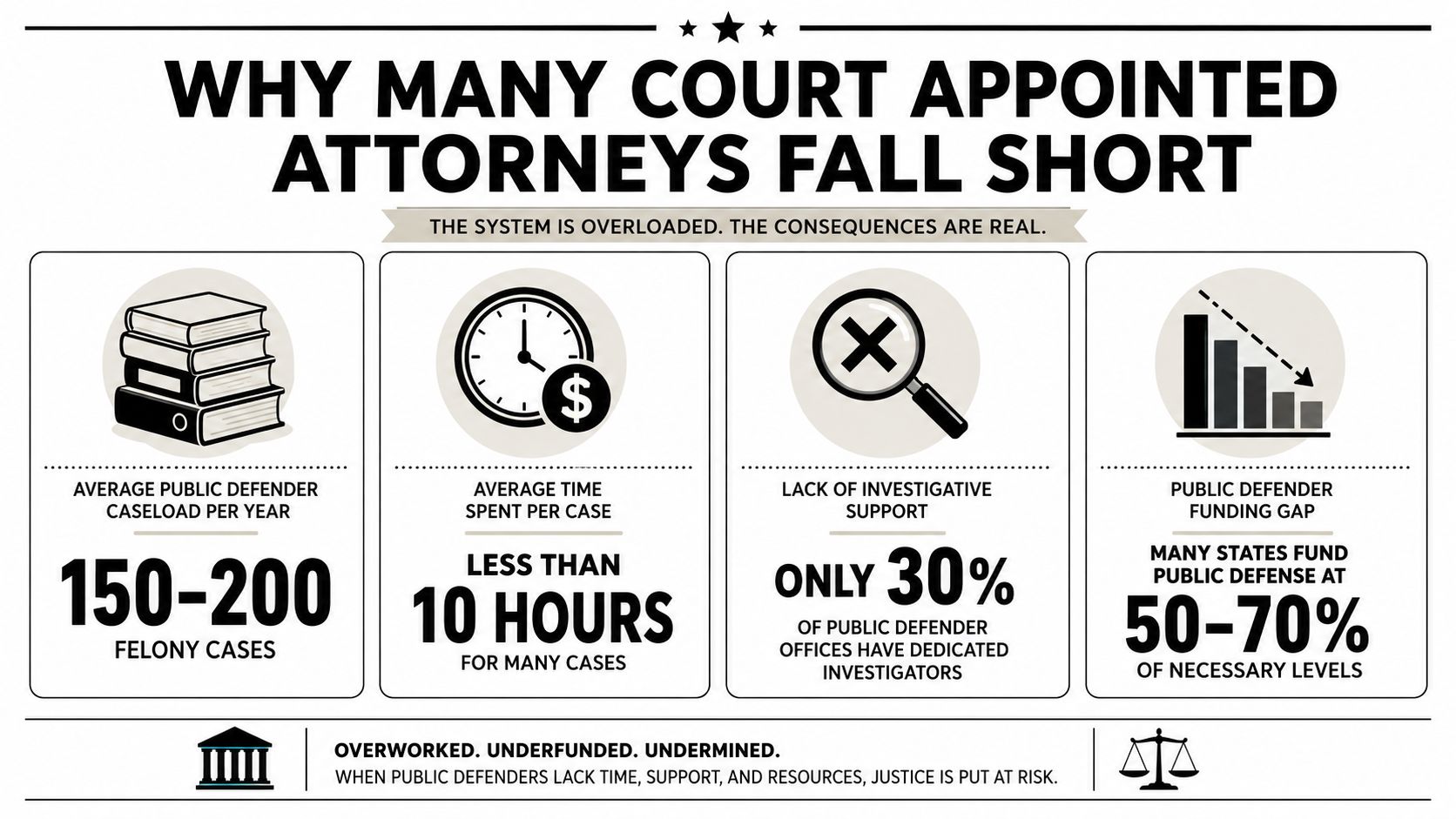
Some appointed lawyers are hardworking and committed. The recurring problems usually come from structure, not lack of intelligence or effort. A DWI defendant feels the impact of that structure fast.
Caseload crushes communication
One major reason clients report problems with court appointed attorneys is volume. According to this discussion of public defense workloads, a single public defense attorney may handle as many as 200 active cases at one time and over 1,000 cases annually. Under that kind of pressure, the lawyer may have little time to investigate evidence, meet with clients, or prepare a defense that gives proper attention to individual facts.
That kind of workload is especially dangerous in DWI cases. These cases often turn on small details. A missed video review, a rushed reading of the offense report, or a failure to question the reason for the stop can shape the entire case.
The system often discourages deep case work
A solid DWI defense can require more than showing up in court. It may involve reviewing body camera footage, patrol car video, maintenance or procedure issues related to testing, and the timing of the officer's investigation. It may also require close communication with the client about medical conditions, fatigue, anxiety, speech patterns, or other facts that can be mistaken for intoxication.
When a lawyer is overloaded or underfunded, the first thing that disappears is time. That loss shows up in familiar ways:
- Short client meetings: you leave without real answers.
- Late review of evidence: problems in the State's case aren't identified early.
- Minimal motion practice: legal challenges that should be raised may never be filed.
- Pressure to resolve quickly: the case gets treated like a file to close, not a defense to build.
DWI defense is a niche, not a generic criminal matter
Not every criminal defense lawyer handles DWI cases the same way. A general docket lawyer may be competent in many types of cases but still lack the focused habits that help in a DWI arrest. For example, the defense may depend on understanding roadside testing, chemical testing procedure, and the separate license process.
A Texas DUI attorney who regularly fights DWI allegations will usually look closely at different parts of the file than someone who treats the case as routine. That difference matters when your job, license, and record are on the line.
If your lawyer speaks only in conclusions, not specifics, ask what evidence has been reviewed, what deadlines are pending, and what legal issues have been identified so far.
What Is at Stake in a Texas DWI Case
A first DWI in Texas is not a traffic ticket with a fine attached. It is a criminal charge with court penalties, license consequences, and practical fallout that can keep affecting you long after the arrest.
Under this summary of Texas first-offense DWI penalties, a first-offense DWI without aggravating factors is a Class B misdemeanor. It carries a mandatory minimum of 3 days in county jail, up to 180 days in jail, and fines of up to $2,000. If your BAC is 0.15% or higher, the charge becomes a Class A misdemeanor with up to one year in jail and fines up to $4,000.
Criminal penalties are only part of the problem
A conviction can also trigger other obligations. The same Texas source explains that a conviction can require a mandatory 12-hour DWI education course and annual license surcharges of $1,000 for three years. Another Texas source states that after a first-offense DWI conviction, a driver also faces a mandatory $125 license reinstatement fee and must complete the 12-hour DWI education course within 180 days of probation, or the license can be revoked until the course is completed, as explained in this overview of first-time DWI consequences in Texas.
Why the early defense work matters
A DWI case usually involves both evidence issues and procedure issues. Your attorney may need to examine:
- The traffic stop: Did the officer have a lawful reason to stop you?
- The arrest decision: Did the officer have probable cause?
- The testing process: Was the breath or blood evidence handled lawfully?
- The license case: Was a timely response made to protect your driving privileges?
That last issue is where many people get blindsided. An administrative license suspension is separate from the criminal prosecution. In practice, people often call the hearing an ALR hearing, referring to the administrative process tied to a refusal or failed test after a DWI arrest.
If you want to fight DWI Texas charges effectively, your lawyer has to treat the case like a layered legal problem, not a single court appearance.
How to Address Problems With Your Appointed Attorney in Texas
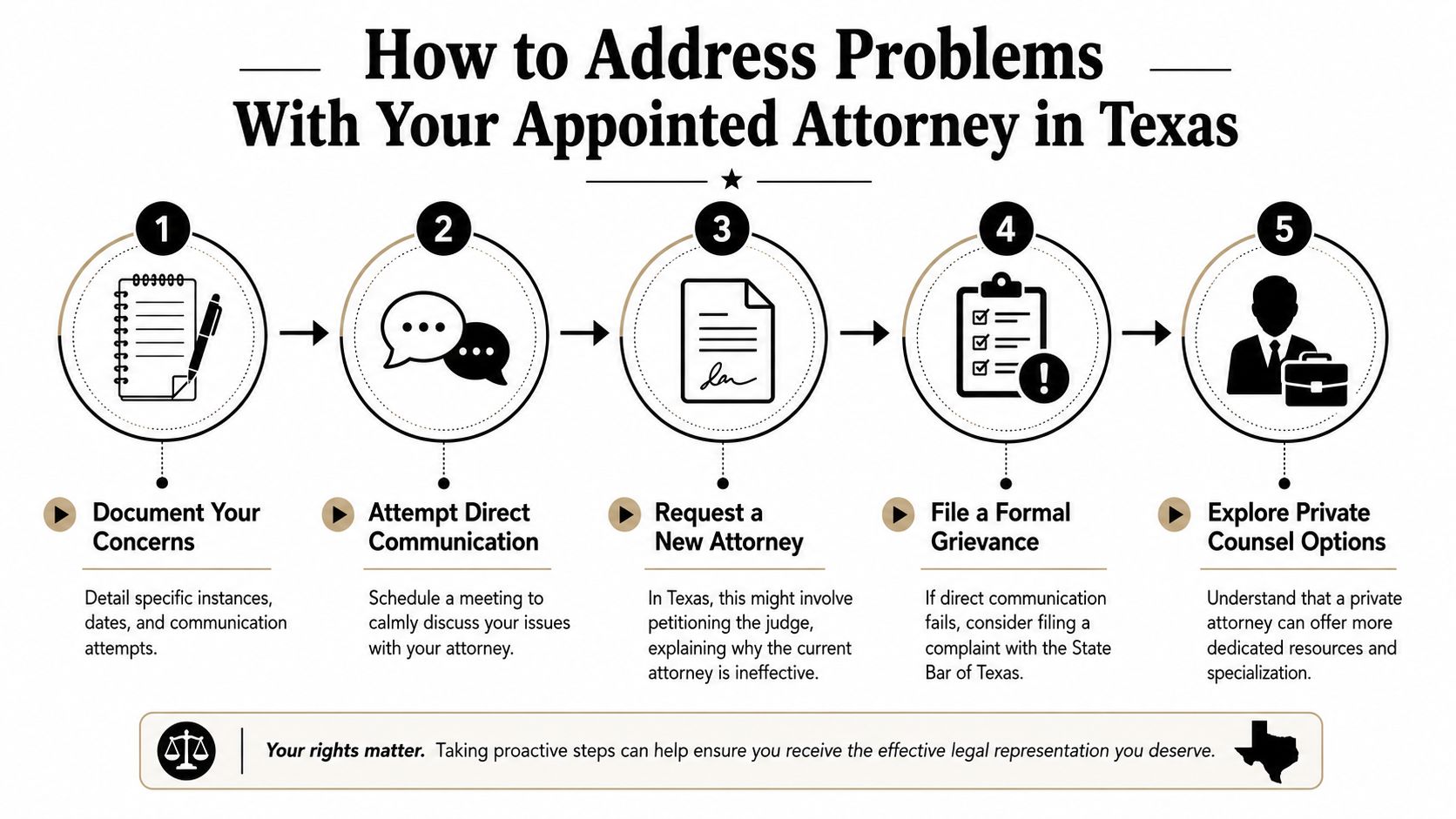
You're not stuck with silence. If your appointed attorney isn't communicating, isn't prepared, or isn't addressing obvious issues in your DWI case, take organized steps.
A scattered complaint rarely helps. A documented complaint sometimes does.
Start with a record, not emotion
Write down what's happening. Keep dates, missed calls, unanswered emails, canceled meetings, and any court appearance where your lawyer seemed unfamiliar with your case. Be factual.
Good notes help because judges usually want specifics. “My lawyer doesn't care” is weak. “I called on these dates, asked about the ALR issue and evidence review, and received no response” is much stronger.
Try direct communication first
Before asking for a new lawyer, make one clear effort to address the issue directly. Request a meeting. Keep your message calm and focused.
Use simple questions:
- Have you received and reviewed the video and reports
- What is the defense plan
- Are there deadlines related to my license
- Do you see issues with the stop, testing, or arrest
- When can we speak in detail
Sometimes that meeting fixes the problem. Sometimes it reveals that the communication gap is only part of a deeper preparation problem.
This video gives a useful overview of the issue:
Requesting new counsel from the court
If the problem continues, you may ask the court to appoint different counsel. In practice, that often means raising the issue through a request to substitute counsel or another court-approved procedure used in your case.
Judges usually look for concrete reasons, such as:
- Complete communication breakdown
- A conflict that affects loyalty or trust
- Serious lack of preparation
- Failure to discuss critical decisions in the case
Be realistic. A judge is not likely to replace appointed counsel just because you prefer a different personality or want someone more aggressive in style. The concern has to relate to your ability to receive meaningful representation.
Ask for relief early. Judges are more receptive when the request is tied to real problems and made before the case is deep into the court schedule.
Know what ineffective assistance usually means
People often say, “My lawyer is ineffective,” but that phrase has a specific legal use. An ineffective assistance of counsel claim usually comes up after a conviction, often on appeal or in post-conviction litigation. It is not usually the cleanest tool for changing lawyers in the middle of an active case.
That distinction matters. If your problem is happening now, your focus should usually be on documenting the issue, communicating directly, and asking the court for new counsel if necessary.
State Bar grievances and private counsel
If the lawyer's conduct involves an ethical issue, you may also consider a grievance with the State Bar of Texas. That step is separate from fixing your immediate defense problem, so think carefully about timing and purpose.
For some defendants, the most practical solution is to retain private counsel. A private lawyer can enter the case, review what has and hasn't been done, and decide whether to push for hearings, negotiate, or prepare the case for trial. The Law Office of Bryan Fagan, PLLC represents Texans in DWI matters, including arrest review, ALR issues, and criminal court defense.
Court Appointed vs Private DWI Lawyer When to Make the Switch
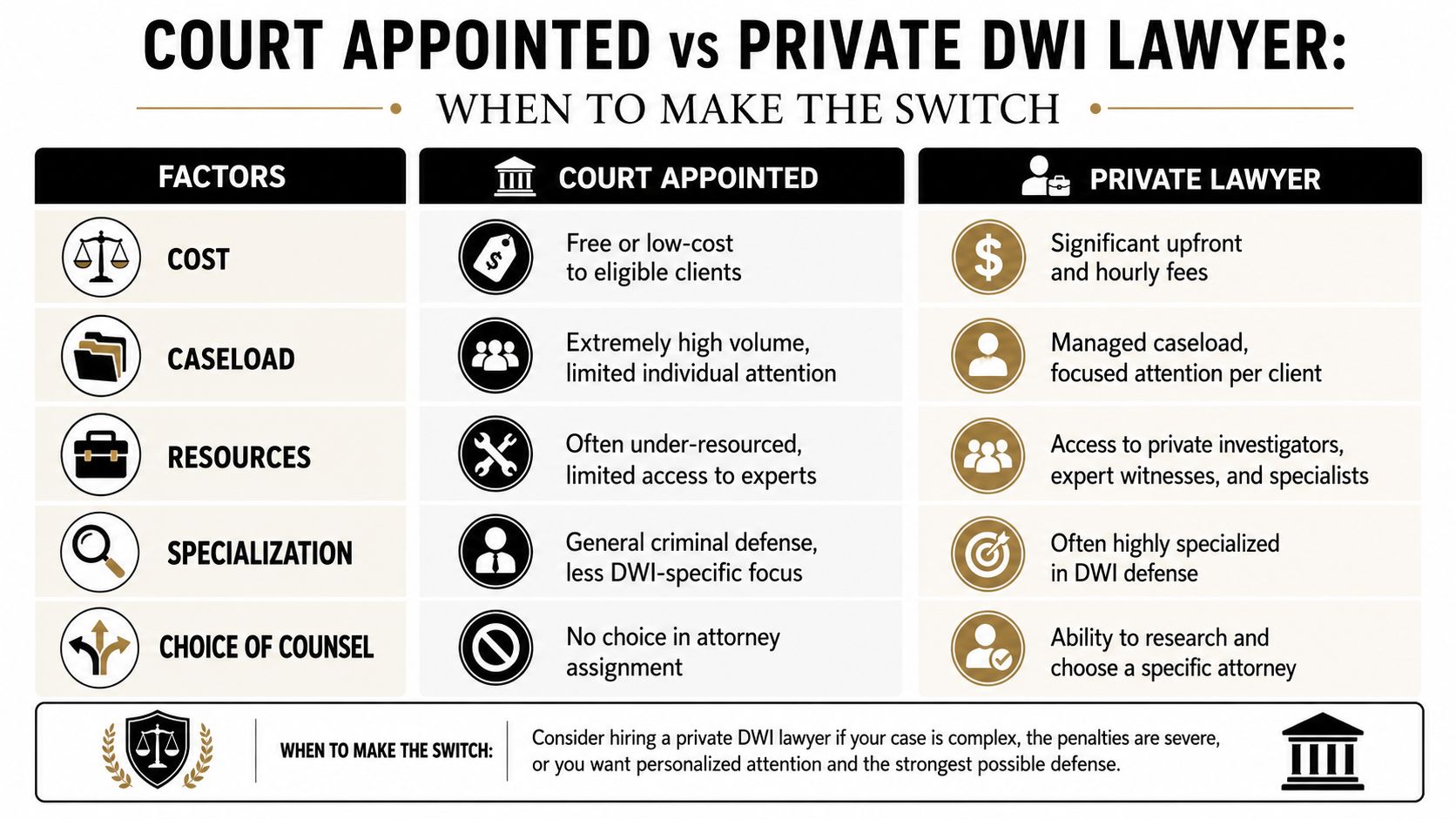
The right question isn't “Are private lawyers better in every case?” The right question is “What does your case need right now?”
A side-by-side way to think about it
| Issue | Court-appointed counsel | Private DWI counsel |
|---|---|---|
| Cost | Usually free or low-cost if you qualify | You pay directly for representation |
| Caseload | Often heavier, with less individual attention | Usually more controlled and client-focused |
| Resources | May have limits on investigation and expert support | May have greater flexibility to build out defense work |
| DWI focus | May be general criminal defense | May be more concentrated on DWI defense |
| Choice | The court assigns the lawyer | You choose who handles the case |
When staying with appointed counsel may make sense
If your appointed lawyer is responsive, explains the case, knows the DWI issues, and is actively preparing, you may not need to switch. Not every appointed lawyer is a bad fit.
A request for new appointed counsel can also make sense if the main problem is communication and you still cannot afford to hire private representation.
When hiring private counsel may be the smarter move
A switch usually deserves serious thought when your case involves technical evidence, a high BAC, serious license concerns, or a lawyer who appears to be reacting instead of leading. If you need focused strategy on a short timeline, private representation can offer more control.
That's especially true if you want a lawyer whose practice is centered on DWI litigation, not just general criminal docket work. If you're comparing options, this breakdown of public defender vs private lawyer for DWI cases is a useful starting point.
The best time to switch is before missed preparation becomes a permanent problem in the record.
Take Control of Your Defense and Protect Your Future
If you're dealing with problems with court appointed attorneys, the main point is simple. You are not required to sit passively while your DWI case drifts. You have the right to meaningful representation, and you have options when that standard isn't being met.
For some people, the right move is a direct meeting with appointed counsel that gets the case back on track. For others, it means asking the judge for different counsel. In more demanding cases, especially where evidence, license issues, or case strategy need close attention, hiring a Houston DWI lawyer or Texas DUI attorney may be the more practical path.
A DWI arrest doesn't define your future. But your response in the first part of the case matters. Prompt action can help protect your license, your record, and your ability to make smart decisions instead of rushed ones.
If you want someone to review the facts of your arrest, explain where your current representation stands, and help you decide whether to stay put or make a change, get legal advice now. A calm, informed review of your case can tell you a lot about what's working, what isn't, and what should happen next.
If you need clear answers after a DWI arrest, request a free consultation with Law Office of Bryan Fagan, PLLC. We help Texans evaluate DWI charges, license issues, defense strategy, and the practical decision of whether to keep current counsel or move in a different direction.