
A DWI arrest can be overwhelming, but you don't have to face it alone.
If you were stopped on a Houston freeway shoulder, saw blue lights in your mirror, and then found yourself trying to balance on one foot while an officer watched with a flashlight, you're probably replaying that moment right now. Many assume the one-leg stand was just one part of a roadside investigation. In practice, it often becomes one of the central pieces of evidence the State uses to justify the arrest and push the case forward.
That's why a one leg stand test challenge Texas DWI defense isn't about arguing feelings or impressions. It's about examining a short, scored event under a strict protocol. When an officer claims you showed clues of impairment, the question is whether the officer followed the standardized rules that make those clues meaningful in the first place.
What the One-Leg Stand Really Means for Your Texas DWI Case
The one-leg stand often feels minor in the moment. It isn't. In many Texas DWI cases, it becomes part of the officer's claimed probable cause for arrest, part of the report the prosecutor reads first, and part of the testimony that shapes how a judge views the stop.
Under the standardized field sobriety system, this test is not free-form. NHTSA treats it as one of the three standardized field sobriety tests used in DWI investigations and describes it as a divided-attention test with two stages. Officers are supposed to score four specific clues, and the decision point is two or more clues. NHTSA's refresher materials also state that, when administered by SFST-experienced personnel, the test is 83% accurate at detecting drivers at or above a 0.08 BAC (NHTSA refresher manual).
Why that matters in court
That 83% figure gives prosecutors a reason to treat the one-leg stand as strong roadside evidence. But that same number has an important condition built into it. The test has to be administered correctly. If the officer skipped steps, rushed the instructions, used the wrong surface, or scored behavior outside the standardized clues, the defense has a roadmap.
A weak one-leg stand issue doesn't always make a case disappear by itself. But it can weaken probable cause, reduce the force of the officer's narrative, and fit into broader issues discussed in signs that a DUI case is weak.
Practical rule: Every clue the officer claims to have seen depends on the protocol that came first.
The four pressure points in a real defense
A disciplined challenge usually turns on four questions:
- Was the two-stage NHTSA procedure followed exactly enough to make the scoring reliable?
- Did the officer ignore conditions that make the test unfair, such as surface, lighting, footwear, or physical limitations?
- What evidence can prove those problems, including video, timing, records, and scene photos?
- How do those flaws become a suppression argument and an ALR strategy instead of just a complaint?
That 30-second window is where the case often tightens. It's also where the defense often begins to open it back up.
How the Standardized One-Leg Stand Test Is Supposed to Work
The one-leg stand isn't supposed to be improvised. NHTSA describes it as a two-stage divided-attention test. The officer should give specific instructions, demonstrate them, and then observe a defined balance-and-counting phase.
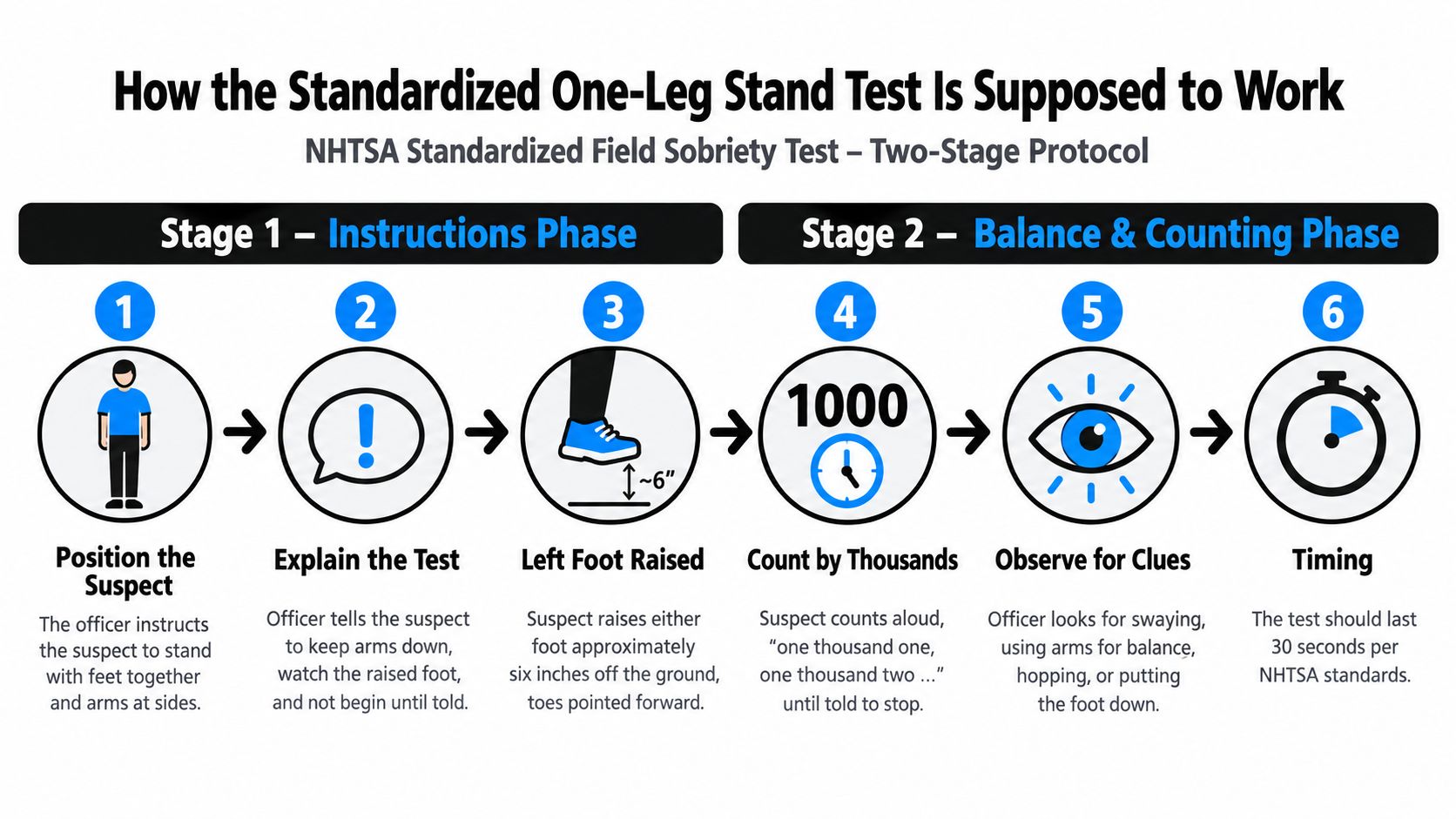
Stage one is the instruction phase
According to NHTSA's participant manual, the standardized protocol requires the subject to stand with feet together and arms at the sides, raise one foot about six inches off the ground, keep both legs straight, look at the raised foot, and count aloud until told to stop (NHTSA participant manual).
This sounds simple. In court, it rarely is.
The officer is supposed to put you in position and explain the task clearly enough that your later performance means something. If the officer talks over the instructions, demonstrates poorly, or changes the wording in a meaningful way, the defense can argue the test no longer matches the validated model.
Stage two is the scored 30-second window
Once the counting and balance phase begins, the officer is supposed to observe only the validated clues. NHTSA and Texas field-sobriety guidance identify four of them:
- Swaying
- Using arms for balance
- Hopping
- Putting the foot down before 30 seconds
The common decision rule is two or more clues. That means a person can remain upright, never fall, and still be scored as showing enough clues for the officer to infer impairment.
The test is narrow by design. Small movements inside a short time frame can be treated as formal clues.
The baseline condition courts expect
The protocol makes the most sense when it is performed in conditions close to the standardized model. That usually means a dry, level, hard surface with enough lighting for the officer to observe what the test requires. When those basics are missing, the value of the result drops.
That's one reason Field Sobriety Tests and How They Are Challenged matters in a defense file. Standardized tests look objective, but they are only as standardized as the officer's administration.
Where Officers Get the Test Wrong in Texas DWI Stops
The prosecution will often lean hard on the idea that the one-leg stand has 83% accuracy under NHTSA's instructor materials when administered by SFST-experienced personnel (NHTSA instructor guide). The courtroom fight is usually about the condition that comes with that statement. Was this test given in substantial compliance with the protocol?
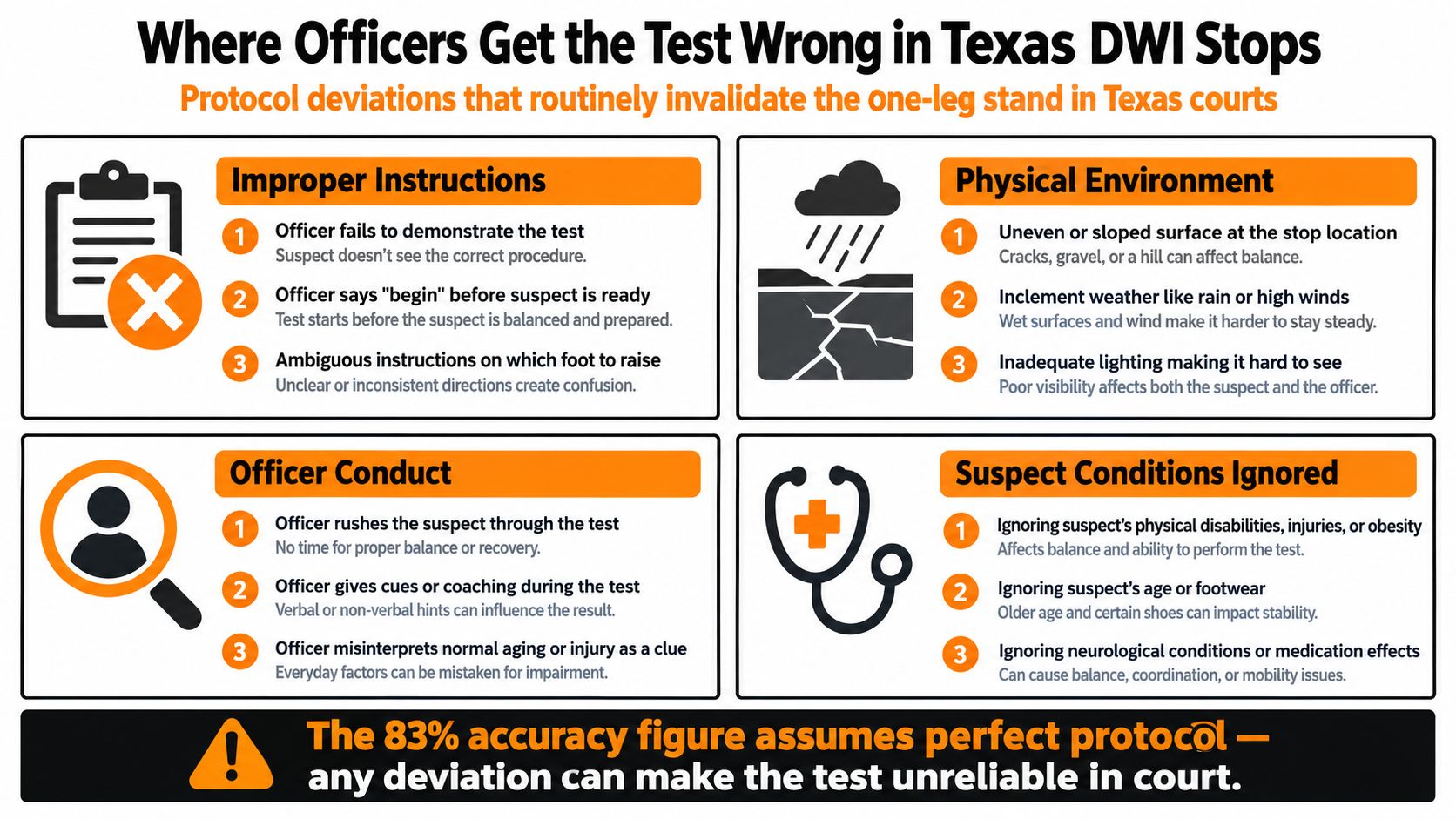
Instruction errors change the whole result
An officer may skip a proper demonstration, rush the instructions, or tell the driver to count to a fixed number instead of counting until told to stop. Some officers also fail to pin down whether the person understood the directions before the test began.
Those mistakes matter because the one-leg stand is a two-stage test. If stage one is defective, the later scoring becomes easier to challenge.
The roadside environment is often a problem
Texas stops happen on shoulders, parking lots, frontage roads, and uneven pavement. Drivers may be in boots, dress shoes, or heels. Wind, rain, poor lighting, and passing traffic can affect balance and concentration.
A proper challenge often shows that the officer used conditions that had little to do with alcohol and a lot to do with the location of the stop.
Scoring errors are more common than people think
Some reports turn normal arm movement into “using arms for balance.” Others exaggerate a brief touch-down or count behavior that doesn't fit the validated clues. Once that report is written, the officer's wording can make ordinary movement sound like failure.
The video becomes essential. Many cases look different on screen than they do on paper.
A closer look at mistakes police make during DWI arrests in Texas often shows that the one-leg stand issue is part of a larger pattern.
The visual record often tells the story better than the arrest report:
Some challenges start before the test even begins
Not every one-leg stand problem is about balance. Sometimes the issue is whether the officer had a lawful basis to keep extending the stop before moving into DWI testing. If the detention expanded without proper support, the defense may attack the test as fruit of an unlawful detention rather than just bad administration.
Evidence That Can Discredit the One-Leg Stand in Court
Good DWI defense work starts fast. The one-leg stand is one of the easiest parts of a case to misremember and one of the easiest parts of a case to preserve if action is taken early.
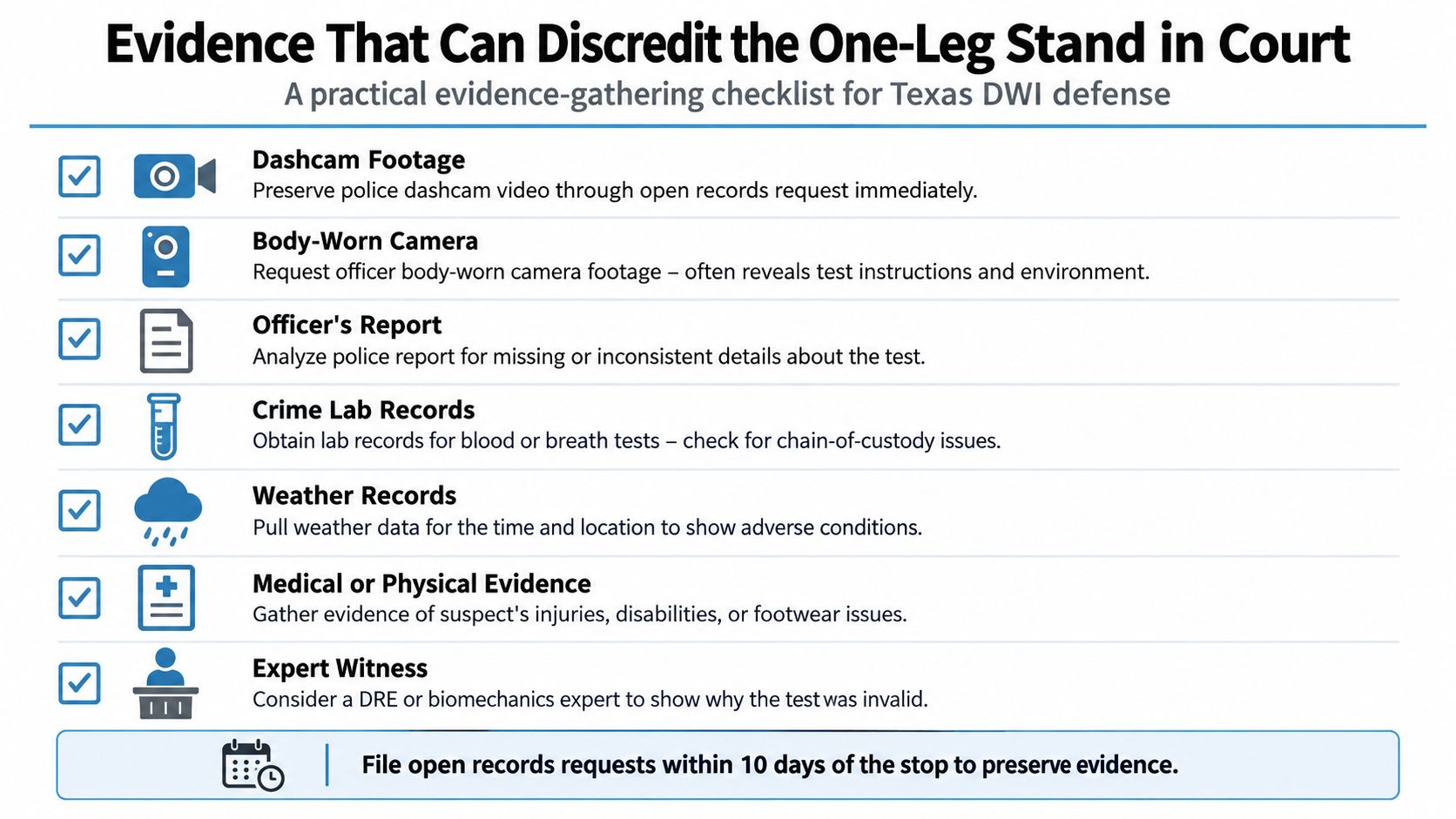
Start with the evidence that disappears first
Video and timing records usually come first. That means requesting dashcam footage, body-worn camera footage, dispatch logs, and the officer's written report as soon as possible. If the officer used a timer, the footage may show whether the full observation window was used.
Write down what you remember while it's fresh. Record the officer's exact words if you can. Note whether the officer demonstrated the test, where you were standing, what shoes you were wearing, and whether traffic, rain, or gravel affected your footing.
Match each item to a defense purpose
A useful evidence file doesn't just collect documents. It connects each item to a flaw.
- Dashcam or bodycam footage helps show bad instructions, poor demonstration, coaching, wrong timing, or a misleading report.
- Scene photographs can show slope, broken pavement, standing water, loose gravel, or weak lighting.
- Medical records can support balance problems tied to injury or physical conditions rather than intoxication.
- Witness statements may confirm that you were steady before and after the stop, or that the officer interrupted or rushed the test.
- Training records can show whether the officer was current on standardized field sobriety procedures.
For many drivers, the broader strategy also includes how to challenge field sobriety test results in Texas, because the one-leg stand rarely stands alone.
Preserve the physical details early. Shoes get lost, bruises fade, and parking-lot conditions change.
Don't ignore the chemical-test side of the case
Even when the one-leg stand is central, the defense still has to examine breath or blood evidence. Challenging Breath and Blood Tests in Texas DWI Cases is relevant because chemical-test evidence can also be questioned in a DWI defense.
That matters because Texas can prosecute a DWI through field evidence, chemical evidence, or both. Weakening one category helps. Weakening both changes the case.
Building the Motion and Cross-Examination Around the Test
A one-leg stand challenge becomes powerful when it moves from “the officer got it wrong” to a precise legal argument. In Texas, suppression arguments often focus on whether the evidence was obtained or used in violation of law, including Article 38.23 issues, and whether the officer had sufficient probable cause under the totality of the circumstances.
What the motion usually targets
A motion to suppress doesn't need drama. It needs detail. The strongest version usually identifies the exact point where the officer departed from standardized administration and explains why that departure made the result unreliable.
That may include arguments such as:
- the officer failed to provide standardized instructions,
- the officer failed to demonstrate the task clearly,
- the observation occurred on an unsuitable surface,
- the officer scored conduct outside the validated clues,
- or the detention itself became unlawful before testing began.
A concise motion theme often sounds like this: the one-leg stand was not administered in substantial compliance with standardized NHTSA procedure, so the court should give the result little weight or suppress derivative conclusions tied to it.
Cross-examination works best when it is narrow
General accusations don't do much in a DWI courtroom. Specific questions do.
Ask about training dates, whether the officer is SFST-trained, whether the officer demonstrated each instruction, whether the officer checked the surface, whether footwear was noted, whether the officer used a timer, and whether the report matches the video. The goal is not to argue with the officer. The goal is to lock the officer into facts.
| NHTSA Violation | Cross-Examination Question | Suppression Argument |
|---|---|---|
| No clear demonstration | “You agree the test includes an instruction phase, correct?” | The test was not administered in standardized form. |
| Sloped or uneven surface | “You chose the shoulder instead of moving the test to a flatter area, correct?” | The location undermined reliability. |
| Incorrect timing | “What did you use to measure the 30-second balance phase?” | The scoring window was not properly observed. |
| Improper clue scoring | “Which specific validated clue are you saying that movement fits?” | The officer counted conduct outside the accepted clues. |
| Ignored physical limitations | “Did you ask about leg, knee, ankle, hip, or back problems before scoring balance clues?” | The officer failed to account for alternative explanations. |
Where this fits in the larger case
In some files, the one-leg stand issue is one piece of a first-offense defense. In others, it matters even more because the stakes rise when a case moves into felony territory. Felony DWI in Texas: Third Offense and Child Passenger is a useful reference for when a Texas DWI becomes a felony charge.
The point is simple. A strong cross-examination plan doesn't attack the officer personally. It shows the judge that the officer's conclusion rests on a test that was not performed the way the science requires.
Using the One-Leg Stand Challenge at Your ALR Hearing
The criminal case is only one track. The other is your license case. In Texas, implied consent means a driver on a public road is deemed to consent to breath or blood testing if lawfully arrested for DWI, and refusing can trigger an automatic administrative license suspension through the ALR process. For a first refusal, the suspension is typically 180 days, compared with 90 days for a first failed test (Texas DWI defense guide).
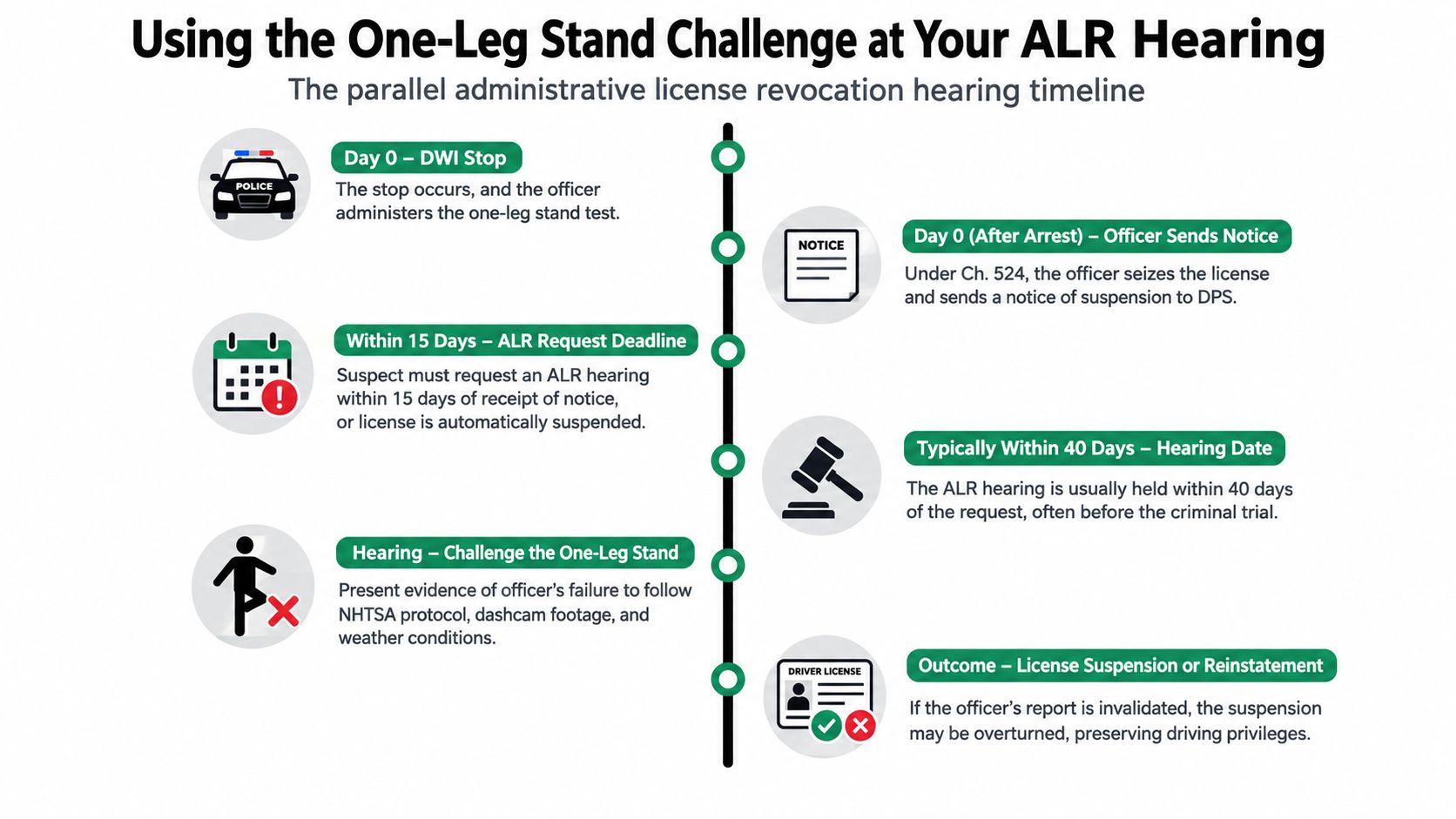
Key terms that matter here
BAC means blood alcohol concentration.
Field sobriety test means a roadside exercise used by an officer to look for signs of impairment.
Implied consent means Texas treats driving on a public road as consent to breath or blood testing after a lawful DWI arrest.
Administrative license suspension refers to the license action handled through the ALR process, separate from the criminal court.
Why the ALR hearing matters early
The ALR hearing is often the first formal setting where the officer's one-leg stand account gets tested under oath. That hearing can expose weak instructions, poor video, and timing problems before the criminal case reaches a suppression hearing.
If the officer appears, cross-examination can be valuable. If the officer doesn't, the documentary record may become the battleground. Either way, the one-leg stand challenge can create an advantage that carries into plea discussions or later motions.
Many drivers focus only on the criminal charge and miss the license deadline. That mistake can cost leverage early.
A practical sequence after arrest
The usual flow looks like this:
- Arrest and release on bond if bond is required in your case.
- ALR request must be handled quickly after notice.
- Evidence preservation begins immediately, especially video and scene conditions.
- ALR hearing preparation focuses on probable cause, arrest grounds, and test reliability.
- Criminal court settings follow, where motions, negotiation, and trial prep continue.
The one-leg stand challenge matters in both places. The legal standards differ, but the factual weaknesses are often the same.
Your Next Steps After a Texas DWI One-Leg Stand Stop
A lot of drivers leave jail or bond out thinking the one-leg stand is already fixed in the record. It is not. In many Texas DWI cases, that test is a 30-second scored window, and the defense work starts by checking whether the officer followed both parts of the NHTSA protocol exactly as taught.
The first few days matter because video can be overwritten, memories get less precise, and small details often decide whether the officer's scoring holds up or falls apart in court. A one-leg stand challenge is usually built from ordinary facts. The surface. The lighting. The timing. The instructions. Whether the officer demonstrated the test correctly and watched for the right clues during the actual counting period.
What to do in the first days
Start with preservation and documentation.
- Get legal help on the ALR deadline quickly so the license case is not left uncontested.
- Send a written preservation request for dashcam, bodycam, jail video, and any in-car audio.
- Photograph the shoes and clothing worn that night, especially anything that could affect footing or movement.
- Go back to the stop location, if it is safe, and photograph pavement condition, shoulder slope, lane proximity, lighting, and available walking space.
- Write down the officer's instructions word for word as best you can remember, including whether the officer told you when to start, how to count, and whether a timer or watch was used.
- Gather medical records or other proof of injuries, balance issues, age-related limitations, neurological conditions, or weight-related concerns if any apply.
Do not clean this story up for the officer or the prosecutor. Accuracy helps more than polish. If you hopped, put your foot down, or used your arms, that does not end the case. Question is whether those observations came from a properly administered two-stage test under conditions the protocol allows.
What happens next in the case
A first Texas DWI is commonly charged as a Class B misdemeanor. The possible penalties are serious enough to treat the case with urgency, including jail exposure, fines, and license consequences, as noted by the Texas Department of Transportation impaired driving guidance.
That does not mean every case ends in a conviction or the maximum punishment. It means the defense should be built early, before the State's version hardens into the only version.
A good file review is specific. I want the stop report, all video, the SFST narrative, the officer's training history, any breath or blood records, and the timeline from roadside investigation through arrest. With the one-leg stand, I am looking for scoring shortcuts. I am also looking for departures from the instruction phase or the balance-and-counting phase, because either one can weaken the State's reliance on the test.
The Law Office of Bryan Fagan, PLLC handles DWI matters involving field sobriety testing, ALR hearings, and criminal court defense.
What usually helps, and what usually does not
The strongest challenges are concrete and test-centered. Video showing an uneven shoulder helps. A missing demonstration helps. A report that says “used arms for balance” without a clear view of arm height can help. A bodycam clip that never captures a full 30-second count can matter more than a general claim that the driver looked unsteady.
General explanations by themselves usually carry less weight. Saying you were nervous or tired is not enough unless the evidence connects that explanation to what the officer scored and what the protocol required.
If the one-leg stand played a major role in the arrest, focus on building a record now. That 30-second window is often presented as a simple roadside failure. In court, it can become the opposite: a narrow, score-based procedure where each missed instruction, poor condition, or timing problem gives the defense a clear path to challenge the stop, the arrest decision, or the weight of the officer's testimony.