
A DWI arrest can be overwhelming—but you don’t have to face it alone. With new Texas DWI law changes that took effect in 2026, the legal landscape has become more complex. These updates introduce stricter penalties, making it absolutely critical to understand your rights and build a strategic defense, even if this is your first offense.
Our goal is to replace your anxiety with clarity and confidence. This guide will walk you through what these changes mean, how they affect you, and how an experienced DWI defense attorney can protect your future.
Understanding the New Texas DWI Law Changes in 2026

A DWI arrest can make your world feel like it’s spinning out of control. With Texas lawmakers passing stricter legislation, that feeling is completely understandable. We are here to cut through the legal jargon and explain exactly what these changes mean for your case.
Think of this as your strategic briefing. The new rules aren't just small tweaks; they represent a major shift in how Texas prosecutes DWI cases. The legislature’s primary goal is to deter impaired driving by significantly increasing the penalties, especially for cases involving high intoxication levels or repeat offenses.
What Is the Most Significant Change?
Perhaps the single most impactful change revolves around how your Blood Alcohol Concentration (BAC) can automatically elevate the charge against you. Previously, a standard first-time DWI was typically a Class B misdemeanor. That has changed.
Under the new 2026 law, if you are arrested for a first-time DWI and your BAC is 0.15% or higher—nearly double the legal limit of 0.08%—the charge is automatically enhanced. It jumps from a Class B to a much more serious Class A misdemeanor. This brings harsher potential consequences, including up to one year in jail and fines up to $4,000.
A DWI arrest is not a conviction. While these new laws may seem to strengthen the prosecutor's position, they also introduce new complexities that a skilled DWI lawyer can challenge to protect your rights.
To give you a clearer picture of how these penalties stack up, we've put together a table summarizing the new landscape.
Texas DWI Penalties Explained (2026 Updates)
This table compares the potential penalties for common DWI offenses under the new laws. It’s designed to help you quickly understand the stakes.
| DWI Offense | BAC Level | Misdemeanor/Felony Class | Maximum Jail Time | Maximum Fine |
|---|---|---|---|---|
| 1st Offense | < 0.15% | Class B Misdemeanor | 180 Days | $2,000 |
| 1st Offense (Enhanced) | ≥ 0.15% | Class A Misdemeanor | 1 Year | $4,000 |
| 2nd Offense | Any | Class A Misdemeanor | 1 Year | $4,000 |
| 3rd Offense or More | Any | 3rd Degree Felony | 10 Years | $10,000 |
| DWI with Child Passenger | Any | State Jail Felony | 2 Years | $10,000 |
As you can see, the distinction between different BAC levels and offense numbers creates a tiered system of punishment that can be confusing.
Key Shifts in DWI Penalties
Understanding this new penalty structure is the first step in building a powerful defense. Here are the key shifts you need to be aware of:
- Tougher Penalties for High BAC: As we covered, a BAC of 0.15% or more now triggers an automatic charge enhancement, which means more potential jail time and higher fines right out of the gate.
- Harsher Consequences for Repeat Offenses: The new laws come down even harder on second or third offenses, making it incredibly difficult to avoid jail time and lengthy license suspensions without a strong legal defense.
- Felony Charges from the Start: Certain situations, like being arrested for DWI with a child passenger, will now more quickly lead to a severe felony charge, bypassing misdemeanor classifications entirely.
These changes highlight just how important it is to have an experienced Texas DWI lawyer review every single detail of your arrest. For a more detailed breakdown of these updates, check out our complete guide on the recent changes in Texas DWI laws. In this new legal environment, a proactive defense isn't just an option—it's a necessity.
How the Stricter DWI Rules Affect Different Texans
Getting arrested for DWI is a disorienting experience, but you don't have to navigate it alone. The recent updates to Texas DWI laws aren't a one-size-fits-all hammer; instead, they target different people in different ways.
Whether this is your first run-in with the law or you have a prior conviction, the first step toward building a strong defense is understanding exactly how these new rules affect you. What might have been a standard charge in the past could now come with much heavier penalties. This makes a defense strategy tailored to your specific situation more critical than ever.
First-Time DWI Offenders
If you’re facing a first DWI in Texas, it can feel like your whole world is crashing down. While a first offense is still typically a Class B misdemeanor, the new laws add serious tripwires. For example, if your blood alcohol concentration (BAC) was 0.15% or higher, the charge gets automatically bumped up to a more serious Class A misdemeanor, doubling the potential jail time and fines.
Even without a high BAC, a conviction can mean:
- Losing your driver's license for up to one year.
- Paying annual surcharges to the Texas Department of Public Safety just to keep your license valid.
- Being forced to install an ignition interlock device (IID) in your vehicle.
These aren't just minor inconveniences; they can disrupt your job, family life, and finances. A skilled Houston DWI lawyer is your best ally in fighting for your record and minimizing these consequences.
Repeat DWI Offenses
For anyone with a prior DWI on their record, the new laws are especially unforgiving. A second DWI is a Class A misdemeanor, and a third DWI is a third-degree felony. A felony conviction could land you in prison for up to 10 years. Critically, Texas has a lifetime look-back period, so even a very old conviction can be used to elevate your current charge.
A prior DWI does not automatically mean you will be convicted again. Every case must be proven on its own merits, and a prosecutor must still establish guilt beyond a reasonable doubt.
This is precisely where a powerful defense strategy comes in. A strategic attorney can challenge every part of the new charge—from the legality of the traffic stop to the accuracy of chemical tests—to fight your DWI in Texas.
Commercial Drivers (CDL Holders)
For a commercial driver, your CDL isn't just a license—it's your livelihood. The new laws put that livelihood in serious jeopardy. A DWI conviction will result in a CDL disqualification for one year on a first offense. A second offense means a lifetime disqualification. These rules apply even if you were driving your personal vehicle at the time of the arrest.
There is no deferred adjudication for CDL holders in DWI cases, which closes a common legal path for keeping a charge off your record. Protecting your career demands an aggressive defense from a lawyer who understands what's at stake for commercial drivers.
DWI with a Child Passenger
The changes hit hardest for anyone accused of driving while intoxicated with a child passenger under the age of 15. This charge is now a state jail felony, even for a first-time offender. A conviction means facing up to two years in a state jail, fines up to $10,000, and a lengthy driver's license suspension. A felony on your record is a life-altering event. You can read more about how the new laws have compounded penalties by learning about the criminal defense implications of these 2026 changes.
If you're facing a charge this serious, seeking immediate legal help is critical to protecting your freedom and your future.
Key Legal Terms and Your Rights During a DWI Stop
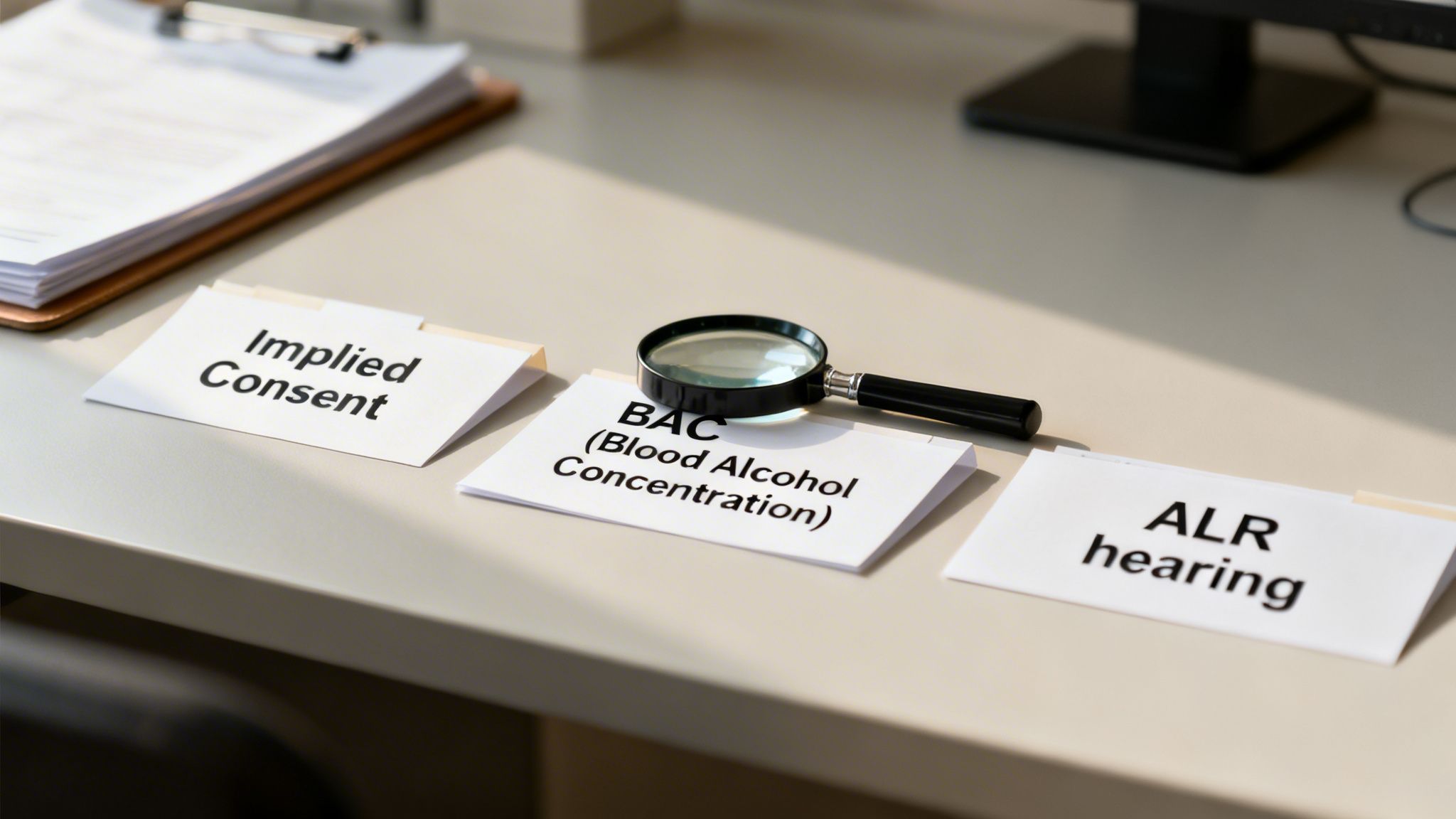
When you see flashing lights in your rearview mirror and the stop turns into a DWI investigation, you are suddenly thrown into a world of confusing legal terms. An officer may use phrases like "BAC," "implied consent," and "field sobriety tests," making it feel like they're speaking another language.
This is a critical moment. Understanding these terms—and your rights—is your first line of defense. An arrest is an overwhelming experience, but being armed with knowledge is the first step toward regaining control.
Let's cut through the legal jargon and clarify what’s happening so you can make informed decisions to protect yourself.
Defining Key DWI Terms
From the moment of the traffic stop, law enforcement is building a case against you. Much of that case revolves around a few key concepts. Knowing what they mean is vital.
Blood Alcohol Concentration (BAC): This is the measure of alcohol in your bloodstream. For most drivers in Texas, the legal limit is 0.08%. However, under the new law, a BAC of 0.15% or higher now automatically triggers much harsher penalties for a first-time DWI, turning a standard charge into a much more serious fight.
Implied Consent: This is one of the most important concepts in Texas DWI law. By holding a Texas driver's license, you have legally "consented" to provide a breath or blood sample if you are lawfully arrested for DWI. Refusing that test doesn't get you off the hook; it comes with its own immediate consequences for your license. You can dig deeper into what the Texas implied consent law means for you.
Field Sobriety Tests (FSTs): These are the roadside balance and coordination exercises—like walking a straight line, standing on one leg, or following a pen with your eyes. Officers use these to gather evidence of impairment. However, these tests are subjective and difficult to perform perfectly even when sober. You have the right to politely refuse to perform Field Sobriety Tests.
Every word you say and every action you take can be used as evidence. Knowing these terms helps you make smarter decisions under pressure.
Your Two Battles: The Criminal Case and the ALR Hearing
A DWI arrest in Texas creates two separate legal battles that proceed on different timelines. You must address both to protect your rights.
The first is the criminal case, where the State of Texas must prove you were intoxicated "beyond a reasonable doubt." This is where you face potential jail time, steep fines, and a permanent criminal record. This process can take several months or even longer.
The second, and more urgent, battle is the Administrative License Revocation (ALR) hearing. This is a civil proceeding, completely separate from the criminal court, where the Texas Department of Public Safety (DPS) will attempt to suspend your driver's license.
Here's the critical part: after a DWI arrest, you have only 15 days to request this ALR hearing. If you fail to meet this deadline, your license will be automatically suspended.
Fighting your DWI license suspension is not just about keeping your ability to drive. It's also the first opportunity for your attorney to challenge the evidence, cross-examine the arresting officer, and lock in their testimony for your criminal case. An experienced Texas DUI attorney will immediately request this hearing on your behalf, protecting your license and beginning the work of building your defense.
How a Strategic Defense Can Fight Your DWI Charge
A DWI arrest feels overwhelming. For most people, it’s their first time in handcuffs, and the future suddenly seems uncertain. But it’s critical to understand one thing: an arrest is not a conviction. This isn't the end of your story; it's the beginning of the fight.
Even with the recent changes to the new Texas DWI law, the state’s case is rarely as airtight as it seems. An experienced DWI lawyer never takes a police report at face value. We see it as the prosecution's opening argument—one that we intend to meticulously take apart, piece by piece.
Challenging the State’s Evidence
Our first step is to dig into every single detail of your arrest. We’re looking for procedural mistakes, constitutional violations, and factual holes that can turn the case in your favor. A powerful defense is built on asking the tough questions.
Some of the most common weak points we find include:
- The Traffic Stop Itself: Did the officer even have a legal reason to pull you over? A stop based on a "hunch" or an illegal pretext isn't just a minor mistake—it can get the entire case thrown out.
- Field Sobriety Tests (FSTs): These tests are notoriously subjective. Was the test done on a safe, level surface? Was the officer properly trained to administer it? Did they give you the instructions correctly? Any deviation from the strict FST protocol can make the results unreliable.
- Breath and Blood Test Flaws: Breathalyzer machines have to be calibrated and maintained with scientific precision. Blood samples must be drawn, handled, and stored according to rigid procedures. One slip-up can contaminate the results and render them completely invalid.
These aren't just technicalities. A single error by law enforcement could be the key to getting the evidence against you suppressed. You can learn more about this process in our guide on how to file a Motion to Suppress Evidence.
The Numbers Tell a Story of Hope
It’s easy to feel hopeless after a DWI arrest, but the data shows that fighting the charge is often the right move. Pleading guilty isn't your only option. Even with stricter laws, a skilled legal team can achieve a favorable outcome in a surprising number of cases.
Statewide, for example, approximately 28% of DWI cases are resolved with something other than a guilty verdict. A closer look at specific counties gives even more reason for optimism. In Dallas County, it's not uncommon to see 18-25% of cases dismissed and another 25-35% reduced to lesser charges. Down in Harris County, experienced attorneys often secure resolutions where 40-50% of cases end without a final conviction.
An arrest feels final, but it's just the prosecution's opening move. Our job is to counter it with a meticulously prepared defense that protects your rights and creates opportunities for a positive resolution.
Your Attorney as Your Shield and Advocate
Facing the Texas criminal justice system by yourself is an intimidating prospect. When you bring our firm on board, you’re not just hiring a lawyer. You’re gaining a strategic partner who will stand between you and the full force of the prosecution.
We start by listening to your side of the story. From there, we launch a full-scale investigation, pulling police reports, dashcam and bodycam footage, and even the maintenance logs for the testing equipment. We interview witnesses and bring in our own experts to find the cracks in the state's narrative.
Our entire goal is to build a wall of reasonable doubt. By systematically poking holes in the prosecution's case, we create the leverage needed to negotiate for dismissals, reductions to non-DWI offenses, or entry into programs that can keep your record clean. When you need to fight DWI Texas, having a formidable advocate in your corner changes everything.
Your Action Plan After a Texas DWI Arrest
The moments after a DWI arrest are a blur of confusion and stress. But what you do next is what matters most. Getting arrested for a DWI in Texas starts two separate legal clocks ticking at the same time, and you have to act fast to protect your rights and your future. This is your immediate action plan—a clear, step-by-step guide for what to do right now.
Your most urgent problem is your driver's license. The officer who arrested you probably took your physical license and handed you a piece of paper that serves as a temporary driving permit. That paper is also your official notice that the Texas Department of Public Safety (DPS) is about to suspend your license.
You have only 15 days from the day of your arrest to request an Administrative License Revocation (ALR) hearing. If you let this deadline pass, your license suspension is automatic. There are no extensions.
Your Immediate Next Steps
Fighting to keep your license is priority number one, but other actions are just as critical for building a powerful defense. Here’s what you need to do immediately:
Request Your ALR Hearing: This is your only opportunity to challenge the automatic DWI license suspension. A skilled Houston DWI lawyer can file this request on your behalf, which not only preserves your right to drive but also creates the first chance to start picking apart the state's case against you.
Contact a DWI Defense Attorney: Don't put this off. The faster you get an experienced lawyer in your corner, the better your odds. We can begin collecting evidence, scrutinizing police reports, and developing a defense strategy built around the unique facts of your arrest.
Gather All Your Paperwork: Find every single document the police gave you. This includes your bail bond papers, the temporary license form, and any tickets or citations. These documents are filled with crucial information about your case that we can use.
This infographic shows you the core strategy behind a successful DWI defense and how a lawyer dismantles the prosecution's case piece by piece.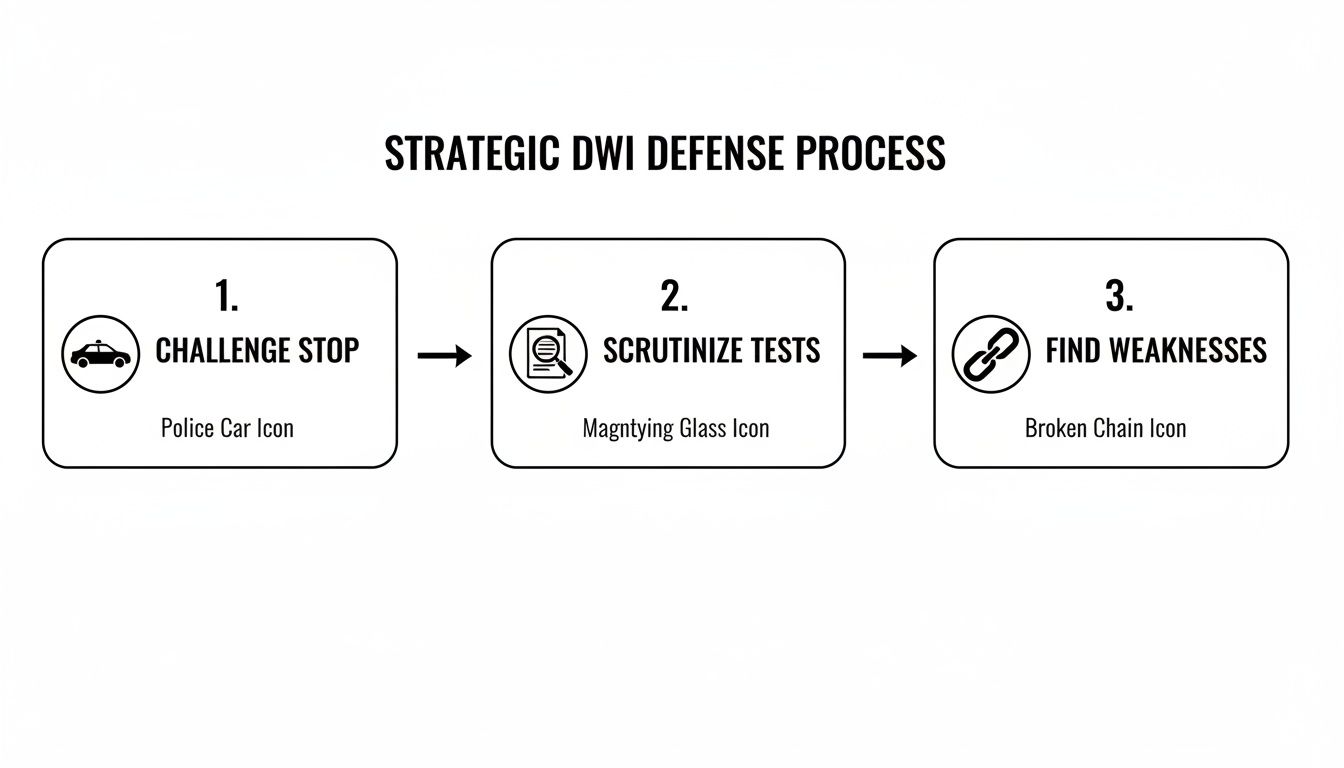
As you can see, a strong defense is all about methodically questioning every single piece of evidence, from whether the traffic stop was legal in the first place to the accuracy of the breath or blood tests.
Why You Should Not Face This Alone
Trying to navigate the criminal court system and the DPS bureaucracy on your own is a recipe for disaster. With the new Texas DWI law raising the stakes, any procedural mistake is more damaging than ever. You don’t have to figure this all out by yourself.
An arrest can feel overwhelming, but you don’t have to face it alone. Taking immediate, decisive action with the guidance of a professional can make all the difference in the outcome of your case.
Our team at The Law Office of Bryan Fagan, PLLC, is ready to stand with you from day one. We will take care of the time-sensitive deadlines, handle all communication with the court and the prosecutors, and work tirelessly to build the strongest possible defense to protect your freedom and your future.
If you or someone you care about has been arrested for a DWI in Texas, your next step is simple: call us. We offer a free, confidential case evaluation to go over your situation and explain exactly how we can help you fight DWI Texas.
FAQ About the New Texas DWI Law
A DWI arrest, especially under Texas's tougher 2026 laws, brings a flood of urgent questions. The uncertainty can be overwhelming. We've taken some of the most common concerns we hear every day and answered them directly, just as we would for one of our clients. The goal is to give you clarity and show why acting fast is so important.
Can I still get a first-time DWI dismissed in 2026?
Yes, getting a first-time DWI in Texas dismissed or reduced is absolutely possible, even with the stricter laws now in place. A dismissal isn't about luck; it’s about a skilled attorney meticulously picking apart the prosecution's case.
Success often hinges on finding critical flaws in the evidence. This could be anything from:
- An unlawful traffic stop where the officer had no valid reason to pull you over.
- Field sobriety tests that were administered incorrectly, making the results unreliable.
- Errors with the breath or blood test equipment, or a failure to follow strict legal procedures during the test.
Our role as your Houston DWI lawyer is to launch a full-scale investigation into your arrest, searching for every weak point we can use to negotiate a reduction or fight for a complete dismissal.
What happens if I refuse a breathalyzer test now?
Refusing a breathalyzer in Texas still comes with an immediate consequence: an automatic license suspension. This is due to the state's "Implied Consent" law, and a first-time refusal typically means a 180-day suspension. Don't forget, you have only 15 days from the date of your arrest to request an ALR hearing to fight this DWI license suspension.
But there's a flip side. While your refusal can be mentioned in court, it also means the prosecutor is missing their single most powerful piece of evidence: a specific BAC number. This can become a huge strategic advantage in your criminal case.
An experienced Texas DUI attorney can guide you through this decision, represent you at the ALR hearing, and turn the lack of chemical evidence into a cornerstone of your defense.
Is hiring a lawyer for a DWI really worth the cost?
Without a doubt. With the serious penalties under the new Texas DWI law, a conviction is far more expensive than a strong legal defense. It can cost you thousands in fines, your driver's license, your job, and could land you in jail. The long-term damage—both financially and personally—almost always dwarfs the investment in a dedicated lawyer.
Hiring a DWI specialist means you have an advocate actively working to protect your rights, challenge the state's case, and pursue a dismissal or reduction of the charges. It's a crucial step toward protecting your freedom, your finances, and your future.
A DWI charge is a serious roadblock, but it doesn't have to define your life. The experienced attorneys at The Law Office of Bryan Fagan, PLLC are here to build a strategic defense aimed at protecting your rights and achieving the best possible outcome for your case. We provide reassurance, confidence, and a clear path forward. Contact us today for a free and confidential case evaluation to discuss your situation and learn how we can help. Visit us at https://texasduilawfirm.com.