
A DWI arrest can be overwhelming — but you don’t have to face it alone. It's easy to feel like you’ve lost control, but the first step to getting back on track is understanding your rights. One of the most confusing concepts you’ll face is the Texas Implied Consent Law.
So, what does implied consent law mean? In simple terms, by accepting a Texas driver's license, you’ve already given your consent to provide a breath or blood sample if an officer has probable cause to believe you’re driving while intoxicated. This does not mean you’ve signed away all your rights. Understanding how this law works is crucial for protecting your license and building a strong defense.
Understanding Texas Implied Consent After a DWI Arrest
When you're pulled over on suspicion of a DWI in Texas, things can move fast. An officer might ask you to perform field sobriety tests, then follow up with a request for a chemical test—like a breathalyzer or blood draw—to check your Blood Alcohol Concentration (BAC).
That request isn't just a suggestion; it’s backed by the state’s implied consent law. The fundamental idea is that driving on public roads is a privilege, not a right, and that privilege comes with certain conditions. By getting behind the wheel, you've implicitly agreed to cooperate with chemical testing if law enforcement suspects you’re impaired. This isn't unique to Texas—it's a legal standard in all 50 states designed to aid in DWI investigations. You can discover more insights about the history of these laws and their impact on road safety.
Texas Implied Consent At a Glance
The concept of implied consent can feel abstract, especially right after an arrest. This table breaks down what the law is and what it means for you in practical terms.
| Key Concept | What It Means for You |
|---|---|
| The Agreement | By driving in Texas, you automatically agree to take a breath or blood test if lawfully arrested for DWI. |
| The Request | An officer must have probable cause to believe you're intoxicated before they can ask for a test. |
| Your Right to Refuse | Despite "implied consent," you still have the right to say no to a chemical test. |
| The Consequences of Refusal | Refusing a test triggers an automatic administrative license suspension, separate from the criminal DWI case. |
| Separate Legal Battles | A refusal starts an administrative license case (ALR) and can also be used against you in your criminal DWI case. |
Understanding these points is the first step, but navigating the consequences requires a clear strategy, which we'll get into next.
What This Means for Your Case
A DWI arrest doesn't just start one legal problem—it kicks off two separate cases at the same time. It’s absolutely critical to know the difference.
-
The Administrative Case: This is a civil matter handled by the Texas Department of Public Safety (DPS). It has nothing to do with guilt or innocence and focuses on one thing only: your driver’s license. The fight to save your license happens at what's called an Administrative License Revocation (ALR) hearing.
-
The Criminal Case: This is the DWI charge itself, which plays out in criminal court. Here, the prosecutor will try to prove you are guilty of a crime, and you could face penalties like fines, probation, or even jail time.
These two cases run on parallel but separate tracks. You could win your ALR hearing and keep your license, but still be found guilty of the DWI in criminal court. The reverse is also true. This is exactly why going it alone after a DWI arrest is a significant risk.
A common myth is that refusing a breathalyzer is the same as admitting guilt. While a prosecutor will argue this in court, your refusal is just one piece of evidence. A strategic defense attorney can challenge everything from the initial traffic stop to the arrest procedures, creating a strong defense regardless of the refusal.
Juggling both the administrative and criminal systems demands a deep knowledge of Texas law and court procedures. An experienced DWI attorney from The Law Office of Bryan Fagan, PLLC knows how to manage both fronts simultaneously, making sure every deadline is met and every possible defense is explored. Protecting your license at the ALR hearing is often the first—and most critical—battle in building a powerful defense for your criminal case.
The Two Legal Battles After a Test Refusal
If you’ve refused a chemical test after a DWI arrest in Texas, it can feel like you've been pushed into a confusing legal maze. The most important thing to understand is that a refusal doesn't start one legal problem—it starts two.
Think of it like two trains leaving the same station (your arrest) but heading to different destinations on separate tracks.
One train is heading toward criminal court, where you'll face the DWI charge itself. The other is on a fast track to an administrative hearing that will decide the fate of your driver's license. These two processes are completely independent, and you need a skilled DWI lawyer who can fight for you on both fronts at the same time.
This flowchart breaks down the basic process, from the moment you're behind the wheel to the consequences of a DWI stop under Texas's implied consent law.
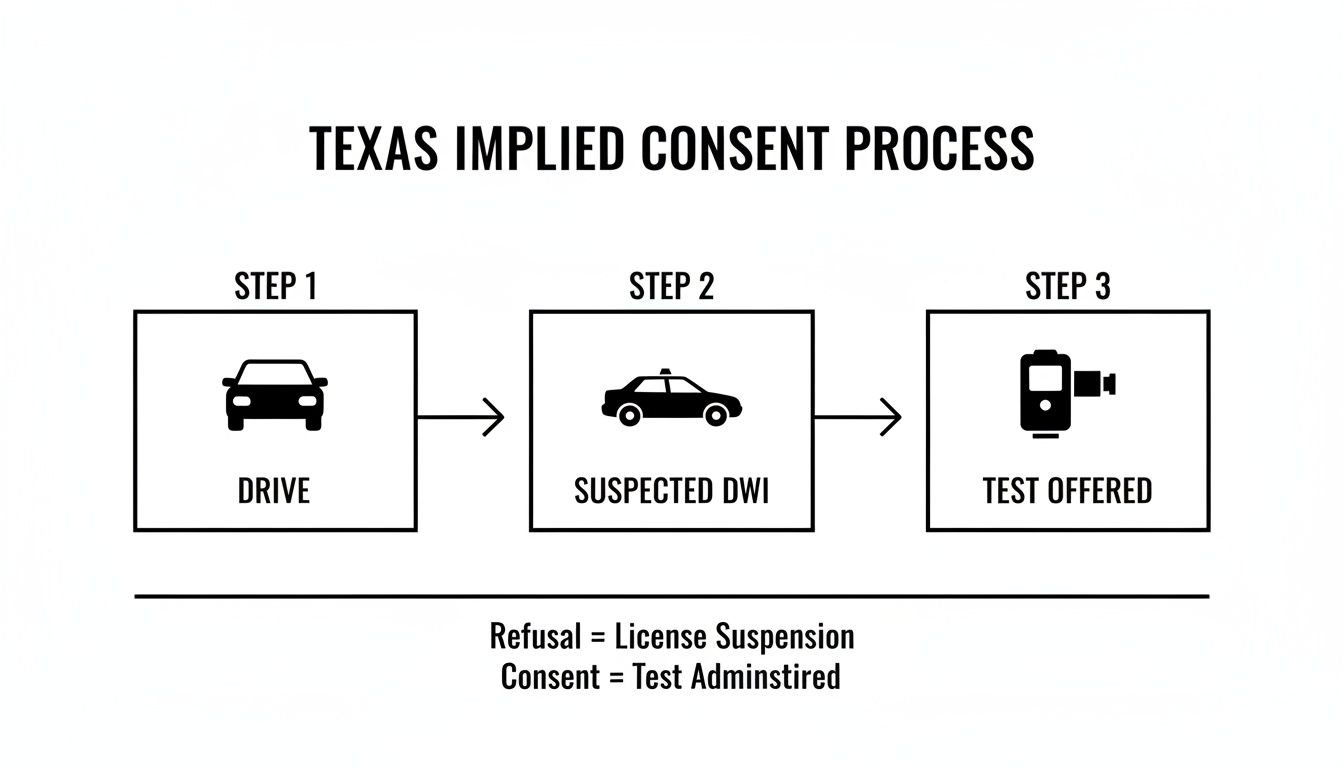
As the visual shows, a DWI suspicion immediately splits into two potential paths—cooperation with testing or refusal. Each one kicks off a distinct set of legal consequences that have to be managed separately.
The Civil Case: Your Administrative License Revocation (ALR)
The first and most time-sensitive battle is the Administrative License Revocation, or ALR, process. This is a civil action taken by the Texas Department of Public Safety (DPS), not the criminal court system. Its sole purpose is to suspend your driving privileges.
When you refuse a breath or blood test, the officer will confiscate your physical driver’s license and issue you a temporary driving permit. That paperwork also serves as your official notice that the DPS intends to suspend your license.
You have only 15 days from the date of your arrest to formally request an ALR hearing.
If you miss this 15-day deadline, your license will be automatically suspended on the 41st day after your arrest. There are no extensions. This is why contacting a DWI attorney immediately isn't just a good idea—it's absolutely critical to protecting your ability to drive.
The ALR hearing is your first, and often best, opportunity to challenge the state's case. It allows your attorney to question the arresting officer under oath, which can expose weaknesses that will be invaluable in your criminal case. You can learn more about this crucial first step by reading our detailed guide on the Administrative License Revocation process in Texas.
The Criminal Case: Your DWI Charge
While the ALR process is unfolding, your criminal DWI case begins to move through the court system. This is the second legal battle where a prosecutor must prove "beyond a reasonable doubt" that you were operating a motor vehicle in a public place while intoxicated.
The stakes in the criminal case are much higher, potentially involving:
- Heavy fines and court costs
- Probation with strict conditions
- Mandatory DWI education classes
- Installation of an ignition interlock device
- Jail time
Crucially, the outcome of your ALR hearing has no direct bearing on the outcome of your criminal case. You can win the ALR hearing and keep your license, but still be convicted of DWI. On the flip side, you could lose your license through the ALR process but ultimately win your criminal case and be found not guilty.
Refusing a BAC test in Texas means facing a swift 180-day driver’s license suspension for a first offense, even before you ever see a courtroom. This immediate consequence highlights how the administrative penalty kicks in long before your criminal trial gets going. Because these two legal proceedings are entirely separate, managing them requires a dual-focused strategy. An experienced Texas DWI attorney knows how to use the ALR hearing as a strategic tool to gather evidence and prepare for the criminal trial, all while fighting to keep you on the road.
Navigating the Administrative License Revocation Hearing
After a DWI arrest where you refused a chemical test, a timer starts on your right to drive. The most urgent deadline you’re facing is requesting an Administrative License Revocation (ALR) hearing. It’s easy to confuse this with your criminal case, but it's a completely separate, civil proceeding. Its sole focus is on the Texas Department of Public Safety (DPS) trying to suspend your driver's license.
You have a non-negotiable 15-day deadline from the date of your arrest to request this hearing. If you miss it, your license gets automatically suspended on the 41st day after your arrest. There are no second chances or extensions. This is why acting immediately isn't just a good idea—it's essential.
What Happens at an ALR Hearing
The ALR hearing is like a mini-trial, but it’s not held in a criminal court. Instead, it takes place before an Administrative Law Judge (ALJ). The goal is straightforward: the DPS has to prove that they have the right to take your license away.
To do this, they only need to establish their case by a "preponderance of the evidence." This is a much lower bar to clear than the "beyond a reasonable doubt" standard used in your criminal case.
The state must prove the officer had:
- Reasonable Suspicion to stop you in the first place.
- Probable Cause to believe you were driving while intoxicated, leading to the arrest.
- That you were properly warned about the consequences of refusing a chemical test.
- And finally, that you did, in fact, refuse to give a breath or blood sample.
This hearing is a significant strategic opportunity. It’s often the first and only chance for your attorney to question the arresting officer under oath before the criminal trial begins. A skilled Houston DWI lawyer can make all the difference here.
Using the ALR Hearing to Build Your Defense
While the immediate goal is to keep you on the road, the ALR hearing’s value goes much deeper. For a seasoned DWI defense attorney, this hearing is a fact-finding goldmine.
By cross-examining the officer, your lawyer can lock them into their testimony, uncovering crucial details and identifying weaknesses in the state's case that might not have been obvious from the police report alone.
The testimony an officer gives at an ALR hearing can be used to challenge their credibility and actions later in your criminal proceedings. Any inconsistency between what they say at the hearing and what's written in their report can become a powerful weapon for your defense.
For instance, your attorney might get the officer to admit they didn't have a solid reason for the traffic stop or that they administered the field sobriety tests incorrectly. This kind of evidence doesn't just help you fight for your license; it lays the foundation to weaken the entire criminal charge against you. This is exactly why you need a strategic Texas DUI attorney to handle your ALR hearing.
Potential Outcomes and Next Steps
The judge’s decision at the ALR hearing will dictate the immediate future of your driving privileges.
-
You Win the Hearing: If your attorney successfully challenges the state's evidence, the judge will rule in your favor. Your driver's license will not be suspended, and you can continue driving normally while your criminal case proceeds.
-
The State Wins the Hearing: If the judge finds that the DPS proved its case, your license will be suspended. For a first-time DWI refusal, this suspension lasts for 180 days.
Even if you lose, you are not necessarily stranded. A strategic attorney can help you apply for an Occupational Driver's License (ODL). Sometimes called an essential need license, an ODL gives you limited permission to drive to work, school, and for essential household duties. Securing an ODL means you can keep your life on track while we continue the fight against the criminal DWI charge.
Texas DWI Penalties Explained: Refusing a Breath or Blood Test
Understanding the theory of implied consent is one thing. Knowing what happens the moment you refuse a breath or blood test is another. While you have the right to refuse, that decision sets off an immediate chain reaction—not in a criminal court, but at the Texas Department of Public Safety (DPS).
These are administrative penalties, not criminal ones. Think of them as civil actions taken directly against your driver's license. The consequences get tougher based on your driving history, which is why handling this alone can leave you without a license and make it harder to fight the criminal DWI charge you're also facing.
First Refusal vs. Subsequent Refusals
For a driver with no prior DWI-related incidents, the penalty for refusing a chemical test is sharp and immediate.
- First-Time Refusal: If this is your first DWI arrest and you refuse a test, you face an automatic driver's license suspension of 180 days.
The stakes climb dramatically if you have a prior DWI on your record. The DPS takes a much stricter view of a second refusal, and the penalties reflect that.
- Subsequent Refusal: If you have any prior DWI-related marks on your record from the last 10 years (like a previous refusal or a conviction), refusing a test this time will cost you your license for two full years.
This tiered system is designed to discourage repeat offenses. The state's patience is limited with drivers who have already been through the system, which makes having a skilled DWI lawyer on your side absolutely critical. Our attorneys can give you specific advice on whether to refuse a breathalyzer in Texas and the strategic thinking behind that choice.
Special Circumstances and Harsher Penalties
For certain drivers, the penalties for refusal are even more severe, depending on the type of license you hold or your age.
For example, a Commercial Driver's License (CDL) holder who refuses a chemical test faces a one-year disqualification of their CDL. It doesn't matter if you were in your personal vehicle at the time—the rule still applies. A second refusal means a lifetime ban, effectively ending a career.
Texas also has a zero-tolerance policy for drivers under the legal drinking age. If you are under 21 years old, refusing a test for a first-offense DWI (often called a DUI for minors) results in a 180-day license suspension.
A refusal is more than a temporary inconvenience. A 180-day suspension is standard for a first DWI in Texas, but the stakes are much higher for CDL holders, licensed professionals, or young drivers. A skilled legal team strategically navigates ALR hearings to protect your livelihood and future.
To put things in perspective, let's compare the automatic license suspension for refusing a test versus failing one for a first-time DWI offender.
License Suspension Comparison: Refusal vs. Failure
| Driver's Action | License Suspension Period (1st DWI Offense) |
|---|---|
| Refusing a chemical test | 180 days |
| Failing a chemical test (BAC ≥ 0.08) | 90 days |
As you can see, the administrative penalty for refusing is double the penalty for failing the test. That might seem like a clear reason to take the test, but it's not the whole story.
While the suspension is longer for a refusal, you are also denying the prosecutor their strongest piece of scientific evidence against you. This trade-off—a longer suspension now for a potentially weaker criminal case later—is why the moments after a DWI arrest are so critical. An experienced attorney can help you understand this balance and fight to protect both your license and your freedom.
How a Test Refusal Can Be Used in Your Criminal Case
One of the biggest anxieties after a DWI arrest is the fear that refusing a breath or blood test is the same as admitting you're guilty. While it’s true that Texas law allows the state to use your refusal against you in court, that is far from the end of the story.
The prosecutor's argument is almost always the same. They'll tell a jury, "The defendant refused the test because they knew they were intoxicated and had something to hide." But a skilled DWI defense attorney knows exactly how to dismantle this narrative and present a much more compelling version of what really happened.
A refusal is not a confession. It's just one piece of evidence that can be challenged, explained, and put into the proper context for a jury.
Building a Counter-Narrative to a Refusal
Just because the prosecutor makes an argument doesn't mean a jury has to accept it. A good defense attorney’s job is to show them that there are plenty of valid, human reasons why a sober and innocent person might refuse a chemical test during a stressful and confusing police stop.
We can reframe the refusal by presenting alternative explanations that jurors can understand and relate to. This strategy shifts the focus from an assumption of guilt to the intense realities of a high-pressure situation.
A test refusal does not equal guilt. It is a single piece of a complex event. An experienced attorney can provide context and demonstrate to a jury that your decision was based on legitimate concerns, not a desire to hide intoxication.
This approach is all about telling the whole story, not just the part the prosecution wants the jury to hear.
Valid Reasons for Refusing a Chemical Test
People say "no" to chemical tests for all sorts of reasons that have nothing to do with being intoxicated. A strong legal defense means digging into those reasons and presenting them clearly and persuasively in court.
Some of the most common and effective alternative explanations include:
- General Anxiety and Fear: A DWI arrest is a frightening experience. The flashing lights and loss of freedom are enough to make anyone feel panicked and overwhelmed. Refusing a test out of pure anxiety is a completely human reaction.
- Distrust of the Equipment: We've all heard stories about breathalyzer machines being inaccurate or poorly maintained. A refusal based on a genuine lack of faith in the technology is a perfectly reasonable position for someone to take.
- Medical or Physical Limitations: Certain health conditions, like asthma or other respiratory issues, can make it physically impossible to provide a strong enough breath sample. Likewise, a legitimate phobia of needles is a powerful reason to refuse a blood draw.
- Confusion About Your Rights: During an arrest, an officer reads your rights and warnings in legal language that most people don't fully understand. It is incredibly easy to get confused about what you're being asked to do and what the consequences really are. A decision made in a state of genuine confusion is not an admission of guilt.
By presenting these valid alternative reasons, a DWI lawyer can effectively argue that your refusal was a reasonable human reaction, not proof of intoxication. This helps neutralize the prosecutor's main argument and allows the jury to consider the facts of your case without prejudice—a critical part of fighting to win your first DWI in Texas.
Building Your Defense with a Strategic DWI Attorney
A DWI arrest can throw your entire world off-balance, but it's a fight you don't have to face alone. Understanding Texas’s implied consent law is a great first step, but transforming that knowledge into a real-world defense takes an experienced and strategic legal ally. At The Law Office of Bryan Fagan, PLLC, our job is to be your shield—protecting your rights, challenging the evidence, and fighting for the best outcome possible.
Dealing with the fallout from a test refusal or a failed test demands a proactive approach. We don't just respond to the prosecutor; we build our own case from the ground up, scrutinizing every single detail of your arrest. A winning defense is built on meticulous, day-one preparation.

How to Fight a Breath Test Result and Other Charges
Our defense strategy is comprehensive. We focus on the weak points in the state’s case because we know a DWI charge is like a chain—a single broken link can make the whole thing fall apart.
Our approach includes:
- Challenging the Initial Traffic Stop: Did the officer have a legitimate reason to pull you over? If the stop was illegal, any evidence they gathered afterward, including a test refusal, can often be thrown out.
- Scrutinizing Probable Cause: We examine the officer’s report and any available video footage to see if they genuinely had enough reason to arrest you in the first place.
- Exposing Errors in Field Sobriety Tests: These tests are notoriously subjective and are frequently administered incorrectly. We know exactly how to spot the procedural mistakes that can render their results useless.
- Identifying Mistakes in the ALR Process: From an officer fumbling the implied consent warning to the state missing a critical deadline, we hunt for any procedural misstep that can be used to save your license at the ALR hearing.
We understand the anxiety that comes with a DWI charge. That's why we offer more than just legal expertise; we provide a dedicated partnership to guide you through this process with confidence and clarity.
The implied consent law creates its own set of challenges, but it also opens up opportunities for a sharp defense. By zeroing in on the officer’s actions and their compliance with strict legal protocols, we can often use the state's own rulebook against them.
Your Path Forward Starts Now
A DWI arrest is serious, but it doesn't have to ruin your future. The tangled web of implied consent and the two separate legal battles you're facing demand a dedicated Houston DWI lawyer who is ready to fight for you. We explore every possible avenue for a positive outcome, whether that's a dismissal, a reduction in charges, or an alternative sentence that minimizes the disruption to your life.
Every case is different, and the right strategy always depends on the specific facts of your arrest. You can learn more about the specific Texas DWI defense attorney strategies we use to protect our clients. Don't wait to get the help you deserve. The sooner we start building your defense, the stronger our position will be.
Common Questions About Implied Consent in Texas
When you're dealing with the fallout of a DWI arrest, questions start piling up fast. Texas's implied consent law, in particular, can feel confusing and unfair. Getting straight answers is the first step to figuring out your next move and building a solid defense. Here are some of the most common questions we hear from clients in your exact situation.
Is the Roadside Breathalyzer the Same as the Official One?
No, and this is a critical difference you need to understand. That small, handheld gadget the officer asks you to blow into on the side of the road is called a preliminary breath test (PBT). In almost every situation, taking this test is completely voluntary.
The official chemical test—the one that really counts under the implied consent law—is the one they offer you after you’ve been arrested. This usually happens back at the station on a much bigger, more accurate machine (the Intoxilyzer) or through a blood draw at a hospital or clinic. Refusing this formal, post-arrest test is what triggers the automatic DWI license suspension.
Can Police Force Me to Give a Blood Sample if I Refuse?
Yes, but they have to play by the rules to do it. If you refuse a breath or blood test after your arrest, the police in Texas can—and very often will—get on the phone with a judge to request a search warrant compelling them to take your blood.
Once a judge signs off on that warrant, you can’t legally refuse the blood draw without risking additional criminal charges, like resisting a search. But this isn't the end of the story. A sharp defense attorney can still fight back by attacking the warrant itself—was there enough probable cause?—and by picking apart the procedure used during the blood draw to make sure your rights weren't violated.
Does Implied Consent Apply if I Was on Private Property?
It often does, which surprises a lot of people. The Texas implied consent law covers anyone operating a motor vehicle in a "public place," and you'd be amazed at how broadly the courts define that term.
A "public place" often includes privately owned property that the public has access to. Think about it: restaurant parking lots, shopping mall garages, or even the parking area of your own apartment complex. Whether the spot where you were arrested legally qualifies as a public place is a crucial detail an experienced Texas DUI attorney will dig into while investigating your case.
I Have an Out-of-State License. Does Texas Law Still Apply to Me?
Yes, 100%. The moment you drive on a Texas road, you’re subject to Texas laws, including implied consent. It doesn't matter where your license was issued.
If you refuse a chemical test here, Texas will suspend your driving privileges within its borders. Then, they’ll report that refusal to your home state's licensing agency. Thanks to an agreement called the Interstate Driver's License Compact, your home state will almost certainly suspend your license, too—just as if the refusal happened on your home turf. This is exactly why it's so important to fight DWI Texas charges, even if you're just passing through.
A DWI arrest feels overwhelming, but it doesn't have to define your future. The maze of Texas's implied consent law demands a strategic, experienced defense. At The Law Office of Bryan Fagan, PLLC, our job is to protect your rights, your license, and your good name. We're here to help you move forward. Contact us today for a free, confidential consultation to go over your case and see how we can help you get back on track.