
A DWI arrest can be overwhelming, but you don't have to face it alone.
You may be reading this from home after bonding out, or from a family member's phone while trying to make sense of paperwork, court dates, and a wreck that turned serious fast. One moment there was a crash. Then police questions, a blood draw or breath request, talk about injuries, and suddenly the charge wasn't just DWI. It was intoxication assault in Texas.
That shift matters. A case involving injury brings higher stakes, more aggressive prosecution, and a much more technical defense. But an arrest doesn't decide the outcome. The state still has to prove every required part of the case, and in these cases, one of the most important battles is often over the injury itself.
An Intoxication Assault Arrest Can Be Overwhelming
The hours after an accident rarely feel orderly. A driver may remember the impact, the ambulance, the officer asking whether they had been drinking, and then the shock of hearing that someone was hurt badly enough for a felony charge. By the time release conditions are set, the questions start piling up. Will I go to prison? Will I lose my license? Can this charge be reduced? Can it be dismissed?
Those reactions are normal. People facing this charge are often scared, embarrassed, and unsure what to say next. They also tend to assume that if another person was injured, the felony charge is automatic and unbeatable. That assumption is where many people make their first mistake.

What usually happens right away
In the immediate aftermath, most clients are dealing with several problems at once:
- Criminal accusations: Police and prosecutors begin building a felony case.
- Driver's license risk: A separate administrative license suspension process may start through the Texas Department of Public Safety.
- Medical records and crash reports: These often become central evidence.
- Pressure to explain: Officers, insurance adjusters, and sometimes even other involved parties may want statements.
A calm, strategic response matters more than trying to talk your way out of it.
Practical rule: The first goal is to stop making the case harder. Use your right to remain silent, follow bond conditions, and get legal advice quickly.
The terms you need to know early
A few DWI terms come up almost immediately:
- BAC: This stands for blood alcohol concentration. Prosecutors may try to use breath or blood evidence to argue intoxication.
- Field sobriety test: These are roadside divided-attention tests officers use as part of a DWI investigation.
- Implied consent: In Texas, driving on public roads means you've already agreed to provide a breath or blood specimen when lawfully requested after arrest, though refusing can trigger license consequences.
- Administrative license suspension: This is the separate civil process that can affect your ability to drive, even before the criminal case is resolved.
A Houston DWI lawyer or Texas DUI attorney doesn't change what happened at the scene. What counsel can do is protect your rights from this point forward, test the state's proof, and identify where the prosecution's case is weaker than it looks.
What Is Intoxication Assault Under Texas Law
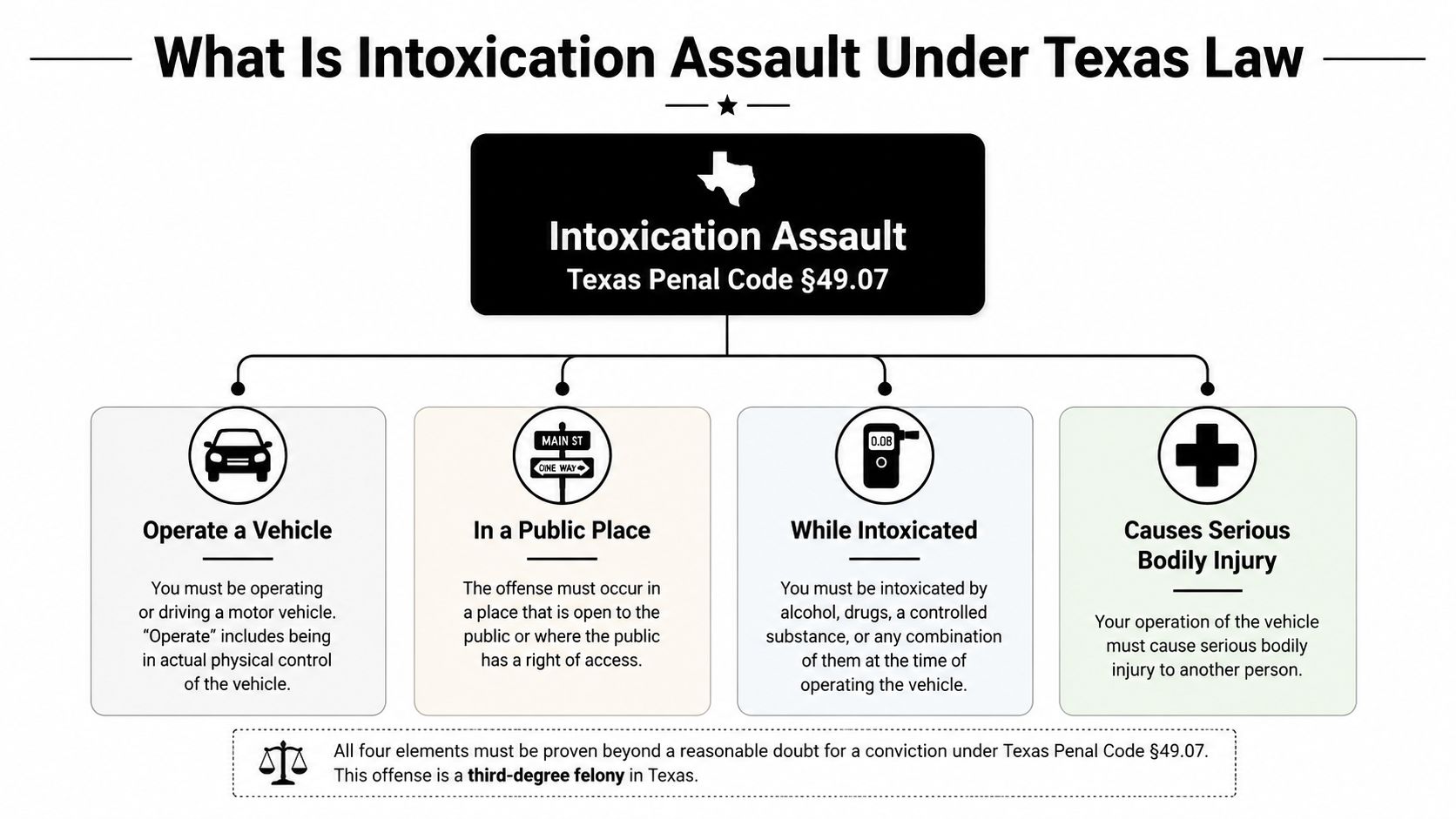
Under Texas law, this offense has a specific definition. It is not just “a DWI with an accident.” The prosecution must prove a felony offense with distinct legal elements.
In Texas, intoxication assault is legally defined as a third-degree felony under Penal Code §49.07. The offense occurs when a person, by accident or mistake, causes serious bodily injury to another while operating a motor vehicle in a public place while intoxicated according to Texas Penal Code §49.07 explained by Saputo Law.
The four parts the state must prove
A prosecutor generally needs to establish these points:
- You were operating a motor vehicle
- It happened in a public place
- You were intoxicated
- Your conduct caused serious bodily injury to another person
Each part can become a defense issue. Some cases focus on the stop, the testing, or whether the driver was operating the vehicle. In many intoxication assault Texas cases, the hardest-fought issue is the last one.
What intoxication means in practice
“Intoxicated” can be alleged through chemical testing, officer observations, statements, driving behavior, or field sobriety tests. A field sobriety test is not a magic truth machine. Officers use it as an investigative tool, but defense lawyers often examine whether instructions were clear, conditions were fair, and the officer followed proper methods.
The legal meaning of serious bodily injury
Texas law does not treat every injury the same.
“Serious bodily injury” means an injury that creates a substantial risk of death, causes serious permanent disfigurement, or results in protracted loss or impairment of any bodily member or organ.
That definition is narrower than many people expect. A person can be hurt, go to the hospital, and still leave room to argue that the injury does not meet the statutory standard. That is one reason these cases require a close review of medical records, diagnosis language, recovery timeline, and causation.
Another point surprises many readers. The law does not require proof that the driver intended to injure anyone. The statute applies when the injury was caused by accident or mistake, which is part of why the defense must focus tightly on the legal elements rather than emotional assumptions.
If you want broader context on when a DWI becomes a felony, Felony DWI in Texas: Third Offense and Child Passenger gives a useful overview of when Texas law upgrades a case beyond a misdemeanor.
How Intoxication Assault Differs from Other DWI Offenses
Not every alcohol-related driving case is built the same way. A standard DWI, an intoxication assault charge, and an intoxication manslaughter case sit at very different places on the risk spectrum. The biggest dividing line is usually the result of the incident, not just the allegation of intoxication.
Texas DWI offenses compared
| Offense | Required Element | Classification | Typical Jail/Prison Time |
|---|---|---|---|
| Standard DWI | Driving while intoxicated | Usually charged less severely than intoxication assault | Varies by facts and prior history |
| Intoxication Assault | Intoxication plus serious bodily injury to another person | Third-degree felony | Prison exposure applies |
| Intoxication Manslaughter | Intoxication plus death of another person | More severe than intoxication assault | Harsher prison exposure than intoxication assault |
This comparison matters because people often search “first DWI in Texas” and assume that the same roadmap applies. It doesn't. Once a crash involves a claimed serious injury, prosecutors usually treat the case as a felony from the beginning. The investigation is more detailed, the medical evidence matters more, and grand jury review becomes part of the process.
Why injury changes the case
A misdemeanor DWI case often centers on intoxication evidence. An intoxication assault case usually has at least two major fights:
- Was the driver intoxicated?
- Did the event cause serious bodily injury as Texas law defines it?
That second question changes everything. A broken bone, surgery, or a frightening ER visit may sound decisive in conversation, but courtrooms run on statutory definitions, not assumptions. In practice, cases rise or fall on exactly how the injury is documented and whether it meets the required threshold.
A DWI with an accident is serious. A felony intoxication assault case is more technical, because the state must prove more than impairment alone.
For readers trying to sort out where their case fits, DWI Involving an Accident or Injury in Texas is a helpful companion resource. It focuses on how an accident changes the defense situation.
Why comparisons can help your defense planning
When you understand the offense category, you can make better decisions early. Someone facing a routine DWI may focus mainly on license issues and test results. Someone trying to fight DWI Texas charges involving injury has to think more broadly. Medical records, witness accounts, crash mechanics, and timing all become central.
That's also why a Houston DWI lawyer handling felony cases will often approach the file differently from a general criminal defense practice. The consequences are more severe, but so is the opportunity to challenge weak assumptions in the state's proof.
The Severe Penalties for an Intoxication Assault Conviction
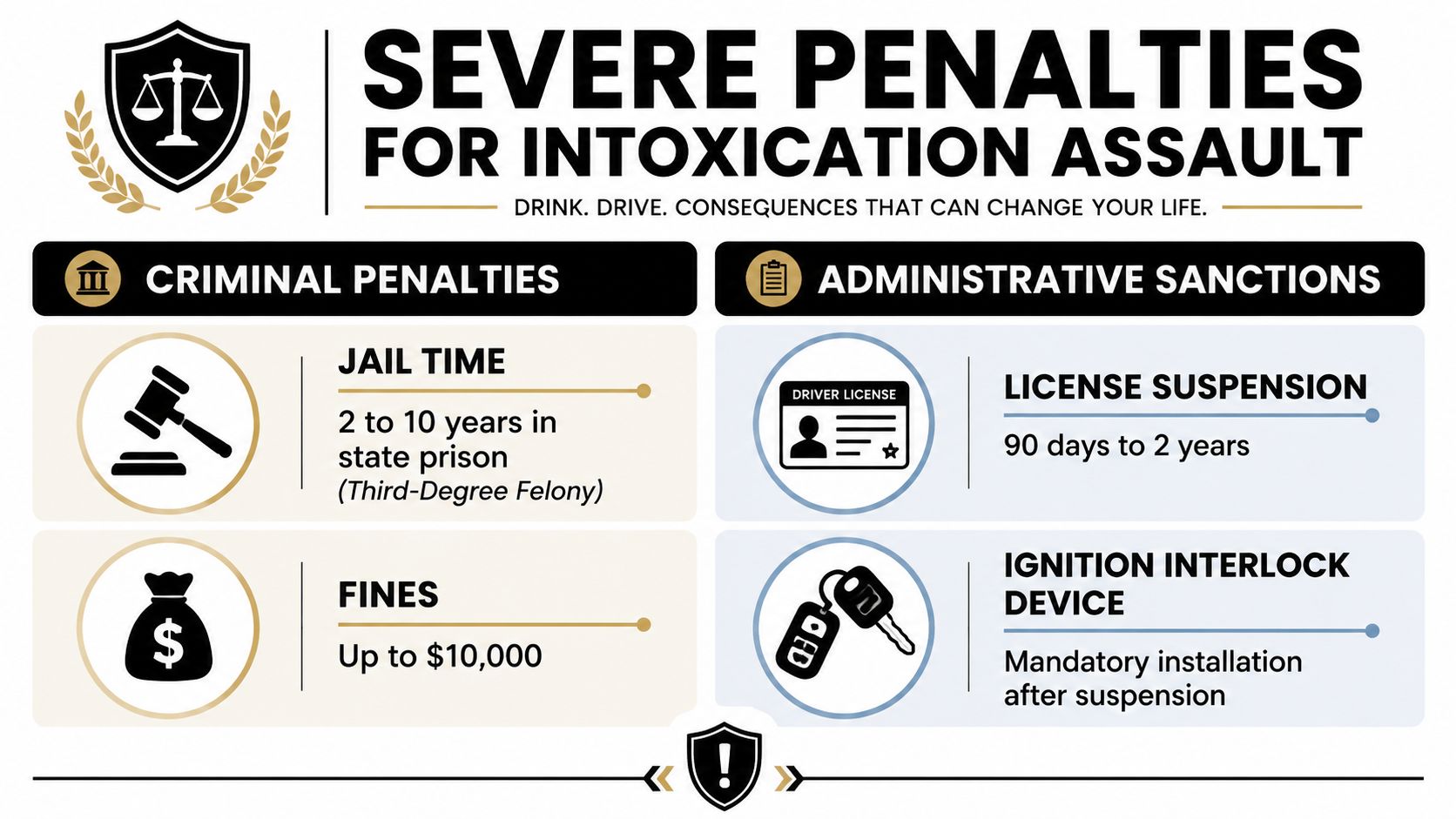
An intoxication assault conviction carries serious criminal punishment. A conviction for third-degree felony intoxication assault in Texas carries a potential prison sentence of between 2 and 10 years and a fine of up to $10,000. If a defendant is granted probation, Texas law still requires a minimum of 30 days in jail as a condition of community supervision according to this Texas intoxication assault penalty overview.
Criminal penalties are only part of the problem
Those are the direct court penalties. They are severe on their own. But a felony DWI-related case can also affect your job, professional licensing, travel, insurance costs, and long-term criminal record.
Some cases can be enhanced under Texas law. The statute discussed earlier recognizes more severe treatment in specific circumstances, including certain injuries or protected victims. A defense lawyer needs to review the charging instrument carefully, because enhancements can change sentencing exposure and negotiation strategy.
The separate fight over your license
A lot of people focus on court and overlook the driver's license problem until it's too late. That's a mistake.
A DWI license suspension can move on its own track through the Administrative License Revocation process, often called an ALR hearing, where implied consent matters. In simple terms, Texas says that by driving on public roads, you've consented to provide a specimen when lawfully requested after arrest. If you refused, or if the state claims you failed testing, DPS may try to suspend your license through an administrative process separate from the criminal felony case.
That means you may be dealing with:
- A felony court case
- An ALR hearing
- Questions about occupational driving privileges
- Possible ignition interlock issues depending on the case and court orders
Here is a short explanation of the stakes from a defense perspective.
Why fast action matters
The ALR process can create useful testimony and early insight into the stop, arrest, and testing. It can also affect your ability to work and handle daily life. In a felony case, that practical pressure often shapes how people respond emotionally. A disciplined legal approach helps keep the license issue from snowballing into employment and family problems.
If the injury allegations in your case are so severe that prosecutors are looking at a death-related charge instead, intoxication manslaughter charges in Texas involves a different and even more serious offense category.
Navigating the Texas Prosecution Process
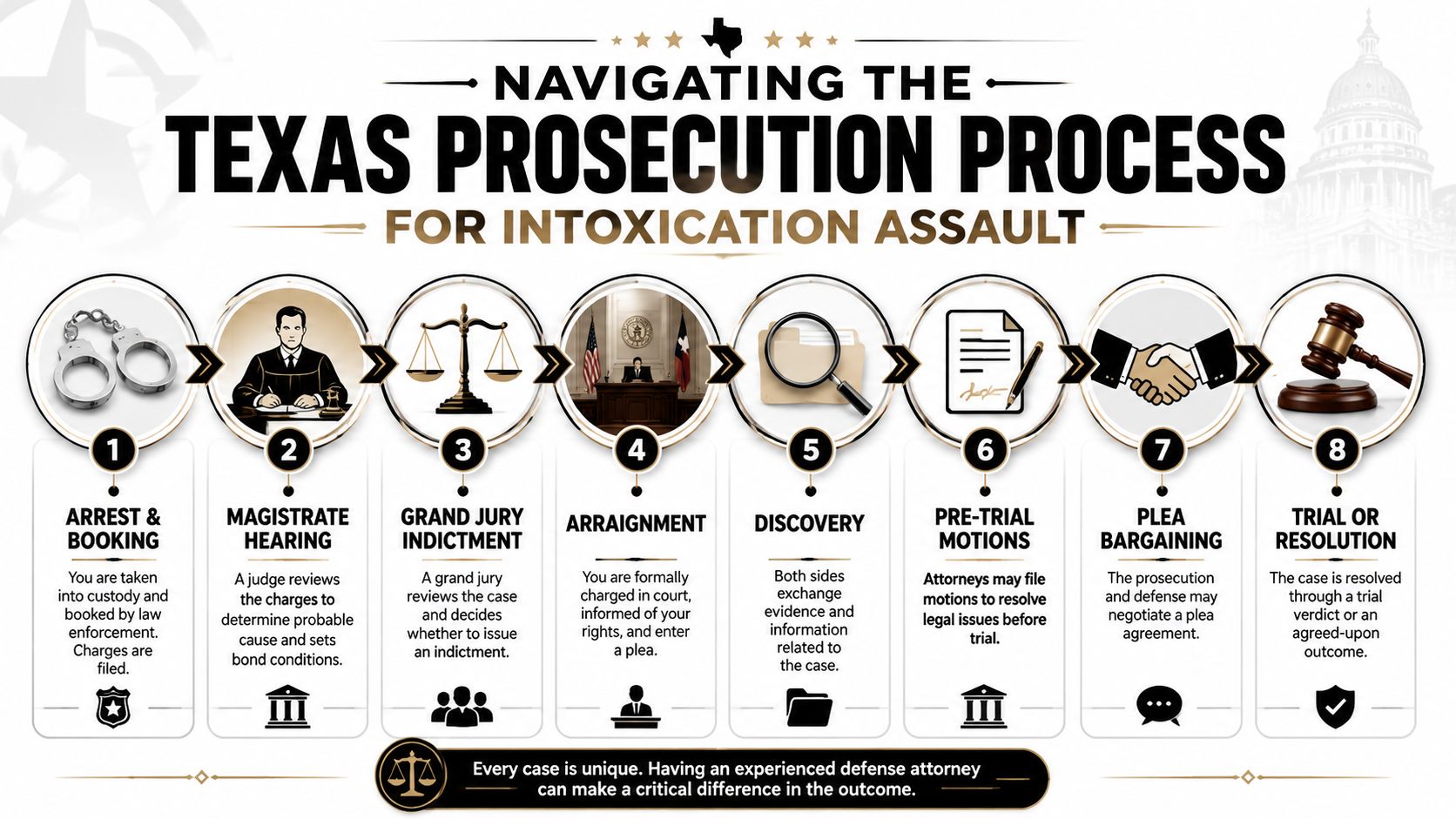
Felony cases feel less chaotic when you know the sequence. The path isn't always quick, but it is usually predictable. Once arrested, you're not just waiting for “court.” You're entering a series of separate stages, each with its own risks and opportunities.
Step by step through the case
Arrest and booking
Police process the arrest, gather identifying information, and document the charge.Magistrate hearing and bond
A judge or magistrate reviews the arrest, sets initial conditions, and may impose restrictions such as no alcohol use, reporting requirements, or an ignition interlock order.ALR hearing request
This is the separate administrative process tied to your driver's license. It is not the same as the felony prosecution.Grand jury review
Because intoxication assault is a felony, prosecutors typically seek an indictment from a grand jury before the case moves deeper into district court.
What happens after indictment
Once indicted, the case becomes more structured.
- Arraignment: The formal reading of the charge and plea.
- Discovery: Exchange and review of police reports, video, lab materials, medical records, and witness information.
- Pretrial motions: Legal challenges to evidence, procedures, or constitutional violations.
- Negotiation or trial: Some cases resolve through reduction or plea bargaining. Others proceed to a jury.
A Texas DUI attorney should be looking at every stage as both a defense opportunity and a fact-gathering opportunity. A weak stop, a flawed warrant, or an issue in specimen collection can change the value of the entire case.
Where blood draw issues often appear
Blood evidence often feels powerful to jurors, so it deserves close scrutiny. The state must still show that officers followed proper legal steps and that the sample was collected and handled lawfully. Questions about warrants can become important very early in a felony DWI case. For a focused look at that issue, see when police need a DWI blood draw warrant.
The process has many stages, but each stage gives the defense a chance to test the prosecution's proof before a jury ever hears the case.
The practical takeaway is simple. Don't wait for trial to start defending yourself. Felony DWI cases are often shaped in the early motions, hearings, and evidence reviews long before a jury is selected.
How to Fight an Intoxication Assault Charge in Texas
A crash happens fast. The felony case that follows can turn on a few medical phrases, a blood result, and whether the State can prove the injury crosses the line from painful to legally "serious bodily injury." That is where many intoxication assault cases are won or lost.
A strong defense examines every element, but in these cases I pay close attention to the injury evidence early. Prosecutors and officers often speak as if a bad wreck automatically proves intoxication assault. Texas law is narrower than that. The State still has to prove intoxication, operation, causation, and a qualifying injury.
Start with the stop and the testing
The defense should first test how the evidence was gathered. Police need a lawful basis for the stop, detention, arrest, and specimen request. If they cut corners at any stage, key evidence may be vulnerable. For a closer look at that issue, see when DWI evidence can be suppressed.
Field sobriety tests also deserve context, not blind acceptance. Fatigue, shock, uneven pavement, poor lighting, injury, weather, and confusing instructions can affect performance. Blood and breath evidence need the same level of scrutiny. Records on maintenance, collection procedures, chain of custody, analyst work, and warrant compliance can all shape the defense.
Still, intoxication assault cases often turn on a different point.
The injury element is often the pressure point
Texas law requires proof of serious bodily injury, not just proof that someone went to the hospital.
That distinction is significant because early medical records are often written for treatment, not for a felony jury charge. Emergency staff may document worst-case concerns, rule-out diagnoses, or temporary symptoms. Later records may show a faster recovery, less lasting impairment, or no substantial risk of death. Those details can change how the charge should be evaluated.
A disciplined defense often focuses on questions like these:
- What do the records say? Initial charting can reflect caution rather than a final conclusion.
- How long did the condition last? Temporary pain or limited function does not always satisfy the statutory standard.
- Was there a substantial risk of death, permanent disfigurement, or protracted loss or impairment? Those words matter.
- Can the prosecution tie that condition to this crash? Prior injuries, later complications, and unrelated medical issues can affect causation.
- Does a treating doctor support the State's theory, or is the prosecutor stretching the records? Those are not always the same thing.
A real injury is not automatically serious bodily injury under Texas law.
This is one of the most overlooked defense strategies in intoxication assault cases. Generic articles spend pages on penalties. The harder and more useful question is whether the medical proof fits the statute. In practice, that often requires a close reading of records, timelines, imaging, follow-up care, and sometimes input from a medical expert.
What tends to help the defense
Specific facts help. Vague denial does not.
The defense needs the crash report, bodycam, dashcam, witness statements, dispatch records, lab materials, treatment records, photographs, and a timeline that holds together under scrutiny. In some cases, an accident reconstruction expert helps. In others, the better investment is a medical review focused on whether the claimed injury was "serious bodily injury" as Texas law defines it.
Law Office of Bryan Fagan, PLLC handles DWI and felony DWI defense matters, including ALR issues, suppression litigation, and cases involving disputed injury allegations. The practical value of counsel comes from early investigation, disciplined record review, and a defense strategy built around the exact weak points in the State's proof.
Take Control of Your Case Today Your Future Is at Stake
If you're facing intoxication assault in Texas, the situation is serious, but it is not hopeless. The state still has work to do. Prosecutors must prove intoxication, operation, causation, and the legally required level of injury. In many cases, a strong defense starts where assumptions end.
What to do next
Take these steps immediately:
- Use your right to remain silent: Don't try to explain the wreck to police, investigators, or anyone else who may be gathering information.
- Get legal counsel quickly: A Houston DWI lawyer or Texas DUI attorney can start preserving evidence, reviewing bond conditions, and preparing for the ALR process.
- Track your license deadline: If you miss the window to challenge a suspension, you may lose an important chance to protect your driving privileges.
- Collect documents: Keep bond paperwork, towing records, hospital discharge information, and any notice related to your license.
- Avoid new problems: Follow every court order, don't discuss the case on social media, and don't assume the criminal case is the only issue you face.
A practical way to think about the case
People often ask whether their case can be reduced, whether probation is possible, or whether they can avoid a felony conviction. The honest answer depends on the facts. But the path forward usually becomes clearer once a lawyer has reviewed the stop, the testing, the injury documentation, and the prosecution timeline.
If your concern started with a first DWI in Texas but the accident changed everything, that doesn't mean your options disappeared. It means the defense has to be sharper. In a felony DWI file, especially one involving alleged injury, the legal details matter more than the assumptions people make in the first few days.
Your future is affected by what happens next, not just by what happened on the roadway. Act early, protect your rights, and build your defense before the prosecution's version becomes the only version in the file.
If you're dealing with an intoxication assault charge, a DWI license suspension issue, or questions about how to fight DWI Texas allegations after a crash, contact Law Office of Bryan Fagan, PLLC for a free, confidential case evaluation. Our team helps Texans understand the process, protect their rights, and respond strategically to felony DWI accusations across Houston and surrounding areas.