
A DWI arrest can be overwhelming, but you don't have to face it alone.
You may be sitting at your kitchen table right now, looking at bond paperwork, trying to figure out how you're supposed to keep driving, keep working, and pay for an ignition interlock device on top of everything else. That reaction is normal. The interlock device Texas cost often becomes an unexpected part of one's life overnight.
My advice is simple. Don't treat the interlock as just another bill. Treat it as part of your defense strategy. If you understand when it's required, what it really costs, and where legal decisions affect that cost, you can make better choices early and avoid expensive mistakes later.
A DWI case in Texas also brings legal terms that sound technical but matter immediately. BAC means blood alcohol concentration. Implied consent means that by driving on Texas roads, you've already agreed to provide a breath or blood specimen in certain lawful DWI investigations. A field sobriety test is the set of roadside exercises an officer may ask you to perform. Administrative license suspension refers to the separate license action that can follow a failed or refused chemical test, even before your criminal case is finished.
If you want to fight DWI Texas cases intelligently, you need to understand both the court process and the money pressure. That starts with a clear breakdown.
Navigating Your DWI and Interlock Device Requirements
A DWI charge in Texas usually creates two problems at once. First, there's the criminal case. Second, there's the threat to your driver's license and your ability to get around. The interlock device often sits right in the middle of those two problems.
What the device actually does
An ignition interlock device is a breath-testing unit installed in your vehicle. Before the car starts, you blow into it. If the device registers alcohol, the vehicle won't start. In some cases, you'll also have to provide additional breath samples while driving.
Texas courts may require an IID as a bond condition, as part of probation, or as a condition tied to restricted driving privileges. County practices can differ, so it helps to review Texas ignition interlock requirements by county if you're trying to understand what local judges commonly order.
Where it fits in the DWI timeline
After a DWI arrest, you may face several steps in quick succession:
- Arrest and booking after the traffic stop.
- Bond conditions set by the court, which may include an IID.
- ALR hearing issues involving your license. This is the administrative side of the case.
- Criminal court proceedings where your attorney challenges the stop, the arrest, and the testing.
- Final outcome, which can affect whether the IID remains necessary and for how long.
Practical rule: The sooner you get legal advice, the more control you have over both the legal process and the costs attached to it.
A Houston DWI lawyer or Texas DUI attorney should be looking at the interlock requirement early, not after you've already agreed to terms that are harder to unwind. That's how you stay on offense instead of reacting to every new expense.
The Full Breakdown of Interlock Device Costs in Texas
A lot of drivers fixate on the install quote and miss the core issue. Your interlock bill is a program cost tied to your DWI case, your court orders, and how long the device stays in your car. If you want control, budget for the full requirement from day one.
That means looking at every fee that can hit you from installation through removal.
What you usually pay for
Most Texas drivers face the same core charges. The amount can vary by provider and county, but the categories stay fairly consistent.
| Fee Type | Typical Cost Range | Frequency |
|---|---|---|
| Installation fee | $50 to $150 | One-time |
| Monthly lease fee | Provider-based monthly charge | Monthly |
| Calibration or monitoring fee | May be bundled or separate | Recurring |
| Removal fee | $50 to $150 | One-time at the end |
| Restricted license fee | About $10 | Annually |
The installation fee is the first bill. In many cases, it falls between $50 and $150, with many drivers landing in the middle of that range, based on this Texas ignition interlock cost breakdown.
After that, the monthly charge becomes the bigger issue. Providers structure these programs differently. Some advertise a low starting rate and charge separately for service appointments or monitoring. Others fold more of the compliance work into the monthly price. If you need a quick refresher on the device itself, read how an ignition interlock device works in practice.
The charges that catch people off guard
The monthly lease is only part of the budget. You may also have recurring calibration appointments, a final removal fee, and costs tied to restricted driving privileges. If your order lasts for months, those smaller charges add up fast.
Transfer fees can also become a problem if you switch vehicles during the case. Insurance-related costs may rise for some drivers as well. Those expenses are not part of the ad you saw online, but they still come out of your pocket.
Budget from the court order and the provider contract, not the teaser rate.
That is the strategic point many people miss. The interlock cost is not just a price tag. It affects how you plan transportation, work, court compliance, and cash flow while your DWI case is pending.
Why this matters in a defense plan
I tell clients to treat the IID like one piece of the larger DWI expense map. If you underestimate it, you start making short-term decisions that hurt you later. You miss service dates. You fall behind on payments. You create compliance problems that were avoidable.
A better approach is simple. Get clear on the full cost early, line it up against the rest of your case expenses, and have your lawyer examine whether the scope and timing of the requirement can be challenged or limited. That is how you keep the device from controlling the case.
If you need the legal framework behind these orders, review Ignition Interlock Devices in Texas DWI Cases. If this is your first DWI in Texas, getting legal advice early matters even more because the interlock requirement can shape both your budget and your day-to-day life for months.
Factors That Influence Your Total Interlock Device Cost
Your total IID bill is shaped by three things. The provider you choose, the vehicle you drive, and how long the order stays in place. If you treat those as fixed, you give up control you may still have.
Provider pricing is not uniform
Two drivers in the same county can end up with very different totals because providers build their pricing differently. One company may look cheaper up front and then add more service, monitoring, or missed-appointment charges later. Another may quote a higher monthly amount but give you better access to service centers and fewer surprises.
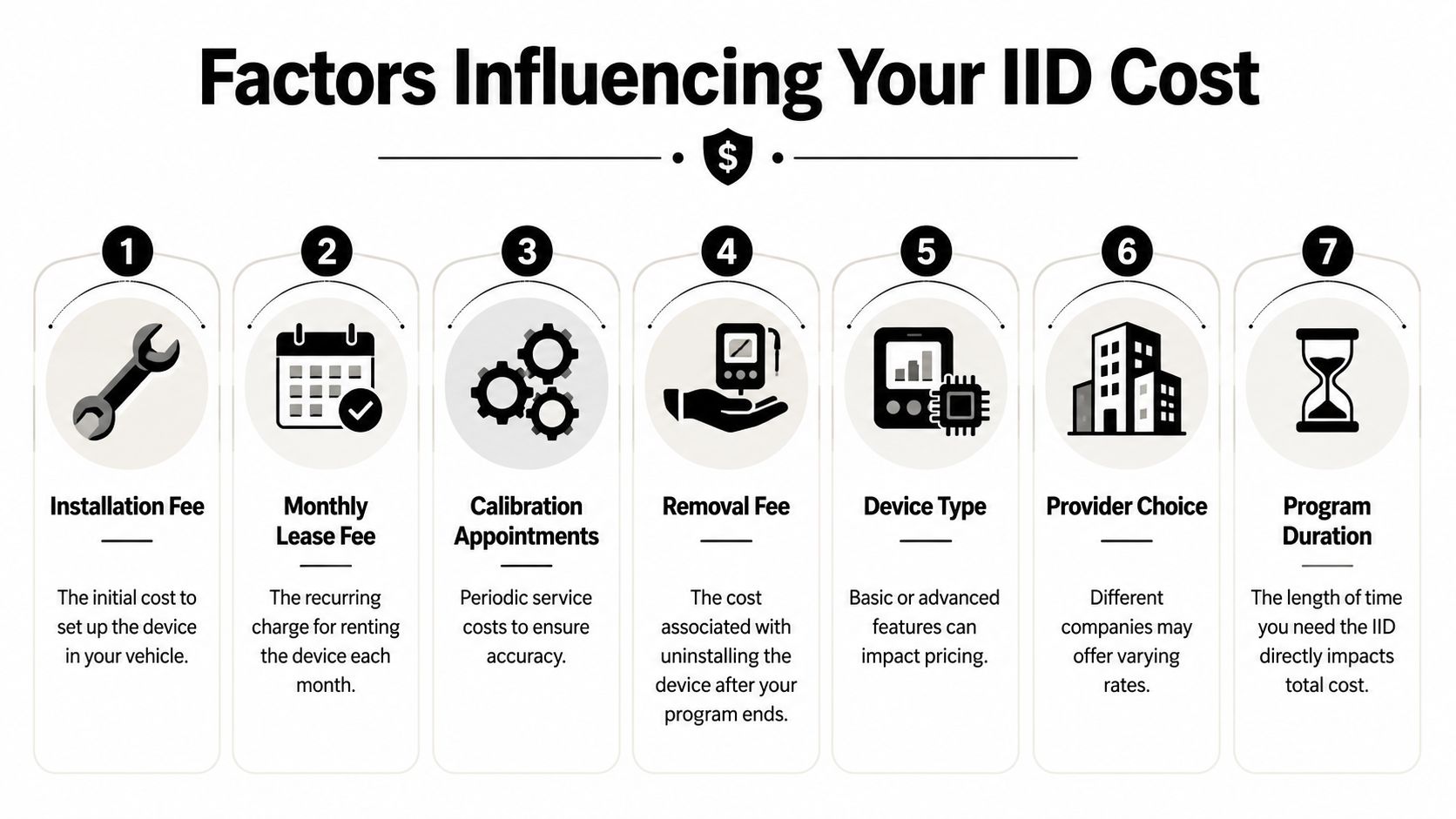
As noted earlier, Texas providers advertise very different starting prices. That is why you should compare the full program cost on paper before you sign anything.
If you want a plain-English overview before choosing a company, review how ignition interlock devices work. It will help you spot which fees are tied to the device itself and which ones come from the provider's contract.
Your vehicle can raise the installation price
Your car matters more than people expect.
Some vehicles are simple installs. Others require more labor because of their wiring, electronics, or anti-tampering systems. That can raise the install charge and sometimes affect later service work too. If you drive a newer vehicle or a model with more complex electrical components, get the provider to confirm the expected labor cost before the appointment.
Ask these questions directly:
- Will my make and model change the installation price?
- What will it cost if I have to move the device to another vehicle later?
- How far is the nearest service location, and how often will I need to return?
That last question matters. A lower quote loses value fast if every calibration visit costs you half a day of work.
Program length is the primary driver of your total cost
Many people miscalculate by focusing on installation because it is the first bill, then ignoring the recurring charges that do the most damage to the budget over time.
A longer IID requirement means more monthly lease payments, more service appointments, and more chances for extra fees if something goes wrong. If your court order, bond condition, or occupational license requirement keeps the device in place for months longer than expected, your total cost rises with it.
The biggest IID expense is usually time, because time keeps triggering monthly charges.
That is why I tell clients to treat IID length as a legal issue, not just a billing issue. If there is room to challenge the scope, timing, or duration of the requirement, that can matter as much as shaving a few dollars off the monthly rate.
Compliance problems make the total worse fast
Miss a service visit and you may face more than a late fee. You can create lockout problems, extra appointments, additional charges, and avoidable trouble with the court. At that point, the cheapest provider on paper stops looking cheap.
Choose a company you can deal with. Pick one with reachable service locations, clear billing, and appointments that fit your work schedule. Then get your lawyer involved early so the IID order, provider choice, and compliance plan all work together instead of creating more pressure on your case.
Payment Options and Financial Assistance for Your IID
You are not just paying for a device. You are deciding how to keep driving, stay compliant, and stop this case from creating bigger financial problems than it already has.

Start with a payment plan you can actually sustain
Ignore the sales pitch built around a low daily number. Your real problem is the monthly bill, paid on time, without missed appointments or surprise add-ons that trigger extra charges.
Treat the IID like part of your defense strategy. If a provider has confusing billing, inconvenient service locations, or poor communication, that can cost you more than a slightly higher monthly rate from a company that is easier to deal with. Control matters here.
Before you agree to anything, get the full billing structure in writing. Ask for the installation charge, the monthly lease amount, service or calibration fees, warranty charges, missed-appointment penalties, and the removal fee. If a company will not spell that out clearly, pick a different company.
Ask the questions that protect you
Use this checklist during the call or at the installation appointment:
- What is due today: Get the exact up-front amount before they touch your car.
- What is due every month: Require a clear breakdown of every recurring charge.
- How often do I have to report for service: Make sure the appointment schedule fits your work and family obligations.
- What triggers extra fees or lockouts: You need to know the rules before a small mistake becomes a legal problem.
- What do I owe at the end: Removal fees should be disclosed early, not sprung on you later.
If you are also trying to keep up with court costs, supervision fees, and other DWI expenses, this guide to DUI fines and payment plans in Texas helps you build a realistic budget for the full case.
Financial help may exist, but you have to press for it early
Hardship arguments can matter. Waiting usually hurts you.
If paying for the IID means you cannot cover rent, groceries, child support, or the gas you need to get to work, tell your lawyer immediately. That is not a side issue. It affects how your case should be handled and what requests should be made to the court.
Relief is not automatic, and it is rarely uniform from one county to the next. Some courts are more willing than others to consider modified conditions or practical solutions when the cost threatens your ability to comply. A lawyer can raise the issue the right way, at the right time, and with the right documentation.
If this is your first charge, First-Offense DWI in Texas: Penalties and Defenses will help you understand the broader case and where the IID fits into it.
A short overview can also help if you're trying to understand how these costs fit into the broader process:
Client advice: If IID payments will force you to choose between compliance and basic living expenses, tell your lawyer before the first missed payment or service visit. That gives you the best chance to fix the problem before it turns into a violation.
The Legal Process for Ignition Interlock Devices in Texas
You get out of jail, finally breathe for a second, and then learn you may need an interlock device before you can legally drive. That moment catches a lot of people off guard. The device is not a side issue. It is part of the legal strategy from day one.
An IID can be tied to your bond, your driver's license, your probation terms, or more than one of those at the same time. If you treat it like a simple equipment problem, you give up control early. Your lawyer should be using the IID issue to protect your ability to work, keep your license where possible, and avoid violations that make the case worse.
When Texas may require an IID
Texas courts often impose an IID while a DWI case is pending as a bond condition. A court can also require one later as part of probation or sentencing. In some cases, it becomes part of restricted driving after a license suspension or other DWI-related license problem.
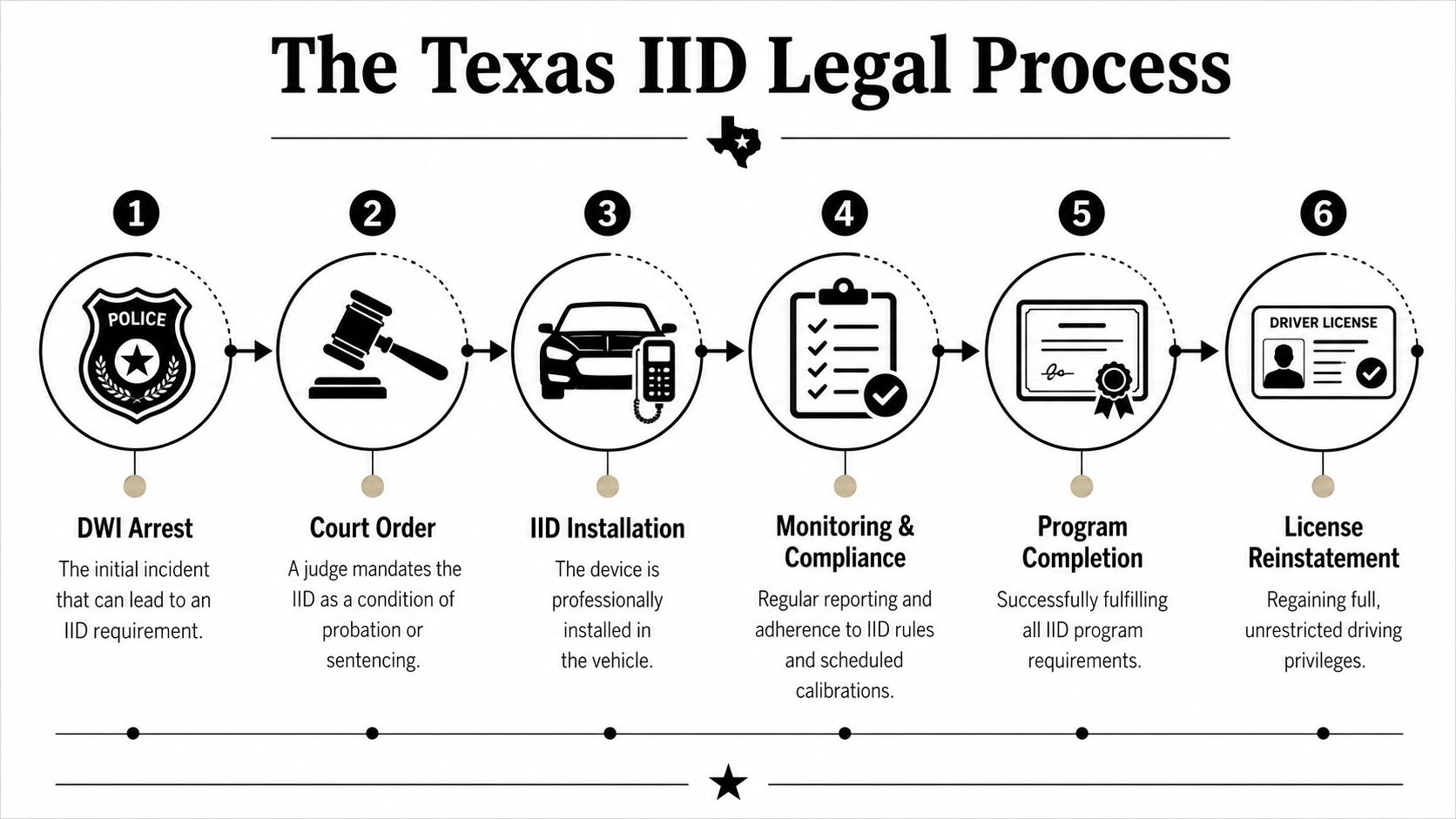
That timing matters.
A broad interlock order can create problems with work, school, childcare, and compliance. A focused legal response can sometimes limit the damage. If the court is asking for more than the facts justify, your lawyer should challenge the scope, the duration, or the need for the condition at all. If the main pressure is coming from the license side, the smarter move may be to attack the suspension in the ALR case.
The steps after a DWI arrest
The process usually follows this path:
Traffic stop and arrest
The officer investigates the stop, may use field sobriety tests, and may request a breath or blood sample under Texas implied consent rules.Bond conditions are set
After release, the judge can place conditions on your driving. An IID may be one of them, sometimes immediately.ALR hearing
This is the civil license case, separate from the criminal charge. What happens here can affect whether you are fighting to keep full driving privileges or trying to limit the fallout.Criminal case review
Your lawyer examines the stop, probable cause, officer reports, video, testing procedures, and any constitutional issues.Negotiation or trial
Some cases should settle. Others should be fought. That decision should turn on the evidence, not fear of the interlock requirement.Compliance and removal
If an IID order stays in place, you must follow every rule tied to use, calibration, and reporting until the court or agency clears removal.
Why legal strategy matters more than the device itself
The interlock cost matters. The court order matters more.
A lot of people fixate on the monthly fee and miss the bigger risk. The larger financial threat is the underlying DWI case. A conviction can trigger fines, court costs, insurance consequences, job problems, and long-term restrictions that cost far more than the device itself. As noted earlier, the IID is usually one piece of a much more expensive problem.
So here is the right order of attack: protect your license, challenge bad evidence, narrow unnecessary conditions, and stay compliant with any order that remains in place.
Handle the DWI case like the main event, because it is. The interlock requirement should be managed as part of that plan, not treated like a separate headache.
That is how you keep control. A strong DWI defense can change whether an IID is required, how long it stays in place, and how much damage the case does to your record and your future.
Your Next Steps to Protect Your Rights and Future
The bill for the device feels urgent. Your DWI case is more urgent.
If you focus only on interlock device Texas cost, you risk missing the decisions that do the most damage. The device is one expense. The charge behind it can affect your license, your record, your insurance, your work, and how long you stay under court restrictions. Treat the IID as part of your defense plan, not as a stand-alone problem.
Put the legal defense first
Your first move should be to get legal advice and build a strategy. Cost control starts there.
A smart defense can affect whether an interlock is ordered, how strict the terms are, how long it stays in place, and what happens to your license while the case is pending. As noted earlier, the device itself is often a smaller issue than the long-term cost of a bad result in the DWI case.
What your lawyer should be evaluating
Your lawyer should examine the pressure points that can change the outcome and reduce unnecessary conditions:
- The stop: Was there a lawful reason to pull you over?
- The arrest: Did the officer have enough evidence to escalate the stop into a DWI arrest?
- Testing issues: Were field sobriety, breath, or blood procedures handled correctly?
- License deadlines: Was the administrative side addressed before you lost options?
- Interlock terms: Is the device required in your situation, or is the state asking for more than it should?
- Resolution strategy: Should you fight the case, negotiate narrower terms, or prepare for sentencing from a stronger position?
That review matters because interlock costs are easier to manage when the larger case is under control.
Take action while you still have options
Delay helps the state. It does not help you.
Deadlines pass fast in DWI cases. Evidence gets harder to challenge. Conditions that felt temporary can stay in place longer than they should. A lawyer can sort out what is required now, what can be challenged, and what steps protect your ability to drive while the case is pending.
Law Office of Bryan Fagan, PLLC handles DWI defense, license-related issues, and the legal questions tied to ignition interlock requirements.
If you have been arrested for DWI and you are worried about cost, your license, or what happens next, request a free consultation with Law Office of Bryan Fagan, PLLC. You will get a clear review of your case, straightforward guidance about your options, and a practical plan to protect your rights, your ability to drive, and your future.