
A DWI arrest can be overwhelming — but you don’t have to face it alone. If a judge has ordered you to install an ignition interlock device (IID), your life has suddenly become more complicated. You're likely wondering what this device is, how it works, and what it means for your daily routine.
An IID is essentially a breathalyzer connected directly to your vehicle's ignition system. Its sole purpose is to prevent you from driving if it detects alcohol on your breath. This guide will break down exactly how these devices work, explain what Texas DWI laws require, and show you how a skilled Houston DWI lawyer can protect your rights and help you take the next step toward a strong legal defense.
What is an Ignition Interlock Device and Why is it Required?
When a judge orders you to install an IID, understanding its function is the first step toward regaining control. An ignition interlock device is a piece of technology required to ensure you remain sober behind the wheel. It's often ordered as a condition of bond after a DWI arrest or as a requirement for obtaining an occupational license to drive legally while your case is pending.
Think of it as a gatekeeper for your car's engine. Before you can start your vehicle, you must provide a deep-lung breath sample into the device's mouthpiece. It analyzes your breath alcohol concentration (BrAC) within seconds. If your BrAC is below the pre-set limit—typically 0.02% in Texas—your car will start. If it’s above that limit, the ignition remains locked, and you cannot drive.
This is a common requirement after a DWI arrest, particularly in cases involving a high Blood Alcohol Concentration (BAC) or for individuals who need to drive for work or family obligations. An experienced Texas DUI attorney can explain the specific reasons it was ordered in your case.
Key Reasons a Texas Court Orders an IID
There are several common scenarios that lead to a mandatory IID installation in Texas. Knowing which one applies to your case helps clarify the road ahead and the legal strategy needed to protect your future.
- As a Condition of Bond: Immediately after an arrest, a judge may require an IID as part of your pretrial release conditions. This allows you to continue driving for essential needs while your case is ongoing.
- For an Occupational License: If your license is suspended through the Administrative License Revocation (ALR) process, you will need an IID to obtain an occupational license. This restricted license permits you to drive to essential locations like work, school, or court-ordered appointments. You can learn more about the complexities of a DWI license suspension in Texas and how to seek reinstatement.
- As Part of a Criminal Sentence: For certain DWI convictions, an IID is a mandatory part of the punishment. This is especially true for a first DWI in Texas with a high BAC of 0.15 or higher or for any subsequent offenses.
A common misconception is that an IID requires a perfect 0.00 BAC to start the car. While most devices are set to a low threshold like 0.02%, it's critical to understand that any positive reading is recorded, logged, and reported to the court or your probation officer.
Navigating these requirements is a significant part of your defense. Every breath sample you provide—whether a pass or a fail—is logged and can impact the outcome of your case. This is precisely why having a knowledgeable legal advocate on your side is so essential to fight a DWI in Texas.
Getting to Know the Tech Behind the IID
If you have been ordered to install an ignition interlock device, understanding how it works day-to-day will help you navigate this period successfully. At its core, an IID is a sophisticated, personal breathalyzer hardwired into your vehicle's ignition system. Its only job is to prevent your car from starting if it detects alcohol on your breath.
The technology is highly precise. The device uses a fuel cell sensor, the same trusted technology law enforcement uses in roadside breathalyzers. Fuel cell sensors are known for their accuracy and specificity to alcohol, which minimizes the risk of a false positive from substances like mouthwash or certain foods.
The Breath Sample Process
Each time you want to drive, you will need to follow a specific routine. You will turn the key to power on the device, wait for its signal, and then provide a steady, deep breath into the mouthpiece for several seconds.
This isn't a simple puff. The device requires a deep-lung air sample because that is where the alcohol concentration most accurately reflects your actual Blood Alcohol Concentration (BAC). The fuel cell sensor then analyzes the sample.
If your measured Breath Alcohol Concentration (BrAC) is below the pre-set limit—usually 0.02% in Texas—the device signals the ignition, and your car will start. However, if it detects a BrAC above that limit, the ignition is temporarily locked, and the engine will not turn over.
This diagram illustrates that critical pass/fail process.

As you can see, the outcome of every test determines your ability to drive. Compliance is a key part of your daily life with an IID.
How an IID Measures Breath Alcohol
Unlike older, less reliable technologies, the fuel cell sensor in a modern IID is remarkably specific. When you breathe into the device, any alcohol molecules in your breath cause a chemical reaction on an electrode surface within the sensor.
This reaction generates a small electrical current. The stronger the current, the more alcohol is present in your system. The device's internal computer measures this current and instantly calculates your BrAC. The process is based on established science, making the readings difficult to challenge unless there is a clear technical malfunction with the device itself.
It's critical to understand that the IID is much more than a simple on/off switch. It’s a data recorder. Every breath sample—passes, fails, even attempts to start the car without blowing—is recorded, time-stamped, and logged. This data gets downloaded regularly and sent straight to your monitoring authority, like a probation officer or the court.
The mechanics are designed to be straightforward. Ignition interlock devices work by forcing a driver to prove they are sober before the engine will even start. If your breath sample is over the limit, the car stays off. You can find more details on this technology in the global market report on GII Research. An experienced Houston DWI lawyer can explain how this data could be used in your case and make sure your rights are protected every step of the way.
Advanced Features and Compliance Requirements
Modern ignition interlock devices are more than just a breathalyzer for your car. They are sophisticated monitoring systems designed to ensure you follow court orders at all times. Understanding these advanced features is crucial, because everything you do with the device is recorded and reported to the authorities managing your case. A single mistake can lead to a lockout or a violation that negatively impacts your DWI proceedings.
The most significant feature you will encounter daily is the rolling retest. This is when the IID randomly prompts you for another breath sample while you are driving. The purpose is to prevent someone from having a sober friend start the car for them. When the device beeps, you will have a few minutes to pull over safely and provide a sample. It is designed with safety in mind and will never shut off your engine while the vehicle is in motion.

Preventing Tampering with Cameras and Data Logs
What stops someone from having a friend blow into the device for them? A camera. Nearly all IIDs required in Texas are equipped with a small, forward-facing camera. Every time a breath sample is provided—at startup or during a rolling retest—it takes a photo. This image is time-stamped and stored with your BrAC reading, creating a clear record that it was you providing the sample.
This feature ensures accountability. If a friend or family member attempts to provide a sample for you, the photo evidence will clearly show it, resulting in a serious tampering violation.
Crucial Takeaway: The IID is a data-gathering machine. It logs absolutely everything: passed tests, failed tests, missed rolling retests, and any attempt to disconnect or bypass it. This complete data log is downloaded at your monthly calibration appointment and sent directly to your probation officer or the court.
That log becomes part of your official case record. A clean record showing consistent compliance can be a powerful tool for your Houston DWI lawyer to use in negotiations, demonstrating your commitment to sobriety. On the other hand, a log with violations can cause serious damage to your case.
Understanding Lockouts and Violations
An IID violation can trigger several types of "lockouts" that will prevent you from using your car. These are not minor inconveniences; they are serious events reported directly to the court.
- Temporary Lockout: This occurs after a failed startup test. The device will lock you out for a few minutes before you can try again. A subsequent failure will result in a longer lockout period.
- Service Lockout: If you miss a required monthly calibration appointment, the device will eventually enter a permanent lockout mode. The only solution is to have your vehicle towed to the service provider at your expense.
- Violation Lockout: Tampering with the device, failing multiple rolling retests, or attempting to bypass the system can trigger a severe lockout that requires you to report to your monitoring authority for clearance.
Each of these events is recorded and can be used against you. This is why understanding how ignition interlock devices work is so vital. It’s not just about starting your car; it’s about successfully navigating a high-stakes period of legal monitoring. If you encounter any issues, such as a false positive or a device malfunction, contact your attorney immediately to protect your rights and ensure the incident is documented correctly.
The Legal Reasons for an IID Order in Texas
Understanding why a judge orders an ignition interlock device (IID) is the first step in getting a handle on your DWI case. In Texas, an IID isn't a random penalty; it's a specific legal tool used in several distinct situations. A court order for an IID can feel overwhelming, but knowing the reason behind it helps you and your attorney build a strategic defense.
Often, an IID is required almost immediately after an arrest. A judge can order it as a condition of bond, allowing you to remain out of jail and continue driving while your criminal case proceeds. This is an extremely common requirement, especially if any aggravating factors were present in your case.
DWI Convictions and Mandatory Installation
For some DWI convictions in Texas, installing an IID is not optional—it is a mandatory part of the sentence. This is intended to ensure public safety and monitor your compliance with court orders.
These mandatory installation scenarios often include:
- A first-time DWI with a high BAC: If your blood alcohol concentration (BAC) was 0.15 or higher, Texas law requires you to have an IID installed as a condition of your probation.
- Any subsequent DWI conviction: If this is your second or third DWI, you can expect an IID to be part of your sentence, often for a year or longer.
- DWI with a child passenger: If you were arrested for DWI with a passenger under the age of 15, the charge is elevated to a state jail felony, which automatically triggers a mandatory IID order.
In these situations, the IID serves a dual purpose: it prevents you from driving after drinking and acts as a condition of your community supervision. You must comply with all IID requirements to successfully complete your probation and put the case behind you.
The Role of Administrative License Revocation
Many people are unaware that a separate civil process can also lead to an IID requirement. This is the Administrative License Revocation (ALR) process, which begins the moment you refuse a breath or blood test or provide a sample over the legal limit of 0.08.
Under Texas's "implied consent" law, all licensed drivers have agreed to submit to a chemical test if lawfully arrested for DWI. Refusing or failing this test triggers an automatic license suspension. To continue driving legally for work, school, or other essential duties during this suspension, you will need an occupational license. A key condition for an occupational license is installing an IID on your vehicle. A skilled attorney can guide you through the Administrative License Revocation process in Texas and fight to protect your driving privileges.
Your criminal DWI case and the administrative license suspension are two separate battles. It is entirely possible to win your criminal case but still have your license suspended through the ALR process, making an IID necessary to drive.
The push for IID laws is part of a nationwide effort to reduce drunk driving. As of 2024, more than 33 states have laws requiring convicted drunk drivers to install IIDs, a mandate heavily supported by the National Highway Traffic Safety Administration (NHTSA). Studies show these devices are effective; repeat DUI offenses can decrease by as much as 70% while the device is installed. You can discover more insights about the effectiveness of IIDs on cognitivemarketresearch.com.
Facing an IID order is a serious matter, but you don’t have to face it alone. A knowledgeable Texas DUI attorney can explain why the device was ordered in your specific case and begin building a strategy to minimize its impact on your life.
Navigating the Installation, Calibration, and Costs
If a court has ordered you to get an ignition interlock device (IID), you are likely facing a new set of responsibilities. From finding a certified installer to managing the costs, the process can seem complex. However, with a little preparation, you can navigate it smoothly and without any surprises.
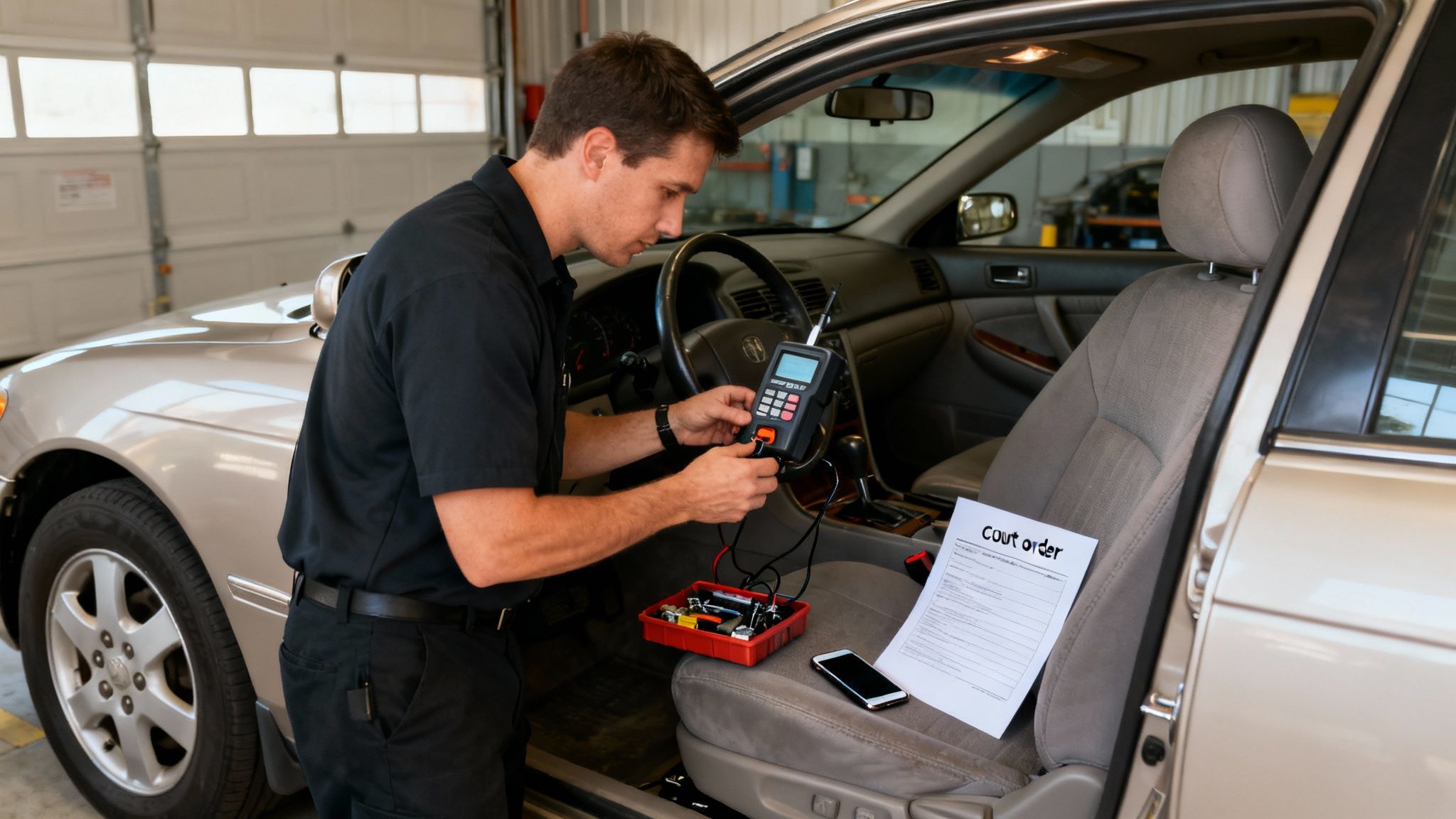
Your first step is to find a state-approved installation vendor in Texas. The court or the Texas Department of Public Safety (DPS) can provide a list of certified companies. This step is critical—only a state-approved provider can legally install your device. Using an uncertified installer will not meet your legal requirements and will be a waste of time and money.
Scheduling Your Installation and What to Bring
Once you choose a vendor, schedule your installation appointment. A certified technician will hardwire the IID into your car's ignition system, a process that typically takes one to two hours. Afterward, the technician will provide a thorough demonstration of how to use your specific device.
To ensure your appointment goes smoothly, bring the following documents:
- Your Court Order or Legal Paperwork: This document officially proves the IID requirement.
- A Valid Photo ID: Your driver's license or another government-issued ID.
- Vehicle Registration and Proof of Insurance: The installer needs to verify the details of the vehicle receiving the device.
Having these items ready will prevent delays and ensure the installation is properly linked to your case.
Understanding the Financial Commitment
The cost of an IID is a major concern for most people. This is not a one-time expense; it is an ongoing financial responsibility for the entire duration of your court order. Budgeting for these fees is essential to remain compliant.
Crucial reminder: If you fail to pay your monthly fees, the provider can lock out your device. When that happens, you won't be able to start your vehicle at all and might have to pay extra to get it towed to a service center for reactivation.
The costs of an ignition interlock device generally fall into a few predictable categories. Here is an overview of what you can expect to pay in Texas.
Estimated Ignition Interlock Device Costs in Texas
| Cost Type | Estimated Price Range | Frequency |
|---|---|---|
| Initial Installation Fee | $70 to $150 | One-Time |
| Monthly Lease & Calibration | $70 to $100 | Monthly |
| Device Removal Fee | $50 to $100 | One-Time |
| Lockout/Reset Fee | $50 to $75 | As Needed |
These figures are estimates and can vary based on the provider and the features of your device. It is always a good idea to get quotes from several state-approved vendors to find the best option for your budget.
Your monthly calibration appointments are mandatory. During these visits, a technician ensures the device is reading your breath samples accurately and downloads the complete data log. This log, which contains a record of every test, is sent directly to your monitoring authority. Consistent attendance and a clean data log are your ticket to successfully completing the IID program and moving forward with your life.
How a Houston DWI Lawyer Can Defend Your Rights
When you’re facing a DWI charge and the installation of an ignition interlock device (IID) feels inevitable, it’s easy to feel like you’ve lost control. But even in this situation, you have rights. Hiring an experienced Houston DWI lawyer is not just about understanding the law; it’s about having a strategic advocate who can defend your freedom and help you regain your footing.
A strong defense often starts long before an IID is ordered. One of the first and most critical opportunities is the Administrative License Revocation (ALR) hearing. This is a civil proceeding, separate from your criminal case, where your attorney can challenge the suspension of your driver's license.
Winning the ALR hearing can be a game-changer. It may prevent your license from being suspended, which could mean you won’t need an IID for an occupational license. This is your first real chance to fight DWI Texas charges.
Advocating for Fair Terms and Using Compliance to Your Advantage
If an IID becomes unavoidable, either as a bond condition or part of a sentence, your lawyer’s work is far from over. They will carefully review the court order to ensure the terms are fair and that the required duration is no longer than what the law mandates.
Problems with the device itself are more common than you might think. A false positive reading from mouthwash, an energy drink, or even fermenting fruit can be flagged as a violation. Without an attorney, a technical glitch could jeopardize your case. Your lawyer can help you document these issues and present evidence to the court, ensuring a machine's error doesn't become your legal nightmare.
A common mistake is thinking that once an IID is installed, the fight is over. In reality, your consistent, perfect compliance with the device can become one of your strongest assets.
Your lawyer can use a clean IID data log as a powerful negotiating tool in your criminal case. It demonstrates responsibility and a commitment to sobriety, which is incredibly persuasive when arguing for reduced charges or a more favorable sentence. It provides the court with concrete proof that you are not a threat to public safety.
Ultimately, a skilled attorney provides more than just legal advice; they offer a strategic advantage. By enlisting the help of an experienced Houston DWI lawyer from our firm, you’re taking a proactive step to protect your rights, minimize the long-term consequences, and start working toward a future without this charge hanging over your head. You don't have to go through this alone.
Common Questions About Texas Ignition Interlock Devices
Living with an ignition interlock device raises many practical, day-to-day questions. It's normal to feel anxious about the rules. Clear, straightforward answers are key to managing this requirement confidently and avoiding accidental violations.
Here, we address some of the most common concerns people have when they begin using an IID in Texas. Understanding these details will help you establish a solid routine, which is essential for successfully navigating this part of your DWI case.
What Happens if I Fail a Rolling Retest?
This is a major source of stress for many people with an IID. If you fail or miss a rolling retest, your engine will not shut off in the middle of the road. The devices are designed with safety in mind and will not create a hazard.
Instead, the device will log the failure. Depending on the model and court orders, your car’s horn may honk or the lights may flash until you pull over and turn off the engine. Most importantly, this violation is recorded and reported to your monitoring authority, which can lead to serious consequences for your case.
Can Someone Else Drive My Car?
Yes, another person can legally drive your vehicle, but there are strict rules to follow. Anyone who drives your car must be trained on how to use the IID. They must provide a clean breath sample to start the car and pass every rolling retest.
Here's the critical part: you are responsible for every single breath sample recorded by your device, no matter who is driving. If a friend borrows your car and fails a test, that violation goes on your record. It is absolutely vital that anyone using your vehicle is completely sober and knows exactly how the system works.
Can Certain Foods Cause a False Positive?
It is possible for some everyday items to cause an initial failed test. This occurs because many common products contain trace amounts of alcohol that these highly sensitive devices can detect.
Some common culprits include:
- Mouthwash: Many brands contain a high percentage of alcohol.
- Energy Drinks: Certain formulas can trigger a positive reading.
- Certain Foods: Unexpected items like rising bread dough or very ripe fruit can ferment and create enough alcohol vapor to be detected.
The best way to avoid a false positive is to rinse your mouth with water and wait 10-15 minutes after eating or drinking anything before blowing into the device. If you do fail an initial test, do not panic. Most devices will allow you to retest after a short waiting period.
A DWI charge and an IID requirement can feel overwhelming and isolating, but you don't have to navigate it alone. At The Law Office of Bryan Fagan, PLLC, our experienced Houston DWI lawyers are here to protect your rights and guide you through every single step. We will explain Texas DWI laws in clear terms and help you take the next step toward a strong legal defense. For a free, confidential case evaluation, contact us today at https://texasduilawfirm.com.