
A DWI arrest can be overwhelming, but you don't have to face it alone.
You may be sitting at your kitchen table right now with a bond paper, a court date, and a sinking feeling that your license is about to disappear. That reaction is normal. Individuals arrested for a first DWI in Texas often don't realize they're dealing with two separate problems at the same time, and one of them moves much faster than the other.
One track is the criminal case. That's the court case where the prosecutor tries to prove you committed DWI. The other track is the administrative license suspension case. That's the Texas Department of Public Safety trying to suspend your driving privilege. Those two tracks overlap, but they are not the same. You can't defend one and ignore the other.
If you want to understand how to get your license back after a DWI in Texas, start with that reality. Your strategy has to protect your record and your right to drive at the same time. If you wait for the criminal case to sort itself out first, you can lose months of legal driving that could have been protected.
Your First Step After a Texas DWI Arrest
The first hours after a DWI arrest feel chaotic. You get released from jail or bonding out, your car may still be impounded, and everyone keeps giving you different advice. A friend says, “Just wait for your court date.” That's bad advice. Waiting is how people lose their license without ever putting up a fight.
A DWI arrest in Texas starts two legal battles immediately. The court handles the criminal charge. DPS handles the threat to your license. If you only focus on the court setting, you're already behind.
Know the terms that matter
Here are the basic terms you need to understand right away:
- BAC means blood alcohol concentration. It refers to the amount of alcohol measured in your breath or blood.
- Field sobriety test means the roadside exercises an officer may ask you to perform, such as balance and eye movement tests.
- Implied consent means that by driving in Texas, you're considered to have agreed to provide a breath or blood sample if lawfully requested after a DWI arrest.
- Administrative license suspension means the civil action by DPS to suspend your license after a DWI-related arrest, separate from the criminal charge.
Practical rule: Treat the license problem and the court case as two files that both need attention now.
What usually happens next
Individuals typically follow the same sequence:
- Release from custody and bond conditions begin.
- Notice of suspension is served or issued.
- Criminal case is filed and set in court.
- License action starts moving on the administrative side.
- Decisions about driving become urgent because work, school, and family obligations don't stop.
That's why a smart fight DWI Texas strategy starts with triage. Protect your license first, preserve evidence early, and don't assume a future court dismissal will fix your driving privileges. It often won't.
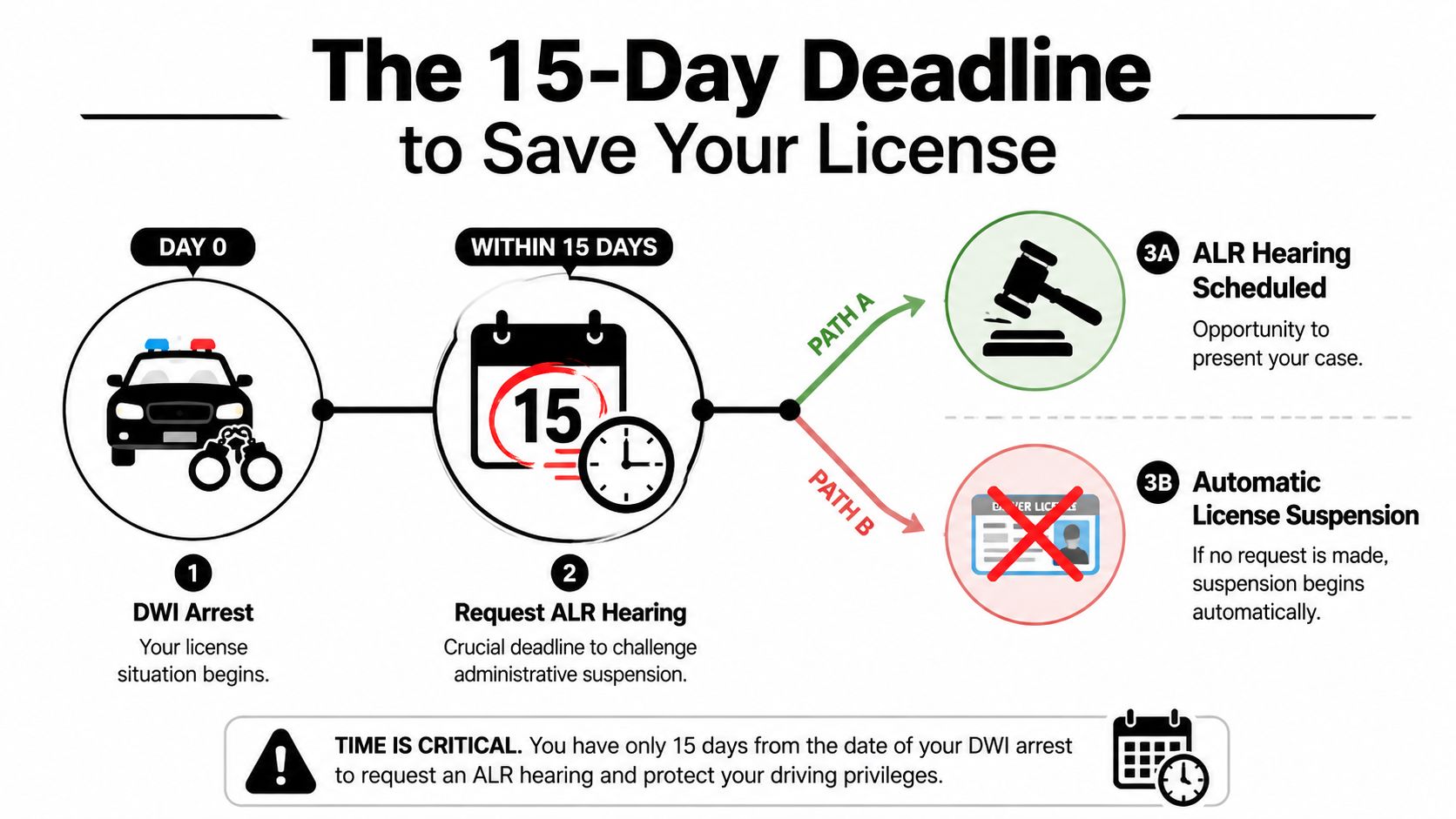
The 15-Day Deadline to Save Your License
You leave jail, get your paperwork, and assume the first court date is the next deadline that matters. It isn't. The deadline that can knock out your driving privileges comes first, and it hits fast.
After a Texas DWI arrest, you have a short window to request an Administrative License Revocation, or ALR, hearing. If you do not request that hearing on time, DPS can move forward with the suspension with little resistance from you.
What the deadline actually protects
The ALR deadline matters because the license case is already moving while your criminal case is still in its early stages. These are two separate tracks, and waiting on the criminal court does nothing to protect you from DPS.
Requesting the hearing does two things. It preserves your chance to challenge the suspension, and it usually keeps the license issue from becoming final right away. That is why experienced DWI lawyers treat the ALR request as immediate triage, not paperwork to handle later.
What the ALR hearing is about
The ALR case is a civil proceeding focused on your license. It usually follows either an alleged test failure or an alleged refusal after arrest.
At the hearing, DPS has to show legal grounds for the stop and arrest, along with the facts supporting the suspension. If you want a plain-language explanation of that process, read What Is an ALR Hearing in Texas?.
This hearing also gives your lawyer an early chance to examine the officer's version of events. That can matter well beyond the license issue.
What you should do right now
Do not sit on the notice.
- Request the ALR hearing immediately: Waiting burns time you do not have.
- Save every document: Keep the notice of suspension, bond papers, any temporary permit, tow paperwork, and booking records.
- Get legal review early: If you were arrested for DWI in Texas, your lawyer should review the stop, arrest, and testing issues before DPS gets a free path to suspension.
- Track the service date carefully: The deadline is tied to when notice was served, not when you got around to reading it.
Miss this deadline, and you give DPS the easiest part of its case.
Why early action gives you options
Early action is about more than trying to win the ALR hearing. It buys time to work both tracks at once.
While the criminal case is pending, your lawyer can press the administrative side, evaluate defense issues, and, if needed, start planning for an Occupational License so you can keep driving to work, school, and court. That is the strategy. Protect your driving privileges before the criminal case is resolved, not after the suspension is already in place.
Administrative Penalties vs Criminal Convictions
A Texas DWI arrest puts you in two cases at the same time. One can take your license quickly. The other decides the criminal charge.
Treat them separately from day one.
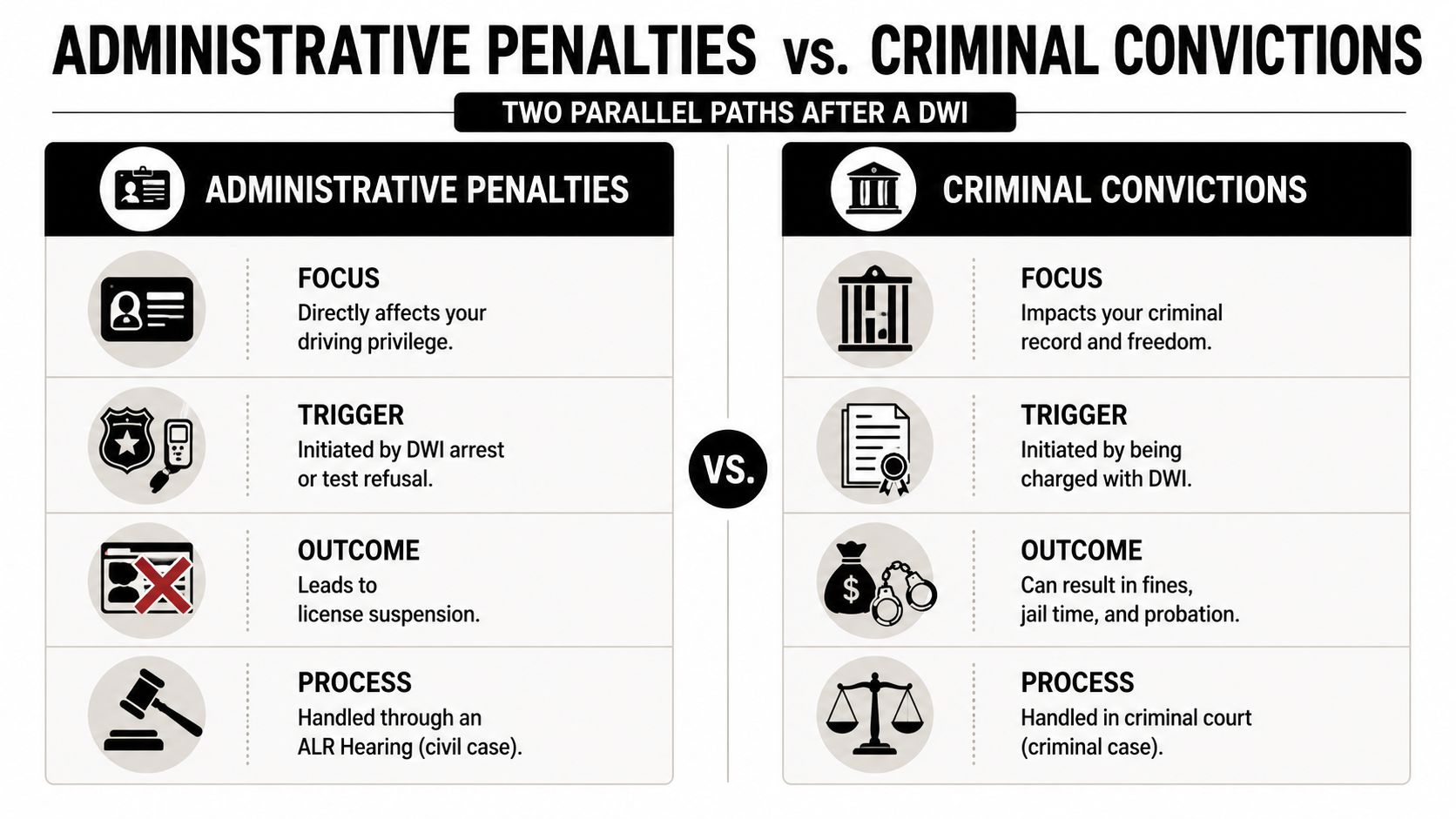
Side-by-side view of the two tracks
| Track | Who handles it | What it affects | How it starts |
|---|---|---|---|
| Administrative case | DPS and an Administrative Law Judge | Your ability to drive | The arrest and any breath or blood test refusal or failure |
| Criminal case | Prosecutor, criminal court, and judge | Your record, fines, probation, jail risk, and other court penalties | A formal DWI charge filed in court |
Texas does not wait for the criminal court to decide whether you were guilty before it moves against your license. That is the mistake many drivers make. They focus on the court date and ignore the license case that is already moving.
The administrative track
The administrative case is about your driving privilege, not whether you will be convicted of DWI. DPS is trying to suspend your license under the ALR process based on the arrest and the testing issue.
That is why early action matters so much. Requesting the ALR hearing can delay the suspension, force DPS to prove its case, and give your lawyer a chance to question the officer under oath. If suspension still happens, you may still be able to keep driving through an Occupational Driver's License after a Texas DWI.
The criminal track
The criminal case is different. The prosecutor has to prove DWI in court, and that process can take months. Your defense may involve legal challenges to the stop, the arrest, the testing, or the officer's conclusions.
If you need a stage-by-stage explanation of what happens in criminal court after arrest, The Texas DWI Court Process From Arrest to Resolution outlines what to expect at each stage of a Texas DWI criminal case.
Winning your ALR hearing does not dismiss the criminal case. Losing the ALR hearing does not convict you.
What this means for your strategy
Handle both tracks at the same time.
A smart defense does more than ask whether the charge can be reduced or beaten. It also protects your ability to work, get your kids to school, make court appearances, and keep your life from sliding sideways while the criminal case is still pending.
Focus on these moves:
- Examine the stop and arrest early: Bad facts for the state can help in the ALR case and the criminal case.
- Review breath or blood evidence closely: The same test result can raise different legal issues in each track.
- Prepare for separate hearings and deadlines: DPS and criminal court do not operate on the same schedule.
- Plan for continued legal driving: If suspension is likely, get ahead of it instead of waiting for the damage to hit.
This is a key distinction that clients seeking a Houston DWI lawyer often overlook. The first question is not only whether you can beat the charge. The first question is how to protect your license while the charge is still being fought.
How to Keep Driving Legally with an Occupational License
You can lose your regular license and still keep driving legally. That is the job of an Occupational Driver's License, or ODL. It gives limited driving privileges for real-life needs like work, school, medical care, court, and basic household duties.
For many drivers, this is the move that keeps life from coming apart while the DWI case is still pending. You do not wait for the criminal case to finish. You act early and protect your ability to function now.

Why the ODL matters
Clients often focus only on beating the DWI charge. That is too narrow. You also need a plan for getting to work on Monday, picking up your kids, and making every court setting.
An ODL handles the practical side of the case. It does not erase the suspension, and it does not restore full driving privileges. It gives you a lawful, court-approved way to keep moving while the administrative and criminal tracks continue at the same time.
What you usually need before filing
An ODL takes preparation. Judges want a clean, complete request, not a rushed stack of forms.
- SR-22 insurance: You usually need proof of financial responsibility before the court signs off.
- Ignition Interlock Device if required: Some cases require an IID before limited driving privileges are granted.
- A properly filed petition: The request has to go to the right court with the right supporting documents.
- A real driving need: Work, school, medical care, court appearances, and household responsibilities usually support the request.
If you want a more detailed breakdown, Texas occupational license after DWI explains the filing process, common requirements, and likely restrictions.
Where people get tripped up
The biggest mistake is waiting too long. The second biggest mistake is treating the ODL like a formality.
It is a court order. The paperwork has to match your suspension status. Your insurance has to be in place. If an interlock is required, that issue has to be addressed before the judge signs the order. A sloppy filing can waste time you do not have.
Some requests also slow down because the procedural steps are mishandled. Courts want a clear legal basis for the order and a proposed schedule that fits the law. If those details are wrong, your request can sit, get rejected, or require a second round of filings.
Here's a helpful walkthrough on the occupational license process:
A clear way to think about the ODL
Handle this in three parts at once:
- ALR hearing request: This gives you the chance to contest the suspension before DPS.
- ODL petition: This gives you a backup plan, or the main plan, if the suspension takes effect.
- Criminal defense: This addresses the DWI charge itself and the long-term consequences.
That is the right frame for how to get your license back after a DWI in Texas. Do not think about driving privileges only at the very end. In many cases, you can protect legal driving in stages long before the criminal case is resolved.
An occupational license is a strategic move. It keeps you legal on the road while you fight the case on both fronts.
Your Roadmap to Full License Reinstatement
You beat one deadline, kept yourself legal, and got through the hardest stretch of the case. Now do not lose at the finish line because a file stayed open at DPS.
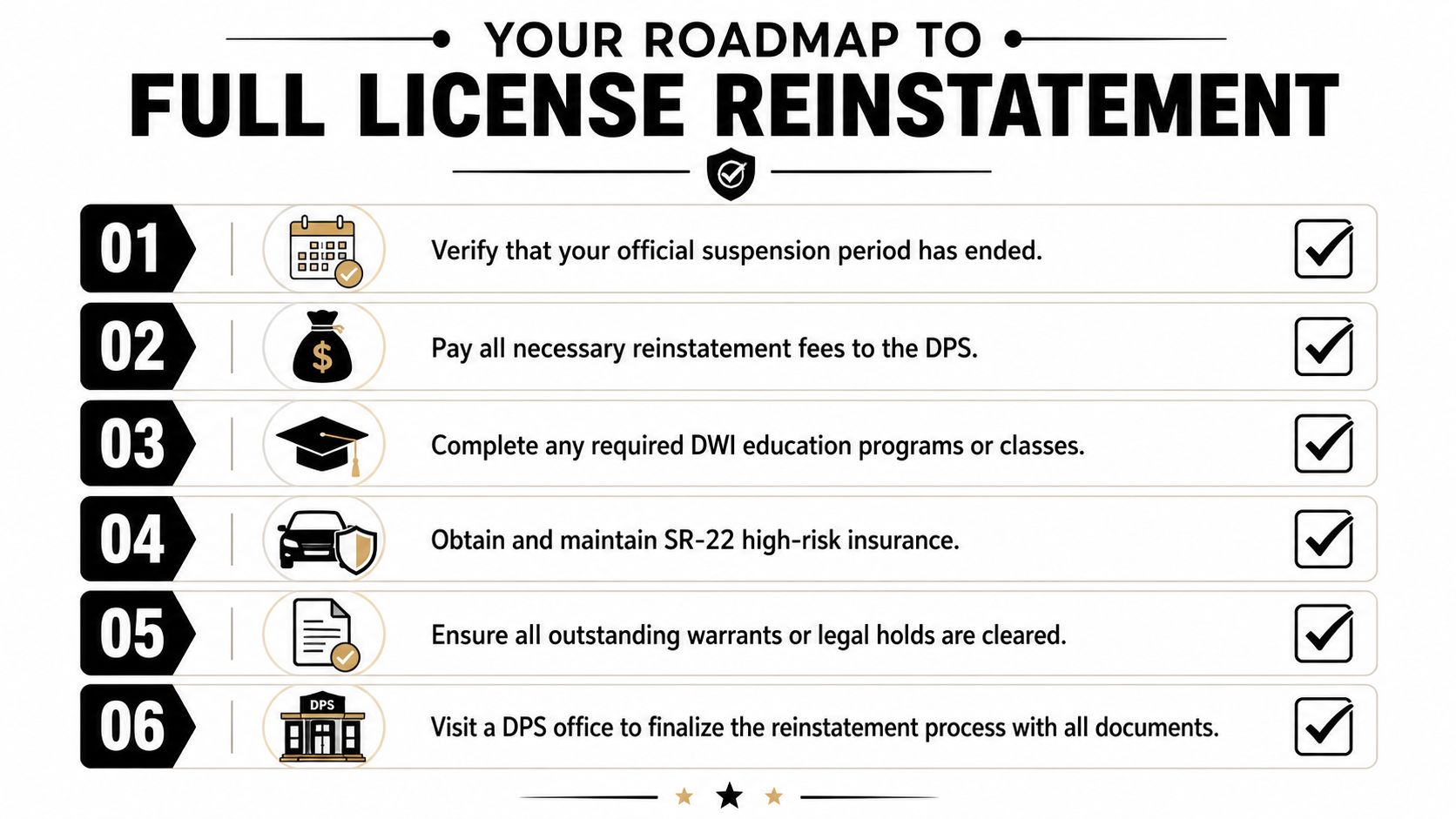
Full reinstatement is the point where the two tracks come back together. The criminal case may be resolved. The administrative suspension may be over. Your license still does not return automatically unless every remaining requirement is cleared.
What to do before you drive again
Start by confirming your status with DPS. Do not guess. Do not rely on the court outcome alone. A dismissed or reduced criminal case does not automatically clear an administrative hold, and the end of a suspension period does not prove DPS processed everything correctly.
Work through the remaining items in order:
- Verify the suspension end date: Make sure the actual suspension period has expired.
- Check for separate holds: Court obligations, unpaid fees, or unresolved DPS issues can still block reinstatement.
- Pay reinstatement fees if required: DPS will not restore your license while required payments remain unpaid.
- Complete any classes or intervention requirements: Finish every assigned program and keep proof of completion.
- Keep your SR-22 active if it applies: A lapse can create a new problem right when you should be finishing the process.
- Confirm DPS has processed everything: Do not drive until your record shows you are reinstated.
If you want a step-by-step breakdown of the DPS side, review this guide on how to reinstate a suspended license in Texas.
What usually holds people up
At this stage, the problem is usually not legal argument. It is incomplete compliance. Drivers often assume the judge's order fixed the license issue, or they let insurance paperwork lapse after the suspension period ends. DPS does not fill in missing pieces for you.
Keep a clean file with every document tied to both tracks of the case.
| Item | Why you need it |
|---|---|
| Proof the suspension period ended | Confirms the waiting period is over |
| SR-22 or other insurance proof | Shows continued financial responsibility if required |
| Course or program completion records | Proves you satisfied educational or intervention conditions |
| Final court paperwork | Shows the criminal case did not leave restrictions or open conditions |
| DPS notices and receipts | Helps you confirm fees, processing, and reinstatement status |
The smartest way to finish
Treat reinstatement like a final audit. Match your court record, DPS record, insurance status, and required filings before you get behind the wheel.
That approach matters because your DWI case was never just one case. It was always two tracks running at the same time. The same strategy that protected your ability to drive early, acting fast on the ALR side and using an Occupational License if needed, should carry through the end. Close out both sides completely, and you put yourself back on solid ground.
When to Hire an Experienced Houston DWI Lawyer
You should hire counsel as early as possible. Not because every case goes to trial. Not because every case is hopeless without a lawyer. You should hire counsel early because the best opportunities in a DWI case often come at the front end, when deadlines are tight and mistakes are still preventable.
The biggest example is the ALR deadline. The 15-day ALR hearing deadline is a strict administrative trap, and data shows that 90% of drivers who miss it lose their license for the full statutory period because they cannot contest the suspension, even if they later win their criminal case, according to this discussion of the Texas ALR deadline.
What a lawyer actually does for you
A seasoned Houston DWI lawyer or Texas DUI attorney should do more than stand next to you in court.
A good early defense effort usually includes:
- Meeting the urgent deadline: Filing the ALR request on time so your license fight stays alive.
- Examining the stop: Looking at reasonable suspicion, probable cause, and what the officer documented.
- Reviewing testing issues: Looking closely at breath, blood, refusal allegations, and the surrounding procedure.
- Handling the ODL process: Preparing the petition, addressing prerequisites, and making sure the request is positioned correctly.
- Managing the criminal case: Negotiating where appropriate, challenging evidence where necessary, and preparing for litigation if needed.
Why timing matters more than reassurance
Clients often call after the deadline has passed and ask if the criminal case result can fix the license problem later. Sometimes there are still options. But once certain rights are waived by inaction, your advantage is reduced.
That's why I'm direct about this. If your ability to drive matters, don't wait to “see how things go.” Take action while action still matters. If you're comparing lawyers, ask specific questions about ALR hearings, occupational licenses, test challenges, and local court practice. You need someone who understands both tracks and can move on both at once.
One option for handling those issues is Law Office of Bryan Fagan, PLLC, a Texas criminal defense firm that represents drivers in ALR hearings, occupational license matters, and DWI court proceedings.
A DWI arrest can throw your life off balance fast, but you still have options if you act quickly and strategically. If you need help protecting your license, fighting a DWI license suspension, or building a defense in a first DWI in Texas case, request a free consultation with Law Office of Bryan Fagan, PLLC. Your consultation is confidential, and it's a chance to get clear answers about your deadlines, your driving options, and the smartest next move in your case.