
A DWI arrest can be overwhelming, but you don't have to face it alone.
If you're reading this, you're probably dealing with the most immediate problem first. How do you keep getting to work, taking your kids where they need to go, and handling basic life while your license is in danger. In Texas, there is often a legal path forward, but it's narrow, paperwork-heavy, and easy to mishandle if you wait too long or file in the wrong place.
An occupational license after a Texas DWI isn't a shortcut and it isn't full driving freedom. It's a restricted court-ordered license that can let you drive for essential needs while your regular license is suspended. The key is acting early, understanding which court has authority, and avoiding the administrative mistakes that cause avoidable delays.
Your Guide to Driving Legally After a Texas DWI
You get out of jail, check your phone, and the first practical problem hits fast. How are you getting to work tomorrow, picking up your kids, or making a court date if your license is about to be suspended? In Texas, an occupational license can keep you on the road for limited, court-approved purposes, but the process is stricter than many drivers expect and small filing mistakes can cost weeks.
An occupational license after a Texas DWI is a restricted, non-commercial license. It allows driving for work, school, court-ordered obligations, and necessary household duties during a suspension. The court order must be specific. If the petition, affidavit, or proposed order is incomplete, or if your SR-22 is missing or lapses, DPS can delay issuance even after a judge signs off.
Texas courts can limit the days, hours, routes, and reasons for driving. In many cases, the order cannot exceed one year, although longer periods may be available in some circumstances under Texas law. Courts also often focus closely on the driving schedule requested, which is why broad language like "for any necessary reason" creates problems. Drivers who do better in these cases ask for exactly what they can prove.
Why timing matters right away
The license problem often starts before the criminal case is resolved. A DWI arrest can trigger an Administrative License Revocation case on one track and a criminal case on another. If you wait for the criminal court to sort everything out, you may lose valuable time on the occupational license side and make your own transportation problem harder to fix.
I tell clients to treat the occupational license as a deadline-driven paperwork case. The court has to be the right one. The petition has to match the reason for the suspension. The order has to contain the restrictions DPS expects to see. Then the insurance filing has to stay active. A surprising number of delays come from preventable issues like filing in the wrong county, requesting terms the court will not sign, or letting the SR-22 start late instead of having it ready before the order is submitted.
A few terms come up early and matter:
- Implied consent means Texas law treats driving as consent to provide a breath or blood specimen after a lawful DWI arrest.
- BAC means blood alcohol concentration.
- Field sobriety tests are roadside divided-attention tests used during a DWI investigation.
- Administrative license suspension is a civil suspension process separate from the criminal case.
If you are trying to keep driving legally, speed matters, but accuracy matters more. A rushed filing with the wrong court or missing documents usually gets corrected later, not forgiven. For a closer look at who qualifies and when, see our guide on Texas occupational license eligibility after DWI.
Are You Eligible for an Occupational License
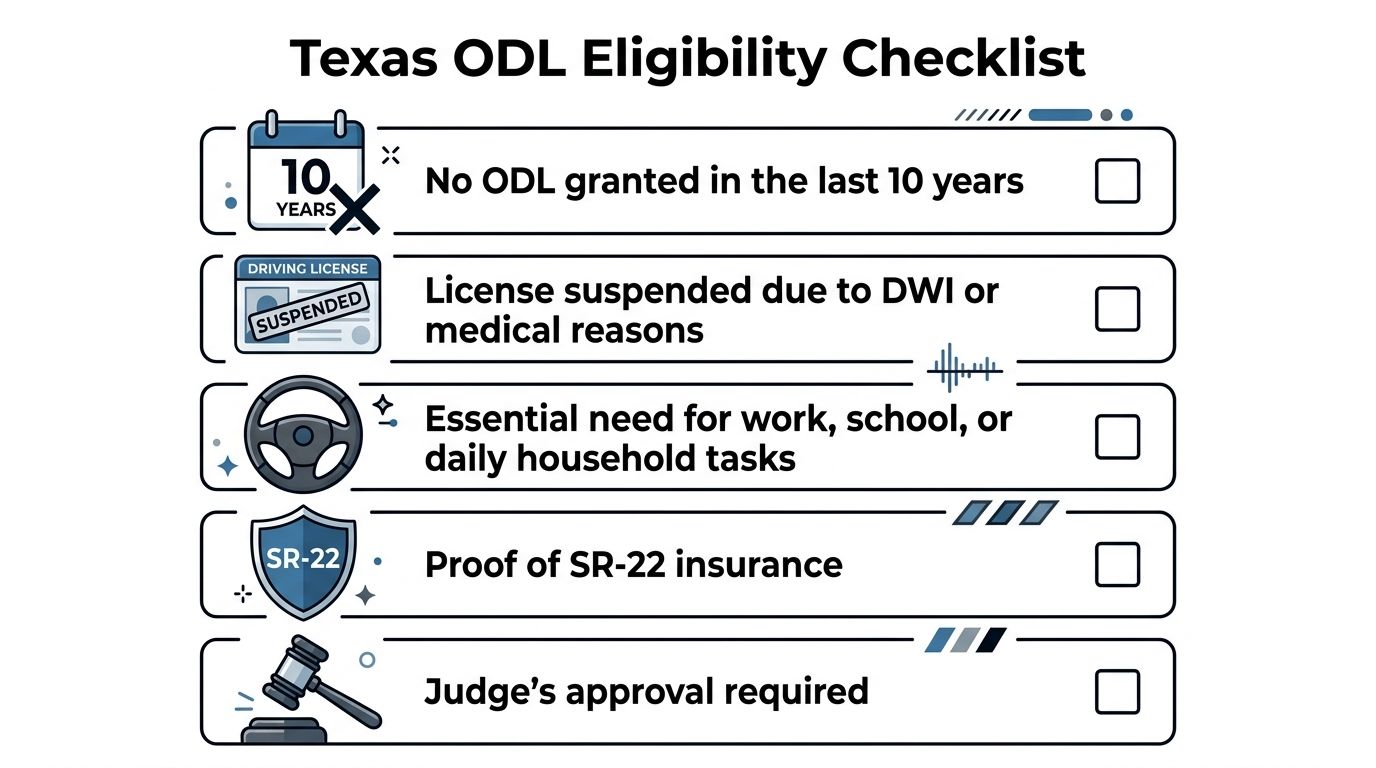
You get pulled over, your license is suspended, and by Monday morning you still have to get to work, pick up your kids, or make a medical appointment. That urgency is real, but eligibility for an occupational license turns on paperwork and timing, not just hardship. Courts want a clean, legally supportable request. DPS wants the order, insurance filing, and supporting documents to line up.
What the court wants to see
The starting point is proof that you need to drive for work, school, or household duties. General statements usually create delays. A stronger filing spells out the job site, work schedule, childcare needs, school hours, doctor visits, and the counties or routes involved. Judges are more likely to sign orders that look fitted to a real routine instead of a broad request to drive whenever needed.
The first question I ask is simple. Can this need be documented? Pay stubs, an employer letter, class schedules, daycare records, or medical appointment records often make the difference between a smooth order and a hearing that gets reset.
For a closer look at the threshold rules, see Texas occupational license eligibility after DWI.
Timing depends on why the license was suspended
Eligibility also depends on which suspension you are dealing with and whether a waiting period applies. Some drivers can petition quickly. Others have to sit through a hard suspension period before a court can grant relief. That is one reason two people arrested on the same night may have very different timelines.
The mistake I see often is filing before the person is legally eligible, or filing in a way that does not match the reason for the suspension. A court may deny the request outright, or sign an order that DPS will not honor because the dates, basis for suspension, or requested hours do not fit the case posture. Delay usually starts there.
If you are pursuing Occupational Driver's License After a Texas DWI, the practical question is not only whether you qualify. It is whether you are filing at the right moment with the right supporting record.
A good eligibility review answers four questions at once: Are you currently barred, when can you file, which court has authority, and what proof will keep DPS from rejecting the order later?
Absolute barriers and the mistakes that trigger them
Some problems can be corrected. Others stop the case.
| Issue | What it means |
|---|---|
| CDL at time of arrest | Texas does not allow an occupational license for a driver who held a commercial driver's license at the time of arrest |
| Vehicular manslaughter history | This can block eligibility |
| Too many prior alcohol-related suspensions in the previous five years | Prior history can make you ineligible |
| No proof of financial responsibility | Without SR-22 coverage, the court should deny the request |
The SR-22 issue causes more trouble than people expect. Some drivers buy a regular auto policy and assume that is enough. It is not. The insurer must file the SR-22 correctly, and it has to stay active. If the filing starts after the order is signed, lapses before DPS processes the paperwork, or gets canceled for missed premiums, the occupational license can stall or fail.
Court filings create the next round of avoidable problems. I regularly see petitions filed in the wrong county, affidavits that do not match the proposed order, and proposed driving hours that are too vague for the judge to approve. Another common mistake is leaving out the facts that show why public transportation, rides from family, or remote work are not realistic options in that specific case. The court is not required to fill in those gaps for you.
This part of the process rewards precision. A person may be legally eligible and still lose weeks fixing an order with the wrong restrictions, correcting an insurance filing, or refiling in the proper court. That is why eligibility is not just a yes-or-no question. It is a timeline question, a documentation question, and a detail question.
The Two Roads to License Suspension ALR vs Criminal Court
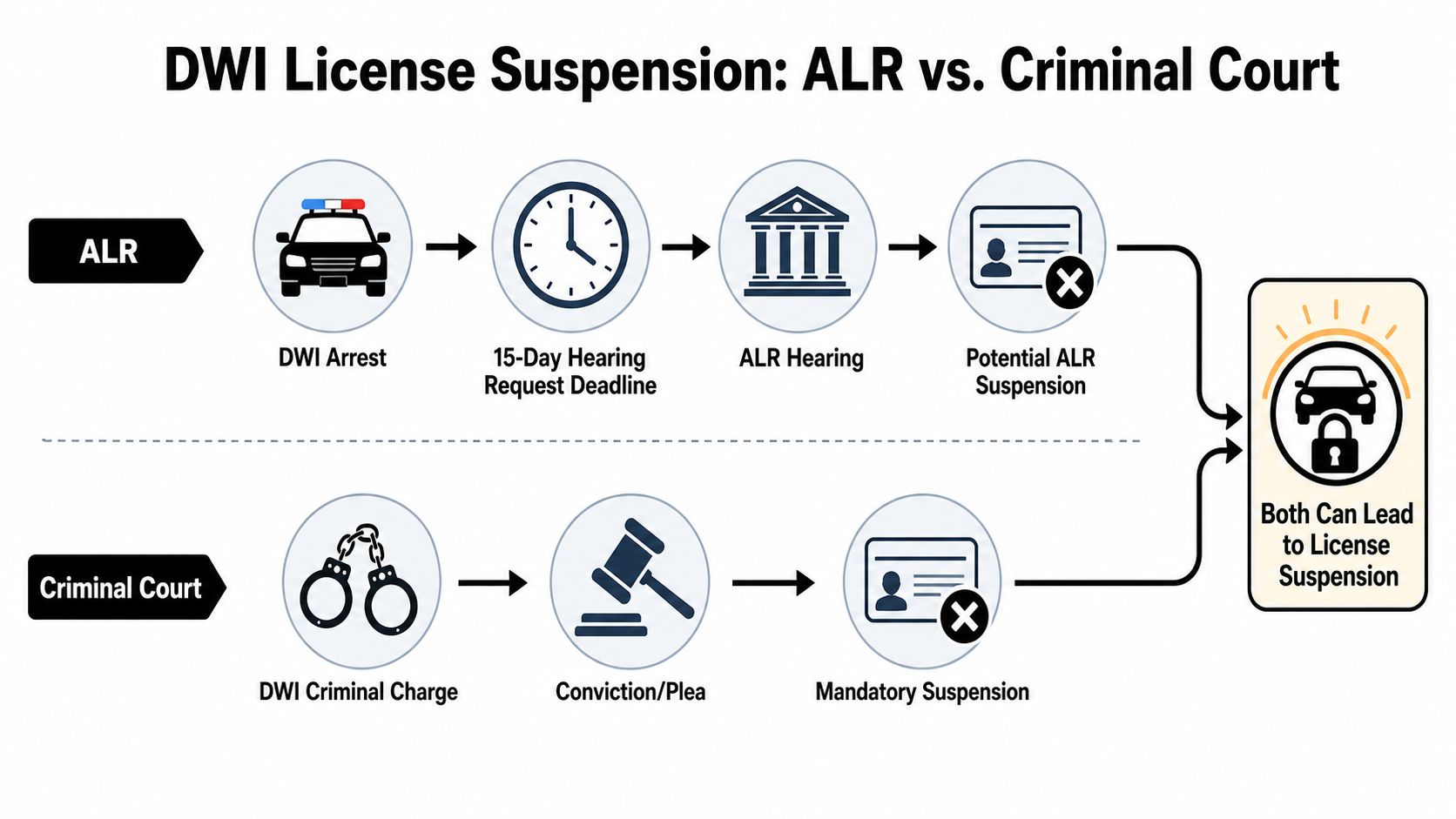
Texas puts many DWI defendants on two tracks at the same time. One track is administrative. The other is criminal. They overlap in real life, but they are not the same case, and confusing them causes missed deadlines.
The ALR case
The Administrative License Revocation, or ALR, case is handled through the Department of Public Safety. It grows out of the testing issue after arrest. If the officer says you failed or refused, DPS can move to suspend your license through this separate civil process.
The most important deadline in this entire part of the case is short. You must request an ALR hearing within 15 days of receiving the notice of suspension, and if you miss that deadline, the suspension becomes automatic with no opportunity to contest it, according to Texas ALR hearing deadline guidance.
If you want a side-by-side breakdown, ALR hearing vs criminal case in Texas explains how the two proceedings interact.
Here's a quick video overview of the license fight many Texas drivers face:
The criminal court case
The criminal case is separate. That's where the prosecution tries to prove the DWI charge itself. Here, issues like probable cause, field sobriety testing, officer observations, chemical testing, and plea negotiations usually get litigated.
An ALR win doesn't automatically dismiss the criminal charge. A criminal plea or conviction can also affect your driving status through the court system. That's why a Houston DWI lawyer or Texas DUI attorney has to approach both tracks strategically instead of treating the license issue as an afterthought.
What happens after arrest
Most cases move through a sequence like this:
- Arrest and release on bond. You receive paperwork that may include notice related to suspension.
- ALR deadline starts running. If there's a basis to challenge the suspension, the hearing request must be timely.
- Criminal case begins. Court dates, evidence review, and defense strategy follow.
- Occupational license planning. If suspension applies or is about to apply, the defense shifts to legal driving options.
The ALR case protects your license in the short term. The criminal case protects your record, your finances, and your future. You need both handled with intention.
For someone facing a first DWI in Texas, this split system is often the biggest surprise. It's also why early legal help matters when you're trying to fight DWI Texas cases without losing your ability to drive.
How to Petition the Court for Your Occupational License
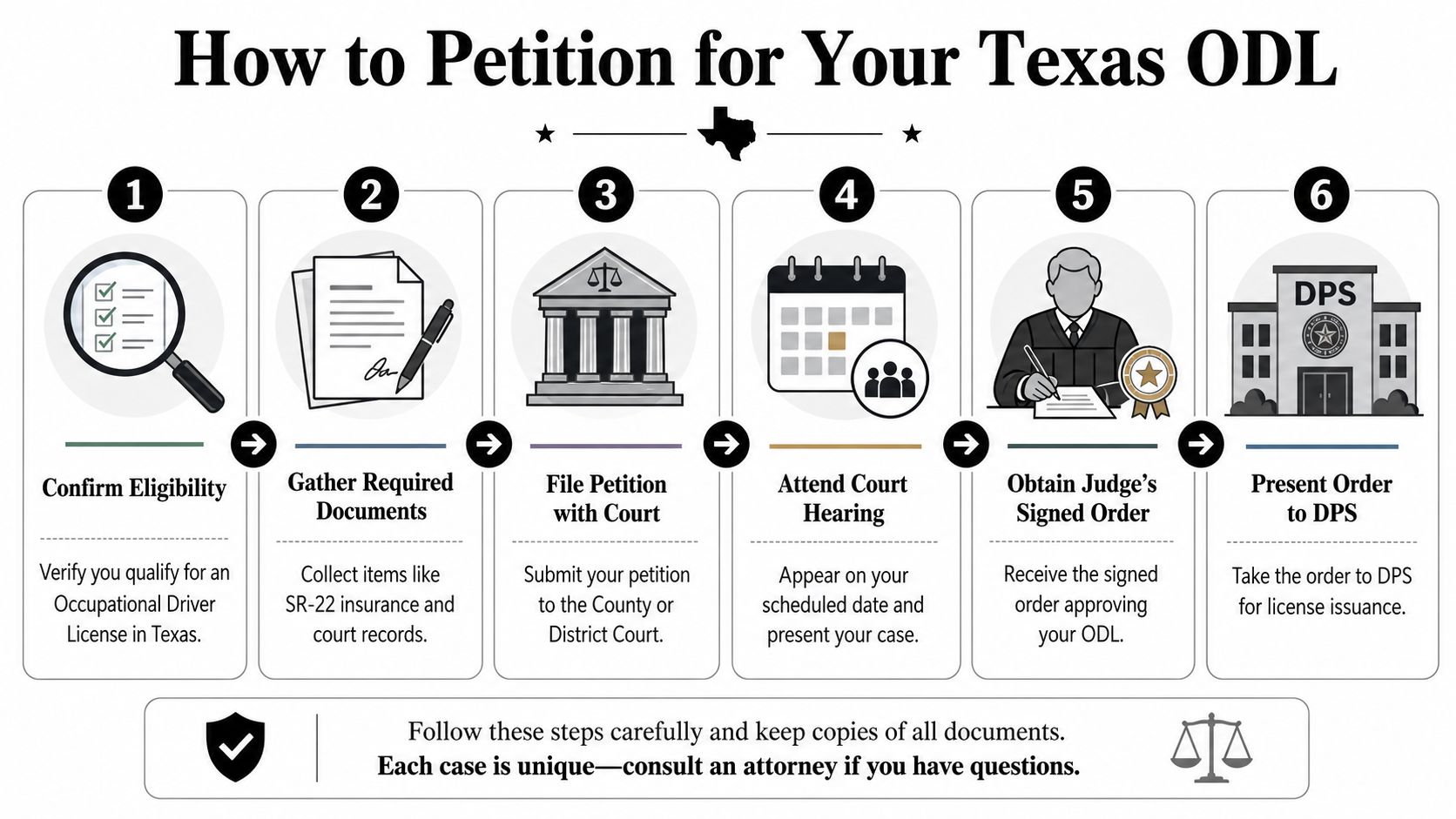
You miss one filing detail, and the delay is rarely a day or two. It can mean another week or two without legal driving while the court clerk rejects the packet, the judge asks for a corrected order, or DPS sends the paperwork back because the submission was incomplete.
File in the correct court
A Texas occupational license case starts with a Verified Petition for Occupational License, but the court you file in matters just as much as the petition itself. In many cases, filing in the county or district court where the arrest happened is the right move. In others, especially after a conviction or in a case tied to a particular court's suspension order, jurisdiction may sit somewhere else.
That is one of the first places drivers lose time. They file where the arrest occurred because that sounds logical, then learn the clerk will not accept it or the judge will not sign it. A week disappears while they refile, reset the hearing, and get corrected paperwork back in front of the court.
What the petition needs to show
A judge needs enough detail to sign an order that can be enforced. General hardship language is not enough.
The petition should clearly explain:
- Why you are legally eligible
- Why you need to drive for work, school, medical care, or household duties
- What days, hours, and routes the court is being asked to approve
- Whether any ignition interlock or other restriction applies
Specific facts help. “I work Monday through Friday from 7:30 a.m. to 4:30 p.m. at a job site in Harris County and take my child to daycare at 6:45 a.m. on the way” gives the court something concrete. “I need to drive for life responsibilities” usually does not.
The documents that cause the most trouble
The same few missing items cause repeat problems across Texas courts and DPS submissions.
- SR-22 certificate. If it is missing, expired, or issued under the wrong name, the case stalls.
- Type AR driver record. Courts use it to confirm the current license status and suspension history.
- Proof of need. Work letters, schedules, school records, or medical appointment records should match the hours requested.
- Proposed Order. Many petitions fall apart at this stage.
- Proof the petition was verified. An unsigned or improperly notarized verification can get kicked back before the judge ever sees the request.
The Proposed Order deserves extra attention because judges often reject it for small drafting problems. A weak order might say only that the driver may operate a vehicle “for work, school, and household duties.” That leaves too much open. A usable order usually identifies the suspension period, the counties or route area, the approved hours, whether travel is limited to work, school, medical care, and household duties, and whether an interlock is required. If the order leaves out the hour limits or fails to state that driving is for a non-commercial vehicle, the court may send it back for revision.
Drivers should also understand the practical side of Texas occupational license restrictions and approved driving terms before asking the court for relief. Asking for more than the law or local practice allows often creates avoidable pushback.
What a hearing may look like
Some judges will review a clean packet without a contested hearing. Others want the driver present, especially when the facts raise concerns or the requested schedule is broad.
At the hearing, the court usually focuses on three questions. Are you eligible? Is the need real and documented? Is the proposed order narrow enough to comply with Texas law?
That last point matters. I have seen courts approve a modest, well-supported request faster than an overreaching one that asked for broad “as needed” driving with no route limits and no explanation.
The DPS step people underestimate
The signed order is only part of the job. The driver still has to get the full packet to DPS, and that packet has to match what the court signed.
Administrative mistakes commonly occur. The order is signed, but the driver submits an outdated SR-22, leaves out the certified driving record, or sends documents that do not line up with the petition. DPS processing then slows down, and the driver assumes the court order alone gives immediate protection.
That assumption causes trouble. In many cases, the safer approach is to treat the process as incomplete until DPS has what it needs and the license status is updated as noted earlier in the article.
The Law Office of Bryan Fagan, PLLC, publishes factual guidance on Texas DWI and occupational license issues. The larger point is simple. A strong petition is not just about getting a signature. It is about building a packet that survives clerk review, court review, and DPS processing without coming back for corrections.
Special Conditions and Common Hurdles to Overcome
The delay often starts after the judge signs the order.
I see the same pattern repeatedly. A driver gets approved, assumes the hard part is over, and then loses weeks to a preventable paperwork problem. In occupational license Texas DWI cases, the trouble is often administrative, not legal. The court order may be correct, but a missed SR-22 payment, a filing mismatch, or a restriction violation can still stop the process or trigger a new suspension.
The SR-22 trap
The biggest mistake is treating the SR-22 like a one-time upload. It is ongoing proof of financial responsibility, and it has to stay active the entire time. If the policy cancels, DPS can revoke the occupational license status and put the driver right back into a suspension problem.
The lapse usually happens for ordinary reasons. Auto-pay fails after a debit card expires. A bank flags a charge. The driver changes insurers and assumes the new policy automatically carries over the SR-22 filing. Sometimes the premium increases, the insured misses the notice, and the policy cancels before anyone realizes what happened.
By the time the driver tries to fix it, damage is already done. DPS is not looking at whether the lapse was understandable. DPS is looking at whether valid SR-22 coverage was on file the whole time. A same-day payment does not always erase the interruption, and a replacement policy does not rewrite the gap.
That is why I tell clients to monitor the policy like a court deadline. Confirm the SR-22 was filed. Save proof of the filing. Watch renewal dates. If you change insurance companies, verify that the old policy does not terminate before the new SR-22 is accepted. Do not assume your insurance agent handled the transition correctly without checking.
Ignition interlock and driving restrictions
Some drivers face extra conditions that create their own delay points. If an ignition interlock is required by bond, prior history, or the court's order, the paperwork needs to match that requirement exactly. A petition that omits the interlock condition, or an order that conflicts with the actual bond terms, can send the case back for correction.
Restrictions also become a problem after approval. The license is limited to the purposes and schedule in the signed order. If the order authorizes driving to work, school, household duties, and court-ordered programs, that does not mean open-ended personal use. For a practical breakdown of those limits, see Texas occupational license restrictions.
Commercial drivers need to be especially careful here. An occupational license does not preserve CDL driving privileges. I have had people assume a restricted license would let them keep working in the same job, only to learn too late that Texas treats commercial driving very differently.
Where cases stall in real life
The most common hold-ups are small, but they matter:
- The SR-22 is purchased, but never filed correctly. The driver pays for the policy and believes the insurer sent everything in. DPS receives no valid filing, or receives it under the wrong policy period, and the driver keeps waiting for an update that never comes.
- The court order and petition do not match. The petition requests one work schedule, the signed order reflects another, and DPS or the clerk flags the inconsistency.
- The wrong court paperwork gets submitted. The driver files in a court that does not have the right authority over that suspension track, or uses a form that does not fit the county's practice.
- The driver starts using the license too broadly. One stop outside the approved purpose or time window can create a compliance issue that was easy to avoid.
- Fees and supporting records are incomplete. A missing reinstatement fee, missing certified record, or stale insurance document can leave the application sitting without action.
A few examples show how this happens.
A hospital employee worked rotating shifts. Her petition listed the employer and job title, but not the changing hours. The judge wanted a schedule specific enough to enforce. We had to go back, get a letter breaking down the shift pattern, and revise the request.
A self-employed contractor had a legitimate need to drive to multiple job sites, supply houses, and client meetings. His first draft was too vague. “Work-related driving as needed” is exactly the kind of phrase that invites resistance. The fix was a tighter order with defined purposes, geographic limits, and a realistic schedule.
Another driver did everything right in court and still lost time because his SR-22 card on file had expired after a billing problem. He thought paying the insurer two days later solved it. It did not. We still had to address the gap and get DPS records straightened out before he was protected again.
Costs, compliance, and avoidable setbacks
The financial side causes delays too. Drivers budget for filing fees and forget about reinstatement fees, interlock costs, and the higher insurance premium that comes with SR-22 coverage. Then a payment gets missed, or a required step gets postponed, and the case stalls for reasons that had nothing to do with eligibility.
Keep a copy of everything. Check that the order, petition, insurance filing, and any interlock requirement all line up. Follow the driving limits exactly. As noted in the DPS guidance mentioned earlier, the occupational license process does not forgive sloppy follow-through.
The drivers who get through this with the fewest problems are usually not the ones with the simplest cases. They are the ones who treat every administrative detail like it matters, because it does.
Take Control and Protect Your Ability to Drive
The path to an occupational license after a Texas DWI is real, but it's technical. You have to identify the right suspension track, act within the correct deadline, file in the proper court, prove essential need, keep your SR-22 active, and follow every restriction once the order is entered.
That's a lot to manage while you're also dealing with bond conditions, work pressure, family logistics, and the criminal case itself. A missed filing, a wrong court, or an insurance lapse can leave you without legal driving privileges even when you otherwise qualified.
The better approach is to treat the license issue as part of the full DWI defense from the start. That includes reviewing the stop, challenging weak evidence where appropriate, protecting your position in the ALR process, and preparing an occupational license petition that a judge and DPS can act on.
If you've been arrested and you need to keep driving, don't guess your way through it. A Houston DWI lawyer or Texas DUI attorney can help you evaluate your timeline, avoid common denials, and build a strategy that protects both your license and your broader defense. If you're trying to handle a first DWI in Texas or you need to fight DWI Texas allegations while staying on the road legally, early action gives you more options.
If you need help with an occupational license, an ALR hearing, or your full DWI defense, contact Law Office of Bryan Fagan, PLLC for a free consultation and confidential case evaluation. The firm represents Texans facing DWI license suspension issues and criminal charges, and can help you take the next practical step toward protecting your ability to drive, your record, and your future.